
James
Fintech writer with a knack for turning complex money and crypto topics into engaging, accessible content. Whether it's demystifying blockchain or breaking down finance trends, he make sure every word counts.
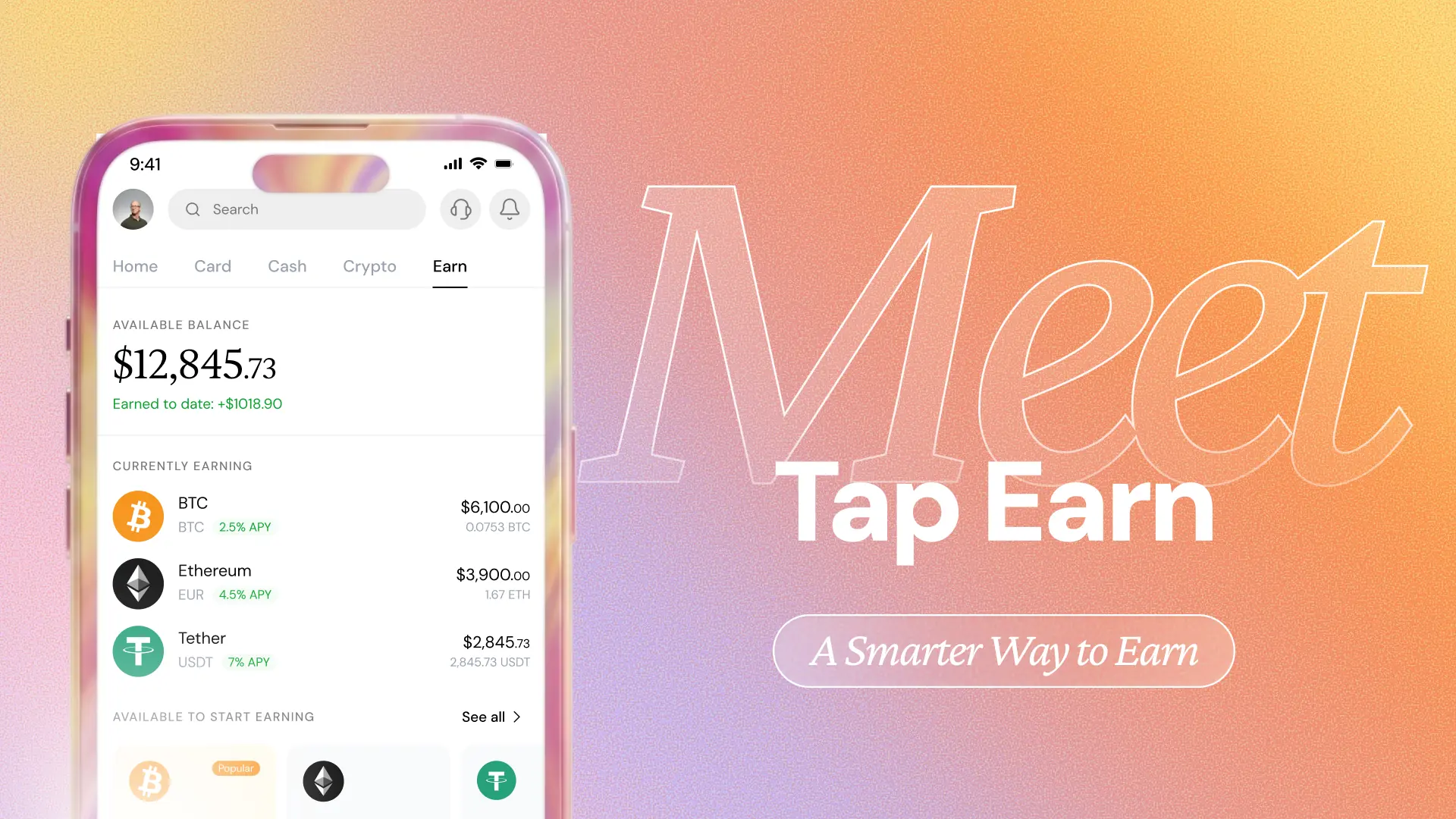
It should be easier to save for your holidays, that nicer car, or your dream house down payment. That's why we built Tap Earn.
Savings accounts haven't changed in decades, but the cost of everything else has. Rent's up. Groceries cost more. A coffee costs what lunch used to. And your savings account? Still paying you next to nothing while the bank lends your money out and keeps the difference.
Most savings accounts pay around 0.4% APY. That's $4 a year on $1,000.Even the fintech "high-yield" ones barely push past 3%, and they still come with the usual catches, fine prints, and withdrawal limits.
Meanwhile, the official inflation rate keeps running higher. When inflation runs higher than your interest rate, you're losing purchasing power every year. Your savings shrink, even if the number in your account slowly ticks up.
It should be easier to save for your holidays, that nicer car, or your dream house down payment. That's why we built Tap Earn.
A Better Way to Earn
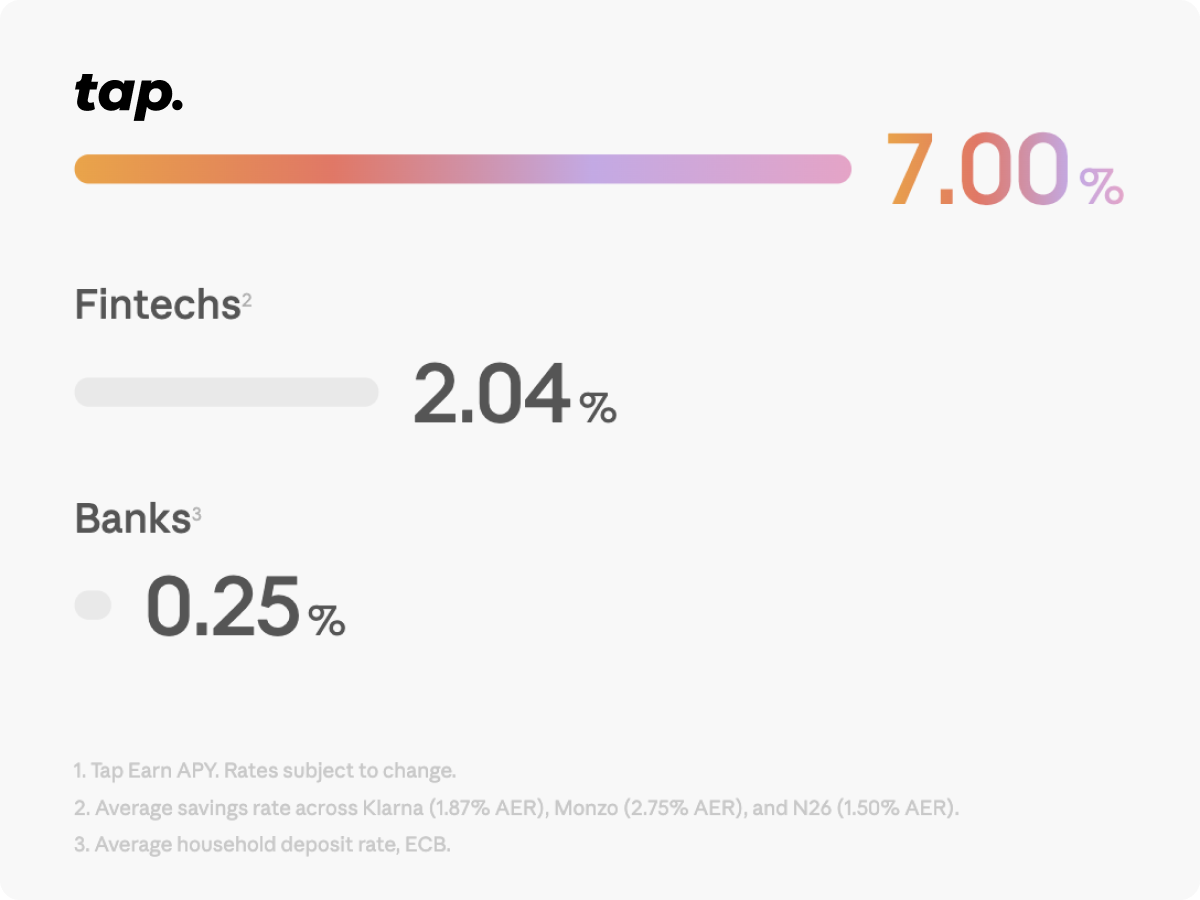
Tap Earn offers up to 7% APY, that's nearly 18x what most banks pay and double what fintechs offer out there.
Your interest compounds daily and pays out every week, straight into your balance. No waiting for end-of-month statements, no quarterly or year cycles, no lockup. Every Monday, your balance is higher than it was on Friday. Not a bad way to start the week.
And unlike your bank, you don't have to guess what you've earned. Open the app anytime and see exactly how much interest you've made, down to the cent.
What Can You Earn On?
Tap Earn launches with USDT, USDC, BTC, ETH, XRP, and SOL. More of your favorite assets are on the way.
We're not trying to list everything under the sun. Every asset we add has to meet one standard: can we offer a rate worth your time? If we can't give you a good rate on it, we won't add it just to pad a menu. Quality over quantity. Your earnings come first.
Deposit From Anywhere
Accessibility matters most to us, earning should be easy no matter how you deposit. With Tap, you can deposit money anytime, anywhere, using whatever method you like best. Tap supports bank transfers and debit cards, from majors to stablecoins to the long tail most platforms don't bother supporting. You don't need to move your life around to start earning. Link your existing bank account in minutes and start earning higher rates on your savings without switching banks or opening new accounts here and there.
Your money is yours, and you should be able to access it when you need it. You can withdraw with no penalties, take out what you want, when you want.
Time to Start Earning
Tap is trusted by 400,000+ users across 40+ countries and is publicly listed on the London Stock Exchange. This isn't a startup in someone's garage.
Ready to get started? Download the app, or head to the app and simply find the "Earn" tab from the hub.
It's time to earn what you deserve.
See you inside.
Tap Earn services are provided by Tap Earn Inc and are not regulated by the Gibraltar Financial Services Commission or by the UK Financial Conduct Authority, or covered by the Gibraltar Investor Compensation Scheme or the UK Financial Services Compensation Scheme.
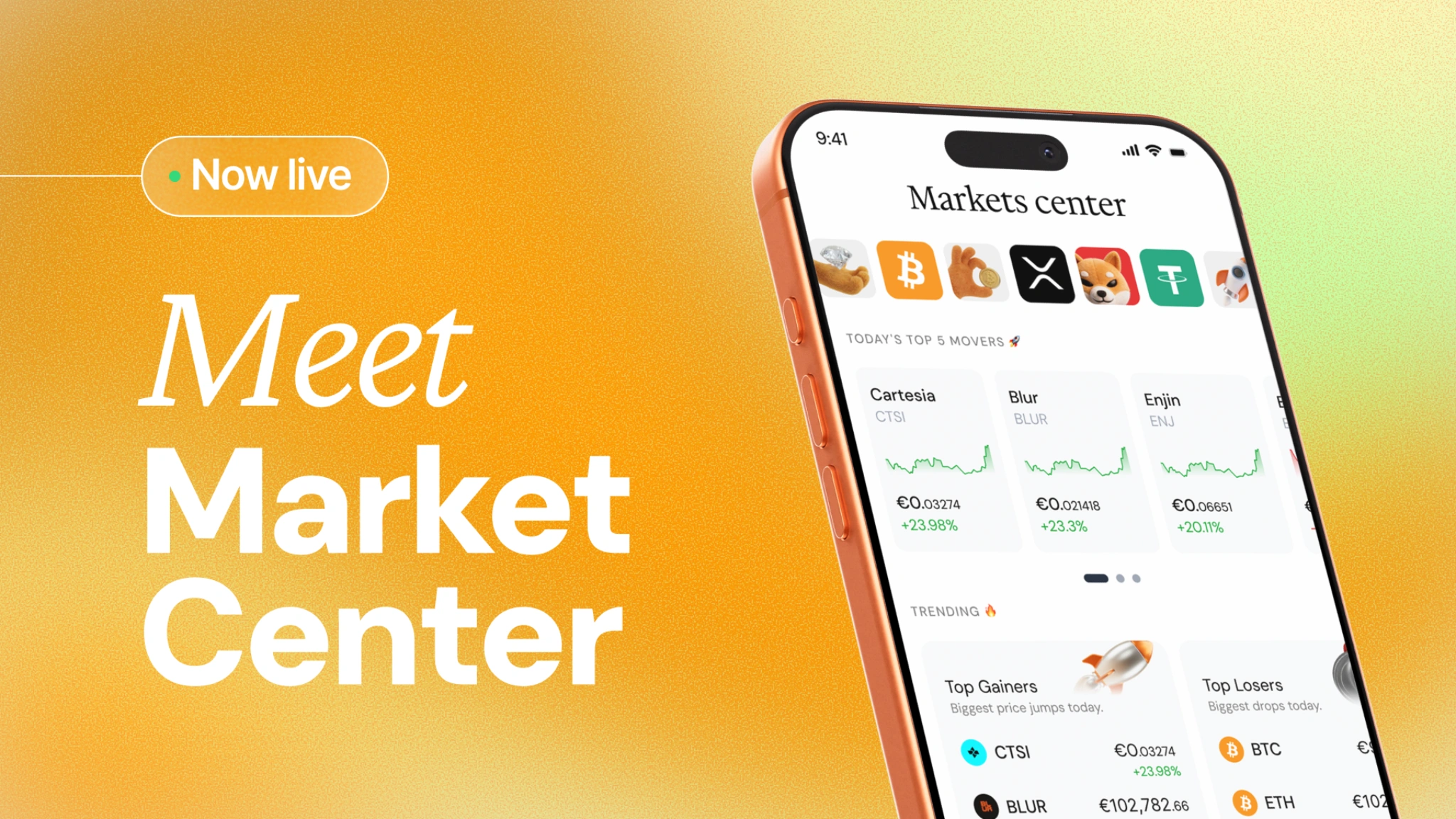
Deja de malabarear con cinco pestañas para seguir el mercado cripto. El Markets Center de Tap reúne precios, gráficos, los activos más activos y noticias en un único lugar dentro de Tap.
Estar al día del mercado de criptomonedas puede llegar a parecer un trabajo a tiempo completo. Una pestaña para los precios. Otra para los gráficos. Un sitio diferente para las noticias. Y luego vuelves a tu aplicación para hacer algo. Antes de que te des cuenta, estás manejando cinco plataformas o más solo para entender qué está pasando.
Ese es exactamente el problema que nos propusimos resolver.
Te presentamos el Markets Center, tu nuevo espacio de referencia dentro de Tap para seguir, explorar y entender el mercado, todo sin salir de la aplicación.
Se acabó el saltar entre pestañas 🫨
Si alguna vez te has encontrado saltando entre aplicaciones solo para consultar precios, tendencias y titulares, no eres el único.
Las criptomonedas se mueven rápido, y mantenerse al día suele implicar depender de múltiples herramientas y plataformas, muchas de las cuales pueden resultar abrumadoras o inconsistentes.
El Markets Center lo reúne todo. En lugar de recopilar información de distintos lugares, ahora puedes obtener una instantánea clara y en tiempo real del mercado en una sola vista, justo donde ya gestionas tus criptomonedas.
Una forma más inteligente de leer el mercado
El Markets Center está diseñado para ofrecerte información de un vistazo, sin ahogarte en complejidad.
Esto es lo que encontrarás:
- Más activos: ve al instante qué activos están registrando los mayores movimientos.
- Mayores subidas y bajadas: entiende rápidamente hacia dónde se dirige el impulso del mercado.
- Nuevos listados: mantente al día de los últimos tokens que entran al mercado.
- Lista completa de activos: navega y ordena por capitalización de mercado, volumen, variaciones de precio y más, adaptado a cómo quieres explorar.
- Feed de noticias integrado: recibe actualizaciones de fuentes fiables, todas en un mismo lugar, sin preocuparte por su credibilidad.
Todo lo que necesitas para estar informado, y algo más.
El pulso del mercado, de un vistazo
Seamos sinceros: demasiados datos pueden ser tan frustrantes como insuficientes.
En el mundo de las criptomonedas, es fácil sentirse abrumado por demasiados indicadores, gráficos y métricas, que pueden ser útiles pero no siempre prácticos para el uso diario.
A veces, lo único que quieres es una respuesta rápida a una pregunta:
"¿Qué está haciendo el mercado ahora mismo?"
Con el Markets Center, esa respuesta está siempre a un toque. Desde las criptomonedas más populares hasta las últimas noticias, puedes hacerte una idea del mercado en segundos, sin necesidad de análisis exhaustivos.
Diseñado pensando en ti
El Markets Center es tu lugar de referencia si quieres:
- Estar informado sin sobrecarga visual
- Seguir el mercado sin cambiar de aplicación
- Filtrar el ruido con un feed de noticias con fuentes selectas
Todo lo que necesitas para ir un paso por delante, sin esfuerzo adicional.
Cómo acceder al Markets Center ✨
Empezar es muy sencillo:
- Abre tu aplicación Tap
- Ve a la pestaña Markets Center (justo al lado de la pestaña Inicio)
- Desplázate y explora los activos más activos, el listado completo y las noticias en un solo lugar
Eso es todo. No se necesita configuración ni ajustes adicionales. Tendrás acceso inmediato a un feed de noticias curado y a datos de mercado en directo.
¿Listo para simplificar tu experiencia cripto?
Con el Markets Center, ya no necesitas tener cinco pestañas abiertas para entender el mercado.
Tanto si quieres analizar los gráficos en detalle como si simplemente quieres tener el dedo en el pulso del mercado, solo tienes que abrir la app y el Markets Center estará listo con todo lo que necesitas. Porque estar al día en cripto no debería ser complicado.
Descubre cómo los on-ramps y off-ramps de stablecoins conectan el dinero fiat tradicional con la blockchain para ofrecer liquidaciones globales casi instantáneas, 24/7.
Mover dinero a nivel internacional no debería sentirse como enviar una carta por correo o usar una paloma mensajera. Sin embargo, para muchas empresas, esa sigue siendo la realidad. A menudo tienen que lidiar con retrasos, comisiones ocultas y poca visibilidad. En los últimos años, las stablecoins han demostrado que este proceso puede ser mucho más eficiente, ofreciendo transferencias globales casi instantáneas. Pero para desbloquear todo su potencial, hay una pieza clave que debe funcionar entre bastidores: los on-ramps y off-ramps.
Estos sistemas actúan como puente entre la banca tradicional y las redes blockchain, permitiendo a las empresas moverse entre monedas fiat (como dólares, euros o libras) y stablecoins. Veamos cómo funcionan y qué pueden aportar a tu negocio.
Cómo las infraestructuras tradicionales siguen marcando el ritmo
Antes de que el dinero llegue a la blockchain, comienza su recorrido en los sistemas bancarios tradicionales. En Europa, esto suele implicar transferencias SEPA, mientras que en el Reino Unido se utilizan Faster Payments. Mover dinero a nivel internacional no debería sentirse como enviar una carta por correo o usar una paloma mensajera. Sin embargo, para muchas empresas, esa sigue siendo la realidad. A menudo tienen que lidiar con retrasos, comisiones ocultas y poca visibilidad. En los últimos años, las stablecoins han demostrado que este proceso puede ser mucho más eficiente, ofreciendo transferencias globales casi instantáneas. Pero para desbloquear todo su potencial, hay una pieza clave que debe funcionar entre bastidores: los on-ramps y off-ramps.
Estos sistemas actúan como puente entre la banca tradicional y las redes blockchain, permitiendo a las empresas moverse entre monedas fiat (como dólares, euros o libras) y stablecoins. Veamos cómo funcionan y qué pueden aportar a tu negocio.
Cómo las infraestructuras tradicionales siguen marcando el ritmo
Antes de que el dinero llegue a la blockchain, comienza su recorrido en los sistemas bancarios tradicionales. En Europa, esto suele implicar transferencias SEPA, mientras que en el Reino Unido se utilizan Faster Payments. Las transferencias SEPA son ampliamente utilizadas en la eurozona y pueden tardar desde unas horas hasta un día laborable completo, dependiendo del banco y el momento. Faster Payments, por su parte, hace honor a su nombre: suele liquidar en segundos y funciona las 24 horas del día, los 7 días de la semana.
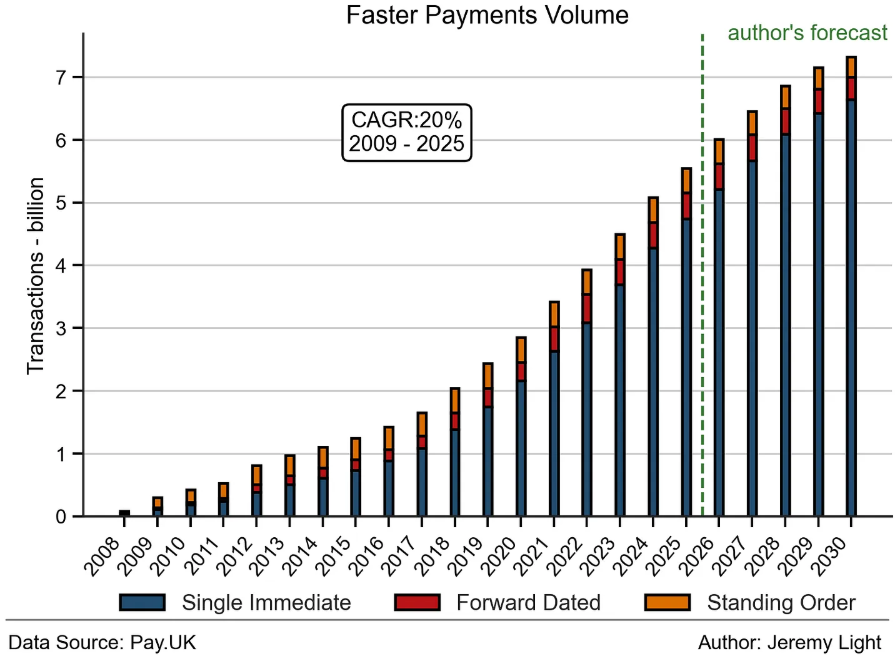
Estos sistemas son fiables, pero siguen sujetos a horarios y estructuras bancarias que pueden generar fricción o retrasos. Aquí es donde entran las stablecoins, no necesariamente para reemplazarlos, sino para mejorar lo que ocurre después del movimiento del dinero.
Por qué las stablecoins cambian las reglas del juego
Las stablecoins como USDT y USDC están diseñadas para mantener un valor estable, generalmente vinculado al dólar estadounidense. A diferencia de las transferencias bancarias tradicionales, operan sobre redes blockchain que funcionan continuamente, sin interrupciones ni limitaciones geográficas.
Una vez que los fondos se convierten en stablecoins, pueden transferirse globalmente en segundos, en cualquier momento del día. Esto las convierte en una capa de liquidación ideal para empresas que gestionan pagos internacionales, tesorería o operaciones transfronterizas.
Mientras que USDT suele utilizarse más para liquidez y trading, USDC es preferida en entornos regulados por su transparencia. Ambas cumplen funciones similares, y la elección depende de las necesidades específicas del negocio.
El papel de las cuentas virtuales
Una innovación clave en los on-ramps modernos es el uso de cuentas virtuales. Una cuenta virtual es un identificador digital, similar a un número de cuenta o IBAN.
Cuando llegan los fondos, el sistema identifica automáticamente a quién pertenecen. Esto permite una conciliación instantánea de los pagos entrantes y una escalabilidad sin intervención manual.
Para empresas que gestionan grandes volúmenes de transacciones, esto es fundamental. Garantiza que los fondos puedan rastrearse, asignarse y procesarse antes de convertirse en stablecoins.
El on-ramp: de fiat a stablecoin
El proceso de on-ramp convierte dinero tradicional en activos digitales. Aunque suene complejo, el flujo suele ser sencillo:
- La empresa envía dinero fiat (por ejemplo, EUR o GBP) mediante SEPA o Faster Payments
- Los fondos llegan y se asignan automáticamente mediante una cuenta virtual
- El sistema ejecuta la conversión a una stablecoin como USDT o USDC
- La stablecoin se envía a una wallet designada
Si la transferencia inicial es instantánea (como con Faster Payments), todo el proceso puede completarse en cuestión de minutos. Si no, la parte en blockchain sigue siendo inmediata una vez que los fondos fiat se liquidan.
El off-ramp: de stablecoin a fiat
El proceso inverso permite convertir stablecoins en dinero tradicional:
- El usuario envía stablecoins a la wallet del proveedor
- El sistema confirma la recepción e inicia la conversión
- El dinero fiat se envía a una cuenta bancaria mediante SEPA o Faster Payments
La velocidad final depende del sistema bancario utilizado, aunque la parte blockchain sigue siendo rápida y eficiente.
Dónde sigue existiendo fricción
Aunque las stablecoins eliminan muchas ineficiencias, no eliminan todas.
Los sistemas fiat todavía pueden introducir:
- Retrasos, especialmente fuera del horario bancario
- Controles de cumplimiento que pueden ralentizar operaciones grandes
- Limitaciones regionales según la infraestructura bancaria
Esto significa que, aunque las transferencias en blockchain sean instantáneas, los puntos de entrada y salida siguen dependiendo del sistema tradicional.
Por qué esto es importante para las empresas
La velocidad de liquidación no es solo un detalle técnico, tiene un impacto directo en las finanzas.
Cuando los pagos tardan días en completarse, el capital queda inmovilizado en tránsito. Esto afecta al flujo de caja, reduce la flexibilidad y genera incertidumbre. Muchas empresas compensan esto manteniendo mayores reservas, lo que reduce la eficiencia.
La infraestructura basada en stablecoins cambia esta dinámica. Al permitir liquidaciones casi instantáneas una vez que los fondos están en blockchain, las empresas pueden mover capital más rápido, reducir saldos inactivos y mejorar la visibilidad de sus operaciones.
Para empresas globales, esto supone un cambio fundamental en cómo se mueve el dinero.
Optimiza tus operaciones con stablecoins con Tap
Si tu empresa quiere superar las limitaciones de la banca tradicional y aprovechar la velocidad de las stablecoins, la cuenta cripto para empresas de Tap te ofrece todo en una sola plataforma.
Obtén tu propio IBAN individual y acceso a cuentas en monedas como EUR o GBP, con soporte completo para SEPA Instant y Faster Payments. Esto permite gestionar on-ramps y off-ramps de forma fluida, sin depender de múltiples proveedores ni sufrir retrasos bancarios.
Además, Tap permite trading entre más de 70 criptomonedas, incluidas stablecoins como USDT y USDC. Tanto si necesitas convertir fiat para liquidaciones rápidas como mover capital globalmente, la plataforma está diseñada para adaptarse al ritmo de tu negocio.
¿Listo para experimentar el futuro de los pagos globales? Ponte en contacto con el equipo de Tap aquí.
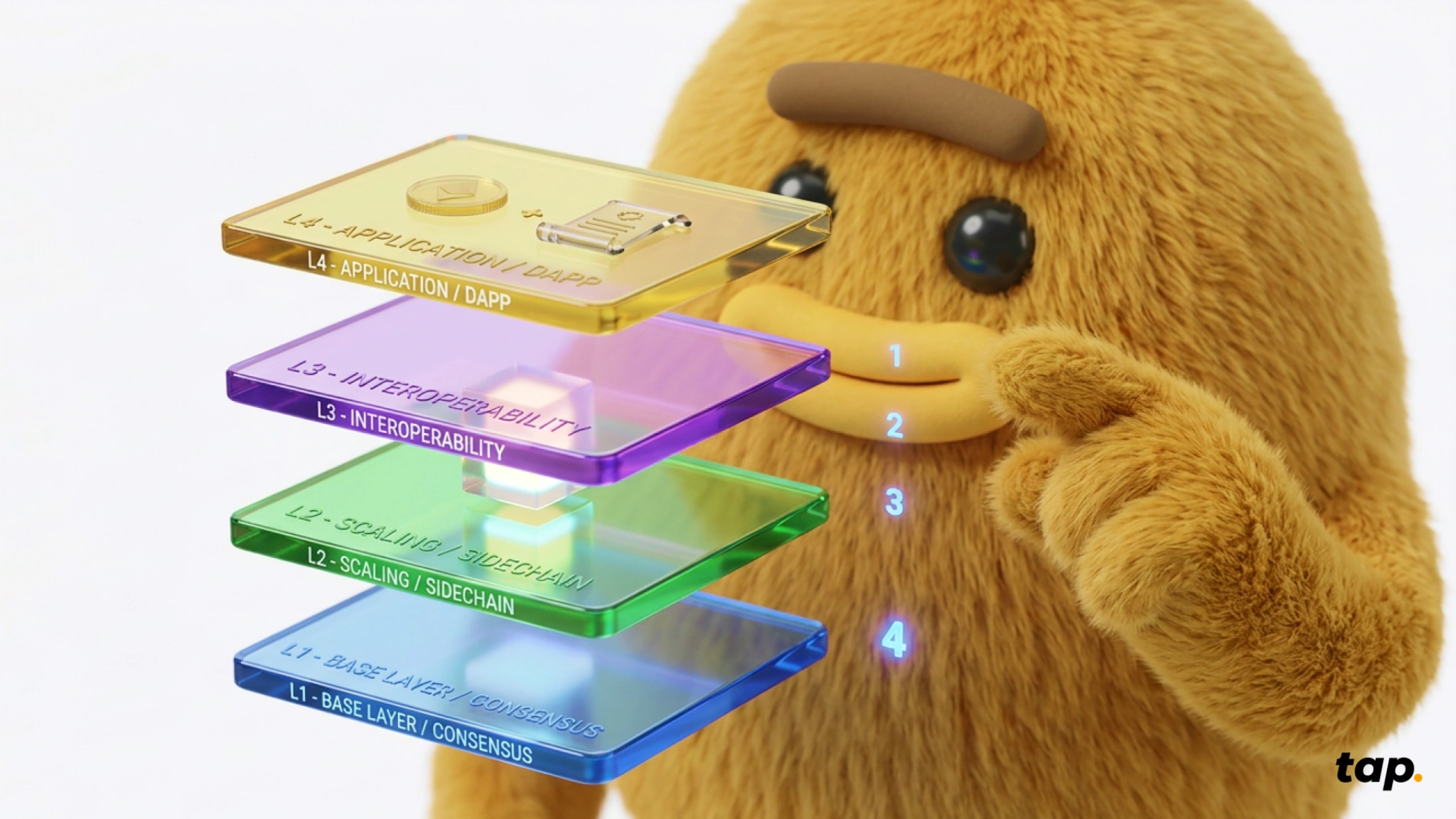
Si alguna vez te has preguntado por qué enviar criptomonedas a veces es instantáneo y otras lento, o por qué algunas transacciones cuestan céntimos mientras que otras tienen comisiones elevadas, no eres el único.
Detrás de escena, las blockchains no son una única tecnología. Funcionan más bien como un sistema de múltiples niveles interconectados, donde cada capa se encarga de una función distinta.
Piensa en ello como una ciudad: tienes carreteras, sistemas de tráfico, edificios y aplicaciones que te ayudan a moverte. La blockchain funciona de forma similar. Y cuando entiendes estas capas, todo el ecosistema empieza a tener mucho más sentido.
¿Por qué las blockchains necesitan capas?
A primera vista, podrías pensar que una blockchain es simplemente una base de datos que almacena transacciones. Pero en realidad tiene que hacer mucho más:
- Almacenar datos de forma segura
- Validar transacciones
- Comunicarse a nivel global
- Mantenerse descentralizada
- Escalar para millones de usuarios
Intentar hacer todo esto en un solo lugar genera compromisos. Por eso las blockchains se diseñan en capas: para que cada parte del sistema pueda especializarse y mejorar de forma independiente.
Para entender por qué esto es importante, primero hay que conocer el principal desafío de cualquier blockchain.
El trilema de la blockchain
En el centro del diseño de blockchain existe una limitación clave conocida como el trilema de la blockchain.
Cada red intenta equilibrar tres propiedades:
- Seguridad: protección frente a ataques y fraudes
- Descentralización: ausencia de control por una única entidad
- Escalabilidad: capacidad de procesar muchas transacciones de forma rápida y barata
El problema es que es muy difícil maximizar las tres al mismo tiempo.
Imagina pagar un café de 4 € con Bitcoin. Podrías pagar más en comisiones que el propio café y esperar varios minutos. Mientras tanto, una tarjeta tarda segundos. Esto ocurre porque Bitcoin prioriza la seguridad y la descentralización sobre la velocidad.
Las nuevas blockchains intentan mejorar la escalabilidad, pero suelen hacerlo sacrificando otros aspectos. Por eso surgió una nueva idea: dividir responsabilidades en distintas capas.
Las 5 capas fundamentales de la blockchain
Antes de hablar de Layer 1 o Layer 2, conviene entender la estructura básica:
1. Capa de infraestructura (la base)
Es el soporte físico de la red:
- Ordenadores (nodos)
- Servidores distribuidos globalmente
Estos nodos almacenan datos y mantienen la red funcionando continuamente.
2. Capa de datos (donde viven las transacciones)
Aquí se almacena toda la información:
- Transacciones
- Bloques
- Timestamps
- Firmas criptográficas
Garantiza transparencia (todo es verificable) e inmutabilidad (no se puede alterar).
3. Capa de red (comunicación)
Permite que los nodos se comuniquen entre sí:
- Comparte datos de transacciones
- Propaga nuevos bloques
Sin esta capa, la red no estaría sincronizada.
4. Capa de consenso (acuerdo)
Aquí se toman decisiones:
- Determina qué transacciones son válidas
- Define qué bloques se añaden
Ejemplos:
- Proof of Work (Bitcoin)
- Proof of Stake (Ethereum)
Es clave para mantener la confianza sin autoridad central.
5. Capa de aplicación (lo que ve el usuario)
Es la capa con la que interactúan los usuarios:
- Wallets
- Plataformas DeFi
- NFTs
- Juegos
Aquí ocurre todo lo que el usuario percibe.
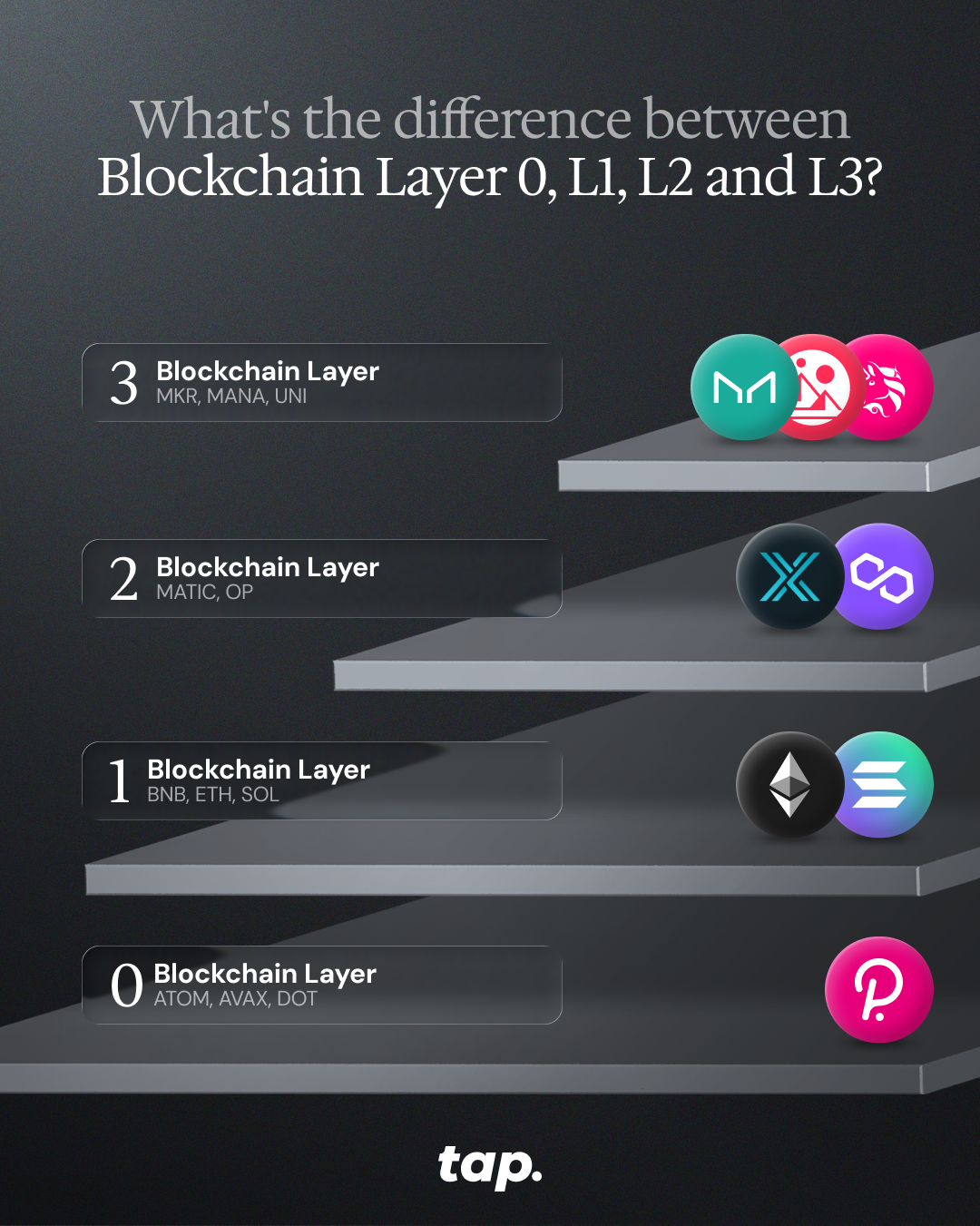
Layer 0, 1, 2 y 3: otra forma de entender las capas
Además de la estructura interna, el término “capas” también se usa para clasificar soluciones dentro del ecosistema.
Layer 0: conexión entre blockchains
Se centra en la interoperabilidad.
Proyectos como Polkadot permiten:
- Comunicación entre blockchains
- Infraestructura compartida
- Creación de nuevas redes
Es como el “internet de las blockchains”.
Layer 1: la base
Es la blockchain principal:
- Bitcoin
- Ethereum
Proporciona:
- Seguridad
- Consenso
Limitaciones:
- Baja capacidad de transacciones
- Comisiones altas
- Lentitud en momentos de congestión
Layer 2: escalabilidad
Se construye sobre Layer 1 para mejorar rendimiento.
Funcionamiento:
- Procesa transacciones fuera de la cadena
- Agrupa datos
- Envía resultados a Layer 1
Ejemplos:
- Lightning Network (Bitcoin)
- Rollups (Ethereum)
Beneficios:
- Mayor velocidad
- Menores costes
- Mejor escalabilidad
Layer 3: aplicaciones
Es donde interactúan los usuarios:
- DeFi (Uniswap, Aave)
- NFTs
- Apps sociales
- Juegos
Aquí es donde la blockchain se vuelve tangible.
Por qué las capas son más importantes que nunca
A medida que crece la adopción, también aumenta la necesidad de:
- Mejor rendimiento
- Menores costes
- Mejor experiencia de usuario
La arquitectura por capas permite:
- Innovación sin comprometer seguridad
- Escalabilidad
- Especialización
En lugar de un solo sistema haciendo todo, múltiples capas trabajan juntas.
Conclusión
Las capas de blockchain pueden parecer complejas, pero la idea es sencilla: dividir un sistema complejo en partes más eficientes.
Desde la infraestructura hasta las aplicaciones que usas cada día, cada capa cumple un papel esencial para que la blockchain sea segura, descentralizada y escalable.
Explora el mundo blockchain
Tanto si te interesan redes Layer 1 como Bitcoin o Ethereum, soluciones de escalado Layer 2 o nuevos ecosistemas Layer 0, entender cómo funcionan estas capas te ayudará a moverte con mayor confianza en el mundo cripto.
En la app puedes acceder a más de 70 criptomonedas, desde proyectos consolidados hasta plataformas DeFi innovadoras, todo en un solo lugar.
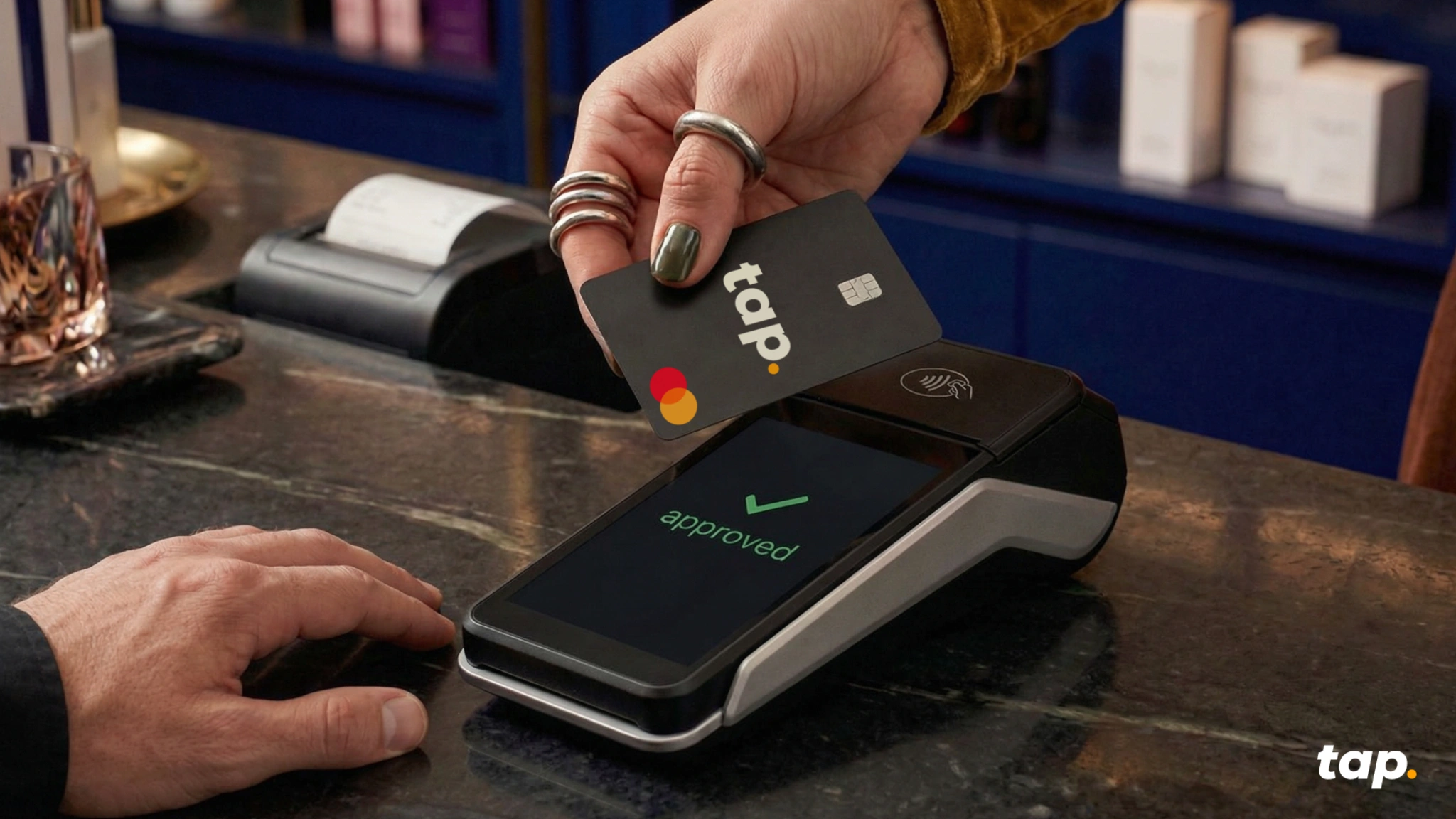
Imagina salir del supermercado y darte cuenta de que te han pagado por hacer la compra semanal. No con cupones ni puntos que caducan, sino con dinero real. Eso es el Cashback.
Por ejemplo, si gastas 200 $ en un supermercado con una tarjeta que ofrece un 2% de Cashback, recibes 4 $ de vuelta. En pocas palabras, es un reembolso sobre tus compras diarias, ya sea en un supermercado, restaurante o tienda online.
Vamos a ver paso a paso cómo funciona el Cashback, los distintos tipos de tarjetas que existen, cómo calcular tus recompensas y cuál puede ser la mejor opción para ti.
¿Cómo funciona el Cashback?
El proceso es sencillo:
- Realizas una compra con tu tarjeta de crédito.
- El comercio procesa el pago a través de una red como Visa o American Express.
- El banco emisor calcula la recompensa según el porcentaje de tu tarjeta.
- La recompensa se acumula en tu cuenta.
Normalmente, el Cashback no se recibe al instante. Las recompensas suelen reflejarse al cerrar el ciclo mensual de facturación. Si gastas 500 $ en un mes con una tarjeta al 2%, ganarás 10 $ (500 × 2% = 10 $), que aparecerán tras el cierre del extracto.
Cashback vs. anticipo de efectivo
Aunque suenen parecido, no son lo mismo:
- Cashback es una recompensa.
- Anticipo de efectivo (cash advance) es un préstamo sobre tu línea de crédito, generalmente con comisión inmediata y alto interés.
Confundirlos puede resultar caro. El anticipo genera intereses desde el primer día, mientras que el Cashback reduce tu gasto efectivo.
Cashback vs. puntos
Algunas tarjetas anuncian “cashback” pero en realidad otorgan puntos. Estos pueden convertirse a una tasa fija (por ejemplo, 1 punto = 1 céntimo) o tener valor variable según cómo los uses (viajes, tarjetas regalo, compras online). Siempre revisa las condiciones para entender el valor real.
Tipos de tarjetas con Cashback
No todas funcionan igual. Estos son los modelos más habituales:
Tarjetas de tasa fija
Ofrecen el mismo porcentaje en todas las compras, normalmente entre el 1,5% y el 2%.
Si gastas 1.000 $ al mes con una tarjeta al 2%, ganarás 20 $ (1.000 × 2% = 20 $), sin importar el tipo de gasto.
Son ideales para quienes buscan simplicidad.
Tarjetas por categorías fijas o escalonadas
Ofrecen mayor porcentaje en categorías específicas (supermercados, gasolineras, restaurantes, viajes) y un porcentaje más bajo (generalmente 1%) en el resto.
Ejemplo:
- 3% en supermercados → 500 $ × 3% = 15 $
- 1% en otros gastos → 500 $ × 1% = 5 $
- Total = 20 $
El banco define qué comercios califican, por lo que conviene revisar las condiciones.
Son adecuadas para quienes tienen patrones de gasto constantes.
Tarjetas con categorías rotativas
Ofrecen un 5% en categorías que cambian cada trimestre, normalmente con límite de gasto.
Ejemplo:
Si el límite trimestral es 1.500 $ y gastas esa cantidad al 5%, ganarás 75 $ (1.500 × 5% = 75 $). Después del límite, suele aplicarse el 1%.
Es necesario activar la categoría cada trimestre. Si no lo haces, solo se aplica el porcentaje base.
Son ideales para usuarios atentos y organizados.
Tarjetas con categoría elegible
Permiten seleccionar la categoría de bonificación cada mes o aplican automáticamente el mayor porcentaje a la categoría donde más gastas.
Si eliges restaurantes al 3% y gastas 400 $, ganarás 12 $ (400 × 3% = 12 $).
Son adecuadas para estilos de vida cambiantes.
Cómo calcular tu Cashback
La fórmula es simple:
Importe gastado × porcentaje de Cashback = recompensa
Ejemplos:
- 100 $ × 1% = 1 $
- 1.000 $ × 1,5% = 15 $
- 500 $ × 5% = 25 $
- 2.000 $ × 5% = 100 $
Ten en cuenta los límites de gasto y condiciones de categoría, que pueden reducir el porcentaje efectivo.
¿Merece la pena una tarjeta con Cashback?
Funciona mejor si pagas el saldo completo cada mes. Si mantienes deuda, los intereses (a veces superiores al 20% anual) pueden superar fácilmente las recompensas.
Ventajas
- Ganas un porcentaje sobre gastos habituales.
- Valor fijo en dinero, a diferencia de sistemas de millas variables.
- Algunas tarjetas no tienen comisión anual.
- Con el tiempo, puede compensar gastos reales.
Por ejemplo, gastar 2.000 $ al mes al 2% genera 40 $ mensuales (2.000 × 2% = 40 $), es decir, 480 $ al año.
Desventajas
- Mantener saldo genera intereses que superan las recompensas.
- Algunas tarjetas tienen cuota anual.
- Las categorías rotativas requieren gestión activa.
- Solicitar varias tarjetas puede afectar temporalmente a tu puntuación crediticia.
También conviene considerar la diferencia entre crédito y débito. La tarjeta de débito utiliza tu propio dinero y evita intereses. La de crédito ofrece recompensas y posibilidad de construir historial crediticio, pero implica riesgo si gastas más de lo que puedes pagar.
El Cashback es un incentivo, no dinero gratis. Funciona mejor cuando forma parte de una planificación financiera disciplinada.
Consejos para maximizar el Cashback
- Elige la tarjeta según tus gastos reales. Revisa tus extractos antes de decidir.
- Paga siempre el saldo completo.
- Activa las categorías rotativas a tiempo.
- Planifica compras grandes estratégicamente.
- Combina tarjetas: una de tasa fija para gastos generales y otra por categorías puede aumentar tus recompensas.
- Complementa con apps o webs de Cashback independientes.
- Evalúa bien los bonos de bienvenida para asegurarte de que el gasto requerido encaja con tu presupuesto habitual.
Obtén Cashback sin caer en la trampa del crédito
Las tarjetas de crédito con Cashback pueden parecer atractivas, pero si mantienes saldo pendiente, los intereses pueden eliminar cualquier beneficio.
Existe una alternativa: el Cashback cripto con tarjeta de débito. La tarjeta de débito de Tap te permite obtener recompensas sin endeudarte. Ganas Cashback en compras cotidianas (supermercado, café, viajes, restaurantes) sin pedir dinero prestado, sin intereses y sin riesgo de sobreendeudamiento.
Las recompensas se pagan en el token XTP y se depositan directamente en tu wallet según la cantidad de XTP que tengas bloqueada (staked). Las tasas de Cashback van del 0,5% al 8%, dependiendo del nivel. Cuantos más XTP bloquees, mayor será tu recompensa.
Si valoras la disciplina financiera y quieres obtener recompensas por tus gastos, la tarjeta de débito cripto de Tap puede ser una alternativa interesante.
¿Listo para ganar Cashback de forma más inteligente? Descarga la app de Tap y empieza a convertir tus compras en recompensas cripto hoy mismo.
Creada como la evolución natural de DAI, USDS es una stablecoin que opera dentro del ecosistema Sky Protocol (anteriormente MakerDAO) y busca combinar estabilidad de precio, transparencia y descentralización en un único activo digital.
A medida que las stablecoins desempeñan un papel cada vez más importante en las finanzas globales, USDS ofrece una alternativa a las opciones centralizadas mediante el uso de colateral respaldado por criptoactivos y smart contracts automatizados, en lugar de depender de una única empresa emisora. Más allá de la estabilidad de precio, USDS está diseñada para integrarse sin fricciones en aplicaciones de finanzas descentralizadas, ofrecer oportunidades de rendimiento a través de incentivos del protocolo y respaldar un futuro multi-chain. Para quienes buscan un dólar digital estable sin control centralizado, USDS representa un enfoque moderno para el almacenamiento y la transferencia de valor.
¿Qué es USDS?
USDS es una stablecoin respaldada por criptoactivos y vinculada al dólar estadounidense, lo que significa que su precio objetivo es aproximadamente 1 dólar en todo momento. A diferencia de los dólares digitales tradicionales emitidos por empresas centralizadas, USDS está gobernada por smart contracts y por un proceso de toma de decisiones descentralizado, en lugar de una autoridad única.
La base de USDS se sustenta en tres principios fundamentales. Primero, la estabilidad: el protocolo está diseñado para mantener a USDS cerca de su paridad con el dólar incluso en periodos de volatilidad del mercado. Segundo, la descentralización: ninguna empresa o gobierno controla su emisión, congelación o redención. Tercero, la colateralización: cada USDS en circulación está respaldado por activos cripto como ETH, USDC y activos tokenizados del mundo real depositados dentro del Sky Protocol.
En comparación con stablecoins centralizadas como USDT o USDC, USDS no depende de reservas bancarias corporativas ni de custodios off-chain. En comparación con DAI, USDS está diseñada para ofrecer mayor escalabilidad y funcionalidad multi-chain. Y a diferencia de las stablecoins puramente algorítmicas, USDS se apoya en colateral tangible en lugar de depender únicamente de incentivos de mercado. Su propósito es proporcionar un dólar digital transparente y resiliente alineado con los valores de las finanzas descentralizadas.
Cómo funciona USDS
Creación a través de Sky Vaults
USDS se crea mediante un sistema conocido como Sky Vaults. Los usuarios depositan activos de colateral aprobados en smart contracts automatizados y, a cambio, acuñan USDS. Una forma sencilla de entenderlo es imaginar que se depositan activos valiosos en una bóveda digital segura y se recibe a cambio un recibo vinculado al dólar que puede gastarse o transferirse.
El colateral aceptado incluye criptomonedas como ETH, activos estables como USDC y ciertos activos tokenizados del mundo real. Cada bóveda opera bajo reglas predefinidas que garantizan coherencia y seguridad en todo el sistema.
Estabilidad y sobrecolateralización
Para proteger la paridad con el dólar, USDS está sobrecolateralizada. Esto significa que los usuarios deben depositar más valor del que generan en USDS. Si el valor del colateral cae por debajo de ciertos umbrales, el sistema vende automáticamente parte de los activos mediante un proceso de liquidación para proteger la estabilidad general. Este margen de seguridad es una de las razones por las que USDS puede mantener su paridad sin depender de un emisor central.
Papel dentro del Sky Protocol
USDS funciona como la stablecoin central del ecosistema Sky Protocol. Da soporte a préstamos, ahorro, pagos y procesos de gobernanza dentro de la plataforma. Aunque las decisiones de gobernanza se gestionan por separado, USDS está profundamente integrada en la arquitectura y el sistema de incentivos de Sky.
Actualización de DAI a USDS
La transición de DAI a USDS está diseñada como un proceso sencillo y centrado en el usuario, alineado con las mejores prácticas de las finanzas descentralizadas modernas y la tecnología de la información. A través del sitio web oficial de Sky, los usuarios pueden conectar una wallet compatible y actualizar sus DAI a USDS mediante smart contracts.
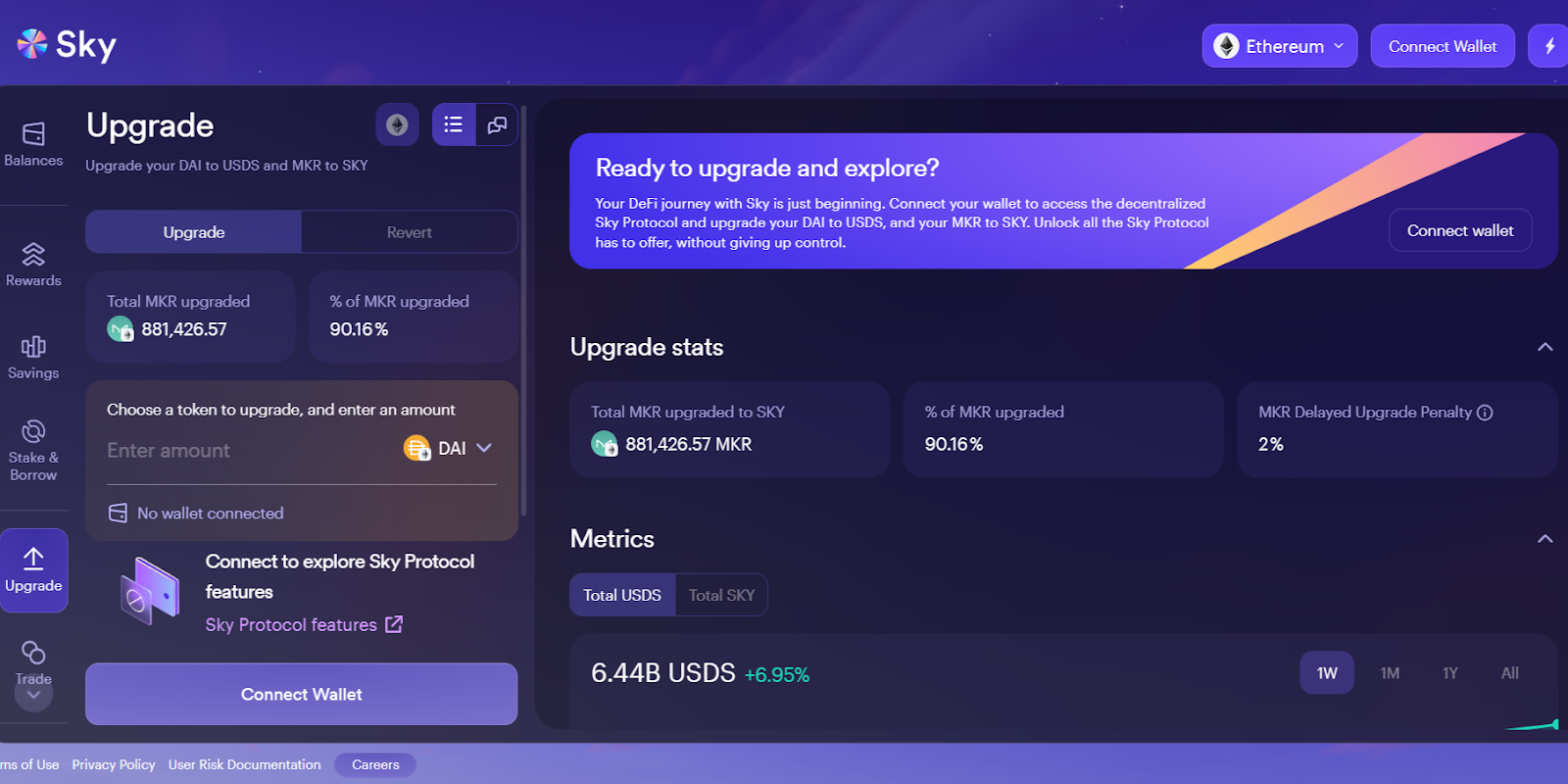
Desde la perspectiva de la experiencia de usuario, el proceso enfatiza accesibilidad, transparencia y eficiencia. Ninguna autoridad central, banco o intermediario controla la transacción, y los usuarios conservan la plena propiedad de sus datos y activos digitales en todo momento.
Una vez completada la actualización, los holders de USDS pueden acceder de inmediato a herramientas adicionales dentro del ecosistema Sky, incluidos mecanismos de ahorro e incentivos. Para usuarios en Estados Unidos y a nivel global, esta actualización no es solo un cambio técnico, sino una mejora en cómo los productos de stablecoins descentralizadas ofrecen valor, escalabilidad y usabilidad.
USDS vs. DAI: ¿Qué ha cambiado?
USDS y DAI comparten una historia común en el sistema MakerDAO, ahora bajo el Sky Protocol. Ambas son stablecoins descentralizadas vinculadas al dólar y respaldadas por colateral on-chain. Sin embargo, USDS representa una evolución arquitectónica y estratégica centrada en escalabilidad, gobernanza e incentivos mejorados para el usuario final.
DAI fue un producto fundacional en DeFi, permitiendo a los usuarios bloquear activos cripto en smart contracts para generar una moneda digital estable. USDS perfecciona ese modelo mediante mejoras tecnológicas, compatibilidad multi-chain ampliada y nuevas estructuras de recompensas que aumentan la eficiencia del capital y la participación de los usuarios.
Desde una perspectiva de gestión de riesgos y políticas, USDS está diseñada para alinearse mejor con expectativas regulatorias sin perder su carácter descentralizado. Incorpora lecciones aprendidas de la volatilidad del mercado, crisis anteriores y desafíos en el diseño de stablecoins. En resumen, DAI sentó las bases; USDS aplica mecanismos actualizados de diseño, gobernanza e incentivos para responder a las necesidades actuales de DeFi.
USDS frente a otras stablecoins
USDS se diferencia principalmente en cómo gestiona el control, el respaldo y la transparencia.
Las stablecoins centralizadas como USDT y USDC son emitidas por empresas que gestionan reservas fiat y pueden congelar fondos si la normativa lo exige. Las stablecoins algorítmicas dependen principalmente de incentivos de mercado y ajustes de oferta basados en código, lo que puede introducir mayor riesgo sistémico.
USDS, por el contrario, es descentralizada y respaldada por colateral. Sus reservas son visibles on-chain y ninguna entidad individual tiene autoridad unilateral sobre los fondos de los usuarios. Esto reduce el riesgo de censura y mejora la transparencia, aunque también hace que el sistema sea algo más complejo que las alternativas centralizadas. En conjunto, USDS se sitúa entre las stablecoins institucionales y los diseños algorítmicos experimentales, ofreciendo un equilibrio entre estabilidad y descentralización.
Cómo obtener y utilizar USDS
Existen varias formas de adquirir y usar USDS, dependiendo del nivel de experiencia del usuario.
La forma más sencilla es comprar USDS en un exchange descentralizado utilizando otra criptomoneda, opción generalmente adecuada para principiantes. Los holders de DAI pueden convertir DAI a USDS en una proporción uno a uno a través de plataformas compatibles. Los usuarios más avanzados pueden acuñar USDS directamente depositando colateral en los Sky Vaults.
Una vez adquirida, USDS puede utilizarse como reserva estable de valor, como par de trading en mercados DeFi o como medio de pago para transferir valor sin exposición a la volatilidad de precios. También desempeña un papel en la provisión de liquidez y en protocolos de préstamo dentro del ecosistema DeFi.
Generar rendimiento con USDS
USDS ofrece oportunidades de rendimiento dentro del Sky Protocol. Una opción es la Sky Savings Rate, que permite bloquear USDS en un smart contract para obtener recompensas variables con el tiempo. Este enfoque es similar a una cuenta de ahorro, aunque los rendimientos fluctúan según las condiciones del protocolo.
Otro mecanismo son las Sky Token Rewards, que proporcionan incentivos adicionales a los usuarios que participan activamente en el ecosistema. Estas recompensas pueden cambiar y no están garantizadas, pero añaden una capa adicional de valor para usuarios comprometidos. Como ocurre con todos los mecanismos de rendimiento en DeFi, los retornos dependen de las condiciones de mercado y de decisiones de gobernanza.
USDS dentro del ecosistema Sky Protocol
Sky Protocol es una plataforma de finanzas descentralizadas construida sobre el legado de MakerDAO. Dentro de este ecosistema, USDS actúa como unidad principal de transferencia de valor. Interactúa con procesos de gobernanza, programas de incentivos y otras aplicaciones descentralizadas compatibles con Sky.
Aunque los tokens de gobernanza y las actualizaciones del protocolo operan en segundo plano, los usuarios no necesitan conocimientos técnicos profundos para beneficiarse de USDS. Su diseño prioriza la usabilidad manteniéndose fiel a principios descentralizados y a una arquitectura transparente.
Conclusión
USDS es una stablecoin descentralizada diseñada para ofrecer un dólar digital fiable sin control centralizado. Como sucesora de DAI, se apoya en un modelo probado al tiempo que introduce mejoras en escalabilidad e integración dentro del Sky Protocol.
Al combinar colateral respaldado por criptoactivos, gestión de riesgos automatizada y transparencia on-chain, USDS ofrece una alternativa tanto a las stablecoins centralizadas como a las algorítmicas. A medida que DeFi continúa evolucionando, USDS representa una opción práctica para usuarios que buscan estabilidad de precio con gobernanza descentralizada.

Probablemente hayas oído hablar de MakerDAO, el protocolo detrás de MKR y la stablecoin DAI. Ahora llega su siguiente etapa: Sky.
Sky es la nueva identidad del ecosistema MakerDAO, uno de los proyectos más consolidados de las finanzas descentralizadas (DeFi). Lanzado en 2024, representa la evolución del sistema de stablecoin y gobernanza de Maker, con un enfoque más claro en accesibilidad, usabilidad y experiencia del usuario.
Sky mantiene el papel histórico de MakerDAO en DeFi, pero introduce un ecosistema renovado centrado en gobernanza y control descentralizado de activos digitales.
Sky vs. Skycoin: aclarando la confusión
A pesar de la similitud en el nombre, Sky (SKY) y Skycoin (SKY) son proyectos de criptomonedas completamente diferentes. Sky es el ecosistema renombrado de MakerDAO, centrado en finanzas descentralizadas, stablecoins y gobernanza en Ethereum. Skycoin, por otro lado, es un proyecto blockchain independiente con su propia plataforma de computación, economía de tokens y equipo de desarrollo.
Difieren en caso de uso, valor de mercado, tecnología y comunidad. La función principal de Sky es facilitar el ahorro descentralizado, los préstamos y la gobernanza a través de USDS y SKY, mientras que Skycoin se enfoca en la arquitectura de red y una infraestructura blockchain alternativa. Sus precios, capitalización bursátil y volumen de negociación tampoco guardan relación alguna.
Entender esta distinción es importante tanto para inversores como para usuarios finales a fin de evitar confusiones al investigar en exchanges, tendencias de mercado u oportunidades de inversión.
¿Cómo funciona Sky? Características principales
Sky opera como un servicio de finanzas descentralizadas sin ninguna autoridad central que controle los fondos de los usuarios. Una de sus funciones principales es el staking de USDS, mediante el cual los usuarios depositan USDS en el protocolo para obtener rendimiento a través de mecanismos como la Tasa de Ahorro de Sky y las Recompensas en Token Sky. Esto permite a los usuarios generar intereses sobre una divisa digital anclada al dólar manteniendo el control total de sus activos.
La gobernanza se gestiona a través del token SKY. Los titulares del token participan en la votación sobre actualizaciones del protocolo, ajustes de comisiones, políticas de colateral y decisiones de gestión de riesgos. Este proceso de votación garantiza la transparencia y una toma de decisiones liderada por la comunidad en todo el ecosistema.
Sky también presenta una estructura modular conocida como Sky Stars, proyectos independientes que operan dentro del ecosistema más amplio manteniendo su autonomía. Este diseño favorece la innovación, la escalabilidad y un desarrollo más ágil, todo ello manteniendo la alineación con los servicios financieros centrales de Sky.
Cómo actualizar de MKR a SKY
Como parte del cambio de marca de MakerDAO, MKR ha sido reemplazado por SKY como el único token de gobernanza del Protocolo Sky. Si bien MKR podría seguir negociándose en mercados secundarios, solo SKY otorga acceso a la gobernanza, al staking y a la participación en el ecosistema Sky.
El proceso de actualización se gestiona directamente a través del sitio web oficial de Sky, garantizando una experiencia no custodiada y controlada por el usuario. Los usuarios simplemente conectan su monedero de Ethereum, inician la actualización y convierten MKR a SKY con la proporción fija de 1 MKR = 24.000 SKY. Durante todo el proceso, los usuarios mantienen el control total de sus activos.
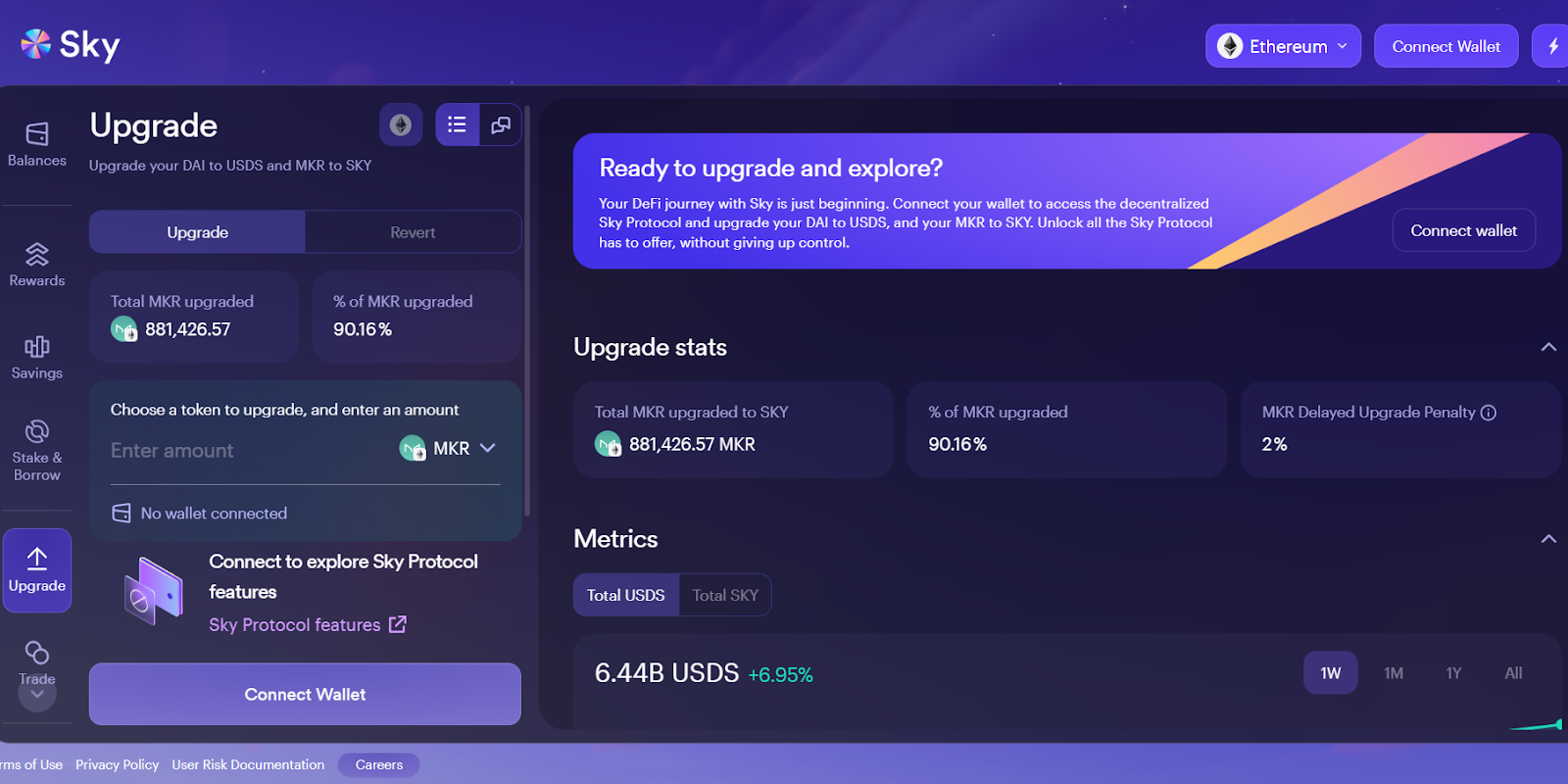
Se recomienda encarecidamente la actualización a cualquier persona que desee seguir votando, delegando o interactuando con los mecanismos de gobernanza y recompensas de Sky. Poseer SKY desbloquea funcionalidades como la votación en el protocolo, la participación en la toma de decisiones y el acceso a funcionalidades relacionadas con el staking vinculadas al ecosistema Sky.
También es importante señalar que el protocolo introduce una penalización temporal por actualizaciones demoradas. A partir del 18 de septiembre de 2025, la cantidad de SKY recibida por cada MKR disminuirá gradualmente, comenzando con una reducción del 1% y aumentando con el tiempo. Actualizar antes de esta fecha garantiza que los usuarios reciban el valor de conversión completo sin penalización alguna.
En resumen, aunque MKR sigue siendo un activo reconocible, SKY es el token que impulsará el ecosistema Sky en el futuro, y la actualización es la vía recomendada para quienes deseen mantenerse alineados con el desarrollo futuro del protocolo.
Valor actual del token SKY y desempeño de mercado
El token SKY desempeña un papel central en la gobernanza y en los incentivos del protocolo. Tras el cambio de marca, MKR se convirtió en SKY con una proporción de 1:24.000, lo que redujo significativamente el precio unitario y mejoró la accesibilidad para los participantes individuales.
En el momento de redactar este artículo, su capitalización bursátil la sitúa entre las 50 criptomonedas principales, junto a tokens de gobernanza DeFi bien consolidados. Sin embargo, como todas las criptomonedas, SKY experimenta volatilidad de precios influenciada por las condiciones generales del mercado y las tendencias de adopción de DeFi.
Conclusión
Sky es el siguiente capítulo de MakerDAO, reinventado para ofrecer un ecosistema de finanzas descentralizadas más accesible y escalable. Al combinar USDS para ahorros y transacciones con SKY para la gobernanza y la toma de decisiones, Sky pretende empoderar a los usuarios con un mayor control, transparencia y autonomía financiera.
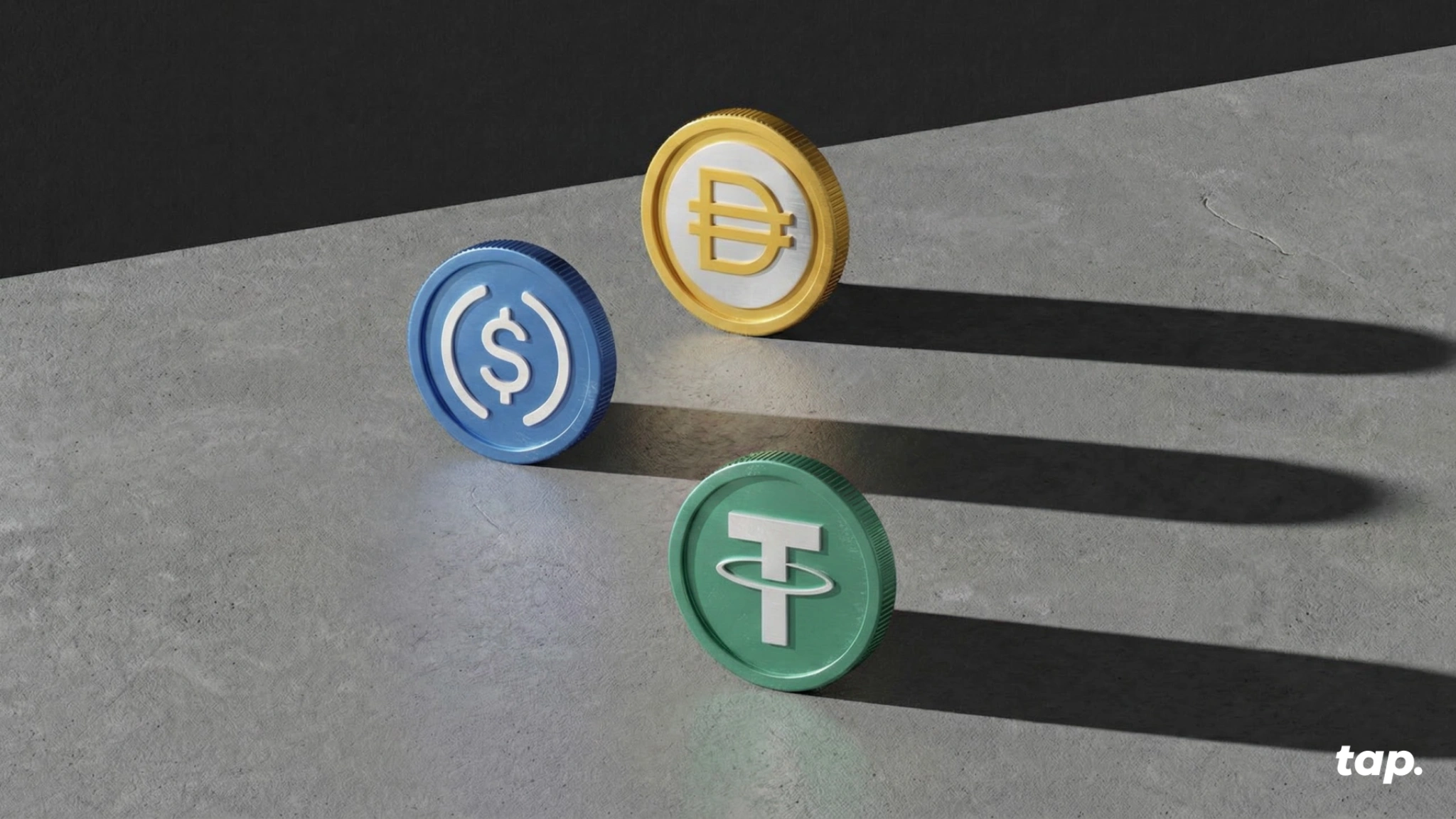
En 2025, millones de personas dejaron de esperar a que el sistema financiero ofreciera alternativas más rápidas y baratas para los pagos. Simplemente empezaron a usar otra cosa. Millones de usuarios en 15 países han comenzado a recibir parte de sus ingresos en stablecoins, y no piensan volver atrás.
Stablecoins: una moneda de uso cotidiano
Una nueva encuesta realizada por YouGov a 4.658 usuarios cripto y potenciales holders aporta datos concretos a lo que antes era más anecdótico que estadístico. Los resultados dibujan una imagen de las stablecoins muy distinta de la percepción especulativa y volátil que tradicionalmente se asocia al mundo cripto.
El 39% de los encuestados afirmó que ya recibe ingresos en stablecoins, representando de media aproximadamente el 35% de sus ganancias anuales. No se trata necesariamente de ingresos secundarios: para muchos, es su fuente principal.
El uso en el día a día también está creciendo. Más de una cuarta parte de los holders de stablecoins (27%) las utiliza para compras habituales, manteniendo una media de unos 200 dólares en sus wallets digitales para transacciones cotidianas. Más de la mitad declaró haber elegido deliberadamente un comercio por aceptar stablecoins. En mercados emergentes, esa cifra asciende al 60%.
La geografía de la adopción es reveladora. La propiedad es mayor en economías de ingresos bajos y medios: el 60% de los encuestados en esas regiones posee stablecoins, frente al 45% en países más ricos. África destaca especialmente, con la tasa de propiedad más alta a nivel mundial (79%) y el mayor crecimiento interanual.
El patrón tiene lógica: donde los bancos son lentos, las remesas costosas y las divisas inestables, un activo digital vinculado al dólar que viaja de forma instantánea y barata deja de ser una novedad para convertirse en una herramienta esencial. Los usuarios que realizan transferencias internacionales afirmaron ahorrar aproximadamente un 40% en comisiones frente a los servicios tradicionales de remesas. Esa cifra cobra especial relevancia cuando se envía dinero a casa cada mes.
Las razones para utilizar stablecoins no son ideológicas. Los principales motivos son menores costes de transacción, mayor seguridad y accesibilidad global. No se trata de un movimiento impulsado por idealistas cripto, sino de un cambio pragmático por parte de personas que han encontrado una herramienta que funciona mejor para su realidad.
La demanda de una mayor integración con el sistema financiero tradicional también es evidente. El 77% de los encuestados afirmó que abriría una wallet de stablecoins si su banco o proveedor fintech principal la ofreciera, y el 71% querría una tarjeta de débito vinculada a su saldo en stablecoins. La brecha de infraestructura entre cripto y banca convencional es, al parecer, algo que muchos usuarios estarían encantados de ver desaparecer.
Expansión estable
El momento también es clave. La aprobación de la GENIUS Act en Estados Unidos y la implementación de la regulación MiCA en Europa han aportado un marco regulatorio que está acelerando los movimientos corporativos en el sector. La plataforma de nóminas Deel anunció recientemente que ofrecerá pagos en stablecoins, comenzando por trabajadores en Reino Unido y la Unión Europea antes de expandirse a Estados Unidos.
El cambio también es visible on-chain, con un aumento drástico en el volumen de transacciones con stablecoins en los últimos años, alcanzando cifras de billones. El mercado total de stablecoins ronda actualmente los 307.000 millones de dólares, frente a los 260.000 millones en el momento en que se aprobó la GENIUS Act.
La trayectoria es difícil de ignorar, y no muestra señales de desaceleración. El crecimiento es real y, cada vez más, también lo son las nóminas pagadas en stablecoins.
Conclusión
Lo que comenzó como una herramienta de nicho para traders cripto se ha convertido en una columna vertebral financiera para millones de personas en todo el mundo: más rápida, más barata y más accesible que los sistemas que empieza a reemplazar.
Con mayor claridad regulatoria a ambos lados del Atlántico, empresas e instituciones ya no permanecen al margen. Bancos, fintechs y plataformas de nómina están entrando en el ecosistema, y los usuarios están preparados para recibirlos. Para ellos, las stablecoins ya no son un experimento. Son simplemente la forma en que funciona el dinero hoy.

En un ecosistema blockchain donde la transparencia suele ser la norma, la privacidad sigue siendo uno de los mayores desafíos de Web3. COTI, acrónimo de Currency Of The Internet, se posiciona como una de las capas de privacidad más rápidas y ligeras de Web3, diseñada para permitir transacciones financieras confidenciales sin sacrificar velocidad, usabilidad ni cumplimiento normativo. Construido como una plataforma de computación de Capa 2 sobre Ethereum, COTI permite a empresas, instituciones y usuarios finales trabajar con datos privados mientras se benefician de la seguridad de la blockchain.
En este artículo exploraremos qué es COTI, cómo funciona su tecnología y por qué su enfoque en privacidad, escalabilidad y cumplimiento regulatorio está ganando interés en el ámbito de las finanzas descentralizadas, aplicaciones empresariales e industrias reguladas.
¿Qué es COTI?
COTI (Currency Of The Internet) es una infraestructura de privacidad de Capa 2 construida sobre Ethereum que permite transacciones y smart contracts confidenciales y programables. Lanzado originalmente en 2017 como una red enfocada en pagos, COTI ha evolucionado significativamente. Con su actualización V2, el protocolo dio un giro hacia capacidades avanzadas de privacidad y computación.
Hoy en día, COTI funciona como software de aplicación y herramienta blockchain diseñada para soportar actividad financiera privada, intercambio de datos conforme a la normativa y procesos empresariales escalables.
Al combinar compatibilidad con Ethereum y computación que preserva la privacidad, COTI permite a desarrolladores e instituciones crear aplicaciones DeFi, sistemas de stablecoins y servicios empresariales donde información sensible como saldos, precios o identidades de usuario permanece protegida.
¿Cómo funciona COTI?
En el núcleo de la tecnología de COTI se encuentra una metodología criptográfica llamada Garbled Circuits, una forma de computación segura multiparte (secure multiparty computation). En términos sencillos, esta técnica permite que un programa procese datos cifrados sin revelar las entradas, variables o atributos subyacentes. Es decir, la lógica de una transacción puede ejecutarse de forma privada mientras produce resultados verificables.
En comparación con soluciones tradicionales como las pruebas de conocimiento cero (zero-knowledge proofs), el enfoque de COTI prioriza eficiencia y velocidad. Los Garbled Circuits permiten cálculos hasta 3.000 veces más rápidos que sistemas basados en ZK-SNARK, con menor latencia y menores requisitos de almacenamiento. Este rendimiento hace que COTI sea adecuado para servicios reales que requieren pagos rápidos, lógica de precios y experiencias de usuario escalables.
Desde el punto de vista arquitectónico, COTI opera como una red de Capa 2 que procesa transacciones off-chain para garantizar privacidad y eficiencia, y posteriormente liquida los resultados finales en Ethereum. Este diseño aprovecha la seguridad y descentralización de Ethereum evitando congestión y comisiones elevadas. Además, al mantener compatibilidad con la EVM, los desarrolladores pueden desplegar contratos inteligentes en Solidity e integrar COTI en flujos Web3 ya existentes.
La privacidad en COTI es programable. Los datos pueden mantenerse completamente privados, divulgarse selectivamente para auditorías o compartirse con reguladores e instituciones cuando sea necesario. Este equilibrio entre protección de datos y cumplimiento normativo es clave en su propuesta de valor.
Características y beneficios clave
La principal característica de COTI es la privacidad programable, que permite a los desarrolladores definir quién puede acceder a determinada información dentro de una transacción financiera o proceso empresarial. Esto resulta especialmente relevante para bancos, fintechs y modelos de negocio basados en suscripción que deben proteger datos de clientes cumpliendo normativas.
La velocidad y la escalabilidad son también beneficios centrales. Al procesar datos off-chain y minimizar la carga computacional, COTI admite alto volumen de transacciones y experiencias fluidas en aplicaciones móviles. Su arquitectura está pensada para pagos, programas de fidelización, wallets digitales y plataformas empresariales.
Además, el diseño de COTI favorece la gobernanza y la transparencia. Aunque los detalles de las transacciones permanezcan privados, el sistema puede proporcionar pruebas verificables cuando sea necesario, facilitando gestión de riesgos, protección del consumidor y adopción institucional.
¿Qué problemas resuelve COTI?
Las blockchains públicas exponen por defecto los datos de las transacciones, lo que genera desafíos para empresas, proveedores sanitarios, bancos y usuarios que necesitan confidencialidad. Esta transparencia puede revelar estrategias de precios, saldos bancarios, límites de crédito o información médica y financiera sensible.
COTI aborda este problema al permitir transacciones financieras privadas que siguen siendo auditables y conformes a la normativa. En DeFi, posibilita que los usuarios negocien, presten o gestionen stablecoins sin exponer saldos o estrategias. En entornos empresariales, facilita contabilidad confidencial, gestión de tesorería y compartición segura de datos en cadenas de suministro.
Su tecnología también ha despertado interés institucional, incluyendo colaboraciones con bancos centrales y empresas que exploran sistemas de moneda digital regulada. La capacidad de equilibrar privacidad, velocidad y cumplimiento hace que COTI sea relevante para tokenización de activos del mundo real, gestión de datos sanitarios e integración empresarial.
El token COTI
La criptomoneda COTI es el activo digital nativo que impulsa la red. Se utiliza para pagar comisiones de transacción, participar en la gobernanza y realizar staking dentro del ecosistema. COTI existe en múltiples redes, incluyendo su Trustchain nativa y Ethereum como token ERC-20, lo que ofrece flexibilidad en almacenamiento y uso.
Con un suministro total aproximado de 2.600 millones de tokens, COTI incentiva la participación en la red y alinea el uso a largo plazo con la demanda de computación privada y servicios financieros. El token desempeña un papel central en la seguridad de la red y en la alineación de intereses de los participantes.
¿Cómo empezar con COTI?
COTI está disponible en varios exchanges de criptomonedas de gran relevancia. La mayoría de plataformas admiten la versión ERC-20, que puede almacenarse en wallets compatibles, tanto hardware como software.
Para desarrolladores y empresas interesadas en integrarse con la red, COTI ofrece herramientas, documentación y recursos técnicos que permiten desplegar contratos inteligentes privados, sistemas de pago y aplicaciones descentralizadas utilizando flujos de desarrollo Web3 conocidos.
Conclusión
COTI representa un enfoque práctico hacia la privacidad en blockchain, combinando computación rápida, arquitectura escalable y diseño consciente de la regulación. Al aprovechar Garbled Circuits y la tecnología de Capa 2 de Ethereum, permite transacciones financieras confidenciales y procesamiento de datos sin sacrificar eficiencia ni cumplimiento normativo.
A medida que la privacidad adquiere mayor relevancia en DeFi, servicios empresariales e industrias reguladas, el equilibrio entre velocidad, gobernanza y usabilidad de COTI lo posiciona como una capa de infraestructura relevante dentro del ecosistema Web3 en evolución.

El intercambio de activos digitales en blockchains públicas ha sido uno de los grandes desafíos de las finanzas descentralizadas: ¿cómo permitir un trading eficiente peer-to-peer sin depender de intermediarios centralizados? En Ethereum, los primeros exchanges descentralizados se enfrentaron a comisiones de gas elevadas, liquidaciones lentas y liquidez fragmentada. 0x Protocol nació precisamente para resolver ese problema.
Lanzado en 2017 por Will Warren y Amir Bandeali, 0x Protocol es un proyecto de infraestructura blockchain de código abierto diseñado para potenciar el trading descentralizado de criptomonedas. En lugar de funcionar como un marketplace propio, 0x proporciona las herramientas y estándares necesarios para que desarrolladores creen exchanges descentralizados, wallets y aplicaciones financieras.
En esencia, 0x permite transacciones financieras peer-to-peer manteniendo el control de los activos en manos del usuario. El protocolo está gobernado por su token nativo ERC-20, ZRX, que desempeña un papel en la gobernanza y en los incentivos de liquidez. Aunque 0x Labs, la empresa desarrolladora original, recibió una sanción regulatoria en 2023, el protocolo continúa operando como infraestructura descentralizada dentro del ecosistema Ethereum.
Cómo funciona 0x Protocol
La arquitectura híbrida explicada
0x utiliza una arquitectura híbrida que separa la coordinación del trade de su liquidación. Este diseño equilibra eficiencia y seguridad, dos prioridades que a menudo compiten en las finanzas basadas en blockchain.
Las órdenes de compra y venta se crean y comparten off-chain, es decir, no se registran inmediatamente en la blockchain de Ethereum. Esto reduce significativamente los costes de transacción y la congestión de la red. Sin embargo, la liquidación final del trade se realiza on-chain mediante smart contracts, garantizando transparencia, cifrado y ejecución sin necesidad de confianza.
Una analogía útil sería un tablón de anuncios digital: las ofertas se publican y descubren fuera de la cadena, pero cuando ambas partes aceptan, el intercambio final se registra en la blockchain de forma segura.
Makers, Takers y Relayers
0x define tres roles principales dentro de su metodología de exchange descentralizado:
- Makers: crean órdenes de trade, especificando el par de activos, precio y cantidad. Contribuyen a la liquidez del mercado.
- Takers: ejecutan esas órdenes aceptando el precio especificado.
- Relayers: aplicaciones o servicios que alojan libros de órdenes y facilitan la distribución de las mismas. No custodian fondos ni ejecutan trades; simplemente ayudan a descubrir órdenes y pueden cobrar comisiones.
Flujo de ejecución de una operación
- Un maker crea y firma una orden off-chain.
- La orden se comparte directamente o a través de un relayer.
- Un taker envía la orden a la blockchain de Ethereum.
- Un smart contract de 0x verifica firmas, condiciones de precio y variables de liquidación.
- Los activos se intercambian de forma atómica entre wallets.
Este enfoque permite a 0x soportar alto volumen de trading manteniendo descentralización y seguridad.
El token ZRX en profundidad
Derechos de gobernanza
ZRX es el token de gobernanza nativo de 0x Protocol. Fue lanzado mediante una ICO en agosto de 2017 y sigue el estándar ERC-20 de Ethereum.
Los poseedores pueden votar en propuestas de mejora del protocolo, conocidas como ZEIPs (0x Improvement Proposals). Estas propuestas abarcan actualizaciones técnicas, ajustes de parámetros y decisiones relacionadas con la tesorería. La votación se realiza off-chain para evitar costes de gas, utilizando un sistema de snapshot para prevenir manipulaciones. Cada token equivale a un voto.
Staking e incentivos de liquidez
ZRX también incentiva la provisión de liquidez. Los market makers pueden hacer staking de ZRX para recibir recompensas derivadas de las comisiones generadas por el protocolo. Estas comisiones se liquidan en ETH y se distribuyen en función del volumen de trading.
A diferencia de sistemas proof-of-stake que recompensan la validación de bloques, el staking en 0x incentiva la participación activa en mercados descentralizados. Los holders pueden delegar sus ZRX en pools gestionados por market makers y compartir recompensas.
Base técnica de 0x Protocol
0x está construido sobre la blockchain de Ethereum y utiliza smart contracts escritos en Solidity. Sus contratos principales son open-source, auditables públicamente y sometidos a pruebas rigurosas para minimizar vulnerabilidades.
El protocolo es compatible con wallets Ethereum estándar y soporta tokens ERC-20, stablecoins como Tether y otros activos tokenizados. Ofrece herramientas para desarrolladores, como la 0x API y librerías JavaScript, que facilitan su integración en aplicaciones, páginas web y marketplaces.
Aunque Ethereum es su capa principal de liquidación, 0x ha mostrado interés en expandirse a entornos multi-chain a medida que evoluciona la infraestructura blockchain.
Casos de uso y ecosistema
0x funciona como infraestructura financiera más que como producto de consumo directo. Sus servicios están integrados en numerosas aplicaciones descentralizadas.
Casos de uso habituales incluyen:
- Agregadores DEX como Matcha
- Swaps integrados en wallets
- Mesas OTC
- Protocolos DeFi con funcionalidad de trading integrada
- Marketplaces NFT y plataformas de gaming
Los desarrolladores valoran 0x por su diseño abierto, acceso a liquidez agregada (incluyendo fuentes como Uniswap) y su liquidación eficiente en gas. Con el tiempo, el protocolo ha facilitado miles de millones de dólares en volumen acumulado, consolidándose como infraestructura clave de DeFi.
Ventajas y limitaciones
Beneficios
- Reducción de costes gracias a órdenes off-chain
- Liquidación segura on-chain
- Modelo no custodial: los usuarios mantienen control de sus activos
- Diseño modular que facilita integración
- Código abierto y gobernanza comunitaria
Desafíos
- Dependencia de un ecosistema activo de relayers para mantener liquidez
- Riesgo inherente a smart contracts
- Incertidumbre regulatoria
- Competencia creciente de otros protocolos DEX y agregadores
Tokenomics de ZRX
ZRX tiene un suministro máximo de 1.000 millones de tokens, con aproximadamente 847 millones en circulación. Su capitalización y precio fluctúan según tendencias del mercado cripto y el uso del protocolo.
Desde su ICO en 2017, el token ha experimentado alta volatilidad, reflejando ciclos del mercado más amplios. Está disponible en exchanges importantes como Binance, Coinbase y Kraken.
Como cualquier activo digital, ZRX conlleva riesgos asociados a demanda de mercado, regulación y evolución tecnológica. Esta información no constituye asesoramiento financiero ni legal.
Situación regulatoria y perspectivas
En 2023, ZeroEx, Inc. resolvió una acción regulatoria relacionada con actividad de trading no registrada y pagó una multa. Sin embargo, el protocolo 0x no fue cerrado y continúa operando como infraestructura descentralizada gobernada por su comunidad. De cara al futuro, 0x compite en un entorno DeFi cada vez más dinámico, pero mantiene relevancia como capa neutral de liquidez y liquidación. Su evolución dependerá de la adopción por desarrolladores, decisiones de gobernanza y el desarrollo regulatorio global.
Conclusión
0x Protocol ocupa una posición única en las finanzas descentralizadas como capa de intercambio peer-to-peer. Su arquitectura híbrida off-chain/on-chain aborda retos históricos de eficiencia y coste sin sacrificar seguridad ni descentralización.
El token ZRX alinea la participación de la comunidad con el crecimiento del protocolo. A pesar de presiones regulatorias pasadas, 0x sigue siendo una pieza clave de infraestructura Web3 que permite a desarrolladores construir servicios financieros flexibles y escalables en Ethereum y más allá.
¿Dónde conseguir ZRX?
Si te interesa ZRX y su papel en la infraestructura de exchanges descentralizados y el trading on-chain, puedes encontrarlo en la app, junto a una amplia gama de otras criptomonedas.

El mercado cripto se mueve rápido, pero hay un componente que ha moldeado silenciosamente la forma en que se realiza el trading hoy en día: los automated market makers. Mucho antes de que los AMM se convirtieran en el estándar, Bancor Network introdujo una nueva forma de automatizar la liquidez, reducir el deslizamiento y permitir intercambios sin depender de libros de órdenes. Hoy, a medida que las finanzas descentralizadas evolucionan, Bancor sigue siendo uno de los sistemas más influyentes del sector, valorado no solo por su historia, sino también por su innovación continua en diseño de liquidez, tokenización y control de riesgos.
Tanto si estás explorando aplicaciones descentralizadas por primera vez como si llevas años interactuando con activos digitales, entender Bancor te ayuda a comprender cómo funciona la infraestructura de liquidez moderna que opera detrás de escena.
¿Qué es Bancor Network (BNT)?
Bancor Network es un protocolo de liquidez descentralizado diseñado para optimizar el intercambio de tokens mediante automatización, en lugar del emparejamiento tradicional de órdenes. La plataforma permite a los usuarios intercambiar criptomonedas directamente desde sus wallets, utilizando smart contracts en lugar de intermediarios. En vez de depender de compradores y vendedores que coincidan en tiempo real, Bancor emplea un modelo matemático para mantener la liquidez del mercado, regular la oferta y la demanda y permitir un volumen de trading continuo.
En el centro de este sistema se encuentra Bancor Network Token (BNT), la criptomoneda nativa del protocolo que actúa como activo conector central. BNT ayuda a unificar la liquidez entre pools, contribuye a una ejecución más estable de las operaciones y es un componente clave del diseño de liquidez inteligente de Bancor. El proyecto fue lanzado por un equipo de innovadores que imaginó una forma más eficiente de operar los mercados digitales, mucho antes de que el DeFi se consolidara a nivel global.
Cómo funciona Bancor Network
Automated market making (AMM) y liquidez inteligente
Bancor se basa en el concepto de automated market making, donde los pools de liquidez, y no los traders humanos, determinan los tipos de cambio. Cuando un usuario intercambia un token por otro, un smart contract ajusta automáticamente los balances y los precios según la oferta disponible en el pool.
Bancor fue pionero en este modelo a través de lo que originalmente denominó Smart Tokens, un mecanismo que mantenía uno o varios activos de reserva y utilizaba una fórmula para calcular los cambios de precio. Este diseño permitió liquidaciones instantáneas, mejorando la eficiencia general y reduciendo la fricción asociada a los mercados tradicionales.
Liquidez unificada a través de BNT
Uno de los elementos que distingue a Bancor es el uso de BNT como activo central. Cada vez que se realiza una operación, el sistema utiliza BNT como puente entre los pares. Esta estructura:
- Garantiza liquidez incluso para tokens con menor capitalización
- Reduce el deslizamiento al distribuir la liquidez de forma más eficiente
- Facilita estrategias de trading automatizadas y actividades de arbitraje
Gracias a esta arquitectura, Bancor actúa como un motor de liquidez que escala con la demanda y mantiene una ejecución fluida para los usuarios finales.
Liquidez continua sin libros de órdenes
La mayoría de los exchanges, incluidos algunos descentralizados, dependen de libros de órdenes que emparejan compras y ventas de forma dinámica. Bancor sustituye este modelo por:
- Precios programáticos
- Cálculos en tiempo real
- Balanceo automático de liquidez
Este enfoque mejora la accesibilidad y hace que el trading se sienta más intuitivo, similar a una experiencia de clic y ejecución, en lugar de una herramienta financiera compleja.
Principales características de Bancor Network
Menor deslizamiento y mejor liquidez de mercado
Al mantenerse la liquidez activa en todo momento, los usuarios pueden realizar intercambios con menor deslizamiento en comparación con exchanges descentralizados de bajo volumen. El protocolo ajusta los precios automáticamente según la oferta y la demanda, permitiendo transiciones de valor más suaves.
Acceso sin permisos
Bancor opera como una aplicación descentralizada y de código abierto. Cualquier persona puede:
- Intercambiar tokens
- Proporcionar liquidez
- Seguir el rendimiento de los pools
- Participar en la gobernanza
No se requieren documentos de identidad, registros de cuenta ni aprobaciones centralizadas, lo que refuerza los principios de transparencia y autonomía del ecosistema cripto.
Incentivos de liquidez
Los usuarios que aportan activos a los pools de liquidez reciben recompensas generadas por las comisiones de trading. Esto crea:
- Un mecanismo de ingresos pasivos para proveedores de liquidez
- Pools más sólidos para los traders
- Un ecosistema más resiliente en general
Diseño cross-chain
Aunque se originó en Ethereum, la infraestructura de Bancor se ha diseñado con la interoperabilidad en mente. Esto encaja con la evolución del sector, donde los activos digitales necesitan moverse entre redes de forma flexible para fomentar la eficiencia y la innovación.
Seguridad, auditorías y gestión de riesgos
La seguridad es un elemento central en el diseño del protocolo. Bancor emplea:
- Verificación formal
- Auditorías continuas de smart contracts
- Programas de recompensas por detección de errores
- Revisiones de seguridad a nivel de aplicación
Estos sistemas ayudan a proteger a los proveedores de liquidez, refuerzan la integridad de la red y garantizan la fiabilidad de los datos a lo largo del tiempo.
Como en cualquier protocolo de liquidez, existen riesgos, principalmente relacionados con la volatilidad, las fluctuaciones del mercado y la pérdida impermanente. Bancor ha desarrollado históricamente mecanismos para mitigar estas exposiciones, aunque ningún sistema puede eliminar por completo los riesgos en entornos de mercado inciertos.
Uso de Bancor: wallets, trading y experiencia de usuario
Al ser un token ERC-20, BNT es compatible con una amplia variedad de wallets de criptomonedas en Android, iOS, macOS y entornos de escritorio. Los usuarios suelen elegir entre:
- Wallets físicas para máxima seguridad
- Wallets de software para un uso cotidiano más cómodo
- Wallets web para intercambios rápidos y ajustes de portafolio
Una vez conectados, pueden realizar intercambios, consultar gráficos de rendimiento, gestionar posiciones de liquidez o explorar funciones de gobernanza. La interfaz de Bancor está diseñada para reducir la fricción y adaptarse tanto a usuarios nuevos como a perfiles más experimentados.
Por qué Bancor sigue siendo relevante en un mercado DeFi competitivo
Bancor fue uno de los primeros proyectos en demostrar cómo los sistemas de trading automatizados podían transformar los mercados digitales. Hoy, su influencia se refleja en gran parte del ecosistema DeFi.
Entre sus principales aportes se incluyen:
- El establecimiento de la metodología AMM
- La mejora en el diseño de liquidez
- La demostración del trading descentralizado en tiempo real
- La evolución de modelos modernos de tokenomics
- Un modelo de referencia para la liquidez multi-chain
En un entorno donde la innovación avanza rápidamente, Bancor continúa adaptando sus versiones de software, actualizando su infraestructura y refinando su sistema de gobernanza. Su permanencia refleja una comunidad activa, desarrollo constante y un compromiso sostenido con la transparencia.
Conclusión
Bancor Network sigue siendo uno de los pilares más importantes de las finanzas descentralizadas modernas. Al introducir el automated market making, la liquidez unificada y el descubrimiento de precios mediante smart contracts, ayudó a definir cómo funcionan hoy los mercados cripto. Su infraestructura sigue evolucionando, su comunidad permanece activa y su modelo continúa influyendo en el diseño de numerosos protocolos de liquidez.
Para quienes desean comprender cómo funciona realmente la liquidez automatizada, o simplemente explorar un proyecto DeFi con una trayectoria sólida, Bancor combina relevancia histórica con utilidad continua en un entorno altamente competitivo.
Dónde conseguir BNT
Si estás explorando el enfoque de Bancor sobre la liquidez automatizada, te interesa cómo su diseño AMM respalda el ecosistema DeFi o simplemente quieres conocer uno de los primeros innovadores en market making descentralizado.
Digital ownership en la era Web3
La propiedad digital se ha convertido en una de las ideas centrales de Web3, especialmente a medida que los juegos, los coleccionables y las economías virtuales se trasladan a la blockchain. Sin embargo, para que estos activos digitales sean realmente utilizables a gran escala, las blockchains deben ofrecer transacciones rápidas y de bajo coste sin comprometer la seguridad.
Immutable (IMX) es uno de los proyectos líderes que aborda este desafío, ofreciendo una Layer 2 de alto rendimiento diseñada específicamente para gaming, creación de activos y ecosistemas impulsados por NFTs. A medida que crece el interés por los juegos basados en blockchain y los desarrolladores buscan infraestructuras más eficientes, Immutable se ha consolidado como un actor clave en el debate sobre la escalabilidad de Web3 y la propiedad digital.
What Is Immutable (IMX)?
Immutable es una solución de escalado Layer 2 de nueva generación creada para potenciar la actividad de gaming y activos digitales en Ethereum. Opera sobre la Layer 1 de Ethereum, heredando su seguridad mientras resuelve una de sus principales limitaciones: las transacciones lentas y costosas.
Gracias a la tecnología de zero-knowledge rollups, Immutable procesa la actividad fuera de la cadena, agrupa miles de acciones y envía una única prueba de validez a Ethereum. El resultado es una red capaz de manejar hasta 9.000 transacciones por segundo, ofreciendo comisiones de gas cero para la creación y el intercambio de NFTs.
El término “Immutable” puede referirse a la empresa, al ecosistema en general, a la red Layer 2 (Immutable X) o al propio token IMX. El proyecto pone el foco en la velocidad, la escalabilidad y una infraestructura neutra en carbono, diseñada para crear un entorno sin fricciones para el gaming Web3. Respaldado por alianzas sólidas en la industria y un conjunto de herramientas en rápida expansión para desarrolladores, Immutable aspira a convertirse en la principal Layer 2 enfocada en gaming dentro del mercado cripto.
How Immutable Works
La infraestructura de Immutable se basa en los ZK-rollups, sistemas criptográficos que permiten procesar grandes volúmenes de actividad fuera de la cadena mientras se demuestra su validez en la blockchain. Cada lote de transacciones incluye una prueba matemática que verifica su corrección, lo que permite a Ethereum confiar en el resultado sin necesidad de recalcular los datos subyacentes.
Este enfoque reduce drásticamente la congestión, minimiza los costes y desbloquea el entorno rápido y fluido que requieren los juegos modernos. Cuando un usuario crea un NFT, intercambia un objeto o interactúa con un marketplace, la transacción se procesa dentro del entorno Layer 2 de Immutable con finalidad casi instantánea. Posteriormente, la red publica una prueba comprimida en Ethereum, actualizando el estado de forma segura.
Al eliminar la necesidad de pagar gas en la cadena principal, Immutable permite a los juegos soportar millones de microtransacciones sin fricción, algo que las blockchains tradicionales no pueden ofrecer de forma eficiente.
Key Features and Benefits
La ventaja más distintiva de Immutable es su capacidad para escalar ecosistemas de gaming basados en NFTs manteniendo seguridad de nivel Ethereum. Su modelo de creación sin comisiones permite a los desarrolladores ofrecer verdadera propiedad digital sin exigir a los jugadores que paguen costes de red.
Immutable también pone un fuerte énfasis en la sostenibilidad. Su enfoque neutro en carbono compensa el consumo energético de su infraestructura, abordando una de las críticas más habituales a la tecnología blockchain. Junto con un ecosistema de wallets, APIs, marketplaces y herramientas para desarrolladores, la red ofrece todo lo necesario para que grandes estudios y creadores independientes puedan construir con éxito.
The Role of the IMX Token
IMX es el token de utilidad nativo que impulsa el ecosistema Immutable. Se utiliza para gobernanza del protocolo, mecanismos de staking y determinadas comisiones o recompensas dentro de la red. Cuando los usuarios interactúan con marketplaces o crean activos, una parte del valor de la transacción se paga en IMX y puede destinarse a pools de staking o incentivos para desarrolladores.
La gobernanza permite a los holders de IMX influir en decisiones del protocolo, como modelos de comisiones o asignaciones de fondos para el ecosistema. Aunque la participación es opcional, aporta descentralización y voz comunitaria a medida que la red crece. El token también juega un papel clave en la recompensa a quienes aportan liquidez, desarrollan juegos o generan actividad dentro del ecosistema.
Ecosystem and Partnerships
Immutable se ha posicionado como una de las redes de gaming más amigables para desarrolladores en Web3. Sus alianzas incluyen grandes estudios, proveedores de infraestructura y plataformas especializadas en gaming. Gracias a integraciones listas para usar, los desarrolladores pueden lanzar marketplaces, wallets y sistemas de creación de NFTs sin enfrentarse a la complejidad técnica de la blockchain.
Esto ha dado lugar a una biblioteca en rápida expansión de juegos y economías digitales que utilizan IMX y las herramientas de Immutable. Los títulos abarcan múltiples géneros, desde juegos de estrategia y cartas coleccionables hasta experiencias multijugador, todos beneficiándose de transacciones rápidas y bajos costes operativos.
How Immutable Stands Out in the Crypto Landscape
El espacio de las Layer 2 está cada vez más concurrido, pero el enfoque de Immutable en gaming le da una identidad clara. Mientras que otras L2 de propósito general buscan soportar todo tipo de aplicaciones descentralizadas, Immutable está optimizada específicamente para la propiedad de activos y el trading de alto volumen.
Esta especialización le permite ofrecer soluciones directas a los principales problemas de jugadores y desarrolladores, como comisiones cero, procesos de onboarding simplificados y flujos de creación de NFTs sin fricción. Además, su uso de ZK-rollups le proporciona una finalidad más rápida y garantías criptográficas más sólidas en comparación con otros enfoques.
Why Immutable (IMX) Matters in 2025
El ciclo de 2025 ha puesto el foco en los tokens de gaming, las economías digitales y la propiedad real de activos en entornos online. A medida que más juegos adoptan estructuras Web3, las redes que ofrecen velocidad, eficiencia de costes y flexibilidad han ganado relevancia.
Immutable se beneficia de esta tendencia, especialmente a medida que los estudios priorizan experiencias fáciles de usar. Cada nuevo lanzamiento de juegos, integración de marketplaces o incorporación de jugadores refuerza la propuesta de valor de IMX, alineando su crecimiento con la actividad real del ecosistema.
IMX Tokenomics Overview
IMX es un token de utilidad ERC-20 con un suministro máximo limitado a 2.000 millones de tokens y cumple tres funciones principales:
- Protocol Fees
Una parte de las comisiones del ecosistema se recauda en IMX, devolviendo valor a la red. - Staking
Los usuarios que bloquean IMX pueden recibir recompensas procedentes de las comisiones del protocolo. - Governance
Los holders de IMX participan en propuestas, asignaciones de fondos y mejoras del ecosistema.
Token Allocation
Aunque los porcentajes exactos pueden variar según el ciclo, la asignación incluye:
- Recompensas para el ecosistema
- Grants para desarrolladores
- Programas comunitarios
- Reservas de la empresa
- Asignaciones para equipo y asesores
- Distribución en ventas públicas
Este modelo prioriza la sostenibilidad a largo plazo y el crecimiento responsable del ecosistema.
Strengths and Risks
Immutable cuenta con una base técnica sólida y un enfoque claro, aunque no es inmune a la volatilidad general del mercado cripto. Su crecimiento depende de la adopción continua por parte de desarrolladores, la participación de los usuarios y la competencia dentro del ecosistema Layer 2. Aun así, su especialización, alianzas estratégicas y tecnología avanzada le otorgan ventajas estructurales frente a muchas redes generalistas.
Future Outlook
El resto de 2025 se perfila como un periodo clave para el gaming Web3. Los estudios están explorando modelos económicos híbridos y una mayor integración on-chain. Immutable, con su entorno rápido, seguro y sin comisiones, está bien posicionada para apoyar esta evolución.
Si la adopción mantiene su ritmo, el uso de IMX podría seguir creciendo en función de la actividad económica real del ecosistema, más allá de narrativas especulativas.
Bottom Line
Immutable se sitúa en la intersección entre gaming, propiedad digital y tecnología de escalado de nueva generación. Al combinar la seguridad de Ethereum con transacciones rápidas y sin gas, crea un entorno donde jugadores, creadores y estudios pueden construir y comerciar sin fricciones. Con un ecosistema en expansión, alianzas sólidas y una base tecnológica basada en ZK-rollups, Immutable ofrece un camino escalable para el futuro del gaming Web3 y las economías digitales.
Where to Get IMX
Tanto si te interesa Immutable por su arquitectura Layer 2 de alto rendimiento, su creciente ecosistema de gaming Web3 o su tecnología avanzada de ZK-rollups, el token IMX ofrece acceso a uno de los sectores más dinámicos del mercado cripto.

El problema de los datos en la economía digital
En la economía digital actual, los datos alimentan casi todos los servicios de internet, las transacciones financieras y las interacciones online. Sin embargo, el usuario final rara vez controla esta información personal, y las empresas que la recopilan suelen capturar la mayor parte del valor.
A medida que se expanden los dispositivos del Internet of Things (IoT), como wearables, sensores y hardware para el hogar inteligente, la cantidad de información sensible que se comparte, almacena y procesa crece de forma exponencial. Esto abre nuevas oportunidades, pero también plantea retos importantes en torno a la privacidad, la gestión de datos y el control de la identidad.
JasmyCoin (JASMY) es uno de los pocos proyectos blockchain que buscan invertir esta dinámica, otorgando a los usuarios la propiedad de sus datos y permitiendo que las empresas compren acceso de forma transparente y basada en permisos. Respaldado por figuras clave de la industria tecnológica japonesa, el proyecto opera en la intersección entre blockchain, IoT, almacenamiento seguro y control de acceso descentralizado. Con un interés creciente en los exchanges y un mayor debate en torno a los “derechos sobre los datos personales”, Jasmy se ha convertido en uno de los activos digitales más comentados recientemente.
¿Qué es JasmyCoin (JASMY)?
JasmyCoin (JASMY) es un token de utilidad ERC-20 construido sobre la blockchain de Ethereum que impulsa la plataforma Jasmy, un ecosistema creado para llevar la democracia de los datos al Internet of Things. En lugar de permitir que las empresas o plataformas centralizadas recopilen y moneticen la información de los usuarios, Jasmy permite a las personas conservar la propiedad de sus datos, almacenarlos de forma segura y conceder acceso solo cuando así lo decidan.
Este modelo convierte los datos en un activo digital controlado por el usuario, respaldado por blockchain, creando una economía en la que las empresas pagan por información verificada a través de sistemas de pago transparentes. Fundado en Japón, Jasmy pone un fuerte énfasis en el cumplimiento normativo, la seguridad de la información y la gestión responsable de datos, algo coherente con un proyecto liderado por exdirectivos de Sony como Kunitake Ando, Kazumasa Sato y Masahiro Yoshida.
El suministro total de JASMY está limitado a 50.000 millones de tokens, destinados a recompensas del marketplace, incentivos del ecosistema, gobernanza y comisiones de servicio. En esencia, Jasmy busca resolver el problema de la propiedad fragmentada de los datos ofreciendo una forma descentralizada para que los individuos gestionen, controlen y compartan información procedente de dispositivos IoT.
Cómo funciona Jasmy: IoT se encuentra con blockchain
Jasmy combina infraestructura IoT con cifrado basado en blockchain y almacenamiento descentralizado para crear un entorno controlado de circulación de datos. Los usuarios interactúan a través de tres sistemas principales:
1. Personal Data Locker (PDL)
Esta solución de almacenamiento seguro fuera de la cadena guarda datos de usuario, imágenes, información de dispositivos y análisis de comportamiento. Cada archivo se procesa mediante criptografía de clave pública, garantizando que los registros sensibles permanezcan privados. El PDL actúa como una capa de permisos entre los usuarios y las empresas, otorgando control total al individuo.
2. Secure Knowledge Communicator (SKC)
Este servicio autentica a usuarios reales, de forma similar a un proceso de verificación de identidad, y gestiona el control de acceso, la verificación y el consentimiento para el intercambio de datos. Asegura que solo participantes validados puedan interactuar dentro del ecosistema.
3. Smart Guardian (SG)
Un módulo de “Know Your Machine” (KYM) a nivel de dispositivo que registra equipos IoT y los vincula a perfiles de usuario. Esto crea un sistema de seguimiento seguro para los datos generados por dispositivos.
El uso de edge computing permite que los datos se procesen localmente antes de subirse, mejorando la eficiencia, reduciendo el consumo de ancho de banda y reforzando la seguridad de las aplicaciones. La plataforma funciona como un marketplace descentralizado donde las empresas pagan a los usuarios finales por información compartida voluntariamente utilizando el token JASMY.
Casos de uso en el mundo real
1. Dispositivos IoT de consumo
Wearables, sensores de movimiento, electrodomésticos y aplicaciones móviles generan datos como métricas de salud, preferencias de usuario, ubicación y actividad del dispositivo. Jasmy permite tokenizar esta información.
2. Acceso a datos empresariales
Las empresas, especialmente en sectores como smart cities e IoT industrial en Japón, utilizan Jasmy para solicitar datos, pagar por ellos e integrarlos en sistemas de analítica.
3. Servicios financieros y e-commerce
Con alianzas en sistemas de pago y proyectos de edge-AI, JASMY respalda computación en tiempo real, gestión de identidad y transacciones seguras en marketplaces online.
4. Ecosistema de desarrolladores
Los desarrolladores pueden crear aplicaciones descentralizadas que utilicen PDL y SKC como capas de verificación de identidad y datos.
Tokenomics de Jasmy
Suministro total y distribución
El suministro total está fijado en 50.000 millones de JASMY, distribuidos de la siguiente forma:
- 48% – Desarrollo del ecosistema e incentivos
- 27% – Inversores y respaldo financiero
- 20% – Contribuidores y grants de desarrollo
- 5% – Recompensas comunitarias e incentivos para proveedores de servicios
Esta estructura prioriza el crecimiento a largo plazo de la plataforma, manteniendo liquidez suficiente para la participación en el mercado y recompensas del ecosistema.
Utilidad del token
JASMY se utiliza para:
- Pagos por acceso corporativo a datos
- Comisiones de servicio dentro del ecosistema
- Gas de transacciones en la infraestructura Layer 2 de Jasmy
- Votaciones de gobernanza
- Incentivos por contribución de datos desde dispositivos IoT
Factores clave de mercado
Capitalización y volumen de trading
La capitalización de mercado de Jasmy fluctúa en función del sentimiento general del mercado cripto, el comportamiento de Bitcoin y factores macroeconómicos. Al cotizar en grandes exchanges, JASMY suele mantener un volumen elevado.
Volatilidad
Como la mayoría de los activos digitales, JASMY presenta volatilidad, influenciada por la especulación, anuncios regulatorios y noticias relacionadas con IoT. Factores a seguir incluyen:
- Presión compradora frente a oferta y demanda
- Nuevas listas en exchanges
- Actualizaciones regulatorias en Japón
- Cambios en el suministro en circulación
Tecnología y adopción
El enfoque de Jasmy en edge computing, cumplimiento normativo y alianzas empresariales le da una base más sólida que muchos tokens impulsados solo por narrativa.
Competencia
Proyectos como Ocean Protocol, IOTA y Fetch.ai operan en economías de datos e IoT similares. Jasmy se diferencia por su énfasis en privacidad, control del usuario y cumplimiento empresarial.
¿Qué le espera a Jasmy?
El análisis del token suele basarse en tendencias de mercado, volumen y comparaciones con otros proyectos de la economía de datos descentralizada. Aunque JASMY es un activo especulativo, su caso de uso en el mundo real le otorga una posición diferenciada.
Factores clave a observar:
- Adopción más amplia del IoT
- Alianzas empresariales
- Interés global en mercados de datos personales
- Claridad regulatoria en Japón y Estados Unidos
Conclusión
Jasmy aspira a crear un ecosistema seguro y descentralizado donde los datos fluyan entre usuarios y empresas de forma transparente y basada en permisos. Al combinar redes IoT, edge computing, almacenamiento cifrado y seguridad blockchain, propone un modelo de propiedad de datos alineado con las tendencias globales de privacidad y empoderamiento del usuario.
Dónde conseguir JASMY
Tanto si te atrae el enfoque innovador de JASMY en la gestión de datos personales, su sólida base construida por exdirectivos de Sony o su papel potencial en el ecosistema IoT, el token ofrece acceso a un proyecto que aborda uno de los desafíos más relevantes de nuestra era.
Puedes encontrar JASMY en Tap, junto a docenas de otros tokens.

¿Alguna vez has enviado una factura y has pasado la semana siguiente persiguiendo el pago? O peor aún… ¿has perdido crypto al enviarla a la dirección equivocada? Si es así, no estás solo. Y precisamente eso es lo que Request viene a solucionar.
Los sistemas tradicionales, en su mayoría, siguen dependiendo de una combinación incómoda de intermediarios, entrada manual de datos y software de contabilidad propio de otra época. A todo esto se suma el factor humano: el error siempre está presente. Request (REQ) busca eliminar estas ineficiencias ofreciendo una solución basada en blockchain para crear, rastrear y liquidar pagos.
Tanto si estás dando tus primeros pasos en crypto como si ya te mueves con soltura en las profundidades de las finanzas Web3, Request destaca por varios motivos. Vamos a verlo.
Cómo funciona realmente Request
En esencia, Request Network permite emitir una solicitud de pago segura e inmutable mediante tecnología blockchain. Piénsalo así: en lugar de enviar fondos manualmente a una dirección de wallet (con el riesgo real de que un solo carácter mal escrito envíe tu dinero al vacío digital), el beneficiario genera una factura a través de un smart contract. El pagador la aprueba con una sola transacción. Simple, limpio y mucho menos propenso a errores costosos.
Este modelo reduce errores habituales en los pagos, mejora el registro contable para todas las partes y crea lo que en finanzas se conoce como una “fuente única de verdad”. Como todos los datos del pago viven on-chain, los historiales financieros pueden verificarse de forma independiente sin necesidad de confiar en procesadores de pago externos ni de lidiar con registros contradictorios.
Y sí, el trabajo de tu contable se vuelve muchísimo más sencillo. Solicitudes de pago, importes, fechas de vencimiento, información fiscal y trazabilidad completa de auditoría pueden convivir dentro del mismo sistema basado en blockchain.
Por qué las empresas están construyendo sobre Request
Request se ha convertido en una especie de héroe silencioso dentro de la infraestructura Web3. Muchas organizaciones blockchain (desde protocolos DeFi hasta estudios de gaming) lo han adoptado porque resuelve problemas para los que los sistemas de pago tradicionales nunca fueron diseñados.
Esto es lo que lo hace especial:
- Trazabilidad fiable para auditorías. Cada solicitud queda sellada con marca de tiempo, es inmutable y verificable de forma independiente. El sueño de cualquier contable.
- Capacidades de compliance integradas. La arquitectura de Request facilita informes fiscales detallados y flujos regulatorios, algo mucho más importante de lo que parece.
- Opciones de integración sencillas. Las empresas pueden conectar Request con plataformas existentes como WooCommerce mediante herramientas como WooReq, o utilizar Request Finance para necesidades más avanzadas.
- Escalabilidad real. La red gestiona pagos recurrentes, transacciones en lote y actividad multi-chain en más de 25 blockchains distintas sin esfuerzo.
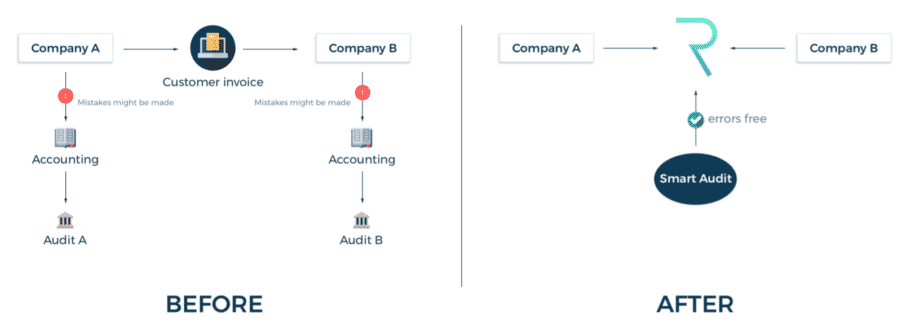
Esta combinación de automatización, transparencia y flexibilidad ha convertido a Request en una herramienta valiosa para equipos de cualquier tamaño.
Entendiendo el token REQ
Aunque Request Network se centra en simplificar la infraestructura de pagos, el token REQ actúa como el motor operativo que mantiene todo en funcionamiento. En lugar de utilizarse como moneda principal de pago (no es para comprar un café), opera entre bastidores impulsando las distintas funciones de la red.
Cada vez que alguien crea o procesa una solicitud de pago, las comisiones de red se pagan en REQ. Estas comisiones se convierten automáticamente en la moneda necesaria de la blockchain correspondiente (por ejemplo, ETH para pagar gas fees en la red Ethereum), lo que permite que Request funcione sin fricciones en múltiples ecosistemas blockchain. Es importante destacar que una parte del REQ utilizado se quema (es decir, se elimina permanentemente de la circulación), creando una presión deflacionaria natural con el tiempo.
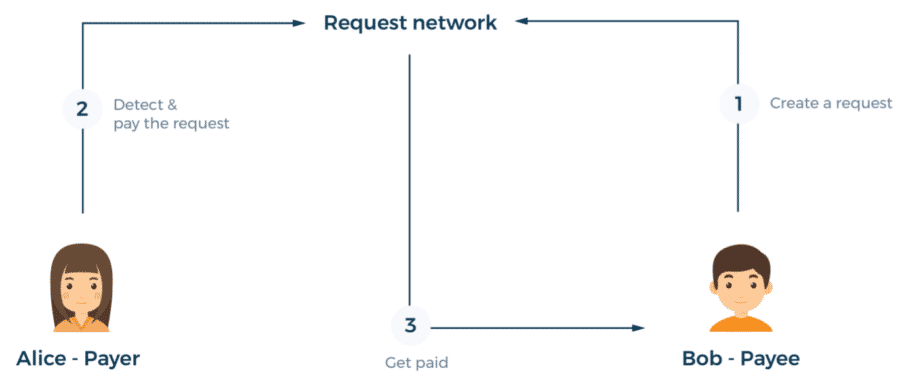
REQ también desempeña un papel relevante en la gobernanza de la red. Los holders del token pueden participar en decisiones sobre actualizaciones del protocolo y prioridades de desarrollo, asegurando que la evolución del proyecto se base en el consenso de la comunidad y no en decisiones centralizadas. Además, pequeñas micro-comisiones en REQ ayudan a prevenir spam y actividades maliciosas, haciendo que el abuso del sistema resulte económicamente inviable.
El diseño económico del token está orientado a la sostenibilidad a largo plazo. Con un suministro total limitado a 1.000 millones de tokens y una distribución relativamente descentralizada, el ecosistema evita muchos de los riesgos de concentración que afectan a otros proyectos, reduciendo la probabilidad de grandes ventas repentinas y favoreciendo un mercado más estable.
Por qué Request importa dentro del ecosistema crypto
A medida que la tecnología blockchain y el sector crypto maduran, proyectos de infraestructura como Request se vuelven cada vez más esenciales para la utilidad real del ecosistema. No buscan reinventar el dinero, sino hacer que los procesos financieros sean objetivamente más inteligentes.
¿Quién se beneficia de Request?
- Grandes organizaciones DeFi como Aave, Fantom y Maker utilizan Request para gestionar contabilidad compleja con múltiples tokens.
- Empresas tradicionales lo adoptan para simplificar la gestión fiscal y el cumplimiento normativo, especialmente aquellas que operan en varias jurisdicciones.
- Desarrolladores usan la API de Request para automatizar desde nóminas hasta facturación recurrente, eliminando procesos manuales.
- Proyectos Web3 aprovechan Request Finance para gestionar pagos en decenas de activos digitales distintos al mismo tiempo, evitando conversiones y seguimientos manuales.
- La red también ha colaborado con Aleo para ofrecer soluciones de nómina confidenciales que mantienen el compliance sin comprometer la privacidad financiera de los empleados.
Además, Request ganó una gran visibilidad en 2021 cuando The Sandbox (una de las mayores plataformas de gaming NFT) eligió Request como su infraestructura de pagos. Esta colaboración no solo impulsó la actividad del token, sino que validó a Request como una herramienta con utilidad real.
Conclusión
Request muestra cómo puede ser la infraestructura financiera en la era Web3: transparente, automatizada y diseñada para una economía digital y rápida. Conecta la fiabilidad de blockchain con necesidades reales del mundo, demostrando que la descentralización sigue siendo tan relevante como siempre.
Dónde conseguir REQ
¿Te interesa lo que Request aporta? Puedes adquirir el token REQ en plataformas como Tap.

Audius es uno de los proyectos más interesantes del ecosistema Web3. Se trata de una plataforma de streaming musical descentralizada creada para devolver el poder a los artistas. En lugar de depender de discográficas o plataformas centralizadas, Audius conecta directamente a los creadores con sus fans, permitiéndoles publicar, compartir y monetizar su música en sus propios términos. Es una plataforma donde los oyentes pueden escuchar música libremente, mientras que los artistas obtienen recompensas en la criptomoneda nativa de la plataforma, AUDIO.
Fundada en 2018 por Roneil Rumburg y Forrest Browning, Audius ha atraído a millones de usuarios mensuales y a cientos de miles de artistas, con el respaldo de grandes nombres como Katy Perry, Nas, Steve Aoki y Jason Derulo. Su misión es clara: eliminar intermediarios y permitir que los artistas sean verdaderos propietarios de su trabajo y se beneficien directamente de él.
¿Cómo funciona Audius?
A nivel técnico, Audius opera sobre una red descentralizada impulsada por nodos de contenido y nodos de descubrimiento.
Los nodos de contenido alojan y protegen los archivos musicales en nombre de los artistas, mientras que los nodos de descubrimiento los indexan para que los fans puedan encontrar fácilmente las canciones. Este sistema sustituye a los servidores centralizados por una red distribuida, ofreciendo mayor resistencia a la censura y más transparencia.
Los artistas pueden subir música directamente a Audius, decidir cómo compartirla (gratis o de pago) e incluso desbloquear contenido exclusivo para sus fans más fieles. A diferencia de las plataformas tradicionales que pagan únicamente por número de reproducciones, Audius recompensa a los artistas en función del compromiso global: canciones en tendencia, subidas verificadas e interacción con la comunidad.
Aunque Audius se construyó originalmente sobre la blockchain de Ethereum, posteriormente migró su sistema de contenidos a Solana para ofrecer transacciones más rápidas y económicas, manteniendo AUDIO como un token ERC-20. Esta configuración híbrida combina la fiabilidad de Ethereum con la escalabilidad de Solana.
¿Qué hace diferente a Audius?
Audius desafía las normas de la industria musical invirtiendo la estructura de beneficios. En el streaming tradicional, los artistas suelen recibir alrededor del 12 % de los ingresos totales. En Audius, los artistas reciben el 90 % de las recompensas directamente en tokens AUDIO, mientras que el 10 % restante se destina a los operadores de nodos que ayudan a asegurar la red.
Este enfoque crea un modelo más transparente y equitativo, que permite a los artistas conectar directamente con sus oyentes, lanzar contenidos exclusivos o gestionar sus propias comunidades. Además, la plataforma colabora con TikTok, permitiendo enlazar canciones de Audius directamente a vídeos, lo que amplía su exposición en redes sociales convencionales.
Gracias al almacenamiento descentralizado (a través de AudSP, un sistema basado en IPFS), los artistas mantienen el control sobre sus archivos musicales. Esto convierte a Audius en una plataforma resistente a la censura y realmente orientada a los creadores, algo poco habitual en el mundo del streaming.
El token AUDIO
El token AUDIO es el pilar del ecosistema Audius y cumple varias funciones clave:
- Staking y seguridad de la red: los operadores de nodos hacen staking de AUDIO para ejecutar la infraestructura y ganar recompensas.
- Gobernanza: cada token AUDIO otorga un voto en las decisiones del protocolo, dando a la comunidad voz sobre la evolución de la plataforma.
- Acceso a funciones: mantener o hacer staking de AUDIO desbloquea funciones premium, acceso anticipado a nuevas herramientas e insignias para artistas.
AUDIO tiene una oferta inicial de mil millones de tokens y se utiliza para recompensas de la plataforma, incentivos comunitarios y la seguridad continua de la red. Los holders también pueden ganar AUDIO adicional mediante staking o contribuyendo al crecimiento del ecosistema.
Por qué Audius es importante
Audius es mucho más que una app de música: es una prueba real de cómo la blockchain puede transformar las industrias creativas. En resumen, ofrece:
- Conexión directa entre artistas y fans sin intermediarios
- Reparto de ingresos transparente mediante recompensas on-chain
- Almacenamiento resistente a la censura para música y metadatos
- Escalabilidad cross-chain con interoperabilidad entre Ethereum y Solana
Para los artistas, supone un trato más justo. Para los oyentes, es una forma de apoyar directamente a los creadores y descubrir nuevas comunidades musicales impulsadas por crypto.
Conclusión
Audius reimagina lo que podría ser el streaming musical en la era Web3: un ecosistema justo, abierto y descentralizado donde creatividad y propiedad van de la mano. Une tecnología blockchain y expresión cultural, demostrando que la descentralización no es solo cosa de las finanzas.
Dónde conseguir AUDIO
¿Te interesa el proyecto? Puedes adquirir el token AUDIO en plataformas como Tap.

Imagina tu red social favorita, por ejemplo 𝕏 o Facebook, pero mejorada con herramientas cripto. La posibilidad de enviar tokens, publicar mensajes cifrados, unirte a aplicaciones descentralizadas (dApps) e interactuar con NFTs, todo sin salir del feed que ya conoces y usas a diario. Esa es la promesa de Mask Network.
El proyecto construye un puente entre Web2 (redes sociales tradicionales) y Web3 (blockchain + crypto) integrando funcionalidades descentralizadas directamente dentro de plataformas familiares, sin exigir que el usuario final entienda términos técnicos como dirección IP, IPv4 o cómo una red informática enruta la información.
En esencia, Mask Network funciona a través de una extensión del navegador y una wallet multi-chain que detectan plataformas sociales compatibles y añaden una capa Web3 de funciones. Así, puedes enviar crypto a amigos desde el feed, publicar contenido que solo ciertas personas puedan ver e incluso conectar distintas blockchains sin salir de tu app social. Este enfoque recuerda a cómo un router o un protocolo de enrutamiento gestiona paquetes de datos en segundo plano: el trabajo técnico complejo permanece “invisible”, mientras la experiencia se mantiene sencilla en la superficie.
¿Cómo funciona Mask Network?
Cuando instalas la extensión de Mask Network (por ejemplo, en Chrome o Firefox), esta añade botones u opciones extra en los sitios compatibles. Según el sitio oficial, actualmente es compatible con varias plataformas sociales en las que la extensión superpone herramientas cripto como mensajería cifrada, autocustodia de activos, interacción con dApps y agregación de identidad.
La extensión del navegador funciona en sistemas operativos principales como Microsoft Windows y macOS, comportándose como un software ligero que se integra de forma natural en tu navegador.
A nivel técnico, la plataforma es compatible con múltiples cadenas EVM (así que no quedas limitado a una sola). La extensión detecta publicaciones, menciones de tickers o cuadros de chat e “inyecta” controles Web3 adicionales. Por ejemplo, puede convertir un simple tweet en un punto de propinas con tokens o en un canal para compartir archivos cifrados. Lo interesante es que no necesitas migrar a una red social nueva: tu feed actual se vuelve Web3 gracias a una capa que se siente más como una actualización cross-platform que como un producto completamente distinto.
El proceso se parece a cómo una capa de Internet Protocol se sitúa sobre el hardware, gestionando el flujo de datos en distintos entornos. Mask hace algo comparable en el mundo del social networking: la plataforma tradicional permanece intacta, pero se añade una nueva capa funcional por encima.
¿Para qué se utiliza el token MASK?
El token nativo, MASK, es el “combustible” y la llave de gobernanza del ecosistema. Con un suministro fijo de 100 millones de tokens, la escasez queda definida desde el inicio. Esto es lo que impulsa:
- Governance: los holders pueden votar cambios del proyecto o actualizaciones del protocolo.
- Participation: algunas funciones, membresías o herramientas premium se desbloquean mediante MASK.
- Utility y servicios dentro de la plataforma: ya sea para publicaciones cifradas, derechos de contenido o interacciones DeFi dentro del feed social, MASK respalda muchas de estas actividades.
Por qué traders y usuarios podrían seguirlo de cerca
Para quienes siguen de cerca el punto donde crypto se cruza con la vida cotidiana, Mask Network ofrece motivos bastante sólidos para prestarle atención. Está diseñado para funcionar dentro de las plataformas sociales en las que ya pasas tiempo. En lugar de pedirle a la gente que abandone sus redes favoritas por alternativas descentralizadas poco conocidas, Mask se integra directamente en esos entornos. Esto es relevante porque abre la puerta no solo a usuarios cripto, sino también a los miles de millones de personas que usan redes sociales cada día. Si incluso una parte pequeña empieza a utilizar funciones Web3 sin sentir que “entró en crypto”, eso se traduce en adopción real.
Luego está el ángulo de la privacidad, cada vez más relevante. Vivimos en una época donde las filtraciones de datos aparecen en titulares constantemente y cada vez más personas se sienten incómodas con cuánto saben las grandes tecnológicas sobre ellas. La capacidad de Mask para cifrar publicaciones, controlar quién puede ver tu contenido y vincular actividad a una identidad descentralizada ofrece un nivel de control que normalmente no existe en plataformas tradicionales. No es solo una función técnica, también responde a una demanda creciente de autonomía digital.
Desde el punto de vista técnico, Mask tampoco depende de una sola red. Tiene un diseño multi-chain y admite componentes modulares como dApplets, capas de identidad e integraciones de wallet. Esa flexibilidad hace que no esté atado al destino de una única blockchain y pueda evolucionar según cambie el ecosistema. Y aquí entra un punto importante: la utilidad del token MASK está vinculada al crecimiento de la plataforma. Se usa para gobernanza, desbloquea funciones premium y sostiene la participación del ecosistema. Cuanto más se utilicen las funciones de Mask Network, más central se vuelve el token dentro del sistema.
Aspectos a tener en cuenta
Ningún proyecto existe aislado, y Mask Network también tiene riesgos que conviene considerar. Para empezar, la mezcla de Web3 con redes sociales sigue en una fase relativamente temprana. La idea es prometedora, pero lograr adopción masiva es otro desafío: no depende solo del producto, también requiere confianza, distribución y tracción con el tiempo. Hoy, la mayoría de las personas no piensa en funciones sociales descentralizadas cuando navega por 𝕏, y cambiar hábitos nunca es fácil.
También existen consideraciones prácticas. Las extensiones de navegador, por su propia naturaleza, pueden abrir vectores adicionales de riesgo si se convierten en objetivo de phishing o actualizaciones maliciosas. Por eso, es importante mantener buenas prácticas de seguridad y verificar siempre lo que se instala y actualiza.
Además, MASK es un token de menor capitalización en comparación con los más grandes del mercado, y eso puede traducirse en movimientos de precio más bruscos. La tecnología no elimina la volatilidad del mercado. Por último, el éxito de Mask no depende solo de Mask: también está condicionado por cómo reaccionen las grandes plataformas sociales ante integraciones de terceros (cambios de políticas, restricciones de APIs o bloqueos), y por la evolución de regulaciones relacionadas con crypto y privacidad.
Es un proyecto con un enfoque interesante y potencial real, pero estos factores externos pueden influir significativamente en su trayectoria.
Conclusión
Si te interesan los proyectos que viven en la intersección entre redes sociales y crypto, Mask Network destaca como una propuesta creativa. Es menos “DeFi puro” y más una capa Web3 aplicada a la interacción digital diaria. Su éxito dependerá de lo bien que se integre en los hábitos de los usuarios y de cuántas personas adopten esta combinación entre social y cripto.
Dónde conseguir MASK
El token MASK se puede encontrar en apps de criptomonedas que permiten comprarlo, guardarlo y hacer seguimiento de su evolución junto al resto de tus activos digitales, todo desde un mismo lugar.
Bitcoin Crashes Below $82K in Brutal Sell-Off
After breaking through several support levels, Bitcoin is trading around $82,000, extending a punishing downtrend that has erased more than 30% of its value since October's peak at $126,000.
The cause? A perfect storm of selloffs in U.S. equity markets, which triggered a wave of risk aversion that swept through global markets. Meanwhile, the Federal Reserve's cautious stance on further rate cuts has injected fresh uncertainty into trading floors. Markets still anticipate a 0.25% cut, but with recession fears intensifying, traders are hitting the exits. Crypto found itself directly in the crosshairs of this flight to safety
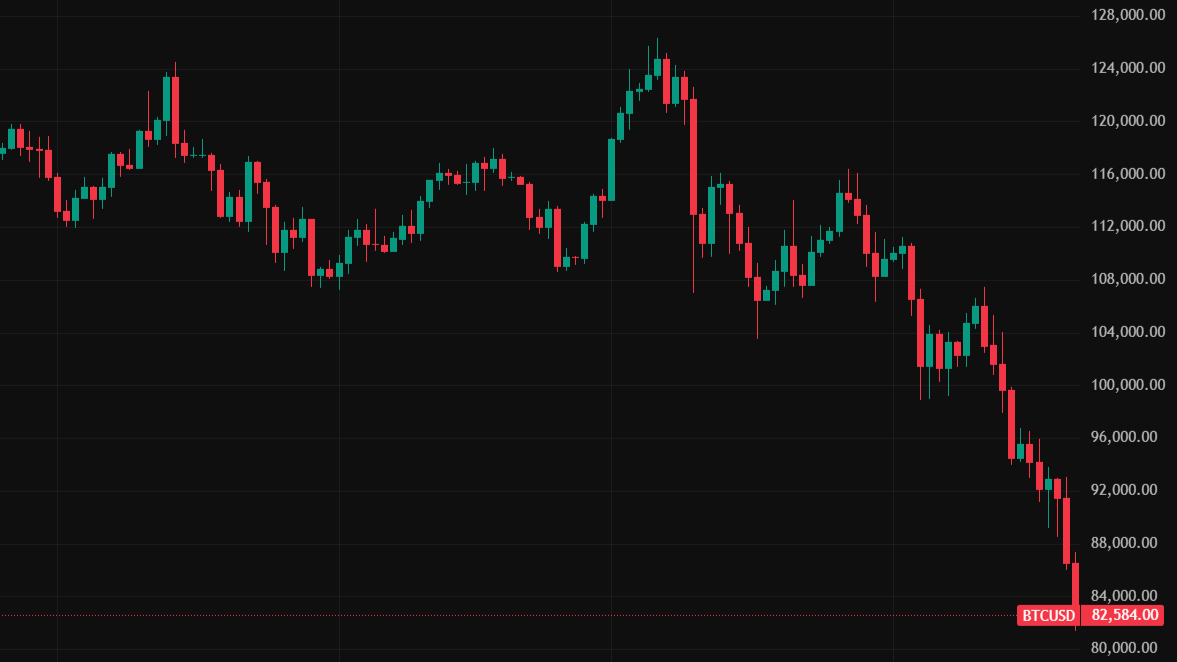
The damage extended well beyond Bitcoin. Estimates show around $2 billion in crypto positions liquidated, as forced selling and evaporating liquidity accelerated the downturn across digital assets. But here's a twist for you: Bitcoin is now entering territory that has historically preceded major recoveries. Let’s dive in.
Bitcoin Is Officially Oversold… And That Matters
The Relative Strength Index (RSI) has officially moved into oversold territory for the first time in nine months, signaling extreme selling pressure. The last time BTC hit oversold levels was in February, right before a notable rebound. Oversold signals don’t guarantee an immediate reversal, but they often mark the beginning of seller exhaustion.
In the previous oversold event, BTC dropped around an additional 10% before bouncing. If that were to happen again, BTC could briefly dip toward $77,000 before bulls regain momentum. If the current selling eases earlier, a shorter-term bounce could happen sooner.
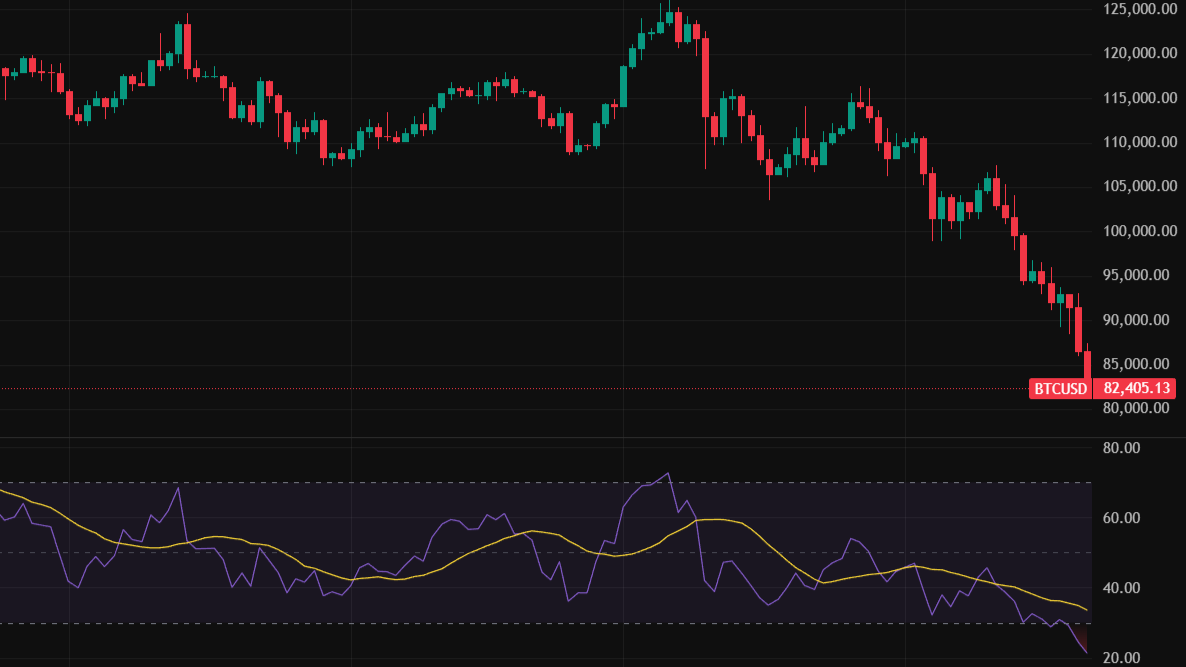
MVRV Points to Undervaluation
Another key indicator worth looking at is Bitcoin’s MVRV Ratio. This on-chain indicator reveals whether investors are collectively sitting on profits or losses. An MVRV Ratio above 1 means the average holder is in the green; below 1 signals most are underwater.
BTC’s MVRV now sits at 1.5, its lowest level in over two years. When MVRV enters a “opportunity zone”, it suggests two things:
- Many short-term holders are underwater
- Downside selling pressure is approaching exhaustion
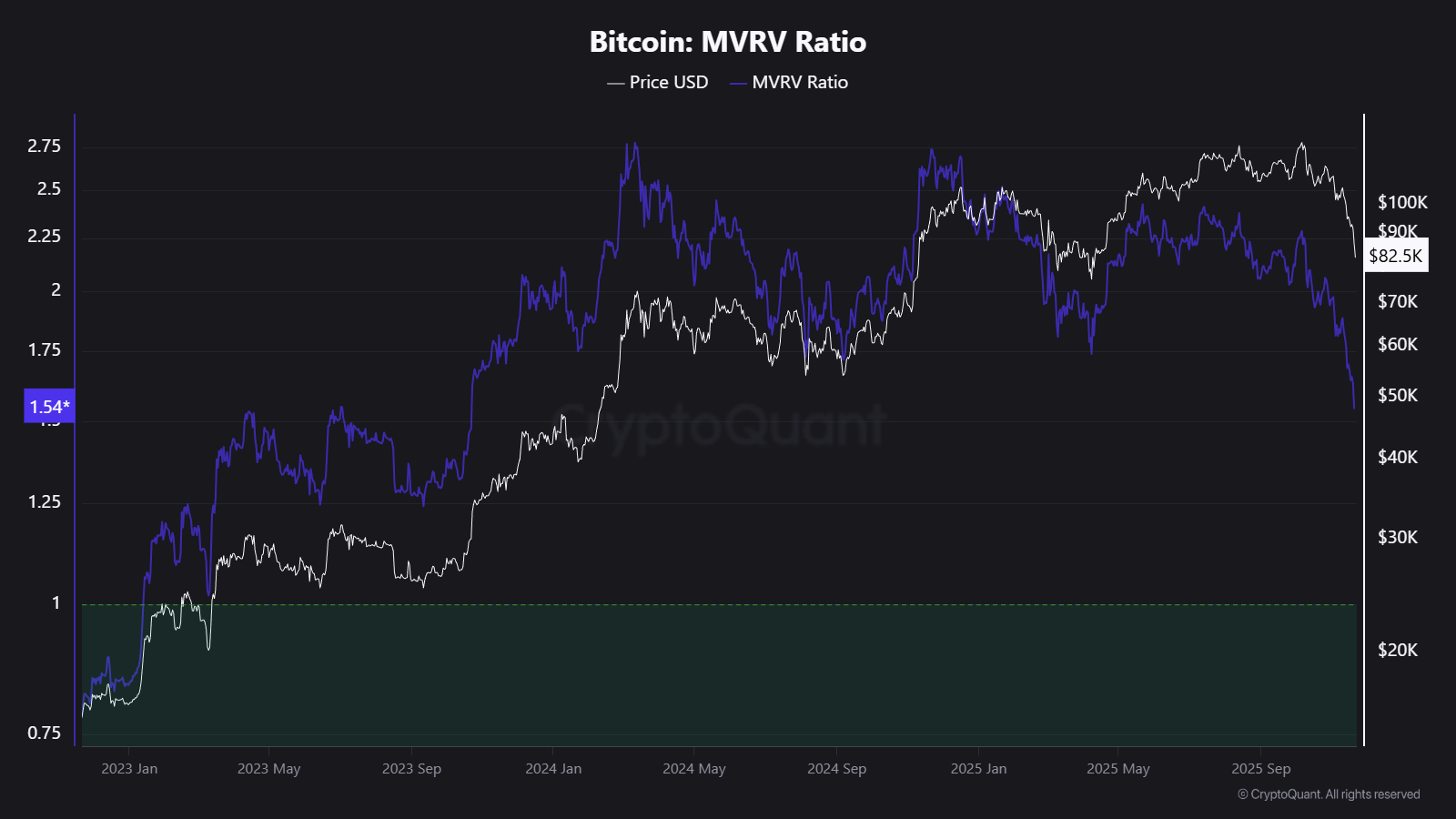
Key Levels to Watch
If bearish pressure continues, it’s possible BTC could revisit the $80,000 level, with a deeper support level around $77,000, matching the RSI’s recent historical pattern.
But there’s also a realistic bullish scenario: reclaiming $92,000 could turn the structure decisively bullish, opening the door to the $95,000 region and beyond.
What Can We Expect From BTC This November?
Beyond the indicators, there’s a seasonal angle worth emphasizing: Bitcoin has historically shown strong end-of-year recoveries and rallies. Even during weaker macro environments, Q4 has often delivered rebounds driven by renewed risk appetite and improved liquidity flows.
Combine that with oversold technicals, undervaluation signals, and easing macro uncertainty if the Fed does follow through on cuts, and the current levels could start looking less like panic territory and more like potential opportunity.
The Takeaway
Bitcoin's slide doesn’t appear to be driven by broken fundamentals; it's the result of macro turbulence, risk-off positioning, and temporary sentiment shifts. Short-term chop may persist, but on the flip side, key indicators are flashing oversold conditions which have historically marked turning points.
Corrections are part of Bitcoin's DNA. It has survived far steeper crashes and consistently emerged more resilient. Whether the bounce starts today or after one final shake-out, the pattern is familiar: selling exhaustion plants the seeds for the next rally. Patient holders have seen this pattern many times, and more often than not, their patience has been rewarded.

Un mercado que madura en 2025
El mundo de las criptomonedas en 2025 no se parece en nada al de hace solo un año, algo significativo en una industria acostumbrada a cambios rápidos. Ha sido un periodo de máximos emocionantes, pero también de caídas inesperadas. El capital institucional está entrando con fuerza gracias a los ETFs recientemente aprobados. Al mismo tiempo, la incertidumbre regulatoria en Estados Unidos empieza a disiparse, ofreciendo un terreno más claro tanto para desarrolladores como para participantes del mercado.
Mientras tanto, los avances en DeFi, tokenización y escalabilidad blockchain están llevando la tecnología mucho más allá del hype y de las inversiones puramente especulativas. Está claro que el ecosistema cripto está evolucionando. La gran pregunta es qué proyectos están liderando esa transformación.
Tanto si llevas tiempo siguiendo el mercado como si acabas de empezar a prestar atención, estas son cinco criptomonedas que merecen estar en tu radar a medida que el año se acerca a su final.
1. Bitcoin (BTC): el estándar de oro
Este era previsible. A día de hoy, Bitcoin sigue siendo el ancla del ecosistema cripto, influyendo en el sentimiento del mercado, la actividad de trading y las condiciones de liquidez en toda la industria. Tras el halving de abril de 2024, la reducción en la emisión de BTC ha reforzado la sensación de escasez y ha modificado la economía de la minería.
Por qué seguir BTC en 2025
-Adopción institucional: Los ETFs de Bitcoin continúan atrayendo interés y han mantenido flujos positivos durante gran parte del año. Con el tiempo, BTC se integra cada vez más en carteras y productos de jubilación dentro de las finanzas tradicionales.
-Factores macroeconómicos: Con los tipos de interés estabilizándose, Bitcoin sigue considerándose un activo relevante frente a la inflación, la volatilidad monetaria y la incertidumbre macro.
-Escalado Layer 2: Las mejoras en Lightning Network y nuevas soluciones basadas en rollups están aumentando la eficiencia de las transacciones y ampliando su utilidad.
A noviembre de 2025, BTC cotiza alrededor de los 97.000 $, con una capitalización cercana a los 2 billones de dólares, tras haber alcanzado recientemente un nuevo máximo histórico de 126.198 $. A pesar de una corrección reciente, mantiene su posición como el activo digital dominante y un indicador clave del sentimiento general del mercado.

2. Ether (ETH): el gigante de los smart contracts
La red Ethereum sigue liderando en smart contracts, aplicaciones descentralizadas y tokenización. En ese aspecto, poco ha cambiado. Las actualizaciones del protocolo han reforzado su posición como plataforma de computación escalable y energéticamente eficiente.
Por qué seguir ETH en 2025
- Eficiencia post-merge: El paso a proof-of-stake y la amplia adopción de soluciones Layer 2 han reducido significativamente las comisiones y mejorado el rendimiento.
- Adopción empresarial: nstituciones y fintechs utilizan cada vez más Ethereum para liquidaciones, activos del mundo real (RWA) y finanzas programables. Las reservas institucionales de ETH han pasado de menos de un millón a más de seis millones durante el año.
- Exposición vía ETFs: Los productos cotizados basados en ETH han ampliado el acceso tanto para usuarios minoristas como profesionales.
ETH cotiza cerca de los 3.200 $ tras un rally histórico que lo llevó a nuevos máximos. Sigue siendo el segundo activo por capitalización y mantiene el ecosistema de desarrolladores más grande de Web3.B
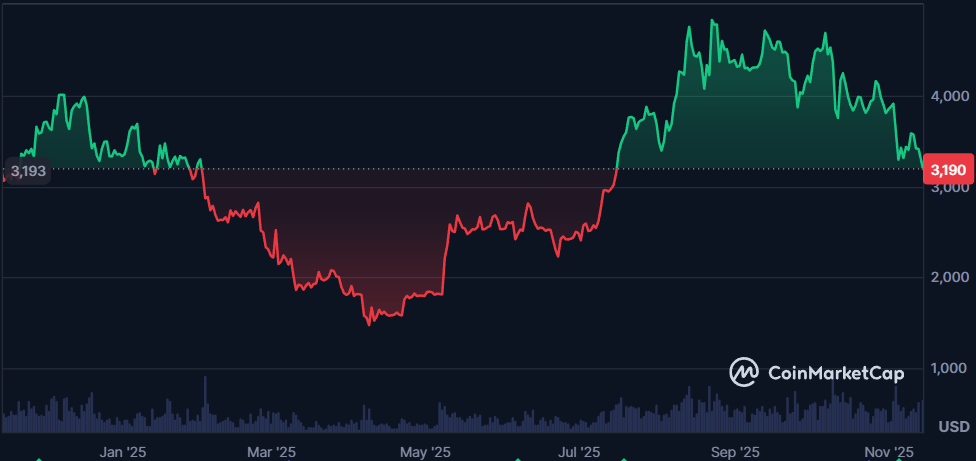
3. XRP: el conector de pagos transfronterizos
XRP continúa desempeñando un papel central en la modernización de los pagos internacionales, impulsado por la creciente red de alianzas de Ripple con bancos y plataformas de pago.
Por qué seguir XRP en 2025
- Claridad regulatoria: Resoluciones positivas este año han reforzado la confianza en el estatus legal de XRP en varias jurisdicciones.
- Integraciones bancarias: La adopción en regiones de rápido crecimiento impulsa un mayor volumen de transacciones y utilidad.
-Nuevos corredores de pago: La red de liquidez de Ripple permite transferencias entre una amplia variedad de monedas fiat y digitales.
XRP cotiza cerca de los 2,3 $ tras acercarse a su máximo histórico a principios de año, y sigue siendo una de las principales criptomonedas por capitalización. Representa como pocas la convergencia entre blockchain y servicios financieros tradicionales.

4. Solana (SOL): la contendiente de alta velocidad
Solana se ha consolidado como una red conocida por su velocidad y eficiencia, habilitando aplicaciones de alto rendimiento en gaming, DeFi y NFTs. Tras problemas de escalabilidad en el pasado, la fiabilidad de la red ha mejorado notablemente.
Por qué seguir SOL en 2025
- Interés institucional: La red Solana se utiliza cada vez más para activos tokenizados y transacciones en tiempo real.
- Expansión del ecosistema: Los desarrolladores continúan lanzando nuevas dApps, juegos y exchanges descentralizados que aprovechan su rápida liquidación.
- Mejoras técnicas: Actualizaciones recientes han aumentado el tiempo de actividad y reducido la congestión de la red.
Al igual que XRP, SOL estuvo muy cerca de alcanzar su máximo histórico, pero se quedó ligeramente por debajo. Actualmente cotiza cerca de los 142 $, consolidándose como un competidor clave entre las blockchains Layer 1.
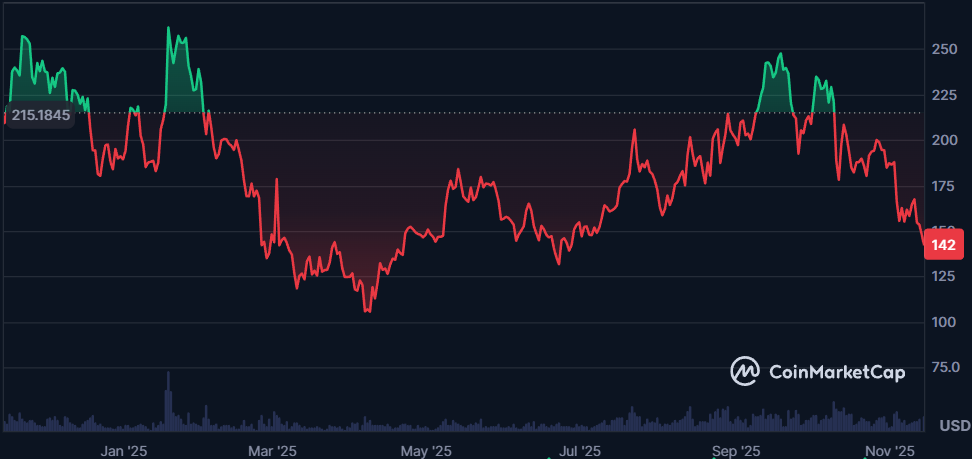
5. Chainlink (LINK): impulsando la economía de los datos
Chainlink sigue siendo la solución de oráculos líder, permitiendo la transferencia segura de datos entre blockchains y el mundo exterior. Es una pieza esencial para smart contracts, RWA y automatización financiera.
Por qué seguir LINK en 2025
-Adopción de RWA: Bancos y gestores de activos confían cada vez más en Chainlink para respaldar bonos, fondos y materias primas tokenizadas.
-Innovación cross-chain: CCIP permite una interoperabilidad fluida entre redes como Ethereum, Avalanche, Polygon y Solana.
-Crecimiento de integraciones: La expansión en el ámbito empresarial refuerza el papel de Chainlink dentro de la infraestructura Web3.
LINK cotiza alrededor de los 14,2 $. Aunque aún está lejos de su máximo histórico, ha mostrado mayor resiliencia durante la corrección actual en comparación con otros altcoins. Más allá del precio, Chainlink sustenta procesos de datos críticos en todo el ecosistema de activos digitales.

Por qué el final de 2025 es importante
Hasta ahora, 2025 ha sido un año clave en la historia relativamente corta del mercado cripto, y sus últimos meses parecen seguir esa misma línea. Los efectos post-halving, los flujos hacia ETFs, los cambios en la liquidez y los patrones estacionales influyen de forma directa en el comportamiento del mercado.
Los ciclos anteriores también han dejado un precedente claro: históricamente, el cuarto trimestre suele mostrar mayor volatilidad y participación que otros periodos del año.
Temas y sectores clave a seguir
Más allá de los gráficos, estas narrativas seguirán ganando protagonismo y están directamente relacionadas con las criptomonedas destacadas:
- Tokenización de activos del mundo real: cada vez más instituciones utilizan blockchain para emitir y liquidar activos.
- Finanzas impulsadas por IA: la inteligencia artificial gana peso en herramientas de trading, automatización y modelado de riesgos.
- Escalado Layer 2: creciente demanda de transacciones más rápidas y baratas en múltiples redes.
- Interoperabilidad: conexión entre blockchains para crear ecosistemas digitales unificados.
Estas tendencias convierten a los activos mencionados en indicadores relevantes de los avances tecnológicos y económicos más amplios.
Conclusión
La recta final de 2025 se perfila como un momento decisivo para el mercado de activos digitales. El liderazgo de Bitcoin, la infraestructura escalable de Ethereum, las integraciones globales de pagos de XRP, la velocidad de Solana y la utilidad basada en datos de Chainlink conforman un ecosistema cada vez más maduro.
Tanto si el mercado entra en una fase de consolidación como si se prepara para nuevos máximos, una cosa está clara: el mundo cripto seguirá ofreciendo desarrollos interesantes a medida que este espacio dinámico e impredecible avanza hacia una nueva etapa de adopción más amplia.

A medida que los activos digitales se convierten en una parte central del patrimonio personal, surge una pregunta incómoda pero inevitable: ¿qué pasará con tu crypto cuando ya no estés? A diferencia de los activos tradicionales, que pueden gestionarse a través de bancos o brokers, las criptomonedas están completamente ligadas a quien posee las claves privadas.
Si se pierden las claves, los fondos desaparecen. Para siempre.
El crypto desaparece constantemente
Cada año, millones de dólares en Bitcoin, Ether y otros tokens se pierden en el vacío digital cuando sus propietarios fallecen sin haber compartido el acceso. Se estima que alrededor de 1,5 millones de BTC, aproximadamente el 7,5 % del suministro total, podrían estar ya perdidos de forma irreversible.
Con la riqueza digital formando parte de cada vez más patrimonios, prepararse para lo inevitable ya no es opcional, es una responsabilidad.
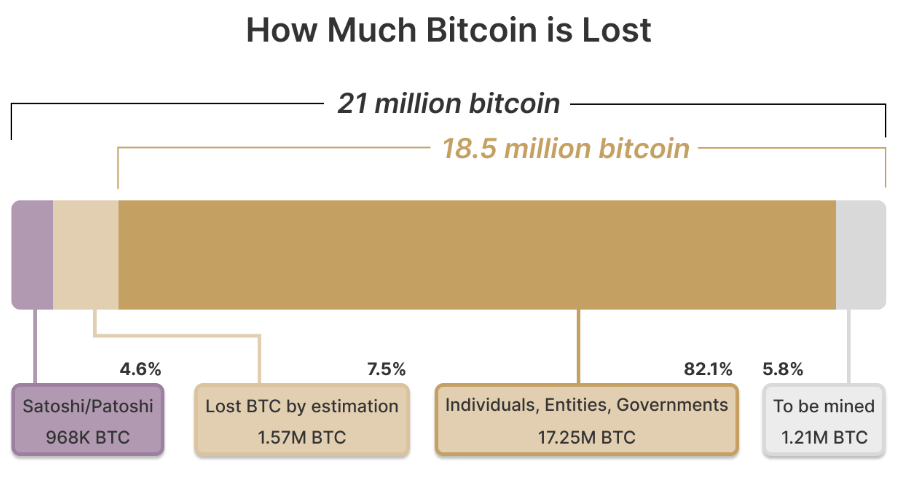
Por qué es importante planificar la herencia cripto
En las finanzas tradicionales, la transmisión del patrimonio se gestiona mediante testamentos, fideicomisos y custodios. El crypto cambia completamente esa lógica: tú eres el banco. Tus herederos no pueden pedir un restablecimiento de contraseña ni llamar a atención al cliente.
Sin claves privadas, wallets o instrucciones claras de acceso, esos activos son irrecuperables a todos los efectos.
Un plan de herencia cripto garantiza que tus activos digitales, desde Bitcoin y altcoins hasta NFTs y posiciones en DeFi, sigan siendo seguros hoy y accesibles mañana para las personas que tú elijas. Conecta dos necesidades clave: proteger tus fondos en el presente y asegurar tu legado en el futuro.
Además, una planificación adecuada reduce la carga emocional y financiera para tus seres queridos, evitando confusión y posibles conflictos legales.
Construir la base de un plan de herencia cripto
Empieza por la claridad legal
Consulta con un abogado familiarizado con activos digitales. Un testamento o fideicomiso bien estructurado debe identificar tus holdings cripto, nombrar beneficiarios y explicar cómo pueden acceder a ellos. Dado que muchas jurisdicciones aún no tienen normativas claras sobre activos digitales, el asesoramiento especializado es clave para garantizar validez legal.
Protege tus claves… sin compartirlas de más
El mayor reto en la herencia cripto es la gestión de las claves privadas. Si falleces con tus claves, tu crypto fallece contigo. Pero dejarlas en texto plano dentro de un testamento o documento es igual de peligroso.
Algunas alternativas más seguras incluyen:
- Wallets multisignature, que requieren varias aprobaciones para mover fondos.
- Shamir’s Secret Sharing, que divide la seed phrase en varias partes distribuidas entre personas de confianza.
- Copias de seguridad cifradas o cartas selladas almacenadas en ubicaciones seguras y offline.
Documenta los pasos de recuperación con un lenguaje claro para que tus herederos puedan seguirlos incluso sin conocimientos técnicos.
Elige al ejecutor adecuado
Un ejecutor tradicional puede no entender cómo gestionar activos cripto. Designar a un ejecutor con conocimientos técnicos o a un custodio especializado en activos digitales puede marcar la diferencia. Esto reduce errores y asegura que el proceso se lleve a cabo correctamente.
En un mercado caracterizado por la innovación constante, un buen plan de herencia ofrece algo poco común en crypto: certidumbre.
Nuevas herramientas para una era digital
El auge de los llamados “protocolos de fallecimiento” basados en blockchain y la automatización mediante smart contracts abre nuevas posibilidades. Algunas plataformas permiten transferencias automáticas cuando se cumplen ciertas condiciones, como la verificación de un certificado de defunción o un largo periodo de inactividad.
Ethereum y otras blockchains ya admiten sistemas de herencia programables, pero estos deben complementar, no sustituir, a los documentos legales. La tecnología puede ayudar a ejecutar tu voluntad, pero la ley sigue siendo la base de cualquier herencia.
Algunos usuarios también utilizan “dead man’s switches”, sistemas automatizados que transfieren fondos si el propietario no inicia sesión durante un periodo determinado. Aunque ingeniosos, conviene combinarlos con documentos legales para evitar activaciones accidentales.
Planificar el futuro sin comprometer la privacidad
Mientras planificas a largo plazo, es crucial mantener la seguridad en el presente. Evita incluir direcciones de wallets, claves privadas o contraseñas en testamentos públicos, ya que pasan a formar parte del registro legal.
En su lugar, guarda esta información en archivos cifrados o sobres sellados accesibles solo para personas concretas. Herramientas como los identificadores descentralizados (DIDs) y las credenciales verificables también pueden ayudar a gestionar identidades y derechos de acceso a largo plazo sin intermediarios.
Custodial vs. non-custodial: encontrar el equilibrio
A la hora de estructurar una herencia, es clave saber si tus activos están en wallets custodial o non-custodial.
- Servicios custodial (como grandes exchanges) gestionan las claves por ti, lo que puede facilitar la recuperación si los herederos presentan la documentación adecuada. Sin embargo, introduce riesgo de terceros: cuentas congeladas, hackeos o cierres de plataforma.
- Wallets non-custodial ofrecen máximo control y privacidad, pero exigen mayor responsabilidad. Si la seed phrase se pierde, no hay plan B.
Una estrategia híbrida puede ser útil: mantener holdings a largo plazo en almacenamiento non-custodial y usar custodios de confianza para cantidades más pequeñas y accesibles.
Mantén el plan actualizado
Un plan de herencia cripto no es un documento estático. Los precios cambian, los portafolios evolucionan y las tecnologías de wallets quedan obsoletas con frecuencia. Conviene revisarlo periódicamente, especialmente tras eventos vitales importantes como un matrimonio, un divorcio o el nacimiento de un hijo.
También es importante seguir las actualizaciones regulatorias en tu jurisdicción. Las leyes sobre activos digitales y herencias evolucionan rápidamente.
Errores comunes en la herencia cripto
Incluso con buenas intenciones, es fácil cometer fallos. Los más habituales incluyen:
- Incluir seed phrases directamente en el testamento.
- No explicar el funcionamiento del plan a los herederos.
- Depender exclusivamente de exchanges centralizados.
Planificar no es solo repartir patrimonio, es garantizar continuidad. Una estrategia clara evita que tu crypto pase a formar parte de los más de 100.000 millones de dólares en activos digitales perdidos en todo el mundo.
Proteger algo más que monedas
Preparar un plan de herencia cripto no trata solo de dinero, sino de legado. En un ecosistema que valora la descentralización y la autonomía, la responsabilidad y la previsión siguen siendo esenciales.
Al planificar con antelación, no solo proteges tu patrimonio digital, también ofreces tranquilidad a quienes más te importan.

2025 ha sido un punto de inflexión para la inteligencia artificial. GPT-5 de OpenAI y Claude Sonnet 4.5 de Anthropic han vuelto a elevar el listón, cada uno con el objetivo de integrar un razonamiento más sólido, mayor memoria y más autonomía en un solo sistema coherente.
Ambos están diseñados para abordar programación, investigación, redacción y tareas a escala empresarial, pero sus filosofías de diseño difieren de forma clara. Este análisis compara su rendimiento en razonamiento, programación, matemáticas, eficiencia y coste para ayudarte a decidir dónde brilla cada uno.
Visión general rápida
Claude Sonnet 4.5 se apoya en la familia Claude de Anthropic, ya consolidada. Amplía la memoria entre sesiones, gestiona contextos de hasta un millón de tokens a través de Amazon Bedrock y Vertex AI, e incorpora una gestión inteligente del contexto que evita cortes bruscos. Además, puede operar de forma autónoma durante hasta 30 horas en tareas prolongadas, lo que lo hace ideal para flujos de trabajo continuos.
GPT-5, por su parte, es el modelo insignia de OpenAI tras GPT-4, optimizado para el razonamiento agentic, donde el modelo planifica, ejecuta y coordina herramientas por sí mismo. Su sistema de razonamiento adaptativo decide dinámicamente entre rutas de pensamiento superficial o profundo, permitiendo equilibrar velocidad, coste y profundidad según la tarea. GPT-5 también ofrece variantes especializadas (Mini y Nano) para cargas de trabajo más ligeras.
Razonamiento y análisis
Ambos modelos superan ampliamente a sus versiones de 2024, pero difieren en cómo razonan.
El modo de razonamiento profundo de GPT-5 mejora de forma notable el rendimiento en tareas de lógica compleja, científicas y espaciales. Es capaz de dividir problemas en cadenas de razonamiento, probar subhipótesis y autocorregirse durante el proceso. Sin embargo, cuando este modo se desactiva, la precisión disminuye de forma significativa. Puede ser brillante cuando “piensa a fondo”, pero más variable cuando no lo hace.
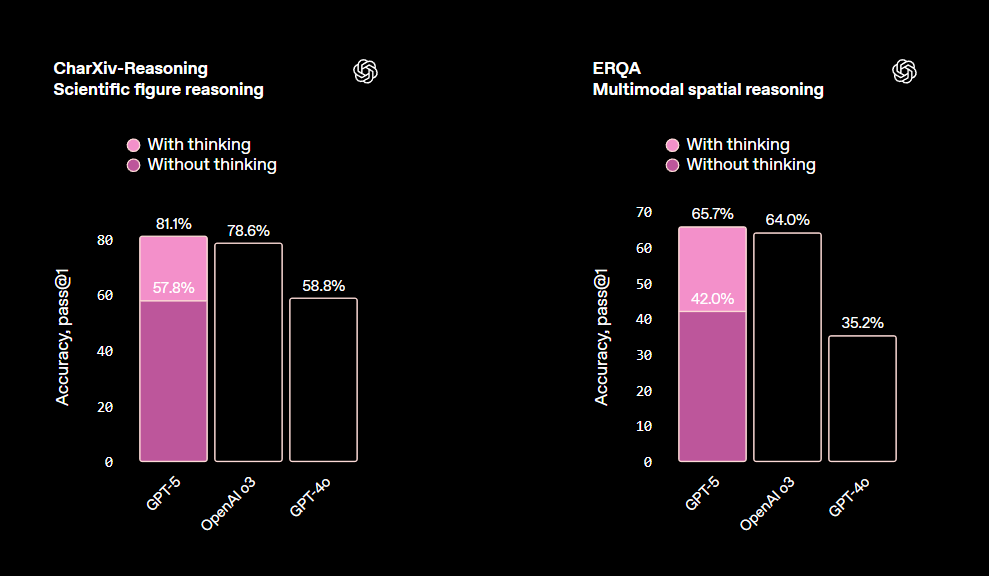
Claude Sonnet 4.5, en cambio, mantiene una estabilidad notable incluso sin configuraciones adicionales. Destaca especialmente en lógica financiera, normativa y empresarial, donde la estructura y la coherencia pesan más que los saltos creativos. Para preguntas corporativas o apoyo a la toma de decisiones, esa previsibilidad es una gran ventaja.

Si buscas un razonamiento constante y fiable, Claude lleva la delantera. Si necesitas lógica exploratoria, como pruebas de hipótesis complejas o síntesis entre dominios, la profundidad de GPT-5 no tiene rival.
Matemáticas y resolución de problemas estructurados
Según los benchmarks publicados por Anthropic, Claude Sonnet 4.5 mantiene su racha de consistencia. Ya sea calculando directamente o utilizando herramientas como Python, alcanza una precisión matemática de primer nivel, incluso en entornos restringidos.
GPT-5 también logra una precisión casi perfecta, pero solo cuando el uso de herramientas y la profundidad de razonamiento están activados. Si se deshabilitan, los resultados caen de forma notable. Depende en gran medida de su pipeline de razonamiento para mantenerse preciso.
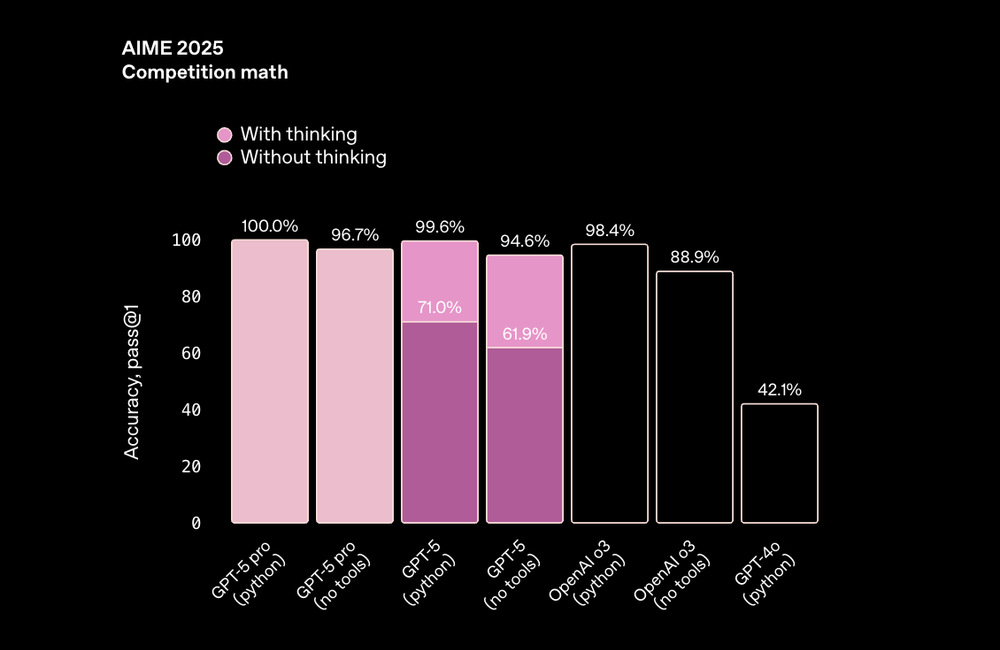
Veredicto:
- Claude Sonnet 4.5: solucionador matemático fiable desde el primer momento.
- GPT-5: flexible, pero requiere ajustes para rendir al máximo.
Programación e ingeniería de software
En programación, los dos modelos adoptan enfoques distintos.
Claude Sonnet 4.5 ofrece un rendimiento estable sin necesidad de configuraciones especiales. En pruebas similares a HumanEval+ y MBPP+, mantiene una alta precisión en distintas condiciones, lo que lo hace fiable para entornos de producción. Su fortaleza es la consistencia: los resultados rara vez fluctúan, algo crucial a nivel empresarial.

GPT-5, en cambio, alcanza puntuaciones máximas más altas cuando se activa su razonamiento avanzado, especialmente en proyectos grandes o multilenguaje. En tareas de refactorización en JavaScript y Python, superó a Sonnet cuando su modo de alto razonamiento estaba activo, aunque las ejecuciones base sin ese modo mostraron mayor variabilidad.
Para programación agentic, donde la IA interactúa con herramientas externas o terminales, Sonnet 4.5 suele ejecutar con menos comandos fallidos. GPT-5, por su parte, puede encadenar más llamadas a herramientas simultáneamente, lo que lo hace más adecuado para orquestaciones complejas, siempre que esté bien configurado.
Veredicto:
- Claude Sonnet 4.5: socio de ingeniería predecible y constante.
- GPT-5: potencia versátil, pero su rendimiento depende de la configuración.
Coste y eficiencia
GPT-5 es claramente más económico por token, especialmente en entradas grandes. Su enrutador adaptativo también ahorra recursos al ejecutar prompts simples por rutas más ligeras.
Claude Sonnet 4.5 es más caro, pero ofrece una latencia predecible, un factor clave en entornos de producción que priorizan la fiabilidad frente a ahorros marginales. En prompts muy largos, su coste aumenta más rápido que el de GPT-5, aunque los descuentos por lotes reducen esa diferencia.
TL;DR: GPT-5 gana en precio y escalabilidad, mientras que Claude destaca por consistencia y estabilidad en tiempos de respuesta.
Precios de los planes premium
Más allá del acceso por API, tanto OpenAI como Anthropic ofrecen suscripciones premium para usuarios individuales.
ChatGPT Plus, impulsado por GPT-5, cuesta 20 dólares al mes e incluye acceso prioritario a GPT-5, respuestas más rápidas y acceso anticipado a nuevas funciones y memoria. La experiencia unificada de ChatGPT también incorpora subida de archivos, generación de imágenes y GPTs personalizados.
Claude Pro, por su parte, también cuesta 20 dólares al mes y da acceso a Claude Sonnet 4.5, con respuestas más rápidas, mayores límites de uso y ventanas de contexto más largas. Aunque carece de herramientas multimodales integradas, se centra en claridad textual y razonamiento estructurado, lo que resulta atractivo para investigadores, analistas y escritores que priorizan la fiabilidad.
TL;DR: ambos planes Plus tienen el mismo precio; lo que los diferencia es la propuesta de valor.
Fortalezas distintas para necesidades distintas
Es tentador declarar un “ganador”, pero GPT-5 y Claude Sonnet 4.5 responden a prioridades diferentes según el usuario o el equipo.
- Claude Sonnet 4.5: ideal para fiabilidad y rendimiento sostenido. Si buscas resultados consistentes y una gestión clara de la memoria, Claude cumple.
- GPT-5: ideal para profundidad, flexibilidad y escalabilidad. Bien configurado, supera a sus competidores en razonamiento creativo, integración multimodal y uso adaptativo de herramientas.
Muchos equipos descubren que la mejor estrategia es multimodelo: usar Claude donde la consistencia es clave y GPT-5 para flujos de trabajo intensivos en datos.
En última instancia, ya no hablamos solo de chatbots, sino de colaboradores digitales completos, cada uno con su propia personalidad. Claude Sonnet 4.5 es el analista tranquilo y metódico. GPT-5 es el polígrafo ambicioso. La elección depende menos de los benchmarks individuales y más de tu objetivo final.

Si operas en este sector, ya conoces la respuesta. La has vivido. Has presentado documentación, explicado tus procesos AML y demostrado cumplimiento normativo… solo para recibir una negativa. O peor aún, despertarte y descubrir que tu cuenta ha sido congelada, sin una explicación clara ni una vía de solución.
Esto no va de casos aislados ni de filtrar a malos actores. Es un patrón de aversión sistemática al riesgo que está creando barreras reales al crecimiento en todo el sector y asfixiando una de las innovaciones financieras más relevantes de nuestra generación.
Somos Tap, y estamos construyendo la infraestructura que los bancos tradicionales se niegan a ofrecer.
La economía detrás del bloqueo
Analicemos qué está impulsando realmente esta exclusión, porque rara vez coincide con los motivos que los bancos declaran públicamente.
La Autoridad Bancaria Europea ha advertido explícitamente contra el de-risking injustificado, señalando que provoca “consecuencias graves” y exclusión financiera de clientes legítimos. Aun así, la práctica continúa, impulsada por dos presiones económicas fundamentales que no tienen nada que ver con el perfil de riesgo real de tu empresa.
El coste del cumplimiento
El cumplimiento en materia de delitos financieros en la región EMEA cuesta a las organizaciones aproximadamente 85.000 millones de dólares al año. Para los bancos tradicionales, el cálculo es sencillo: atender a empresas cripto requiere conocimientos especializados, mayor monitorización y diligencia continua.
Desde un punto de vista puramente económico, resulta más barato rechazar a todo el sector que invertir en la infraestructura necesaria para servirlo adecuadamente.
La carga de capital regulatoria
Las nuevas regulaciones de la UE imponen una ponderación de riesgo del 1.250 % a los criptoactivos no respaldados, como Bitcoin y Ethereum. No es un requisito de cumplimiento, es una penalización de capital que hace que la exposición al crypto sea comercialmente inviable para las instituciones tradicionales, independientemente del riesgo real que presente cada cliente.
En el Reino Unido, aproximadamente el 90 % de las solicitudes de registro de empresas cripto han sido rechazadas o retiradas, a menudo citando controles AML insuficientes. Sean o no precisas esas evaluaciones, han servido como justificación perfecta para políticas de rechazo generalizado.
¿El resultado? Empresas que cumplen la normativa reciben el mismo trato que los malos actores, no por lo que hacen, sino por el sector al que pertenecen.
El coste real de la exclusión financiera
La exclusión financiera no es un simple contratiempo. Crea barreras operativas tangibles que afectan a todos los aspectos de la gestión de una empresa cripto.
Empresas con autorización MiCA, programas de cumplimiento sólidos y requisitos regulatorios cumplidos se encuentran sin acceso a servicios bancarios básicos. Los on-ramps y off-ramps fiat siguen siendo inaccesibles, lo que ralentiza pagos, limita el crecimiento y complica la gestión de la liquidez.
Los casos individuales lo ilustran claramente. Cuentas cerradas por recibir un pago desde un exchange regulado. Otras canceladas bajo vagas referencias a “decisiones comerciales”, sin una justificación concreta. Los fundadores tienen dificultades para separar finanzas personales y empresariales, ya que ambas se consideran demasiado arriesgadas.
La ironía es evidente. Al negarse a servir a empresas que cumplen la normativa, los bancos tradicionales no reducen el riesgo, lo amplifican. Al verse obligadas a operar a través de canales menos regulados, estas empresas afrontan mayores riesgos operativos y de cumplimiento, transacciones más lentas y menor confianza de los inversores.
Con el tiempo, esto frena la innovación y encarece el coste de operar para compañías que son legal y técnicamente sólidas.
El debanking más allá de Europa: los retos en Estados Unidos
El acceso limitado a servicios bancarios no es exclusivo de Europa. Empresas líderes del sector cripto en Estados Unidos también han afrontado importantes obstáculos.
Alex Konanykhin, CEO de Unicoin, describió cierres reiterados de cuentas por parte de grandes bancos como Citi, JPMorgan y Wells Fargo, señalando que el acceso se cortó sin explicaciones. La experiencia de Unicoin refleja un sentimiento generalizado entre directivos del sector, que consideran que las instituciones financieras tradicionales siguen desconfiando de las empresas de activos digitales pese a los recientes cambios hacia posturas más favorables a la innovación.
Jesse Powell, cofundador de Kraken, también ha denunciado la pérdida de socios bancarios de larga duración, calificando la práctica como “censura financiera encubierta”. Caitlin Long, fundadora de Custodia Bank, relató cómo su entidad fue rechazada repetidamente. Los fundadores de Gemini, Tyler y Cameron Winklevoss, compartieron frustraciones similares.
Estos testimonios revelan un patrón que muchos interpretan como aversión sistémica al riesgo. Incluso en un mercado tan grande y maduro como el estadounidense, las empresas cripto siguen teniendo dificultades para mantener una infraestructura financiera básica.
El problema se agravó tras el colapso de bancos favorables al crypto como Silvergate, Signature y Moonstone, instituciones que actuaban como puentes clave entre el dinero fiat y los activos digitales. Su desaparición dejó un vacío que pocos actores tradicionales han querido cubrir.
Por qué existe Tap
El sector cripto ha llegado a un punto de inflexión. Marcos regulatorios como MiCA aportan claridad. La adopción institucional se acelera. La tecnología está probada. Pero persiste una brecha fundamental: el acceso a banca empresarial que funcione de verdad para empresas de activos digitales.
Por eso creamos Tap for Business.
Ofrecemos cuentas empresariales con IBANs dedicados en EUR y GBP, diseñados específicamente para empresas cripto y negocios que interactúan con activos digitales. No es un producto secundario ni un experimento. Es nuestro enfoque principal.
Nuestro enfoque es claro
Construimos infraestructura para este sector
En lugar de adaptar sistemas bancarios tradicionales para acomodar a regañadientes a empresas cripto, diseñamos nuestros marcos de cumplimiento, monitorización y operaciones específicamente para flujos de activos digitales. Esto nos permite evaluar y servir adecuadamente a empresas que otros rechazan automáticamente.
Valoramos el riesgo real, no el sector
Las políticas de rechazo generalizado existen porque son baratas y simples. Nosotros seguimos otro camino: evaluar cada empresa según sus controles reales, su postura de cumplimiento y su operativa. Es más costoso, pero es la única forma correcta de servir a este mercado.
Apostamos por la normalización del sector
Cada vez que una empresa cripto legítima se ve obligada a operar sin infraestructura bancaria adecuada, se refuerzan estigmas obsoletos. Al ofrecer servicios financieros profesionales a empresas que cumplen la normativa, ayudamos a demostrar algo evidente: las empresas cripto pueden y deben ser atendidas por el sistema financiero.
No se trata de asumir riesgos que otros no quieren. Se trata de evaluar correctamente riesgos que otros se niegan a comprender.
Mirando hacia adelante
El sector está madurando. La claridad regulatoria avanza. La adopción institucional se acelera. Pero no puedes poner tu negocio en pausa mientras los bancos tradicionales se ponen al día.
Eso no es sostenible.
Como empresa, no deberías tener que rogar por una cuenta bancaria. No deberías minimizar tu actividad cripto para acceder a servicios financieros básicos. Y desde luego no deberías aceptar una exclusión sistemática con explicaciones vagas como “así funcionan las cosas”.
El sector cripto está construyendo el futuro de las finanzas. Tu socio bancario debería creer en ese futuro.
Si estás listo para trabajar con una infraestructura financiera diseñada para tu negocio, y no en su contra, aquí estamos. Habla hoy con uno de nuestros expertos y descubre cómo podemos ayudarte a acceder a la infraestructura bancaria que tu empresa necesita.
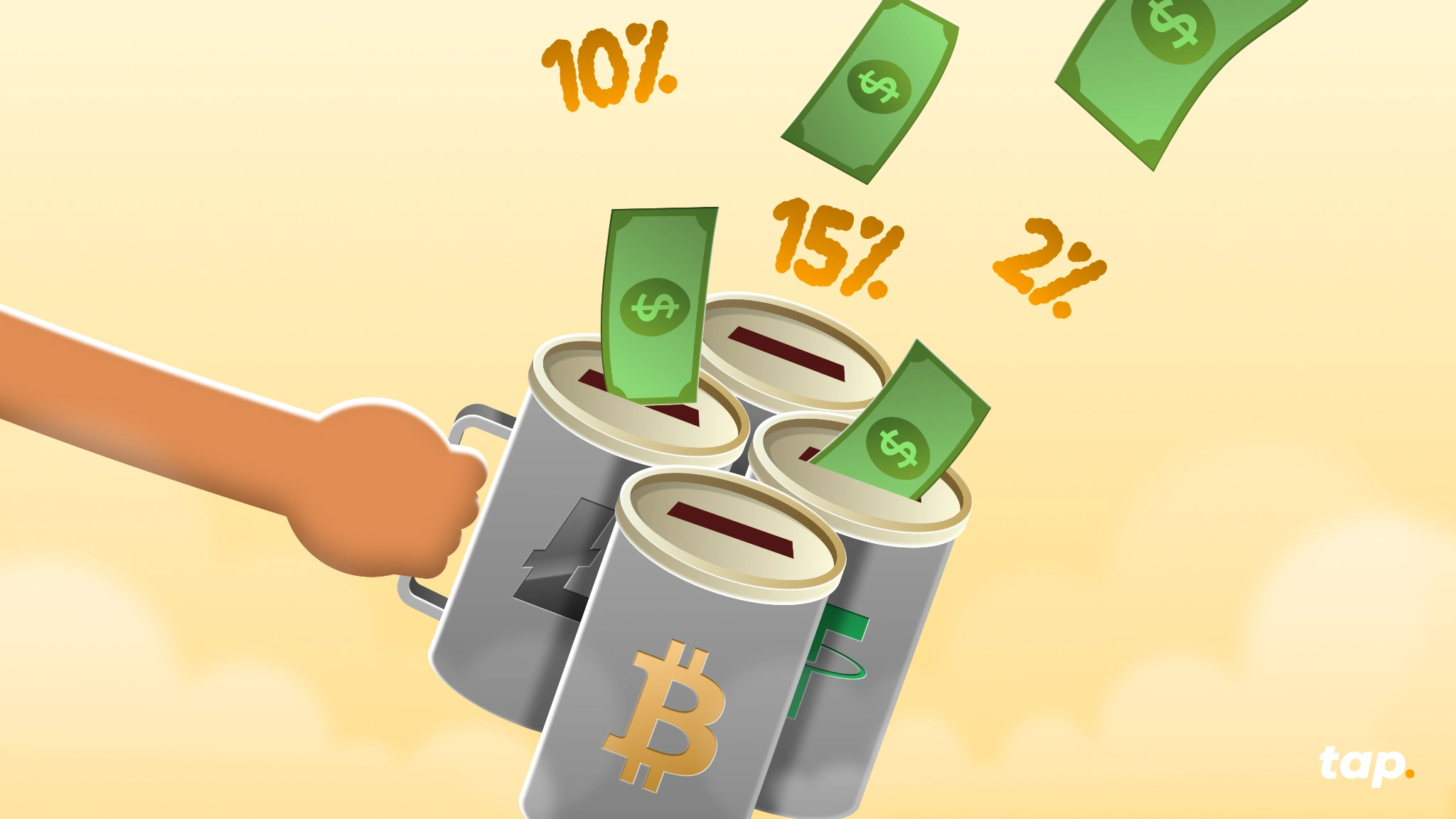
¿Recuerdas cuando tus abuelos presumían de una cuenta de ahorro al 2 %? Hoy eso suena a otra época, especialmente cuando en cripto aparecen cifras de APY que harían palidecer a cualquier banquero tradicional. Pero antes de soñar con jubilarte el mes que viene gracias a esos rendimientos tan llamativos, conviene entender qué significa realmente el APY y por qué algunos números parecen sacados de un boleto de lotería.
¿Qué es el APY, en realidad?
Piensa en el APY como el interés compuesto llevado al siguiente nivel. Mientras una cuenta bancaria tradicional apenas se mueve, el APY mide cuánto puede crecer tu saldo en un año cuando los intereses se acumulan sobre intereses. Aquí es donde la idea de “que tu dinero trabaje solo” cobra sentido.
Un pequeño ejercicio de realidad: coloca 1.000 € en un banco con un 5 % de interés simple y al final del año tendrás 1.050 €. Predecible.
Ese mismo importe con un 5 % de APY, compuesto mensualmente, se convertiría en 1.051,16 €.
“Solo un euro más”, podrías pensar. La diferencia aparece con el tiempo. El interés compuesto crea una bola de nieve que no deja de crecer. No son céntimos: es el tipo de efecto que, con el paso del tiempo, marca distancia.
APY vs. APR: la rivalidad que conviene entender
Vale, confesión: incluso gente con experiencia en cripto los mezcla. Aquí tienes la chuleta:
APY (Annual Percentage Yield): lo que puedes ganar cuando prestas o pones a trabajar tus criptomonedas, teniendo en cuenta el interés compuesto.
APR (Annual Percentage Rate): lo que pagas cuando pides prestado, normalmente sin considerar la capitalización.
Piénsalo así: el APY es el que te “trae” rendimiento; el APR es el que te “cuesta” rendimiento.
Para una comparación más detallada, haz clic aquí.
¿Dónde aparece el APY en cripto?
“Cuentas de ahorro” cripto
Algunas plataformas te permiten depositar tokens y ver cómo crecen. Es como poner tus criptomonedas a trabajar en un empleo que sí paga. Tus activos se prestan a traders que los necesitan y tú recibes una parte.
Staking: conviértete en validador de la red
En blockchains con Proof of Stake como Ethereum o Cardano, puedes hacer staking de tus tokens para ayudar a asegurar la red. Es como ser un “vigilante digital” que cobra en cripto: la red se mantiene segura y tú recibes recompensas.
Yield farming: el Lejano Oeste de DeFi
Aquí es donde la cosa se pone interesante… y un poco salvaje. Aportas liquidez a exchanges descentralizados y, a cambio, ganas comisiones de trading más tokens de gobernanza. A veces aparecen APY que parecen números de teléfono, pero suelen bajar rápido. Estos rendimientos tienen fama de aterrizar de golpe.
Protocolos de lending: conviértete en el banco
Plataformas como Aave y Compound te dejan jugar a ser banco. Prestas tus tokens, los prestatarios pagan intereses y tú cobras. El APY sube cuando mucha gente quiere pedir prestado ese activo y baja cuando la demanda se enfría.
¿Por qué los APY en cripto son tan altos?
Mientras un banco te ofrece un 0,5 % (si tienes suerte), en cripto puedes ver cifras como 10 %, 50 % o incluso 1.000 %+. ¿Por qué?
- Los traders pagan primas altas para abrir cortos o ejecutar estrategias complejas de arbitraje. Pura oferta y demanda.
- Los proyectos nuevos suelen “tirar de APY” para atraer liquidez. Es como una promo de lanzamiento, pero con más ceros.
- El riesgo va incluido. En cripto hay más incertidumbre, y los rendimientos reflejan esa montaña rusa.
- Los incentivos en tokens inflan muchas cifras. Parte del APY puede venir en tokens del proyecto, cuyo valor puede subir… o desplomarse.
Las matemáticas detrás de la magia
Tranquila, no vamos a convertir esto en una pesadilla de cálculo. La fórmula del APY es bastante simple:
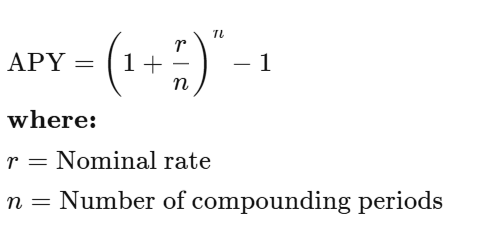
Ejemplo: un 10 % de interés compuesto mensualmente da alrededor de un 10,47 % de APY. ¿Compuesto a diario? Aproximadamente 10,52 %. En cripto, algunos protocolos componen por bloque, casi cada pocos segundos. Tu calculadora podría empezar a sufrir.
La letra pequeña
Antes de dejar tu trabajo y declararte “yield farmer” profesional, toca hablar de lo que no suele salir en las conversaciones con entusiasmo.
Primero, la volatilidad. Puedes ver un APY del 20 %, pero si el token cae un 50 %, el resultado final cambia por completo.
Luego está la pérdida impermanente, que puede morder tus ganancias cuando aportas liquidez y los precios se mueven.
Y ojo con el riesgo de contratos inteligentes. En DeFi, el dinero vive dentro de código, y si algo falla, los fondos pueden evaporarse sin despedida.
También existe riesgo de plataforma. Casos como Celsius o FTX demostraron que, a veces, el problema no es el mercado, sino la propia entidad.
Y por último: el “latigazo” del APY. Ese 100 % que viste ayer puede ser 15 % hoy. En cripto, los tipos cambian rápido por demanda, competencia, tokenomics… o simplemente porque el mercado gira.
¿Qué es un “buen” APY?
Conservador. Activos más consolidados y plataformas conocidas: 3 % a 8 %. Para quien prefiere menos sobresaltos.
Moderado. Staking de ciertos altcoins o liquidez: 10 % a 20 %. Emoción contenida.
Alto (YOLO). Proyectos nuevos en DeFi: 50 % a 100 %+… con una posibilidad real de que el riesgo sea igual de alto que el porcentaje.
Si un APY parece demasiado bueno para ser verdad, normalmente viene acompañado de riesgos igual de “creativos”.
Bola de cristal: el futuro del APY en cripto
Aquí cambia el tono. A medida que cripto madura, los APY se están pareciendo menos a boletos de lotería y más a productos financieros de verdad. Entran instituciones, hay más supervisión y el “Lejano Oeste” se va convirtiendo en una ciudad con normas.
Es probable que cripto siga ofreciendo rendimientos más atractivos que la banca tradicional, pero los días de 10.000 % de APY parecen cada vez más un recuerdo.
Conclusión
El APY en cripto es el mismo concepto matemático de siempre, pero con ropa digital y dinámicas distintas. Ya sea staking, lending o yield farming, entender el APY te ayuda a separar oportunidades reales de promesas dudosas.
El APY no es un truco para generar dinero infinito. Es una métrica que puede ayudarte a entender cómo crecen los rendimientos, pero siempre dentro de un entorno con riesgos.
Y vale la pena recordar esto: el mejor APY del mundo no sirve de nada si el proyecto desaparece del mapa. Elige con criterio, diversifica con cabeza y que el interés compuesto te trate bien.
Imagina la escena: estás navegando por plataformas DeFi y de repente ves dos proyectos distintos. Uno anuncia a gritos “12 % APR” y otro presume de “12 % APY”. Tu cerebro probablemente piensa: “Es lo mismo, ¿no?”
Error. Y no uno pequeño.
Cuando se trata de comparar tipos de interés, APR y APY pueden parecer gemelos… pero no lo son en absoluto. La diferencia entre ambos puede marcar si tus ahorros crecen o si terminas pagando de más por un préstamo. En esta guía vamos a explicar qué significan realmente APR y APY, cómo funcionan en banca, préstamos y cripto, y por qué entenderlos te ayuda a interpretar mejor cualquier oferta.
Puntos clave
- El APR (Annual Percentage Rate) muestra el coste anual de un préstamo, incluyendo intereses y ciertas comisiones.
- El APY (Annual Percentage Yield) refleja el rendimiento anual total, teniendo en cuenta la capitalización.
- Para prestatarios, un APR más bajo implica un coste total menor. Para ahorradores, un APY más alto significa mayores ganancias.
- En cripto y DeFi, la frecuencia de capitalización puede convertir APR modestos en APY mucho más altos.
APY vs. APR: la diferencia esencial
A simple vista, el APR indica cuánto interés se paga o se gana en un año sin capitalización. El APY, en cambio, incluye la capitalización, es decir, cuando los intereses generan más intereses con el paso del tiempo.
Al comparar productos financieros, ya sea una tarjeta de crédito, una cuenta de ahorro o un pool de staking, esta diferencia importa. Para quien pide prestado, el APR revela el coste real de la deuda. Para quien busca rendimiento, el APY muestra el poder del crecimiento compuesto.
En resumen rápido: el APR habla de coste, el APY habla de crecimiento. Saber cuál estás viendo te permite comparar opciones con mayor claridad.
¿Qué es el APR (Annual Percentage Rate)?
El APR representa el tipo de interés anual que se cobra por pedir dinero prestado, o el tipo base que se obtiene al prestar, antes de aplicar capitalización. Incluye intereses y determinadas comisiones, lo que ayuda a entender el coste total del crédito.
El APR se utiliza ampliamente en tarjetas de crédito, préstamos personales, hipotecas y financiación de vehículos. Por ejemplo, si tu tarjeta tiene un APR del 18 %, pagarás ese porcentaje sobre el saldo pendiente.
Los préstamos a tipo fijo mantienen el mismo APR, mientras que los de tipo variable pueden cambiar según las condiciones del mercado.
Ejemplo: pides prestados 10.000 € a un 10 % APR durante un año. Pagarás 1.000 € en intereses. Simple, directo y sin efectos de capitalización.
¿Qué es el APY (Annual Percentage Yield)?
El APY mide cuánto crece tu dinero a lo largo de un año teniendo en cuenta la capitalización. Refleja cada cuánto se añaden los intereses al saldo, ya sea a diario, mensualmente o de forma anual, y cómo esos intereses generan nuevos intereses.
Es la métrica estándar para cuentas de ahorro, cuentas remuneradas y depósitos. Bancos y plataformas financieras suelen destacar el APY porque ofrece una visión más completa del potencial de crecimiento.
Ejemplo: depositas 10.000 € en una cuenta con un 5 % APY compuesto mensualmente. Tras un año, el saldo asciende a unos 10.511 €, ligeramente más que con un 5 % sin capitalización.
Cuanto más frecuente es la capitalización, mayor es el crecimiento, algo especialmente relevante en protocolos DeFi donde el proceso puede repetirse cada pocos minutos.
APR vs. APY según el producto financiero
Tarjetas de crédito y préstamos (enfoque en APR)
Cuando se pide dinero prestado, el APR ayuda a entender el coste real. Por ejemplo, una hipoteca con un 6,5 % APR incluye tanto el interés como ciertos gastos asociados. Préstamos personales, estudiantiles y tarjetas de crédito utilizan APR para facilitar la comparación entre entidades.
La regla general es sencilla: APR más bajo, préstamo menos costoso.
Cuentas de ahorro e inversión (enfoque en APY)
Si el objetivo es hacer crecer el dinero, el APY es la referencia. Una cuenta con un 4,5 % APY crecerá más rápido que una con un 4 %, gracias al efecto de la capitalización.
En productos como depósitos o cuentas a plazo, el APY permite comparar el impacto real de la frecuencia de capitalización.
Criptomonedas y DeFi (APR y APY juntos)
En lending, staking o yield farming, es común ver ambos términos, lo que puede generar confusión.
El APR suele mostrar la recompensa base, sin capitalización.
El APY asume que las recompensas se reinvierten de forma constante.
Ejemplo: un pool DeFi puede anunciar un 100 % APR, pero con capitalización diaria ese rendimiento se transforma en un APY mucho mayor. La clave está en entender cada cuánto se pueden reclamar recompensas y si los costes asociados hacen viable la capitalización.
Cómo calcular APR y APY
Para comparar correctamente, es posible convertir uno en el otro mediante fórmulas matemáticas.
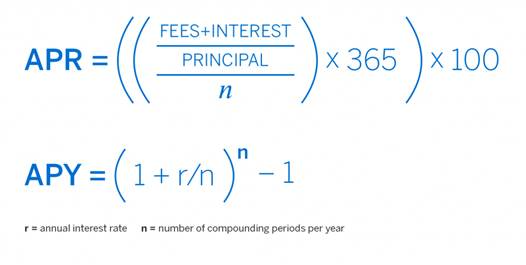
Ejemplo: un 12 % APR con capitalización mensual se convierte en un APY aproximado del 12,68 %.
Cuanto más frecuente es la capitalización, mayor será el APY resultante.
¿En cuál deberías fijarte?
- Si pides prestado, céntrate en el APR. Refleja el coste total.
- Si ahorras o buscas rendimiento, observa el APY. Muestra el efecto del interés compuesto.
- En cripto, revisa ambos. El APR indica la base, el APY muestra el potencial con reinversión.
Al comparar ofertas, conviene leer siempre los detalles: frecuencia, comisiones y condiciones pueden cambiar mucho el resultado final.
Errores comunes y consejos prácticos
Mito: “El APY siempre es mejor.”
Realidad: solo si existe capitalización o reinversión de recompensas.
Mito: “El APR no sirve porque no capitaliza.”
Realidad: el APR es clave para comparar costes de forma clara.
Consejo: usar calculadoras online de APR a APY facilita las comparaciones y elimina conjeturas.
Conclusión
APR y APY no son dos formas distintas de decir lo mismo. Representan enfoques diferentes para medir rendimientos y costes.
Cuando ves APR, estás viendo interés simple calculado a lo largo de un año. Cuando ves APY, estás viendo el efecto de la capitalización en el tiempo.
La diferencia se vuelve más evidente cuanto más altos son los porcentajes. A mayor tipo base, mayor será la distancia entre APR y APY.
Entender cuál estás observando te permite comparar opciones con mayor precisión. El APR muestra el punto de partida; el APY muestra lo que puede suceder cuando los rendimientos se acumulan.
Una vez que distingues ambos conceptos, muchas ofertas financieras dejan de parecer confusas. Los números empiezan a tener sentido y las comparaciones se vuelven mucho más claras.

De oro cómico a pueblo fantasma digital
Las memecoins fueron durante un tiempo el corazón palpitante de la especulación minorista en los mercados de criptomonedas. Desde los rallies de Dogecoin impulsados por Elon Musk hasta el ascenso meteórico de tokens como Shiba Inu o Pepe, estos activos digitales nacidos de internet convirtieron bromas online en capitalizaciones de mercado considerables… al menos para quienes supieron entrar y salir en el momento justo.
Pero al llegar a finales de 2025, el panorama ha cambiado de forma drástica. Los precios han sufrido caídas significativas, la liquidez se ha reducido de manera notable y la euforia que definía ciclos anteriores parece ahora un recuerdo lejano.
La gran pregunta para la comunidad cripto es si las memecoins son simplemente una moda del último mercado alcista o si todavía guardan potencial para un regreso inesperado, como tantas tendencias virales antes que ellas.
Cuando el caos se convirtió en moneda: el origen de las memecoins
El nacimiento de las memecoins está íntimamente ligado a la cultura de internet y a las dinámicas de las redes sociales. A diferencia de Bitcoin o Ethereum, que surgieron a partir de documentos técnicos y visiones claras sobre sistemas financieros descentralizados, las memecoins comenzaron como humor digital, sostenido por comunidades activas, contenido viral y entusiasmo colectivo.
Dogecoin, considerada la memecoin original, se lanzó en 2013 como una parodia explícita de la especulación en criptomonedas. A pesar de su origen irónico, llegó a alcanzar una capitalización de mercado de varios miles de millones de dólares gracias al apoyo de su comunidad y a menciones de alto perfil, como las de Elon Musk. Ese éxito creó un modelo que muchos otros proyectos intentaron imitar, a menudo prometiendo beneficios rápidos sin una base sólida detrás.
Durante los ciclos de mercado de 2021 y 2024, las memecoins dejaron de ser simples activos digitales para convertirse en fenómenos culturales. Las redes sociales amplificaron el hype de forma exponencial y la participación minorista fue masiva. Sin embargo, como ocurre con la mayoría de movimientos puramente especulativos, tras la euforia llegó la corrección.
La gran corrección de las memecoins en 2025
Desde los máximos especulativos de finales de 2024, el sector de las memecoins ha estado sometido a una presión bajista constante. Capitalizaciones que antes alcanzaban decenas de miles de millones de dólares se han reducido entre un 60% y un 90% en conjunto. Según datos de CoinMarketCap, la capitalización total del mercado de memecoins cayó de más de 120.000 millones de dólares en diciembre de 2024 a menos de 70.000 millones en el momento de redactar este artículo, con muchos tokens enfrentándose además a problemas de liquidez.
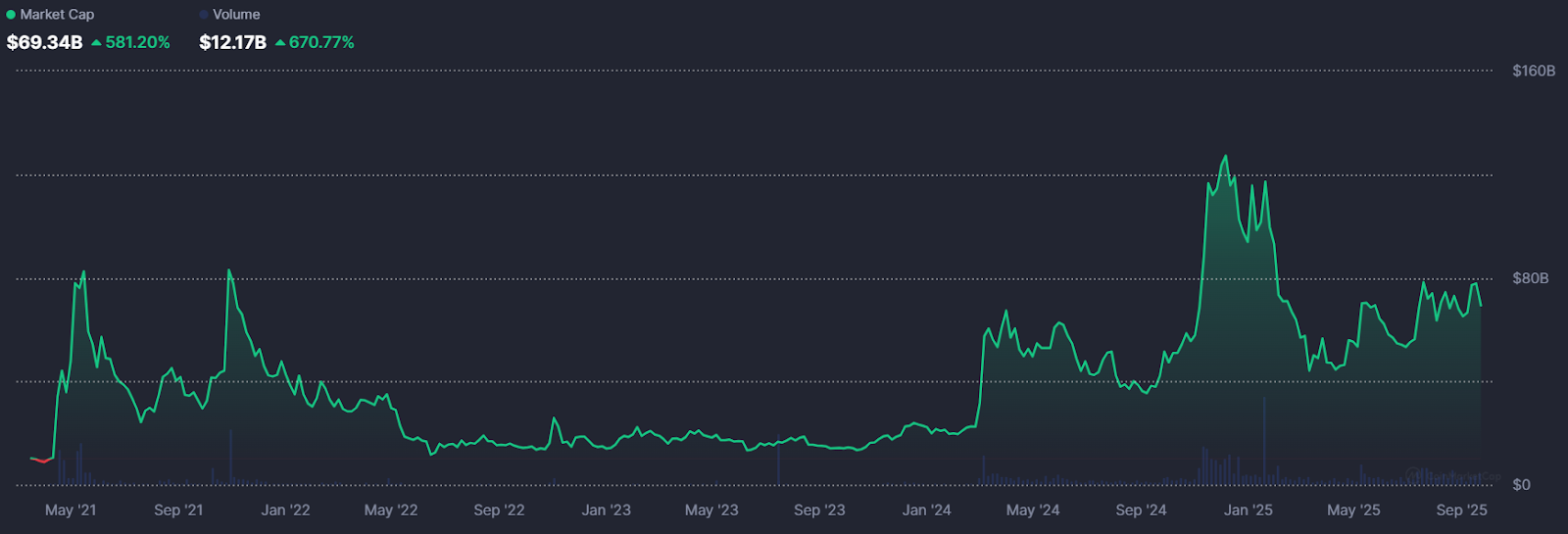
Esta corrección ha puesto de manifiesto el principal reto del sector: sin una base tecnológica fuerte ni casos de uso claros, las memecoins dependen casi por completo de la atención viral y de flujos constantes de liquidez. Cuando estos factores desaparecen, el precio suele seguir el mismo camino.
Muchos participantes minoristas que entraron cerca de los máximos ahora mantienen activos que quizá no recuperen sus valoraciones anteriores, mientras que el entusiasmo colectivo que impulsaba subidas exponenciales se ha diluido en gran medida.
Ya no hacía tanta gracia: por qué la mayoría de los memes no sobreviven
Uno de los factores clave de la inestabilidad de las memecoins es lo que algunos analistas describen como el fenómeno de la “avenida flash”. El hype en cripto rara vez se desarrolla de forma gradual: suele explotar con rapidez e intensidad, desbordando la dinámica normal del mercado. Pero esa atención también se desvanece con la misma velocidad.
Este comportamiento genera un patrón bastante repetido:
- Lanzamiento viral con subidas impulsadas por la comunidad
- Movimiento explosivo del precio que atrae nuevos compradores
- Fatiga de atención cuando el foco se desplaza a otro proyecto
- Colapso del mercado en semanas o meses
Algunos memes nunca pasan de moda: qué separa a los ganadores de los perdedores
¿Qué diferencia a supervivientes como Dogecoin o Shiba Inu —que siguen siendo reconocidos— de los miles de tokens olvidados? Los analistas hablan de una “brecha de autoridad”: la distancia entre la atención viral momentánea y la credibilidad sostenida en el mercado.
Las memecoins que perduran suelen lograr relevancia cultural o algún tipo de utilidad que va más allá del hype inicial. Dogecoin se ha mantenido como un icono de la cultura de internet, con una comunidad fiel y presencia constante en el imaginario popular. Shiba Inu, por su parte, amplió su ecosistema con staking y aplicaciones descentralizadas, acercándose más a un proyecto cripto con funcionalidades definidas.
Sin estos elementos, incluso los lanzamientos más virales tienden a caer en el olvido. El meme por sí solo ya no parece suficiente para sostener un proyecto a largo plazo; es necesario construir narrativas que sigan teniendo sentido cuando se apaga la especulación.
¿Puede caer un rayo dos veces?
A pesar del pesimismo actual, no todo el mundo cree que las memecoins hayan llegado a su final definitivo. Algunos observadores del mercado, como Darkfost, señalan que la dominancia de las memecoins dentro del mercado de altcoins se acerca a niveles que históricamente han precedido a giros de tendencia.
El ratio de dominancia de memecoins —que compara su capitalización con la del resto de criptomonedas alternativas— se mueve cerca de zonas técnicas que en el pasado marcaron puntos de inflexión. Si el capital especulativo vuelve a buscar activos de alto riesgo, algo habitual en mercados alcistas impulsados por liquidez, las memecoins podrían vivir otro episodio de crecimiento explosivo.
La lógica es sencilla: el capital especulativo suele buscar volatilidad, y pocos segmentos ofrecen tanta como las memecoins.
Los riesgos de Memeland: nada ha cambiado
Incluso contemplando un posible rebote, las memecoins siguen siendo uno de los activos con mayor riesgo dentro del ecosistema cripto. A diferencia de Bitcoin, con su narrativa de escasez, o Ethereum, que sustenta un amplio ecosistema de aplicaciones descentralizadas, la mayoría de las memecoins carecen de una propuesta de valor intrínseca. Su precio depende casi exclusivamente del relato y del sentimiento del mercado.
Esto hace que el factor tiempo sea crítico. Los movimientos suelen ser rápidos y las subidas exponenciales pueden revertirse sin previo aviso. La falta de fundamentos sólidos implica que la volatilidad extrema forma parte de su naturaleza.
¿Telón final o solo un descanso?
¿Ha terminado realmente la era de las memecoins? La respuesta no es sencilla. Si se observan los miles de proyectos fallidos, el sector parece un auténtico cementerio digital. Muchos nunca se diseñaron para durar, y su desaparición es una consecuencia lógica del exceso especulativo.
Sin embargo, la historia sugiere prudencia antes de dar por muertas a las memecoins. Su carácter cíclico, impulsado por la cultura de internet y la dinámica especulativa, hace que puedan reaparecer cuando cambian las condiciones de liquidez y apetito por el riesgo. Ya sea a través de nuevos memes o de estrategias emergentes, futuros ciclos podrían traer sorpresas.
La conclusión es clara: las memecoins no son activos financieros tradicionales. Son instrumentos altamente especulativos, capaces de generar tanto subidas espectaculares como caídas abruptas. El chiste puede que no haya terminado… pero cualquiera que siga dentro debería estar preparado para el remate final.

Bitcoin y Ethereum dominan los titulares, pero representan solo una de las muchas formas posibles de construir tecnología de libro mayor distribuido. Mientras la mayoría de los proyectos se limitan a iterar sobre los fundamentos del blockchain, Hedera Hashgraph (HBAR) adopta un enfoque completamente distinto, basado en una arquitectura alternativa.
El resultado es una red diseñada para uso empresarial, capaz de procesar miles de transacciones por segundo con comisiones deterministas y un consumo energético mínimo. Allí donde muchas blockchains chocan con el conocido trilema de la escalabilidad, el mecanismo de consenso hashgraph de Hedera ofrece una alternativa sólida sin sacrificar seguridad a cambio de velocidad.
Lo que realmente diferencia a Hedera es su nivel de adopción empresarial. Grandes corporaciones de sectores como finanzas, salud y gestión de cadenas de suministro han pasado de pruebas piloto a implementaciones en producción. No se trata de adopción teórica, sino de actividad real en la red por parte de organizaciones con exigencias estrictas en rendimiento y cumplimiento normativo.
Hedera se ha posicionado como una de las tecnologías de libro mayor distribuido (DLT) más orientadas a empresas del mercado actual. Pero ¿cómo funciona exactamente y por qué se desmarca del resto del ecosistema blockchain?
Lo esencial: ¿qué es Hedera Hashgraph?
Lanzada en 2018, Hedera Hashgraph es una tecnología de libro mayor distribuido que ofrece una alternativa real a la arquitectura blockchain. En lugar de organizar las transacciones en bloques secuenciales, como si fuera un archivador digital, Hedera utiliza una estructura de grafo acíclico dirigido (DAG) conocida como hashgraph, más parecida a una red de conexiones interrelacionadas.
Este diseño permite procesar múltiples transacciones en paralelo, sin necesidad de esperar turnos. El resultado es una capacidad superior a las 10.000 transacciones por segundo (TPS), con finalización en pocos segundos, frente a las 6–8 TPS de Bitcoin o las 12–15 TPS de Ethereum.
En esencia, Hedera está diseñada para abordar tres problemas persistentes de las DLT:
- Velocidad real: las transacciones se confirman en segundos, no en minutos u horas.
- Escalabilidad sin compromisos: la red puede manejar miles de transacciones simultáneamente sin encarecerse ni ralentizarse.
- Eficiencia energética: el consumo es lo suficientemente bajo como para resultar viable a nivel corporativo.
Cómo funciona Hedera: gossip y votación virtual
El rendimiento de Hedera se basa en un mecanismo de consenso único que combina dos innovaciones clave.
En lugar de difundir cada transacción a toda la red al mismo tiempo, los nodos comparten información de forma aleatoria con otros nodos cercanos. Estos, a su vez, la transmiten a otros, creando un efecto en cadena. Este proceso se conoce como gossip-about-gossip.
La votación virtual añade una capa adicional de eficiencia. Una vez que todos los nodos comparten el mismo historial de información, pueden calcular de forma independiente cómo votaría la red sobre cada transacción, sin necesidad de enviar mensajes de votación reales. El resultado es matemáticamente determinista.
Gracias a este enfoque, Hedera alcanza tolerancia a fallos bizantinos asíncronos (aBFT), uno de los niveles de seguridad más altos en sistemas distribuidos, incluso si hasta un tercio de los nodos falla o actúa de forma maliciosa.
Gobernanza: el Consejo de Hedera
Uno de los aspectos más distintivos, y debatidos, de Hedera es su modelo de gobernanza. En lugar de depender de mineros anónimos o titulares de tokens, la red está gobernada por un consejo de hasta 39 organizaciones globales.
Entre los miembros se encuentran empresas como Google, IBM, Dell, Boeing, Standard Bank o Ubisoft. Cada miembro tiene un voto igual en decisiones clave, como actualizaciones del software, estructura de comisiones o gestión de la tesorería.
El objetivo es ofrecer estabilidad, responsabilidad y planificación a largo plazo. Sin embargo, este modelo genera debate. Para algunos, reduce la descentralización; para otros, proporciona la previsibilidad que muchas empresas necesitan para adoptar esta tecnología a gran escala.
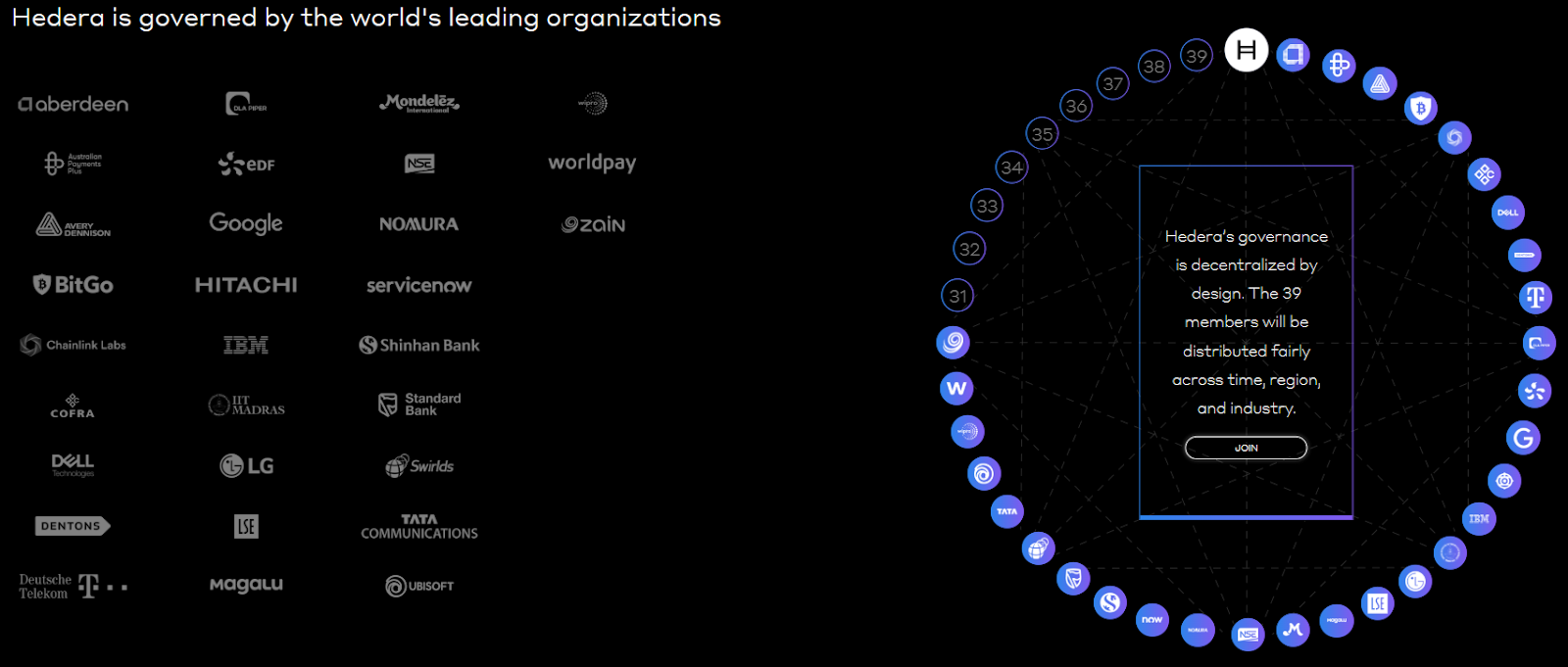
Servicios clave de Hedera
Hedera no es solo una red de pagos. Ofrece tres servicios principales:
Hedera Consensus Service (HCS)
Permite crear registros inmutables y verificables de eventos y datos, especialmente útiles para auditorías, trazabilidad y sectores altamente regulados.
Hedera Token Service (HTS)
Facilita la creación y gestión de tokens, incluidos stablecoins, NFTs y activos tokenizados, con controles integrados a nivel de cuenta y herramientas de cumplimiento normativo.
Hedera Smart Contract Service (HSCS)
Admite contratos inteligentes compatibles con Ethereum, permitiendo desarrollar aplicaciones DeFi, juegos y automatizaciones con mayor velocidad y comisiones significativamente más bajas.
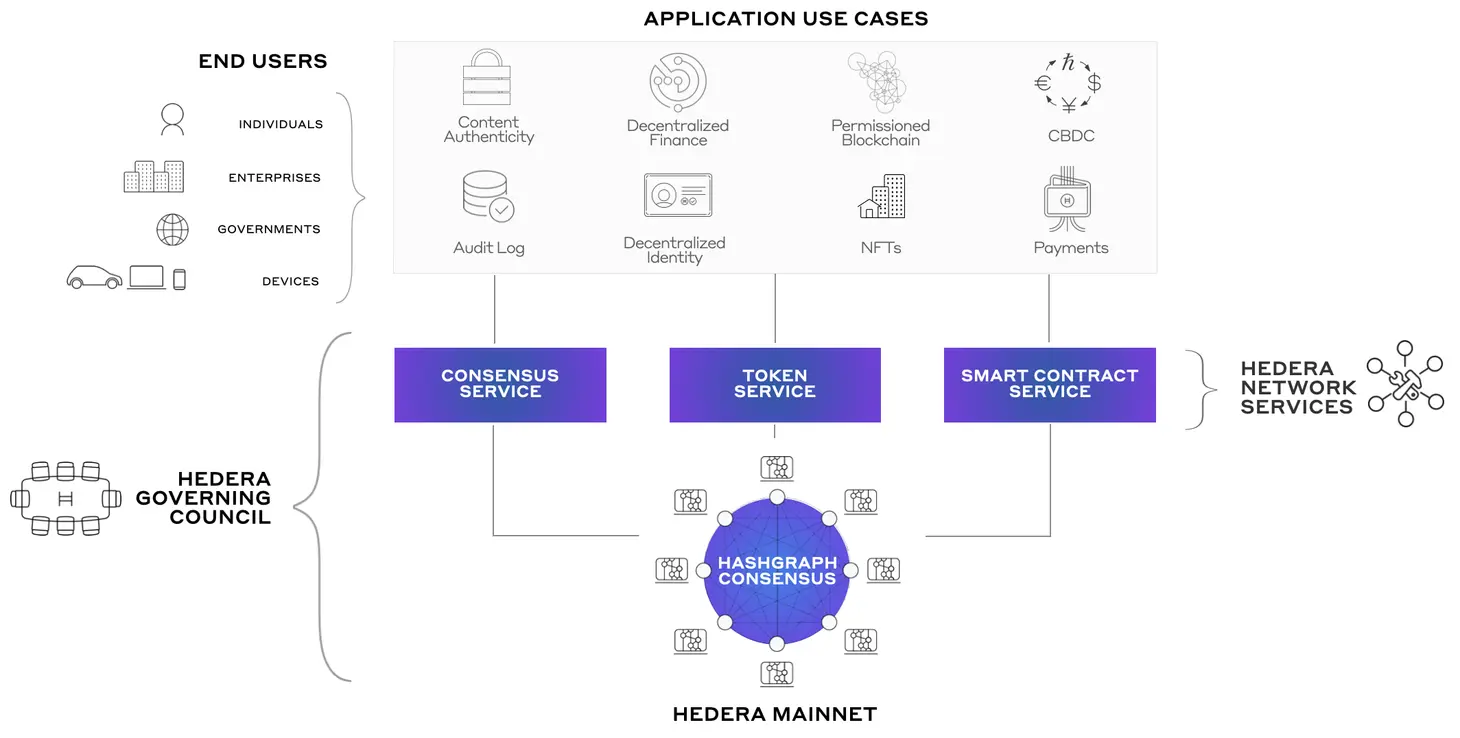
Casos de uso reales
El enfoque empresarial de Hedera se refleja en aplicaciones prácticas en distintos sectores:
- Finanzas: Standard Bank utiliza Hedera para pagos transfronterizos más rápidos y transparentes.
- Cadena de suministro: empresas como Suku y Avery Dennison emplean la red para trazabilidad y logística.
- Salud: Safe Health Systems registra datos médicos y de ensayos clínicos de forma segura.
- Gaming: Animoca Brands integra Hedera para economías digitales verificables.
- Sostenibilidad: organizaciones ambientales usan HCS para rastrear créditos de carbono y datos de impacto.
HBAR: el token nativo
HBAR es la criptomoneda nativa de Hedera y cumple dos funciones principales:
- Combustible de la red: se utiliza para pagar comisiones y acceder a los servicios.
- Seguridad: los operadores de nodos utilizan HBAR para participar en el consenso.
Una de las ventajas más prácticas de Hedera es su estructura de costes. Una transacción típica cuesta alrededor de 0,0001 USD, lo que permite casos de uso como micropagos o pagos entre máquinas.
El suministro total de HBAR está limitado a 50.000 millones de tokens, con una distribución gradual diseñada para evitar impactos bruscos en el mercado.
Cómo se compara Hedera con otras redes
- Proof of Work (PoW): muy seguro, pero lento y con alto consumo energético.
- Proof of Stake (PoS): más eficiente, pero con riesgos de concentración.
- Hashgraph: combina velocidad, seguridad y eficiencia bajo un modelo de gobernanza corporativa.
La diferencia es clara: Hedera prioriza confianza empresarial, rendimiento y claridad regulatoria, aceptando críticas sobre su nivel de descentralización.
Los desafíos por delante
A pesar de sus fortalezas técnicas y su adopción a nivel empresarial, Hedera se enfrenta a varios retos que podrían influir en su evolución a largo plazo. El modelo del Consejo de Gobierno sigue generando debate sobre si Hedera representa una descentralización real o más bien una forma de control corporativo distribuido, una cuestión especialmente relevante para la aceptación dentro de la comunidad cripto en general.
Al mismo tiempo, redes consolidadas como Solana, Avalanche y Ethereum mantienen su dominio en el desarrollo de ecosistemas, lo que dificulta que Hedera atraiga comunidades de desarrolladores tan activas como las que impulsan la innovación en otros entornos.
La plataforma también se enfrenta a un reto de adopción más amplio. Aunque destaca claramente en casos de uso empresariales, Hedera podría ampliar su atractivo más allá de las aplicaciones corporativas para alcanzar un nivel de reconocimiento que sostenga el crecimiento a largo plazo. Además, como ocurre con cualquier proyecto de criptomonedas, debe adaptarse a marcos regulatorios en constante evolución en distintas jurisdicciones, cada una con sus propios requisitos y limitaciones.
Aun así, el enfoque de Hedera en el rendimiento, la fiabilidad de nivel empresarial y el cumplimiento normativo podría ofrecerle una mayor resiliencia en determinados contextos de mercado, especialmente allí donde otros proyectos tendrían dificultades para mantener la confianza institucional.
Un ETF de HBAR en el horizonte
En los últimos meses, ha cobrado fuerza la conversación en torno a un posible ETF de HBAR. Un ETF permitiría a inversores institucionales y minoristas obtener exposición a HBAR sin necesidad de gestionar wallets, claves privadas o custodia directa, lo que reduce significativamente las barreras de entrada.
Además, la aprobación por parte de la SEC de un ETF basado en Hedera implicaría un cierto nivel de supervisión, diligencia debida y cumplimiento normativo, factores que pueden ayudar a reducir la percepción de riesgo entre inversores más cautelosos o sujetos a regulación. Esto acercaría a HBAR al ámbito de los instrumentos financieros tradicionales.
Recientemente, la Comisión de Bolsa y Valores de Estados Unidos (SEC) aplazó la decisión sobre el ETF Canary HBAR hasta el 8 de noviembre. El ETF fue propuesto por Nasdaq en febrero y la SEC ya ha retrasado su decisión en dos ocasiones. A pesar de este último aplazamiento, algunos analistas del mercado siguen siendo optimistas. Analistas de Bloomberg, por ejemplo, mantienen una probabilidad del 90 % de aprobación del ETF en el corto plazo.
El futuro de Hedera
Hedera destaca en un sector saturado precisamente por adoptar un enfoque distinto al de la mayoría de proyectos blockchain. En lugar de seguir el guion habitual, ha construido una infraestructura pensada para empresas reales: transacciones rápidas, costes predecibles y un consumo energético que no genera fricciones a nivel financiero.
La verdadera prueba no es si Hedera puede seguir haciendo bien lo que ya hace, sino si logrará mantenerse relevante a medida que el ecosistema de los libros mayores distribuidos evoluciona a un ritmo acelerado. Mientras muchos intentaban convertirse en “el próximo Bitcoin”, Hedera ha desarrollado silenciosamente una solución que las empresas Fortune 500 están dispuestas a utilizar.
Que esta apuesta dé resultados a largo plazo es algo que solo el tiempo dirá. Lo que sí está claro es que Hedera ha demostrado que existen múltiples formas de construir un libro mayor distribuido y que, en ocasiones, el camino menos transitado puede llevar a destinos muy interesantes.

El oro tiene el toque de Midas. El metal precioso ha experimentado un alza histórica, con un aumento del 45% este año, alcanzando un máximo histórico de 3789 dólares por onza. Este tipo de movimiento parabólico ha dejado a los mercados de materias primas e incluso de criptomonedas con una apariencia de estancamiento en comparación. Pero en la historia financiera, un patrón se ha repetido: cuando el oro se dispara, el bitcoin no se queda atrás.
La pregunta que se hacen muchos operadores es simple: ¿podría el bitcoin estar a punto de replicar el repunte del oro, como lo ha hecho en ciclos anteriores?
Por qué está subiendo el oro
El ascenso meteórico del oro comenzó en febrero de 2024, cuando por fin logró superar la resistencia de los 2.100 dólares tras varios intentos fallidos. Una vez superado ese nivel, el impulso hizo el resto, llevando el precio a subir cerca de un 90% desde ese punto de ruptura.
Este rally no ha sido gradual ni ordenado; ha tenido un carácter casi parabólico. Aunque el sentimiento alcista es evidente, también aparecen señales de cautela. El Índice de Fuerza Relativa (RSI) mensual, un indicador habitual para medir si un activo está “sobrecomprado” o “sobrevendido”, se encuentra ahora en niveles históricamente elevados. En términos sencillos, esto sugiere que el reciente impulso del oro podría estar yendo demasiado rápido, aumentando la probabilidad de una corrección a corto plazo.
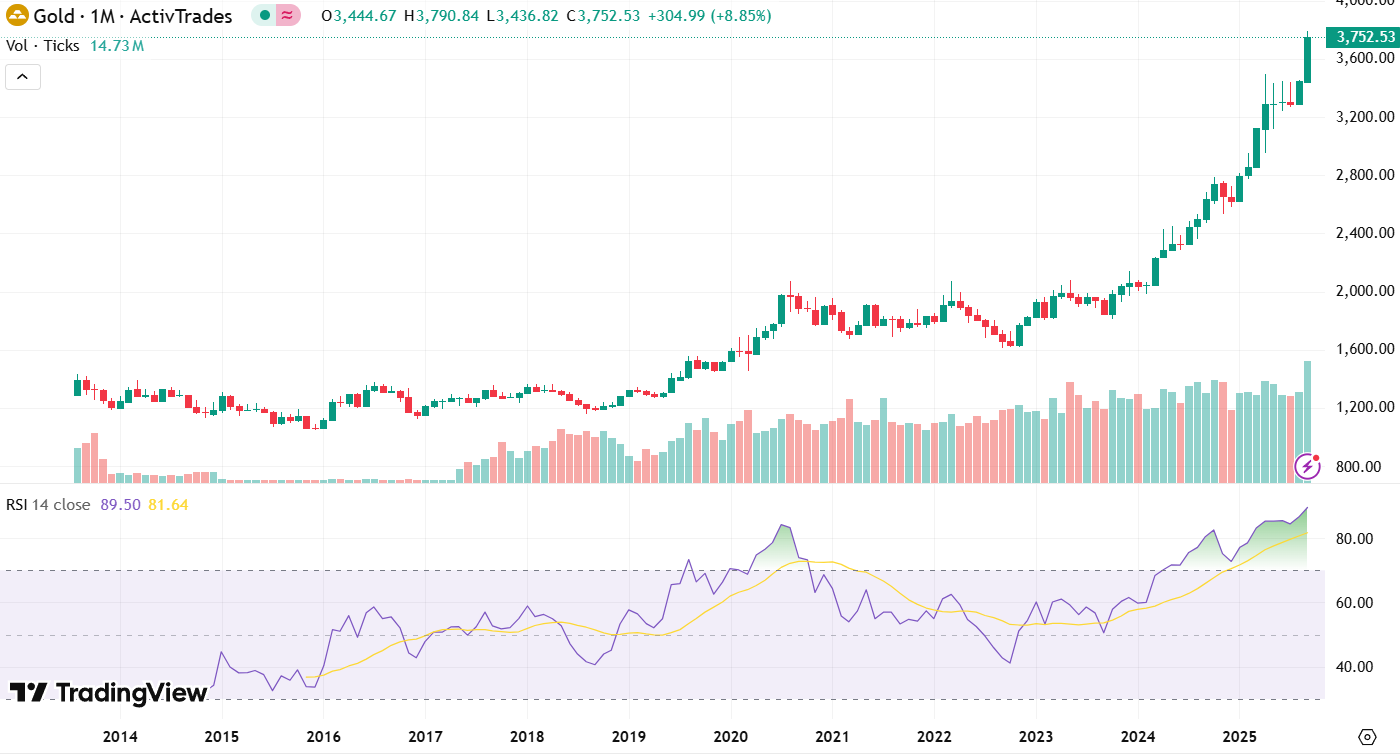
La correlación entre Bitcoin y el oro
A Bitcoin se le suele llamar “oro digital”, y no sin motivo. Ambos activos comparten la idea de escasez: el oro por su propia naturaleza, Bitcoin por su límite algorítmico de 21 millones de monedas. Además, los dos tienden a beneficiarse cuando la confianza en las divisas fiduciarias se debilita.
Históricamente, Bitcoin y el oro han mostrado una correlación positiva durante periodos de aversión al riesgo. Cuando el miedo entra en el mercado —ya sea por inflación, tensiones geopolíticas o inestabilidad financiera— los inversores suelen inclinarse por uno, por otro o por ambos.
Pero hay un matiz importante: durante los mercados alcistas, sus caminos suelen separarse.

Este patrón ya se ha repetido al menos en dos ocasiones. Por ejemplo, a finales de 2016 y de nuevo en 2024, el oro subió primero, se tomó una pausa y después Bitcoin tomó el relevo con un movimiento alcista explosivo. El oro marca el ritmo inicial y Bitcoin acaba siguiendo.
Con el oro ahora en un movimiento parabólico y con riesgo de enfriarse, la historia sugiere que el capital podría rotar hacia Bitcoin a continuación.
¿Está BTC preparado para su rally de “puesta al día”?
El rally del oro puede estar acercándose a un punto de agotamiento, pero eso no implica necesariamente que desaparezca su narrativa de refugio. Más bien, ambos activos podrían compartir protagonismo: el oro como reserva de valor tradicional y Bitcoin como su versión moderna.
Aun así, Bitcoin suele moverse de forma más agresiva. Donde el oro avanza con subidas constantes, Bitcoin responde a menudo con movimientos más bruscos, reflejo de su menor capitalización de mercado y su mayor volatilidad. Si se produce una rotación de capital, el potencial movimiento de Bitcoin podría superar al del oro por múltiplos, como ya ocurrió en ciclos anteriores.
Algunos analistas consideran que esta combinación coloca a Bitcoin en una posición especialmente interesante para los próximos meses. Los máximos históricos del oro reflejan una fuerte demanda de activos escasos en un mundo incierto. Incluso si solo una parte de esa demanda se traslada a Bitcoin, el efecto podría amplificarse por su tamaño relativo y su perfil de liquidez.
¿Tan bueno como el oro?
Si el oro comienza a corregir tras una subida tan rápida, operadores e instituciones que busquen un nuevo vehículo podrían ver en Bitcoin un beneficiario natural. Varios factores refuerzan esta idea:
Ciclos de mercado
Históricamente, Bitcoin ha iniciado nuevas tendencias alcistas cuando el impulso del oro se ha frenado, beneficiándose de los cambios en los flujos de capital.
Atractivo de la escasez
El halving de Bitcoin en abril de 2024 redujo la recompensa por bloque a 3,125 BTC, reforzando su narrativa de escasez justo cuando el rally del oro recordaba a los inversores el valor de los activos con oferta limitada.
Vías institucionales
Con la aprobación de los ETFs de Bitcoin al contado en Estados Unidos y la entrada de flujos, el acceso para grandes inversores es hoy más sencillo que nunca. Esta estructura recuerda a cómo los ETFs de oro abrieron la puerta a la adopción institucional en los años 2000.
Narrativa de cobertura digital
Para inversores más jóvenes y familiarizados con la tecnología, Bitcoin desempeña cada vez más el papel que el oro ha tenido para generaciones anteriores: una cobertura frente a la inflación, la depreciación de las divisas y los shocks sistémicos.
Conviene recordar que correlación no implica causalidad. Aunque Bitcoin haya seguido al oro en ciclos anteriores, las condiciones macroeconómicas actuales son distintas. Las políticas de los bancos centrales, los cambios en el apetito por el riesgo y los marcos regulatorios influyen de forma decisiva en la evolución de Bitcoin.
Además, Bitcoin sigue siendo mucho más volátil que el oro, lo que lo hace menos predecible como activo refugio. El oro se mide en milenios; Bitcoin cuenta con poco más de 15 años de historia. La comparación es útil, pero no idéntica.
Aun así, los paralelismos son difíciles de ignorar. Cuando el oro entra en modo parabólico, Bitcoin suele no quedarse muy atrás. Y si el patrón de divergencia y posterior “alcance” se repite, BTC podría estar preparando su propio momento de protagonismo.
Una oportunidad dorada
La subida explosiva del oro hasta máximos históricos ha recordado, una vez más, por qué los activos escasos ganan relevancia en tiempos de incertidumbre. Pero los datos históricos recientes sugieren que la historia aún podría no haber terminado. Bitcoin podría ser el siguiente en la fila.
Con infraestructuras institucionales ya operativas, un halving reciente y el oro mostrando señales de agotamiento, el contexto parece propicio para que Bitcoin salga de la sombra del oro y vuelva a captar la atención del mercado.
Los próximos meses mostrarán si Bitcoin vuelve a reflejar el camino del oro o si empieza a trazar el suyo propio.
Paw-sitively Profitable
Back in 2013, Dogecoin (DOGE) launched as a tongue-in-cheek knock-off version of Bitcoin (BTC). It was inspired by Kabosu, an incredibly cute Shiba Inu dog that sadly passed away last year, though not without leaving an Instagram account full of posts to remember her by.

The picture that started the meme. Fundamentals… what? Look at this cute doggy. Source.

Fast forward to 2020, and Shiba Inu (SHIB) popped up as a parody of the parody. Both were brushed off as silly, short-lived plays… until they weren’t. In February 2021, a certain billionaire you might have heard of, called Elon Musk, drew attention to Dogecoin through a series of tweets. One could safely pinpoint that tweet spree as the origin of the memecoin bonanza.
Now, let’s fast forward to September 2025. A $100 bet on Dogecoin at $0.0002 would be worth about $124,850 today. The same stake in Shiba Inu at launch? Nearly $25.5 million. Meme magic at its wildest.
For a time, Shiba Inu looked like the stronger contender thanks to its growing ecosystem. But 2025 has flipped the script: SHIB is up a good 24%, while DOGE barked its way to a massive 173% gain. Let’s dig into why.
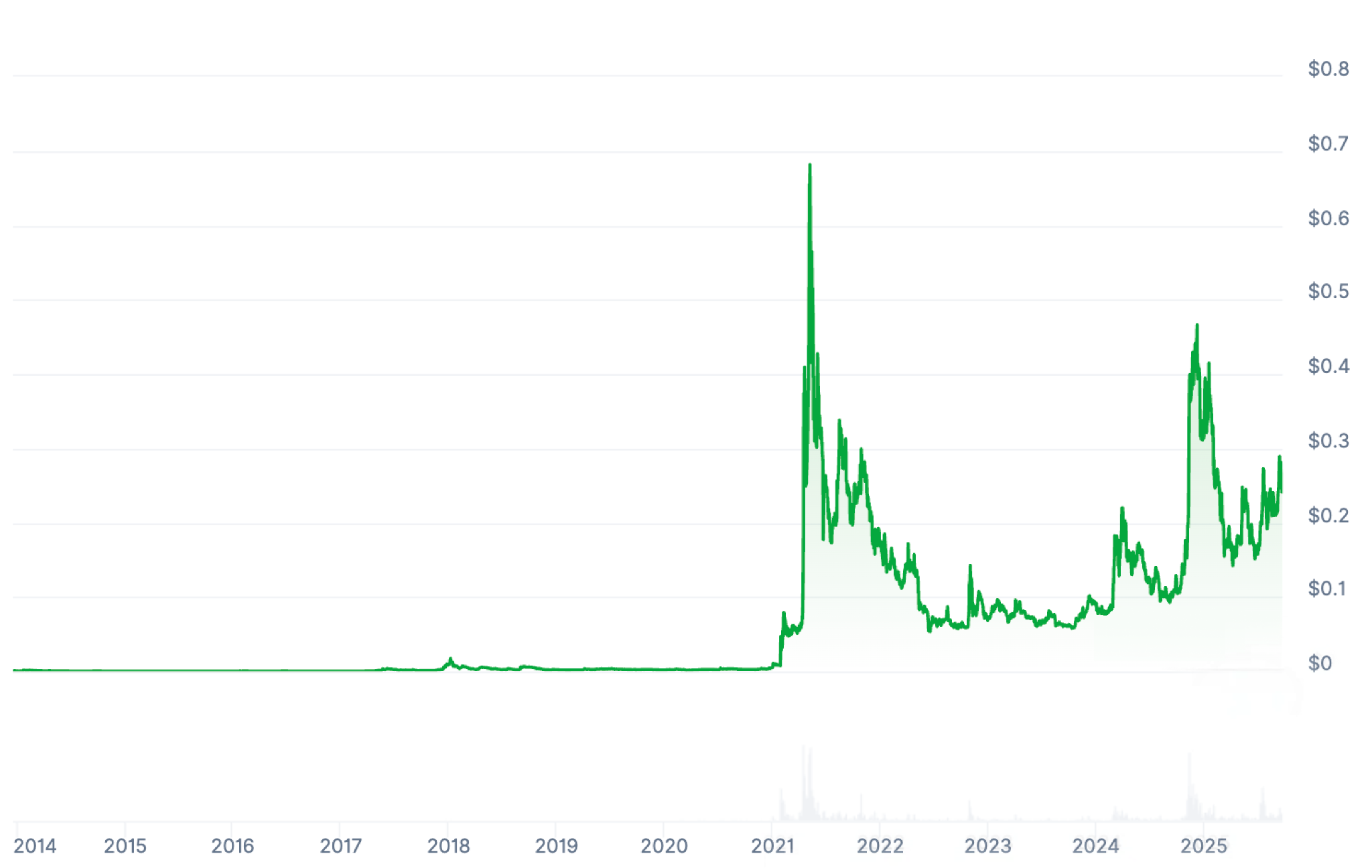
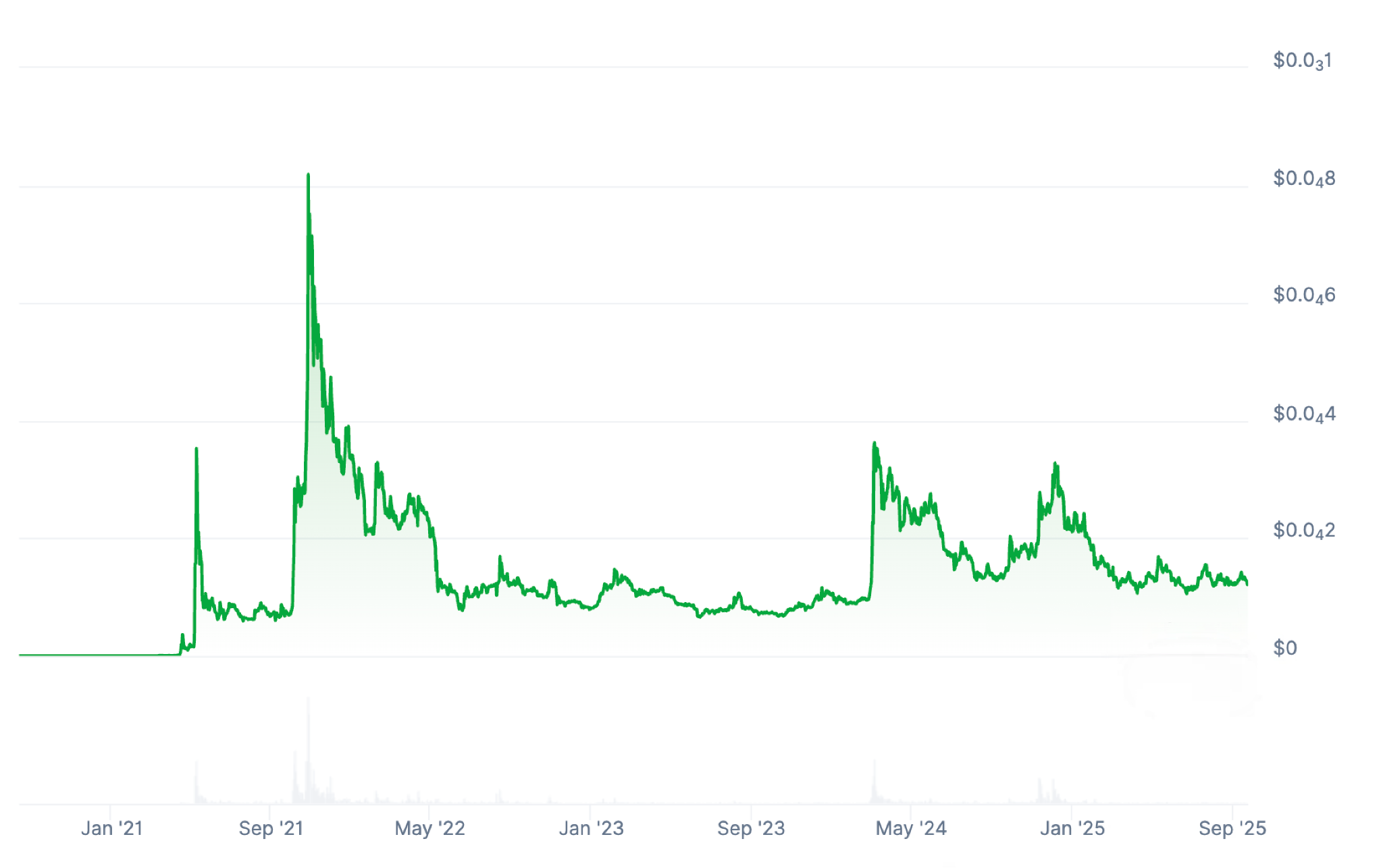
Two Breeds of Dogs
Dogecoin runs on Litecoin’s proof-of-work code, meaning it still relies on miners. It’s inflationary, has no max cap, and uses Scrypt for faster, cheaper payments than Bitcoin. That’s given it a reputation as the “fun” payments coin.
And of course, the Musk effect can’t be ignored. Elon has championed DOGE in tweets, Tesla accepts it for select merch, and even the government’s Department of Government Efficiency was cheekily nicknamed DOGE. Very few coins, memes or not, can summon mainstream buzz the way Dogecoin can.
Shiba Inu, on the other hand, was built on Ethereum. It ditched mining for staking, is deflationary thanks to aggressive token burns (over 40% gone already), and plugs into Ethereum’s smart contract universe. That makes it more versatile than DOGE on paper.
In recent years, Shiba Inu rolled out Shibarium, a Layer-2 chain for speed and lower costs, and ShibaDEX, a cross-chain DEX. The project isn’t just riding a meme, it’s trying to build an ecosystem too.
The Dog Race Is on
For starters, both coins could ride a friendlier U.S. regulatory environment as crypto advocates step into power.
For Dogecoin, near-term ups include:
- Possible integration into Musk’s 𝕏 platform as a payments option.
- Wider retailer adoption.
- Network upgrades for scalability.
- And, of course, the constant wildcard of Musk’s next DOGE tweet.
Rumors of a Dogecoin ETF keep swirling too, which could inject serious momentum.
Shiba Inu’s playbook looks different:
- Ongoing Shibarium growth and new developer activity.
- Token burns that keep tightening supply.
- A developing metaverse with virtual land sales.
However, without a Musk-like hype machine, SHIB’s catalysts may not hit as hard.

Elon Musk’s first Dogecoin tweet, which started it all. Source.
So… Which Meme Coin Will Bark the Loudest?
Both coins are speculative, fueled as much by community buzz as fundamentals. Shiba Inu has a deeper ecosystem and long-term ambition. Dogecoin has clearer short-term sparks and, crucially, Elon Musk’s megaphone.
If forced to pick for the next 12 months, Dogecoin seems to have the edge. It may be the older meme, but for now it still has more bite.
You know that feeling when the Fed announces a rate cut and suddenly everyone's talking about how "bullish" it is for crypto? Many people just nod along, but honestly have no clue why cheaper borrowing costs would make Bitcoin go up. Let's dig deep into this topic and share what the data shows – whether you're totally new to this stuff or already trading like a pro.
Let's Start Simple: What Are Interest Rates Anyway?
Okay, let's assume you're not an economics major here. Interest rates are basically the price of money. When you borrow money, you pay interest. When you save money, you (hopefully) earn interest. The big kahuna is the rate set by central banks like the Federal Reserve – this is the rate that affects pretty much everything else in the economy.
Here's the deal: when rates are high, borrowing money sucks because it's expensive. People spend less, businesses hold off on big investments, and suddenly that savings account looks pretty attractive. When rates are low, it's the opposite – borrowing is cheap, so people and businesses start spending and investing more aggressively.
A rate cut is just the central bank saying "Hey, we want people to spend more money and take more risks." And guess what falls into that "risky investment" bucket? Yep, crypto.
The Crypto Connection (Or: Why Bitcoin Doesn't Care About Your Savings Account)
Here's something that becomes clear when you think about it: Bitcoin doesn't pay you anything to hold it. Neither does Ethereum, Solana, or pretty much any other crypto sitting in your wallet. They're not like bonds or savings accounts that give you a steady income.
When interest rates are near zero, this isn't a big deal. But imagine government bonds are paying 5% with zero risk. Suddenly, holding volatile crypto that might crash 50% overnight doesn't look so smart, right?
So the math is pretty straightforward:
- High rates = "Why gamble on crypto when you can get guaranteed returns?"
- Low rates = "These bonds pay nothing, maybe Bitcoin looks interesting..."
This is probably the biggest reason why rate cuts get crypto people excited. When safe investments pay peanuts, risky assets start looking a lot more appealing.
How Rate Cuts Actually Push Money Into Crypto
Alright, let's get into the nitty-gritty of how this actually works. It's not just about psychology – there are real mechanisms at play here. Beyond simple psychology, several concrete mechanisms drive capital toward cryptocurrency markets when central banks ease monetary policy.
When central banks cut rates, they typically inject additional liquidity into the financial system. This expanded money supply creates excess capital that seeks higher returns, with crypto markets often benefiting from these flows.
Lower interest rates fundamentally alter investment opportunity costs. This is finance speak for "what am I giving up?" If I can only earn 0.5% in a savings account, the opportunity cost of holding Bitcoin (which pays nothing) is pretty low. But if savings accounts pay 5%, then holding Bitcoin means I'm giving up a lot of guaranteed income.
Here's something interesting: when the U.S. cuts rates, it often makes the dollar less attractive to international investors. A weaker dollar historically has been good for Bitcoin, especially since many people see it as "digital gold", a way to protect against currency debasement.
Accommodative monetary policy encourages risk-taking across markets. Traders can borrow more to make bigger bets, capital flows more easily toward crypto startups, and regular folks start FOMOing into altcoins. It's like the whole market gets a shot of adrenaline.
The COVID Case Study (AKA When Everything Went Bananas)
Want to see this in action? Look at what happened during COVID. In March 2020, everything crashed: stocks, crypto, you name it. Central banks freaked out and slashed rates to basically zero while printing money like it was going out of style.
At first, Bitcoin crashed along with everything else (down to around $3,200). But once all that stimulus money started flowing through the system, crypto went absolutely bonkers. Bitcoin went from that March low to nearly $70,000 by late 2021. That's more than a 20x return in less than two years!
Now, rate cuts alone didn't cause that rally, there was a lot going on, including institutional adoption, the whole "inflation hedge" narrative, and pure FOMO. But the massive liquidity injection definitely set the stage.
Fast forward to now, and we're starting to see rate cuts again. The Fed just cut rates for the first time in years, and everyone's wondering if we're about to see another crypto supercycle. Spoiler alert: it's complicated.
Why It's Not Always That Simple (The Plot Thickens)
The relationship between monetary policy and cryptocurrency prices isn't as straightforward as it seems. Rate cuts don't guarantee crypto rallies, and several factors can throw a wrench in this supposedly reliable connection.
Take timing, for instance. Monetary policy doesn't work like flipping a switch. The Fed cuts rates today, but that doesn't mean money suddenly floods into Bitcoin tomorrow. These effects take months to work through the financial system, creating frustrating delays between policy changes and actual market movements.
Then there's the whole expectations game. If everyone and their mother already expects a rate cut, the actual announcement might barely move markets. It's already baked into prices, as traders say. But when cuts come by surprise? That's when things get interesting, and volatile.
Inflation makes everything messier. Central banks get nervous about cutting rates when prices are already rising. And if they do cut while inflation is running hot, investors start worrying about the economy overheating. This is why smart money watches real interest rates, the actual rate minus inflation, which sometimes tells a completely different story than the headline numbers.
The Advanced Stuff (For Market Nerds)
Okay, this is where things get really interesting. If you're already trading and want to understand what moves the big money, here are the deeper dynamics that separate amateur hour from professional-grade analysis.
Real rates matter more than anything else. When rates sit at 2% but inflation runs at 4%, cash holders are losing 2% annually in purchasing power. That’s the kind of environment where Bitcoin’s ‘hard money’ narrative tends to resonate, and where institutional investors have historically shown greater interest.
The yield curve tells stories that headline rates can't. This relationship between short and long-term rates reveals market psychology. When short rates exceed long rates, the dreaded inverted curve, recession fears dominate. Rate cuts during these periods often fall flat because fear trumps greed, and nobody wants to touch risky assets regardless of how cheap money becomes.
But here's what separates the pros from everyone else: they know it's never just about rates. Credit spreads show how much extra yield risky borrowers pay compared to safe government debt. Dollar funding conditions reveal whether international markets can actually access all that cheap liquidity. And bank lending standards determine if that Fed money ever makes it past Wall Street desks into the real economy. The Fed can slash rates to zero, but if banks won't lend and credit markets freeze up, crypto won't see a dime of that stimulus.
The Dark Side (Because Nothing's Ever Perfect)
Let's be honest here, painting rate cuts as some magic crypto catalyst without acknowledging the risks would be doing everyone a disservice. Easy money creates bubbles, and when those bubbles burst, crypto typically gets damaged first and hardest.
The inflation trap is real and brutal. When rate cuts work too well and prices start spiraling upward, central banks panic and slam the brakes with aggressive rate hikes. That policy whiplash absolutely crushes speculative assets, with crypto leading the carnage every single time.
Then there's the liquidity trap – monetary policy's most frustrating failure mode. Sometimes rate cuts simply don't work. Banks refuse to lend, consumers won't borrow, and all that cheap money sits trapped in the financial system instead of flowing into markets. Japan learned this lesson painfully over decades of ineffective stimulus.
Here's an uncomfortable truth: despite all the "digital gold" rhetoric, crypto still dances to the stock market's tune most days. When rate cuts happen during genuine recessions and equities crater, Bitcoin rarely stays immune. The correlation breaks down only during very specific market conditions, not during broad-based selloffs.
Finally, there's the regulatory sword hanging over everything. Crypto rallies have this annoying habit of attracting government attention, especially when retail investors pile in and inevitably lose their shirts. That regulatory risk never disappears, it just sits there waiting for the next bubble to pop.
Strategic Approaches at Different Levels
The beauty of understanding rate cut dynamics is that you can apply this knowledge regardless of where you are in your trading journey. Here's how to think about it based on your experience level.
Starting out? Keep things dead simple. Track Fed meetings, watch inflation numbers, and brace for wild swings around major announcements. Don't get lost in the weeds trying to predict every twist and turn. Just remember that cheaper money generally makes crypto more attractive, even if the timing stays unpredictable.
Getting more serious about this game? Time to expand the toolkit. Real interest rates become your new best friend, along with the dollar index (DXY) and whatever the Fed chair actually says about future moves. Pay close attention to how crypto moves when stocks hiccup, that correlation hasn't disappeared just because Bitcoin hit some arbitrary price target.
Going full macro nerd? Now we're talking. Layer in yield curve analysis, credit spreads, and options flow data. The goal shifts from reacting to news toward positioning ahead of surprises. This means using derivatives to hedge positions and managing risk like the professionals do. At this level, it's less about being right and more about surviving when you're wrong.
The Bottom Line
So why are interest rate cuts good for crypto? Because they make safe assets less attractive, flood the system with liquidity, weaken fiat currencies, and make everyone a little more willing to take risks. For Bitcoin, that often strengthens its narrative as a store of value. For altcoins, it can fuel speculative rallies and bring more funding to interesting projects.
But here's the key insight: context is everything. Rate cuts during an economic expansion can be rocket fuel for crypto. Rate cuts during a deep recession might just keep things from getting worse. The difference comes down to liquidity conditions, market sentiment, and whether people actually believe the central bank's strategy will work.
For newcomers, the headline is simple enough: lower rates usually help crypto. For everyone else, remember that it's not just about the rate cut itself, it's about how that cut fits into the bigger macroeconomic puzzle.
The most successful traders don't just look at rate cuts in isolation. They consider the whole picture: inflation, employment, credit conditions, dollar strength, and market positioning. Because at the end of the day, markets are about human psychology as much as they are about monetary policy.
And honestly? That's what makes this whole game so fascinating, and frustrating at the same time.

Dejemos algo claro desde el principio: la mayoría de las promesas cripto de “gana dinero mientras duermes” son puro humo. Internet está lleno de fórmulas mágicas que prometen 10.000 € al mes y que suelen terminar en wallets vacías y arrepentimiento.
Pero sí, en 2025 se puede generar ingresos pasivos con crypto. La palabra clave es “se puede”, no “ocurre automáticamente” ni “está garantizado”. La diferencia está en tener expectativas realistas. Hablamos de rangos aproximados del 3% al 12% anual a través de métodos legítimos, no de los cuentos de 300% que inundan las redes.
Por suerte, el panorama de ingresos pasivos cripto ha madurado desde la era salvaje de 2021. ¿Esas granjas de 20.000% APY que desaparecían de la noche a la mañana? En gran medida ya no están (aunque todavía puede aparecer alguna si te atraen las emociones fuertes).
Esta guía cubre siete métodos habituales para generar ingresos pasivos con crypto. Encontrarás opciones sencillas para principiantes con rendimientos del 3% al 8% anual, y estrategias más arriesgadas que pueden moverse en rangos más altos si sabes lo que estás haciendo. También hablaremos de lo menos glamuroso pero esencial: riesgos, volatilidad y cómo reducir la probabilidad de perderlo todo.
Si buscas esquemas de “hazte rico rápido”, mejor mirar en otro sitio. Si lo que quieres es entender qué es realista en 2025 y cómo funciona, vamos a ello.
Entendiendo los ingresos pasivos en crypto
Antes de entrar en métodos concretos, aclaremos qué significa “ingresos pasivos” en crypto. En el mundo tradicional, los ingresos pasivos pueden venir de alquileres o dividendos: inviertes y recibes pagos sin estar gestionando a diario. En crypto es similar, pero con un giro digital y, sobre todo, mucha más volatilidad.
La diferencia clave es que en inversiones tradicionales quizá veas variaciones del 5% al 10% anual. En crypto, un activo puede moverse un 50% en una semana. Esto hace que lo “pasivo” sea pasivo solo en teoría si terminas pendiente del precio constantemente.
La realidad es que los ingresos pasivos cripto existen en un espectro de riesgo. En el extremo más prudente hay productos tipo “cuentas de ahorro” cripto que pueden ofrecer 2% a 8% APY, parecido a cuentas remuneradas pero en activos digitales. En el extremo más arriesgado está el yield farming, donde a veces se ven retornos muy elevados, pero también puede haber riesgos serios ligados a fallos de smart contracts o movimientos bruscos del mercado.
En conjunto, el mercado de ingresos pasivos cripto ha crecido mucho. En 2025, más de 150.000 millones de dólares están bloqueados en distintos protocolos DeFi, y algunas instituciones importantes ya ofrecen productos de “earn”. Eso no elimina el riesgo, pero sí significa que el ecosistema es, en general, más maduro que en los primeros años.
¿Por qué la gente lo elige? Además del potencial de rendimiento, ofrece mercados 24/7, alcance global y la posibilidad de empezar con importes pequeños.
7 métodos habituales para generar ingresos pasivos con crypto
Opciones de baja complejidad (recomendadas para principiantes)
1. “Cuentas de ahorro” cripto
Piénsalas como cuentas remuneradas, pero con crypto. Depositas tus activos en productos de rendimiento de plataformas custodiales (la disponibilidad varía por país) y la plataforma los presta o los utiliza en estrategias, compartiendo parte del retorno contigo.
Cómo funciona: la plataforma usa los depósitos para prestar a prestatarios institucionales o para estrategias en DeFi. Tú recibes un porcentaje.
Rendimientos realistas: suele verse un rango aproximado del 2% al 8% APY, según activo y plataforma. Bitcoin suele tener tasas más bajas (2% a 4%) y las stablecoins a menudo se mueven en rangos superiores (4% a 8%). Cada plataforma varía, así que conviene leer condiciones.
Cómo empezar: normalmente requiere KYC. Depositas, eliges el producto y el interés se acumula a diario o semanalmente.
El “pero”: no hay cobertura tipo FDIC. Existe riesgo de plataforma (casos como Celsius o BlockFi en 2022 lo recuerdan). Conviene investigar y no comprometer más de lo que estás dispuesto a perder.
2. Staking
El staking es como recibir “recompensas” por ayudar a asegurar una red blockchain. En lugar de minería, redes Proof-of-Stake utilizan validadores que bloquean tokens para procesar transacciones.
Opciones habituales:
- Ethereum (ETH): a menudo alrededor del 2% al 4%
- Solana (SOL): comúnmente 6% a 8% efectivo con el tiempo (depende de inflación y staking)
- Cardano (ADA): suele estar en 3% a 5%
- Polkadot (DOT): el unbonding puede ser de 28 días; las recompensas varían
Dos enfoques: staking directo (más técnico y a veces con mínimos) o staking delegado mediante plataformas (más simple, normalmente con comisiones).
Punto importante: puede haber periodos de bloqueo, así que conviene considerar la liquidez antes de entrar.
Métodos de complejidad media
3. Lending cripto
Consiste en prestar tus activos a cambio de intereses. Puede ser más “manual” que una cuenta custodial, pero a veces ofrece más flexibilidad.
Lending en plataformas: protocolos como Aave, Compound o Kava permiten aportar liquidez a pools de préstamos.
Rendimientos esperados: varían según demanda. Las stablecoins pueden moverse en rangos como 5% a 15% APY, y los activos más volátiles pueden variar mucho según el mercado.
Riesgos: vulnerabilidades de smart contracts, hacks o cambios bruscos de condiciones.
4. Pools de liquidez y provisión de liquidez
DEX como Uniswap o PancakeSwap necesitan liquidez. Si aportas pares de activos a un pool, puedes ganar una parte de las comisiones.
Cómo funciona: depositas dos activos con el mismo valor (por ejemplo, ETH y USDC). Los traders pagan comisiones y tú recibes una parte según tu porcentaje.
Potencial: puede variar mucho (por ejemplo, 5% a 30% APY en determinados pares), dependiendo de volumen y comisiones.
Impermanent loss: el gran riesgo específico. Si el precio de un activo cambia mucho frente al otro, podrías terminar con menos valor que si hubieras mantenido ambos por separado. Se llama “impermanent” porque la relación puede revertirse, pero se vuelve “real” si sales en un momento desfavorable.
Métodos de mayor complejidad (para usuarios DeFi con experiencia)
5. Yield farming
Es el “juego de alto riesgo” de DeFi: mover fondos entre protocolos buscando retornos más altos, a menudo con estrategias complejas y múltiples tokens.
Atractivo: a veces se ven APYs elevados durante periodos cortos, pero tienden a ser inestables y a caer rápido.
Realidad: muchas granjas de alto rendimiento dependen de incentivos con tokens que se deprecian o de modelos poco sostenibles.
Para quién es: usuarios avanzados que entienden riesgos de smart contracts, economía de tokens y aceptan la posibilidad de pérdidas importantes.
6. Tokens con reparto de ingresos o “dividendos”
Algunos proyectos reparten parte de ingresos o incentivos a holders, similar a un “bonus” ligado a actividad del protocolo.
Ejemplos mencionados habitualmente:
- KuCoin Token (KCS): bonus ligado a comisiones para holders elegibles (según condiciones)
- NEO: genera GAS para uso en la red
- VeChain (VET): genera VTHO para uso de red
Rendimientos: variables y dependientes del éxito del proyecto.
7. Masternodes
Los masternodes son servidores que realizan funciones específicas en redes determinadas. Suelen requerir capital y mantenimiento técnico.
Requisitos: a menudo se necesitan cantidades significativas en tokens, a veces equivalentes a 10.000 € a 100.000 € o más, además de conocimientos para mantener seguridad y uptime.
Barreras: coste alto, complejidad y mantenimiento. No suele ser el punto de entrada ideal para la mayoría.
Realidad: ¿cuánto se puede generar realmente?
Veamos ejemplos hipotéticos con condiciones de mercado típicas:
Escenarios con 1.000 €
- Cuenta cripto (5% APY): 50 € al año
- Staking de ETH (3,2% APY): 32 € al año
- Lending de stablecoins (8% APY): 80 € al año
Escenarios con 10.000 €
- Enfoque diversificado (staking + lending): 400 € a 800 € al año
- Estrategias DeFi más arriesgadas: 1.000 € a 2.000 € al año (con posibilidad real de pérdidas)
Escenarios con 100.000 €
- Perfil conservador: 4.000 € a 8.000 € al año
- Yield farming agresivo: 10.000 € a 20.000 € al año (riesgo muy alto)
Comparación rápida: una cartera tradicional con 4% de dividendos sobre 100.000 € da 4.000 € al año. Crypto puede superar eso, pero con más volatilidad.
El factor volatilidad importa: podrías generar intereses, pero si el activo subyacente cae un 30%, el balance total puede quedar en negativo. Por eso mucha gente usa stablecoins cuando el objetivo principal es “yield”.
Implicaciones fiscales que conviene conocer
Los ingresos pasivos en crypto no suelen ser “invisibles” fiscalmente. En muchos países, las recompensas se tratan como ingresos y pueden estar sujetas a impuestos.
Puntos habituales:
- Recompensas de staking: pueden considerarse imponibles al recibirse, según valor de mercado
- Intereses de lending: suelen tratarse como ingreso
- Rendimientos DeFi: también pueden computar, incluso si se pagan en tokens poco conocidos
El registro es clave: fechas, importes y valor. Algunas plataformas ofrecen informes, pero la responsabilidad suele recaer en el usuario.
La complejidad varía por país, por lo que conviene revisar la normativa local si los importes son relevantes.
Riesgos y cómo reducirlos
Los ingresos pasivos en crypto no solo van de “ganar”, sino de evitar pérdidas por riesgos evitables.
- Riesgo de plataforma: plataformas centralizadas pueden fallar, ser hackeadas o congelar retiros.
Mitigación: diversificar, investigar reputación y no comprometer capital crítico. - Riesgo de smart contracts: el código puede tener fallos y los hacks ocurren.
Mitigación: priorizar protocolos auditados y consolidados. - Volatilidad de mercado: movimientos de precio pueden comerse cualquier rendimiento.
Mitigación: considerar stablecoins para estrategias centradas en yield, o aceptar la volatilidad como parte del perfil cripto. - Riesgo regulatorio: normas pueden cambiar de forma rápida.
Mitigación: mantenerse informado y entender el marco aplicable en tu jurisdicción.
Gestión práctica del riesgo:
- Empezar pequeño mientras aprendes
- No usar fondos de emergencia
- Diversificar métodos y plataformas
- Mantener registros detallados
- Seguir actualizaciones y cambios de protocolos
Cómo empezar: primeros pasos
¿Quieres empezar de forma razonable? Un enfoque prudente podría ser:
- Empieza por aprender: wallets, seguridad y el método que te interesa.
- Empieza conservador: cuentas cripto o staking en plataforma, con cantidades pequeñas.
- Revisa tu exposición total: muchas guías sugieren limitar la exposición a crypto dentro de un conjunto de activos, y que las estrategias de “earn” sean una parte aún más pequeña.
- Elige plataformas con criterio: reputación, licencias cuando aplique, transparencia en comisiones, y evitar promesas irreales.
- Seguridad básica: 2FA, no compartir claves privadas, y considerar hardware wallets para importes altos.
Conclusión
Generar ingresos pasivos con criptomonedas en 2025 es posible, pero requiere expectativas realistas y gestión de riesgos. La era de los “20% garantizados” quedó atrás, pero siguen existiendo opciones legítimas para quien se informa y actúa con prudencia.
Para la mayoría, el punto más equilibrado suele estar en estrategias conservadoras: cuentas cripto, staking consolidado y, en algunos casos, lending con stablecoins. No te harán rico de la noche a la mañana, pero pueden ofrecer un retorno constante mientras entiendes mejor el ecosistema.
Y recuerda: en crypto, “pasivo” suele requerir más atención que en finanzas tradicionales. Mantente informado, empieza pequeño y no arriesgues fondos que no puedas permitirte perder.
En nuestra economía global interconectada, los símbolos de moneda están presentes en todas partes. Aparecen al planificar viajes internacionales, gestionar un negocio de comercio electrónico, dar formato a documentos financieros o simplemente al intentar entender precios en un sitio web extranjero. Saber reconocer y utilizar correctamente los símbolos de moneda es una habilidad esencial.
En esencia, los símbolos de moneda son notaciones abreviadas que representan distintas unidades monetarias en todo el mundo. A diferencia de los códigos ISO, como USD o EUR, estos símbolos ofrecen una referencia visual rápida que trasciende las barreras del idioma. Desde el conocido signo del dólar ($) hasta el símbolo de la rupia india (₹), cada uno refleja identidad económica y contexto cultural.
Comprender los símbolos de moneda resulta especialmente útil al trabajar con transacciones internacionales, crear sitios web multilingües, dar formato a facturas o desarrollar aplicaciones financieras. No se trata solo de teoría, sino de herramientas prácticas para cualquier persona que interactúe con el comercio global o los viajes.
¿Qué es un símbolo de moneda?
Un símbolo de moneda es una representación gráfica utilizada para indicar una unidad monetaria específica. Funciona como un atajo universal que permite identificar rápidamente una moneda sin necesidad de escribir su nombre completo ni recordar códigos complejos de tres letras.
Por ejemplo, el signo del dólar ($) identifica inmediatamente al dólar estadounidense, mientras que el símbolo del euro (€) representa la moneda de la Unión Europea. La libra esterlina utiliza (£) y el yen japonés emplea (¥). Cada símbolo ha sido diseñado para ser distintivo y fácil de reconocer.
Es importante diferenciar los símbolos de moneda de los códigos ISO. Mientras que el símbolo del dólar estadounidense es $, su código ISO es USD. El símbolo del euro es €, pero su código es EUR. Los símbolos son visuales y compactos, mientras que los códigos son abreviaturas estandarizadas utilizadas principalmente en sistemas financieros y banca internacional.
Reglas de colocación del símbolo de moneda (¿antes o después del número?)
La posición del símbolo de moneda respecto a la cifra varía considerablemente entre países y culturas, siguiendo convenciones locales más que reglas universales.
En la mayoría de los países de habla inglesa, el símbolo se coloca antes del número: $100, £50 o A$75 para dólares australianos. En cambio, muchos países europeos sitúan el símbolo después de la cifra, como 100€ en Francia o 50₽ en Rusia.
Algunas monedas presentan formatos particulares. En Cabo Verde, por ejemplo, puede verse 20$00, donde el símbolo aparece antes de la parte decimal. De forma similar, en varios países de América Latina se escribe $20.00 o $20,00, según el separador decimal utilizado.
Al trabajar con documentos o sitios web internacionales, conviene verificar siempre la convención local del país y la moneda correspondiente. Este nivel de detalle transmite conocimiento cultural y profesionalidad en contextos globales.
Lista completa de símbolos de monedas del mundo por región
Europa
América
Asia y Pacífico
Oriente Medio
África
Criptomonedas
Cómo escribir símbolos de moneda con el teclado
Atajos en Windows
Dólar ($): Shift + 4
Euro (€): Alt + 0128
Libra esterlina (£): Alt + 0163
Yen japonés (¥): Alt + 0165
Céntimo (¢): Alt + 0162
Atajos en Mac
Dólar ($): Shift + 4
Euro (€): Option + Shift + 2
Libra esterlina (£): Option + 3
Yen japonés (¥): Option + Y
Céntimo (¢): Option + 4
Métodos adicionales
Para los símbolos que no están disponibles mediante atajos de teclado, puedes utilizar códigos Unicode, copiarlos desde mapas de caracteres o recurrir a generadores de símbolos en línea. Ten en cuenta que algunas fuentes no admiten todos los símbolos de moneda, por lo que es recomendable usar fuentes comunes como Arial o Times New Roman si la tipografía elegida no los muestra correctamente.
Símbolos de moneda en documentos y hojas de cálculo
Microsoft Word
Accede a Insertar > Símbolos para ver la biblioteca completa. También puedes utilizar códigos Alt o configurar atajos personalizados para los símbolos que uses con frecuencia.
Microsoft Excel
Utiliza Formato de celdas > Moneda para aplicar el formato automáticamente. Excel reconoce la mayoría de los símbolos principales y ajusta los números en consecuencia.
Google Docs
Ve a Insertar > Caracteres especiales y busca “moneda” o “currency” para encontrar los símbolos disponibles. También puedes guardar los símbolos que uses con frecuencia para un acceso rápido.
Google Sheets
Usa Formato > Número > Moneda para aplicar el formato. Google Sheets detecta automáticamente tu ubicación y sugiere los símbolos de moneda adecuados.
Símbolos de moneda más utilizados y reconocidos
Entre los símbolos de moneda más reconocidos y utilizados a nivel global se encuentran:
Dólar estadounidense ($): la principal moneda de reserva del mundo y ampliamente utilizada en el comercio internacional
Euro (€): la segunda moneda más negociada, representando a 19 países de la Unión Europea
Libra esterlina (£): una de las monedas más antiguas que siguen en circulación y con gran relevancia financiera
Yen japonés (¥ o JP¥): moneda clave en Asia y protagonista en los mercados internacionales
Yuan chino (¥ o CN¥): con una importancia creciente en el comercio y las reservas globales
Rupia india (₹): representando a una de las economías más grandes del mundo
Resumen final
Entender los símbolos de moneda va mucho más allá del conocimiento teórico. Es una habilidad práctica que facilita moverse con confianza en la economía global. Ya sea al viajar, interactuar con negocios internacionales o interpretar precios en sitios web extranjeros, reconocer y utilizar correctamente estos símbolos permite desenvolverse con mayor claridad en un entorno cada vez más conectado.

¿Intentas contactar con alguien en Estados Unidos desde otro país? El código de país de EE. UU. es más sencillo de lo que parece, pero un pequeño error en el formato puede hacer que la llamada no se conecte. Ya seas un expatriado echando de menos casa, un profesional organizando una llamada importante o un viajero resolviendo cuestiones logísticas, saber cómo marcar correctamente puede ahorrarte tiempo, dinero y frustración.
Estados Unidos comparte su sistema de códigos de país con Canadá y varios países del Caribe, lo que genera algunas particularidades que no se encuentran en otros destinos. A continuación, te explicamos todo lo que necesitas saber para llamar a EE. UU. sin complicaciones.
¿Cuál es el código de país de Estados Unidos?
El código de país de Estados Unidos es el 1. También puede aparecer como 001, pero ambos representan lo mismo y son formas correctas de referirse al código internacional del país.
Este código 1 no solo cubre a Estados Unidos, sino también a Canadá y a muchos países del Caribe como parte del Plan de Numeración de América del Norte (NANP). Al llamar desde el extranjero, se utiliza este dígito seguido del código de área y el número de teléfono.
Así se ve una llamada internacional completa:
Prefijo de salida de tu país + 1 + código de área + número de teléfono
Ejemplo desde Reino Unido a Nueva York:
00-1-212-555-0123
Cómo llamar a Estados Unidos desde el extranjero: paso a paso
Las llamadas internacionales siguen un patrón bastante uniforme en todo el mundo. Este es el proceso:
Paso 1: Encuentra el prefijo de salida de tu país
Cada país utiliza un código distinto para salir de su red nacional:
Reino Unido y la mayoría de Europa: 00
Australia: 0011
Japón: 010
Brasil: 0015
China: 00
Paso 2: Añade el código de país de EE. UU. (1)
Después del prefijo de salida, marca siempre el número 1 para Estados Unidos.
Paso 3: Incluye el código de área
Los códigos de área en EE. UU. tienen siempre tres dígitos. No los omitas, ya que incluso los números móviles lo requieren cuando se llama desde el extranjero.
Paso 4: Marca el número local
Los números de teléfono en EE. UU. tienen siete dígitos después del código de área.
Ejemplos de formato completo:
Desde Reino Unido a Los Ángeles: 00-1-310-555-7890
Desde Australia a Miami: 0011-1-305-555-2468
Desde Japón a Chicago: 010-1-312-555-9876
En la mayoría de los teléfonos modernos, puedes sustituir el prefijo de salida por el símbolo +, lo que simplifica el proceso:
+1-310-555-7890
¿Cuáles son los códigos de área en Estados Unidos?
Los códigos de área son números de tres dígitos que identifican regiones geográficas específicas dentro de EE. UU. Originalmente se crearon cuando las llamadas eran conectadas manualmente por operadores, pero hoy siguen siendo esenciales para dirigir las llamadas correctamente.
Las grandes ciudades suelen tener varios códigos de área debido al crecimiento de la población y al uso masivo de dispositivos móviles.
Consejo útil: los números móviles conservan su código de área original incluso si la persona se muda, por lo que un número con código 212 no garantiza que alguien esté actualmente en Manhattan.
Cómo dar formato correctamente a un número de teléfono de EE. UU.
Los números de teléfono estadounidenses siguen una estructura estándar, aunque el formato varía según el contexto:
Formato nacional en EE. UU.:
(XXX) XXX-XXXX o XXX-XXX-XXXX
Ejemplo: (555) 123-4567 o 555-123-4567
Formato internacional:
+1-XXX-XXX-XXXX
Ejemplo: +1-555-123-4567
Al escribir para audiencias internacionales:
Incluye siempre el código de país (+1) y utiliza guiones o espacios para mejorar la legibilidad. Evita los paréntesis alrededor del código de área en contextos internacionales, ya que pueden generar confusión.
La longitud total es siempre la misma: 10 dígitos después del código de país, siendo los tres primeros el código de área.
Errores comunes al llamar a Estados Unidos
Incluso quienes están acostumbrados a hacer llamadas internacionales pueden cometer estos fallos frecuentes:
Olvidar el prefijo de salida: marcar 1-555-123-4567 en lugar de 00-1-555-123-4567
Omitir el código de país: asumir que basta con marcar el código de área y el número
Usar el prefijo incorrecto: marcar 011 (prefijo de EE. UU./Canadá) al llamar desde otro país
No incluir el código de área: intentar marcar solo el número local de siete dígitos
Restricciones del operador: no saber que el plan bloquea llamadas internacionales por defecto
Lista rápida de verificación:
Antes de rendirte con una llamada fallida, asegúrate de haber incluido el prefijo de salida de tu país, el número 1, el código de área completo y los siete dígitos del número local.
¿Se puede llamar gratis a Estados Unidos?
Sí, aunque no mediante llamadas tradicionales. Existen varias alternativas que no tienen coste adicional más allá del uso de datos de internet.
Opciones de llamadas por internet
WhatsApp: muy popular a nivel global, permite llamadas de voz y video
FaceTime: ideal si ambas personas usan dispositivos Apple
Google Voice o Google Meet: llamadas gratuitas entre cuentas
Facebook Messenger: llamadas de voz y video desde la app
Viber: buena calidad de llamadas y amplia compatibilidad
Lo que necesitas
Conexión a internet estable, preferiblemente Wi-Fi
Que ambas personas tengan instalada la misma aplicación
Cuenta activa en la plataforma elegida
Un punto a tener en cuenta: aunque estas opciones son “gratuitas”, la calidad depende totalmente de la conexión a internet. Para llamadas importantes, el servicio telefónico tradicional puede resultar más fiable, mientras que para conversaciones informales las llamadas por internet suelen ser suficientes.
Mejor momento para llamar a Estados Unidos desde el extranjero
Estados Unidos abarca varias zonas horarias, lo que influye en el momento adecuado para llamar.
Zonas horarias en EE. UU. (de oeste a este)
Hora del Pacífico: California, Nevada, Washington
Hora de la Montaña: Colorado, Arizona, Utah
Hora Central: Texas, Illinois, Luisiana
Hora del Este: Nueva York, Florida, Georgia
Recomendaciones de horario
Para llamadas profesionales, lo ideal es entre las 9:00 y las 17:00 en la zona horaria del destinatario, de lunes a viernes. Conviene evitar festivos federales como el Día de la Independencia, Acción de Gracias o Navidad.
Para llamadas personales, las tardes entre las 18:00 y las 21:00 suelen funcionar bien, así como las tardes de fin de semana. Evita muy temprano por la mañana o muy tarde por la noche si no conoces el horario de la otra persona.
Ten en cuenta que algunos operadores internacionales ofrecen tarifas más bajas en horarios de menor demanda. Usar un conversor de zonas horarias antes de una llamada importante puede evitar situaciones incómodas.
Números de emergencia en Estados Unidos
Si visitas EE. UU. o necesitas ayudar a alguien en una situación urgente, estos números funcionan desde cualquier teléfono:
Servicios de emergencia principales
911: policía, bomberos y ambulancias (funciona incluso desde móviles sin servicio activo)
Líneas de ayuda especializadas
988: línea de prevención del suicidio y crisis, disponible 24/7
1-800-222-1222: centro de toxicología
1-800-656-4673: línea nacional de ayuda para víctimas de agresión sexual
211: servicios comunitarios y recursos locales
Notas importantes:
Los servicios de emergencia son gratuitos desde cualquier teléfono, incluidos teléfonos públicos y móviles sin línea activa. Los visitantes internacionales pueden utilizarlos igual que los residentes de EE. UU.
Cierre: llamar a Estados Unidos sin complicaciones
Llamar a Estados Unidos se resume en una fórmula sencilla: prefijo de salida + 1 + código de área + siete dígitos. Una vez dominas este patrón, podrás conectar sin problemas, ya sea con un rascacielos en Nueva York o con un pequeño restaurante en una ciudad rural de Kansas.
El código de país 49 es la puerta de entrada para comunicarte con Alemania desde cualquier parte del mundo, ya sea para llamar a una empresa en Berlín, a tu familia en Múnich o a ese acogedor hotel en Baviera que quieres reservar.
Usar el formato correcto al marcar puede evitar llamadas fallidas, cargos inesperados y la frustración de escuchar el clásico mensaje de “el número marcado no existe”. Esta guía explica todo lo que necesitas saber para llamar a Alemania, desde los pasos básicos hasta la solución de errores comunes que afectan incluso a quienes llaman con frecuencia al extranjero.
¿Qué es el código de país 49?
El código de país 49 es el número asignado a Alemania dentro del sistema telefónico internacional. Siempre que quieras llamar a un número alemán desde fuera del país, debes comenzar marcando este código de dos dígitos.
Los códigos de país forman parte de un sistema global gestionado por la Unión Internacional de Telecomunicaciones (UIT), que garantiza que cada llamada llegue al país correcto. Puedes imaginarlo como un código postal internacional para llamadas telefónicas. Sin él, la red global no sabría a dónde dirigir tu llamada. El código 49 cubre todo Alemania, tanto teléfonos fijos como móviles.
Cómo llamar a Alemania desde Estados Unidos (o desde el extranjero)
Llamar a Alemania sigue un proceso sencillo de cuatro pasos que funciona desde cualquier país.
Formato de marcación paso a paso
- Marca el prefijo de salida internacional de tu país
Desde EE. UU. y Canadá: 011
Desde la mayoría de países europeos: 00
Desde muchos países asiáticos: 00 - Marca el código de país de Alemania: 49
- Marca el código de área alemán (sin el cero inicial)
Berlín pasa a ser 30 (no 030)
Múnich pasa a ser 89 (no 089) - Marca el número de teléfono local
Ejemplos completos
Llamar a un fijo en Berlín desde EE. UU.:
011 49 30 12345678
Llamar a un móvil en Múnich desde Reino Unido:
00 49 171 1234567
Atajo en móviles
La mayoría de los smartphones permiten usar el símbolo + en lugar del prefijo de salida. Solo tienes que mantener pulsada la tecla 0 hasta que aparezca + y luego marcar:
+49 30 12345678
El error más habitual es incluir el cero inicial del código de área alemán. En Alemania, los números empiezan por 0 cuando se marcan dentro del país, pero ese cero debe eliminarse en llamadas internacionales.
Códigos de área más comunes en Alemania
Alemania utiliza un sistema de códigos de área lógico, donde las grandes ciudades suelen tener códigos más cortos y fáciles de recordar.
Recuerda: cuando llames desde el extranjero, utiliza siempre la versión sin el cero inicial.
Las ciudades y pueblos más pequeños tienen códigos de área más largos, a veces de cuatro o cinco dígitos. La norma es siempre la misma: eliminar el primer cero en llamadas internacionales.
Cómo llamar a números móviles alemanes
Los números móviles en Alemania son fáciles de identificar una vez conoces el patrón. Normalmente comienzan con estos prefijos:
015x (varios operadores)
016x (O2, E-Plus)
017x (Telekom, Vodafone)
Cómo llamar a un móvil alemán
Formato:
+49 [prefijo móvil] [número de 7 dígitos]
Ejemplo:
+49 171 1234567
A diferencia de los teléfonos fijos, los móviles no utilizan códigos de área por ciudad. El prefijo de tres dígitos identifica al operador y siempre va seguido de siete dígitos.
Consejo práctico: en Alemania, WhatsApp se utiliza de forma masiva. Si llamas a amigos o familiares, puede ser más fácil y cómodo hacer la llamada por WhatsApp con una buena conexión a internet.
Por qué tu llamada a Alemania puede no funcionar
Nada resulta más frustrante que una llamada que no se conecta. Estos son los problemas más frecuentes y cómo solucionarlos.
Errores comunes
Prefijo de salida incorrecto: usar 00 en lugar de 011 desde EE. UU., o al revés
Solución: comprueba el prefijo de salida correcto de tu país
Incluir el cero inicial: marcar 011 49 030 en lugar de 011 49 30
Solución: elimina siempre el primer cero del código de área
Omitir el código de país: intentar marcar un número alemán sin el 49
Solución: nunca saltes el código de país en llamadas internacionales
Formato incorrecto en móviles: tratar un número móvil como si fuera fijo
Solución: recuerda que los móviles no usan códigos de ciudad
Restricciones del operador: tu tarifa bloquea llamadas internacionales
Solución: contacta con tu proveedor para activar las llamadas al extranjero
Confusión horaria: llamar durante la noche en Alemania
Solución: Alemania está en GMT+2, revisa la hora antes de llamar
Comprobación rápida
Puedes probar llamando primero a un servicio de información alemán, como +49 11833, para verificar que la marcación internacional funciona correctamente.
Otras formas de llamar a Alemania
Las llamadas tradicionales no son la única opción. Existen alternativas modernas que pueden resultar más económicas y ofrecer mejor calidad.
Opciones por internet
WhatsApp: extremadamente popular en Alemania, con llamadas de voz y video
Google Voice: tarifas internacionales competitivas desde EE. UU.
Viber: llamadas gratuitas entre usuarios y buena cobertura en Europa
FaceTime: gratuito entre dispositivos Apple
Proveedores VoIP
Empresas como Vonage, RingCentral o 8x8 ofrecen soluciones de llamadas internacionales pensadas para empresas, con planes de tarifa plana que pueden resultar útiles para quienes llaman con frecuencia.
Ventajas y desventajas
Ventajas: coste bajo o nulo, buena calidad de audio, opción de videollamada
Desventajas: requiere conexión a internet y, en algunos casos, que ambas personas usen la misma aplicación
Códigos de país similares al 49
Si viajas por regiones de habla alemana o países vecinos, estos códigos pueden resultarte útiles:
Austria: +43
Suiza: +41
Francia: +33
Países Bajos: +31
Bélgica: +32
Dinamarca: +45
Consejo para viajeros: algunos operadores ofrecen paquetes de roaming europeo que pueden ser más prácticos que las llamadas internacionales si te mueves entre varios países.
Conclusión
Llamar a Alemania no tiene por qué ser complicado si recuerdas lo esencial. La regla de oro es clara: usa el código 49, elimina el cero inicial del código de área y no olvides el prefijo de salida internacional, como el 011 desde Estados Unidos.
Y si tienes dudas, las llamadas por internet pueden ser una alternativa cómoda tanto para tu bolsillo como para la calidad de la conexión.
¡Guten Tag y felices llamadas!
¿Necesitas llamar a Irlanda y no estás seguro de cómo marcar correctamente? Estás en el lugar adecuado. El código de país de Irlanda es +353, y saber cómo utilizarlo bien puede ahorrarte esos momentos incómodos en los que la llamada no conecta.
Ya sea que estés llamando a familiares en Dublín, haciendo negocios en Cork o intentando contactar con ese encantador B&B en Galway, esta guía cubre todo lo que necesitas saber para llamar a Irlanda sin errores. Te explicamos el proceso paso a paso, los fallos más comunes y algunas opciones gratuitas para llamar sin complicaciones.
¿Cuál es el código de país de Irlanda?
El código de país de Irlanda es 353. Este número de tres dígitos es el que debes marcar cuando llamas a Irlanda desde cualquier otro país del mundo.
Los códigos de país forman parte del sistema internacional de numeración telefónica y sirven para dirigir las llamadas al país correcto. Funcionan como códigos postales para llamadas telefónicas, indicando a la red exactamente a dónde debe enviarse la llamada. El código 353 se utiliza desde que Irlanda estableció su sistema moderno de telecomunicaciones.
Como referencia adicional, los códigos ISO de Irlanda son IE (alpha-2) e IRL (alpha-3), que pueden aparecer en formularios, sitios web o documentación oficial.
Cómo llamar a Irlanda desde el extranjero
Llamar a Irlanda sigue una fórmula sencilla de tres pasos que funciona desde cualquier país:
Código de acceso internacional → Código de país → Número local
Así es como funciona:
Marca el prefijo internacional de salida de tu país
(011 desde EE. UU. y Canadá, 00 desde la mayoría de países europeos)
Añade el código de país de Irlanda: 353
Marca el número local eliminando el “0” inicial
Ejemplos prácticos
Desde EE. UU. a Dublín:
011 353 1 234 5678
Desde Reino Unido a Cork:
00 353 21 234 5678
Desde Alemania a Galway:
00 353 91 234 5678
Lo más importante a recordar es eliminar siempre el 0 inicial del código de área irlandés cuando llamas desde el extranjero. Dentro de Irlanda, los números empiezan por 0, pero ese cero no se utiliza en llamadas internacionales.
Códigos de área de Irlanda (los más comunes por ciudad)
Estos son algunos de los códigos de área más utilizados en Irlanda:
Dublín: 01
Cork: 21
Limerick: 61
Galway: 91
Waterford: 51
Drogheda: 41
Dundalk: 42
Wexford: 53
Kilkenny: 56
Athlone: 90
Sligo: 71
Letterkenny: 74
Tralee: 66
Ennis: 65
Carlow: 59
Nota importante: los números móviles irlandeses, que comienzan por 08, no utilizan códigos de área. Basta con marcar el número completo después del código de país.
Cómo llamar a Irlanda desde un móvil
Los teléfonos móviles hacen que las llamadas internacionales sean aún más sencillas. En lugar de memorizar distintos prefijos de salida, puedes usar el símbolo universal +.
Formato
+353 [código de área] [número local]
Ejemplos
A un móvil en Dublín:
+353 87 123 4567
A un fijo en Cork:
+353 21 234 5678
La mayoría de los smartphones reconocen automáticamente el símbolo + al mantener pulsada la tecla 0. Este método funciona desde cualquier país, sin importar el prefijo local.
Cómo llamar a Irlanda gratis
A todos nos gusta ahorrar. Existen varias aplicaciones que permiten llamar a Irlanda sin usar la red telefónica tradicional.
Llamadas por internet
WhatsApp: llamadas de voz y video gratuitas
FaceTime: gratuito entre dispositivos Apple
Google Meet: llamadas de voz y video
Viber: llamadas gratuitas entre usuarios
Ventajas y desventajas
Ventajas: sin coste adicional, buena calidad de llamada con buena conexión
Desventajas: ambas personas deben usar la misma app y contar con conexión a internet
Estas opciones son ideales para hablar con amigos y familiares, aunque algunos servicios oficiales o empresas pueden requerir llamadas tradicionales.
Motivos comunes por los que una llamada a Irlanda no conecta
Si una llamada no funciona, suele deberse a alguno de estos motivos:
Código de país incorrecto: asegúrate de usar 353
Código de área equivocado: comprueba que corresponde a la ciudad
Dígitos incompletos: los fijos suelen tener 7 dígitos tras el código de área
No eliminar el cero inicial: recuerda omitirlo en llamadas internacionales
Restricciones del operador: algunas tarifas bloquean llamadas internacionales
Problemas de red: prueba desde otra ubicación o inténtalo más tarde
Consejo práctico: si sigues teniendo problemas, prueba a llamar primero a un servicio de información irlandés para comprobar la conexión.
¿Cuál es el mejor momento para llamar a Irlanda?
Irlanda utiliza el horario GMT en invierno y el horario de verano irlandés (GMT+1) entre marzo y octubre.
Para llamadas profesionales:
De lunes a viernes, entre las 9:00 y las 17:00 (hora local)
Para llamadas personales:
Las primeras horas de la tarde suelen funcionar bien, ya que la cena suele ser entre las 18:00 y las 19:00
Usar un conversor de zonas horarias antes de una llamada importante puede evitar más de un malentendido.
Números de emergencia y servicios en Irlanda
En caso de necesidad, estos son los principales números de servicio en Irlanda:
112 y 999: servicios de emergencia
116000: línea para menores desaparecidos
116123: línea de apoyo emocional
Estos números son gratuitos desde cualquier teléfono en Irlanda y deben usarse solo en situaciones reales de emergencia.
Conclusión
Llamar a Irlanda es sencillo cuando conoces lo básico: utiliza el código de país 353, elimina el cero inicial de los códigos de área y ten en cuenta las opciones de llamadas por internet.
Tanto si planeas una llamada profesional a Dublín como si quieres contactar con un B&B en plena campiña irlandesa, seguir estos pasos te ayudará a conectar sin problemas.
Con un poco de preparación, estarás hablando con Irlanda como un auténtico profesional. Sláinte 🍀
¿Alguna vez miraste tu teclado, viste el pequeño símbolo € junto al número 4, lo pulsaste con confianza y apareció un testarudo $? No eres el único. Esta frustración tan común tiene una solución mucho más sencilla de lo que parece.
Cómo escribir el símbolo del euro (€)
La combinación mágica es Alt Gr + 4. Mantén pulsada la tecla Alt Gr (la Alt de la derecha) y presiona 4. Como por arte de magia, aparece el €.
¿No encuentras Alt Gr? No pasa nada. Ctrl + Alt + 4 hace exactamente lo mismo. Estos atajos funcionan incluso si el símbolo del euro no aparece impreso en la tecla 4. Muchos teclados del Reino Unido lo muestran, pero el método funciona igual.
Este pequeño “truco” existe porque el sistema suele dar prioridad al dólar, pero el euro está ahí, esperando la combinación correcta para salir a escena.
Atajos del símbolo del euro (Windows y Mac)
Usuarios de Windows
- Alt Gr + 4 – método principal
- Ctrl + Alt + 4 – alternativa práctica
- Alt + 0128 – usando el teclado numérico (Num Lock activado)
Usuarios de Mac
- Opción (Option) + 2 – limpio y sencillo
- Opción + Mayús + 2 – para teclados con distribución estadounidense
- Método Unicode: escribe 20AC y pulsa Enter para convertirlo en €
Cada método tiene su propio ritmo. Encuentra el que te resulte más natural y deja que la memoria muscular haga el resto.
¿No ves el símbolo del euro en tu teclado?
Las distribuciones de teclado varían mucho. En algunos el € aparece junto a la E, en otros en el 5, y en algunos ni siquiera se muestra. Da igual dónde esté impreso: los atajos siguen funcionando.
Confía en Alt Gr + 4, aunque no veas el símbolo. Tu teclado sabe perfectamente dónde vive el euro.
Si tu teclado no tiene Alt Gr, el método Alt + 0128 con el teclado numérico es tu plan B más fiable. Solo asegúrate de que el Num Lock esté activado.
Usar el Mapa de caracteres o funciones del procesador de texto
A veces toca tomar la ruta “manual” usando herramientas integradas.
Mapa de caracteres en Windows
Ve a Menú Inicio → Mapa de caracteres. Escribe “euro” en la búsqueda, selecciona € y haz clic en Insertar. Aparecerá directamente en tu documento.
Microsoft Word y Google Docs
- En Word: Insertar → Símbolo
- En Google Docs: Insertar → Caracteres especiales
El símbolo del euro está en la sección de monedas, listo para un solo clic.
Atajo con Autocorrección
Puedes crear tu propio atajo configurando la autocorrección para que “EUR” se convierta automáticamente en “€”. Escribes tres letras y el símbolo aparece solo.
Escribir el símbolo del euro en móviles
En el móvil es todavía más fácil. Cambia al teclado de números o símbolos y mantén pulsado el símbolo del dólar ($). Se abrirá un menú con distintas monedas: selecciona €.
Este método funciona tanto en iOS como en Android.
Copiar y pegar el símbolo del euro
Cuando los atajos fallan o tienes prisa, lo más simple suele ser lo más efectivo:
€ Copia este símbolo y pégalo donde lo necesites.
¿Qué significa el símbolo del euro (€)?
Un dato curioso: el símbolo del euro se basa en la letra griega épsilon (ε), que representa tanto a Europa como a la estabilidad económica. Las dos líneas horizontales simbolizan la solidez y la unidad de la moneda.
La Comisión Europea eligió este diseño en 1995, buscando un símbolo reconocible, elegante y coherente con otras monedas internacionales.
¿El símbolo del euro va antes o después del número?
El símbolo del euro se coloca antes del número y sin espacio:
€10, €250, €1.000
Este formato sigue el estándar europeo y hace que las cifras sean más claras y fáciles de leer a nivel internacional.
USDT está en todas partes en crypto: impulsa operaciones, conecta plataformas y funciona como refugio cuando el mercado se pone volátil. Respaldado por Tether, promete la estabilidad de un dólar con la velocidad de los activos digitales. Pero… ¿qué tan sólida es esa promesa?
En este artículo vamos a explicar cómo funciona USDT, los riesgos que hay bajo la superficie y por qué sigue siendo una pieza clave de la economía cripto.
Qué es USDT y por qué importa
Piensa en USDT (Tether) como el intento del mundo cripto de crear efectivo digital que no te dé un susto cada vez que miras el precio. Lanzado en 2014 por una empresa llamada Tether Limited, USDT fue diseñado como una “stablecoin”: una criptomoneda que mantiene una relación estable 1:1 con una moneda fiat, en este caso el dólar estadounidense. Un USDT debería valer siempre un dólar. Fácil, ¿no?
Bueno… como casi todo en crypto, es un poco más complicado.
USDT se convirtió en la herramienta utilitaria del ecosistema cripto: te permite entrar y salir de posiciones de forma rápida sin tener que volver a fiat. Es el “idioma común” del mercado: facilita transferencias, hace el trading más fluido y sirve para aparcar valor cuando todo tiembla.
Tether Limited, la empresa detrás de USDT, opera globalmente, con raíces en las Islas Vírgenes Británicas y operaciones que van de Hong Kong a las Bahamas. A diferencia de un banco central, Tether no imprime dólares: emite tokens, afirmando que cada uno está respaldado 1:1 por activos en reserva.
Con más de 160.000 millones de dólares en circulación a mediados de 2025, USDT no es solo una herramienta de trading: es infraestructura base para crypto. Y sí, sigue siendo la stablecoin más grande por capitalización y volumen.
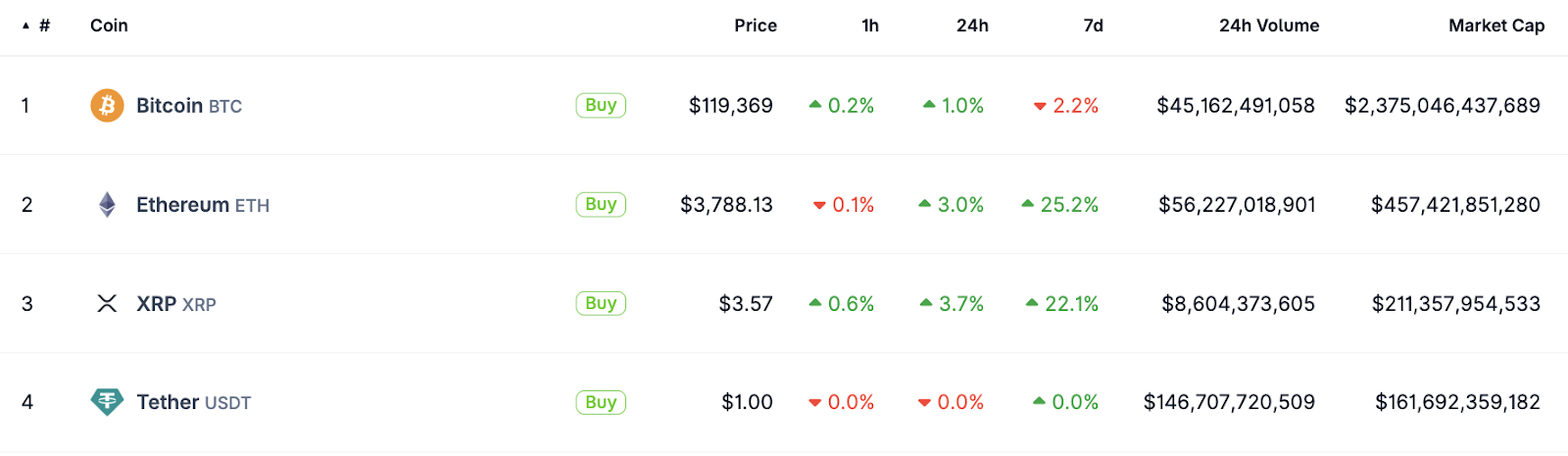
¿Es seguro USDT?
¿La respuesta corta? USDT vive en una zona gris entre “razonablemente seguro para lo que es” y “úsalo con cuidado”.
¿La respuesta un poco más larga? Esto es lo esencial:
Lo que juega a favor:
- Ha mantenido la paridad con el dólar durante múltiples crashes
- Está respaldado por una mezcla de efectivo, deuda pública y otros activos líquidos
- Es la stablecoin más aceptada en exchanges y plataformas
- Publica attestations periódicas de firmas contables
Lo que preocupa:
- Menos transparencia que algunos competidores
- Incertidumbre regulatoria y problemas legales en el pasado
- Riesgo de concentración (¿demasiado grande para caer… o demasiado grande para rescatar?)
- No está respaldado únicamente por efectivo
Realismo: USDT ha sobrevivido inviernos cripto, “bank runs” y presión regulatoria durante casi una década. No es libre de riesgo (nada en crypto lo es), pero ha demostrado más resistencia de la que muchos esperaban. Para trading y pagos a corto plazo, la mayoría lo considera fiable. Para guardar patrimonio a largo plazo… ahí conviene pensárselo dos veces.
Cómo se respalda USDT: entendiendo las reservas de Tether
Aquí se pone interesante y también donde nace gran parte del escrutinio.
En términos simples, USDT funciona como un “recibo digital”: depositas dólares y recibes tokens que puedes usar en el ecosistema. Pero ¿qué pasa con esos dólares? ¿Están quietos en una caja fuerte o se invierten?
Tether históricamente ha optado por invertir. En lugar de mantener solo efectivo, respalda USDT con una cartera diversificada de activos. Según su attestation de Q1 2025 firmada por BDO, las reservas se veían aproximadamente así:
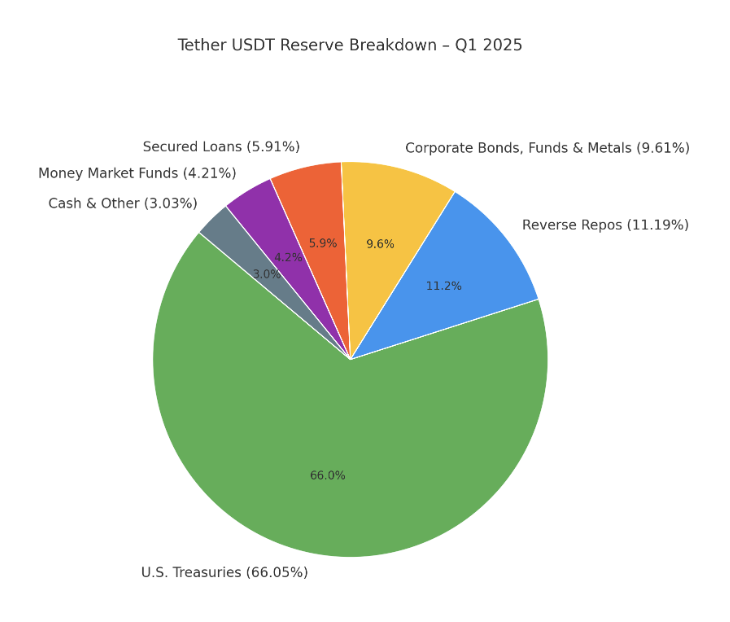
El giro hacia bonos del Tesoro de EE. UU. y la salida de activos más arriesgados fue una mejora importante en la calidad de reservas. Aunque no hay auditoría completa, Tether publica attestations trimestrales con BDO que aportan algo de visibilidad. No es una auditoría, pero es un avance frente a lo opaco de años anteriores.
Dicho esto, las controversias pasadas siguen pesando. En 2019, Tether admitió que USDT no estaba respaldado totalmente por efectivo en todo momento y reveló que había prestado 850 millones de dólares a Bitfinex, su empresa “hermana”. Esto acabó en un acuerdo con la fiscalía de Nueva York (NYAG) en 2021, que obligó a Tether a mejorar la transparencia y a dejar de operar en Nueva York.
En simple: imagina que tu banco presta depósitos de clientes a una empresa relacionada sin explicarlo claramente. Puede que no sea “ilegal” en todos los sentidos, pero sí rompe la confianza de quien esperaba un respaldo 1:1.
Escrutinio regulatorio y riesgos legales
Si USDT fuese una persona, tendría un expediente gordísimo en reguladores de medio mundo. Ser la stablecoin más grande te convierte en objetivo… pero Tether también ha estado en el punto de mira por la forma en la que ha comunicado y gestionado su modelo.
En Estados Unidos, Tether opera en una especie de “zona crepuscular” regulatoria. La empresa ha recibido presión de organismos como la CFTC, que multó a Tether con 41 millones de dólares en 2021 por declaraciones falsas sobre estar completamente respaldado por dólares.
La Unión Europea va por un camino más estructurado con MiCA, que exigirá que las stablecoins estén respaldadas por activos altamente líquidos. Esto podría jugar a favor de Tether, porque ya lleva tiempo moviéndose en esa dirección.
En mercados emergentes, el panorama es aún más caótico: algunos países adoptan USDT como cobertura ante monedas locales débiles, y otros lo prohíben directamente. Un “whack-a-mole” regulatorio global.
Para el usuario, el riesgo regulatorio suele ser indirecto. Si grandes jurisdicciones endurecen el marco contra Tether, podría afectar a la liquidez o a la facilidad de uso. Un cierre total e inmediato parece poco probable dado lo integrado que está USDT, pero sí puede haber más exigencias de cumplimiento que lo hagan más incómodo (como ha pasado con la banca tradicional con los años).
¿Qué tan seguro es USDT para mantener valor?
Aquí toca ser honestos sobre qué significa “seguro” en territorio cripto.
Corto plazo (días a semanas):
USDT funciona bastante bien. Para trading o para aparcar fondos entre movimientos, es como un buen hotel: no es tu casa para siempre, pero te sirve perfectamente unos días. La paridad ha aguantado de forma notable y la liquidez suele ser excelente.
Medio plazo (meses):
Aquí entra el matiz. USDT ha pasado “pruebas de estrés” duras: colapso de Terra/Luna, caída de FTX, sustos bancarios… Pero sigues dependiendo de que la gestión de reservas se mantenga sólida y de que no explote una bomba regulatoria.
Largo plazo (años):
Aquí muchos expertos levantan ceja. Mantener grandes cantidades en cualquier stablecoin durante años acumula riesgos: cambios regulatorios, mala gestión empresarial y los “unknown unknowns” de instrumentos financieros relativamente nuevos.
En esencia, USDT se parece a tener dinero en un banco extranjero: puede ir genial durante mucho tiempo, pero estás sujeto a leyes, regulaciones y prácticas fuera de tu jurisdicción.
Por eso, incluso quienes apoyan USDT rara vez recomiendan poner “todo” en Tether. Diversificar es la palabra.
Buenas prácticas de seguridad al usar USDT
Usar USDT “de forma segura” no es solo confiar en Tether: también es protegerte de todo lo que puede salir mal en crypto.
Gestión del riesgo de plataforma:
USDT es tan seguro como el lugar donde lo guardas. El token puede estar bien, pero si lo dejas en un exchange dudoso que quiebra o es hackeado, puedes perderlo todo. Quédate con plataformas reguladas y de buena reputación.
Estrategias de diversificación:
Mucha gente reparte stablecoins entre varios emisores y plataformas. Ejemplo típico: 40% USDT, 40% USDC y 20% en otras stablecoins o activos tradicionales. La idea es sencilla: no pongas todos tus huevos digitales en una sola cesta digital.
Si estás empezando:
Empieza pequeño, aprende el flujo, sube exposición poco a poco si te interesa. Usa exchanges establecidos, activa 2FA en todo, y trátalo como tu banca online. Porque, en la práctica, lo es.
USDT vs otras stablecoins
El mundo stablecoin no es un monopolio. Entender alternativas ayuda a poner los riesgos de USDT en perspectiva.
USDT vs USDC
USDT domina en uso y liquidez global: es la stablecoin más aceptada en exchanges, DeFi y “rails” de pago. Pero arrastra críticas por la falta de auditorías completas y por su historial de opacidad.
USDC, emitida por Circle, suele verse como la stablecoin “regulada”: publica attestations mensuales y mantiene una mezcla de reservas más conservadora (principalmente efectivo y Tesoros de EE. UU. a corto plazo).
- USDT: ideal para mercados rápidos y compatibilidad universal
- USDC: mejor para quien prioriza transparencia y supervisión regulatoria
USDT vs DAI
DAI va por otro camino. La emite MakerDAO y es descentralizada, respaldada por cripto colateral sobrecolateralizado (como ETH), no por fiat. No hay una empresa única: hay contratos inteligentes y gobernanza comunitaria.
DAI ofrece transparencia on-chain y evita custodios centralizados, pero implica más complejidad y riesgos propios: bugs de smart contracts o condiciones extremas de mercado.
- USDT: rapidez y simplicidad con estructura corporativa
- DAI: alternativa descentralizada para usuarios más DeFi-native
USDT vs BUSD
BUSD, antes grande (respaldada por Binance y Paxos), se fue apagando en 2024 por presión regulatoria. Es un recordatorio de que las stablecoins centralizadas dependen de cumplimiento y pueden “cerrarse” si el marco cambia.
USDT sigue en pie, pero el caso BUSD refuerza la importancia de mirar quién está detrás y cuán robusta es su operación.
¿Qué pasa si Tether falla?
Vamos con el escenario hipotético: ¿y si USDT colapsa?
Dado que USDT es el principal par de trading y fuente de liquidez en gran parte del mercado, una caída de Tether sería como quitar una autopista principal a una ciudad. Efectos probables:
- Caos de mercado: salida masiva de USDT hacia otros activos, presión brutal de venta y, potencialmente, la mayor “fire sale” de la historia cripto.
- Crisis de liquidez: muchos tokens pequeños dependen de pares con USDT; sin esa liquidez podrían volverse casi intradeables temporalmente.
- Efecto contagio: otras stablecoins podrían sufrir “runs” por pérdida de confianza sectorial, incluso las mejor gestionadas.
El lado “bueno”: el ecosistema es más resiliente que hace años. USDC y otras stablecoins han crecido, dando redundancia. Y el mercado ha sobrevivido a eventos que parecían de extinción.
Conclusión: ¿merece la pena el riesgo?
USDT no es perfecto, pero se ha ganado su lugar en crypto. Con liquidez altísima y aceptación global, es práctico para trading, pagos y almacenamiento de valor a corto plazo.
Aun así, las dudas sobre transparencia y claridad regulatoria lo hacen menos ideal para mantenerlo a largo plazo, especialmente si quieres máxima visibilidad. Como cualquier herramienta financiera, su “valor” depende del uso.
La jugada inteligente: entiende los trade-offs, diversifica entre stablecoins y alinea tu decisión con tus objetivos y tolerancia al riesgo. USDT sigue siendo útil… pero es solo una pieza dentro de una estrategia de finanzas digitales más amplia.

Orca es un exchange descentralizado (DEX) fácil de usar construido sobre la blockchain de Solana que emplea un sistema de creador de mercado automatizado (AMM) para ofrecer intercambios rápidos y comisiones bajas, al mismo tiempo que da a su comunidad una voz real en la evolución de la plataforma.
Imagina entrar en un mercado animado donde, en lugar de vendedores gritando y regateos interminables, todo funciona de forma fluida gracias a un sistema automático que te encuentra el mejor precio al instante. Suena bien, ¿no? Vamos a los detalles.
TL;DR
- DEX impulsado por Solana: construido sobre una blockchain rápida y barata usando un modelo AMM
- Enfoque centrado en el usuario: diseño intuitivo y herramientas útiles para operar
- Utilidad del token ORCA: sirve para gobernanza, incentivos de liquidez y recompensas por yield farming
- Funciones avanzadas: incluye CLAMM (liquidez concentrada) y Aquafarms
- Impulsado por la comunidad: gobernanza democrática e iniciativas ambientales y sociales
¿Qué es Orca (ORCA) y cómo funciona?
Piensa en Orca como el exchange “del barrio” que de verdad quiere que el trading cripto sea accesible para todos, no solo para los más técnicos. Mientras que algunos exchanges parecen el panel de control de una nave espacial, Orca se siente como una app bien diseñada que simplemente tiene sentido (sí, igual que Tap).
Orca como exchange descentralizado (DEX)
Orca opera como un DEX sobre Solana. La infraestructura de Solana permite procesar transacciones en segundos, no en minutos, y por céntimos en lugar de dólares. Eso significa swaps rápidos sin las esperas frustrantes ni las comisiones elevadas típicas de otras redes.
La gran ventaja de un DEX como Orca es que no hay una entidad central custodiando tus fondos ni decidiendo qué puedes o no operar. Los smart contracts hacen el trabajo pesado mientras tú mantienes el control total de tus activos.
¿Cómo funciona el creador de mercado automatizado (AMM)?
A diferencia de los exchanges tradicionales que usan libros de órdenes, los AMM trabajan con pools de liquidez. En lugar de esperar a que alguien quiera exactamente lo que tú vendes al precio que pides, intercambias directamente contra un pool que contiene dos tokens.
Imagina una piscina con cantidades equivalentes de dos tokens. Cuando añades uno, recibes el otro según una fórmula matemática. Cuanto más se intercambia un token, más “caro” se vuelve en relación con el otro, reflejando oferta y demanda.
Orca va un paso más allá con su CLAMM (Concentrated Liquidity AMM), que concentra la liquidez donde realmente ocurre el trading, haciendo los intercambios más eficientes y rentables.
¿Qué hace único a Orca?
En un mar de DEXs, Orca destaca por tomarse en serio la experiencia de usuario. En lugar de diseñar solo para desarrolladores, piensa en quienes alguna vez se sintieron perdidos usando DeFi.
Indicador de Precio Justo y Magic Bar
El Fair Price Indicator actúa como una alerta amistosa que te avisa si estás a punto de hacer un trade a un mal precio. Evita esos momentos de “ouch” cuando te das cuenta de que pagaste de más.
La Magic Bar facilita la búsqueda de tokens. Nada de copiar direcciones largas o rezar para no equivocarte al escribir el nombre: buscas y listo.
Diseño centrado en el usuario
La interfaz es clara y humana. Ves tus balances de forma sencilla y navegas sin complicaciones. Además, funciona bien en móvil, algo que muchos DEX todavía no consiguen.
Modelo de gobernanza DAO
Orca está avanzando hacia un modelo de organización autónoma descentralizada (DAO). Los holders de ORCA pueden votar sobre decisiones clave: nuevas funciones, cambios de comisiones o direcciones futuras del proyecto.
El sistema de gobernanza, construido sobre Solana Realms, es transparente y conecta el éxito de la plataforma con los beneficios de la comunidad. Más actividad = más valor para todos.
Iniciativas ambientales y sociales
En un sector criticado por su impacto ambiental, Orca destaca. En 2021 creó un fondo climático y ha donado a organizaciones como Ocean Conservancy y Rainforest Foundation. También lanzó Orcanauts, un proyecto NFT que refuerza la comunidad.
¿Para qué sirve el token ORCA?
ORCA no es solo un token especulativo; es el motor del ecosistema.
Gobernanza y votaciones
Cada token ORCA te da derecho a votar en decisiones sobre el futuro de la plataforma.
Yield farming y Aquafarms
Las Aquafarms permiten aportar liquidez y ganar ORCA como recompensa, combinando ingresos atractivos con el fortalecimiento del ecosistema.
Tesorería y crecimiento
Parte de las comisiones va a la tesorería controlada por la comunidad. A medida que Orca crece, el beneficio potencial también lo hace.
Tokenomics
ORCA tiene un suministro máximo de 100 millones. La distribución prioriza a la comunidad y el crecimiento del ecosistema, con un calendario de emisión diseñado para el largo plazo.
¿Es ORCA una buena inversión?
No hay bola de cristal. Pero sí factores a considerar.
Ventajas potenciales:
- Crecimiento del ecosistema Solana
- Fuerte enfoque en experiencia de usuario
- Incentivos DeFi y gobernanza
Riesgos clave:
- Posibles interrupciones de la red Solana
- Alta volatilidad del mercado cripto
- Incertidumbre regulatoria en DeFi
Este contenido es educativo y no constituye asesoramiento financiero.
Cómo comprar y almacenar ORCA
Comprar:
- Exchanges centralizados para principiantes
- DEXs con wallet de Solana para usuarios avanzados
Almacenar:
- Hot wallets como Phantom o Trust Wallet para uso frecuente
- Cold wallets como Ledger para máxima seguridad a largo plazo
Orca vs otras plataformas DeFi
- Orca vs Uniswap: Uniswap tiene más liquidez, pero comisiones más altas y menor velocidad. Orca gana en coste y experiencia de usuario.
- Orca vs Raydium: Raydium ofrece más funciones avanzadas; Orca destaca por simplicidad y comunidad.
Al final, la elección depende de tus prioridades: potencia y complejidad, o facilidad de uso y enfoque comunitario.

La revolución financiera no está ocurriendo en los edificios emblemáticos de Wall Street: está explotando en las pantallas de smartphones en aldeas rurales, pisos urbanos y comunidades migrantes en todo el mundo. Y mientras la banca tradicional sigue pidiendo tres documentos de identidad y un historial crediticio impecable, el fintech está reescribiendo las reglas de quién puede participar en la economía global.
La realidad es esta: 1.400 millones de adultos en el mundo siguen sin acceso a servicios bancarios, excluidos de herramientas financieras básicas que muchos damos por sentadas. En EE. UU., aproximadamente el 5,4% de los hogares (unos 5,6 millones de familias) no tiene relación con un banco o cooperativa de crédito. No son solo estadísticas: son personas pagando comisiones por cobrar cheques, cargando efectivo a todas partes y acumulando cero historial crediticio pese a trabajar en varios empleos.
Pero aquí viene lo interesante: el fintech no está poniendo “parches”. Está cambiando cómo funcionan los servicios financieros desde la raíz, creando caminos de participación económica que saltan por encima de los guardianes tradicionales.
Desde apps de banca móvil sin saldo mínimo hasta préstamos basados en blockchain que ignoran el score crediticio, la tecnología está democratizando las finanzas de formas que parecían imposibles hace apenas una década.
La pregunta ya no es si el fintech puede ayudar a los no bancarizados: ya lo está haciendo. La pregunta real es a qué velocidad puede escalar esta transformación y si logrará llegar a las comunidades que más lo necesitan.
Por qué tantas personas siguen sin acceso a servicios bancarios
Vamos a entrar en las barreras que mantienen a millones fuera de la banca tradicional. No es solo una cuestión de dinero, aunque claro, influye.
¿El culpable más obvio? Los propios bancos. Las instituciones tradicionales construyeron su modelo alrededor de evaluar riesgo, que normalmente significa: puntuaciones de crédito, verificación de ingresos y requisitos de documentación que excluyen a grandes partes de la población.
Si eres inmigrante sin historial crediticio, trabajador “gig” con ingresos irregulares o alguien que ya fue quemado por prácticas abusivas en el pasado… conseguir una simple cuenta corriente con facilidades de crédito puede ser una misión.
La accesibilidad geográfica también pesa mucho. Las zonas rurales han visto desaparecer sucursales a una velocidad brutal: desde 2009, han cerrado más de 10.000 sucursales bancarias en el Reino Unido. Si el banco más cercano está a 80 km y trabajas dos empleos para llegar a fin de mes, mantener una relación bancaria tradicional se vuelve casi imposible.
Luego está la confianza. Muchas personas no bancarizadas vienen de comunidades donde los bancos han sido más extractivos que útiles. ¿Por qué confiar en una institución que cobra comisiones por sobregiro diseñadas para atraparte en ciclos de deuda? Para muchos, el efectivo se siente más seguro y transparente que navegar cargos ocultos y términos complejos.
La alfabetización digital añade otra capa de exclusión. Aunque el fintech promete soluciones “mobile-first”, siguen exigiendo smartphone, conexión y conocimientos para manejar apps cada vez más complejas. Para personas mayores o con acceso irregular a internet, la banca digital puede sentirse más como muro que como puente.
El impacto demográfico lo deja claro: inmigrantes, jóvenes construyendo su primera identidad financiera, trabajadores gig cuyos ingresos no encajan en los modelos tradicionales y poblaciones rurales donde la infraestructura va por detrás. No son nichos: son segmentos que crecen rápido dentro de la fuerza laboral.
Las limitaciones de la banca tradicional
Aquí va una verdad incómoda: la banca tradicional fue diseñada para otra época, cuando el empleo era estable, el historial de crédito era lineal y las relaciones financieras duraban décadas. La economía actual no funciona así, pero muchos bancos no se han actualizado.
El sistema FICO lo resume perfecto. Nació en 1989 y reduce tu “valor financiero” a un número, ignorando señales como pagos puntuales de alquiler, facturas de servicios o patrones de pago del móvil. Si nunca tuviste tarjeta de crédito o un préstamo tradicional, eres invisible para el sistema que decide si puedes acceder a servicios básicos.
Y las comisiones lo empeoran. La comisión media por sobregiro en EE. UU. ronda los 35 USD, y las comisiones de mantenimiento pueden sumar 200 USD o más al año en cuentas “básicas”. Para alguien que vive al día, no es una molestia: es devastador.
La burocracia cierra el círculo: abrir una cuenta suele exigir prueba de domicilio, verificación laboral, números de seguridad social, y a menudo un depósito mínimo. Para inmigrantes sin documentación, personas que se mudan frecuentemente o quienes están entre trabajos, estos requisitos son barreras imposibles.
Además, los bancos tradicionales tienen dificultades para personalizar a escala. Están pensados para perfiles de clase media con ingresos predecibles, no para gig workers con ingresos variables o pequeños negocios que necesitan crédito flexible. Resultado: productos que no encajan con la vida real.
Cómo el fintech está cambiando las reglas
El fintech no es una cura milagrosa, pero sí está revolucionando las finanzas dándole la vuelta al modelo: en vez de obligar a la gente a adaptarse a sistemas viejos, crea sistemas que encajan con cómo la gente vive y trabaja.
Banca móvil y wallets digitales
Apps como Chime, Venmo y Cash App han destruido muchas barreras de entrada. Chime ofrece banca sin comisiones, sin saldo mínimo y con depósito anticipado: te pagan hasta dos días antes. Para alguien viviendo al día, cobrar dos días antes puede ser la diferencia entre pagar el alquiler o comerse penalizaciones.
Venmo simplificó los pagos P2P: de transferencias engorrosas a “como mandar un mensaje”. Cash App fue más allá con inversión, compra de Bitcoin y cobros para pequeños negocios en una sola app gratuita.
Y cada vez más, plataformas como Tap también entran en juego: no solo como wallet, sino como ecosistemas integrados que combinan gasto, ahorro y acceso transfronterizo para usuarios desatendidos. No son “bancos simplificados”: son enfoques distintos, diseñados para accesibilidad y experiencia, no para monetizarte con comisiones ocultas.
Préstamos P2P y construcción de crédito
La revolución del crédito es aún más intensa. Plataformas como Avant y Earnest, y también protocolos más recientes de cripto-préstamos, usan datos alternativos e IA para evaluar riesgo de formas que la banca tradicional no contempla.
En lugar de depender solo del score crediticio, analizan patrones de pago del móvil, historial de ingresos, comportamiento financiero y más. Están creando perfiles de crédito para personas que antes eran invisibles para el sistema, abriendo rutas de crecimiento que no existían.
El préstamo P2P elimina al banco del medio, conectando prestatarios con prestamistas individuales o pools de capital. Eso puede traducirse en tasas más competitivas y condiciones más flexibles, especialmente para quienes no encajan en el molde tradicional.
Micro-inversión y herramientas para crear patrimonio
Apps como Robinhood, Acorns y jugadores internacionales han democratizado la inversión al eliminar mínimos y reducir fricción. Acorns redondea tus compras e invierte el “cambio”, permitiendo construir una cartera con céntimos.
Esto redefine la inversión para quienes no nacieron con ventaja. Educación, interfaces simples y acciones fraccionadas hacen posible que alguien con salario mínimo empiece a construir patrimonio con herramientas antes reservadas a grandes patrimonios.
DeFi y blockchain como acceso financiero
La DeFi es la reinvención más radical: plataformas sobre Ethereum permiten prestar, pedir prestado y generar rendimiento sin instituciones tradicionales. Los smart contracts ejecutan acuerdos automáticamente, sin bancos, sin burocracia y sin fronteras.
Las wallets cripto ofrecen servicios financieros a cualquiera con smartphone e internet, sin importar documentación, historial o ubicación. Aun siendo un sector joven y volátil, la DeFi mueve miles de millones y demuestra que sistemas alternativos pueden operar a escala.
Beneficios reales del fintech para los no bancarizados
Las ventajas no son teoría: están cambiando vidas.
Accesibilidad: servicios 24/7 desde un teléfono. Si trabajas de noche o tienes dos trabajos, gestionas tus finanzas cuando puedes, no cuando abre una sucursal.
Asequibilidad: menos costes operativos = menos comisiones para el usuario. Sin sucursales físicas ni sistemas heredados caros, muchas plataformas pueden ofrecer cuentas y transferencias con costes mínimos o nulos.
Velocidad: decisiones de crédito en minutos, no semanas. Cuando el coche se rompe y necesitas trabajar mañana, esa diferencia es supervivencia.
Transparencia, transparencia, transparencia: datos en tiempo real, comisiones claras, términos directos. Menos sorpresas, menos cargos “misteriosos”.
Datos en lugar de moldes viejos: personalización basada en patrones reales de gasto, ingresos variables y objetivos financieros. Menos producto “talla única”.
Menos exposición a usura: marketplaces competitivos y algoritmos transparentes dificultan prácticas como los payday loans abusivos.
Casos reales y ejemplos
Los mejores “proof points” se ven en la calle.
- Gig workers en EE. UU.: apps como Earnin permiten acceder a ingresos antes del día de pago, reduciendo dependencia de préstamos abusivos. DoorDash y DasherDirect ofrecen acceso inmediato a ganancias y cashback en gasolina: servicios pensados para la economía gig.
- África y el dinero móvil: M-Pesa en Kenia procesa más transacciones al año que Western Union a nivel global. Permite enviar dinero, pagar facturas y acceder a microcréditos incluso con móviles básicos. Más del 80% de adultos en Kenia usa servicios de dinero móvil.
- LatAm y neobancos: Nubank en Brasil supera los 70 millones de clientes, con banca sin comisiones y construcción de crédito para quien antes no tenía acceso. En México, Clip permite a micronegocios y vendedores aceptar pagos sin infraestructura bancaria tradicional.
No son excepciones: son un mapa del futuro.
Barreras que el fintech aún no ha resuelto
Aun con el potencial, hay obstáculos duros.
- Brecha de alfabetización digital + acceso a smartphone/internet: no todo el mundo tiene conectividad estable o comodidad con apps financieras.
- Regulación: KYC/AML y licencias varían por país; escalar globalmente es complejo. La incertidumbre cripto/DeFi añade fricción.
- Infraestructura: regiones con mala cobertura limitan servicios más sofisticados.
- Desconfianza hacia cripto/DeFi: volatilidad, complejidad y estafas generan rechazo, incluso entre quienes más podrían beneficiarse.
- Barreras culturales: donde el efectivo manda desde siempre, el cambio no es solo tecnológico: es de hábitos y confianza, y eso toma tiempo.
Qué viene: innovación e inclusión
La siguiente ola puede ser aún más grande.
- IA y personalización extrema: asesoría financiera “tipo wealth management” para todos, y modelos de crédito más inclusivos.
- Open banking: obligará a instituciones a compartir datos (con permiso), acelerando competencia e innovación.
- Marco regulatorio más claro + CBDCs: alternativas respaldadas por gobiernos podrían ampliar inclusión donde el mercado no llega.
- Identidad digital en blockchain: podría eliminar barreras de documentación, permitiendo reputación financiera independiente del sistema tradicional.
- Convergencia tecnológica: IoT para financiación de cadenas de suministro, AR para educación financiera, 5G para pagos globales en tiempo real.
Conclusión
El fintech no solo está “disrumpiendo” la banca: está democratizando la participación económica global.
Desde el dinero móvil que transformó economías en África hasta soluciones de pago para trabajadores gig en ciudades de EE. UU., la tecnología demuestra que la inclusión financiera no es solo correcta: es inevitable.
Pero el trabajo no está terminado. Todavía hay brechas, infraestructura por construir y confianza que ganar. Aun así, la dirección es clara: servicios más accesibles, asequibles y alineados con cómo vive la gente hoy.
Los avances más potentes llegarán de la colaboración entre innovadores fintech, reguladores y organizaciones comunitarias que entienden necesidades locales.
Los no bancarizados no están esperando permiso para participar. Ya están usando las herramientas que tienen para construir estabilidad. El reto del fintech es que esas herramientas sean más seguras, más potentes y diseñadas de verdad para sus vidas reales.
La revolución financiera está ocurriendo, con o sin la banca tradicional. La pregunta es si construiremos un sistema que incluya a todos… o que siga dejando a millones atrás.

El apalancamiento en el trading de criptomonedas es como añadir combustible de cohete a tu cartera: puede disparar tus beneficios o convertir tu inversión en un espectáculo de fuegos artificiales que termina en cenizas. Si te preguntas si el trading con apalancamiento es para ti, vas por buen camino. La respuesta no es un simple sí o no, depende de tu experiencia, tu tolerancia al riesgo y tu estrategia.
Vamos a profundizar en el mundo del apalancamiento en cripto para que tomes una decisión informada y evites lamentarte frente a una cartera vacía.
¿Qué es el apalancamiento en el trading de criptomonedas?
El apalancamiento te permite controlar una posición mayor de lo que permitiría tu saldo real. Es, en esencia, pedir dinero prestado al exchange para amplificar tu poder de trading. Con un apalancamiento de 10x, por ejemplo, puedes operar con 10.000 $ aportando solo 1.000 $ propios.
Es importante distinguir entre apalancamiento y margen. El apalancamiento es la proporción (2x, 5x, 100x), mientras que el margen es la garantía que aportas. Para abrir una posición de 5.000 $ con 5x, necesitarías 1.000 $ de margen.
Los ratios de apalancamiento pueden ir desde conservadores 2x hasta extremos 100x o incluso 125x en algunas plataformas. A mayor apalancamiento, mayor potencial de ganancia, pero también un riesgo mucho mayor de liquidación.
¿Cómo funciona el trading con apalancamiento en cripto?
Al abrir una posición apalancada, el exchange te presta fondos para aumentar tu exposición al mercado. Tu margen queda como garantía y se te cobra una comisión o tasa de financiación por usar ese capital.
El mecanismo es simple: depositas el colateral, eliges el apalancamiento y abres la posición. El exchange monitoriza constantemente tu saldo. Si las pérdidas se acercan al valor de tu margen, se produce la liquidación, cerrando automáticamente la posición para evitar que pierdas más de lo aportado.
El apalancamiento suele operar a través de futuros, swaps perpetuos u opciones. Los swaps perpetuos son los más populares, ya que no tienen vencimiento y siguen de cerca el precio del activo subyacente mediante tasas de financiación.
Ejemplos reales de operaciones apalancadas
Veamos algunos escenarios concretos. Supón que abres una posición en Bitcoin de 1.000 $ con apalancamiento 10x cuando BTC cotiza a 50.000 $. Tu exposición real es de 10.000 $, controlando 0,2 BTC.
Escenario 1: Bitcoin sube a 55.000 $ (un 10 %). Tu posición gana 1.000 $, duplicando tu inversión inicial.
Escenario 2: Bitcoin baja a 45.000 $ (un 10 %). Tu posición pierde 1.000 $ y es liquidada, perdiendo todo tu margen.
Nota: algunas plataformas liquidan antes de una caída completa del 10 % debido al margen de mantenimiento y comisiones, a menudo alrededor de una caída del 8–9 % con apalancamiento 10x.
En un ejemplo más conservador, con apalancamiento 5x en Ethereum y 500 $ de margen a un precio de 3.000 $, controlas 2.500 $ en ETH. Una caída del 15 % hasta 2.550 $ supondría una pérdida de 375 $, dejándote con 125 $ y muy cerca de la liquidación.
Estos ejemplos muestran cómo pequeños movimientos del mercado pueden tener grandes efectos en tu cartera cuando usas apalancamiento.
Tipos de margen: aislado vs. cruzado
Entender los tipos de margen es clave para gestionar el riesgo.
El margen aislado limita el riesgo a una posición concreta. Si una operación sale mal, no afecta al resto de tu cuenta. Solo puedes perder el margen asignado a esa posición.
El margen cruzado utiliza todo el saldo disponible como garantía para todas las posiciones. Puede ayudar a evitar liquidaciones al añadir margen automáticamente, pero un solo error puede borrar toda la cuenta.
El margen aislado suele ser más seguro para principiantes, ya que limita las pérdidas por operación. El margen cruzado ofrece más flexibilidad, pero requiere una gestión del riesgo más avanzada.
¿Cuáles son los riesgos de usar apalancamiento?
El mayor riesgo es la liquidación, y los mercados cripto son extremadamente volátiles. Bitcoin puede moverse fácilmente un 5–10 % en un solo día. Con apalancamiento 10x, un movimiento adverso del 10 % equivale a perder el 100 % del margen.
El sobreapalancamiento es uno de los errores más comunes. La tentación de usar el máximo apalancamiento es grande, pero cuanto mayor es, menor es el margen de error.
El trading emocional se intensifica con apalancamiento. El estrés puede llevar a malas decisiones, a operar por revancha y al llamado “riesgo de ruina”, cuando las pérdidas impiden seguir operando de forma efectiva.
En resumen, la volatilidad del mercado cripto, combinada con apalancamiento, crea una tormenta perfecta para destruir cuentas rápidamente.
¿Cuáles son las ventajas del apalancamiento?
A pesar de los riesgos, el apalancamiento tiene ventajas para traders experimentados. La principal es la amplificación de retornos: una subida del 5 % puede convertirse en un 50 % con apalancamiento 10x. Esto permite eficiencia de capital y mantener fondos libres para otras oportunidades.
También facilita estrategias avanzadas como cobertura y ventas en corto. Puedes beneficiarte de mercados bajistas o proteger posiciones spot con posiciones opuestas.
Para quienes tienen poco capital, el apalancamiento permite acceder a exposiciones relevantes sin grandes inversiones iniciales.
¿Deberían los principiantes usar apalancamiento?
Para la mayoría de principiantes, la respuesta es no. El apalancamiento exige comprensión del mercado, gestión del riesgo y control emocional, habilidades que se desarrollan con el tiempo.
Si aun así quieres probar, hazlo con extrema cautela. Usa apalancamiento bajo, como 2x o 3x, y solo arriesga capital que puedas perder por completo. Utiliza margen aislado y no arriesgues más del 1–2 % de tu capital en una sola operación.
La regla de oro: domina primero el trading spot. Aprende análisis de mercado y disciplina antes de añadir apalancamiento. Es una herramienta avanzada, no un atajo.
Cómo gestionar el riesgo al usar apalancamiento
La gestión del riesgo es la diferencia entre sobrevivir y quemar la cuenta.
El tamaño de la posición es crucial. Nunca arriesgues más de lo que puedes perder. Muchos traders siguen la regla del 1 %.
Los stop-loss son imprescindibles. Deben establecerse antes de entrar en la operación. Calcula también la relación riesgo-beneficio; muchos traders buscan al menos 2:1.
La diversificación es aún más importante con apalancamiento. No concentres todo en un solo activo o sector.
¿Es legal el trading con apalancamiento en cripto?
La regulación varía según el país. En Estados Unidos, el apalancamiento está muy restringido. En otros países, los traders pueden acceder a ratios más altos, pero con menor protección regulatoria.
Siempre verifica la normativa local antes de operar con apalancamiento.
Veredicto final
¿Deberías usar apalancamiento al operar con criptomonedas? Depende de si estás preparado para manejar una herramienta de doble filo.
Tiene sentido si ya eres rentable en spot, tienes una gestión del riesgo sólida y puedes tolerar grandes fluctuaciones. No es una solución mágica.
Evítalo si eres nuevo, operas por impulso o usas dinero que necesitas para gastos básicos. El mercado seguirá ahí cuando estés listo.
La conclusión es clara: el cripto ofrece oportunidades sin necesidad de apalancamiento. Domina primero los fundamentos y considera el apalancamiento como un instrumento de precisión, no como un boleto de lotería. El objetivo es mantenerse en el juego el tiempo suficiente para hacer crecer tus habilidades y tu capital.

Has escuchado las historias. Alguien compró Bitcoin por unos pocos dólares y hoy tiene la vida resuelta. Tal vez sea un amigo, una noticia o esa persona que no deja de hablar de cripto. Y ahora te preguntas: “¿Es demasiado tarde para comprar Bitcoin?”
No estás solo. La gente ha hecho esta misma pregunta en todos los niveles de precio: cuando Bitcoin llegó a 100 $, 1.000 $, 10.000 $, incluso 100.000 $. Algunos entraron, otros esperaron convencidos de que ya habían perdido su oportunidad.
Esta es la realidad: intentar acertar el momento del mercado es muy difícil. Lo que hoy parece “demasiado tarde” puede verse como el momento perfecto dentro de unos años. O quizá realmente sí sea tarde. Nadie lo sabe con certeza.
Esta guía desglosa lo que necesitas saber. Analizaremos la volátil historia del precio de Bitcoin, dónde se encuentra hoy y los argumentos a favor y en contra. Tendrás la información necesaria para tomar tu propia decisión, porque al final eso es exactamente lo que es: una decisión personal.
La historia del precio de Bitcoin y sus ciclos de mercado
Entender de dónde viene Bitcoin ayuda a poner los precios actuales en contexto. Hagamos un recorrido rápido.
Los primeros años (2009-2013)
Bitcoin comenzó como un experimento. En 2009 no tenía precio; la gente solo estaba probando este nuevo tipo de dinero digital. La primera transacción registrada fue la compra de dos pizzas por 10.000 Bitcoin. Hoy, esas pizzas valdrían cientos de millones.
Para 2013, Bitcoin había subido hasta unos 100 $. Quienes compraron entonces eran considerados locos por amigos y familiares. “Dinero digital de Monopoly”, decían. Sin embargo, esos “locos” vieron crecer su inversión más de 100 veces en los años siguientes.

El primer gran rally (2014-2017)
Aquí Bitcoin empezó a llamar la atención en serio. El precio fue muy volátil, cayó hasta unos 200 $ en 2015 y luego se disparó. A finales de 2017, Bitcoin rozó los 20.000 $.
De repente, todo el mundo hablaba de ello. Tu dentista te daba consejos cripto. El tipo del supermercado miraba el precio de Bitcoin en su móvil. Comportamiento clásico de burbuja.
El invierno cripto (2018-2020)
Luego llegó el golpe de realidad. En 2018, Bitcoin se desplomó hasta alrededor de 3.200 $. Quienes habían comprado cerca del máximo estaban en pérdidas enormes. Muchos vendieron con pérdidas y juraron no volver a tocar cripto.
Este periodo enseñó una lección clave: Bitcoin se mueve en ciclos. Grandes subidas, grandes caídas y largos periodos de aparente calma.
La era institucional (2021-presente)
Algo cambió alrededor de 2020. Grandes empresas empezaron a comprar Bitcoin. Tesla lo añadió a su balance. PayPal permitió a sus clientes comprarlo. Dejó de ser algo solo para tecnólogos.
Bitcoin alcanzó nuevos máximos históricos, volvió a caer y luego se recuperó. El patrón se repitió, pero con una diferencia clave: los actores institucionales ya estaban dentro.
Dónde se encuentra Bitcoin en 2025
Avanzando hasta hoy, Bitcoin ha pasado por múltiples ciclos, ha sobrevivido a incontables predicciones de su “muerte” y sigue recuperándose. Pero ¿dónde estamos exactamente?
Sentimiento actual del mercado
El mercado de Bitcoin hoy se siente diferente. Hay menos especulación salvaje y más interés medido. Aún existen predicciones extremas, pero también hay fondos de pensiones añadiéndolo discretamente a sus carteras.
Adopción institucional
Las grandes instituciones financieras ya ofrecen servicios relacionados con Bitcoin. Existen ETFs que puedes comprar desde una cuenta de inversión tradicional. Algunas empresas lo mantienen como reserva de tesorería. Algo impensable en los primeros años.
Panorama regulatorio
Los gobiernos siguen definiendo cómo regular Bitcoin, pero el enfoque ha cambiado. En lugar de intentar prohibirlo, la mayoría trabaja en marcos regulatorios. Esto genera incertidumbre a corto plazo, pero puede aportar estabilidad a largo plazo.
Por qué muchos sienten que “llegaron tarde”
Seamos honestos con la psicología. Hay razones reales por las que Bitcoin intimida a los nuevos.
Cada artículo menciona a alguien que se hizo millonario con una pequeña inversión. Es cierto, pero son casos poco comunes. Es como escuchar historias de ganadores de la lotería: inspiran, pero no son una estrategia.
Los medios amplifican lo extremo. “Bitcoin cae un 50 %” genera más clics que “Bitcoin sigue siendo volátil”. Esto distorsiona la percepción de lo que es normal.
Cuando Bitcoin cuesta decenas de miles de dólares, comprar “un Bitcoin” parece imposible. Pero muchos no saben que se pueden comprar fracciones. No necesitas uno entero.
Por qué NO es demasiado tarde
- Oferta limitada frente a demanda creciente
- El concepto de “oro digital” aún está en desarrollo
- La adopción global apenas comienza
- La infraestructura tecnológica sigue mejorando
Por qué PODRÍA ser demasiado tarde
- La volatilidad sigue siendo extrema
- Persisten las incertidumbres regulatorias
- Existen preocupaciones medioambientales
- Hay competencia de otras tecnologías
Enfoques inteligentes para invertir en Bitcoin
Promedio del coste en el tiempo
Invertir pequeñas cantidades de forma regular reduce el impacto de la volatilidad.
Estrategia del “dinero del café”
Invertir solo lo que gastarías en pequeños lujos cotidianos.
Definir horizontes temporales claros
Pensar en Bitcoin como una inversión a largo plazo reduce el estrés.
Tamaño de posición responsable
Nunca invertir más de lo que puedes permitirte perder.
Perspectivas de expertos
Los asesores financieros tradicionales están divididos. Algunos recomiendan pequeñas asignaciones (1-5 %), otros siguen siendo escépticos. DYOR.
Los analistas cripto van desde muy optimistas hasta moderados, pero coinciden en que la volatilidad seguirá siendo alta.
La historia de otras tecnologías disruptivas muestra patrones similares de adopción en oleadas.
Alternativas para exponerte a Bitcoin
ETFs de Bitcoin
Exposición sin gestionar wallets, pero sin propiedad directa.
Acciones de minería
Correlacionadas con el precio, con riesgos empresariales añadidos.
Inversiones en tecnología blockchain
Exposición al ecosistema más amplio.
Errores comunes a evitar
- Invertir dinero que no puedes permitirte perder
- Intentar acertar el momento perfecto
- Caer en esquemas de enriquecimiento rápido
- Descuidar la seguridad
- Tomar decisiones emocionales
Conclusión: tomar tu decisión
¿Es demasiado tarde para comprar Bitcoin? Nadie lo sabe con certeza.
Bitcoin ha superado múltiples ciclos y sigue atrayendo interés institucional, pero sigue siendo volátil y especulativo. Tu decisión debe basarse en tu situación financiera, tolerancia al riesgo y horizonte temporal.
No hay prisa. Aprender más y esperar también es una decisión válida. Lo importante es que la elección te permita dormir tranquilo por la noche.

Quien lleve tiempo en el espacio cripto sabe que durante años ha estado dominado por titulares sobre oscilaciones dramáticas de precios, meme coins virales y frenesíes especulativos. Aunque estas historias captan la atención del público, eclipsan un desarrollo mucho más importante: la construcción constante de infraestructura digital que está redefiniendo silenciosamente cómo entendemos el dinero, la propiedad y la coordinación global.
Esta infraestructura, compuesta por protocolos, redes y plataformas, representa la capa fundacional sobre la que se construirá la economía digital del futuro. Comprender su importancia exige mirar más allá del ruido de la especulación de mercado y examinar el lecho tecnológico que hace posibles las aplicaciones descentralizadas, las finanzas globales y nuevas formas de cooperación digital.
Algunos dirán que el paso de una conciencia superficial sobre cripto a una apreciación profunda de su infraestructura se parece a la evolución temprana de internet. Así como en los años 90 pocos entendían los protocolos TCP/IP mientras navegaban por la web, hoy muchos usuarios interactúan con una infraestructura cripto sofisticada sin reconocer su complejidad ni su potencial. Así que vayamos a ello.
Entendiendo la infraestructura cripto
La infraestructura cripto abarca los sistemas fundamentales que permiten que las redes descentralizadas funcionen. En su núcleo están las blockchains de Capa 1 como Bitcoin y Ethereum, que actúan como capas base de liquidación. Las soluciones de Capa 2 se construyen sobre estas bases y ofrecen transacciones más rápidas y costos reducidos, manteniendo la seguridad de la cadena subyacente.
Más allá de las propias capas de blockchain, la infraestructura cripto incluye redes de almacenamiento descentralizado, sistemas de oráculos que conectan blockchains con datos del mundo real, puentes entre cadenas y plataformas de contratos inteligentes que habilitan dinero programable y acuerdos automatizados.
Aquí vuelve la comparación con el desarrollo de la infraestructura de internet. Así como internet necesitó protocolos fundamentales como TCP/IP para la transmisión de datos y HTTP para la navegación web, cripto requiere su propio stack de protocolos interoperables. La introducción de los contratos inteligentes por parte de Ethereum en 2015 fue comparable a la evolución de la web desde páginas estáticas hacia aplicaciones dinámicas, habilitando lo que hoy llamamos Web3.
Esta infraestructura muestra composabilidad, permitiendo que distintos protocolos y aplicaciones interactúen sin fricciones y generen efectos de red donde cada nuevo componente incrementa la utilidad de los existentes.
Por ejemplo, un exchange descentralizado puede integrarse con un protocolo de préstamos, que a su vez se conecta con una plataforma de seguros, todo funcionando sobre infraestructura compartida y hablando el mismo lenguaje digital.
El papel de la infraestructura en casos de uso reales
Quizá el caso más maduro de uso de infraestructura cripto sea el de las finanzas descentralizadas (DeFi). Plataformas como Uniswap han procesado cientos de miles de millones en volumen de trading sin intermediarios tradicionales, mientras que los protocolos de préstamos permiten mercados de crédito globales que operan 24/7 sin restricciones geográficas. Esto no son experimentos teóricos, son sistemas financieros en funcionamiento que atienden a millones de usuarios.
Los tokens no fungibles (NFTs), pese a su fuerte asociación con mercados especulativos de arte, demuestran capacidades de infraestructura para la propiedad digital y la trazabilidad. La tecnología subyacente habilita desde el seguimiento de cadenas de suministro hasta la verificación de identidad digital, con aplicaciones que van mucho más allá de los coleccionables.
Otro ejemplo son las organizaciones autónomas descentralizadas (DAOs), que muestran cómo la infraestructura cripto permite nuevas formas de gobernanza y coordinación. Organizaciones como MakerDAO gestionan protocolos de miles de millones mediante votación basada en tokens, mientras DAOs más pequeñas coordinan desde financiación de investigación hasta gestión comunitaria sin estructuras corporativas tradicionales.
Las remesas globales evidencian el impacto práctico de esta infraestructura. Las transferencias internacionales tradicionales suelen tardar días y conllevan comisiones elevadas, especialmente para usuarios de países en desarrollo. En cambio, la infraestructura cripto permite transferencias casi instantáneas y de bajo costo que evitan los sistemas bancarios heredados, aportando inclusión financiera a poblaciones desatendidas.
Más allá de las finanzas, redes de almacenamiento como Filecoin e IPFS muestran cómo los principios cripto se aplican a otros ámbitos. Estos sistemas crean alternativas descentralizadas al almacenamiento en la nube centralizado, con incentivos criptoeconómicos que garantizan la persistencia y disponibilidad de datos sin depender de garantías corporativas.
Por último, las redes de oráculos como Chainlink conectan los sistemas blockchain con datos externos, permitiendo que los contratos inteligentes respondan a eventos del mundo real. Este componente es esencial para aplicaciones que van desde seguros agrícolas hasta mercados de predicción.
Por qué la infraestructura supera al hype
Los ciclos de hype son inevitables en tecnologías emergentes. Internet los vivió con la burbuja puntocom y la especulación en redes sociales, pero la infraestructura subyacente siguió evolucionando durante esos periodos.
Cripto sigue un patrón similar: los excesos especulativos acaparan titulares, pero el desarrollo de infraestructura continúa independientemente del sentimiento del mercado.
- La innovación en blockchains de Capa 1 avanza pese a la volatilidad de precios.
- La transición de Ethereum a proof of stake redujo el consumo energético en más de un 99% manteniendo la seguridad.
- Surgen constantemente nuevos mecanismos de consenso y soluciones de escalado que abordan limitaciones anteriores mediante iteración tecnológica, no promesas de marketing.
Las soluciones de Capa 2 han madurado notablemente. Plataformas como Arbitrum y Polygon procesan miles de transacciones por segundo a costos ínfimos sin aparecer en portadas. Estos avances resuelven problemas reales que habilitan una adopción más amplia, creando valor a través de la utilidad y no de la especulación.
La infraestructura garantiza utilidad a largo plazo al centrarse en capacidades fundamentales y no en la apreciación de precios a corto plazo. Una plataforma robusta de contratos inteligentes conserva su valor tanto si el token vale 10 como 10.000, porque su utilidad proviene de habilitar nuevos modelos de negocio y aplicaciones.
Blockchains públicas: acceso root para todos
Las blockchains públicas ofrecen algo sin precedentes en sistemas digitales: acceso root para usuarios comunes. En informática tradicional, el acceso root otorga control total sobre un sistema y suele estar reservado a administradores. Las blockchains públicas extienden privilegios similares a cualquiera con conexión a internet, permitiendo interacción directa con infraestructura financiera global sin permisos de intermediarios.
Esto supone un cambio fundamental en soberanía digital. Los usuarios pueden mantener activos, ejecutar contratos y participar en gobernanza sin depender de bancos, corporaciones o gobiernos para mantener cuentas o procesar transacciones. La infraestructura opera según reglas transparentes codificadas en software, no políticas opacas sujetas a cambios arbitrarios.
La gobernanza compartida surge de forma natural, ya que los cambios de protocolo requieren consenso comunitario. Los sistemas evolucionan mediante participación democrática y no decisiones corporativas centralizadas. Los holders de tokens votan sobre actualizaciones, comisiones y asignación de recursos, participando en gobernanza económica a una escala antes imposible.
La interoperabilidad se beneficia de estándares abiertos y protocolos compartidos, permitiendo integraciones fluidas. Una wallet puede funcionar en múltiples plataformas, un protocolo de préstamos puede obtener liquidez de varios exchanges, y los sistemas de identidad pueden portar credenciales entre servicios.
Además, la resistencia a la censura pasa de ser un ideal teórico a una realidad práctica. Las transacciones se ejecutan según reglas del protocolo, no políticas institucionales, brindando acceso financiero independientemente del estatus político, ubicación geográfica o condición social. Esto ha sido especialmente valioso en países con controles de capital o inestabilidad política.
Limitaciones y críticas
Celebrar avances exige reconocer desafíos. La escalabilidad sigue siendo un reto significativo. Bitcoin procesa alrededor de siete transacciones por segundo y Ethereum unas quince, muy por debajo de la capacidad teórica de Visa. Esta comparación simplifica en exceso los trade-offs, ya que las soluciones de Capa 2 y nuevos consensos mejoran el rendimiento manteniendo descentralización y seguridad.
El consumo energético, especialmente en proof of work como Bitcoin, es otra crítica frecuente. Sin embargo, el relato mediático suele ignorar que la minería usa cada vez más energías renovables, que sistemas proof of stake consumen energía mínima y que la huella energética del sistema financiero tradicional rara vez se contabiliza por completo.
En gobernanza, pueden surgir tensiones entre descentralización y coordinación. Forks como Bitcoin Cash y Ethereum Classic muestran divisiones por desacuerdos técnicos o filosóficos. Aunque disruptivos, también demuestran la capacidad del sistema para acomodar visiones distintas sin imponer consenso.
El Banco de Pagos Internacionales (BIS) ha señalado preocupaciones sobre confianza, escalabilidad e integración institucional. Estas observaciones resaltan retos reales: confianza en criptografía en lugar de garantías institucionales, trade-offs en escalado y complejidad de integración con sistemas existentes.
Muchas críticas, sin embargo, pasan por alto avances en curso. Decir que “cripto es lento” ignora innovaciones de Capa 2 que alcanzan velocidades comparables a sistemas tradicionales. Afirmar que “Bitcoin consume demasiada energía” omite alternativas proof of stake y el uso creciente de renovables.
Un nuevo paradigma: la economía cripto
La economía cripto transforma cómo los sistemas digitales crean valor. Las plataformas tradicionales extraen valor mediante datos y atención de usuarios. La infraestructura cripto invierte el modelo: los usuarios poseen participaciones, ganan tokens por contribuir y participan en decisiones de gobernanza.
Esta infraestructura no tiene fronteras. Un desarrollador en Nigeria cobra a un cliente en Suecia mediante el mismo sistema que permite a una DAO en Singapur financiar investigación global. Los contratos inteligentes automatizan relaciones complejas: seguros que pagan según datos climáticos, fondos que se rebalancean algorítmicamente y repartos de ingresos a miles de contribuyentes al mismo tiempo.
La idea de que “cripto se comerá la economía digital” refleja el potencial de reorganizar sistemas en torno a la propiedad del usuario y no a la extracción de plataformas. Esto se evidencia en la aparición de alternativas descentralizadas, la adopción institucional de blockchain y la exploración gubernamental de monedas digitales basadas en tecnologías similares.
Reflexiones finales
Mientras la especulación acapara titulares, la infraestructura cripto representa una revolución silenciosa en coordinación digital y transferencia de valor. Así como el valor duradero de internet surgió de habilitar nuevas aplicaciones y no de la especulación con dominios, el impacto de cripto vendrá de sus capacidades de infraestructura, no de los precios de los tokens.
Esta infraestructura redefine propiedad, gobernanza y coordinación económica en entornos digitales, ofreciendo ejemplos tempranos de economías donde los usuarios tienen mayor control y participación.
A medida que madura, su influencia se expandirá a ámbitos que apenas empezamos a imaginar. La revolución silenciosa de la infraestructura cripto puede resultar más transformadora que cualquier burbuja especulativa, generando cambios duraderos en cómo las sociedades coordinan y crean valor en un mundo cada vez más digital.

Construir una cartera de inversión sólida no se trata solo de perseguir acciones “de moda”, se trata de jugar de forma inteligente. En el mundo financiero acelerado de hoy, saber cómo estructurar tus inversiones y planificar tu estrategia puede acercarte (o alejarte) de tus metas. Vamos a lo esencial para que subas de nivel tu cartera.
¿Qué es una cartera de inversión?
Una cartera de inversión es, básicamente, tu conjunto de activos financieros: acciones, bonos, ETFs, bienes raíces y otras inversiones trabajando juntas para tus objetivos. No es un combo aleatorio de cosas que compraste en el camino, sino una estrategia diseñada para equilibrar riesgo y rendimiento.
La magia está en la diversificación. Al repartir tu dinero entre distintos activos que reaccionan diferente a las subidas y bajadas del mercado, te das mejores probabilidades de aguantar los periodos malos y aprovechar los buenos. Piensa en ello como armar una playlist: quieres una mezcla que funcione, no una sola canción en bucle.
En general, tu cartera debería alinearse con tres elementos: tu tolerancia al riesgo, el rendimiento esperado y tus objetivos financieros personales. Cuando estas piezas encajan, tu cartera se vuelve una herramienta potente para construir patrimonio con el tiempo, y no solo una lista de inversiones “a ver si pega”.
Por qué importa construir la cartera correcta
La diferencia entre una cartera bien estructurada y un conjunto desordenado de inversiones puede definir tu futuro financiero. Una mala construcción suele llevar a pérdidas innecesarias en caídas de mercado, oportunidades perdidas en fases de crecimiento y noches en vela por la incertidumbre.
En cambio, una cartera bien pensada funciona como tu base financiera: lo suficientemente estable para resistir tormentas y bien posicionada para capturar crecimiento cuando el mercado acompaña. Se trata de crear una estrategia que encaje con tus metas y tu tolerancia al riesgo, no de seguir la tendencia del momento o copiar lo que le funcionó a otra persona.
El éxito en inversión empieza con un marco hecho para ti: tus objetivos, tu tolerancia al riesgo, tus necesidades de ingresos e incluso tus valores. No se trata de la estrategia más compleja, sino de una que entiendas y puedas mantener cuando el mercado se ponga intenso.
Cómo construir una cartera de inversión
Paso 1: Define tus objetivos de inversión y tu horizonte temporal
Antes de comprar tu primera acción o bono, necesitas claridad total sobre para qué estás invirtiendo. ¿Jubilación en 30 años? ¿Enganche de una casa en cinco? ¿Educación de tus hijos? Cada objetivo exige un enfoque distinto.
Tu horizonte temporal es clave. Los objetivos de largo plazo (10+ años) pueden tolerar más volatilidad porque tienes tiempo para atravesar ciclos. Los objetivos de corto plazo (menos de 5 años) requieren un enfoque más conservador, porque no te puedes permitir perder dinero justo cuando lo necesitas.
Así influye el tiempo en tu estrategia: si tienes 25 años e inviertes para retirarte, puedes ser más agresivo con inversiones orientadas al crecimiento. Si tienes 55 y necesitas ese dinero en 10 años, probablemente te convenga un enfoque más equilibrado con estabilidad incluida.
Conecta la definición de objetivos con tu perfil de riesgo. Metas de crecimiento agresivo implican aceptar más volatilidad, mientras que metas de ingresos conservadoras piden inversiones más estables. Mucha gente busca alinear objetivos, horizonte y tolerancia al riesgo para tener una estrategia coherente.
Paso 2: Entiende tu tolerancia al riesgo
La tolerancia al riesgo no es solo cuánto dinero puedes permitirte perder, sino cuánta volatilidad puedes soportar sin tomar decisiones emocionales que dañen tu plan. Algunas personas duermen tranquilas aunque su cartera suba o baje 20%; otras se estresan con movimientos del 5%.
Pregúntate: ¿cómo te sentirías si tu cartera cae 25% en un año? ¿Entrarías en pánico y venderías todo, o lo verías como una oportunidad de compra? Tu respuesta honesta dice más que cualquier cuestionario.
Los inversionistas conservadores suelen preferir estabilidad sobre potencial de crecimiento. Aceptan rendimientos más bajos a cambio de resultados más predecibles y menos ansiedad. Los inversionistas agresivos, en cambio, toleran subidas y bajadas fuertes por la posibilidad de mayores rendimientos a largo plazo.
Usa una escala simple: si la volatilidad te hace revisar tu cuenta todo el tiempo y te quita el sueño, probablemente eres conservador. Si puedes ignorar el ruido y enfocarte en el largo plazo, puede que seas más agresivo. La mayoría está en un punto intermedio, y está perfecto.
Paso 3: Elige tu asignación de activos
Según varios estudios, se ha demostrado que la asignación de activos explica la mayor parte de la variabilidad de la rentabilidad de una cartera. Aquí es donde usted decide cómo dividir su dinero entre diferentes clases de activos en función de sus objetivos y su tolerancia al riesgo.
Las principales clases de activos incluyen:
- Acciones: Las acciones y los ETF ofrecen un potencial de crecimiento, pero tienen una mayor volatilidad
- Renta fija: Los bonos gubernamentales y corporativos proporcionan estabilidad e ingresos estables
- Activos reales: Los bienes raíces y las materias primas ayudan a protegerse contra la inflación
- Efectivo y equivalentes: Conserve esto para obtener liquidez y como red de seguridad
- Inversiones alternativas: El capital privado, los fondos de cobertura y los activos digitales añaden diversificación
La asignación estratégica establece tus objetivos a largo plazo (como un 70% de acciones y un 30% de bonos), mientras que la asignación táctica permite realizar ajustes a corto plazo en función de las condiciones del mercado. La mayoría de los inversores de éxito se centran principalmente en su asignación estratégica.
Estos son tres ejemplos de diversificación de carteras:
- Cauteloso: 40% en acciones, 50% en bonos, 10% en efectivo: prioriza la estabilidad
- Equilibrado: 60% de acciones, 30% de bonos, 10% de alternativas: crecimiento moderado con cierta protección
- Aventurero: 80% de acciones, 15% de alternativas, 5% de efectivo: máximo potencial de crecimiento
Recuerda que no existe una asignación universalmente «correcta», solo lo que es correcto para tu situación y tus objetivos específicos. Ponte en contacto con un asesor financiero para obtener recomendaciones de cartera específicas para ti.
Paso 4: Diversificar dentro de las clases de activos
Una vez que haya establecido su asignación general de activos, es hora de diversificar dentro de cada categoría. Esto significa distribuir el riesgo entre diferentes sectores, regiones, tamaños de empresas y estilos de inversión, en lugar de invertir todo el dinero en inversiones similares.
Para la asignación de existencias, considera la posibilidad de diversificar en:
- Sectores: No se sobrecargue con la tecnología ni con ninguna industria en particular
- Geografía: Combinar los mercados nacionales e internacionales
- Capitalización bursátil: Combine empresas de gran, mediana y pequeña capitalización
- Estilos de inversión: Combinar enfoques de crecimiento y valor
La diversificación en bonos funciona parecido. Puedes combinar bonos corporativos (más rendimiento), bonos gubernamentales (más seguridad) y distintos plazos (corto, medio y largo). Los bonos municipales pueden aportar ventajas fiscales para algunos perfiles.
La diversificación geográfica reduce el impacto de problemas locales. Si el mercado de EE. UU. sufre, la exposición internacional podría rendir distinto. La diversificación por sectores evita que un solo golpe (como lo que pasó con carteras muy concentradas en tech en 2022) te afecte de forma desproporcionada.
La meta no es “tenerlo todo”, sino evitar que el éxito de tu cartera dependa de un solo factor. Esto suele suavizar rendimientos y reducir el riesgo de pérdidas catastróficas.
Paso 5: Elige tus inversiones (acciones, fondos, ETFs, etc.)
Ahora viene la parte táctica: escoger inversiones específicas dentro de tu marco de asignación. Hay varias opciones, cada una con pros y contras.
Las acciones individuales te dan control total y la posibilidad de rendimientos superiores, pero exigen mucha investigación y conllevan más riesgo. Si no vas a analizar empresas a fondo y monitorear con frecuencia, probablemente no deberían dominar tu cartera.
Los fondos de inversión ofrecen gestión profesional y diversificación inmediata. Los fondos activos intentan superar al mercado; los fondos pasivos replican índices. La diferencia suele estar en los costos: los activos cobran más y con frecuencia no superan a sus benchmarks a largo plazo.
Los ETFs combinan diversificación amplia con la flexibilidad de comprarse y venderse como acciones. Suelen tener costos más bajos que muchos fondos tradicionales y permiten exposición a casi cualquier segmento del mercado.
Pon atención a las comisiones: se acumulan con el tiempo y pueden impactar mucho tus resultados. Los fondos indexados y ETFs de bajo costo suelen ser preferidos por inversionistas de largo plazo por su diversificación y costos reducidos.
Paso 6: Considera impuestos y tipos de cuenta
Los impuestos pueden comerse tus rendimientos si no eres estratégico con los tipos de cuenta y la ubicación de los activos. La idea es entender qué inversiones conviene tener en qué cuentas.
Las cuentas con diferimiento fiscal permiten que tus inversiones crezcan sin impacto fiscal anual, pero pagarás impuestos al retirar. En otras cuentas, pagas impuestos al inicio y disfrutas crecimiento libre de impuestos más adelante. Asegúrate de entender bien las implicaciones fiscales antes de invertir.
Las cuentas gravables dan flexibilidad (puedes acceder al dinero cuando quieras), pero normalmente pagarás impuestos sobre dividendos y ganancias de capital cada año. El truco está en poner los activos correctos en las cuentas correctas.
Algunos inversionistas colocan activos “menos eficientes fiscalmente” en cuentas con ventajas fiscales para reducir el desgaste por impuestos. La estrategia de ubicación de activos puede sumar valor con el tiempo.
Paso 7: Monitorea y rebalancea tu cartera regularmente
Tu cartera no es algo de “configurar y olvidar”. Necesita revisiones para mantenerse alineada con tus metas. Los movimientos del mercado cambian tu asignación con el tiempo, y tu vida también cambia.
Rebalancear significa ajustar tus posiciones para volver a tu asignación objetivo. Si las acciones subieron y ahora son 80% de tu cartera cuando tu objetivo era 70%, venderías una parte de acciones y comprarías más bonos para regresar al plan.
Puedes rebalancear por calendario (anual o trimestral) o cuando tu asignación se desvíe más allá de cierto umbral (por ejemplo, 5% fuera del objetivo). Ambas formas funcionan; la consistencia importa más que el método exacto.
Algunas personas usan estrategias como tax-loss harvesting para compensar ganancias y gestionar impuestos, aunque los resultados dependen de cada situación fiscal.
El objetivo no es el “timing perfecto” ni estar ajustando todo el tiempo. Es mantener disciplina y que tu cartera trabaje hacia tus metas de largo plazo, sin caer en el ruido del corto plazo.
Errores comunes que se deben evitar al crear una cartera
Incluso los inversores experimentados caen en estas trampas, pero saber a qué atenerse puede ayudarlo a mantenerse en el buen camino.
Toma de decisiones emocionales encabeza la lista. Las oscilaciones del mercado pueden provocar decisiones impulsivas, pero ceñirse a la estrategia es lo que separa a los inversores exitosos de la multitud. La disciplina siempre vence al pánico. Cuando los mercados se desploman, los inversores exitosos mantienen el rumbo o ven oportunidades de compra.
Diversificación insuficiente es otro error clásico. Invertir todo tu dinero en activos conocidos o en un sector puede parecer seguro, pero te expone a riesgos innecesarios. Distribúyelo en diferentes clases de activos, sectores y zonas geográficas para protegerse.
Sesgo de exceso de confianza atrapa a muchos inversores que han tenido éxito recientemente. El hecho de que haya obtenido ganancias en el pasado no significa que haya descifrado el código del mercado. Los mercados cambian constantemente: mantén la humildad, la capacidad de adaptación y apégate a principios comprobados en lugar de asumir que puedes ganarle al mercado de forma constante.
Tampoco te olvides de las tasas y los impuestos. Con el tiempo, las inversiones de alto costo y las estrategias ineficientes desde el punto de vista fiscal pueden mermar silenciosamente su rentabilidad y marcar una gran diferencia en la creación de patrimonio a largo plazo.
En pocas palabras
Gestionar una cartera es un proceso, no una tarea de una sola vez. Si te enfocas en lo esencial, mantienes disciplina y evitas errores comunes, puedes construir una cartera que te acerque a tus metas y te deje dormir tranquilo. La mejor cartera es la que entiendes y puedes mantener en cualquier condición de mercado: esa consistencia vale más que cualquier estrategia compleja que no puedas sostener.

Si buscas una forma sencilla de sacarle más partido a tu dinero, aquí va un consejo que muchos usuarios ya aprovechan: hacer staking de XTP en la app de Tap puede marcar una gran diferencia. Es un proceso simple que te da acceso a funciones premium, reduce comisiones y desbloquea ventajas exclusivas, sin complicaciones ni pasos innecesarios.
La idea es clara: poner tus XTP a trabajar dentro del ecosistema Tap para obtener beneficios reales en tu día a día.
Hablemos de los niveles premium
Hacer staking de XTP no significa “congelar” tus activos sin más. Es la forma de acceder a ahorros reales y ventajas prácticas. Cuantos más XTP destinas al staking, mayor es el nivel premium que desbloqueas y más beneficios obtienes. El sistema es transparente, por niveles, y premia el uso activo de la plataforma.

Ahorros reales: dónde se nota de verdad
Comisiones de trading más bajas
Al hacer staking de XTP y acceder a un plan premium, cada operación te cuesta menos. Para quienes hacen trading con frecuencia, esta diferencia se nota rápido. A mayor nivel, menores comisiones, lo que te permite conservar más valor en cada trade.
Ejemplo: una persona que realiza €10.000 en operaciones mensuales puede ahorrar cientos de euros al año al pasar de Essential a Plus, y mucho más al alcanzar niveles como Premier o superiores.
Cashback que suma sin esfuerzo
Obtener hasta un 8% de Cashback en tus compras es como recibir un pequeño descuento automático cada vez que pagas, sin activaciones ni pasos extra.
Ejemplos cotidianos:
Café diario: un café de €5 pasa a costar €4,60 con el plan Prestige (8% de Cashback)
Compra semanal: una compra de €200 devuelve €16 con el plan Platinum (6% de Cashback)
Compra grande: una compra de €1.000 en electrónica devuelve €40 con el plan Premier (4% de Cashback)
Incluso en el plan Plus, con staking de XTP equivalente a €300, el 1,5% de Cashback puede marcar la diferencia a lo largo del mes.
Retiradas de efectivo sin comisiones
Los planes premium incluyen límites más altos de retiradas gratuitas en cajeros, evitando comisiones que se acumulan con el tiempo:
Prestige: retiradas gratuitas ilimitadas
Platinum: hasta €1.000 mensuales sin comisiones
Otros planes premium: hasta €500 mensuales sin comisiones
Este beneficio es especialmente útil para quienes viajan con frecuencia o usan efectivo de forma habitual.
Mejores tipos de cambio
Como usuario premium, accedes a tipos de cambio más competitivos al viajar o pagar en otras divisas. Cuanto más alto sea tu nivel, mejores serán las condiciones, lo que se traduce en ahorro en cada pago internacional.
Cómo sacar el máximo partido a tu staking de XTP
Paso 1: Revisa tus hábitos
Analiza cuánto gastas al mes, cuánto operas y cuánto usas cajeros para identificar qué plan premium encaja mejor con tu uso real.
Paso 2: Ten en cuenta el periodo de staking
El staking de XTP no significa perder el control de tus tokens. Mantienes la propiedad y desbloqueas ventajas premium durante el periodo de staking, que es de un año.
Paso 3: Empieza cuando quieras
Puedes comenzar con un plan básico y subir de nivel más adelante si lo necesitas:
Descarga la app de Tap y verifica tu cuenta
Compra la cantidad de XTP que prefieras
En la pantalla principal, selecciona “Upgrade” en el menú inferior
Elige tu plan y sigue los pasos indicados
Ventajas premium adicionales
Hacer staking de XTP no solo te ayuda a ahorrar. También mejora toda tu experiencia en Tap:
Soporte prioritario: acceso a atención rápida premium
Límites de gasto más altos: hasta €30.000 mensuales con tarjeta en el plan Prestige
Contenido exclusivo: newsletters e insights premium sobre el mercado cripto
Gestión multidivisa: administra varias monedas desde un solo lugar
Conclusión
Tanto si usas Tap de forma ocasional como si lo haces a diario, hay un plan premium pensado para ayudarte a ahorrar mediante comisiones más bajas, mayor Cashback y ventajas que se notan en el uso real.
Hacer staking de XTP es una forma simple de desbloquear más valor dentro de Tap, con beneficios claros y una experiencia diseñada para quienes quieren que su dinero rinda un poco más cada día.

¿Quieres ampliar tu marca, reforzar la fidelidad de tus clientes y abrir nuevas vías de ingresos sin el coste ni la complejidad de crear tu propia infraestructura financiera? Las soluciones de tarjetas white label hacen todo esto (y sí, mucho más).
Estos productos de pago totalmente personalizables, desde tarjetas físicas hasta digitales, permiten a las empresas entrar de forma fluida en el mundo de las finanzas integradas. En una era en la que la velocidad, la innovación y la experiencia de cliente marcan la diferencia, ofrecer tarjetas de pago con tu propia marca puede darte la ventaja competitiva que necesitas.
¿Cómo funcionan las soluciones de tarjetas white label?
Las soluciones de tarjetas white label operan mediante asociaciones entre empresas y plataformas especializadas en emisión de tarjetas, que se encargan de los aspectos técnicos y regulatorios.
Normalmente, este modelo implica la colaboración entre la empresa (gestor del programa), un socio bancario (emisor con licencia) y un proveedor tecnológico que gestiona la infraestructura del programa de tarjetas (en este caso, Tap).
El proceso suele seguir estos pasos:
- Una empresa se asocia con un proveedor de tarjetas white label (Tap)
- El proveedor gestiona la infraestructura, el cumplimiento normativo y el procesamiento
- La empresa aplica su marca y define las funcionalidades de la tarjeta
- Las tarjetas se emiten a los clientes bajo la marca de la empresa
Existen distintos tipos de tarjetas white label según las necesidades del negocio:
- Tarjetas de débito, vinculadas a cuentas de cliente
- Tarjetas de crédito, con líneas de crédito y opciones de reembolso
- Tarjetas prepago, que permiten cargar fondos por adelantado
Las soluciones modernas utilizan APIs robustas que facilitan la integración con sistemas existentes y permiten personalizar desde el proceso de alta hasta notificaciones, límites y programas de recompensas.
La ventaja estratégica de las tarjetas de marca
Al integrar tarjetas de marca en su oferta, las empresas no solo añaden un método de pago, sino que crean una extensión de su marca con la que el cliente interactúa a diario.
Estas soluciones permiten mantener una coherencia total de marca mientras se aprovecha tecnología de pagos avanzada que, de otro modo, requeriría una inversión interna significativa.
No solo las entidades financieras se benefician de este enfoque. Empresas de sectores como retail, viajes, salud o servicios profesionales están descubriendo cómo las tarjetas de marca transforman la relación con sus clientes y generan nuevas fuentes de ingresos.
Principales beneficios de las soluciones de tarjetas white label
Branding y personalización
Las tarjetas white label refuerzan la marca tanto en formatos físicos como digitales. Cada transacción se convierte en un punto de contacto con la marca, aumentando visibilidad y reconocimiento. Es posible personalizar diseños, packaging y experiencias digitales para crear un ecosistema coherente.
Lanzamiento rápido al mercado
Desarrollar un programa de tarjetas tradicional puede llevar años y requerir millones de inversión. Las soluciones white label reducen drásticamente estos plazos, permitiendo lanzar programas en semanas y ganar ventaja competitiva rápidamente.
Nuevas fuentes de ingresos
Además de mejorar la experiencia del cliente, las tarjetas de marca generan beneficios financieros como:
- Ingresos por comisiones de intercambio
- Mayor retención y valor de vida del cliente
- Incremento del importe medio por transacción
- Reducción de costes de adquisición
En muchos casos, estos programas son autosostenibles o incluso rentables por sí mismos.
Fidelización y engagement
Los programas de recompensas personalizados y alineados con la oferta principal del negocio incentivan el uso recurrente. Al vincular la tarjeta con servicios clave, se crea un círculo virtuoso de uso y fidelidad.
Datos y analítica
Los programas white label proporcionan información detallada sobre hábitos de gasto y preferencias. Estos datos permiten optimizar la oferta, personalizar el marketing e identificar nuevas oportunidades basadas en el comportamiento real del cliente.
Más allá de la banca tradicional: la evolución de las soluciones de tarjetas
La revolución fintech ha democratizado capacidades antes reservadas a la banca tradicional. Hoy, las soluciones white label ofrecen a las empresas un control y flexibilidad sin precedentes para participar activamente en el ecosistema financiero y adaptarlo a su propuesta de valor.
Seguridad y cumplimiento normativo
La seguridad y el cumplimiento son la base de cualquier programa de tarjetas exitoso. Las soluciones modernas incluyen:
- Funciones de seguridad avanzadas: chips EMV, tokenización y 3D Secure
- Cumplimiento normativo: PCI DSS, KYC/AML y licencias financieras
- Controles personalizados: límites de gasto, reglas y restricciones por categoría
- Monitorización en tiempo real: detección proactiva de fraude
Trabajar con proveedores expertos garantiza que estos aspectos críticos estén bien gestionados.
Creando experiencias de cliente sin fricciones
Los consumidores actuales esperan experiencias fluidas en todos los puntos de contacto. Las tarjetas de marca extienden esa experiencia al momento del pago, tanto online como en tienda física.
Cuando el uso de la tarjeta se integra con los servicios principales del negocio, el valor se multiplica. Por ejemplo, una tarjeta de una empresa de viajes puede ofrecer recompensas especiales en reservas, reforzando el uso del servicio principal.
Comparativa: white label vs. soluciones a medida
Soluciones white label:
- Menor inversión inicial
- Implementación rápida (semanas o meses)
- Menor carga regulatoria
- Soporte operativo continuo
- Dependencia de las capacidades del proveedor
Soluciones desarrolladas a medida:
- Control total de funcionalidades
- Potencial reducción de costes a gran escala
- Mayor diferenciación
- Alta complejidad técnica y regulatoria
Para la mayoría de empresas, las soluciones white label ofrecen el equilibrio óptimo entre personalización y practicidad. Con Tap, el proceso puede completarse en tan solo 12 semanas.
Cómo elegir el proveedor adecuado de tarjetas white label
Antes de decidir, conviene evaluar:
- Nivel de personalización disponible
- Facilidad de integración técnica y APIs
- Experiencia en cumplimiento normativo
- Escalabilidad del programa
- Calidad del soporte técnico y operativo
La elección correcta dependerá de las necesidades específicas, los recursos técnicos y los objetivos de crecimiento del negocio.
Tendencias futuras en tarjetas white label
El sector sigue evolucionando con tendencias como:
- Tarjetas digitales como opción principal
- Integración con criptomonedas
- Opciones Buy Now, Pay Later
- Uso de IA para análisis de gasto y prevención de fraude
- Expansión de las finanzas integradas
Para las empresas con visión de futuro, la pregunta no es si lanzar tarjetas de marca, sino cuándo hacerlo.
Empieza sin complejidad
La complejidad técnica que antes hacía inviable la emisión de tarjetas ha desaparecido gracias a las plataformas fintech modernas. Hoy, el cumplimiento, la prevención del fraude y la integración técnica están resueltos.
Con el socio adecuado, las empresas pueden lanzar programas de tarjetas de marca rápidamente y crear ventajas competitivas duraderas.
Si quieres saber cómo las soluciones de tarjetas white label pueden impactar en tu negocio, deja tus datos y un gestor especializado te acompañará en todo el proceso.

¿Buscas una ventaja competitiva? Los programas de tarjetas white-label permiten a las pymes lanzar tarjetas de pago con su propia marca sin la complejidad de convertirse en una entidad financiera. Esta guía explica cómo funcionan las tarjetas white-label y cómo pueden ayudar a generar nuevas fuentes de ingresos, mejorar la fidelidad de los clientes y simplificar las operaciones, manteniendo siempre el control.
Introducción a la emisión de tarjetas para pymes
Tradicionalmente, solo los bancos podían emitir tarjetas de pago. La innovación fintech ha cambiado este escenario y hoy las pymes pueden lanzar sus propias tarjetas de marca mediante soluciones white-label, sin tener que afrontar el proceso de obtener una licencia bancaria.
No se trata solo de procesar pagos, sino de abrir nuevas oportunidades, reforzar la relación con los clientes y garantizar altos estándares de seguridad y cumplimiento. Con el socio adecuado, es posible acceder a todas las ventajas de la emisión de tarjetas sin asumir la complejidad operativa.
Cómo funciona la emisión de tarjetas para pymes
Implementar un programa de tarjetas white-label es más sencillo de lo que muchas empresas imaginan. Al colaborar con una plataforma de emisión de tarjetas de confianza como Tap, las pymes pueden lanzar fácilmente tarjetas con su marca sin preocuparse por la infraestructura técnica o los requisitos normativos.
Estas plataformas ofrecen APIs sólidas y paneles de control intuitivos que permiten gestionar el programa de tarjetas de forma eficiente. En la práctica, actúan como un puente entre tu negocio y la compleja infraestructura financiera necesaria para emitir tarjetas. Se encargan del procesamiento de pagos, los protocolos de seguridad y el cumplimiento normativo, mientras tú mantienes el control de la experiencia del cliente y de la marca.
Ventajas de la emisión de tarjetas para pymes
Los programas de tarjetas white-label ofrecen múltiples beneficios para empresas en crecimiento:
Nuevas oportunidades de ingresos
Al ofrecer tarjetas de pago con marca propia, las empresas pueden generar ingresos adicionales a través de comisiones de intercambio, modelos de suscripción y servicios de valor añadido.
Mayor visibilidad de marca
Las tarjetas personalizadas funcionan como un recordatorio constante de tu marca en la cartera de los clientes, reforzando el reconocimiento y la fidelidad.
Mejor control financiero
Las herramientas avanzadas de informes y seguimiento ofrecen información en tiempo real sobre patrones de gasto y flujos financieros, facilitando una mayor visibilidad y control operativo.
Experiencia de cliente superior
Las tarjetas white-label se integran de forma fluida con los servicios existentes, ofreciendo una experiencia coherente y de marca en todos los puntos de contacto.
Buenas prácticas para gestionar la emisión de tarjetas
El éxito de un programa de tarjetas white-label requiere atención a varios aspectos clave:
Planificación financiera
Es importante tener en cuenta tanto los costes iniciales como los gastos operativos continuos. Muchas plataformas ofrecen modelos de precios escalables que se adaptan al crecimiento del negocio.
Estrategia de integración
Elige una plataforma que se integre fácilmente con tus sistemas actuales, desde el software de contabilidad hasta las herramientas de gestión de clientes.
Coherencia de marca
Aprovecha las opciones de personalización para que las tarjetas reflejen la identidad de tu marca, manteniendo siempre un diseño profesional.
Infraestructura de seguridad
Aplica medidas de seguridad sólidas desde el primer momento, como cifrado, tokenización y monitorización del fraude en tiempo real.
Cumplimiento normativo y regulación
El cumplimiento normativo es un aspecto esencial de la emisión de tarjetas y las soluciones white-label de calidad lo gestionan de forma integral. Tu proveedor de plataforma debería garantizar:
- Actualizaciones automáticas ante cambios regulatorios
- Protocolos integrados de KYC (Know Your Customer) y AML (Anti-Money Laundering)
- Auditorías y certificaciones de seguridad periódicas
- Documentación clara sobre los procedimientos de cumplimiento
Prevención del fraude
Las soluciones modernas de tarjetas white-label incorporan medidas avanzadas de prevención del fraude, como:
- Supervisión de transacciones en tiempo real
- Algoritmos de aprendizaje automático para detectar comportamientos sospechosos
- Controles de gasto y límites personalizables
- Bloqueo instantáneo de tarjetas
- Alertas automáticas ante actividades inusuales
Emisión de tarjetas sin fricciones, máximo crecimiento empresarial
Los programas de tarjetas white-label permiten a las pymes ampliar sus servicios, impulsar nuevas fuentes de ingresos y construir relaciones más sólidas con sus clientes, sin tener que gestionar directamente la infraestructura financiera. Con el socio adecuado, lanzar una tarjeta de pago con marca propia es más rápido y sencillo que nunca.
Tap se encarga de la complejidad para que tú puedas centrarte en crecer. ¿Listo para empezar? Ponte en contacto con nosotros y hagamos realidad tu programa de tarjetas white-label.

Imagina entrar en tu tienda favorita y ver que todo está un 10% más barato que el mes pasado. Suena genial, ¿no? Pero… ¿y si tu salario también bajara un 15% y el valor de tu casa se desplomara un 20%? Bienvenido al mundo, bastante menos simple de lo que parece, de la deflación: un fenómeno económico que convierte algo tan cotidiano como “esperar para comprar” en una estrategia a escala nacional, y no precisamente de las buenas.
Solemos preocuparnos por la subida de precios, pero la deflación demuestra que las bajadas también pueden ser una amenaza para el bienestar económico. En esta guía veremos por qué la caída generalizada de precios quita el sueño a tanta gente, revisaremos ejemplos reales que marcaron a países enteros y entenderemos por qué una economía sana depende de encontrar el equilibrio.
¿Qué es la deflación?
La deflación ocurre cuando los precios de bienes y servicios bajan de forma generalizada en la economía a lo largo del tiempo. Es, básicamente, lo contrario de la inflación, que es lo que solemos ver con más frecuencia (cuando los precios suben año tras año).
Dicho de forma simple: si la inflación significa que tu dinero compra menos mañana que hoy, la deflación significa que tu dinero comprará más mañana que hoy.
Imagina que en tu supermercado la leche cuesta 3,50$ este mes, frente a 3,75$ el mes anterior. Y el mes siguiente baja a 3,25$. Si este patrón se repite en muchos productos y servicios a lo largo de la economía, eso es deflación en acción.
¿La deflación es buena o mala?
Es tentador pensar que la deflación es una gran noticia (pagar menos en la compra suena como un sueño). Pero la realidad es más compleja.
Lo bueno
Tu poder adquisitivo aumenta
Tus ahorros “valen más” sin hacer nada
Los bienes esenciales pueden volverse más asequibles
Lo no tan bueno
La gente retrasa compras (¿por qué comprar hoy si mañana será más barato?)
Las empresas ingresan menos, lo que puede llevar a recortes de personal
La deuda se vuelve más pesada (debes lo mismo, pero el dinero vale más)
El mayor riesgo es lo que los economistas llaman “espiral deflacionaria”: cuando la bajada de precios reduce la producción, eso provoca pérdida de empleos, baja el gasto, caen aún más los precios… y el ciclo sigue hacia abajo.
¿Qué causa la deflación?
La deflación no aparece por arte de magia. Suele venir impulsada por algunos factores clave:
1. Contracción de la oferta monetaria
Cuando hay menos dinero circulando en la economía en relación con los bienes y servicios disponibles, los precios tienden a bajar. Esto puede ocurrir cuando los bancos centrales endurecen la política monetaria o cuando los mercados de crédito se bloquean durante crisis financieras.
2. Caída de la demanda del consumidor
Cuando la gente gasta menos, ya sea por incertidumbre económica, aumento del desempleo o cambios de preferencias, las empresas suelen bajar precios para atraer clientes.
3. Aumento de la productividad o la eficiencia
A veces la deflación puede darse por razones “positivas”. Si las empresas logran producir más con menos recursos (por ejemplo, gracias a la innovación tecnológica), pueden trasladar esos ahorros a precios más bajos. No siempre ocurre, pero es posible.
4. Políticas gubernamentales y de bancos centrales
Algunas decisiones fiscales y monetarias pueden provocar deflación de forma indirecta, sobre todo si resultan demasiado restrictivas en momentos de desaceleración.
¿Cómo se mide la deflación?
Igual que la inflación, la deflación suele medirse con índices de precios, siendo el Índice de Precios al Consumidor (IPC) el más común. Cuando el IPC muestra una variación porcentual negativa a lo largo del tiempo, se considera deflación.
También conviene distinguir entre:
Deflación: descenso general de precios (inflación negativa)
Desinflación: la inflación se desacelera, pero los precios siguen subiendo, solo que más lentamente
Inflación: aumento general de precios con el tiempo
Los economistas también analizan subíndices, porque la deflación puede afectar de forma distinta según el sector. Por ejemplo, los productos tecnológicos llevan décadas bajando de precio, incluso en periodos de inflación general.
¿Cuáles son los efectos de la deflación?
Beneficios a corto plazo para los consumidores
En el corto plazo, puede parecer una buena noticia: el dinero rinde más, los bienes esenciales bajan y el valor “real” del ahorro aumenta.
Consecuencias a largo plazo
Con el tiempo, aparecen los problemas:
Compras aplazadas: la gente pospone compras no esenciales esperando mejores precios
Dificultades para las empresas: caen los ingresos mientras muchos costes se mantienen
Impacto en el empleo: con menos beneficios, aumentan los despidos y el desempleo
Deflación salarial: los salarios también pueden bajar, reduciendo o anulando el beneficio de precios más bajos
La espiral deflacionaria, explicada
La consecuencia más temida es la espiral deflacionaria:
Bajan los precios
Baja el consumo (la gente espera más caídas)
Se recorta la producción
Sube el desempleo
Se gasta menos en la economía
Vuelven a bajar los precios
Y se repite
Este ciclo ayudó a convertir el crack bursátil de 1929 en la Gran Depresión, por eso los bancos centrales suelen reaccionar rápido ante señales de deflación.
Por qué la deflación hace que la deuda sea más difícil
Uno de los efectos más duros de la deflación es su impacto sobre la deuda. ¿Por qué?
Si los precios y, en algunos casos, los salarios bajan, pero la deuda se mantiene igual, la carga “real” de esa deuda aumenta. Imagina una hipoteca de 250.000$:
Con inflación: los ingresos suelen subir con el tiempo, y la cuota fija se siente relativamente más ligera
Con deflación: los ingresos pueden bajar, pero la cuota no cambia, así que pesa más en el presupuesto
Además, el valor del activo comprado (por ejemplo, una vivienda) puede caer durante la deflación, lo que puede llevar a “equidad negativa” (deber más de lo que vale el activo). Esto puede extenderse por la economía y aumentar impagos, ejecuciones hipotecarias y quiebras.
¿Cómo afecta la deflación a la economía?
El impacto macroeconómico puede ser serio:
Riesgo de recesión o depresión
Periodos prolongados de deflación suelen asociarse con contracciones económicas. Un caso emblemático es la Gran Depresión, cuando los precios en EE. UU. cayeron aproximadamente un 25% entre 1929 y 1933.
Menor inversión empresarial
Si las empresas esperan precios e ingresos a la baja, es menos probable que inviertan en proyectos, equipamiento o contratación.
Dificultad para los bancos centrales
Combatir la deflación puede ser más complejo que combatir la inflación. Para frenar la inflación se pueden subir tipos, pero para luchar contra la deflación hay un límite práctico para bajarlos (el conocido “límite inferior cero”).
Tensión en el sistema bancario
Si la carga real de la deuda aumenta, crecen los impagos, lo que puede afectar a la estabilidad financiera.
¿La deflación puede ser algo bueno?
Sí, en ciertos contextos no tiene por qué ser negativa:
Deflación tecnológica
Las bajadas continuas de precio en productos como televisores, ordenadores o smartphones suelen venir de innovación y mejoras de eficiencia, no de un problema económico general. Es un ejemplo de “deflación buena”.
Beneficios sectoriales
Algunas industrias pueden beneficiarse si bajan los costes de sus insumos, como materias primas, aunque el efecto global sea complejo.
Deflación leve y temporal vs. deflación estructural
Episodios cortos y moderados no siempre son un desastre. Las alarmas saltan cuando la caída es persistente y afecta a toda la economía.
La clave está en la causa: la deflación por productividad suele ser más saludable que la deflación por desplome de demanda.
¿Cómo combaten la deflación los gobiernos y bancos centrales?
Cuando la deflación amenaza, los responsables de política económica suelen recurrir a varias herramientas:
Herramientas de política monetaria
Bajar los tipos de interés: abaratar el crédito para impulsar gasto e inversión
Expansión cuantitativa (QE): compra de activos para aumentar la liquidez
Orientación futura (forward guidance): comunicar que las políticas se mantendrán favorables durante un periodo para dar confianza
Enfoques de política fiscal
Gasto público: inversión en infraestructuras y servicios
Reducciones de impuestos: aliviar carga fiscal para aumentar capacidad de gasto
Pagos directos: medidas de estímulo a hogares en determinados escenarios
¿Qué pasa con las inversiones durante la deflación?
Distintos tipos de activos pueden comportarse de manera muy diferente en periodos deflacionarios:
Efectivo y bonos de alta calidad
El efectivo y los bonos soberanos suelen verse favorecidos, ya que sus rendimientos fijos valen más cuando los precios bajan. Dicho esto, en crisis severas pueden aparecer riesgos adicionales incluso en activos considerados seguros.
Acciones e inmobiliario
Suelen sufrir porque:
Los beneficios empresariales bajan cuando caen los precios
Los valores inmobiliarios pueden caer mientras la deuda hipotecaria no se reduce
Los dividendos pueden recortarse si las empresas priorizan liquidez
Estrategias defensivas
Algunas ideas que suelen mencionarse en contextos deflacionarios incluyen:
Preferir empresas con mucha liquidez y poca deuda
Dar prioridad a negocios con demanda estable de bienes esenciales
Considerar bonos soberanos como cobertura
Buscar empresas con capacidad de mantener márgenes en entornos difíciles
La idea clave
Que los precios bajen puede parecer atractivo al principio, pero la deflación plantea retos serios que afectan a propietarios, empresas y trabajadores. Entender estos mecanismos ayuda a explicar por qué economistas y responsables de política económica suelen buscar una inflación baja y estable.
Más que desear una caída general de precios, muchos expertos consideran más saludable una economía con inflación moderada, capaz de sostener un crecimiento estable y evitar la trampa deflacionaria, que suele ser difícil de revertir.

Imagina que tienes euros en la cartera pero necesitas pagar en dólares en una tienda. Primero tendrías que cambiar tu dinero, ¿verdad? El wrapped crypto funciona de forma similar, pero aplicado a los activos blockchain.
Una criptomoneda wrapped es una versión tokenizada de otro activo cripto que existe en una blockchain distinta. Puedes pensar en ella como tu cripto original con una “capa exterior” que le permite funcionar en otra red. Por ejemplo, Bitcoin no puede operar de forma nativa en Ethereum porque son sistemas separados con reglas distintas.
Al “envolver” Bitcoin, se crea un token que representa su valor pero es compatible con el ecosistema de Ethereum. Esta innovación, aparentemente sencilla, se ha convertido en un pilar de las finanzas descentralizadas (DeFi), permitiendo que los activos se muevan entre ecosistemas blockchain que antes estaban aislados y desbloqueando miles de millones en liquidez cross-chain.
Cómo funciona el wrapped crypto
El proceso de wrapping implica tres elementos clave: custodios, intermediarios y contratos inteligentes.
Así es como suele funcionar:
Depósito: envías tu criptomoneda original (por ejemplo, Bitcoin) a un custodio, que puede ser una entidad o un contrato inteligente encargado de mantener los activos de forma segura.
Emisión: una vez confirmado el depósito, el custodio emite una cantidad equivalente de tokens wrapped (como WBTC) en la blockchain de destino.
Entrega: esos tokens wrapped recién creados se envían a tu wallet en la nueva red, listos para usarse.
Cuando quieres recuperar tus activos originales, el proceso se invierte, en lo que se conoce como “unwrapping” o “burning”:
Devolución: envías tus tokens wrapped al custodio.
Quema: los tokens wrapped se destruyen.
Liberación: la cantidad equivalente del activo original se devuelve a tu wallet.
Este mecanismo garantiza una paridad 1:1 entre el token wrapped y el activo subyacente. Por cada Bitcoin wrapped (WBTC) en circulación, hay un Bitcoin real mantenido en reserva por el custodio, de forma similar a cómo las stablecoins respaldan su valor.
Ventajas del wrapped crypto
Compatibilidad entre blockchains
La ventaja más evidente es la interoperabilidad. Los tokens wrapped permiten que activos de una blockchain participen en actividades de otra red completamente distinta. Los holders de Bitcoin pueden acceder a DeFi en Ethereum sin vender sus BTC, mientras que los usuarios de Ethereum pueden aprovechar el valor y la liquidez de Bitcoin sin salir de su ecosistema.
Más posibilidades en DeFi
Antes de los tokens wrapped, activos como Bitcoin quedaban prácticamente fuera del auge de DeFi. Hoy, miles de millones en activos que antes estaban inactivos pueden utilizarse para generar rendimiento, servir como colateral o aportar liquidez a pools de trading.
Funcionalidad ampliada
Cuando activos como Bitcoin se convierten en tokens ERC-20 en Ethereum, adquieren nuevas capacidades:
- Interacción con contratos inteligentes: Bitcoin no admite contratos inteligentes complejos de forma nativa, pero el Bitcoin wrapped sí puede interactuar con cualquier smart contract en Ethereum.
- Liquidaciones más rápidas: las transacciones de Bitcoin suelen tardar unos 10 minutos en confirmarse, mientras que en Ethereum pueden completarse en segundos o pocos minutos, haciendo que el Bitcoin wrapped sea más práctico en ciertos casos.
Aumento de la liquidez
Al hacer que los activos sean utilizables en múltiples blockchains, los tokens wrapped incrementan significativamente la liquidez del mercado. El mismo valor puede circular por distintos ecosistemas sin fragmentarse entre plataformas.
Tipos comunes de tokens wrapped
Wrapped Bitcoin (WBTC)
El token wrapped más popular por capitalización. WBTC lleva el valor de Bitcoin a la blockchain de Ethereum, con cada WBTC respaldado por un Bitcoin en reserva. Esto ha permitido que miles de millones en BTC participen en el ecosistema DeFi de Ethereum.
Wrapped Ether (WETH)
Incluso Ethereum tiene su propia versión wrapped. El motivo es que ETH se creó antes del estándar ERC-20. WETH hace que Ether sea compatible con aplicaciones descentralizadas que requieren ese formato estándar.
Otros activos wrapped destacados
A medida que la interoperabilidad cobra mayor importancia, aparecen más versiones wrapped de distintos activos:
- Wrapped AVAX (WAVAX) en Ethereum
- Wrapped UST (stablecoin de Terra) en varias redes
- Tokens wrapped de diversas blockchains de capa 1
Cómo usar tokens wrapped en DeFi
Préstamos y borrowing
Plataformas como Aave, Compound o MakerDAO permiten depositar activos wrapped como colateral para pedir prestadas otras criptomonedas. Esto hace posible acceder a stablecoins u otros tokens utilizando Bitcoin como respaldo, sin venderlo.
Provisión de liquidez
Exchanges descentralizados como Uniswap o SushiSwap dependen de proveedores de liquidez. Al aportar tokens wrapped a estos pools, los usuarios pueden obtener comisiones de trading y recompensas adicionales.
Por ejemplo, el pool WBTC/ETH de Uniswap ha sido de forma constante uno de los mayores, facilitando grandes volúmenes de intercambio entre Bitcoin y Ethereum.
Yield farming
Muchos protocolos DeFi incentivan a quienes aportan liquidez o prestan activos. Los tokens wrapped permiten participar en estas estrategias en distintas blockchains, ampliando las opciones dentro del ecosistema.
Riesgos asociados
Riesgo de custodia
La mayoría de los tokens wrapped dependen de custodios que mantienen los activos originales, lo que introduce un grado de centralización y confianza. Si el custodio falla o actúa de forma indebida, el token wrapped puede perder su respaldo.
Por ejemplo, WBTC utiliza a BitGo como custodio principal. Aunque mantiene altos estándares de seguridad, sigue siendo un posible punto único de fallo.
Vulnerabilidades en contratos inteligentes
Como cualquier activo basado en smart contracts, los tokens wrapped pueden verse afectados por errores o exploits en el código, con el consiguiente riesgo de pérdida de fondos.
Fricción en la emisión y redención
El proceso de wrapping y unwrapping suele implicar comisiones, tiempos de espera y cantidades mínimas, lo que puede hacerlo menos práctico para operaciones pequeñas o muy rápidas.
Ataques a puentes cross-chain
Los puentes entre blockchains, que facilitan la creación de muchos tokens wrapped, han sido objetivos frecuentes de ataques. Algunos incidentes han supuesto pérdidas de millones.
El futuro de los tokens wrapped
Mecanismos de wrapping más descentralizados
El sector avanza hacia modelos que reducen la dependencia de custodios centralizados. Proyectos como tBTC o renBTC exploran alternativas con custodia distribuida o gestionada íntegramente por contratos inteligentes.
Integración multichain
A medida que los ecosistemas blockchain evolucionan hacia una mayor interoperabilidad, los tokens wrapped seguirán siendo piezas clave para crear experiencias fluidas entre cadenas. En el futuro, muchos usuarios podrían interactuar con distintas blockchains sin darse cuenta de que están utilizando activos wrapped.
Estandarización y regulación
Con una integración cada vez mayor en las finanzas tradicionales, es probable que surjan estándares más claros y una mayor atención regulatoria, especialmente en lo relativo a la verificación de reservas y la protección del usuario.
Conectando las “islas” blockchain
Los tokens wrapped han construido puentes entre blockchains que antes estaban aisladas, dando lugar a un entorno DeFi más conectado donde los activos pueden fluir entre redes. Ofrecen una flexibilidad notable, permitiendo, por ejemplo, aprovechar la velocidad de una red mientras se accede al ecosistema de aplicaciones de otra.
Aunque resuelven grandes retos de interoperabilidad, no están exentos de compromisos. La custodia centralizada entra en tensión con los principios de descentralización, y los riesgos de seguridad siguen presentes.
Mientras surgen soluciones cross-chain más avanzadas, los tokens wrapped continúan siendo los conectores esenciales que impulsan la economía cripto cada vez más interconectada de hoy.

Ya no más “Uy, me quedé sin saldo” 😬
A todos nos ha pasado: vas a pagar algo importante y la tarjeta no tiene suficiente. Auto Top-Up se encarga de que siempre tengas saldo disponible, sin que tengas que estar pendiente.
Lo configuras una vez y puedes olvidarte
Activa Auto Top-Up una sola vez y el resto se gestiona automáticamente. Nada de recargar manualmente cada vez que el saldo baja.
Tu dinero, tus reglas 💸
¿Quieres usar fiat? ¿Cripto? ¿Ambos? Tú decides qué moneda se utiliza en cada recarga.
Siempre lista para pagar
Da igual si compras en tienda, online o estás de viaje. Con Auto Top-Up, tu tarjeta está lista cuando la necesitas.
¿Cómo funciona? ✨
Con Auto Top-Up tú tienes el control. Tú decides:
- Qué saldo activa una recarga automática
- Cuánto se recarga cada vez
- Qué moneda se usa: fiat o cripto
Imagina que vas a pagar algo importante y de repente el saldo es demasiado bajo. Molesto, ¿verdad? Con Auto Top-Up eso deja de pasar. Configuras tu límite y Tap recarga tu tarjeta automáticamente antes de que lo notes, siguiendo exactamente tus preferencias.
Así puedes empezar
- Inicia sesión en tu app de Tap
- Ve a los ajustes de la tarjeta
- Activa Auto Top-Up y elige tus preferencias
- Listo: tu tarjeta siempre estará preparada
Diseñado para tu tranquilidad 😌
Estés viajando, comprando o pagando gastos del día a día, con Auto Top-Up no tienes que preocuparte por quedarte corto de saldo. La tarjeta se mantiene recargada y tú te olvidas.
Empieza a usar Auto Top-Up hoy mismo
Asegúrate de tener la app de Tap actualizada, entra en la pestaña de tarjeta y activa Auto Top-Up desde ahí.
¿Tienes preguntas? Nuestro equipo de soporte está aquí para ayudarte a configurarlo.

Así como Bitcoin revolucionó el panorama financiero, las stablecoins están llamadas a transformar los pagos internacionales. Y ya están listas para hacerlo.
En el exigente mundo del comercio global, cada segundo y cada céntimo cuentan. Hoy existe una tecnología financiera capaz de atravesar la burocracia de los pagos internacionales, eliminando semanas de espera y miles en comisiones innecesarias.
Bienvenido a la revolución de las stablecoins: una innovación que está redefiniendo silenciosamente las reglas de las transacciones empresariales globales.
El coste oculto de los pagos tradicionales
Los pagos internacionales tradicionales suelen sentirse como recorrer un laberinto con los ojos vendados. Bancos e intermediarios financieros crean una red compleja de comisiones, retrasos y falta de transparencia que convierte una operación sencilla en un proceso costoso y lento.
Durante años, las empresas multinacionales aceptaron estas ineficiencias como un coste inevitable del negocio. Hasta ahora.
El auge de las stablecoins
Las stablecoins representan algo más que una mejora tecnológica: son una herramienta estratégica para las empresas con visión de futuro. A diferencia de las criptomonedas volátiles, estas monedas digitales están vinculadas a activos estables como el euro o el dólar estadounidense, ofreciendo una base sólida para los pagos internacionales.
Desglosando los beneficios
Transformación de la estructura de costes
Las stablecoins no solo reducen costes, los replantean por completo. Al eliminar intermediarios, las empresas pueden reducir las comisiones de transacción hasta en un 80 %. Para una empresa internacional de tamaño medio, esto puede suponer millones de ahorro anual, que pueden destinarse a innovación, expansión o talento.
Transacciones ultrarrápidas
Donde las transferencias bancarias tradicionales avanzan lentamente, las stablecoins se mueven a toda velocidad. Una operación que antes tardaba entre 3 y 5 días hábiles puede completarse ahora en cuestión de minutos. Una ventaja competitiva clara, especialmente cuando el tiempo marca la diferencia.
Previsibilidad en un mundo incierto
La volatilidad de las divisas ha sido durante mucho tiempo un desafío para los negocios internacionales. Las stablecoins ofrecen un valor estable y predecible, lo que facilita la planificación financiera y la creación de estrategias a largo plazo sin la necesidad constante de cubrir riesgos cambiarios.
La revolución de la transparencia
Gracias a la blockchain, ambas partes de una transacción pueden seguirla en todo momento. Cada operación queda registrada en un libro mayor distribuido, creando un rastro de auditoría inmutable.
Para responsables de cumplimiento y control financiero, esto se traduce en seguimiento en tiempo real, verificación inmediata y una reducción significativa del riesgo de fraude.
Un nuevo paradigma para la expansión empresarial
Las stablecoins abren la puerta al comercio global. Pequeñas y medianas empresas pueden competir a nivel internacional sin las barreras tradicionales de relaciones bancarias complejas o costes de transacción prohibitivos.
Más allá de la tecnología, el avance más relevante de las stablecoins es humano. Devuelven la confianza a un sistema financiero que se ha vuelto cada vez más opaco. Al ofrecer transacciones claras, inmediatas y seguras, están reconstruyendo el activo más valioso en los negocios: la confianza.
Empezar a usar stablecoins en tu empresa
Cómo funcionan realmente las stablecoins
Antes del “cómo”, conviene entender el “qué”. En esencia, las stablecoins son tokens digitales que operan sobre redes blockchain, pero mantienen un valor estable al estar vinculados a activos tradicionales.
A diferencia de Bitcoin o Ethereum, que pueden experimentar grandes fluctuaciones de precio, las stablecoins buscan mantener un valor constante, normalmente en una proporción 1:1 con monedas fiat como el euro o el dólar estadounidense.
Esta estabilidad se logra mediante tres mecanismos principales:
- Respaldadas por fiat: sostenidas por reservas de moneda tradicional custodiadas por una entidad.
- Respaldadas por cripto: garantizadas por otras criptomonedas con sobrecolateralización para absorber la volatilidad.
- Algorítmicas: utilizan contratos inteligentes para ajustar la oferta en función de la demanda.
Para uso empresarial, las stablecoins respaldadas por fiat suelen ser la opción más directa y comprensible, funcionando como una versión digital de la moneda subyacente con las ventajas de la blockchain.
Stablecoins populares para transacciones empresariales
Algunas stablecoins se han consolidado como referentes en el ámbito corporativo:
Stablecoins respaldadas por el dólar
USDC (USD Coin), USDT (Tether), USDP (Pax Dollar)
Stablecoins respaldadas por el euro
EUROC (Euro Coin), EURS (Stasis Euro), agEUR (Angle Euro)
Stablecoins respaldadas por cripto
DAI, FRAX, USDD
Stablecoins multidivisa
XSGD (dólar de Singapur), CAUD (dólar australiano), NZDS (dólar neozelandés)
Para la mayoría de los casos de uso empresarial, USDC y USDT ofrecen la mayor utilidad inmediata debido a su amplia aceptación y marcos de cumplimiento consolidados. Conviene analizar cada opción antes de tomar una decisión.
Empezar con la app de Tap
La app de Tap ofrece una de las experiencias de incorporación más sencillas para empresas que desean utilizar stablecoins. Ponte en contacto con nosotros y un gestor de cuenta se pondrá en contacto contigo para analizar cómo las stablecoins pueden apoyar las necesidades de tu negocio.
Te acompañamos durante todo el proceso, desde el concepto hasta la implementación, explicando cada paso y resolviendo cualquier duda.
Mirando al futuro
A medida que la tecnología blockchain madura, las stablecoins están llamadas a convertirse en algo más que una alternativa: todo apunta a que se convertirán en el estándar.
Las empresas que miran hacia adelante no solo están adoptando esta tecnología, sino que se están posicionando en la primera línea de una transformación financiera global que está redefiniendo cómo se mueve el dinero en el mundo empresarial.
.webp)
El viernes 7 de marzo de 2025, la Casa Blanca celebró su primera Cumbre Cripto, marcando un punto de inflexión en la forma en que el gobierno estadounidense percibe la industria de los activos digitales. El evento reunió a líderes del sector, responsables políticos y actores clave para debatir el futuro de las criptomonedas en Estados Unidos.
En este artículo analizamos qué se esperaba de la cumbre, qué ocurrió realmente y cómo ya está influyendo en el mercado cripto.
Qué se esperaba
Antes de la cumbre, la comunidad cripto mostraba un optimismo prudente. La administración Trump ya había dado señales de interés en los activos digitales, especialmente tras la aparición del presidente Trump en Bitcoin 2024, un movimiento que generó reacciones mixtas en el mercado.
Muchos inversores y líderes del sector esperaban que el encuentro trajera mayor claridad regulatoria, impulsara la innovación y corrigiera fricciones regulatorias del pasado. El entusiasmo aumentó aún más tras anunciarse una orden ejecutiva para crear una Reserva Estratégica de Bitcoin, lo que elevó las expectativas sobre un papel más relevante de Bitcoin en la economía estadounidense.
En los días previos a la reunión, el mercado cripto experimentó una subida general del 12 %, con el precio de Bitcoin superando los 92.000 dólares en anticipación al evento.
Desarrollo de la cumbre
La cumbre contó con la participación de figuras destacadas como Michael Saylor (Strategy), Brian Armstrong (Coinbase) y Brad Garlinghouse (Ripple), reflejando el compromiso de la administración por dialogar con actores clave del sector.
Uno de los momentos más relevantes fue la firma por parte del presidente Trump de una orden ejecutiva para crear una Reserva Estratégica de Bitcoin de EE. UU. El objetivo es reforzar la posición económica del país mediante la custodia de Bitcoin incautado en procesos de decomiso de activos. La iniciativa fue descrita como una especie de “Fort Knox virtual” para el oro digital, bajo la gestión del Tesoro.
Según datos de Arkham Intelligence, el gobierno estadounidense posee actualmente 198.109 Bitcoin, valorados en unos 17.500 millones de dólares según precios de mercado recientes.
La orden ejecutiva también instruye a los departamentos federales a revisar sus tenencias en criptomonedas y a explorar formas de adquirir más Bitcoin mediante estrategias “neutrales para el presupuesto”, sin generar costes adicionales para los contribuyentes.
Además, se debatió la posible creación de una Reserva de Activos Digitales que incluiría otras criptomonedas como XRP, Solana (SOL) y Cardano (ADA), con el objetivo de reforzar la credibilidad de estos activos.
Reserva Estratégica de Bitcoin vs. Reserva de Activos Digitales
El enfoque del gobierno estadounidense contempla dos iniciativas diferenciadas: la Reserva Estratégica de Bitcoin y la Reserva de Activos Digitales.
La Reserva Estratégica de Bitcoin tiene como objetivo mantener Bitcoin a largo plazo, utilizando activos ya incautados en lugar de realizar nuevas compras. Este planteamiento ha generado controversia debido a la volatilidad de Bitcoin y a su naturaleza descentralizada, que algunos consideran difícil de conciliar con el control estatal.
También existen preocupaciones sobre que una reserva basada en activos confiscados pueda derivar en tenencias motivadas políticamente, más que en una estrategia claramente definida.
Por su parte, la Reserva de Activos Digitales, también bajo la gestión del Tesoro, incluiría otras criptomonedas como Ethereum, XRP, Solana y Cardano. A diferencia de la reserva de Bitcoin, esta estructura podría permitir una mayor flexibilidad, incluyendo la posibilidad de vender activos.
Mientras que la reserva de Bitcoin busca consolidar su papel como activo estratégico, la inclusión de otras criptomonedas plantea interrogantes sobre la estrategia global del gobierno en materia de activos digitales. Muchos detalles aún permanecen sin definir.
Reacción del mercado al resultado
La reacción del mercado fue mixta. Inicialmente, el precio de Bitcoin subió impulsado por el optimismo. Sin embargo, cuando quedó claro que la Reserva Estratégica de Bitcoin se basaría únicamente en tenencias existentes y no en nuevas compras, el sentimiento cambió.
La orden ejecutiva firmada confirmó que la reserva incluiría solo Bitcoin ya en posesión del gobierno, principalmente procedente de decomisos en casos penales y civiles. Muchos participantes del mercado habían anticipado compras adicionales de Bitcoin, algo que no se materializó a corto plazo, aunque la posibilidad no quedó completamente descartada.
Esto provocó una corrección significativa del precio, con Bitcoin cayendo hasta alrededor de los 85.000 dólares antes de estabilizarse cerca de los 88.000 dólares, lo que supuso una caída superior al 3 % en 24 horas. En los días siguientes, el precio descendió por debajo de los 80.000 dólares.
Además, los ETF de Bitcoin registraron salidas de capital relevantes, con unos 370 millones de dólares retirados, mientras los inversores reevaluaban el impacto de la estrategia gubernamental. El resto del mercado cripto reflejó una volatilidad similar, mostrando la compleja relación entre anuncios de política pública y sentimiento inversor.
Navegando el futuro de la regulación cripto
La Cumbre Cripto de la Casa Blanca representó un hito en la relación entre el gobierno estadounidense y la industria de las criptomonedas. Si bien la creación de la Reserva Estratégica de Bitcoin supone un paso hacia el reconocimiento oficial de los activos digitales, la reacción del mercado dejó claro que los inversores esperan políticas más definidas y accionables.
Estados Unidos se encuentra en un momento clave para definir el futuro de las finanzas digitales. La cumbre envió una señal de apertura hacia el sector cripto, pero el verdadero reto está por venir: diseñar un marco regulatorio que fomente la innovación sin generar inestabilidad. Con el enfoque adecuado, el país podría posicionarse como líder en la evolución financiera global y sentar las bases para un futuro donde innovación y estabilidad puedan coexistir.

La volatilidad de las divisas es un reto que las empresas que operan a nivel internacional no pueden permitirse ignorar. Las fluctuaciones en los tipos de cambio pueden erosionar los beneficios, aumentar los costes y generar incertidumbre financiera, dificultando una planificación eficaz.
Para las empresas que realizan transacciones internacionales, las soluciones tradicionales como la cobertura de divisas (forex hedging) suelen ser costosas y complejas. Afortunadamente, hoy existe una alternativa más inteligente y eficiente: las stablecoins.
Las stablecoins permiten a las empresas esquivar la imprevisibilidad de las fluctuaciones de las divisas al ofrecer un activo digital vinculado a monedas estables como el dólar estadounidense. En pocas palabras, hacen que los pagos transfronterizos sean más rápidos, más baratos y más fiables.
En este artículo, analizamos por qué las stablecoins son una solución ideal para afrontar la volatilidad de las divisas en la gestión financiera global.
Los retos de la volatilidad de las divisas en las finanzas globales
Las empresas globales están expuestas de forma constante al riesgo cambiario por múltiples motivos, entre ellos:
Eventos geopolíticos: guerras comerciales, conflictos o inestabilidad política pueden afectar al valor de las divisas.
Inflación y cambios en los tipos de interés: las políticas de los bancos centrales pueden provocar movimientos bruscos en los tipos de cambio.
Especulación de mercado: traders e inversores pueden generar oscilaciones rápidas de precios.
Para las empresas, la volatilidad de las divisas puede traducirse en mayores costes de transacción, ya que mover dinero a nivel internacional resulta más caro. También puede dar lugar a ingresos impredecibles, dificultando la gestión de precios para las compañías que operan en varios países. Además, si una divisa se deprecia de forma repentina, las empresas pueden sufrir pérdidas financieras al reducirse sus beneficios de un día para otro.
Muchas empresas recurren a estrategias de cobertura en forex, como contratos a plazo u opciones, para gestionar el riesgo. Sin embargo, estos métodos suelen ser caros, complejos y requieren conocimientos especializados. Se necesita una solución más sencilla y eficiente, y ahí es donde entran en juego las stablecoins.
Por qué las stablecoins son la cobertura perfecta para las empresas
Las stablecoins ofrecen una forma práctica de protegerse frente a la volatilidad de las divisas. A diferencia de las criptomonedas tradicionales, que suelen ser altamente volátiles, las stablecoins están vinculadas a una moneda fiat, lo que proporciona un valor estable y predecible.
Principales ventajas para las empresas
Estabilidad de precios: con las stablecoins, las empresas no tienen que preocuparse por cambios bruscos en los tipos de cambio que afecten a sus ingresos o costes.
Transacciones rápidas y de bajo coste: los pagos internacionales con stablecoins se liquidan en minutos, no en días, y con comisiones significativamente inferiores a las de los sistemas bancarios tradicionales.
Sin dependencia de los bancos: a diferencia de las transferencias bancarias, los pagos con stablecoins no requieren intermediarios, lo que reduce retrasos y costes adicionales.
Transacciones transparentes y seguras: al estar basadas en blockchain, las stablecoins permiten pagos auditables y resistentes a manipulaciones, añadiendo una capa extra de seguridad.
Para las empresas que operan en comercio internacional, nóminas, gestión de tesorería o e-commerce, las stablecoins representan una herramienta financiera moderna que ayuda a optimizar operaciones y a minimizar los riesgos asociados a las divisas.
Cómo elegir la stablecoin adecuada para las necesidades de tu empresa
No todas las stablecoins son iguales. Las empresas deben seleccionar la opción más adecuada en función de factores como la confianza, la regulación y la eficiencia de la red.
Principales stablecoins a tener en cuenta
💰 USDT (Tether): la stablecoin más utilizada, aunque con ciertas dudas en torno a su transparencia.
💰 USDC (USD Coin): respaldada al 100 % por instituciones financieras reguladas, lo que la convierte en una opción fiable.
💰 DAI: una stablecoin descentralizada que ofrece estabilidad sin depender de un emisor centralizado.
💰 EUROC (Euro Coin): una stablecoin denominada en euros, totalmente respaldada y emitida por Circle, que ofrece una alternativa digital estable para transacciones en euros.
Aspectos clave a considerar
Cumplimiento normativo: asegúrate de que la stablecoin cumple con la normativa financiera en las regiones donde opera tu empresa.
Red blockchain: algunas stablecoins operan en múltiples blockchains (Ethereum, Tron, Solana). Elegir la red adecuada influye en la velocidad de las transacciones y en las comisiones.
Liquidez y aceptación: es recomendable optar por stablecoins con alta liquidez y una amplia adopción en la industria.
Elegir la stablecoin correcta es fundamental para realizar transacciones globales de forma fluida, manteniendo la estabilidad y la seguridad.
El futuro de las stablecoins en las finanzas globales
Las stablecoins ya no son una herramienta de nicho; están ganando aceptación generalizada entre empresas, instituciones financieras y reguladores.
Creciente adopción: compañías como PayPal y Visa están integrando stablecoins en sus sistemas de pago.
Respaldo institucional: bancos y gestoras de inversión están explorando el uso de stablecoins para liquidaciones y gestión de activos.
Mayor regulación: los gobiernos trabajan en marcos regulatorios para las stablecoins, buscando equilibrar innovación y seguridad.
Nuevos productos financieros: préstamos, cuentas de ahorro y servicios de remesas basados en stablecoins están ampliando el ecosistema financiero.
A medida que las stablecoins evolucionan, su papel en la gestión financiera global seguirá creciendo, consolidándose como una herramienta clave para empresas de todo el mundo.
Conclusión
La volatilidad de las divisas sigue siendo un desafío importante para las empresas que operan a nivel global. Las estrategias tradicionales de cobertura suelen ser costosas e ineficientes, lo que lleva a las compañías a buscar mejores formas de gestionar el riesgo financiero.
Como hemos visto, las stablecoins ofrecen una solución sencilla, eficaz y de bajo coste para hacer frente a las fluctuaciones de las divisas. Al proporcionar estabilidad de precios, transacciones rápidas y una menor dependencia del sistema bancario, permiten a las empresas operar sin fricciones a nivel internacional.
Para las compañías que buscan preparar sus operaciones financieras globales para el futuro, las stablecoins son una opción que merece la pena considerar. Descubre cómo aprovecharlas a través de una cuenta crypto para empresas, y nuestro equipo estará enca

Mira, lo entendemos. La banca no es exactamente el tema más emocionante que existe, pero es una de esas cosas para adultos que todos necesitamos entender. Ya sea que por fin estés creando tu primera cuenta o simplemente estés cansado de la aplicación prehistórica de tu banco actual, estamos aquí para explicarte todo lo que necesitas saber sobre la gestión de tus finanzas en la era digital.
Cómo empezar
Hubo un tiempo en que abrir una cuenta bancaria significaba sentarse en una sucursal mal ventilada mientras alguien con un traje explicaba los términos y condiciones de lo que parecían horas. Afortunadamente, esos días se acabaron. Esto es lo que realmente necesitas saber:
Qué necesitarás para abrir una cuenta bancaria
Mantengamos esto simple. Para abrir una cuenta bancaria, necesitarás:
- Una identificación válida (pasaporte, licencia de conducir, tarjeta de identificación)
- Comprobante de domicilio (factura de servicios públicos, arrendamiento, etc.)
- Tu teléfono y acceso a internet
- Unos minutos de tu tiempo
No es necesario imprimir nada, enviar nada por correo o, Dios no lo quiera, enviar nada por fax. Bienvenidos al 2025, amigos.
Explicación de los conceptos básicos bancarios
Tipos de cuentas
Piense en las cuentas bancarias como en los servicios de streaming, diferentes para diferentes necesidades:
- Cuentas diarias
Tu opción para la vida diaria. Facturas, cafeterías, compras en línea.
- Cuentas de ahorro
Dónde vive tu dinero «adulto».
- Cuenta bancaria conjunta
Si estás buscando dar un gran paso adelante con tu pareja. Solo para adultos serios.
Hablemos de tarjetas bancarias
¿Recuerdas cuando el efectivo era el rey? Ahora es probable que tu teléfono tenga más métodos de pago que tarjetas reales en tu billetera. Esto es lo que pasa:
- Tarjetas de débito físicas: las clásicas. Pulsa, desliza el dedo con un chip o desliza el dedo.
- Tarjeta virtual: para todas sus necesidades de compra en línea.
- Billetera digital: porque a veces llevar una billetera real es demasiado.
¿Qué es un número de cuenta bancaria?
Un número de cuenta bancaria es básicamente la etiqueta de identificación de su dinero. Es una cadena única de dígitos que indica a tu banco (y a cualquier persona que te envíe dinero en efectivo) dónde se encuentra exactamente tu cuenta (por ejemplo, la dirección particular de tu cuenta en el mundo financiero).
Por lo general, lo necesitarás para cosas como recibir pagos, configurar adeudos domiciliados o fingir que estás muy organizado a la hora de pagar tus facturas a tiempo. Ten cuidado: no es exactamente el tipo de número que quieres que circule por Internet.
En ese sentido, nunca comparta sus contraseñas bancarias, inicios de sesión, PIN de tarjetas u OTP con nadie. ¿Nunca?.
Las cosas geniales que realmente te importan
Si bien abrir una cuenta bancaria tradicional no es exactamente una ciencia espacial, ¿por qué no tomar el camino más fácil? Entra en Tap, tu cuenta de dinero moderna que elimina la complejidad de administrar tus finanzas. Si bien los bancos tradicionales tienen su lugar, Tap ofrece algo diferente: una experiencia digital perfecta que se adapta perfectamente a tu estilo de vida (y a tu bolsillo: es una aplicación).
Con Tap, obtienes todas las funciones esenciales que esperarías para administrar tu dinero, pero sin los problemas bancarios tradicionales. Y la ventaja de las criptomonedas. Abre tu cuenta Tap en cuestión de minutos, directamente desde tu teléfono, sin papeleo, sin visitas a la sucursal y sin procesos complicados.
Simplemente una administración del dinero sencilla para la era digital.
Movimientos de dinero instantáneos (gratis entre usuarios de Tap)
Atrás quedaron los días de «el cheque está en el correo». Con Tap, enviar dinero es tan fácil como enviar un meme:
- Divida las facturas sin la incómoda conversación de «quién debe qué»
- Paga a tu amigo por el almuerzo incluso antes de que salgas del restaurante
- Envía dinero internacionalmente sin vender un riñón para cubrir las comisiones
Seguridad
Nos tomamos la seguridad muy en serio. Obviamente. De eso se trata la regulación:
- Inicio de sesión con Face ID o huella digital
- Congelación instantánea de tarjetas
- Notificaciones en tiempo real
Para los amantes de las criptomonedas (no obligatorio)
También lo tenemos cubierto (o si sientes curiosidad por las criptomonedas pero no estás muy seguro de lo que significa todo esto, también es genial). En Tap, hacemos que integrar las criptomonedas en tus finanzas sea muy fácil:
- Compra y vende las principales criptomonedas directamente en tu aplicación
- Obtenga acceso a nuestro enrutador inteligente integrado que encuentra los mejores precios en tiempo real
- Guarda tus criptomonedas de forma segura junto con tu dinero habitual, todo en un solo lugar
- Realice un seguimiento de su cartera de criptomonedas sin tener que preocuparse por los complicados gráficos
- Convierte entre criptomonedas y monedas tradicionales cuando quieras
- Carga monedas criptográficas o fiduciarias en tu tarjeta Tap y gastalas en cualquier momento y lugar
¿Y si las criptomonedas no son lo tuyo? Sin presión. Tu cuenta Tap funciona perfectamente sin tocar las criptomonedas. Nuestro objetivo es ofrecerte opciones.
Sin embargo, ¿por qué Tap?
Mira, hay muchas instituciones financieras por ahí. Pero esta es la razón por la que creemos que le gustaremos:
- Hablamos de persona, no de banquero
- Nuestra aplicación no parece haber sido diseñada en 1995
- Sin cargos ocultos (porque las sorpresas son para los cumpleaños, no para los estados de cuenta bancarios)
- Soporte 24 horas al día, 7 días a la semana de personas reales que realmente quieren ayudar
- Tenemos licencia y estamos regulados (más información disponible en nuestro sitio web)
- También ofrecemos cuentas premium con ventajas adicionales
¿Está listo para mejorar sus operaciones bancarias?
La banca no tiene por qué ser aburrida, y definitivamente no tiene por qué ser difícil. Tap es para personas que prefieren centrarse en vivir sus vidas que preocuparse por administrar su dinero. Sin sucursales, sin burocracia, solo administra tus finanzas de una manera que funcione tan rápido como tú.
Descarga nuestra aplicación y, en el tiempo que tardes en pedir tu café de la mañana, podrás crear una cuenta y obtener la verificación.

¿Quieres intentar ser más astuto que el mercado y llevar sus operaciones con criptomonedas al siguiente nivel? La IA está reescribiendo las reglas del juego y, aunque aún se encuentra en sus primeras etapas, ya está ayudando a los operadores a obtener información más nítida, predecir tendencias y realizar movimientos más rápidos e inteligentes.
Tanto si eres un profesional experimentado como si acabas de empezar, las herramientas adecuadas pueden cambiar las reglas del juego. Estas son seis potentes soluciones impulsadas por la inteligencia artificial diseñadas para darle a su estrategia de negociación la máxima ventaja.
Tenga en cuenta que este artículo es solo para fines informativos y no debe considerarse asesoramiento financiero. Realice siempre su propia investigación antes de tomar cualquier decisión de inversión. Si bien estos complementos son potentes, siempre verifique su información. La IA no es perfecta y, en el mundo de las criptomonedas, es mejor verificar dos veces que perder dinero una vez.
1. Plugins de ChatGPT para la investigación criptográfica
Si ya estás familiarizado con ChatGPT, te entusiasmará conocer sus complementos criptográficos especializados. Necesitarás la versión Plus (20$ al mes) para acceder a estos complementos y abrir un mundo completamente nuevo de análisis criptográfico. Estos son los más útiles:
Complemento DefillAma
Este complemento es como tener un asistente de investigación personal de DeFi. He aquí cómo usarlo:
- Ir a la barra lateral de ChatGPT
- Haga clic en «Explorar GPT»
- Busca Defillama y comienza a chatear
- DeFillama aparecerá entonces en la lista superior izquierda de GPT disponibles
A continuación, puede hacer preguntas como las siguientes:
- «Muéstrame los grupos con mayor rendimiento en Optimism»
- «¿Cuáles son los principales protocolos de TVL?»
- «Compare las tasas de rendimiento en diferentes cadenas»

Plugin Smarter Contracts
Perfecto para evitar estafas criptográficas, este complemento actúa como un guardia de seguridad para sus inversiones. Acceda a él por los mismos medios que los anteriores. Puede:
- Escanea nuevos tokens antes de invertir
- Compruebe si hay señales de alerta en los contratos inteligentes
- Analice los proyectos recién lanzados que encuentre en DexScreener

Plugin Crypto X
Este es tu especialista en datos de blockchain. Proporciona información fiable sobre el mercado de las criptomonedas al extraer datos de fuentes como CoinMarketCap, CoinGecko y CryptoCompare.

2. ChatWeb3: tu guía criptográfica personal
Tanto si acabas de empezar como si eres un operador experimentado, ChatWeb3 te apoya con una guía personalizada impulsada por GPT y Langchain. ¿La mejor parte? Se adapta a tu nivel de experiencia. Simplemente elige tu punto de partida (si eres nuevo en Web3, DeFi Trader, Web3 Developer o NFT Degen) y obtén información y explicaciones personalizadas para ti.

3. Lector de códigos Etherscan: comprensión de los contratos inteligentes
No dejes que el complejo código de contrato inteligente te asuste. El lector de códigos de Etherscan desglosa el código técnico de la cadena de bloques en un lenguaje simple y fácil de entender. Solo tienes que conectar tu clave de API de OpenAI y podrás empezar a analizar el código fuente de cualquier contrato inteligente. Hacer una investigación sólida antes de lanzarse a nuevos proyectos supone un punto de inflexión.

4. Scorehood: señales de IA en tu bolsillo
¿Quiere señales de negociación impulsadas por IA sobre la marcha? La aplicación móvil de Scorehood combina análisis técnicos, de opinión y fundamentales para generar recomendaciones de negociación fáciles de entender. La aplicación desglosa el potencial de cada criptomoneda utilizando cuatro componentes clave: impulso, análisis técnico, volumen/volatilidad y análisis de sentimiento. Además, proporciona indicadores útiles, como los niveles de Fibonacci y las lecturas del RSI, al alcance de la mano.

Reflexiones finales
Si bien estas herramientas de inteligencia artificial pueden mejorar significativamente su estrategia de negociación, recuerde que están destinadas a complementar, no a reemplazar, su propia investigación y juicio. A medida que la tecnología de inteligencia artificial siga evolucionando, podemos esperar que estas herramientas se vuelvan aún más sofisticadas y precisas en sus análisis y predicciones.
Comience con una prueba gratuita cuando esté disponible e incorpore gradualmente estas herramientas a su rutina de negociación para encontrar la combinación que mejor se adapte a su estrategia. ¡Felices operaciones!

Onyxcoin (XCN), anteriormente conocido como Chain (CHN), representa un avance importante en el ámbito de la infraestructura blockchain. Desde su rebranding en marzo de 2022, el proyecto se ha posicionado como una alternativa destacada para empresas que buscan construir servicios financieros sobre redes blockchain privadas. Pero, ¿qué es lo que hace que XCN resulte tan interesante? Vamos a analizarlo.
¿Qué es XCN?
XCN es la criptomoneda que impulsa el protocolo Onyx, una red blockchain flexible diseñada para mejorar los procesos de liquidación financiera. El token se utiliza tanto como acceso a servicios del ecosistema como herramienta de gobernanza dentro de una estructura descentralizada.
El protocolo Onyx permite que redes independientes se comuniquen de forma eficiente mediante estándares compartidos. Su diseño prioriza la seguridad y la flexibilidad, separando el control de los activos de la sincronización del registro. La red se apoya en un conjunto limitado de firmantes de bloques para garantizar la integridad y en un único generador de bloques para optimizar la creación de nuevos bloques.
Todo el ecosistema se gestiona a través de la Onyx DAO en Ethereum, donde XCN se utiliza para gobernanza, servicios premium y mejoras del protocolo.
El proyecto se fundó en 2014 y ha contado con el respaldo de inversores como Nasdaq y Citigroup. Desde entonces, ha evolucionado hasta convertirse en una solución blockchain avanzada y autónoma.
Características clave
- Infraestructura blockchain en la nube orientada a empresas
- Herramientas personalizables para la creación de activos
- Smart contracts mediante programas de control
- Gobernanza DAO con participación de los usuarios
- Niveles de servicio estándar y premium
Análisis de mercado: técnico y fundamental
Tokenomics
El suministro total de XCN es de 48.470 millones de tokens, de los cuales aproximadamente el 65 % ya se encuentra en circulación. De este total, 15.000 millones están reservados para la fundación y 10.000 millones para la DAO, con una asignación mensual de 200 millones de XCN para gestionar el ritmo de emisión.
Arquitectura técnica
- Redes blockchain paralelas
- Control de acceso estricto para los activos
- Validación mediante nodos de confianza
- Producción de bloques eficiente
Volumen, volatilidad y sentimiento del mercado
Volumen de negociación
El volumen de negociación de XCN puede ofrecer señales sobre el interés del mercado. Volúmenes altos o estables suelen indicar una actividad sólida, mientras que movimientos bruscos pueden reflejar especulación o reacciones a noticias relevantes.
Volatilidad del precio
El precio de XCN ha alternado periodos de estabilidad con movimientos rápidos. La volatilidad puede atraer a algunos participantes del mercado y alejar a otros. Estos cambios suelen estar influenciados por factores macroeconómicos y por el sentimiento general del sector cripto.
Sentimiento del mercado
El análisis de redes sociales, foros y cobertura mediática ayuda a entender la percepción del mercado. Las noticias positivas sobre el desarrollo del proyecto suelen generar un sentimiento optimista, mientras que la incertidumbre puede afectar negativamente a la confianza.
Pronósticos a corto plazo (1 a 3 años)
Escenario positivo potencial
Factores impulsores:
- Adopción empresarial y asociaciones estratégicas
- Mejoras tecnológicas como tiempos de transacción y costes
- Mayor interés institucional
Estimación:
Entre 0,005 USD y 0,015 USD, dependiendo del desarrollo del proyecto y de la respuesta del mercado.
Escenario negativo potencial
Riesgos:
- Incertidumbre regulatoria
- Competencia de proyectos similares
Estimación:
Entre 0,001 USD y 0,0017 USD.
Pronósticos a largo plazo (3 a 5 años)
Escenario positivo potencial
Factores impulsores:
- Uso generalizado de la tecnología Onyx
- Crecimiento del ecosistema
- Expansión general del mercado cripto
Estimación:
Entre 0,02 USD y 0,08 USD, en función del crecimiento y la innovación.
Escenario negativo potencial
Riesgos:
- Prolongada fase bajista del mercado cripto
- Competencia más avanzada
Estimación:
Entre 0,0005 USD y 0,0015 USD.
Conclusión
Onyxcoin (XCN) presenta un potencial de crecimiento ligado a su adopción y a su desarrollo tecnológico, pero también se enfrenta a desafíos que pueden influir en su evolución futura. Las previsiones varían ampliamente según el contexto del mercado, los avances del proyecto y la confianza general.
Como ocurre con cualquier activo digital, conviene informarse bien, seguir de cerca las novedades y tener en cuenta el nivel de riesgo personal. Puedes seguir la evolución y los movimientos de precio de XCN directamente desde la app de Tap para estar al día de las últimas actualizaciones.

La temporada navideña, con todo su brillo, alegría y tradición, a veces puede parecer un torbellino de emociones y gastos. Entre esos anuncios persuasivos y los incesantes anuncios y personas influyentes en las redes sociales, puedes sentir una presión adicional sobre tus finanzas contra la que simplemente no tienes energía para luchar al final del año.
Pero no te preocupes, controlar los gastos navideños no es tan difícil como envolver una bola de boliche, incluso si tus seres queridos están a la altura de la zona de derroche navideño mientras tú llevas puesto el sombrero de Papá Noel que dice «tengo un presupuesto limitado».
Estamos aquí para ayudarlo a pasar la temporada festiva sin que su cuenta bancaria entre en hibernación invernal. Estos son cinco límites financieros realistas que puedes poner en práctica con tus amigos y familiares en estas fiestas.
Crea un presupuesto
¿Quién podría haber predicho esto? Bueno, no es exactamente una noticia de última hora, pero un presupuesto bien elaborado son tus riendas de renos de confianza. Y no, no está aquí para arruinar tu desfile festivo, es la voz de la razón cuando las cosas se ponen demasiado alegres.
Planificar un presupuesto para las fiestas puede no parecer divertido, pero créenos, es la clave para desbloquear la serenidad financiera esta temporada. Esta es tu guía paso a paso para que disfrutes un poco más:
Primer paso: Acurrúcate con tu regalo navideño favorito y ponte cómodo. Planifique su presupuesto teniendo en cuenta los regalos, las decoraciones, los viajes y el entretenimiento.
Segundo paso: Sea brutalmente honesto consigo mismo acerca de sus límites de gastos y mantenga las expectativas bajo control. Sé realista y no ignores tu voz de la razón de enero.
Paso tres: Ahora, administre y siga su presupuesto como si su vida dependiera de él. Es su GPS financiero, que lo aleja de los traicioneros precipicios del gasto excesivo. Si te dedicas a mantener la disciplina, tanto tu billetera como tu futuro yo cantarán tus alabanzas.
Sé exigente con tu calendario social
Encontrar el equilibrio adecuado durante la temporada navideña puede ser un poco complicado, especialmente si eres el alma de la fiesta que nunca rechaza la oportunidad de celebrar. Si bien las reuniones navideñas son indudablemente divertidas, también pueden poner a prueba tu bolsillo, ya sea comprando regalos o derrochando en ropa nueva para cada fiesta de Navidad o Día de Amistad de tu lista de invitados.
Entonces, ¿cuál es la salsa secreta? En realidad, es muy simple: establece un límite a la cantidad de eventos a los que asistirás y llena tu calendario con actividades económicas o gratuitas.
Piensa en organizar una acogedora noche de cócteles navideños en casa en lugar de ir a caros bares emergentes navideños, disfrutar de cenas compartidas con amigos en lugar de salir a comer o simplemente intercambiar libros de temática navideña con tus amigos. Estas opciones te permiten saborear el espíritu navideño sin arruinarte.
Propón un intercambio de regalos en lugar de jugar a Papá Noel para todos
¿La forma más rápida de vaciar los bolsillos durante las fiestas? Regalando regalos a todos los que adoras. No cabe duda de que es reconfortante, ya que las fiestas se centran en dar, pero si tu misión es rescatar tus finanzas, es fundamental que te mantengas dentro de ese presupuesto.
Esta es la jugada más inteligente: sugiere un intercambio de regalos grupal, como Secret Santa o White Elephant, en el que cada persona sea responsable de un solo regalo. Esta magnífica idea funciona de maravilla, especialmente si estáis acostumbrados a jugar a Papá Noel para toda la oficina o para toda la banda de amigos, a costa de una buena época en enero.
Ahora lo entendemos. Tu lenguaje de amor puede ser el de regalar y contener tu deseo de regalar a todos puede ser un desafío. Sin embargo, le ahorrará un montón de dinero a largo plazo. ¿Bonificación? Es posible que descubras que puedes hacer un regalo más sincero cuando no estás preocupado por varias compras o buscando los regalos perfectos para todos. Más feliz tú, más felices todos.
Adopte el enfoque de efectivo o débito
Controlar el frenesí de los gastos navideños exige algunas tácticas inteligentes. Cambie esa tentadora tarjeta de crédito por dinero en efectivo o una tarjeta de débito confiable cuando emprenda sus aventuras de compras navideñas. Con este enfoque, te limitarás a gastar solo lo que esté guardado de forma segura en tu cuenta bancaria.
Es como si el propio Papá Noel vigilara tu billetera, asegurándose de que no te aventuras en la tierra de los gastos excesivos. Cuando ves que esos billetes salen de tu mano o los números caen en tu cuenta, se convierte en un recordatorio tangible de que debes mantenerte dentro de tu presupuesto.
Por lo tanto, en estas fiestas, deje que su dinero en efectivo o tarjeta de débito sea su guardián financiero y mantenga las festividades felices sin la resaca del presupuesto.
Domina el arte de comprar online de forma responsable
Por último, pero no menos importante, sí, las compras en línea siguen siendo un gasto. El atractivo de las ofertas y descuentos en línea puede resultar irresistible, lo que lleva a gastar de más en un abrir y cerrar de ojos. Para conquistar este reino de las compras digitales, establezca un límite estricto para sus compras en línea y elimine las tendencias de compra impulsivas.
Pero hay más: ordene su bandeja de entrada cancelando la suscripción a esos tentadores correos electrónicos promocionales. Es como construir una fortaleza en torno a tu fuerza de voluntad financiera. Con menos tentaciones, es menos probable que te dejes llevar por compras espontáneas.
Reflexiones finales
Es posible sortear el torbellino navideño sin vaciar los bolsillos. Elabora un presupuesto, cúmplelo y luego apégate a las festividades que te rodean. Cumplir con estos límites no solo protegerá tu salud mental, sino que también garantizará una temporada festiva llena de alegría, no de estrés financiero. Porque, después de todo, ¿no son lo suficientemente estresantes las preguntas de la tía Linda sobre lo que estás haciendo con tu vida?

No importa cuánto sepas sobre las criptomonedas, las posibilidades de que hayas oído hablar de Dogecoin son altas. Además de su espectacular ascenso hasta convertirse en una de las criptomonedas más populares, DOGE sin duda destaca en un mercado abarrotado.
Lo que comenzó como una broma desenfadada se ha convertido en un fenómeno mundial, impulsado por una comunidad devota y el respaldo de celebridades, incluido el autoproclamado Dogefather, Elon Musk.
Con su icónica mascota Shiba Inu, la moneda inspirada en los memes se ha hecho un hueco en el mundo de las criptomonedas, allanando el camino para una avalancha de otras memecoins que han seguido sus huellas.
Últimamente, la gran pregunta ha sido: ¿Dogecoin está subiendo? ¿Continuará su ascenso o se vislumbra una caída de precios? Para averiguarlo, exploremos los factores clave que configuran el futuro de Dogecoin.
Primero echemos un vistazo a las tendencias del mercado de criptomonedas
Sabemos que la clave para navegar por el mercado de las criptomonedas es mantenerse informado sobre las últimas tendencias. Sin embargo, cuando se trata de comprender las fuerzas que impulsan los activos digitales como Dogecoin, usted De Verdad necesitas estar al día.
En este momento, el rumor de Dogecoin es innegable. Desde las recientes afiliaciones políticas hasta los inversores minoristas e institucionales que se han lanzado al mercado, la capitalización general del mercado se ha llevado a nuevos niveles.
Una tendencia destacada es la creciente adopción de la tecnología blockchain por parte de las principales empresas. A medida que más empresas comienzan a aceptar las criptomonedas como forma de pago legítima, la lista de comerciantes que adoptan las monedas digitales sigue ampliándose, lo que supone una gran ventaja para los entusiastas de las criptomonedas.
Otro factor importante en juego es la turbulencia en los mercados financieros tradicionales. La incertidumbre ha llevado a muchos inversores a buscar alternativas, y las criptomonedas se están convirtiendo rápidamente en las favoritas para la diversificación de carteras. Esta afluencia de dinero nuevo no ha hecho más que aumentar el ambiente optimista que rodea a los activos digitales.
Luego está el auge de las finanzas descentralizadas (DeFi). Las plataformas que ofrecen herramientas innovadoras, como los fondos de liquidez y la agricultura de rendimiento, han abierto la puerta a la obtención de ingresos pasivos en el espacio criptográfico. Estos avances están atrayendo a nuevos usuarios, lo que aumenta aún más la demanda de monedas como Dogecoin.
Todas estas tendencias apuntan a un futuro dinámico para Dogecoin y el mercado criptográfico en general, y aunque nadie puede predecir el futuro ni saber con certeza lo que podría suceder, la mejor opción es mantenerse informado.
Precios históricos de Dogecoin
El viaje de precios de Dogecoin ha sido nada menos que una montaña rusa. Lo que comenzó como una moneda de memes desenfadada en 2013 se ha convertido en un activo digital con una de las 10 capitalizaciones bursátiles más importantes de la actualidad.
Uno de los momentos más destacados de la historia de Dogecoin se produjo a principios de 2021, cuando la moneda se disparó a niveles sin precedentes, alcanzando su ATH de USD 0.73. Este aumento se vio impulsado por el revuelo en las redes sociales, los aplausos de celebridades (te estoy mirando, Elon Musk) y una ola de entusiasmo por las ventas minoristas. Por supuesto, lo que sube con frecuencia baja, y la subsiguiente corrección del mercado hizo que los precios volvieran a situarse en el nivel más bajo.
Este año, la resiliencia de Dogecoin ha estado a la vista, subiendo un 412% y ganando un 380% de valor solo en 2024 (en el momento de escribir este artículo). Estas cifras han hecho que algunos analistas especulen sobre la posibilidad de que Dogecoin vuelva a sus días de gloria, con predicciones de que incluso podría alcanzar la marca de 1 dólar, algo de lo que la comunidad lleva años hablando (y por lo que se le hace la baba).
Por contexto, actualmente, su capitalización bursátil ronda los 63.140 millones de dólares, con una impresionante cifra de 10.560 millones de dólares negociados en las últimas 24 horas.
Factores clave que dan forma al precio de Dogecoin
Cuando se trata del precio de Dogecoin, varios factores clave están impulsando sus altibajos. Estos elementos influyen en todo, desde la demanda y la confianza de los inversores hasta las condiciones más amplias del mercado, y todos ellos pueden influir a la hora de determinar si Dogecoin se encamina hacia una subida o una caída.
Demanda del mercado: En pocas palabras, cuanta más gente esté interesada en Dogecoin, mayor será su precio. Cuando la demanda se dispara (ya sea por parte de inversores minoristas, comerciantes o simplemente de personas curiosas por las criptomonedas), el valor de Dogecoin suele hacer lo mismo.
Sentimiento de los inversores: El estado de ánimo del mercado puede tener un gran impacto en el precio de Dogecoin. Las noticias positivas, como las promociones o las novedades importantes, pueden hacer que los precios suban, mientras que los titulares negativos pueden provocar una fuerte caída. Todo gira en torno al ambiente de la multitud.
Novedades normativas: Las leyes y regulaciones en el mundo de las criptomonedas también son importantes. Cualquier cambio importante en las reglas o restricciones podría afectar la forma en que se usa o acepta Dogecoin y, en última instancia, influir en su valor.
En este momento, todos estos factores están en juego, y comprender cómo interactúan puede ofrecer una visión útil de hacia dónde podría dirigirse el precio de Dogecoin a continuación.
Especulaciones y predicciones: ¿qué sigue para Dogecoin?
Dogecoin sigue dominando la conversación sobre las criptomonedas, lo que ha provocado muchas especulaciones y predicciones gráficas sobre el futuro de su precio. Tanto analistas como entusiastas y escépticos han intervenido, ofreciendo un abanico de posibilidades para el futuro de esta moneda inspirada en los memes.
Algunos predicen que la creciente popularidad de Dogecoin y el continuo respaldo de celebridades podrían seguir haciendo subir su precio, mientras que otros advierten que es posible que el bombo publicitario no dure para siempre, lo que sugiere que podría estar en juego una corrección de precios.
Por supuesto, el mercado de las criptomonedas es famoso por su imprevisibilidad, y precisar los movimientos exactos de los precios no es poca cosa. Si bien algunas previsiones se basan en el análisis técnico y las tendencias del mercado, siempre es aconsejable abordar las predicciones con una buena dosis de escepticismo.
En última instancia, estas especulaciones pueden despertar la confianza del mercado e incluso influir en el comportamiento de los inversores. Para los operadores, es otra pieza del rompecabezas, pero como siempre, es fundamental realizar una investigación exhaustiva y tener una perspectiva equilibrada antes de tomar cualquier medida en el mundo de las criptomonedas.
El poder estelar detrás de Dogecoin
Cuando las celebridades y personas influyentes apoyan algo, sus fanáticos tienden a hacer lo mismo, y Dogecoin no ha sido la excepción. A lo largo de los años, una lista de seguidores de alto perfil ha ayudado a catapultar a la criptomoneda inspirada en los memes a convertirse en el centro de atención de la opinión pública.
Los grandes nombres que respaldan a Dogecoin
- Elon Musk: El CEO de Tesla y SpaceX, conocido como el «Dogefather», ha sido el defensor más famoso de Dogecoin. Desde tuits divertidos hasta memes crípticos, las publicaciones de Musk han disparado repetidamente los precios de DOGE.
- Mark Cuban: El multimillonario empresario estadounidense y propietario de los Dallas Mavericks es otro destacado entusiasta de Dogecoin. Cuban no solo ha hablado positivamente sobre DOGE, sino que los Mavericks también lo aceptan como forma de pago por mercadería y entradas.
- Snoop Dogg: El legendario rapero se unió al bombo publicitario de Dogecoin e incluso actualizó sus perfiles en las redes sociales para incluir a la icónica mascota Shiba Inu de la moneda, lo que aumentó aún más su popularidad.
- Gene Simmons: El bajista de KISS y autoproclamado «evangelista de Dogecoin» ha tuiteado sobre sus inversiones en DOGE, añadiendo un toque rockero al fandom de la moneda.
- Mia Khalifa: La personalidad de las redes sociales también ha expresado su apoyo a Dogecoin, lo que ha contribuido a su atractivo entre los inversores más jóvenes y las comunidades en línea.
¿Por qué mencionas esto? Nos guste o no, el respaldo de las celebridades ha hecho más que aparecer en los titulares: han puesto a Dogecoin en el centro de atención, aumentando su visibilidad, credibilidad y precio. Desde tuits hasta memes, esta publicidad impulsada por las estrellas ha ayudado a atraer mucha atención sobre Dogecoin (si la gente compra o invierte en la moneda es otra historia). No podemos decir con certeza si esta influencia es efímera o duradera, pero no se puede negar el impacto de la cultura de las celebridades en su auge.
El resultado final
Después de revisar las tendencias del mercado, el historial de precios, los factores que influyen y su popularidad impulsada por las celebridades de Dogecoin, es evidente que esta criptomoneda inspirada en memes sigue captando la atención, al igual que su hermano mayor, Bitcoin.
Comprender estos elementos, junto con la dinámica más amplia del mercado, puede proporcionar un contexto valioso para cualquiera que siga el viaje de Dogecoin. Dado que su crecimiento potencial sigue siendo un tema de interés para muchos, mantenerse informado es clave para navegar por el cambiante panorama de las criptomonedas.

Seamos honestos, entrar en el mundo de las criptomonedas puede ser como intentar surfear un tsunami con los ojos vendados. Especialmente durante un mercado alcista, cuando la emoción es alta y todo el mundo parece estar ganando dinero, es fácil dejarse llevar por la locura. Todos hemos estado ahí. Pero este es el problema: la navegación inteligente se basa en la estrategia, no solo en atrapar la ola más grande.
Lo que necesita saber sobre los mercados alcistas
Un mercado alcista es la versión primaveral de las criptomonedas: todo está floreciendo, los precios suben y el optimismo está en el aire. Pero al igual que la primavera puede traer tormentas inesperadas, el mercado de las criptomonedas tiene su propio clima impredecible.
Haz tus deberes (solo hazlos)
Olvídate de seguir a personas influyentes aleatorias que prometen riquezas de la noche a la mañana El mundo de las criptomonedas se mueve rápido y la información es tu mejor chaleco salvavidas. Esto es en lo que debes concentrarte:
- La investigación es tu superpoder: Sumérjase en los proyectos. ¿Qué problema están resolviendo? ¿Quién está detrás del equipo? ¿Qué los hace únicos?
- Comprenda las narrativas: Al mercado de las criptomonedas le encantan las historias. En este momento, todo el mundo habla de los tokens de inteligencia artificial, la infraestructura descentralizada y las monedas memes. Conoce las tendencias, pero no te lances a ciegas.
Crea tu kit de supervivencia criptográfica
Piense en su viaje criptográfico como si se preparara para una aventura:
- La diversificación es tu amigaalgún texto
- No pongas todos tus huevos en una canasta digital
- Mezcla diferentes tipos de criptomonedas
- Considera una combinación de monedas establecidas y nuevos proyectos prometedores
- La disciplina emocional es tu mentoraalgún texto
- FOMO (Fear Of Missing Out) es el peor enemigo del comerciante de criptomonedas
- Establece objetivos claros y cúmplelos
- Tenga un plan tanto para comprar como para vender
Detecta las banderas rojas y las señales de advertencia
Detectando las banderas rojas
- ¿Promesas de devoluciones garantizadas? 🚩 Bandera roja
- ¿Proyectos con transparencia cero? 🚩 ¿Huir
- Todo el mundo habla de una moneda, ¿y te sientes presionado? Toma un respiro
Implementación de la gestión de riesgos
- Invierta solo lo que pueda permitirse perder
- Considere la posibilidad de utilizar estrategias como el promedio de costos en dólares (comprar pequeñas cantidades con regularidad)
- Configure mecanismos de stop-loss para proteger su inversión
El aprendizaje nunca se detiene
No hay nada malo en un plan de espera a largo plazo. Pero si quieres cambiar las cosas: mantén la curiosidad, sigue aprendiendo:
- Siga fuentes acreditadas de noticias sobre criptomonedas
- Únase a los debates de la comunidad
- Vea el contenido educativo de operadores experimentados
Mire siempre más allá de las expectativas
Mire más allá del precio. Comprender la tecnología blockchain, las tendencias del mercado y las aplicaciones reales de las criptomonedas lo convertirá en un inversor más inteligente.
La mentalidad importa
Recuerda que este no es un plan para hacerse rico rápidamente. Es un viaje de aprendizaje, estrategia y riesgos calculados. Algunos días te sentirás como un mago de las criptomonedas, otros días como si estuvieras jugando al Jenga financiero.
Consejos profesionales de las trincheras de las criptomonedas
- Mantén las emociones bajo control
- No persigas todas las fichas nuevas y brillantes
- Aprenda tanto de sus victorias como de sus derrotas
- Mantente humilde y curioso
El resultado final
El comercio de criptomonedas durante un mercado alcista es emocionante, pero no es una lotería. Se trata de tomar decisiones informadas, aprender continuamente y mantener la calma.
Descargo de responsabilidad: Esta guía es solo para fines educativos. El mercado de las criptomonedas es volátil y el rendimiento pasado no garantiza resultados futuros. Investiga siempre por tu cuenta y considera la posibilidad de consultar con un asesor financiero cualificado antes de tomar decisiones de inversión.
¡Manténgase inteligente, seguro y disfrute del viaje!

Las Bahamas, un paraíso tropical de aguas cristalinas, playas vírgenes y una cultura vibrante, ofrecen más que un simple destino de vacaciones: pueden ser su nuevo hogar compatible con las criptomonedas. Ya sea que te atraiga el relajado estilo de vida isleño, los beneficios fiscales o la oportunidad de despertarte con impresionantes vistas al mar todos los días, mudarte a las Bahamas podría ser tu mejor opción hasta el momento.
Esta guía completa está diseñada para ayudarlo a navegar por el proceso de reubicación en las Bahamas y cubre todo, desde los requisitos legales hasta la búsqueda de su hogar isleño perfecto. Sumérjase en su nueva vida caribeña.
Tabla de contenido
Tu guía definitiva para mudarte a las Bahamas 1
Datos curiosos sobre las Bahamas 2
Requisitos legales: visados y permisos de residencia 3
Residencia basada en inversiones 3
Cómo encontrar un lugar para hospedarse 4
Configuración de una cuenta bancaria 5
Cómo moverse por las Bahamas 6
Datos curiosos sobre las Bahamas
- Población: 415 223 hab.
- Número total de islas: 700, con unas 30 habitadas
- Capital: Nassau, ubicada en la isla de Nueva Providencia
- Moneda: dólar bahameño (BSD), vinculado 1:1 con el dólar estadounidense *También utilizan el dólar de arena, que es la versión digital del dólar bahameño (B$).
- Idioma oficial: inglés
Entendiendo las Bahamas
Ubicación y clima
Las Bahamas son un estado archipelágico en el Caribe, que consta de más de 700 islas, cayos e islotes repartidos en 100,000 millas cuadradas del Océano Atlántico. Ubicado a solo 50 millas de la costa de Florida (un viaje en ferry de 3 a 4 horas), es un destino popular tanto para turistas como para expatriados que buscan un estilo de vida tropical.
El clima es tropical, con veranos calurosos y lluviosos (de mayo a octubre) e inviernos suaves (de noviembre a abril). La temporada de huracanes suele ir de junio a noviembre, así que prepárate para posibles tormentas durante este período.
Consideraciones culturales
La cultura bahameña es una mezcla vibrante de influencias africanas, británicas y estadounidenses, que refleja su historia y su población diversa. La gente es conocida por su actitud amistosa y relajada de «estilo isleño», lo que puede suponer un cambio significativo para quienes están acostumbrados a un estilo de vida acelerado.
La religión desempeña un papel importante en la sociedad bahamesa, siendo el cristianismo la fe predominante. El respeto por las costumbres y tradiciones locales es importante, al igual que apreciar el ritmo relajado de la vida en la isla.
Idioma
El inglés es el idioma oficial de las Bahamas, lo que facilita la comunicación para la mayoría de los expatriados. Sin embargo, es posible que te encuentres con el criollo bahameño, un dialecto que hablan muchos lugareños, especialmente en entornos más informales.
Beneficios tributarios
Las Bahamas a menudo se consideran un paraíso fiscal, ya que no hay impuestos sobre la renta, las ganancias de capital, el impuesto sobre sucesiones ni el impuesto corporativo. Además, el impuesto al valor agregado (IVA) sobre los bienes y servicios es relativamente bajo, y los productos básicos como la leche y el pan están totalmente exentos del IVA.
Requisitos legales: visados y permisos de residencia
Antes de mudarse a las Bahamas, es importante conocer los requisitos de visa y residencia. Si planeas quedarte a largo plazo, necesitarás un visado de larga duración, que se expide por motivos específicos, como el trabajo, la inversión, el estudio o la reunificación familiar.
Alternativamente, puedes entrar al país con una visa de visitante y solicitar un permiso de residencia anual una vez que estés allí.
Visas y permisos de trabajo
Los no bahameños que buscan empleo necesitan una visa y un permiso de trabajo. Los pasos incluyen:
- Su empleador debe anunciar el trabajo a nivel local.
- Si no se encuentran candidatos locales, presentan una solicitud al Director de Trabajo.
- Una vez aprobado, recibirá un certificado laboral (LC), que le permitirá solicitar una visa de trabajo en el Departamento de Inmigración.
Residencia basada en inversiones
Los inversores y propietarios de propiedades pueden calificar para la residencia invirtiendo 500 000 USD (454 000€) o más en propiedades. Deberás demostrar un patrimonio neto elevado y unos ingresos suficientes para mantenerte sin tener que trabajar. Los propietarios también pueden obtener una tarjeta de propietario de vivienda, lo que acelera la inmigración para usted y su familia.
Visas de estudiante
Para estudiar en las Bahamas, necesitarás una visa de estudiante. Esto requiere un comprobante de admisión a una escuela bahameña, una carta de aceptación y una ayuda financiera para cubrir la estancia. Una visa de estudiante te permite vivir y trabajar mientras estudias.
Reunificación familiar
Si está casado con un ciudadano bahameño, puede solicitar un permiso de cónyuge residente enviando una carta al Director de Inmigración con los documentos de respaldo. Si ha estado casado durante cinco años o más, también puede ser elegible para solicitar la ciudadanía.
Consulte siempre el sitio web oficial de inmigración de Bahamas para obtener la información más reciente: inmigration.gov.bs
Cómo encontrar un trabajo
Encontrar empleo en las Bahamas puede ser un desafío para los expatriados, ya que el gobierno prioriza los trabajos para los ciudadanos bahameños. Sin embargo, existen oportunidades, particularmente en los siguientes sectores:
- Turismo y hostelería
- Servicios financieros
- Bienes inmuebles
- Educación
- Industrias marinas y marítimas
Para buscar empleo, puede utilizar plataformas en línea como:
La creación de redes es crucial en las Bahamas, así que considera unirte a grupos de expatriados y asociaciones profesionales para establecer conexiones.
Cómo encontrar un lugar para quedarse
Las Bahamas ofrecen una variedad de opciones de alojamiento, desde villas frente al mar hasta condominios en la bulliciosa ciudad de Nassau. Las áreas populares para los expatriados incluyen:
- Nueva Providencia (Nassau, donde vive el 70% de la población del país)
- Isla Paradise
- Isla Gran Bahama
- Los Ábacos
- Eleuthera
- Isla San Salvador
- Los Exumas
Cuando busque un lugar para vivir, tenga en cuenta:
- Proximidad al trabajo o a los servicios
- Resistencia de la propiedad a los huracanes
- Acceso a los servicios públicos (algunas islas tienen una infraestructura limitada)
Sitios web que le ayudarán con la búsqueda de propiedades:
Vivir en Nassau ofrece una variedad de opciones de alojamiento, ya sea que se encuentre en el centro de la ciudad o un poco más lejos. Un apartamento de una habitación en el corazón de la ciudad cuesta alrededor de 1.340€ al mes, mientras que el mismo tipo de apartamento fuera del centro cuesta un poco más, 1.510€.
Para espacios más grandes, un apartamento de tres dormitorios en el centro de la ciudad cuesta un promedio de 3.420€, y propiedades similares fuera del centro cuestan alrededor de 3.510€. Hay muchas opciones que ofrecen flexibilidad en función de tu presupuesto y tus preferencias de estilo de vida.
Costo de vida
Si bien las Bahamas pueden ser caras (se considera uno de los países más caros para vivir en el Caribe), los costos varían significativamente según la isla y el estilo de vida. Esta es una idea general de los costos mensuales (sin incluir el alquiler):
- Persona soltera: 1.717$ (1.545€)
- Familia de cuatro miembros: 6.125,30 dólares (5.510€)
Algunos costos específicos:
- Servicios básicos (electricidad, agua, basura) para un apartamento de 85 m²: 325 dólares (290€)
- Internet (60 Mbps o más): 105$ (94€)
- Plan mensual de telefonía móvil con llamadas y más de 10 GB de datos: 70$ (63€)
- Membresía de gimnasio: 113$ (101€)
El costo de vida en Nassau, sin incluir el alquiler, es de aproximadamente el 3,5% más bajo que en la ciudad de Nueva York, mientras que los precios de alquiler son un 41,5% más bajos. Tenga en cuenta que los productos importados pueden ser bastante caros debido a los altos derechos de importación.
Configuración de una cuenta bancaria
Para abrir una cuenta bancaria en las Bahamas, normalmente necesitarás:
- Pasaporte válido
- Comprobante de residencia (contrato de arrendamiento o factura de servicios públicos)
- Carta de referencia de su banco actual
- Comprobante de ingresos o fondos
Los principales bancos de las Bahamas incluyen:
- Banco de las Bahamas
- Banco del Commonwealth
- Scotiabank
- Banco Fidelity
Muchos expatriados mantienen cuentas en el extranjero además de sus cuentas locales en las Bahamas. Pero tenga en cuenta las implicaciones fiscales y los requisitos de presentación de informes para su país de origen.
Antes de abrir tu cuenta bancaria en las Bahamas (y después), la aplicación Tap ofrece una solución monetaria perfecta. La aplicación te permite gestionar tanto monedas fiduciarias como criptomonedas en un solo lugar, lo que te ofrece una forma sencilla de cargar fondos en tu tarjeta Tap y pagar bienes y servicios estés donde estés.
Ya sea que realices compras diarias o cubras las facturas de tu país, Tap simplifica el proceso al permitirte usar tu moneda preferida sin esfuerzo.
Cómo moverse por las Bahamas
El transporte en las Bahamas varía según la isla:
- En Nassau y Freeport, los autobuses públicos (llamados localmente «jitneys») están disponibles y son económicos. Tenga en cuenta que son menos frecuentes los domingos y días festivos.
- Los taxis están ampliamente disponibles, pero pueden ser costosos para viajes más largos.
- El alquiler de coches es una opción en las islas más grandes, ten en cuenta que se conduce por el lado izquierdo de la carretera.
- Los viajes entre islas suelen realizarse en avión pequeño o en ferry.
Para el transporte entre islas, consulta:
Acceso al sistema de salud
Las Bahamas tienen centros de salud públicos y privados, con uno de los sistemas de salud más exitosos del Caribe (para los lugareños). Si bien la atención de emergencia está disponible para todos, generalmente se espera que los expatriados tengan un seguro médico privado.
- Las clínicas y los hospitales privados ofrecen una atención de mayor calidad, pero a un costo mayor.
- Para afecciones médicas graves, muchos expatriados optan por viajar a Florida para recibir tratamiento.
Considera los planes de seguro médico internacionales que cubran la evacuación médica para tu tranquilidad.
Aprende el idioma
El inglés se habla ampliamente en las Bahamas, por lo que las barreras lingüísticas son mínimas para la mayoría de los expatriados. Sin embargo, aprender algo de jerga bahamesa puede ayudarte a conectarte con los lugareños:
- «Sip sip» - chismes
- «Sky juice»: un cóctel local hecho con ginebra, agua de coco, leche condensada y, a veces, nuez moscada
- «Conchy joe»: una bahameña blanca
Conclusión
Mudarse a las Bahamas ofrece una oportunidad única de disfrutar de la vida en la isla sin dejar de disfrutar de las comodidades modernas. Desde las aguas turquesas hasta los amables lugareños, la vida en las Bahamas puede ser un sueño hecho realidad para muchos.
Recuerde respetar las costumbres locales, prepararse para el clima tropical y adoptar un ritmo de vida relajado. Ya sea que esté planificando su jubilación, buscando un cambio de profesión o simplemente quiera despertarse en el paraíso todos los días, las Bahamas lo invitan a escribir la historia de su propia isla.
Lleva tu protector solar, tu tarjeta Tap, tu sentido de la aventura y, tal vez, un buen libro para esos relajantes días de playa: tu viaje a las Bahamas te espera.

Dubái es una ciudad de deslumbrantes rascacielos, tiendas de lujo y una cultura vibrante, que combina la modernidad con la tradición en un entorno desértico único. Ya sea que lo atraiga su floreciente mercado laboral, su cautivadora arquitectura o su entorno favorable a los impuestos, mudarse a Dubái es una aventura emocionante.
Esta guía definitiva está diseñada para proporcionarle todo lo que necesita saber para que su reubicación sea fluida y exitosa. Desde navegar por el mercado inmobiliario hasta comprender las costumbres locales, lo tenemos cubierto en cada paso del camino.
Tu guía definitiva para mudarte a Dubái 1
Requisitos legales: visados, permisos de residencia 2
Cómo encontrar un lugar para hospedarse 4
Configuración de una cuenta bancaria 5
Datos curiosos sobre Dubái
- Población de Dubái: 3,638 millones
- Total de extranjeros: 2,72 millones (75%)
- Moneda: Dirham de los Emiratos Árabes Unidos (AED), también llamado dirhams (simbolizado como Dhs)
- Capital: Dubái, la ciudad, es la ciudad más grande del Emirato de Dubái
- Idiomas oficiales: árabe, aunque el inglés es muy común
Entender Dubái
Ubicación y clima
Dubái se encuentra en la costa sureste de la Península Arábiga, justo a lo largo del resplandeciente Golfo Arábigo. Los modernos rascacielos y el lujoso estilo de vida de la ciudad contrastan marcadamente con el tradicional telón de fondo desértico, y ofrecen una fascinante mezcla de encanto del viejo mundo y estilo contemporáneo.
Espere temperaturas extremas, con un calor abrasador (las temperaturas pueden elevarse hasta 54° C (129° F) durante el verano (mayo a septiembre), y noches mucho más frías, las noches de invierno generalmente caen a entre 10° C y 16° C (50° F a 61° F).
Consideraciones culturales
Dubái es un crisol de culturas, con gente de todo el mundo que lo considera su hogar. Esta diversidad la convierte en una ciudad vibrante, pero también significa que es importante comprender y respetar las costumbres locales.
Las leyes y normas culturales de Dubái y los Emiratos Árabes Unidos están profundamente arraigadas en la tradición islámica, con costumbres y etiqueta que pueden diferir de las habituales. Para mantener el respeto y evitar cualquier problema, vístete modestamente en público, evita estar intoxicado o ser molesto y reduce al mínimo las muestras de afecto, como abrazos o besos.
No estaría de más profundizar en los valores árabes tradicionales para comprender mejor el modo de vida local antes de aterrizar.
Idioma
El árabe es el idioma oficial, pero descubrirás que el inglés se habla y se entiende ampliamente, especialmente en entornos empresariales y sociales. Esto facilita la adaptación de los recién llegados y les ayuda a afrontar la vida diaria sin demasiados problemas. Vea más sobre esto más adelante.
Requisitos legales: visas, permisos de residencia
Antes de trasladarse a Dubái, asegúrese de que sus documentos estén en orden. Su pasaporte debe ser válido durante al menos seis meses a partir de la fecha de entrada y asegúrese de tener todos los documentos necesarios, como las licencias de matrimonio o los diplomas, certificados antes de viajar.
Si eres de los EE. UU., el Reino Unido, Canadá o la mayoría de los países europeos, puedes obtener un visado de 30 días a tu llegada y volver a solicitar un visado de trabajo una vez que hayas encontrado trabajo. Como alternativa, puedes tramitar tu permiso de residencia de antemano buscando un trabajo y haciendo que el empleador lo solicite en tu nombre.
Obtener una visa le permite abrir una cuenta bancaria, obtener préstamos (personales o para automóviles), acceder a viajes sin visa a varios países, inscribir a sus hijos en escuelas privadas o gubernamentales, obtener una licencia de conducir y acceder a los servicios y seguros de salud del gobierno.
Para estancias de larga duración, hay tres opciones principales de visa: la visa verde, la visa estándar y la visa dorada. También existe la opción de estudiar allí, para lo que necesitarás una visa de estudiante.
- Visa verde
La visa verde de los Emiratos Árabes Unidos es una visa de residencia de cinco años que permite a los titulares autopatrocinarse, eliminando la necesidad de que un ciudadano o empleador de los Emiratos Árabes Unidos brinde el patrocinio.
Requisitos:
- Autónomos y trabajadores por cuenta propiaalgún texto
- Permiso de trabajo independiente o autónomo del Ministerio de Recursos Humanos y Emiratización
- Licenciatura o diploma especializado
- Prueba de ingresos anuales de al menos 360.000 AED durante los últimos dos años o de solvencia financiera durante la estancia.
- Empleados cualificadosalgún texto
- Contrato de trabajo válido
- Clasificación en el primer, segundo o tercer nivel ocupacional
- Mínimo de una licenciatura o equivalente
- Salario de al menos 15 000 AED al mes
- Visa de trabajo estándar
Su empleador es responsable de esta solicitud y deberá solicitar una visa de residencia a través de la Dirección General de Residencia y Asuntos Exteriores (GDRFAD) de Dubái. Disponible para empleados de los sectores privado y gubernamental y de la zona franca.
- Visa dorada
La visa dorada de los Emiratos Árabes Unidos es una visa de residencia de larga duración diseñada para talentos extranjeros, que ofrece los siguientes beneficios:
- Visado de entrada: Un visado de entrada de seis meses con entradas múltiples para proceder a la emisión de la residencia.
- Residencia de larga duración: Visa renovable válida por 5 o 10 años.
- No se necesita patrocinador: Permite a los titulares vivir sin necesidad de un patrocinador local.
- Estancia prolongada: Permite a los titulares permanecer fuera de los Emiratos Árabes Unidos más allá del período habitual de seis meses.
- Patrocinio familiar: Permite el apadrinamiento de miembros de la familia, incluidos cónyuges e hijos de cualquier edad, y de ayudantes domésticos ilimitados.
- Continuidad: Los miembros de la familia pueden permanecer en los Emiratos Árabes Unidos hasta que caduque su permiso si el titular principal de la visa fallece.
- Visa de estudiante
Los estudiantes necesitan una visa de estudiante, que normalmente es válida por un año y se renueva anualmente. Para solicitarla, proporciona un pasaporte, fotos recientes, una carta de aceptación de una institución educativa de los Emiratos Árabes Unidos y un contrato de arrendamiento, si corresponde. También es posible que se requieran un control de seguridad y pruebas médicas para detectar la tuberculosis, el VIH y la hepatitis.
Como toda esta información está sujeta a cambios, asegúrese de comprobar los detalles más detallados antes de dar el salto. Encuentra más información aquí.
Encontrar un trabajo
Encontrar un trabajo en Dubái puede ser una oportunidad emocionante debido a sus ingresos libres de impuestos y a la diversidad de su mercado laboral. Para empezar, puede explorar bolsas de trabajo en línea populares como Bayt, Buzzon, Dubizzle, Naukrigulf y Gulf Talent.
Como alternativa, considere asociarse con una agencia de contratación acreditada conocida por conectar a los solicitantes de empleo con los empleadores de Dubái (¡asegúrese de revisar las reseñas!). Si es posible, es recomendable asegurarse un puesto antes de llegar.
Los solicitantes de empleo también pueden usar sitios de habla inglesa como Agencia de contratación de los EAU, Caterer Global, GoToGulf y Gulflancer.
Tenga en cuenta que la semana laboral normalmente va de domingo a jueves, con el viernes y el sábado como fin de semana, y las horas de trabajo se reducen durante el Ramadán.
Cómo encontrar un lugar para hospedarse
Encontrar un lugar para vivir en Dubái puede ser un poco difícil, pero se puede gestionar con un poco de preparación. Muchos puestos de trabajo incluyen subsidios o subsidios para la vivienda, pero si alquila, no se sorprenda si le piden que desembolse el alquiler entre seis meses y un año por adelantado. Encontrarás opciones tanto amuebladas como sin amueblar, así que elige la que más te convenga.
Si busca zonas elegantes como Jumeirah o Dubai Marina, prepárese para alquileres más altos y una competencia feroz. Si busca algo un poco más económico, pruebe The Lakes, The Meadows o The Springs. Y si no te importa conducir más tiempo, los suburbios de Sheikh Zayed Road también tienen muchas opciones.
En Dubái, alquilar un apartamento de una habitación en el centro de la ciudad tiene un promedio de alrededor de 2.000€ al mes, mientras que fuera del centro de la ciudad es más asequible, aproximadamente 1.250€. Para un apartamento de tres habitaciones, prepárate para pagar unos 3.750€ en el centro de la ciudad y 2.600€ fuera de él.
He aquí un resumen rápido de lo que implicará alquilar un apartamento:
- Haga una oferta: Ponte de acuerdo sobre el alquiler y las condiciones.
- Pague un depósito: Por lo general, un mes de alquiler, más una copia de su pasaporte y visa.
- Firma el contrato de arrendamiento: Revisa y firma el contrato de arrendamiento.
- Registra tu arrendamiento: Usa Ejari para registrar tu arrendamiento en línea o a través de un agente.
Necesitarás:
- Contrato de arrendamiento original
- Título de propiedad del arrendador
- Copias de pasaportes (suyos y del propietario)
- ID de Emirates
Además, recuerde solicitar los servicios públicos a la DEWA y obtener un permiso de mudanza si es necesario. Si contrata a un agente, asegúrese de que esté registrado en la Agencia Reguladora Inmobiliaria (RERA) de Dubái.
Costo de vida
La buena noticia es que vivir en Dubái es considerablemente más asequible que vivir en ciudades como Nueva York. He aquí un vistazo rápido a algunos costos comunes:
- Servicios básicos (electricidad, calefacción, refrigeración, agua, basura) para un apartamento de 915 pies cuadrados: 732,78 AED (180€)
- Plan mensual de telefonía móvil (llamadas y más de 10 GB de datos): 197,80 AED (50€)
- Internet (60 mbps o más, datos ilimitados): 365,99 ANUNCIOS (90€)
- Cuota mensual del gimnasio: 316,49€ (78€)
Costos mensuales estimados sin alquiler:
- Persona soltera: 4.020,9 ANUNCIOS (90€)
- Familia de cuatro: 14.036,8 ANUNCIOS (3.500€)
En general, Dubái está a 40.8% más barato que en Nueva York sin tener en cuenta el alquiler, y el alquiler en Dubái es aproximadamente un 49,9% más bajo.
Configuración de una cuenta bancaria
Tras recibir su visado, tendrá que obtener su documento de identidad de Emirates a través del sitio web de la Autoridad Federal de Identidad, Ciudadanía, Aduanas y Seguridad Portuaria. No es solo para el banco; es un requisito legal que todo el mundo en los Emiratos Árabes Unidos debe llevarlo consigo.
Una vez que tenga esto, abrir una cuenta bancaria es relativamente sencillo. Para ello, tendrás que proporcionar:
- Una copia de su pasaporte con la visa de residencia
- Una copia de su tarjeta de identificación de Emirates
- Un certificado de salario o una carta de su empleador o patrocinador confirmando esto
La creación de una cuenta bancaria puede llevar algún tiempo, por lo que inicialmente necesitarás otras formas de gestionar tu dinero. Ahí es donde servicios como Tap pueden resultar útiles.
Con la aplicación Tap, puedes administrar todas tus monedas en un solo lugar (moneda fiduciaria y criptográfica), cargar los fondos que necesites en tu tarjeta Tap y pagar bienes y servicios con un solo toque. La aplicación también te permite pagar las cuentas de tu país sin esfuerzo y con la moneda que prefieras. Obtenga más información aquí.
Tenga en cuenta que, una vez que haya recibido su permiso de residencia, ya no podrá utilizar la aplicación Tap en los Emiratos Árabes Unidos, ya que no cubrimos esa jurisdicción.
Cómo moverse por Dubái
El sistema de transporte de Dubái es tan elegante y eficiente como la propia ciudad. El metro de Dubái, con su configuración de última generación, es una forma económica de moverse. Un billete sencillo cuesta unos 7 AED (unos 1,7€) y un abono mensual para viajes ilimitados cuesta unos 300 AED (unos 74€).
Si prefieres un toque más personalizado, hay taxis fácilmente disponibles, a partir de 12 AED (3€) con una tarifa de alrededor de 4,83 AED (1,2€) por milla.
¿Estás pensando en conducir? Las carreteras de Dubái están bien mantenidas, aunque el tráfico puede ser intenso. La gasolina tiene un precio razonable de 11,35 AED (2,8€) por galón, lo que hace que tener un automóvil sea atractivo. Un Volkswagen Golf nuevo o algo similar le costará unos 124 000 AED (30 500€). Alquilar un coche también es una opción, ya que te permite disfrutar de la conducción sin tener que comprometerte a largo plazo.
Acceso al sistema de salud
El sistema de salud de los Emiratos Árabes Unidos es bastante amplio, con opciones privadas y financiadas por el gobierno.
En Dubái, puede obtener atención gratuita o asequible en los hospitales públicos si tiene una tarjeta sanitaria del Departamento de Salud y Servicios Médicos. Los empleadores están obligados a proporcionar un seguro médico a su personal y, si apadrinas a familiares, también tendrás que cubrirlos.
Si te encargas de tu propio patrocinio, tendrás que organizar tu propia cobertura de seguro.
Aprende el idioma
Si realmente quieres involucrarte, puedes aprender algunos conceptos básicos. El árabe es el idioma oficial en Dubái y los Emiratos Árabes Unidos, pero escucharás que muchos residentes hablan inglés. Debido a la afluencia de visitantes internacionales, también son comunes idiomas como el hindi, el chino y el urdu.
Si quieres aprender algo de árabe, hay muchos recursos en línea gratuitos como Duolingo y Árabe de Medina. Las universidades y escuelas locales de Dubái también ofrecen clases de idiomas si prefieres un enfoque más práctico.
Conclusión
Así que ahí lo tienes. Desde navegar por el laberinto de visados hasta dominar el arte de viajar en metro en metro, ahora tienes todo lo esencial para tu aventura en el desierto.
Recuerda que Dubái es una ciudad en la que las tradiciones ancestrales van de la mano de sueños futuristas, así que, ya sea que estés persiguiendo éxitos profesionales en un rascacielos o perfeccionando tu árabe en un café local, disfruta del viaje. Lleva tu protector solar, tu sentido del asombro y, quizás, un libro de frases: la historia de Dubái te espera.

Cuando haces compras con tu tarjeta de débito, normalmente se te pide que proporciones un código de seguridad, también conocido como código CVV o CVV2. Este número de 3 dígitos (o, a veces, de 4 dígitos) es una importante función de seguridad que ayuda a proteger tu tarjeta contra el uso no autorizado. Entender qué es este código, dónde encontrarlo y por qué es crucial mantenerlo seguro puede ayudar a prevenir el fraude financiero y darte un mayor control sobre tus cuentas. En este artículo, profundizamos en los detalles.
¿Para qué se usa el código de seguridad?
El código de seguridad de la tarjeta de débito tiene un propósito fundamental para verificar tu identidad y protegerte contra actividades fraudulentas. Cuando proporcionas el código durante una transacción, confirmas que posees físicamente la tarjeta, en lugar de que solo tengas acceso al número de la tarjeta.
Esto ayuda a evitar que los delincuentes realicen compras no autorizadas, especialmente para transacciones en línea, por teléfono o por correo en las que la tarjeta física no está presente. Al solicitar el código de seguridad, los comerciantes y las instituciones financieras pueden contar con una medida de protección adicional contra el fraude, lo que le brinda una mayor confianza de que el dinero que tanto le costó ganar permanece seguro.
¿Por qué son importantes los códigos de seguridad de las tarjetas de débito?
La conclusión es que los códigos de seguridad de las tarjetas de débito desempeñan un papel vital a la hora de salvaguardar su información financiera y proteger el dinero que tanto le costó ganar. Este código de seguridad actúa como una capa de seguridad adicional, más allá del número y la fecha de caducidad de la tarjeta, y sin él, los delincuentes tendrían más facilidad para realizar compras no autorizadas o acceder a sus cuentas.
¿Dónde puedo encontrar el código de seguridad de mi tarjeta de débito?
El código de seguridad de la tarjeta de débito normalmente se encuentra en uno de los dos lugares de la tarjeta:
En la mayoría de las tarjetas de débito estándar, el código de 3 dígitos está impreso en el reverso de la tarjeta, a menudo en la franja de firma o justo a la derecha de la misma.
Algunas tarjetas de débito pueden tener un código de seguridad de 4 dígitos impreso en la parte frontal de la tarjeta, normalmente en la esquina superior derecha.
Cómo funcionan los códigos de seguridad de las tarjetas de débito con los pagos sin contacto
Si bien las tarjetas de débito con códigos de seguridad se utilizan principalmente para transacciones en persona, en línea y por teléfono, el código también desempeña un papel en los pagos sin contacto o con un toque para pagar.
Cuando colocas tu tarjeta de débito en una terminal de pago sin contacto, el código de seguridad de 3 o 4 dígitos se transmite digitalmente junto con la información de tu tarjeta. Esto permite que el sistema de pago verifique tu identidad y apruebe la transacción, tal como lo haría con un pago por contacto que requiere introducir manualmente el código de seguridad.
Por lo tanto, el código de seguridad proporciona una capa adicional de protección, incluso para compras rápidas con solo tocar y usar.
CVV frente a OTP
La diferencia clave entre el código CVV (valor de verificación de la tarjeta) de una tarjeta de débito y una OTP (contraseña de un solo uso) radica en cómo funcionan para verificar las transacciones. Un CVV es un código estático de 3 o 4 dígitos impreso en tu tarjeta de débito física, que ingresas manualmente para confirmar tu identidad.
Por el contrario, una OTP es un código generado dinámicamente, que normalmente se envía a tu dispositivo móvil por SMS desde el banco o una aplicación de autenticación, que cambia con cada nueva transacción. Si bien ambas añaden una capa de seguridad adicional, las OTP brindan una protección más sólida, ya que no se pueden reutilizar como una CVV estática.
La combinación del uso del código CVV de su tarjeta de débito y una contraseña de un solo uso (OTP) brinda la protección más sólida contra el fraude financiero.
CVV frente a PIN
El PIN (número de identificación personal) de su tarjeta de débito es diferente del código CVV (valor de verificación de la tarjeta).
El PIN se usa para verificar las transacciones en persona cuando usas la tarjeta física, como en la caja de una tienda o en un cajero automático.
El código CVV se usa en su lugar para compras remotas, como en línea o por teléfono, donde la tarjeta física no está presente.
Reflexiones finales
En resumen, el código de seguridad de la tarjeta de débito, que también se encuentra en una tarjeta de crédito, es una protección esencial contra el fraude y las transacciones no autorizadas. Si entiendes qué es este código, dónde puedes encontrarlo y cómo protege tus finanzas, puedes tomar el control de tu seguridad financiera y disfrutar de una mayor tranquilidad al usar tu tarjeta de débito de forma virtual o virtual.

Sea cual sea su presupuesto de viaje, vale la pena pagar las comisiones de los cajeros automáticos cuando viaje por Europa. En este artículo, te explicamos cuáles son los cargos más comunes a los que te puedes enfrentar, desde los cargos por retiro y consulta de saldos hasta los costos de conversión de divisas, y te explicamos cómo manejarlos fácilmente.
¿Por qué cobran comisiones los cajeros automáticos?
¿Se pregunta por qué los cajeros automáticos cobran esas molestas tarifas? La verdad es que hay un costo para los bancos detrás de esos prácticos cajeros automáticos. Tienen que almacenar el efectivo, mantener el equipo y ponerse en contacto con su banco local para conciliar las transacciones. ¿Ve esas comisiones de cajero automático? Así es como los bancos recuperan esos gastos operativos, con un pequeño margen de beneficio añadido, por si acaso.
Tarifas de cajero automático comunes en Europa
Cuando utilices cajeros automáticos en Europa, es probable que te encuentres con varias comisiones comunes que pueden acumularse rápidamente. Si bien son menos comunes en el Reino Unido, en países como Alemania, las comisiones de los cajeros automáticos pueden ascender rápidamente a 4€. Echemos un vistazo a los tipos de comisiones que se pueden aplicar.
Ten en cuenta que el importe que tendrás que pagar en un cajero automático europeo depende de dos factores principales:
- Comisiones de su banco local: es posible que le cobren una comisión por retiro, normalmente de unos pocos euros a varios dólares, cada vez que utilice un cajero automático en el extranjero.
- Los propios cargos del cajero automático: el banco propietario del cajero automático que está utilizando también puede cobrar su propio cargo por retiro, además de lo que cobra su banco local.
Estos cargos variarán según el banco, así que asegúrate de comprobarlo antes de salir. Si bien la mayoría de los bancos especifican los cargos por uso de cajeros automáticos en sus condiciones, algunos ofrecen retiros gratuitos limitados, otros cobran una comisión fija por transacción, especialmente cuando se utilizan cajeros automáticos fuera de la red o internacionales, así que ten en cuenta los posibles cargos cuando accedas a tu dinero en el extranjero.
Además de las comisiones por retirada, también es posible que te cobren comisiones por consultar el saldo de tu cuenta, así como comisiones por conversión o transacciones en el extranjero cuando utilices una tarjeta emitida fuera de la zona euro.
Factores que afectan las comisiones de los cajeros automáticos
Las comisiones que encontrarás en los cajeros automáticos europeos pueden variar bastante en función de varios factores clave. En primer lugar, la ubicación del cajero automático marca una gran diferencia: si forma parte de la red de tu banco local, es probable que pagues comisiones de retiro más bajas (o incluso ninguna). Sin embargo, si usas un cajero automático fuera de la red, esos cargos pueden empezar a acumularse rápidamente.
El tipo de tarjeta que utilices también influye. Por lo general, las tarjetas de débito incurren en menos cargos que las tarjetas de crédito cuando se utilizan para retirar dinero en cajeros automáticos. Además, las políticas específicas de su banco local sobre el uso de cajeros automáticos internacionales pueden afectar aún más los costos a los que se enfrenta.
Tener en cuenta estas variables al acceder a efectivo en el extranjero te ayudará a evitar cargos innecesarios y a hacer que tu presupuesto de viaje se estire aún más.
Consejos para minimizar las comisiones de los cajeros automáticos en Europa
Al navegar por el panorama de los cajeros automáticos en Europa, hay algunas estrategias inteligentes que puedes emplear para evitar esas comisiones de cajeros automáticos:
- Busque una cuenta bancaria que ofrezca retiros sin comisiones; algunos bancos exclusivamente digitales ofrecen una cantidad determinada de transacciones gratuitas en cajeros automáticos cada mes.
- Opta por los cajeros automáticos que son propiedad de los bancos y son operados por ellos, en lugar de los cajeros independientes que suelen encontrarse en las tiendas de conveniencia, ya que es más probable que conlleven cargos adicionales.
- Sea estratégico con sus retiros de efectivo: si su cuenta permite el uso gratuito de los cajeros automáticos de las sucursales, planifique con anticipación y haga retiros más grandes y menos frecuentes para minimizar las comisiones. Por el contrario, si tienes un número limitado de transacciones mensuales gratuitas, opta por sumas más altas para sacarles más partido.
- Por último, minimice por completo el uso de efectivo confiando en su tarjeta de débito para los pagos siempre que sea posible y reservando efectivo para establecimientos pequeños que solo aceptan efectivo, como los mercados.
Al emplear estas tácticas, puedes guardar en tu bolsillo una mayor parte del dinero que tanto te costó ganar mientras exploras Europa.
La solución Tap
Tap ofrece a los usuarios de la zona europea una tarjeta criptográfica y fiduciaria prepaga gratuita que se puede utilizar en cualquier parte del mundo. La tarjeta, que funciona con Mastercard, se vincula directamente a los fondos de la aplicación Tap del titular, lo que les permite administrar su dinero fácilmente y estar siempre informados.
Con todas las opciones que ofrecen depósitos con tarjeta gratuitos y compras gratuitas en tiendas, las opciones premium ofrecen comisiones impresionantes cuando se trata de intercambiar y negociar fondos. En lo que respecta a las retiradas mensuales en cajeros automáticos, la cuenta Essential permite retirar hasta 500€ de forma gratuita, mientras que las de los niveles superiores ofrecen hasta 1000€, mientras que la de nivel Prestige ofrece retiradas gratuitas ilimitadas sin incurrir en comisiones.
Obtén más información sobre las opciones disponibles en lo que respecta a tu tarjeta Tap aquí.
Conclusión
En resumen, conocer las comisiones de los cajeros automáticos europeos, incluidos los cargos por retiro, consultas de saldos y costos de conversión de divisas, es clave para administrar su presupuesto de viaje. Investiga las políticas de tu banco, localiza los cajeros automáticos de la red y planifica estrategias para retirar efectivo antes de viajar. Con una planificación inteligente, puedes evitar comisiones innecesarias y aprovechar al máximo tu tiempo explorando Europa.

El mundo cripto nunca deja de sorprender y, fiel a su estilo, 2024 trajo consigo una nueva tendencia inesperada: las monedas PolitiFi. Estos activos digitales con temática política han logrado competir con la propia actualidad electoral en cuanto a giros inesperados, irrumpiendo en escena con un crecimiento llamativo del 782,4 % en tan solo ocho meses.
Para ponerlo en contexto, las memecoins “tradicionales” apenas registraron un crecimiento del 90,2 % en el mismo periodo. Más allá de las opiniones políticas, hay algo en lo que todos podemos coincidir: en el ecosistema cripto nunca hay un momento aburrido.
¿Qué es PolitiFi?
Las memecoins PolitiFi se inspiran en figuras políticas conocidas y en acontecimientos del ámbito político, a menudo desde un enfoque humorístico o satírico. Sin embargo, la mayoría de estos tokens no tienen una vinculación oficial con políticos reales. Al igual que ocurre con otras memecoins, su valor es puramente especulativo y depende del entusiasmo de la comunidad y de las tendencias del momento.
De cero a 2.100 millones de dólares
Lo que comenzó como una intersección aparentemente de nicho entre política y criptomonedas se ha convertido en un mercado valorado en 2.100 millones de dólares a noviembre de 2024. Aunque esta cifra representa solo el 1,77 % del mercado total de memecoins, el rápido ascenso de PolitiFi refleja lo rápido que nuevas categorías cripto pueden captar la atención —y el capital— de los participantes del mercado.
Cuando la política se cruza con la blockchain
Lo que realmente diferencia a PolitiFi es su sensibilidad a los acontecimientos políticos del mundo real. Por ejemplo, cuando Donald Trump ganó los caucus republicanos de Iowa en enero, el token MAGA (TRUMP) subió un 79,1 % en un solo día.
Siguiendo esta misma lógica, el mercado ha reaccionado de forma similar ante eventos como resoluciones judiciales o problemas de salud. Tokens como Jeo Boden (BODEN) y Kamala Horris (KAMA) han experimentado fuertes oscilaciones de precio en función de las noticias relacionadas.
Incluso el intento de asesinato de Trump provocó una subida del 41,2 % en MAGA (TRUMP), mientras que el diagnóstico de COVID-19 de Biden llevó a Jeo Boden a caer un 27,3 %.
Sin bromas: un nuevo ecosistema político
Aunque muchos tokens PolitiFi nacieron como simples sátiras, algunos han evolucionado hacia usos más prácticos. MAGA (TRUMP), por ejemplo, dirige parte de las comisiones de transacción directamente a la wallet de Ethereum de Donald Trump y a organizaciones benéficas afines, creando una conexión poco convencional entre la especulación cripto y la financiación política.
¿Es el cripto una nueva forma de expresión política?
Solo el tiempo dirá si PolitiFi es una moda pasajera o algo más duradero. Por ahora, representa una nueva forma de participación política. Estos tokens combinan especulación financiera, comentario político y financiación de base comunitaria, dando lugar a un espacio donde las opiniones colectivas pueden transformarse rápidamente en apoyo económico.
A medida que las finanzas digitales, el activismo político y la cultura online continúan entrelazándose, las monedas PolitiFi podrían señalar una nueva etapa en la forma en que las personas se relacionan con causas políticas. Si se trata de una tendencia temporal o del inicio de un cambio más profundo en la participación política, aún está por verse.
Lo que está claro es que, en el impredecible mundo cripto, las sorpresas son la norma. Y eso es, precisamente, lo que lo hace tan fascinante.

La forma en que se mueve el dinero está cambiando rápidamente: las monedas digitales han pasado de ser activos de inversión a herramientas prácticas para las transacciones diarias. Ahora que grandes nombres como Microsoft, AT&T y Starbucks aceptan criptopagos, la aceptación generalizada está oficialmente en aumento.
Por qué las empresas están haciendo el cambio
Eficiencia financiera
Los sistemas de pago tradicionales suelen tener inconvenientes: comisiones elevadas, retrasos en el procesamiento y transferencias internacionales complicadas. Las criptomonedas ayudan a resolver estos problemas al ofrecer:
- Tiempos de liquidación casi instantáneos
- Tarifas de transacción mínimas, especialmente para pagos transfronterizos
- Sin costes de conversión de divisas
- Reducción de los gastos operativos
Arquitectura de seguridad mejorada
La tecnología blockchain subyacente proporciona a las empresas beneficios de seguridad sin precedentes:
- Registros de transacciones inmutables
- Sistemas de verificación distribuidos
- Protección contra las revocaciones no autorizadas
- Reducción del riesgo de fraude en los pagos
Oportunidades de expansión del mercado
Al aceptar criptomonedas, las empresas pueden:
- Aproveche la creciente base de consumidores criptonativos
- Llegue a las poblaciones subbancarizadas de todo el mundo
- Opere en los mercados internacionales sin las restricciones bancarias tradicionales
- Atrae a los clientes preocupados por la privacidad
Guía de implementación: aceptación de criptopagos
Paso 1: Elige tu método de integración
- Transferencias directas de billetera a billetera
- Integración de procesadores de pagos
- Soluciones híbridas con conversión automática a fiat
Paso 2: Configurar la infraestructura
- Crea carteras de criptomonedas empresariales
- Implemente sistemas de generación de códigos QR
- Establecer protocolos de verificación de transacciones
- Capacite al personal sobre el manejo de pagos criptográficos
Paso 3: Diseño de la experiencia del cliente
- Instrucciones de pago claras al finalizar la compra
- Múltiples opciones de criptomonedas
- Estructura de tarifas transparente
- Visualización del tipo de cambio en tiempo real
Con Tap's Cuentas empresariales te asignaremos un administrador de cuentas dedicado que te guiará en cada uno de estos pasos para que la transición sea increíblemente fluida.
Ventajas estratégicas
Gestión de riesgos
- Protección contra contracargos
- Menor exposición al fraude en los pagos
- Verificación de transacciones integrada
- Registros de pagos inmutables
Ventajas operativas
- Procesamiento de pagos automatizado
- Reducción de los gastos administrativos
- Transacciones internacionales simplificadas
- Pago en tiempo real
Planificación financiera
- Posibles ventajas fiscales (varían según la jurisdicción)
- Cobertura contra la inflación a través de criptoactivos
- Reducción de los costos de procesamiento de pagos
- Nuevas oportunidades de flujo de ingresos
Proceso de transacción con el cliente
- Selección: El cliente elige la opción de pago con criptomonedas
- Verificación: El sistema genera una dirección de pago única o un código QR
- Traslado: El cliente inicia el pago desde su monedero digital
- Confirmación: La transacción se verifica en la cadena de bloques
- Finalización: El pago se liquida y el pedido se procesa
Prepare su empresa para el futuro
La adopción de los pagos con criptomonedas no se trata solo de mantenerse al día, sino de prepararse para un futuro en el que las monedas digitales desempeñen un papel cada vez más importante en el comercio global. Las empresas que integran estos sistemas de pago ahora obtienen:
- La ventaja de ser los primeros en moverse en su mercado
- Experiencia con la tecnología blockchain
- Mayor atractivo para los clientes expertos en tecnología
- Flexibilidad operativa para futuras expansiones
Equilibrio entre privacidad y transparencia
Una de las características únicas de las criptomonedas es su capacidad de proporcionar privacidad y transparencia simultáneamente:
- Las transacciones se registran públicamente pero son seudónimas
- Los datos personales del cliente no son necesarios para el procesamiento
- Los registros de auditoría se mantienen automáticamente
- El cumplimiento normativo se simplifica mediante el seguimiento integrado
Mirando hacia el futuro
La revolución cripto no solo está cambiando la forma en que pensamos sobre el dinero, sino que está transformando la forma en que operan las empresas. Las empresas con visión de futuro que integran monedas digitales están haciendo más que simplemente añadir otra opción de pago; se están posicionando a la vanguardia de una nueva era financiera.
Piensa en la adopción de las criptomonedas como en los primeros días del comercio electrónico. Lo que parecía opcional a finales de los 90 se convirtió rápidamente en algo esencial para la supervivencia. Estamos viendo patrones similares con las monedas digitales, en las que las primeras en adoptarlas están adquiriendo una valiosa experiencia y ventajas competitivas, mientras que otros intentan ponerse al día.
El verdadero poder de los criptopagos se extiende mucho más allá de las transacciones. Están desbloqueando nuevos modelos de negocio, derribando las barreras internacionales y ofreciendo una flexibilidad financiera sin precedentes. Para las empresas que buscan una expansión global o buscan reducir los costos de las transacciones, las criptomonedas no son solo una alternativa, sino que se están convirtiendo en un imperativo estratégico.
La decisión de aceptar pagos con criptomonedas debe basarse en las necesidades y objetivos específicos de su empresa. Pero seamos prácticos: el tiempo importa. Las circunstancias únicas de su empresa (posición en el mercado, base de clientes, capacidades técnicas) deben guiar su estrategia de implementación. Si bien la cuestión de la adopción está pasando del "si" al "cuándo", apresurarse sin la preparación adecuada podría hacer más daño que bien.
La implementación inteligente significa integrar las criptomonedas junto con su infraestructura de pagos existente. Piense en ello como una expansión de su ecosistema de pagos en lugar de reemplazarlo. Tus clientes deberían poder elegir, ya sean entusiastas de las criptomonedas o prefieran los métodos de pago tradicionales, para garantizar la máxima accesibilidad de los clientes y flexibilidad empresarial.

En el panorama en constante evolución de las criptomonedas, las stablecoins se destacan como las primas sensatas de los activos digitales más volátiles. Estas criptomonedas, diseñadas para mantener un valor estable, han ido ganando terreno en el mundo financiero. Sin embargo, su creciente popularidad no ha pasado desapercibida para los reguladores, particularmente en la Unión Europea.
La UE, conocida por su postura proactiva sobre la regulación financiera, ha puesto sus miras en las stablecoins. Los acontecimientos recientes indican un cambio significativo en el enfoque regulatorio, con la implementación de nuevas reglas que podrían tener un impacto sustancial en el futuro de las stablecoins en Europa.
Este blog analiza las últimas medidas regulatorias de la UE, sus implicaciones para el mercado de las stablecoins y lo que esto significa para el ecosistema de criptomonedas en general.
¿Qué son los mercados de criptoactivos (MiCA)?
La regulación de los mercados de criptoactivos (MiCA) sirve como un marco unificado para estandarizar la regulación de los criptoactivos en todo el Espacio Económico Europeo (EEE). Sus objetivos son fomentar la innovación y, al mismo tiempo, salvaguardar los intereses de los consumidores, garantizar la integridad del mercado y mantener la estabilidad financiera.
Al reemplazar las regulaciones nacionales individuales, MiCA crea un enfoque coherente para los proveedores de servicios de criptoactivos y los emisores de tokens.
Según los títulos III y IV, las disposiciones sobre stablecoins de MiCA entraron en vigor el 30 de junio de 2024. Este marco también introduce un proceso de concesión de licencias para las empresas que emitan stablecoins en el EEE, lo que significa que solo las entidades que cumplan con los requisitos de la MICA podrán emitir y distribuir stablecoins en la región.
Cómo define la UE las stablecoins
Según el reglamento MiCA de la UE, las stablecoins se clasifican en dos tipos distintos:
- Tokens de dinero electrónico (EMT): Estas stablecoins están vinculadas a una moneda oficial única y funcionan de manera similar al dinero electrónico. Por ejemplo, USDT y USDC.
- Tokens referenciados a activos (ART): Estas stablecoins están respaldadas por múltiples activos, como una cesta diversificada de divisas, materias primas u otras criptomonedas. Por ejemplo, DAI y PAXG.
Ambos tipos están diseñados para proporcionar estabilidad en el mercado de criptomonedas, a menudo volátil, pero cada uno tiene sus propios requisitos reglamentarios específicos en virtud de la MiCA.
Normativas clave de la UE sobre stablecoins
MiCA impone restricciones a la emisión y el uso de stablecoins, centrándose especialmente en su uso como medio de intercambio de bienes y servicios. Este reglamento tiene como objetivo proteger la soberanía monetaria dentro de la UE.
Para los tokens de dinero electrónico en moneda extranjera (como USDC o Tether) y los tokens referenciados a activos, existen límites en su uso para las transacciones diarias dentro de la UE. Sin embargo, estos límites están diseñados específicamente para no restringir el uso de stablecoins en el mundo de las criptomonedas ni para fines de inversión más amplios.
La regulación permite el uso ilimitado de stablecoins para actividades e inversiones relacionadas con las criptomonedas, pero tiene como objetivo limitar su uso como reemplazo de las monedas tradicionales en las transacciones diarias.
Una gran conclusión es que la UE se está preparando para que las stablecoins tengan una mayor presencia en las transacciones financieras cotidianas.
Límites en los volúmenes de transacciones
MiCA establece límites diarios para las stablecoins en monedas no pertenecientes a la UE que se utilizan «como medio de cambio dentro de una zona de moneda única». Los emisores deben detener la emisión si el uso diario supera el millón de transacciones o los 200 millones de euros.
Sin embargo, hay varias exclusiones que reducen el alcance de estos límites:
- Las transacciones en las que participe al menos una parte fuera de la UE están exentas.
- Se excluyen las transacciones relacionadas con la inversión, incluidas las que involucran criptoactivos.
- Las transacciones entre carteras sin custodia no están sujetas a informes.
- Las transacciones con garantías y derivados no se cuentan.
La orientación de la Autoridad Bancaria Europea (EBA) ha aclarado aún más estas exenciones, lo que sugiere que el impacto en el uso de las stablecoins puede ser mínimo. Sin embargo, para los emisores que desean expandirse en el mercado de pagos minoristas de la UE, MiCA indica una clara preferencia por las stablecoins basadas en euros frente a las alternativas en moneda extranjera.
Requisitos para los emisores de stablecoins
Por motivos de interés, el marco de MiCA también describe los requisitos clave para los emisores de stablecoins:
- Gestión de reservas: Los emisores deben asegurarse de que los activos de reserva se gestionan eficazmente, permanecen separados de sus propios activos y no se pignoran como garantía.
- Emisores de tokens de dinero electrónico: Estos emisores deben tener licencia como entidades de crédito o entidades de dinero electrónico (EMI) y deben permitir a los titulares canjear el valor del token por la moneda de referencia en cualquier momento.
- Emisores de tokens referenciados a activos: Estos emisores deben mantener una reserva para respaldar el valor del token, mitigando los riesgos cambiarios y de mercado. Deben obtener la autorización reglamentaria y aprobar su documento técnico antes de lanzar los tokens al público.
- Presentación de informes: Los emisores también deben presentar informes trimestrales sobre el volumen de transacciones para garantizar el cumplimiento continuo de los umbrales reglamentarios.
Reflexiones finales
El enfoque regulatorio de la UE para las stablecoins en el marco del MiCA logra un equilibrio cuidadoso entre fomentar la innovación y mantener la estabilidad financiera. Al clasificar las stablecoins y establecer limitaciones estratégicas, la UE señala que está abierta al progreso, al tiempo que hace hincapié en la estabilidad.
De ahora en adelante, podemos anticipar un mercado de stablecoins más organizado en la UE, con opciones basadas en el euro que probablemente lideren las transacciones rutinarias. En un panorama más amplio, a nivel internacional, el enfoque de la UE podría establecer un punto de referencia regulatorio y alentar a otras regiones a adoptar marcos similares.
A medida que avance este proceso regulatorio, la comunidad mundial de criptomonedas observará de cerca el impacto del enfoque estructurado de la UE.

Con miles de millones de tarjetas de crédito, débito y prepago en circulación en todo el mundo, es indudable que se han convertido en un elemento permanente del sector de pagos. Según Statista, entre 2019 y 2021 el número total de tarjetas a nivel global aumentó en 2.000 millones, alcanzando los 25.200 millones. Se prevé que este volumen crezca un 21% entre 2021 y 2025 antes de estabilizarse.
Además, el panorama de pagos ha evolucionado para incluir una amplia variedad de métodos digitales más allá de las tarjetas tradicionales. Entre ellos se encuentran los pagos por SMS en móviles, las soluciones de “Buy Now, Pay Later”, los monederos digitales, los pagos contactless mediante tecnología NFC, las transacciones con códigos QR y los pagos con criptomonedas.
A medida que estas tendencias avanzan, destaca la presencia de las tarjetas white label personalizables, que pueden adaptarse a las necesidades específicas de cada cliente e integrar cualquiera de los métodos mencionados. Veamos cómo funciona el mercado de las tarjetas white label.
¿Qué es una tarjeta white label?
A modo de recordatorio, los productos y servicios white label son creados por un tercero, pero se comercializan bajo una marca distinta, lo que permite a esa marca utilizar de forma transparente la infraestructura ya existente. Esta práctica se ha extendido más allá del retail hasta el sector financiero, permitiendo a las empresas ofrecer tarjetas de pago con su propia marca.
Con la emisión de tarjetas white label, una empresa puede lanzar tarjetas bajo su identidad visual mientras la funcionalidad y el procesamiento corren a cargo de proveedores externos. Esto permite introducir tarjetas de marca sin la complejidad de obtener una licencia de emisión propia, algo especialmente exigente en un sector regulado.
Como ejemplo, en 2023 Bitfinex, una destacada plataforma de intercambio de criptomonedas, se asoció con Tap para ofrecer una solución de tarjeta prepago white label. De este modo, Bitfinex pudo proporcionar a sus clientes una opción de pago de marca propia y, al mismo tiempo, crear una nueva fuente de ingresos aprovechando la infraestructura financiera de Tap.
Las múltiples soluciones de tarjetas white label
Las tarjetas de pago white label existen en diferentes formatos para adaptarse a distintas necesidades financieras:
Tarjetas de débito
Permiten acceder a los fondos de una cuenta bancaria para pagos diarios y retiradas en cajeros.
Tarjetas de crédito
Ofrecen la posibilidad de endeudamiento hasta un límite determinado, de forma similar a una tarjeta de crédito tradicional.
Tarjetas prepago
Se cargan con un importe fijo para facilitar el control del gasto y la presupuestación.
Tarjetas virtuales
Existen únicamente en formato digital y se utilizan para pagos online seguros.
Tarjetas de nómina
Permiten a los empleadores abonar salarios directamente, eliminando la necesidad de efectivo o transferencias bancarias.
Tarjetas de gastos
Diseñadas para usos específicos, con límites o restricciones, como los gastos corporativos.
Ventajas de las tarjetas white label para los consumidores
Aunque los beneficios suelen asociarse a las empresas, los consumidores también salen ganando:
Ventajas personalizadas
Ofrecen recompensas, descuentos y promociones exclusivas adaptadas al cliente.
Experiencia de compra más fluida
Agilizan las compras dentro de determinadas marcas o comercios, facilitando transacciones rápidas y cómodas.
Mejor acceso al crédito
Permiten a usuarios con distintos perfiles crediticios acceder a productos que ayudan a construir o mejorar su historial.
Ventajas de las tarjetas white label para las empresas
La emisión de tarjetas white label aporta beneficios clave a las compañías:
Branding distintivo
Las tarjetas se adaptan a la identidad visual de la marca, aumentando visibilidad y reconocimiento.
Salida rápida al mercado
La colaboración con un proveedor white label permite lanzar tarjetas en menos tiempo y ganar presencia antes de que el mercado se sature.
Reducción de costes de desarrollo
Se evitan los costes de crear un programa de tarjetas desde cero, aprovechando infraestructuras ya existentes.
Mayor engagement del cliente
Los beneficios exclusivos fomentan la fidelidad y la repetición de compra.
Operativa eficiente
El uso de infraestructuras consolidadas garantiza seguridad, fiabilidad y buen funcionamiento.
Sectores que utilizan tarjetas white label
La emisión de tarjetas white label se ha convertido en una solución versátil para numerosos sectores:
Retail y comercio electrónico
Permiten ofrecer facilidades de pago y programas de fidelización que incentivan el gasto.
Neobancos
Utilizan tarjetas white label para facilitar pagos multidivisa y experiencias bancarias digitales.
Tarjetas corporativas
Integradas en sistemas de gestión de gastos, simplifican procesos internos.
Tarjetas de combustible para flotas
Optimizan la gestión de gastos y ofrecen descuentos específicos.
Economía gig
Plataformas de freelancers emplean estas tarjetas para facilitar pagos rápidos y acceso a ingresos.
El estado actual del sector de tarjetas white label
El mercado de tarjetas white label vive una etapa de fuerte crecimiento e innovación, con oportunidades en múltiples industrias. Estas soluciones permiten personalizar productos de pago sin asumir el coste de desarrollar infraestructuras propias.
Empresas de comercio electrónico, SaaS, instituciones financieras y marketplaces digitales se benefician de estas tarjetas para reforzar su marca, mejorar la fidelidad del cliente y generar ingresos adicionales mediante programas de recompensas.
Una de sus mayores ventajas es la adaptabilidad: admiten distintos métodos de pago, operaciones internacionales y una integración sencilla con sistemas existentes. Las tarjetas virtuales, en particular, están ganando popularidad por su facilidad de uso en pagos digitales.
En resumen, el sector de tarjetas white label ofrece una base sólida para que las empresas amplíen sus soluciones de pago con una inversión mínima en infraestructura, mejorando su propuesta de valor y la relación con sus clientes.
Para aprovechar esta evolución en los pagos, descubre las capacidades de una cuenta corporativa crypto de Tap contactando con nuestro equipo.
Para acceder a esta evolución en las soluciones de pago, explora las capacidades de un Tap cuenta corporativa cripto. Comienza por ponerte en contacto con nuestro equipo.

Bitcoin options trading has been making waves as a small yet significant catalyst in Bitcoin’s latest price surge. The launch of Bitcoin options linked to BlackRock’s iShares Bitcoin Trust ETF brought new energy to the market, attracting attention from both big institutions and everyday investors.
But this bull run isn’t just about options trading, it’s driven by growing confidence in Bitcoin’s future, boosted by market trends, technological progress, and changes in regulations. Let’s take a closer look at what Bitcoin options trading is and how it fits into this exciting rally.
What are Bitcoin options?
Options trading is a type of financial trading where you buy or sell the right, but not the obligation, to purchase or sell an asset, like Bitcoin, at a specific price within a set time frame. Essentially, you’re betting on whether the price of that asset will go up or down.
There are two types of options: calls and puts. A call option lets you buy the asset at a certain price (if you think the price will rise), while a put option lets you sell it at a certain price (if you think the price will drop). Instead of buying the asset outright, you’re paying a smaller fee, called a premium, for the option to trade later.
Traders typically use options to hedge risk or profit from price movements without directly owning the asset. In the case of Bitcoin, options trading allows investors to manage volatility while taking advantage of its price swings, making it a popular tool in the fast-moving crypto market.
The game-changer: Bitcoin ETF options
January 2024 marked a historic moment when the SEC approved spot Bitcoin ETFs, and now we're seeing the next evolution with Bitcoin ETF options. BlackRock's iShares Bitcoin Trust ETF (IBIT) made waves when its options began trading on the Nasdaq, quickly becoming one of the most exciting new financial products on the market.
The numbers tell the story: In just the first hour of trading, IBIT saw 73,000 options contracts traded, instantly placing it among the top 20 most active non-index options.
Why Bitcoin ETF options matter
The introduction of Bitcoin ETF options is significant for several reasons:
- Accessibility: Anyone can now trade Bitcoin options through traditional brokerage accounts, no crypto exchange is required.
- Regulated environment: These products trade on established exchanges like Nasdaq, offering a level of oversight that many crypto platforms can't match.
- Market sophistication: The availability of ETF options helps mature the Bitcoin market, potentially leading to more stable prices over time.
The new Bitcoin ETF options landscape
The Bitcoin ETF options market is growing fast, with big names like BlackRock's iShares Bitcoin Trust (IBIT), Grayscale Bitcoin Trust (GBTC), Fidelity Wise Origin Bitcoin Fund (FBTC), and ARK 21Shares Bitcoin ETF (ARKB) leading the way. These funds are already offering or planning to offer options trading, giving investors more choices than ever before.
As the market develops, experts expect to see even more innovative products, including covered call funds, buffer funds, trend-following strategies, and other option-based investment tools. This rapid growth is certainly making the crypto space more dynamic and accessible for more “traditional” investors.
Final thoughts
The launch of Bitcoin ETF options is a big step forward for the crypto market as it continues to grow and evolve. While these options bring exciting opportunities they also come with their own risks and complexities, so whether you’re curious or serious about trading, it’s important to fully understand how they work before diving in.

El mundo financiero está experimentando una transformación profunda, impulsada en gran medida por los Millennials y la Generación Z. Estas generaciones nativas digitales están adoptando las criptomonedas a un ritmo sin precedentes, desafiando los sistemas financieros tradicionales y catalizando un cambio hacia nuevas formas de finanzas digitales, redefiniendo la manera en que percibimos e interactuamos con el dinero.
Este movimiento no es una moda pasajera, sino un cambio estructural que está redefiniendo nuestra relación con el dinero.
Nativos digitales liderando el camino
Al haber crecido en la era digital, los Millennials (nacidos entre 1981 y 1996) y la Generación Z (nacidos entre 1997 y 2012) se sienten naturalmente cómodos con la tecnología. Esta familiaridad se extiende a sus comportamientos financieros, con una clara inclinación hacia la adopción de soluciones innovadoras como las criptomonedas y la tecnología blockchain.
Según un informe conjunto de Grayscale Investments y Harris Poll realizado en Estados Unidos, el 44% de los encuestados afirma que “las criptomonedas y la tecnología blockchain son el futuro de las finanzas”. Al analizar los datos demográficos, Millennials y Gen Z mostraron los niveles más altos de entusiasmo, lo que subraya el papel clave que desempeñan las generaciones más jóvenes en la adopción de las criptomonedas.
Deseo de empoderamiento financiero e inclusión
Desafíos económicos como la crisis financiera de 2008 y los efectos de la pandemia de COVID-19 han moldeado la percepción de estas generaciones sobre las finanzas tradicionales. Existe un creciente escepticismo hacia las instituciones financieras convencionales y un fuerte deseo de tener mayor control sobre las finanzas personales.
El informe Grayscale-Harris Poll reveló que el 23% de los encuestados considera que las criptomonedas son una inversión a largo plazo, frente al 19% del año anterior. Además, el 41% afirmó estar prestando más atención a Bitcoin y otros criptoactivos debido a tensiones geopolíticas, inflación y el debilitamiento del dólar estadounidense (frente al 34% anterior).
Este sentimiento impulsa la participación en las criptomonedas como activos de inversión viables y como herramientas de empoderamiento financiero.
Influencia en la dinámica de los mercados
La influencia financiera colectiva de Millennials y Gen Z es considerable. Su participación activa en los mercados de criptomonedas contribuye a una mayor liquidez y moldea las tendencias del mercado. Plataformas de redes sociales como Reddit, Twitter y TikTok se han convertido en canales clave para difundir información y estrategias de inversión entre estas generaciones.
El auge de criptomonedas como Dogecoin y Shiba Inu demuestra cómo los inversores más jóvenes utilizan comunidades online para impactar en los mercados financieros. Este fenómeno pone de manifiesto su capacidad para movilizarse y generar movimientos de mercado, desafiando los paradigmas tradicionales de inversión.
Adopción de la innovación y el avance tecnológico
Las criptomonedas representan mucho más que oportunidades de inversión; encarnan una innovación tecnológica que conecta profundamente con Millennials y Gen Z. La tecnología blockchain y los activos digitales son ámbitos en los que estas generaciones no solo son usuarias, sino también participantes activas.
Una encuesta de 2021 del Pew Research Center indicó que el 31% de los estadounidenses de entre 18 y 29 años ha invertido, operado o utilizado criptomonedas, frente a solo el 8% de las personas de entre 50 y 64 años. Esta diferencia generacional resalta la fuerte adopción de los activos digitales y de las tecnologías que los sustentan.
Impacto en las instituciones financieras tradicionales
El giro hacia las criptomonedas está obligando a las instituciones financieras tradicionales a adaptarse. Bancos, firmas de inversión y plataformas de pago están integrando cada vez más servicios cripto para responder a las nuevas demandas de los clientes más jóvenes.
Empresas como PayPal y Square han ampliado su oferta de criptomonedas, permitiendo a los usuarios comprar, mantener y vender criptoactivos directamente desde sus plataformas. Estos avances reflejan el reconocimiento por parte de la industria financiera de la creciente relevancia de las criptomonedas.
Desafíos y consideraciones
Aunque el entusiasmo es elevado, persisten desafíos como la incertidumbre regulatoria, las preocupaciones de seguridad y la volatilidad del mercado. Aun así, Millennials y Gen Z parecen dispuestos a asumir estos riesgos, atraídos por el potencial de recompensa y por la alineación con valores como la innovación y la autonomía financiera.
En resumen
Millennials y Gen Z están redefiniendo el panorama financiero, y su adopción de las criptomonedas actúa como catalizador de un cambio más amplio. No se trata solo de inversiones alternativas, sino de una transformación en la forma en que las generaciones más jóvenes entienden los sistemas financieros y su papel dentro de ellos. Su búsqueda de autonomía, transparencia e integración tecnológica está obligando a las instituciones tradicionales a innovar a gran velocidad.
Esta influencia generacional va más allá de las finanzas personales y podría llegar a remodelar las estructuras económicas globales. Para los actores del sector, desde bancos consolidados hasta startups fintech, adaptarse a estas nuevas preferencias no es solo una ventaja competitiva, sino una necesidad para garantizar la viabilidad a largo plazo.
A medida que las criptomonedas y la tecnología blockchain maduran, es probable que veamos más transformaciones en la forma en que la sociedad interactúa con el dinero. Quienes sepan moverse en este entorno cambiante, equilibrando innovación y estabilidad, estarán mejor posicionados para el futuro de las finanzas. El cambio es complejo, pero abre la puerta a un ecosistema financiero más inclusivo y tecnológicamente avanzado. El mundo financiero está cambiando, y son los jóvenes quienes están marcando el ritmo.

Al igual que los cajeros automáticos tradicionales, los cajeros automáticos de Bitcoin son cajeros automáticos especializados que permiten a los usuarios comprar o vender Bitcoin mediante efectivo, transferencias bancarias o tarjetas de débito. Estas máquinas proporcionan una forma cómoda de cambiar moneda tradicional por criptomonedas, o viceversa. En este artículo, profundizaremos en todo lo que necesita saber sobre el uso de los cajeros automáticos de Bitcoin, incluido cómo encontrar uno.
Los beneficios de usar un cajero automático de Bitcoin
Hay varias razones por las que uno podría optar por utilizar un cajero automático de Bitcoin en lugar de una aplicación de cambio o monedero.
- Accesibilidad y conveniencia
Compra y vende Bitcoin fácilmente sin complejos procesos en línea.
Ubicado en áreas de alto tráfico, de fácil acceso.
- Transacciones instantáneas
Sin esperas para procesar transferencias bancarias o cambios.
- No se necesita una cuenta bancaria
Accesible para personas no bancarizadas o subbancarizadas.
Proporciona una opción confiable cuando la banca tradicional no está disponible.
Problemas de seguridad al usar un cajero automático de Bitcoin
Los cajeros automáticos de Bitcoin ofrecen una forma rápida y accesible de ingresar al mercado de las criptomonedas, especialmente para aquellos que buscan más privacidad o carecen de opciones bancarias tradicionales. Sin embargo, también hay desventajas que hay que tener en cuenta:
- Riesgos de fraude y robo
Los cajeros automáticos pueden ser objetivos para los delincuentes. Esté siempre atento a su entorno y utilice los cajeros automáticos en áreas públicas bien iluminadas.
- Proteja su monedero de Bitcoin
Asegúrese de que su monedero de Bitcoin sea inquebrantable, utilizando contraseñas seguras con autenticación de dos factores. Además, asegúrate de que, si utilizas una cartera de cambio, la plataforma sea fiable y esté regulada.
- Consejos para realizar transacciones seguras en cajeros automáticos de Bitcoin
- Verifica todos los detalles de la transacción antes de confirmarla
- No compartas información confidencial con nadie
- No aceptes la ayuda de extraños
- Guarde su recibo
- Controle su billetera para detectar discrepancias
Si se mantiene alerta y sigue estas precauciones, puede utilizar los cajeros automáticos de Bitcoin de forma segura y, al mismo tiempo, minimizar los riesgos de seguridad.
Tarifas asociadas con el uso de un cajero automático de Bitcoin
Las comisiones de los cajeros automáticos de Bitcoin suelen consistir en comisiones de transacción (normalmente un porcentaje) y comisiones de red para las transferencias de Bitcoin. Estas tarifas pueden variar significativamente entre los cajeros automáticos y los operadores, por lo que es mejor utilizar herramientas de comparación en línea para encontrar las mejores ofertas.
Para minimizar los costos, considera usar cajeros automáticos con tarifas más bajas, incluso si son menos convenientes. Y ten en cuenta que realizar transacciones más grandes puede reducir el impacto de las comisiones fijas, mientras que los métodos alternativos pueden ser más rentables para montos más pequeños.
Ten en cuenta que las comisiones de los cajeros automáticos de Bitcoin suelen ser más altas que las de las bolsas en línea, así que comprueba siempre la estructura de comisiones antes de realizar una transacción para evitar costes inesperados.
Cómo encontrar un cajero automático de Bitcoin cerca de mí
Encontrar un cajero automático de Bitcoin cerca de usted es más fácil de lo que piensa, con varias herramientas en línea y recursos locales a su disposición. Ya sea que prefieras usar Google, aplicaciones móviles o explorar tu área local, hay varias maneras de encontrar un cajero automático de Bitcoin cerca de ti.
- Directorios y mapas en línea
• Utilice sitios web como Coin ATM Radar o Bitcoin.com ATM Map
• Ingresa tu ubicación para encontrar cajeros automáticos cercanos
• Filtrar los resultados por opciones de compra/venta y criptomonedas compatibles
- Aplicaciones móviles
• Descarga aplicaciones como Bitcoin ATM Map o CoinATMRadar
• Habilite los servicios de ubicación para obtener información de cajeros automáticos cercanos en tiempo real
• Obtenga indicaciones y detalles del cajero automático sobre la marcha
- Empresas locales y puntos de venta
• Visite las tiendas de conveniencia, las gasolineras y los centros comerciales
• Pida recomendaciones a las empresas favorables a las criptomonedas
• Busque la señalización de cajeros automáticos de Bitcoin en áreas de alto tráfico
Recuerde verificar la legitimidad del cajero automático y comparar las tarifas antes de usar uno. No todos los cajeros automáticos de Bitcoin se crean de la misma manera, investigue.
Cómo usar un cajero automático de Bitcoin para comprar/vender criptomonedas
Una vez que tenga DYOR y encuentre un cajero automático de Bitcoin confiable, usarlo es sencillo. Para comprar o vender criptomonedas, comience por seleccionar el tipo de transacción en la interfaz de la máquina.
Por lo general, tendrás que verificar tu identidad escaneando un documento de identidad o introduciendo un número de teléfono, según la cantidad que quieras comprar o vender y la normativa local. A continuación, introduce la dirección de tu monedero o escanea su código QR.
Para comprar, introducir efectivo y para vender, envía Bitcoin a la dirección indicada. Una vez procesada la transacción, recibirás una confirmación y un recibo. Manténgalo seguro hasta que el Bitcoin se haya depositado en su billetera.
Al igual que con cualquier transacción de criptomonedas, comprueba siempre todos los detalles antes de finalizar la transacción.
Una alternativa más fácil: aprovechar el futuro
¿Por qué buscar cajeros automáticos de Bitcoin cuando puedes tener una aplicación criptográfica todo en uno en tu bolsillo? La aplicación Tap revoluciona la forma de comprar y vender criptomonedas. Ya no tendrás que buscar cajeros automáticos ni llevar dinero en efectivo: solo tienes que abrir la aplicación e intercambiar una amplia gama de activos digitales al instante.
Con una seguridad de alto nivel y la libertad de realizar transacciones en cualquier lugar y en cualquier momento, Tap ofrece una comodidad sin igual. Disfruta de comisiones más bajas, una interfaz elegante y una gestión de carteras en un lugar seguro (tu teléfono).
Tanto si eres un novato en el mundo de las criptomonedas como si eres un comerciante experimentado, Tap ofrece una experiencia perfecta que los cajeros automáticos tradicionales no pueden igualar. ¿Estás listo para mejorar tu juego de criptomonedas? Aproveche el futuro de la negociación de activos digitales.

El mercado de las criptomonedas ha entrado en una fase que los veteranos suelen llamar la "zona aburrida". Es un momento en el que:
- El precio de Bitcoin parece estancado, fluctuando entre 50 000 y 70 000 dólares durante meses.
- Las altcoins están en un sueño aún más profundo, y muchas han bajado entre un 50 y un 80% desde sus picos.
- Los volúmenes de negociación en las principales bolsas se han desplomado, cayendo un 30% desde los últimos niveles alcistas del mercado.
¿Te suena familiar? Debería. Esta pausa es un tema recurrente en el ciclo del mercado de las criptomonedas e, históricamente, suele ser la calma antes de la tormenta. También es un atributo común después de la reciente reducción a la mitad del precio del bitcóin.
Veamos lo que ocurrió después de las anteriores reducciones a la mitad de Bitcoin:
- Reducción a la mitad en 2012:92 días hasta un nuevo máximo histórico
- Reducción a la mitad en 2016:291 días hasta un nuevo máximo histórico
- Reducción a la mitad en 2020:216 días hasta un nuevo máximo histórico
En perspectiva, el 28 de julio de 2024 se cumplen 100 días de la reducción a la mitad más reciente, y el 25 de febrero de 2025 marca la marca de los 300 días.
El poder de invertir en los pacientes
Invertir en criptomonedas en horizontes temporales más largos puede compararse con la inversión de riesgo en etapas iniciales, donde la paciencia podría generar beneficios significativos. Si bien el rendimiento pasado no garantiza resultados futuros, ejemplos históricos como Ethereum y Solana demuestran este potencial.
Ethereum, que se lanzó a menos de 1 dólar en 2014, y Solana, que comenzó por debajo de 1 dólar en 2020, han visto crecer sus valores hasta superar los 3000 y 140 dólares, respectivamente, a principios de 2024.
En el espacio criptográfico, lo que se conoce como el enfoque HODL hace hincapié en el poder del tiempo y el crecimiento compuesto, similar al de las clases de activos tradicionales. La idea es sencilla: si has tomado una posición en un proyecto que consideras que tiene unos fundamentos sólidos, mantener esa posición durante períodos de alta volatilidad podría generar ganancias significativas.
Para ilustrar aún más este punto, en 2010, Bitcoin valía menos de 0,01 dólares. En abril de 2024, había alcanzado alrededor de 70 000 dólares. Un inversor que hubiera comprado Bitcoin por valor de 100 dólares en 2010 y lo hubiera mantenido hasta 2024 habría visto crecer su inversión hasta alcanzar los millones de dólares.
Estrategias para sobrevivir (y prosperar) en la «zona aburrida»
Durante los períodos de calma en el mundo de las criptomonedas, profundiza en los fundamentos de la cadena de bloques, investiga proyectos prometedores, en lugar de comprobar los precios con ansiedad o reaccionar ante cada noticia, aprovecha este tiempo de forma productiva.
Alternativamente, para quienes tienen capital para invertir, el promedio del costo en dólares (DCA) podría ser algo a tener en cuenta. Un estudio de Vanguard descubrió que el DCA obtuvo mejores resultados que las inversiones a tanto alzado en el 68% de los casos durante las caídas del mercado, lo que pone de manifiesto su eficacia potencial en mercados notoriamente volátiles.
Sepa con certeza que esta «zona aburrida» es a menudo temporal. Según los ciclos anteriores, es posible que veamos un nuevo máximo histórico de Bitcoin dentro de 30 a 150 días y, una vez que Bitcoin rompa su récord anterior, los principales proyectos de altcoins históricamente han registrado ganancias del 200% al 1,000%.
Si se mantiene paciente y disciplinado durante los períodos de tranquilidad, puede estar preparado para las posibles oportunidades que puedan surgir a medida que evolucione el mercado de las criptomonedas. Recuerda que, si bien los patrones históricos ofrecen información, no garantizan resultados futuros, pero vale la pena tenerlos en cuenta a la hora de planificar tu estrategia.
Lo entendemos, el juego de la espera es difícil
Conservar tus criptomonedas en tiempos de mercado aburridos puede ser más difícil de lo que piensas. Cuando los precios no se mueven mucho, es fácil ponerse nervioso o empezar a dudar de tus opciones. Pero mantener la cabeza fría y ser racional es clave para el éxito a largo plazo.
En primer lugar, recuerda por qué te interesaste por las criptomonedas. ¿Fue la tecnología? ¿El potencial? Ten en cuenta ese panorama general. También ayuda establecer expectativas realistas: las criptomonedas son conocidas por sus altibajos, por lo que los períodos fijos son normales.
Intenta limitar la frecuencia con la que compruebas los precios. Echar un vistazo constante a tu cartera puede volverte loco en tiempos de baja actividad. En su lugar, céntrate en otras partes de tu vida o profundiza en el aprendizaje sobre la cadena de bloques.
Conectarse con otros fanáticos de las criptomonedas también puede ayudar. Charla sobre ideas, no solo sobre precios. Y no olvides celebrar las pequeñas ganancias: aunque el mercado esté tranquilo, los proyectos siguen desarrollándose y creciendo.
Ten paciencia, sé curioso y recuerda: en las criptomonedas, el aburrimiento de hoy puede ser la emoción de mañana.

En un mundo que cambia rápidamente, donde el dinero se mueve de forma instantánea y las fronteras financieras se difuminan, Tap destaca como una plataforma fintech pionera que une la banca tradicional con la gestión de criptomonedas.
Fundada en 2019, la misión de Tap es simplificar la forma en que las personas almacenan, envían y gastan tanto dinero fiat como activos digitales, todo desde una sola app segura y fácil de usar. El token nativo de la plataforma, XTP, es un ERC-20 que impulsa un ecosistema integrado donde los usuarios pueden operar, obtener recompensas y desbloquear beneficios premium.
Más que una simple billetera digital o un exchange, Tap representa un puente entre dos mundos: la velocidad de las finanzas descentralizadas y la fiabilidad de las finanzas tradicionales. Tanto si estás dando tus primeros pasos en cripto como si buscas formas más inteligentes de gestionar pagos globales, Tap permite mantener el control sin añadir complejidad.
XTP es el elemento que mantiene unido ese puente. A continuación, te explicamos cómo.
¿Cómo funciona Tap?
En esencia, Tap combina la gestión del dinero tradicional con servicios cripto modernos en una única plataforma intuitiva. Diseñada para ser flexible y fácil de usar, y como solución al problema inicial de su fundador, la plataforma permite gestionar monedas fiat y digitales desde una sola interfaz, sin necesidad de múltiples herramientas o cuentas.
Una vez verificados, los usuarios acceden a las billeteras multidivisa de Tap, compatibles con más de 60 criptomonedas junto con las principales monedas fiat. Es posible comprar cripto mediante transferencias bancarias o tarjetas de débito, así como conectar billeteras externas para ingresar fondos en la plataforma. También se puede vender cripto y retirar fiat directamente a la cuenta bancaria, o usar los fondos de la app para pagar a cuentas bancarias externas.
Una de las funciones más destacadas de Tap es su Tap Mastercard, disponible en formato físico y virtual. La tarjeta se conecta directamente a tu billetera Tap y te permite gastar cripto o fiat en tiempo real, realizando las conversiones de moneda de forma automática. Funciona a nivel global para retiradas en cajeros y compras en tiendas físicas u online, con tipos de cambio competitivos y sin sorpresas ocultas. Según el nivel del usuario, las transacciones pueden generar hasta un 8 % de cashback, lo que hace que Tap sea práctica para el uso diario.
Por último, Tap permite la conversión instantánea de cripto a fiat. Esto significa sin esperas, sin intercambios manuales y sin interrupciones en el momento de pagar: tus activos digitales son tan utilizables como tu moneda local. Todas las transacciones están protegidas con funciones de seguridad avanzadas y cifrado, manteniendo tu dinero y tus datos seguros en todo momento.
Características clave que hacen único a Tap
Tap se diferencia en el competitivo entorno fintech gracias a varias funciones innovadoras que resuelven problemas financieros reales.
La capacidad de transferencias instantáneas dentro de la red Tap2Tap permite enviar dinero y criptomonedas a otros usuarios de Tap de forma totalmente gratuita, respetando la intención original peer-to-peer de Bitcoin y haciendo las remesas internacionales más accesibles que nunca.
Sistema de alertas en tiempo real
El sistema de alertas en tiempo real garantiza que los usuarios mantengan una visibilidad total de su actividad financiera. Cada transacción, ya sea una compra de cripto, un pago con tarjeta o una transferencia de fondos, genera notificaciones inmediatas que aportan tranquilidad y facilitan una gestión proactiva de la cuenta.
Tarjeta de débito vinculada directamente a la cuenta
La accesibilidad global es otro pilar clave de la propuesta de valor de Tap. La Mastercard integrada permite retiradas en cajeros y compras en todo el mundo, mientras que los tipos de cambio garantizan que los usuarios puedan gastar con confianza sin importar dónde se encuentren. Esta funcionalidad resulta especialmente valiosa para viajeros frecuentes, nómadas digitales y personas que realizan negocios internacionales.
Al mantener y utilizar tokens XTP, los usuarios pueden acceder a funciones premium como hasta un 8 % de cashback en gastos, comisiones de trading reducidas, menores costes de cambio de divisa, límites de gasto más altos en la tarjeta y acceso a información exclusiva de mercado. Este sistema por niveles crea un valor tangible para los holders del token y fomenta la participación en la plataforma.
Este sistema avanzado analiza múltiples exchanges y proveedores de liquidez en tiempo real, encontrando automáticamente los mejores precios disponibles para las transacciones cripto. Así, los usuarios obtienen siempre las mejores tarifas sin necesidad de comparar manualmente entre plataformas.
¿Para qué se utiliza el token XTP?
XTP es el token utilitario nativo de la plataforma Tap, construido sobre Ethereum (ERC-20) y diseñado para mejorar la experiencia tanto en cripto como en finanzas tradicionales.
- Reducción de comisiones de trading cripto y de cambio de divisas para los holders, incluyendo menores costes al convertir entre cripto y fiat, facilitando una entrada y salida fluida del ecosistema.
- Desbloqueo de niveles premium con beneficios como cashback en compras realizadas con la Tap Mastercard, mayores límites y soporte prioritario.
- Pagos peer-to-peer instantáneos y sin comisiones dentro de la red Tap, ideales para remesas y transferencias internacionales.
- Acceso a funciones premium como límites ampliados, newsletters y recompensas exclusivas.
Al mantener XTP, los usuarios no solo ahorran en comisiones, sino que también se integran más profundamente en el ecosistema Tap, incentivando la participación a largo plazo.
Factores clave de crecimiento de Tap (XTP)
El éxito de Tap está directamente relacionado con la adquisición de usuarios y el nivel de uso de la plataforma. Una mayor adopción de la Mastercard, el crecimiento del uso de la red Tap2Tap y la expansión a nuevos mercados geográficos pueden aumentar la demanda de XTP.
Las colaboraciones con instituciones financieras, exchanges cripto y empresas fintech pueden reforzar la utilidad de la plataforma y favorecer la apreciación del token.
Los avances regulatorios favorables en mercados clave, especialmente en lo relativo a la integración del cripto con la banca tradicional, podrían impulsar de forma significativa la adopción de la plataforma y la utilidad del token.
El desarrollo continuo de la plataforma, con mejoras en seguridad, mayor soporte de criptomonedas y una experiencia de usuario optimizada, respalda sus perspectivas de crecimiento a largo plazo.
Cómo comprar Tap (XTP)
Comprar XTP con criptomonedas
Si ya posees Bitcoin, Ethereum o stablecoins como USDT, puedes intercambiarlos por XTP en la app o en exchanges como Uniswap o ProBit. Solo tienes que crear una cuenta, depositar tus criptomonedas y realizar el intercambio.
Comprar XTP con dinero fiat
¿Prefieres usar tu tarjeta de débito o cuenta bancaria? Descarga la app, completa la verificación y compra XTP directamente con moneda tradicional. Es la opción más sencilla para principiantes, ya que todo ocurre en un solo lugar.
Consejo de almacenamiento
Aunque la app es ideal para el uso diario, considera una billetera hardware como Ledger o Trezor si planeas mantener grandes cantidades a largo plazo. Es como llevar efectivo en la cartera para el día a día y guardar el resto en una caja fuerte.
¿Merece la pena prestar atención a XTP?
En resumen, Tap es una plataforma fintech regulada y que cotiza en bolsa, que integra funciones de banca tradicional con servicios cripto. Ofrece almacenamiento seguro de activos, gasto global mediante Mastercard, tipos de cambio competitivos y transferencias peer-to-peer a través de su red Tap2Tap.
Tap resulta atractiva para distintos perfiles de usuarios: viajeros que buscan tipos de cambio favorables y amplia aceptación de tarjeta, usuarios internacionales que disfrutan de transferencias gratuitas dentro de la app, y traders cripto que aprovechan una experiencia de gasto fluida. Todo ello con una interfaz y un proceso de onboarding accesibles tanto para principiantes como para usuarios avanzados.
El token XTP cumple un papel funcional dentro del ecosistema, orientado a la utilidad de la plataforma más que a la especulación. Aun así, es importante tener en cuenta la volatilidad del mercado cripto, la variabilidad regulatoria y la competencia tanto de bancos como de otras fintech.

Estamos encantados de abrir el telón y compartir la inspiración y el viaje creativo detrás de nuestro último diseño de tarjetas. No se trata de una tarjeta cualquiera: es una pieza llamativa que encarna el estilo de vida ambicioso y audaz de nuestros clientes.
La servilleta donde empezó todo
Como muchas ideas brillantes, este diseño de tarjeta se bosquejó por primera vez en una humilde servilleta de restaurante una noche en la oficina. Nunca lo olvidaré: ahí estábamos, tomando un café a altas horas de la noche y, de repente, nos sorprendió la idea de combinar colores modernos de alto contraste de una manera inesperadamente genial. Al principio solo fue un garabato rudimentario, pero las semillas de la inspiración estaban plantadas.
A partir de ahí, el concepto evolucionó hasta convertirse en una obsesión. Nuestro pequeño equipo de diseñadores se dejó llevar por la borda y superó los límites con atrevidos experimentos de color y minuciosos estudios de materiales. Nos quedábamos encorvados sobre nuestras estaciones de trabajo hasta bien entrada la noche, buscando esa elusiva combinación de estética de primera calidad y funcionalidad elegante. Impulsados por la imaginación (y probablemente por el exceso de cafeína), sabíamos que el diseño de esta tarjeta tenía que ser algo más que bonito: tenía que captar a la perfección el sentido del estilo y la ambición de nuestros clientes.
El eterno frescor del negro
Cuando empezamos a esbozar ideas, inmediatamente surgió un color imprescindible: el negro. Hay algo innegablemente genial en el negro. Proyecta confianza, sofisticación y un toque inigualable. Imaginamos que nuestra tarjeta tuviera una presencia llamativa cada vez que saliera de una cartera o bolso para gestionar una transacción sin esfuerzo.
El negro también es el lienzo en blanco perfecto que permite que el color secundario destaque realmente. Y para ese tono de acento, queríamos algo vibrante, enérgico y atrevido, cualidades que nuestros clientes aprecian todos los días como emprendedores y pioneros.
La energía del naranja despierta
Introduce la brillante idea de la naranja. Esta tonalidad se asocia con la creatividad, el éxito y un espíritu aventurero. Igual de importante, ese naranja brillante complementa la profundidad del negro de una manera inconfundiblemente moderna. Juntos, estos dos colores crean una declaración audaz y unificada que llama la atención.
Dar vida a la visión
Con la paleta de colores integrada, nuestros diseñadores se pusieron a trabajar en la propia tarjeta física. Hemos realizado docenas de iteraciones y pruebas de materiales para conseguir la textura perfecta: un acabado mate suave al tacto con sutiles rayados cruzados que hacen que sea agradable deslizarse por una superficie.
La tipografía fue un proceso igualmente considerado para lograr ese difícil equilibrio entre la sencillez y el carácter distintivo. Hemos optado por una fuente limpia y sencilla que sea extremadamente legible, pero con letras ligeramente alargadas que desprenden un espíritu de avance.
Una llegada tan esperada
Tras semanas de intensa colaboración y refinamiento, por fin llegó el día para inspeccionar los primeros prototipos físicos. Nunca olvidaré el momento en que tuve el primer lote en mis manos. Si bien las renderizaciones y las maquetas digitales ofrecían una idea de la visión final, nada podía sustituir la experiencia visceral de pasar los dedos por el acabado negro mate suave al tacto con detalles en naranja precisos.
Se notaba al instante que se trataba de una tarjeta diseñada con una atención increíble y un compromiso inquebrantable de crear algo especial. Desde las pepitas anaranjadas del borde, que emanan energía, hasta los números grabados con ese sublime rayado en cruz que puedes sentir, cada detalle reflejaba la pasión por un trabajo de diseño meticuloso y con un propósito.
Persiguiendo la perfección
Finalmente, después de semanas de iteraciones progresivas, reseñas de muestras y más que unos pocos desacuerdos (¡los diseñadores son un grupo fervientemente obstinado!) , nos decidimos por ese esquema icónico: la suavidad sin igual de un cuerpo negro mate suave al tacto, realzado por penetrantes vetas de naranja brillante, ambos colores llamativos que llaman la atención pero que mantienen una frescura atemporal.
Nunca olvidaré la emoción de recibir esos primeros prototipos físicos y pasar las yemas de los dedos por el producto terminado. El sutil patrón rayado, los pesos y las crestas de primera calidad: todo cobró vida de una manera vibrante de una manera que las maquetas digitales nunca podrían replicar. Esta labor de amor trascendió el ámbito de «una carta más» y se convirtió en algo innegablemente hermoso, pero a la vez compacto y funcional a propósito.
Diseñar un estilo de vida
Al fin y al cabo, esta carta representa mucho más que el producto material. Es un símbolo de un estilo de vida moderno, definido por la ambición, el gusto y el aprecio por la calidad. Al combinar colores llamativos con elementos texturizados de primera calidad y una tipografía elegante, hemos creado una tarjeta diseñada para encarnar la brillante mentalidad de nuestros clientes.
Ya sea para hacer una compra de diseño o simplemente para realizar una transacción diaria, sacar esta tarjeta es un acontecimiento en sí mismo. Es una pieza de diseño industrial destinada a inspirar confianza y orgullo en cada interacción.
Una oda a los Tappers
Por eso, si bien se necesitaron un talento formidable y un trabajo en equipo para dar vida a este producto, podría decirse que la inspiración provino de ustedes, nuestros notables usuarios. Con esta última creación, esperamos infundir en tus transacciones diarias un sentimiento de orgullo, belleza y modernidad que te inspire a perseguir sin cesar tus atrevidas ambiciones.
Si bien el camino para llegar hasta aquí implicó el trabajo apasionado de tantos diseñadores industriales, expertos en color y otras mentes creativas, esperamos que esté de acuerdo en que el producto final valió la pena. Esta nueva tarjeta es un auténtico punto de encuentro entre la utilidad funcional y la individualidad y la autoexpresión.
Bienvenido a un estilo de vida en el que la confianza se une a la individualidad. Este es para ti.
Estamos ansiosos por ver cómo revitaliza tu vida diaria.

Antes del lanzamiento de Bitcoin en 2009, Satoshi Nakamoto diseñó la criptomoneda con un suministro máximo de 21 millones de monedas. Como parte de este plan, la cantidad de nuevos bitcoins que entran en circulación disminuye a intervalos regulares, lo que permite mantener controlado el suministro total. Estos intervalos se conocen como halvings (reducciones a la mitad) y afectan desde el valor de mercado hasta las estrategias de inversión y la rentabilidad potencial. Veamos de qué se trata.
¿Qué es el halving de Bitcoin?
Aproximadamente cada 4 años, o cada 210.000 bloques minados, la red experimenta un halving, en el que la recompensa por bloque que reciben los mineros se reduce en un 50 %. Esta recompensa se obtiene al verificar transacciones y añadir un nuevo bloque a la blockchain.
El proceso de halving reduce la velocidad a la que nuevos bitcoins entran en circulación, agotando gradualmente el suministro restante hasta que se mine el último satoshi, algo que se espera que ocurra alrededor del año 2140. A partir de ese momento, los mineros dependerán únicamente de las comisiones por transacción como incentivo para validar bloques.
El halving más reciente de la red Bitcoin tuvo lugar en abril de 2024, cuando la recompensa por bloque se redujo de 6,25 BTC a 3,125 BTC.

¿Por qué ocurre el halving?
El halving de Bitcoin está programado directamente en el código base de Bitcoin y no puede modificarse: es inmutable. Está diseñado para controlar y ralentizar la emisión de nuevos bitcoins con el paso del tiempo, de modo que tras cada halving se acuñan cada vez menos monedas.
Este suministro limitado es una parte fundamental de la naturaleza deflacionaria de Bitcoin y de su potencial aumento de valor. Dado que el suministro total está limitado a 21 millones, la reducción progresiva de nuevas monedas que llegan al mercado refuerza la escasez artificial de Bitcoin.
Halvings anteriores de Bitcoin
A continuación, repasamos los halvings anteriores y cómo afectaron al precio de Bitcoin. Históricamente, entre 12 y 18 meses después de cada halving, Bitcoin ha alcanzado un nuevo máximo histórico. Aunque no es una regla fija, sí ha sido un patrón observado.
2009 – Lanzamiento de Bitcoin
Fecha: 3 de enero de 2009
Recompensa por bloque: 50 BTC
2012 – Primer halving de Bitcoin
Fecha: 28 de noviembre de 2012
Bloque: 210.000
Recompensa por bloque: 25 BTC
Precio antes del halving (noviembre de 2012): alrededor de 12 USD
Siguiente máximo histórico tras el halving: 1.156 USD (noviembre de 2013)
2016 – Segundo halving de Bitcoin
Fecha: 9 de julio de 2016
Bloque: 420.000
Recompensa por bloque: 12,5 BTC
Precio antes del halving (julio de 2016): alrededor de 650 USD
Siguiente máximo histórico tras el halving: 19.891 USD (diciembre de 2017)
2020 – Tercer halving de Bitcoin
Fecha: 11 de mayo de 2020
Bloque: 630.000
Recompensa por bloque: 6,25 BTC
Precio antes del halving (mayo de 2020): alrededor de 8.800 USD
Siguiente máximo histórico tras el halving: 69.000 USD (noviembre de 2021)
2024 – Cuarto halving de Bitcoin
Fecha: 19 de abril de 2024
Bloque: 840.000
Recompensa por bloque: 3,125 BTC
Precio antes del halving (abril de 2024): alrededor de 65.000 USD
En el momento de redactar este texto, siguiente máximo histórico tras el halving: 99.655,50 USD (noviembre de 2024)
De cara al futuro, se espera que el próximo halving tenga lugar en 2028, cuando la recompensa por bloque se reduzca a 1,5625 BTC. Posteriormente, se producirán halvings en 2032 y 2036, y así sucesivamente hasta que se hayan minado todos los bitcoins, algo previsto para el año 2140.
Posibles impactos del halving más reciente
El último halving de Bitcoin puede tener varios efectos potenciales en la criptomoneda. En primer lugar, reduce en un 50 % la oferta de nuevos bitcoins que entran en circulación, disminuyendo de forma significativa su tasa de inflación. Esta reducción programada refuerza la escasez incorporada en el diseño de Bitcoin, lo que podría aumentar la demanda si los inversores perciben la menor oferta como algo más atractivo. Una mayor demanda junto a una oferta más limitada podría impulsar el precio de Bitcoin.
Sin embargo, el halving también reduce a la mitad las recompensas de los mineros, lo que puede obligar a algunas operaciones mineras más pequeñas a cerrar si sus costes superan los ingresos reducidos. Esto podría provocar una menor descentralización de la minería, ya que las entidades más grandes, con mayores economías de escala, pueden seguir operando de forma rentable. Como resultado, podría producirse una mayor concentración del hashrate en manos de menos actores.
Independientemente del movimiento del precio, el halving más reciente es relevante para el calendario de emisión desinflacionaria de Bitcoin, que continuará hasta que se mine el último bitcoin alrededor de 2140. Este suministro decreciente refuerza la propuesta de valor clave de Bitcoin como activo deflacionario con escasez absoluta integrada en su diseño. Comprender este punto ayuda a entender por qué algunos inversores consideran la escasez de Bitcoin como un factor central de su valor potencial a largo plazo.
¿Cómo afectará al resto del mercado cripto?
El halving de Bitcoin genera un efecto dominó en todo el mercado de criptomonedas. Aunque impacta directamente en Bitcoin, también puede provocar cambios más amplios que afectan a muchas altcoins, ya que los inversores ajustan sus carteras durante este periodo. Esto puede traducirse en una mayor volatilidad y en movimientos de capital entre distintos activos digitales.
Criptomonedas consolidadas como Ethereum suelen reaccionar a los cambios de mercado de Bitcoin, aunque sus respuestas no siempre son previsibles. Las monedas más pequeñas y menos conocidas pueden enfrentarse a una incertidumbre aún mayor. Dado que los mercados cripto están altamente interconectados, incluso los efectos indirectos del halving pueden generar movimientos significativos, convirtiéndolo en un evento clave para todo el ecosistema.
¿Debería invertir durante un halving de Bitcoin?
Navegar por la especulación en torno al halving de Bitcoin puede sentirse como recorrer un laberinto. Los inversores debaten con frecuencia sobre cuál es el mejor momento para entrar —antes, durante o después del evento—, pero no existe una estrategia universal.
El mercado de criptomonedas se mueve de forma impredecible, influido por innumerables factores globales, y los halvings anteriores han mostrado comportamientos de mercado muy distintos, lo que dificulta cualquier predicción. Mientras algunos ven estos eventos como oportunidades potenciales, otros los afrontan con cautela.
La clave está en entender que ninguna estrategia garantiza el éxito. Realizar una investigación propia, tener claro el nivel de riesgo personal y comprender la dinámica general del mercado es fundamental para cualquiera que esté considerando participar en este entorno tan volátil.
Conclusión
El halving de Bitcoin es un evento de gran relevancia que merece ser comprendido, ya que refuerza la política monetaria desinflacionaria integrada en el diseño de la criptomoneda. Aunque los halvings anteriores han ido seguidos de fuertes mercados alcistas y aumentos significativos de precio, como se ha visto, es importante tener claro que los movimientos futuros siguen siendo impredecibles y no pueden darse por garantizados.
El valor de Bitcoin está influido por una combinación compleja de factores más allá de la dinámica de oferta, como los niveles de adopción, los desarrollos regulatorios y el sentimiento general del mercado. Aunque la oferta artificialmente limitada puede aumentar la escasez, es la demanda la que, en última instancia, impulsa las valoraciones a largo plazo.

¡Hola, Comunidad! ✨
Tenemos algunas noticias interesantes que compartir, y se trata de hacerte la vida un poco más fácil y mucho más clara. Estamos encantados de anunciar nuestra asociación con TaPix, y antes de que te preguntes de qué va todo esto, permíteme resumirlo en un inglés sencillo, solo para ti.
No más juegos de adivinanzas 🎲
Alguna vez has mirado tu historial de transacciones y has pensado: "¿En qué diablos gasté ese dinero?" Todos hemos estado ahí, rascándonos la cabeza, intentando descifrar nombres crípticos o preguntándonos qué cafetería era esa.
Aquí es donde entra en juego TaPix y por qué estamos tan entusiasmados con él. TaPix convierte esos códigos y nombres confusos en información que realmente puedes entender. Estamos hablando de los nombres reales de las tiendas, con el idioma local y todos los detalles para que todo funcione al instante. Sí, ¡eso significa que se acabaron los juegos de adivinanzas!
Una imagen vale más que mil palabras 📷
Pero, ¿por qué detenerse en los nombres? Al observar tus transacciones, ahora puedes ver logotipos e imágenes reales, lo que hace que sea aún más fácil identificar de un vistazo dónde has estado comprando. Es como convertir tu historial de transacciones en una colorida galería de tus hábitos de gasto.

Ubicaciones de compras precisas 📍
Alguna vez te han hecho un cargo en una tienda y te has preguntado: "¿Cuándo fui allí?". Ahora, no solo verás el nombre, sino también la ubicación exacta. Estamos hablando de la dirección, la ciudad e incluso los códigos postales, perfectos para aquellos que dicen "¡Ajá!"

Detalles adicionales al alcance de su mano
Y hay más. ¿Quieres volver a visitar una tienda pero no recuerdas el nombre? Ahora puedes acceder a información adicional, como enlaces a sitios web, horarios de apertura y mucho más, de la tienda y de las empresas que la respaldan. Es como tener un pequeño asistente escondido en tu historial de transacciones.

Por qué esto es importante para ti 👀
Creemos que administrar su dinero debe ser tan sencillo como comprar. Por eso nos asociamos con TaPix: para transformar tu lista de transacciones de una aburrida hoja de cálculo en una parte clara, comprensible e incluso útil de tu vida diaria.
Esto es a lo que se reduce: menos tiempo para descifrar lo que has gastado en el pasado y más tiempo para disfrutar de tu presente. Tanto si eres un experto en presupuestar como si solo estás intentando llevar un registro de a dónde va tu dinero, creemos que te encantará esta nueva función.
Todo gira en torno a ti 💙
En Tap, todo lo que hacemos tiene como objetivo ofrecerte una mejor experiencia. Escuchamos, nos preocupamos y actuamos en función de lo que necesites. ¿Esta asociación? Se trata de hacer que su vida financiera sea más clara y sencilla.
Estamos aquí para ayudarlo a entender sus gastos, ahorrar tiempo y, tal vez, incluso descubrir nuevos lugares favoritos a lo largo del camino. Y esto es solo el principio: siempre estamos buscando maneras de mejorar tu experiencia.
Así que, adelante, echa un vistazo a tu historial de transacciones actualizado y comprueba la diferencia por ti mismo.
Brindemos por unas finanzas más claras, simples y agradables.
Calurosamente,
El equipo de Tap.

We are pleased to announce the reintroduction of our locking feature for users in the EU/EEA territories. By locking XTP and advancing to higher tiers, users can now access a diverse range of benefits. This upgrade reaffirms our commitment to delivering meaningful enhancements to our users, optimising their experience within the Tap ecosystem.
About XTP Locking
XTP locking is an innovative feature within the Tap app ecosystem, crafted for our savvy users seeking premium perks. By locking XTP tokens, users can unlock increased limits on their Tap Prepaid Mastercard and take advantage of reduced crypto exchange fees and FX fees. Upgrading is a straightforward process: simply choose the plan that suits you and enjoy enhanced perks for a secure 12-month period while your tokens remain safely locked.
The benefits of XTP locking include increased spending limits on the Tap Prepaid Mastercard, reduced transaction fees, and access to exclusive perks that making the Tap experience even more rewarding.
✨ The perks of our premium plans
- Boost spending limits on the Tap card
- Enjoy reduced crypto exchange fees
- Experience lower FX fees
- Get cashback on card purchases
- Access special rewards and promotions
📈 Discounted Trading fees using XTP
In addition to the exciting relaunch of XTP staking, we are reintroducing a key utility of the XTP token - the ability to pay trading fees within the Tap App. This means that users in the EU/EEA region can now resume paying with XTP, to cover their trading fees, availing themselves to an enticing 25% discount in addition to the benefits included in their current plan.
- Utilize XTP for trading fees
- Enjoy a 25% discount
- Maximize your savings while trading on the Tap platform
This enhancement not only provides added utility to the XTP token but also enables users to save significantly on their trading activities, creating a more cost-effective and rewarding experience.
🙌 Embrace the XTP Revolution!
Experience the latest upgrade for EU/EEA territories: Tap locking is back. Whether you're a seasoned trader looking to optimize your experience or a newcomer eager to explore the benefits of locking, you can now access exclusive perks and save on trading fees.
Step into the future of finance with the Tap App, where locking means savings and open the doors to valuable rewards.

Etherscan es un explorador de cadenas de bloques gratuito y ampliamente utilizado que permite a cualquier persona ver las transacciones realizadas en la plataforma Ethereum. En la página no solo se pueden encontrar transacciones, bloqueos, tarifas de gas, direcciones de monederos, contratos inteligentes y otros datos de la cadena. Obtén más información sobre qué es Etherscan y cómo funciona a continuación.
¿Qué es Etherscan?
Como se mencionó anteriormente, Etherscan es un explorador de cadenas de bloques basado en Ethereum. Además de ofrecer un vistazo a las ventajas de las tecnologías de cadena de bloques, Etherscan también ofrece una visión profunda del estado de las transacciones, las tarifas del gas, los contratos inteligentes y el contenido de las dapps. Etherscan es la herramienta que aprovecha la naturaleza transparente de la cadena de bloques.
Al actuar como motor de búsqueda y fuente de información sobre la cadena de bloques, no se necesita una cuenta para acceder a nada. Sin embargo, los usuarios pueden crear una cuenta para acceder a funcionalidades adicionales asociadas a su cartera de Ethereum, como las herramientas para desarrolladores, la activación de notificaciones para las transacciones entrantes y la creación de fuentes de datos. Ya sea que inviertas en una dapp, supervises una cartera o deposites fondos en un juego basado en una cadena de bloques, toda la actividad se puede rastrear a través de este servicio basado en el navegador.
¿Por qué es popular Etherscan?
Etherscan es el explorador de cadenas de bloques de Ethereum más utilizado y es muy apreciado en la industria debido a su experiencia perfecta. Si bien no te permitirá almacenar ni intercambiar ETH, ofrece una visión fiable del funcionamiento de la red, del análisis de la cadena de bloques y de toda la actividad relacionada con los tokens basados en Ethereum y Ethereum.
El uso de Etherscan también permite comprender mejor cómo funciona la cadena de bloques, ya que proporciona información sobre sus operaciones y la capacidad potencial para detectar actividades sospechosas en la cadena de bloques (como los líderes de proyectos que venden sus fichas o los grandes movimientos de ballenas que afectarán al precio del token).
Cómo usar Etherscan
Ya sea que desee buscar una transacción o verificar la validez de un contrato inteligente, puede usar Etherscan. A continuación, le indicaremos cómo buscar una transacción.
Cómo encontrar una transacción en Etherscan
Entender cómo rastrear tus transacciones puede ser una herramienta poderosa en el mundo de las criptomonedas, desde ver cuántas confirmaciones se han realizado hasta el monto de las tarifas de gas pagadas.
Cada transacción en la cadena de bloques recibe un identificador de transacción (TXID) o un hash de transacción que identifica la transacción específica (similar al número de identidad de una persona). Se ve más o menos así:
0x3349ea4144aed83291f87b3904b02f8f1e76c3b5bfed0d95a000fafddaed01bc
Para obtener las actualizaciones en tiempo real de una transacción, tendrá que introducir este TXID en el espacio provisto en el sitio web de Etherscan.

A continuación, mostrará toda la información relacionada con esta transacción, como se muestra a continuación:


Consulte nuestro desglose de la terminología a continuación.
Terminología de Etherscan
Hash de transacción: el TXID asociado a su transacción en particular.
Estado: estado de su transacción (en curso, fallida, exitosa)
Bloquear: el número del bloque en el que se incluyó la transacción (las confirmaciones de bloque indican el número de bloqueos que se han producido desde entonces).
Marca de tiempo: la fecha y la hora en que se ejecutó esta transacción.
Desde: la dirección del monedero desde el que se envió la transacción
Para: la dirección del monedero o el contrato inteligente en el que se recibe la transacción.
Valor: el valor de la transacción.
Tarifa de transacción: las tarifas de gas o las tarifas de transacción pagadas.
Precio del gas: el coste por unidad de gas en el momento de la ejecución de la transacción (mostrado en Ether y Gwei).
Cómo encontrar los precios de la gasolina en Etherscan
Al utilizar la red Ethereum, se le pedirá que pague tarifas de gas para realizar cualquier actividad. Las tarifas de gas se asignan a los bloques y fluctúan según la ocupación de la red en ese momento.
Etherscan proporciona un rastreador de gas que observa los precios actuales del gas e indica qué tan ocupada está la red en ese momento.

En conclusión
Etherscan es una gran herramienta para cualquiera que utilice Ethereum o cualquier otra criptomoneda relacionada con su ecosistema. Desde la confirmación de las transacciones hasta la verificación de los precios de la gasolina, esta herramienta proporciona una excelente supervisión de la red, destacando los beneficios transparentes del uso de activos digitales.
Tanto si estás empezando a invertir como si llevas años activo en los mercados, nunca es demasiado pronto (ni demasiado tarde) para comprender los distintos tipos de oportunidades de inversión disponibles. Como ya sabemos, no existe una solución única para todos, por lo que en este artículo repasamos las opciones existentes y te ayudamos a determinar qué categoría se adapta mejor a tus necesidades.
Los 3 niveles de inversión
Antes de adentrarte en el mundo de la inversión, es fundamental determinar tu tolerancia al riesgo. El nivel de riesgo que estés dispuesto a asumir te ayudará a decidir qué tipo de inversión es más adecuada para ti. Existen tres opciones principales:
1. Bajo riesgo
Este tipo de inversores no busca asumir riesgos con su capital. El objetivo principal es preservar la inversión inicial, incluso aunque eso limite el potencial de rentabilidad. Es una excelente opción para inversores principiantes, ya que el riesgo es mínimo mientras aprenden cómo funciona el mercado.
Una alternativa muy habitual es el fondo del mercado monetario. Estos fondos suelen estar gestionados por gestores profesionales con licencia e incluyen depósitos bancarios, pagarés comerciales y letras del tesoro. Aunque el riesgo es bajo, la rentabilidad es moderada y la inversión es líquida, lo que significa que normalmente el inversor puede acceder a su dinero en cualquier momento.
2. Riesgo medio
Pensado para inversores con algo más de confianza, este perfil combina un nivel de riesgo moderado con mecanismos para evitar grandes pérdidas. Esta estrategia suele mezclar inversiones de bajo y alto riesgo, logrando un equilibrio entre ambas.
Las opciones de riesgo medio suelen incluir una combinación de fondos de inversión y fondos en dólares, que invierten en acciones, bonos y letras del tesoro de riesgo moderado. El riesgo de perder capital es menor que en las inversiones de alto riesgo, mientras que el potencial de rentabilidad es superior al de las opciones conservadoras.
3. Alto riesgo
Esta categoría está destinada a inversores con una alta tolerancia al riesgo, que se sienten cómodos asumiendo la posibilidad de perder su capital a cambio de una mayor rentabilidad potencial. Es importante destacar que los esquemas piramidales nunca son una buena inversión; lo recomendable es optar por fondos gestionados profesionalmente y diseñados para perfiles de alto riesgo.
Estas inversiones pueden incluir fondos de renta variable que invierten en acciones de empresas consolidadas y con grandes cotizaciones públicas. Suelen ser más adecuadas para horizontes de inversión a largo plazo, ya que la volatilidad puede afectar negativamente a los resultados a corto plazo. Aunque las inversiones de alto riesgo pueden generar mayores beneficios, nunca existe garantía de rentabilidad.
Cómo identificar qué tipo de inversor eres
Aunque un asesor financiero profesional puede ayudarte a definir tu perfil, a continuación te presentamos una forma sencilla, en tres pasos, para determinar si encajas en la categoría de inversor conservador (bajo riesgo), moderado (riesgo medio) o agresivo (alto riesgo). Ten en cuenta los siguientes factores:
¿Cuál es tu edad?
Si eres joven, tienes más años por delante para recuperarte de una mala inversión. Por ello, a medida que pasan los años, la tolerancia al riesgo suele disminuir gradualmente.
¿Cuál es tu estado civil?
Como norma general, estar casado implica más responsabilidades económicas y, por tanto, menos margen para asumir riesgos, en comparación con una persona soltera sin cargas familiares. Menores responsabilidades financieras suelen permitir una mayor asunción de riesgos.
¿Cuál es tu patrimonio neto?
Por último, tu patrimonio neto también influye en tu apetito por el riesgo. Cuanto mayor sea tu capital, mayor capacidad tendrás para asumir riesgos y hacer crecer tu dinero, además de contar con un mayor colchón en caso de que una inversión no salga como esperabas.
Conclusión
Es importante recordar que ningún tipo de inversor es mejor que otro; lo fundamental es elegir el que mejor se adapte a tus necesidades y objetivos. Cuanto más tiempo mantengas tus inversiones, mayor suele ser el potencial de rentabilidad. Asegúrate de contar con un buen colchón de ahorro antes de invertir, de modo que dispongas de recursos alternativos si algo sale mal. Liquidar una inversión antes de tiempo puede provocar pérdidas y, sin duda, la pérdida de oportunidades futuras.

The Graph simplifica mucho el proceso de interacción con las cadenas de bloques al agilizar la creación de nuevas aplicaciones y el proceso de seguimiento de datos valiosos, lo que impulsa el crecimiento de las plataformas DeFi y Web3. La plataforma permite a los desarrolladores ofrecer una experiencia de usuario mejorada en todos los ámbitos, en lugar de tener que crear una infraestructura de back-end personalizada para cada aplicación.
The Graph indexa los datos de la cadena de bloques de una manera única y descentralizada, lo que permite consultar y recuperar datos fácilmente accesibles y que muchos pueden adoptar. La contribución de la plataforma a la infraestructura global de DeFi y Web3 se hará sentir en los próximos años.
¿Qué es The Graph?
The Graph es un protocolo descentralizado único que utiliza DLT (tecnología de registro descentralizado) y el potente lenguaje de programación GraphQL para permitir la recopilación de datos de la cadena de bloques sin depender de terceros. La tecnología de vanguardia hace que sea más sencillo que nunca indexar, organizar y consultar la información de datos de la cadena de bloques con una precisión y velocidad notables.
The Graph proporciona servicios de indexación y consulta que son compatibles con redes como Ethereum, IPFS y PAO, y habrá más en el futuro. La infraestructura puede entonces organizar los datos a través del servicio hospedado e implementar procesos de flujo de trabajo automatizados a través de API abiertas, denominadas subgrafos en el ecosistema de The Graph.
Este protocolo de indexación resuelve el problema de consultar la seguridad de los datos, la reorganización de la cadena y otros asuntos relacionados con los subgráficos.
El lanzamiento de la red principal de The Graph marcó un hito en la creación de aplicaciones totalmente descentralizadas compatibles con una red expansiva de proveedores de servicios. Con estos subgrafos abiertos y públicos, los desarrolladores ahora pueden crear miles de dapps en la red, y cientos ya están alojadas en la red principal de The Graph. Esto permite un acceso seguro a los datos de la cadena de bloques, lo que hace que el mundo esté mucho más conectado que nunca.
The Graph (GRT) recaudó con éxito 12 millones de dólares de una venta pública de fichas y 7,5 millones de dólares adicionales de una ronda privada financiada por Coinbase Ventures, Digital Currency Group y Framework Ventures, incluida la inversión de 2,5 millones de dólares de Multicoin Capital.
¿Cómo se protege la red The Graph?
La red principal de Graph funciona con nodos, mientras que los indexadores, curadores, delegadores y consumidores utilizan tokens GRT para garantizar la integridad de los datos protegidos dentro de la red. GRT es la criptomoneda nativa de la red The Graph que ayuda a asignar recursos dentro de su ecosistema. Todos los participantes de la red deben apostar por GRT para desempeñar sus funciones y, a cambio, pueden obtener comisiones de la red.
La Fundación Graph ofrece a los participantes de la red coordinación y apoyo mientras dirige y hace crecer el ecosistema. La fundación rinde cuentas financiera y legalmente ante The Graph Council, que supervisa las decisiones de gobierno.
¿Quién creó la plataforma The Graph?
Impulsado por su experiencia de primera mano sobre lo difícil que es crear nuevas dapps en Ethereum, Yaniv Tal unió fuerzas con Brandon Ramirez y Jannis Pohlmann en 2018 para formar el equipo The Graph. Los objetivos de Graph eran diseñar la primera aplicación de indexación y consulta descentralizada del mundo que pudiera hacer que la creación de aplicaciones Web3 y dapp fuera accesible para cualquier persona. Esta visión incluía la capacidad de crear API inmutables con el lenguaje de consulta GraphQP.
Anteriormente, los tres cofundadores lanzaron juntos una startup de herramientas para desarrolladores que compartían un interés común en la optimización de las pilas de API. Todos ellos con formación en ingeniería, Yaniv Tal es el líder del proyecto, Brandon Ramírez es el director de investigación y Jannis Pohlmann el líder tecnológico.
The Graph se lanzó el 17 de diciembre de 2020.
¿Cómo funciona el protocolo The Graph?
Al aprovechar el Graph Protocol, los desarrolladores y los usuarios pueden abrir API para crear subgráficos para una variedad de aplicaciones. Solo en abril de 2021, el servicio alojado de The Graph gestionó 20 000 millones de consultas, lo que demuestra aún más su poder en la indexación de datos, la consulta de datos y la recopilación de datos.
El nodo Graph sostiene todo el sistema, escaneando la base de datos de la cadena de bloques para organizar e indexar los datos. La estructura de la plataforma se centra en los delegadores, los índices, los comisarios y los consumidores, que utilizan los tokens GRT para participar en la red.
Indexadores: operadores de nodos gráficos
Con staked GRT, los indexadores pueden proporcionar servicios de consulta e indexación a la red, lo que les permite ganar comisiones de consulta y recompensas por sus esfuerzos. También son responsables de ejecutar el software de nodos, que constituye una parte vital del ecosistema de The Graph y permite acceder a los datos almacenados en Ethereum u otras redes compatibles a la velocidad de la luz. Los indexadores son los puestos más técnicos del ecosistema.
Curadores: fuentes de datos de cadenas de bloques de identidad
Los curadores son responsables de desarrollar subgrafos (las API abiertas se denominan subgrafos en la red) y de señalar a los indexadores cuáles deben ser indexados por la red. También identifican las fuentes de datos más fiables basándose en sus conocimientos sobre el ecosistema de la cadena de bloques, los consumidores y las aplicaciones.
Para incentivar la calidad de su fuente de datos, los curadores deben depositar el GRT en una curva de unión en subgrafos específicos existentes, ganando una parte de las tarifas de consulta de los subgráficos sobre los que señalan. Cuanto antes señale un comisario en un subgrafo, mayor será su porcentaje de comisiones de consulta, en función de la cantidad de GRT depositada.
Los curadores son puestos semitécnicos dentro del ecosistema, ya que requieren una comprensión de los datos abiertos. Como ejemplo, supongamos que aparece un nuevo subgrafo de DeFi y un comisario cree que parece prometedor. Pueden hacer señales en el subgrafo para que los indexadores reconozcan su potencial y hagan que los desarrolladores de aplicaciones digitales puedan descubrirlo. A cambio, los comisarios reciben una parte de las comisiones de consulta por ser de los primeros en detectarla.
Delegadores: proteger la red
Los delegadores son colaboradores no técnicos de la red y son responsables de proteger la red sin ejecutar un nodo. Seleccionan los indexadores en función de las métricas de rendimiento y delegan el GRT en los indexadores a través de la aplicación virtual Graph Explorer, lo que les permite obtener una parte de las comisiones de consulta y, a cambio, recompensas por la indexación.
Consumidores: usuarios finales
Los consumidores son los usuarios finales de The Graph y son quienes consultan los subgráficos y pagan comisiones a los indexadores, curadores y delegadores por sus servicios. Estas tarifas de consulta se pagan a través de pasarelas o carteras que se basan en los contratos de código abierto de la red.
¿Qué es GRT en la red The Graph?
El Graph (GRT) es un token ERC-20 y el token nativo de la red The Graph. La moneda forma parte integral del sistema de recompensas creado para beneficiar a los indexadores, comisarios y delegadores, lo que los incentiva a mejorar las operaciones del mercado y de la red.
Los delegadores pueden delegar sus existencias de GRT a los indexadores, quienes utilizan GRT bloqueado para alimentar los nodos de la red The Graph. Los comisarios reciben una recompensa en forma de GRT por prestar servicios de selección y los consumidores pagan con GRT para acceder a los servicios de indexación. Además, el desbloqueo de las dapps disponibles a través de la red The Graph, así como de las redes interoperables, se realiza mediante el uso de tokens GRT.
Los participantes de la red ganan dinero al recibir los tokens GRT de The Graph, que tienen un valor de mercado cuando se negocian en el mercado de las criptomonedas.
Cuando se lanzó el proyecto, se crearon 10 mil millones de TRB, con una tasa de emisión anual del 3% para las recompensas de indexación. A continuación, la plataforma deduce el impuesto de retirada que pagan los comisarios, así como el 1% del total de las comisiones de consulta. Todas las formalidades de emisión están sujetas a una futura gobernanza técnica. En el momento de redactar este informe, el suministro circulante actual de GRT era de 6.900 millones.
¿Cómo puedo comprar los tokens de The Graph (GRT)?
La app ha introducido recientemente The Graph en la lista de monedas compatibles, lo que permite a cualquier usuario acceder a The Graph (GRT) en cualquier momento.

Si bien estos términos pueden usarse indistintamente, de hecho existen diferencias fundamentales entre ellos. Ya sea que sea nuevo en la industria, esté buscando una nueva oportunidad de inversión o haya estado en el mercado durante un tiempo, distinguir entre los tres será un esfuerzo valioso. En lo que respecta al negocio de los activos de la cadena de bloques y la información que los rodea, lo sabemos todo. Vamos a entrar en ello.
¿Qué son los activos digitales?
Los activos digitales son activos no tangibles que se crean, comercializan y almacenan en formato digital. Esto incluye todo, desde un sitio web hasta una hoja de cálculo y un logotipo, cualquier cosa identificable de forma única que tenga valor. En el contexto de los activos digitales frente a las criptomonedas frente a los tokens, tanto las criptomonedas como los tokens son activos digitales, ya que se crean, almacenan y comercializan mediante la tecnología blockchain.
A través de la tecnología blockchain, las criptomonedas y los tokens utilizan una técnica de cifrado avanzada conocida como criptografía. Esto mantiene su seguridad y garantiza que los activos digitales no puedan falsificarse ni gastarse dos veces. Cada activo individual representa algo, ya sea contenido, valor o un elemento tangible.
¿Qué son las criptomonedas?
Si bien las criptomonedas caen bajo el paraguas de los activos digitales, también tienen una característica única. Para que un activo digital se clasifique como criptomoneda, debe crearse en su propia cadena de bloques única (a menudo denominada token nativo de la cadena de bloques).
Las criptomonedas se pueden negociar como medio de intercambio o depósito de valor, según la plataforma para la que estén creadas. Además de eso, las criptomonedas también se pueden usar para pagar tarifas de transacción por el uso de la red, o como incentivo para garantizar que la red esté bien mantenida.
Por lo general, las criptomonedas están descentralizadas, lo que significa que no dependen de una entidad central para mantener la red, sino que se operan mediante código para facilitar las transacciones y la emisión. Creadas con tecnología blockchain o de contabilidad distribuida (DLT), las criptomonedas utilizan la criptografía para proteger cada red de forma automatizada y sin confianza y evitar cualquier tipo de fraude.
Bitcoin, ya que se crea utilizando su propia cadena de bloques y actúa como una forma de dinero digital, es un ejemplo de criptomoneda.
¿Qué son los tokens?
Los tokens se diferencian de las criptomonedas en que se crean sobre las redes de cadenas de bloques existentes y no sobre las suyas propias. Un buen ejemplo es cualquier token ERC-20 construido sobre la red Ethereum. Si bien siguen siendo activos digitales, se clasifican como tokens debido a que utilizan una cadena de bloques existente. DAI, COMP y USDT son todos ejemplos de tokens que utilizan la cadena de bloques de Ethereum.
Si bien algunos también son medios de intercambio o depósitos de valor, los tokens ofrecen casos de uso más variados. Por ejemplo, algunos tokens se usan para jugar, mientras que otros pueden usarse para servicios específicos de esa plataforma o en el panorama más amplio de las finanzas descentralizadas (DeFi).
Hay una serie de estándares de tokens disponibles, cada uno de los cuales sirve para diferentes casos de uso, la mayoría de los cuales se basan en Ethereum. El más común, el estándar de tokens ERC-20, permite la creación de un token que luego se puede usar en una variedad de dapps (aplicaciones descentralizadas) compatibles. Otro estándar de token común es el ERC-721, que se utiliza para crear tokens no fungibles (NFT).
Los tokens suelen caracterizarse por lo siguiente:
- Sin permiso
- Programable
- Sin confianza
- Transparente
Los tokens tienden a tener casos de uso mucho más amplios, como representar tanto lo tangible (propiedad, arte) como lo no tangible (poder de procesamiento, derechos de gobierno), ya que las criptomonedas son parte integral del funcionamiento de la red blockchain.
En conclusión
Los activos digitales abarcan tanto las criptomonedas como los tokens, mientras que las criptomonedas se crean utilizando una cadena de bloques única y los tokens se construyen sobre una cadena de bloques existente. A medida que la industria de la cadena de bloques y la regulación que la rodea sigan desarrollándose, es probable que los estándares de los tokens y la gama de casos de uso tanto de las criptomonedas como de los tokens sigan desarrollándose para ofrecer una amplia gama de soluciones sociales y económicas.

Desde que Bitcoin se lanzó en 2009, ha surgido una ola constante de criptomonedas alternativas que han entrado al mercado cripto con el objetivo de ampliar lo que la criptomoneda original (y la tecnología blockchain) puede hacer. Aunque Litecoin y Ethereum difieren enormemente en su diseño, comparten una similitud clave: ambas fueron creadas para mejorar las llamadas debilidades de la red de Bitcoin.
En este artículo analizamos tanto Litecoin como Ethereum de forma individual, cubriendo desde su concepto hasta su integración en el mercado, para entender mejor el debate Litecoin vs Ethereum.
La red de Litecoin
Litecoin es una moneda digital creada a partir de un hard fork de la blockchain de Bitcoin. La criptomoneda fue diseñada para ser una versión “más ligera” de la criptomoneda original (de ahí su nombre) y ofrecer un dinero digital peer-to-peer más eficiente. Litecoin (LTC) es la moneda nativa de la red.
Con una base de código similar, el equipo de Litecoin realizó varios cambios en su blockchain para garantizar que fuera más rápida y rentable. Nunca se diseñó para reemplazar a Bitcoin, sino para ofrecer una alternativa y complementar su red.
Creada en 2011, Litecoin fue lanzada por Charlie Lee, exingeniero de Google y graduado del MIT. Junto con un equipo de desarrolladores, Lee aumentó el tamaño de los bloques y el suministro total. Litecoin tiene un suministro máximo de 84 millones de monedas.
Transacciones por segundo
Actualmente, la red de Litecoin puede procesar 56 transacciones por segundo, frente a las 7 de Bitcoin (y superando a Ethereum, que actualmente puede procesar alrededor de 30 transacciones por segundo, cifra que se espera aumente considerablemente con el lanzamiento de ETH 2.0).
Comisiones por transacción
Litecoin también supera a ambas criptomonedas en cuanto a comisiones más bajas, cobrando una tarifa mínima que no está sujeta a grandes fluctuaciones. En la mayoría de las criptomonedas, las comisiones varían según la demanda de la red, aumentando cuando esta se encuentra congestionada.
Tamaño de bloque
La red también redujo el tiempo de bloque, es decir, el tiempo necesario para validar una transacción. Las transacciones de Litecoin tardan en promedio 2,5 minutos, mientras que las de Bitcoin tardan unos 10 minutos. En resumen, una transacción de Litecoin puede procesarse a menor costo, cuatro veces más rápido y con aproximadamente el 3% del consumo energético.
Proceso de minería
Aunque Litecoin utiliza el mismo consenso de minería Proof of Work que Bitcoin, emplea un algoritmo de hash diferente llamado Scrypt, que requiere software y hardware de minería específicos. Este es el mismo sistema que utiliza Dogecoin, lo que permite a los mineros minar ambas criptomonedas simultáneamente.
La blockchain de Ethereum
Ethereum es una plataforma descentralizada que permite a los desarrolladores crear aplicaciones descentralizadas (dapps) y contratos inteligentes. Ethereum es conocida por sus características de neutralidad e inmutabilidad, que contribuyen a su eficacia como plataforma para lanzar nuevos proyectos. En esta blockchain, Ether (ETH) es la criptomoneda nativa.
Ethereum fue creada para aprovechar la naturaleza de código abierto de Bitcoin y aportar mayor innovación a la industria cripto. Al ofrecer una plataforma en la que los desarrolladores pueden crear nuevos proyectos blockchain, ha impulsado la aparición de numerosas criptomonedas y la adopción de esta tecnología en sectores mucho más allá de las finanzas.
Comisiones por transacción
Ethereum utiliza ETH para alimentar todas las operaciones de la red, y los usuarios deben pagar las llamadas comisiones de gas para realizar cualquier transacción. Estas comisiones están diseñadas para compensar a los mineros por la potencia computacional requerida.
Las comisiones fluctúan cuando la red está congestionada, lo que a menudo provoca costos muy elevados para los usuarios que desean ejecutar contratos inteligentes o enviar fondos a través de la red.
Contratos inteligentes
Los contratos inteligentes son acuerdos digitales que se ejecutan automáticamente cuando se cumplen determinadas condiciones. Al crear el contrato, el acuerdo y sus condiciones se escriben en el código, y una vez que se cumplen, el contrato se ejecuta de forma automática.
Suministro total
Debido a que la blockchain de Ethereum funciona como una plataforma para que los usuarios construyan y desarrollen, la criptomoneda no tiene un suministro máximo limitado. Sin un tope fijo, la red puede seguir creando tokens según sea necesario y los desarrolladores pueden continuar utilizando la plataforma para ejecutar operaciones y crear aplicaciones.
No obstante, Ethereum sí tiene un límite en la cantidad total de nuevas monedas que pueden entrar en circulación cada año. Su modelo de crecimiento de suministro garantiza que no se emitan más de 18 millones de monedas por año.
Proceso de minería
Actualmente, la red de Ethereum utiliza un consenso de minería Proof of Work, aunque está en proceso de transición hacia un consenso Proof of Stake, que se espera que se lance a finales de este año. La nueva versión seguirá usando la misma criptomoneda (ETH), pero adoptará un método más sostenible para validar transacciones y crear nuevas monedas.
¿Cuál es mejor: Litecoin vs Ethereum?
Mientras que Litecoin ofrece una forma de dinero digital peer-to-peer, Ethereum va más allá de ser solo una moneda, ya que proporciona una plataforma completa. En términos de funcionalidad, Ethereum lleva la delantera.
Sin embargo, cuando se trata de transacciones rápidas y económicas, así como de escasez gracias a su suministro limitado, Litecoin ofrece una alternativa tecnológica más eficiente.
Al comparar Litecoin vs Ethereum y decidir cuál es mejor, primero hay que analizar sus objetivos. ¿Buscas desarrollar dapps o simplemente una forma rápida y barata de enviar dinero a cualquier parte del mundo?
Ambas redes cuentan con comunidades fieles y equipos sólidos detrás. Por ello, al decidir qué criptomoneda comprar, considera tus propios objetivos y cómo se alinean estas redes con ellos, o busca asesoramiento profesional que te ayude a tomar una decisión informada.

It's no secret that discussing finances is often considered taboo. Oftentimes, people quickly become uncomfortable when the topic is brought up. But why is talking about money so awkward for most people?
It's because most people are still afraid to discuss about savings openly for a wide variety of reasons from shame, embarrassment, or simply fear of their financial privacy.
However, there are many reasons why saving (and actively building a savings account) is important, and we think that today is a great opportunity to break the stigma around discussing savings openly. Here's what you need to know about starting to save, several ways to save money, and how Tap can help you in your saving quest.
The stats on talking about money
Discussing finances can be an uncomfortable subject for many people, as revealed by a recent survey. In fact, the survey found that over half of respondents, 56%, consider talking about money a taboo topic. Debt emerged as the most controversial financial topic, with 45% of those surveyed expressing discomfort discussing it.
The survey also highlighted that people are more likely to open up about their finances if others do the same. This means that breaking the taboo around money talk can have a positive impact on our financial well-being. By being more transparent about our saving methods, we can help others learn and achieve their own financial goals.
Below are a few ways to get you started with how to save money more efficiently.
How to get started: start saving money
It's never too late to start your savings journey. Whether you're starting your first job, looking to make a down payment on a house, or you're already retired, setting aside money for savings is an important step in building your wealth. Here are a few simple steps to take and ways to save money.
Establish your savings goals
In order to get started, first calculate how much money you need to save each month to reach your financial goals. This will help you determine how much money you need to set aside each paycheck.
Create a budget
The first step is always the most difficult, but it's important to be honest with yourself about your current situation. Review your finances on a regular basis and consider how much you would like to save as well as what that savings goal entails. Build this savings plan to be realistic, making a savings plan you're never going to stick to is only a waste of your time.
If your monthly bills exceed your income, it might be time to make a budget. Look at what you spend on grocery shopping, auto insurance, energy costs or online shopping and see if your monthly budget has room for some cuts. While homeowners insurance and utility bills can't be neglected, consider if there are cheaper alternatives in your area for the things you can afford to cut on - you never know where you might be able to save some extra dollars.
In doing so you are already taking the first step toward your quest to save money.
See where you can cut spending and save money
Take a closer look at your spending habits. Where are you wasting money? Are you eating out too often? Do you have a lot of expensive subscriptions? Once you identify your problem areas, you can start making changes to better save money.
For example, if you're spending too much on eating out or buying lunch, try cooking at home more often. If you have a lot of subscriptions, see if there are any you can live without and consider canceling an expensive subscription service. There are plenty of ways to save money and build wealth, get creative!
Set up a savings account
Next, you can open a savings account and make sure to deposit money into it regularly. This account should be a separate savings account from your checking account so that you're not tempted to spend the money.
You can opt for a saving account programme which allows you to put money in an account that generates extra cash for you, paid out monthly or yearly. The key in this process is to make sure the money is going into savings before you have a chance to spend it.
Also consider putting unexpected income in these accounts, like a tax refund.
Review and adjust
Finally, in your efforts to save money make sure to review your budget regularly and adjust your savings goals as necessary. By following these simple steps, you can start saving money and building your wealth today.
Don't forget to give yourself some breathing room. It's important to have money set aside in an emergency fund, but that doesn't mean you should never spend any of your savings. Indulge in some of your favorite things every once in a while and appreciate all that you've worked for!
Consider paying off credit card debt and building an emergency fund as equally important to building your savings account. If you're making use of passive income generation you could use these earned funds to pay off one of the two. Savings accounts might sound scary but the truth is they're simple, important, and integral to save money.
Here are some of the best saving tips that we think everyone should know:
- Don't wait to start saving money. The more time you give yourself to spend it the greater the temptation will be. Transferring a fixed percentage of your income into savings accounts as soon as you receive it is an excellent way to make sure you're putting some money away as soon as you get paid.
- If you're always frugal with your money, you'll only be frustrated and won't achieve your savings goals. From time to time, remember to give yourself a little treat!
Closing thoughts
Saving money is something that everyone has to do, and it can be made easier by doing it with others. No matter your situation, there are probably other people around you who know exactly how you feel and with whom you could share advice that could help you both save money more efficiently.
Open that savings account today and start building a better financial future. Whether you cut your monthly bills to make a down payment or save money for your emergency fund or dream vacation, putting money aside for your future is always a good idea.
_%2520(1).svg)
¿Y si pudieras operar con materias primas o divisas sin salir de la blockchain? Esa es la puerta que abre Synthetix. Construido sobre Ethereum, este protocolo de finanzas descentralizadas permite crear y negociar activos sintéticos, es decir, tokens digitales que replican el precio de activos del mundo real.
En el centro del sistema se encuentra el token SNX. Al depositarlo como colateral, los usuarios acuñan “Synths” que siguen el valor de divisas fiat, materias primas y criptomonedas. Lanzado originalmente como Havven en 2017 antes de cambiar su nombre un año después, Synthetix se ha consolidado como una de las plataformas de derivados más relevantes dentro de DeFi. Actualmente impulsa mercados sintéticos y futuros perpetuos, ofreciendo acceso a clases de activos globales sin abandonar el ecosistema Ethereum.
¿Qué es Synthetix (SNX)?
Synthetix es un protocolo descentralizado de provisión de liquidez que permite la negociación de derivados sobre distintas clases de activos, incluyendo materias primas, divisas fiat y criptomonedas. Mediante el uso de activos sintéticos (conocidos como Synths), los usuarios pueden obtener exposición al precio de activos reales sin necesidad de poseer el activo subyacente ni depender de un intermediario centralizado.
A través de los Synths del protocolo, colateralizados por el Synthetix Network Token (SNX) y otros activos aprobados en el ecosistema V3, los usuarios pueden acceder a mercados financieros tradicionales y estrategias de trading más sofisticadas. Aunque en el pasado ofrecía opciones binarias, la plataforma ha evolucionado para centrarse en futuros perpetuos y mercados spot.
Cuando la plataforma se lanzó en 2017 estaba gobernada por la Synthetix Foundation, una organización sin ánimo de lucro australiana. Sin embargo, desde 2020 el ecosistema está gobernado por tres organizaciones autónomas descentralizadas (DAO):
- ProtocolDAO: controla la financiación de actualizaciones del protocolo y cambios en los smart contracts.
- GrantsDAO: gestiona la financiación de propuestas comunitarias y bienes públicos dentro de Synthetix.
- SynthetixDAO: financia entidades que impulsan el desarrollo de la red.
Synthetix ofrece una plataforma descentralizada, sin permisos y resistente a la censura, permitiendo a los usuarios obtener exposición tanto a activos cripto como no cripto sin necesidad de poseerlos directamente.
¿Quién creó la plataforma Synthetix?
La plataforma fue lanzada inicialmente por Kain Warwick en 2017 bajo el nombre Havven (HAV), antes de cambiar su marca a Synthetix un año más tarde. Warwick fue miembro del Consejo Asesor de Blockchain Australia y del Advisory Board en The Burger Collective.
Warwick trabajó junto al desarrollador de software Peter McKean, CEO en funciones, así como con el estratega de negocio y COO Jordan Momtazi. El CTO, Justin J. Moses, cofundó anteriormente Pouncer con Warwick y ha formado parte del proyecto desde sus inicios.
En 2018, la plataforma recaudó 30 millones de dólares mediante una Oferta Inicial de Monedas (ICO). En 2019 obtuvo 3,9 millones adicionales a través de la venta de tokens SNX a Framework Ventures.
El objetivo inicial era crear criptomonedas que replicaran el valor de monedas como el dólar estadounidense o el euro en distintas blockchains, incluyendo Ethereum y EOS. Tras el rebranding, el proyecto amplió su visión hacia activos sintéticos de materias primas y otras criptomonedas.
¿Cómo funciona el protocolo Synthetix?
El protocolo permite la creación de activos sintéticos, tokens digitales que siguen el valor de activos reales como oro, divisas fiat u otras criptomonedas.
El sistema está impulsado por su token nativo SNX y por los distintos Synths. En el ecosistema moderno Synthetix V3, el protocolo ha adoptado un modelo de colateral múltiple. Aunque SNX sigue siendo el motor principal, ahora también se aceptan otros activos de alta calidad como ETH o USDC como colateral para aportar liquidez a la red.
Economía y colateralización
Para acuñar Synths, los usuarios bloquean principalmente SNX en un smart contract. Este colateral respalda el pool de deuda del protocolo. Dado que SNX es un activo volátil, el sistema exige sobrecolateralización.
- Ratios dinámicos: A partir de 2026, el ratio objetivo (C-Ratio) para SNX suele situarse entre el 400% y el 500%. Por ejemplo, con 1.000 dólares en SNX y un ratio del 500%, se podrían acuñar aproximadamente 200 dólares en sUSD.
- Fluctuaciones: Si el precio de SNX sube, el C-Ratio mejora y se desbloquea margen adicional para acuñar más Synths. Si el precio cae significativamente, el usuario debe aportar más colateral o quemar (reembolsar) Synths para mantener el ratio y seguir recibiendo recompensas por staking.
Kwenta (DEX)
Synthetix no utiliza un libro de órdenes tradicional. En su lugar emplea un modelo peer-to-contract (P2C). Cuando un trader opera en un DEX como Kwenta (el principal exchange del ecosistema para futuros perpetuos y spot), opera directamente contra el pool colectivo de colateral del protocolo.
- Sin deslizamiento (slippage): Al no existir contraparte tradicional, las operaciones se ejecutan al precio del oráculo (proporcionado por redes descentralizadas), eliminando el slippage en la mayoría de tamaños de operación.
- Conversión instantánea: Permite intercambiar cualquier Synth por otro (por ejemplo, oro sintético por euro sintético) sin esperar a que exista una contraparte.
Integración con DeFi
Al estar basados en Ethereum, los Synths pueden depositarse en otras plataformas DeFi compatibles como Uniswap o Curve para aportar liquidez y generar rendimiento. Además de los derivados, los Synths ayudan a construir mercados más eficientes, facilitar la recuperación de precios y ofrecer herramientas de cobertura frente a la volatilidad.
¿Qué es SNX?
Synthetix Network Token (SNX) es un token ERC-20 nativo del ecosistema. Cumple cuatro funciones principales:
- Colateral para Synths: SNX se bloquea en smart contracts para respaldar activos sintéticos.
- Recompensas por staking: Los stakers reciben recompensas en SNX y comisiones en sUSD generadas por la actividad de trading.
- Gobernanza: Los holders votan a través de estructuras como el Spartan Council.
- Seguridad del protocolo: Los stakers actúan como respaldo financiero del sistema.
El suministro total es de aproximadamente 343 millones de SNX, actualmente en circulación.
Comparación con otros protocolos DeFi
En comparación con Maker o Aave, centrados en préstamos y colateralización de stablecoins, Synthetix se especializa en derivados sintéticos. A diferencia del modelo AMM de Uniswap, Synthetix ha utilizado históricamente un mecanismo peer-to-contract respaldado por un pool de deuda. Con su evolución V3, ha introducido una arquitectura híbrida que combina emparejamiento de órdenes off-chain de alto rendimiento con liquidación segura on-chain.
¿Dónde conseguir SNX?
Cualquiera puede añadir SNX a su cartera de criptomonedas a través de la app. Crear y verificar una cuenta es sencillo, lo que permite comprar o vender Synthetix Network Token (SNX) y más de 70 criptomonedas de forma segura.

Gnosis está liderando la unión entre los mercados de predicción y los activos digitales, permitiendo un enfoque más descentralizado. Los mercados de predicción permiten a los usuarios negociar sobre el resultado de eventos, de forma parecida a como intercambian criptoactivos.
¿Qué es Gnosis?
Gnosis es una plataforma de mercados de predicción construida sobre la blockchain de Ethereum. Permite negociar tokens cripto que representan resultados de eventos de todo el mundo, desde partidos deportivos hasta elecciones. A medida que se acercan los resultados, el valor de esos tokens sube o baja en función de lo que haya anticipado el usuario.
El objetivo de Gnosis es construir una base que otras aplicaciones descentralizadas puedan usar como herramienta de previsión. Esto se logra permitiendo que cualquiera cree sus propios mercados, además de recopilar opinión pública desde una fuente sin censura. A largo plazo, Gnosis busca convertirse en un sistema fiable de predicción que ayude a sectores como finanzas, empresa o seguros a tomar mejores decisiones.
La plataforma se compone de tres partes principales: la red Apollo, Gnosis Safe y DutchX. Además, utiliza dos activos: GNO y OWL, para que las transacciones sean seguras y el sistema funcione de forma fluida. Aunque el proyecto avanza, todavía compite con otras soluciones similares, como Augur (REP).
¿Quién creó Gnosis?
El mercado de predicción de Gnosis fue fundado por Martin Koeppelmann y Stefan George en 2015. George ya tenía experiencia en este tipo de productos, ya que anteriormente fundó fairlay.com, un mercado de predicción centralizado basado en Bitcoin. Gnosis fue uno de los primeros proyectos respaldados por el incubador centrado en Ethereum, ConsenSys, y ha crecido hasta contar con un equipo de más de 50 personas, con su principal centro de desarrollo en Berlín.
En 2017, el proyecto realizó una ICO (oferta inicial de monedas) con la que recaudó 250.000 ETH (aprox. 12,5 millones de dólares en ese momento). En solo 15 minutos, vendió el 4% del suministro total de GNO.
Meses después, el equipo lanzó Olympic, una versión de prueba del mercado de predicción. Al año siguiente, se lanzó Apollo (Gnosis 1.0) junto con DutchX, un exchange descentralizado para negociar y gestionar activos digitales. A finales de 2018, el ecosistema lanzó Gnosis Safe, la cartera integrada del proyecto.
¿Cómo funciona el protocolo de Gnosis?
Para ofrecer una experiencia completa, Gnosis utiliza tres líneas de producto interoperables, organizadas en tres capas dentro de su arquitectura (totalmente construida sobre Ethereum):
Capa Core
Aporta los contratos inteligentes base que impulsan los eventos, liquidaciones, mecanismos de mercado y tokens de resultado.
Capa de Servicios
Ofrece recursos para aplicaciones de consumo (por ejemplo, chatbots, stablecoins e integración con procesadores de pago) y también gestiona el modelo de comisiones.
Capa de Aplicaciones
Incluye las dApps de mercado de predicción. La mayoría son creadas por terceros (que pueden cobrar por su uso), mientras que Gnosis solo construye algunas.
En la práctica, el ecosistema se apoya en tres productos clave: Apollo Network, DutchX y Gnosis Safe.
Apollo Network (mercado de predicción)
Apollo permite crear mercados para cualquier evento y emitir tokens asociados. Los usuarios especulan comprando y vendiendo posiciones.
A medida que se acerca el desenlace, los tokens suben o bajan de valor. Cuando el evento finaliza, el token que representa el resultado correcto captura el valor total, mientras que los demás pasan a valer cero.
DutchX (exchange)
DutchX es el exchange descentralizado del ecosistema, donde los usuarios pueden intercambiar y subastar sus tokens.
Gnosis Safe (wallet)
Gnosis Safe es una cartera cripto (y herramienta en navegador) diseñada para interactuar con aplicaciones basadas en Ethereum.
¿Cuáles son los activos digitales de Gnosis?
Token GNO
GNO es la criptomoneda nativa de Gnosis, un token basado en Ethereum que se vendió durante la ICO. Tiene un suministro máximo de 3 millones de tokens.
Su principal utilidad es permitir la creación de OWL mediante staking. Los usuarios pueden bloquear GNO en la Gnosis chain para generar OWL, y la cantidad obtenida depende del tiempo de bloqueo (hasta un máximo de un año).
Token OWL
OWL se utiliza para pagar comisiones dentro del mercado de predicción. Estos tokens están vinculados al dólar estadounidense y su distribución se gestiona para mantener esa paridad. Antes se llamaban WIZ, hasta que fueron renombrados junto con la web.
Los usuarios también pueden pagar comisiones con otros tokens compatibles con Ethereum. Las comisiones que no se pagan en OWL se recaudan, se venden por GNO y luego se queman.

Aave es uno de los principales protocolos de finanzas descentralizadas (DeFi) del mercado, que permite a los usuarios prestar y pedir prestadas más de 20 criptomonedas diferentes de forma sencilla. Basándose en la práctica financiera tradicional del préstamo y el endeudamiento, la plataforma permite a los usuarios gestionar sus activos de manera totalmente descentralizada.
El token AAVE también permite a los usuarios participar en la toma de decisiones sobre el futuro del protocolo. Los titulares de AAVE obtienen derechos de voto proporcionales a la cantidad de tokens que poseen.
¿Qué es Aave?
Aave nació como respuesta a la creciente demanda de mercados monetarios descentralizados y ha logrado posicionarse firmemente entre los 10 mayores protocolos DeFi. Construido sobre la blockchain de Ethereum, permite prestar y pedir prestadas una amplia variedad de criptomonedas, desde altcoins hasta stablecoins.
El token nativo de la plataforma, AAVE, cumple una doble función: actúa como token de utilidad —ofreciendo descuentos en comisiones— y como token de gobernanza.
Los prestamistas depositan sus activos digitales en pools de liquidez dentro del protocolo y, a cambio, reciben intereses. Los usuarios que necesitan liquidez pueden utilizar sus criptomonedas como garantía para obtener préstamos, incluidos los conocidos flash loans, directamente desde estos pools.
El protocolo se lanzó originalmente en noviembre de 2018 bajo el nombre de ETHLend, con el token LEND. Tras perder tracción durante el mercado bajista de 2018, el equipo decidió rediseñar el proyecto y relanzarlo como Aave, una palabra que significa “fantasma” en finés.
¿Quién creó Aave?
Aave fue creado por Stani Kulechov junto con un equipo de desarrolladores. Kulechov detectó la falta de aplicaciones de préstamo en Ethereum y decidió crear una plataforma que facilitara el préstamo y el endeudamiento de criptomonedas, incluso antes de que el concepto de DeFi estuviera ampliamente definido.
Programador autodidacta y temprano adoptante de blockchain, Kulechov estudió Derecho mientras desarrollaba sus habilidades técnicas. Tras el lanzamiento inicial mediante una ICO en noviembre de 2017, anunció la transformación de ETHLend en Aave para ampliar el alcance del protocolo más allá de los préstamos en ETH e integrar un ecosistema más amplio de criptoactivos.
¿Cómo funciona Aave para sus usuarios?
El protocolo Aave utiliza algoritmos que gestionan automáticamente los préstamos desde pools de liquidez, sin necesidad de emparejar manualmente a prestamistas y prestatarios. Los usuarios que depositan criptomonedas en estos pools generan intereses en función de la utilización del capital.
Cuando la demanda de préstamos es alta y los fondos del pool se utilizan en gran medida, los tipos de interés aumentan para incentivar nuevos depósitos. Si la utilización es baja, los intereses disminuyen para atraer a más prestatarios. Prestamistas y prestatarios dependen mutuamente del equilibrio del sistema.
Para solicitar un préstamo, los usuarios deben aportar una garantía cuyo valor supere el importe prestado. Si el valor de la garantía cae por debajo del umbral establecido por el protocolo, se activa un proceso de liquidación. Además, Aave ofrece flash loans, que permiten pedir prestados fondos sin garantía siempre que el préstamo se devuelva dentro del mismo bloque y se pague la comisión correspondiente.
¿Qué son los tokens AAVE?
AAVE es un token ERC-20 que actúa como mecanismo de respaldo del protocolo. A través del denominado “Safety Module”, los tokens AAVE pueden utilizarse para cubrir déficits de liquidez en caso de que el protocolo no disponga de fondos suficientes para proteger a los prestamistas. Solo los AAVE depositados en este módulo pueden ser liquidados, y a cambio los usuarios reciben recompensas periódicas en AAVE.
La segunda función clave de AAVE es la gobernanza. Los titulares pueden proponer y votar las Aave Improvement Proposals (AIPs), que abarcan desde cambios en los parámetros del mercado monetario hasta la gestión de los fondos de la tesorería del ecosistema. Cada token AAVE equivale a un voto.
El protocolo utiliza parte de las comisiones generadas para recomprar y quemar tokens AAVE. Aproximadamente el 80% de las comisiones se destinan a la quema, mientras que el 20% restante se utiliza para incentivar a los prestamistas. El suministro máximo de AAVE está limitado a 16 millones de tokens.
¿Cómo puedo comprar el token AAVE?
Para quienes quieran adentrarse en el mundo DeFi e incorporar Aave a su cartera, el proceso es cada vez más sencillo. La app ha añadido recientemente AAVE a su lista de activos compatibles, permitiendo comprar y vender el token de forma rápida y cómoda. Además, la app permite almacenar y gestionar los tokens AAVE de manera segura desde un único lugar.
.png)
Compuesto por el sistema operativo blockchain Overledger y el token QNT, el objetivo de Quant Network es permitir que múltiples blockchains trabajen juntas y ofrecer mayor flexibilidad a la hora de conectar redes, servicios y cadenas globales. Con un fundador de gran prestigio y una notable resistencia durante los mercados bajistas, QNT ha dejado una huella importante en la industria.
¿Qué es Quant Network?
Quant Network fue diseñado para conectar blockchains y redes a escala global, priorizando la interoperabilidad y la confianza entre sistemas mediante Overledger, el primer sistema operativo creado específicamente para blockchains.
Overledger actúa como la columna vertebral del proyecto. No es una blockchain en sí, sino una pasarela basada en API (interfaz de programación de aplicaciones) que permite a los desarrolladores crear aplicaciones descentralizadas multicadena, conocidas como Mapps, y cerrar la brecha entre distintas redes blockchain.
El proyecto Quant considera que esta tecnología será la base sobre la que se construya la futura economía digital. En este contexto, la red ha colaborado con bancos centrales del Reino Unido y Estados Unidos en el desarrollo de monedas digitales de bancos centrales (CBDC).
Fundada en 2015, la plataforma se lanzó oficialmente en 2018 tras una ICO exitosa. En julio de 2020 se presentó la versión 1.0 del primer sistema operativo blockchain del mundo.
¿Quién creó Quant Network?
Quant fue fundada por Gilbert Verdian, experto en ciberseguridad con experiencia en puestos gubernamentales y del sector privado a nivel internacional. Ha trabajado con el Tesoro del Reino Unido, el Departamento de Salud de Australia, la Reserva Federal de EE. UU., así como con empresas como HSBC, Mastercard Vocalink y BP.
Con más de 20 años de experiencia en ciberseguridad, Verdian comprendió el potencial de la tecnología blockchain para resolver problemas de seguridad en el intercambio global de activos digitales e información. Actualmente preside el comité británico de blockchain y DLT y es miembro del Observatorio Blockchain de la UE.
En 2017 se unieron como cofundadores Colin Paterson y Paolo Tasca. Paterson, CTO, cuenta con una sólida trayectoria en ciberseguridad y ha trabajado en Deutsche Bank, Vocalink y el Ministerio de Justicia del Reino Unido. Tasca, Chief Strategist, es director ejecutivo del Centre for Blockchain Technologies de la University College London y miembro de varios comités internacionales relacionados con blockchain y economía digital.
¿Cómo funciona Quant Network?
El núcleo de Quant Network es Overledger. Gracias a este sistema, las empresas pueden conectar sus infraestructuras tecnológicas existentes con múltiples blockchains mediante una API fácil de usar.
Las APIs actúan como intermediarios entre programas y son ampliamente utilizadas en aplicaciones financieras, plataformas de trading y redes sociales. Overledger permite a los desarrolladores lanzar Mapps, aplicaciones descentralizadas que funcionan sobre varias blockchains al mismo tiempo.
Overledger opera de forma similar a sistemas operativos como Windows, Android o macOS, situándose entre la infraestructura blockchain subyacente y las aplicaciones, permitiendo que estas se comuniquen de forma fluida entre distintas cadenas.
Para acceder a Overledger y desarrollar Mapps, los desarrolladores deben poseer tokens QNT y utilizarlos para pagar comisiones de transacción, además de una licencia anual basada en moneda fiat. La plataforma también permite crear tokens propios mediante el estándar QRC-20 (similar al ERC-20 de Ethereum) y desarrollar contratos inteligentes QRC-20 mediante herramientas visuales tipo “arrastrar y soltar”.
Por ejemplo, un desarrollador podría crear un contrato inteligente que conecte Bitcoin y Ethereum, donde Jane pague a Sandy 1 BTC solo después de que Paul pague a Jane 1 ETH.
¿Qué es QNT?
QNT es un token ERC-20 utilizado para acceder a la red Overledger y validar transacciones. Tiene un suministro máximo de 14,6 millones de tokens, de los cuales más del 80 % están en circulación (en el momento de redactar este artículo).
Todos los usuarios, desarrolladores y operadores deben adquirir licencias anuales. Estas tasas se convierten en QNT y se bloquean en la tesorería de Quant. Si una licencia no se renueva, los fondos se pierden, lo que desincentiva la venta masiva de tokens.
Las comisiones por usar Overledger se pagan en QNT a los operadores de pasarela. Desde su lanzamiento en 2018, QNT ha mostrado una actividad constante y un crecimiento sostenido.
¿Dónde puedo comprar QNT?
Puedes comprar y vender QNT fácilmente a través de la app. La plataforma permite operar con criptomonedas y monedas fiat, crear una cartera diversificada y almacenar los activos en un monedero integrado.

Desde su lanzamiento en 2017, Tron ha ganado notoriedad gracias a su sistema operativo basado en tecnología blockchain. Usuarios de todo el mundo han adoptado la red desarrollada por la Tron Foundation para crear dapps (aplicaciones descentralizadas) y contratos inteligentes, atrayendo también a numerosos inversores.
En un ecosistema con miles de activos digitales, a continuación exploramos qué es Tron y qué aporta a la industria cripto.
¿Qué es Tron (TRX)?
La blockchain de Tron es una plataforma sobre la que los desarrolladores pueden crear dapps, contratos inteligentes y tokens mediante un modelo de consenso Delegated Proof-of-Stake (DPoS). Inicialmente construida sobre Ethereum como un token ERC-20, en 2018 Tron migró a su propia blockchain y lanzó el token TRX nativo.
Ese mismo año, la fundación adquirió BitTorrent, el mayor sitio de intercambio de archivos de Internet. En 2019 se lanzó el token BitTorrent (BTT), incorporando un segundo activo al ecosistema.
El objetivo de la plataforma es ofrecer a los desarrolladores un entorno para crear productos basados en blockchain y, al mismo tiempo, recompensar mejor a los creadores de contenido. La red permite a los usuarios recompensar directamente a los creadores con TRX, eliminando intermediarios y reduciendo costes.
Gracias a su alta capacidad de procesamiento, Tron destaca frente a otras redes. Según el proyecto, puede gestionar hasta 2.000 transacciones por segundo (TPS), muy por encima de Bitcoin o Ethereum en sus capas base.
¿Quién creó la red Tron?
El proyecto fue creado por Justin Sun (Sun Yuchen), galardonado dos veces con el reconocimiento “30 Under 30” de Forbes. Antes de Tron, Sun lanzó la plataforma de audio Peiwo y trabajó como representante de Ripple, donde captó la atención de grandes inversores.
Actualmente, Justin Sun ejerce como CEO de la Tron Foundation.
¿Cómo funciona el protocolo Tron?
Tron utiliza un modelo DPoS y se estructura en tres capas:
La capa núcleo (Core Layer) se encarga de ejecutar instrucciones escritas en Java o Solidity y enviarlas a la Tron Virtual Machine para su ejecución.
La capa de aplicación (Application Layer) permite a los desarrolladores crear aplicaciones y monederos compatibles, impulsados por TRX.
La capa de almacenamiento (Storage Layer) separa los datos de estado de los contratos inteligentes y el historial de transacciones de la blockchain.
Mediante DPoS, 27 “super representantes” validan las transacciones y mantienen la red. Son elegidos cada seis horas y reciben recompensas en TRX. Los usuarios pueden votar por estos representantes bloqueando TRX y obteniendo Tron Power, que otorga derechos de voto.
El tiempo de creación de bloques es de tres segundos y la recompensa actual por bloque es de 32 TRX.
Además, existen tres tipos de nodos: nodos testigo (witness), nodos completos (full nodes) y nodos Solidity. Cada uno cumple funciones específicas dentro de la red, desde proponer bloques hasta ofrecer APIs.
¿Qué es TRX?
TRX es el token nativo de la red Tron. Tras el lanzamiento de la blockchain propia, los tokens ERC-20 originales pudieron intercambiarse por TRX y posteriormente fueron quemados.
TRX se utiliza para interactuar con aplicaciones de la red, hacer staking y participar en el sistema de consenso.
¿Cómo puedo comprar Tron?
Próximamente podrás comprar y mantener TRX de forma sencilla desde la app. Con su incorporación al catálogo, los usuarios podrán invertir en TRX y almacenarlo mediante distintas opciones de pago de forma cómoda y segura.
Preguntas frecuentes
¿Qué es la Tron Foundation?
La Tron Foundation es una organización sin ánimo de lucro con sede en Singapur responsable del desarrollo del ecosistema Tron.
¿Qué es Tron Power?
Tron Power es un sistema de energía y ancho de banda que permite a los usuarios participar en la gobernanza y el staking de la red.
¿Cuál es el suministro de TRX?
TRX no tiene un suministro máximo. En el momento de redactar este artículo, el suministro circulante es de aproximadamente 92.500 millones de tokens.

El ecosistema DeFi ha crecido de forma exponencial en los últimos años, con protocolos como Uniswap, PancakeSwap o SushiSwap aumentando el volumen y la liquidez del mercado. Aunque han democratizado el trading en cripto, participar conlleva riesgos. Uno de los más importantes es la pérdida impermanente.
Si ya has operado en DeFi, probablemente hayas oído este término. La pérdida impermanente se refiere a la diferencia de valor que se produce cuando los precios de los activos cambian entre el momento en que aportas liquidez a un pool y el momento en que la retiras. A continuación, explicamos cómo ocurre y cómo gestionar este riesgo.
¿Cómo se produce la pérdida impermanente?
La pérdida impermanente aparece cuando el precio de los activos depositados cambia respecto al momento del depósito. Cuanto mayor sea el cambio de precio, mayor puede ser la pérdida (menor valor en euros o dólares al retirar).
El riesgo se reduce en pools con activos de menor volatilidad, como stablecoins o versiones envueltas (wrapped assets). En estos casos, el rango de precios es más estrecho y la probabilidad de pérdida impermanente disminuye.
En algunos escenarios, las comisiones de trading pueden compensar la pérdida. Por ejemplo, Uniswap paga a los proveedores de liquidez un 0,3 % por operación. Si el pool tiene mucho volumen, las comisiones pueden hacer rentable la provisión de liquidez pese a la pérdida impermanente. Todo depende del protocolo, los activos, el pool concreto y las condiciones del mercado.
Ejemplo práctico de pérdida impermanente en un AMM
Imagina que Juan aporta liquidez a un automated market maker (AMM) con un par de activos de igual valor. Supongamos que 1 ETH = 1.000 USDT, por lo que deposita 1 ETH y 1.000 USDT, con un valor total de 2.000 $.
Otros proveedores aportan en total 10 ETH y 10.000 USDT, así que Juan posee el 10 % del pool.
Si el precio de ETH sube a 4.000 USDT, los arbitrajistas ajustan el pool hasta reflejar el nuevo precio. El pool pasa a contener 5 ETH y 20.000 USDT, con un valor total de 40.000 $.
Al retirar, Juan recibe el 10 %: 0,5 ETH y 2.000 USDT, equivalentes a 4.000 $. Si hubiera mantenido sus activos (1 ETH + 1.000 USDT), ahora valdrían 5.000 $. Esa diferencia es la pérdida impermanente.
Este ejemplo no incluye las comisiones que Juan habría ganado, que en muchos casos pueden compensar o superar la pérdida.
Pérdida impermanente según cambios de precio (sin comisiones)
- Cambio de precio 1,25x → 0,6 % de pérdida
- 1,50x → 2,0 %
- 1,75x → 3,8 %
- 2x → 5,7 %
- 3x → 13,4 %
- 4x → 20,0 %
- 5x → 25,5 %
La pérdida impermanente se produce tanto si el precio sube como si baja, ya que depende de la relación de precios respecto al momento del depósito. La volatilidad es el principal enemigo del proveedor de liquidez.
Riesgos de ser proveedor de liquidez
El término “impermanente” puede resultar engañoso: la pérdida solo se materializa al retirar los fondos, pero una vez retirada, es permanente. Aunque las comisiones pueden compensarla, no siempre ocurre.
Al aportar liquidez a un AMM:
- Ten en cuenta que cuanto más volátiles sean los activos, mayor será el riesgo.
- Empieza con cantidades pequeñas para evaluar el rendimiento.
- Prioriza protocolos consolidados y auditados.
- Desconfía de pools con rentabilidades excepcionalmente altas: suelen implicar mayor riesgo.
Antes de depositar fondos, entiende a fondo cómo funciona cada pool y cuáles son los posibles escenarios. Con conocimiento y prudencia, la provisión de liquidez puede ser una estrategia útil dentro de DeFi.

Las tres preguntas clave que deberías hacerte antes de invertir son:
- ¿Qué objetivo quieres alcanzar con cada inversión?
- ¿Cuánto dinero puedes invertir de forma segura?
- ¿Qué nivel de riesgo estás dispuesto a asumir?
Definir estas respuestas desde el principio te ayudará a determinar qué tipos de inversión se ajustan mejor a tus necesidades. Por ejemplo, invertir pensando en la jubilación suele requerir un enfoque más estable y de menor riesgo, mientras que buscar altas rentabilidades normalmente implica asumir un riesgo mayor.
A continuación, otros factores importantes a tener en cuenta:
Inflación
La inflación es la tasa a la que disminuye el valor del dinero con el tiempo. Es fundamental que la rentabilidad de tu inversión supere la inflación; de lo contrario, aunque ganes nominalmente, tu poder adquisitivo se reducirá.
Riesgo
La gestión del riesgo es una parte esencial de la inversión. Por lo general, mayores rendimientos potenciales conllevan mayores riesgos. Asegúrate de que tu estrategia se ajusta a lo que realmente estás dispuesto a asumir, tanto financiera como emocionalmente.
Liquidez
La liquidez indica la facilidad y rapidez con la que un activo puede convertirse en efectivo. Si necesitas disponer del dinero a corto plazo, conviene invertir en mercados con alta liquidez. Por ejemplo, Bitcoin suele ser más líquido que muchas altcoins de menor capitalización.
Diversificación
Diversificar ayuda a gestionar el riesgo y a repartir las posibles recompensas. Siguiendo la idea de “no poner todos los huevos en la misma cesta”, una cartera diversificada reduce el impacto negativo si uno de los activos tiene un mal rendimiento. Intenta incluir distintos tipos de inversiones en tu cartera.
Impuestos
Por último, es imprescindible conocer las implicaciones fiscales de tus inversiones. Las leyes fiscales varían según el país y la responsabilidad de cumplirlas recae en cada inversor. Infórmate bien y asegúrate de cumplir con la normativa vigente en tu lugar de residencia.
.png)
BitDAO está construyendo una economía tokenizada descentralizada abierta a todo el mundo. Gestionada por los holders del token BIT y considerada una de las organizaciones autónomas descentralizadas (DAO) más grandes del sector, BitDAO está comprometida con el crecimiento del ecosistema DeFi a través de proyectos asociados y una economía verdaderamente descentralizada.
¿Qué es BitDAO?
BitDAO tiene como objetivo crear una economía tokenizada accesible que ofrezca apoyo —como investigación y desarrollo, provisión de liquidez y financiación— a una amplia variedad de proyectos asociados dentro de los sectores DeFi, DAO, NFT y gaming. A través de acuerdos de co-desarrollo e intercambios de tokens, BitDAO busca atraer talento desarrollador y construir una tesorería sostenible compuesta por criptomonedas líderes.
El objetivo final de BitDAO es crear productos que no solo mejoren la eficiencia y efectividad de BitDAO, sino también la de otras DAOs. Su producto principal incluye una serie de soluciones y herramientas de gobernanza tanto on-chain como off-chain. Estas últimas permiten a la tesorería de la DAO desplegar y monitorizar activos para generar rendimiento.
Además, BitDAO planea conceder subvenciones a distintos equipos del sector cripto para fines de investigación o desarrollo. Todas estas decisiones se someten a votación por parte de la comunidad y se conceden en beneficio público para las comunidades cripto a nivel global.
Gracias a su estructura DAO, la plataforma no depende de una jerarquía tradicional. En su lugar, está gestionada por un conjunto de holders de tokens que contribuyen al desarrollo del protocolo y reciben recompensas en tokens BIT por su participación.
Las modificaciones al protocolo BitDAO se proponen a los holders de BIT, quienes tienen el poder de votar si se implementan o se rechazan. Aunque la visión general del proyecto está definida, su evolución final dependerá de las propuestas de gobernanza y la participación en los foros.
En resumen, los holders del token BitDAO, los inversores y los miembros de la comunidad son quienes darán forma a la visión de BitDAO, dedicando recursos financieros y humanos al desarrollo del ecosistema DeFi.
¿Qué es la tesorería de BitDAO?
Controlada por los holders de BIT, la tesorería de BitDAO es responsable de asignar fondos conforme a las decisiones aprobadas por la comunidad. La tesorería también realiza intercambios de tokens con proyectos emergentes y consolidados con el fin de apoyarlos e incentivar su contribución al ecosistema.
La asignación inicial a la tesorería fue del 30 % del suministro total inicial de 10.000 millones de tokens BIT. A esto se suman aportaciones mensuales de Bybit y contribuciones variables de socios DeFi, determinadas mediante smart contracts, que refuerzan las soluciones de gestión de la tesorería.
¿Quién creó la plataforma BitDAO?
De forma poco habitual, BitDAO no tiene fundadores. Aunque cuenta con el apoyo de grandes nombres como Bybit, Peter Thiel, Pantera, Founders Fund y otros, el proyecto está gestionado íntegramente por los contribuyentes que poseen tokens BIT. Bybit figura como uno de los primeros colaboradores y se estima que ha aportado más de 1.000 millones de dólares a la iniciativa.
Llevando la descentralización a un nuevo nivel, el proyecto no tiene equipos directivos, líderes ni empresas detrás de sus operaciones. Todos los cambios son propuestos por miembros de la comunidad y votados por los holders de BIT.
¿Cómo funcionan los protocolos principales de BitDAO?
BitDAO está gobernada y administrada por los holders del token BIT mediante un modelo DAO, una estructura de gobernanza común en el ecosistema cripto. Este marco otorga a los holders el poder de decidir sobre las acciones y el rumbo del proyecto a través de votaciones sobre propuestas.
Entre las medidas que pueden aprobarse se incluyen:
– Financiación o subvenciones por hitos para equipos de desarrollo y centros de I+D que creen soluciones para BitDAO o apoyen proyectos asociados.
– Actualizaciones de los protocolos fundamentales de BitDAO, especialmente en gobernanza y gestión de la tesorería.
– Intercambios de tokens con iniciativas actuales o nuevas.
– Despliegue de fondos de la tesorería según distintas estrategias.
– Concesión de ayudas para proyectos de tecnología blockchain, programas educativos y otros servicios relacionados.
– Apoyo financiero a proyectos asociados mediante los activos existentes.
Existen tres formas de participar en BitDAO: contribuir al proyecto, convertirse en socio o mantener tokens BIT. Los contribuyentes y socios pueden ser proyectos DeFi o CeFi que deseen construir el ecosistema BitDAO, mientras que los holders de tokens son considerados copropietarios de la plataforma al poder proponer y votar las estrategias de crecimiento y el uso de la tesorería.
Los usuarios que no poseen tokens son considerados miembros de la comunidad y pueden participar a través del foro y las redes sociales, donde pueden presentar ideas que los holders de BIT decidirán si adoptar.
¿Qué es el token BIT?
El token BIT es el activo nativo del ecosistema BitDAO. Este token de gobernanza permite la agregación de votos off-chain y la votación delegada, con la posibilidad de migrar a una gobernanza totalmente on-chain en el futuro. El token BIT puede compararse con el token COMP del ecosistema Compound Finance.
El suministro máximo es de 10.000.000.000 de tokens BIT, de los cuales el 30 % está asignado a la tesorería de BitDAO. Los holders poseen indirectamente estos tokens de la tesorería en proporción a su participación. Por ejemplo, quien posea el 10 % del suministro total de BIT controla el 10 % del 30 % de la tesorería, equivalente a un 3 % adicional del total.
Cómo pueden los holders de BIT utilizar Tap
Ahora puedes incorporar BitDAO (BIT) fácilmente a tu cartera cripto utilizando la app. Las wallets integradas en la plataforma facilitan la gestión y el almacenamiento de los tokens BIT.

Querido Tappers,
Nos complace informarle de las importantes mejoras que se están introduciendo en su cuenta, ya que nos hemos asociado con éxito con un proveedor regulado por la FCA del Reino Unido para revolucionar su experiencia financiera.
¡Tenemos noticias fantásticas para compartir! Nuestra búsqueda para encontrar el socio bancario perfecto ha terminado, y nos complace anunciar que hemos unido fuerzas con un proveedor regulado por la FCA del Reino Unido para mejorar su experiencia financiera con beneficios adicionales.
A continuación encontrará un resumen de los próximos cambios:
- Transición perfecta: hemos trabajado con diligencia para garantizar una transición fluida e imperceptible, lo que le permitirá seguir utilizando nuestros servicios sin interrupciones.
- Funciones mejoradas: nuestro nuevo socio ofrece una gran cantidad de funciones innovadoras, diseñadas para hacer que su experiencia de usuario en nuestra plataforma sea más intuitiva y agradable.
- Seguridad sólida: su información financiera sigue siendo una prioridad principal y, con las medidas de seguridad líderes del sector de nuestro nuevo socio, puede tener la tranquilidad de saber que sus datos están bien protegidos.
Tenga en cuenta que, como resultado de esta actualización, su cuenta recibirá nuevos detalles de IBAN, código de clasificación y número de cuenta para los pagos en euros y libras esterlinas, respectivamente.
🚨 Importante: absténgase de enviar fondos a sus cuentas antiguas, ya que se las devolverán. Asegúrate de actualizar los detalles de pago en las cuentas bancarias que utilizas para transferir fondos a tu cuenta Tap.
Entendemos que el cambio puede ser tan intimidante como una noche de karaoke, pero estamos seguros de que esta transición será positiva y fluida para ti.
Nuestro amable equipo de soporte está aquí para ayudar.
Gracias por ser un miembro valioso de nuestra comunidad. ¡Nos entusiasma embarcarnos juntos en este nuevo capítulo!
Sinceramente,
El equipo de Tap

Seguro que has oído hablar de las “ballenas” que nadan por los mares del mundo cripto. Pero no hablamos de mamíferos marinos. Se trata de personas y organizaciones extremadamente grandes que poseen cantidades masivas de criptomonedas.
¿Qué es exactamente una ballena cripto?
Entonces, ¿qué convierte a alguien en una ballena cripto? No existe una definición universal, pero suele referirse a quien controla una parte significativa del suministro total de una criptomoneda. Si hablamos de más del 10% de las monedas disponibles de un activo concreto, estamos ante una cartera de tamaño oceánico.
Tomemos Bitcoin como ejemplo. En octubre de 2025, las direcciones más ricas controlaban más del 14% de todos los bitcoins existentes. Desde el propio Satoshi Nakamoto hasta empresas como MicroStrategy. Eso sí que es poder ballena.
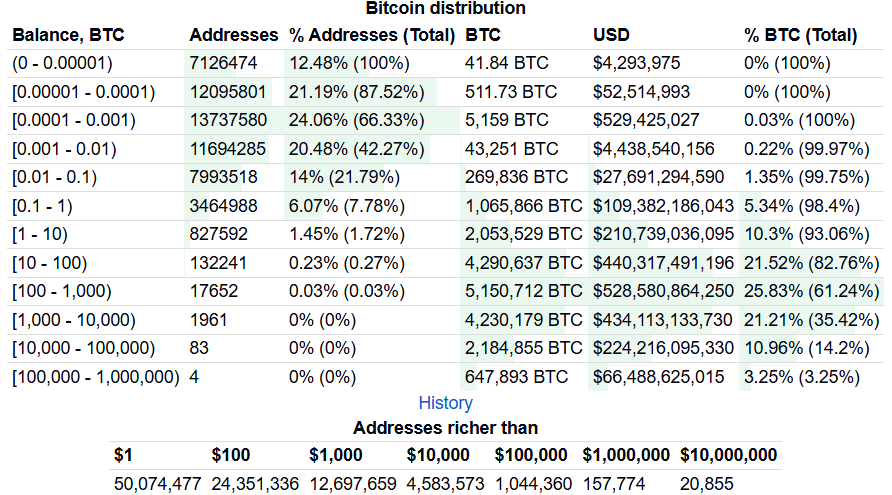
Bitcoin no es la única criptomoneda con ballenas. Dogecoin, la famosa memecoin, también mostró una concentración llamativa. En 2025, solo 3 direcciones controlaban más del 32% de su suministro total. Incluso Vitalik Buterin, el creador de Ethereum, es considerado una ballena de Ether gracias a la gran cantidad de ETH que posee.
¿Cuánto dinero te convierte en una ballena cripto?
El umbral exacto varía según la criptomoneda, pero Bitcoin suele servir como referencia clara. Normalmente, se considera ballena de Bitcoin a quien posee más de 1.000 BTC, lo que equivalía a unos 100 millones de dólares según los precios de mercado de 2025.
¿Y en otros activos?
- En Ethereum, suele hablarse de ballenas con 10.000 ETH o más.
- En Solana, alrededor de 500.000 SOL o más.
Estos límites no son fijos y cambian con el valor de mercado, la liquidez y la oferta y la demanda. En resumen, las ballenas son la élite del mercado cripto, capaces de mover precios con una sola transacción.
Cómo las ballenas crean olas
Con semejante poder de compra (o venta), las ballenas pueden provocar auténticas olas en el mercado. Si una ballena decide vender una gran parte de sus activos, puede generar una fuerte presión bajista sobre el precio debido al volumen y a la liquidez limitada. Por eso, muchos participantes del mercado vigilan de cerca los movimientos hacia los exchanges en busca de señales de un posible “dump” de ballenas.
Aquí viene el giro interesante: cuando las ballenas mantienen sus monedas inmovilizadas, también reducen la liquidez disponible, ya que hay menos activos circulando activamente. Sus grandes fortunas inactivas son como icebergs que alteran el equilibrio del océano cripto.
Seguimiento de los movimientos de las ballenas
No todas las transacciones de una ballena implican ventas. A veces simplemente están moviendo fondos entre carteras, cambiando de plataforma o realizando compras de gran tamaño. Aun así, los usuarios más experimentados suelen seguir de cerca estas direcciones para interpretar cualquier señal relevante.
Whale Alert es uno de los servicios más conocidos para rastrear grandes transacciones y suele publicar estas alertas en redes sociales como X (antes Twitter). Cuando una ballena se mueve, la información suele difundirse rápidamente.
El lado humano de las ballenas
Detrás de estas enormes carteras hay personas y organizaciones reales. Algunas ballenas son usuarios tempranos que adquirieron Bitcoin u otras criptomonedas cuando su precio era muy bajo. Otras son empresas que han apostado fuerte por el crecimiento a largo plazo del sector. Un ejemplo claro es Vitalik Buterin, fundador de Ethereum, considerado la mayor ballena de ETH por la cantidad que posee del activo que creó.
Cómo afectan las ballenas al precio de las criptomonedas
Las ballenas pueden aumentar la volatilidad de los precios, especialmente cuando mueven grandes cantidades de una criptomoneda de una sola vez. Por ejemplo, cuando una ballena intenta convertir BTC a moneda fiduciaria, el tamaño de la operación y la liquidez disponible pueden ejercer presión a la baja sobre el precio. En estos casos, otros participantes del mercado se mantienen muy atentos para detectar si la ballena está “vendiendo” y cómo podría reaccionar el mercado.
Uno de los indicadores más observados es el exchange inflow mean, que mide la cantidad media de una criptomoneda depositada en los exchanges. Si este valor supera ciertos niveles, puede interpretarse como una señal de que algunas ballenas están moviendo fondos hacia plataformas de intercambio, algo que suele despertar atención en el mercado.
Cómo afectan las ballenas a la liquidez
Al hablar de ballenas y liquidez, conviene recordar que, aunque suelen considerarse actores neutrales, cuando muchas ballenas acumulan una criptomoneda sin usarla, la liquidez del mercado disminuye. Hay menos monedas disponibles para negociar, lo que puede amplificar los movimientos de precio.
Qué significan las ballenas para los inversores
En la relación entre ballenas e inversores, es importante entender que una transferencia grande no siempre implica una venta. Puede tratarse de un cambio de cartera, de exchange o de una compra importante.
En ocasiones, las ballenas venden pequeñas partes de sus activos de forma escalonada para no llamar la atención ni provocar movimientos bruscos en el precio. Por eso, muchos observadores siguen las direcciones conocidas de ballenas, analizando el número y el tamaño de las transacciones. No es algo imprescindible para principiantes, pero comprender estos conceptos ayuda a interpretar mejor el mercado.
Por qué importan las ballenas
Te gusten o no, las ballenas son una fuerza poderosa dentro del ecosistema cripto y moldean su dinámica de manera significativa. Ya sean creadores, grandes poseedores o actores institucionales, sus movimientos pueden generar olas que recorren todo el mercado.
Entender la actividad de las ballenas ayuda a navegar mejor este entorno cambiante. Mantenerse informado sobre sus movimientos aporta contexto y una visión más completa de lo que ocurre en el mercado cripto, tanto para quienes empiezan como para quienes ya tienen experiencia.

Puede que ya hayas visto el término p.a. en inversiones tradicionales, pero ¿cómo se aplica al mundo cripto? En este artículo explicamos qué significa p.a., cómo aprovecharlo y cómo se relaciona con la industria de las criptomonedas.
¿Qué significa P.A.?
P.A. es un término de inversión que significa per annum (por año). Se refiere al interés que un inversor puede obtener a lo largo de un periodo de 12 meses y ofrece una visión clara del rendimiento anual de una inversión. Normalmente se calcula como interés simple, no compuesto.
Por ejemplo, algunas plataformas de carteras digitales ofrecen recompensas del 8% p.a. o 14% p.a.. Esto indica que, tras un año, el inversor recibiría ese porcentaje sobre el capital inicial invertido.
Cabe destacar que PA también puede significar price action (acción del precio), un término popular en Crypto Twitter. En este artículo nos centramos exclusivamente en su significado como interés anual.
¿Cómo pueden los usuarios ganar dinero con criptoactivos?
Existen varias formas relativamente seguras y habituales de generar ingresos con criptomonedas. A continuación, repasamos las principales, teniendo en cuenta que las condiciones varían según la red blockchain.
Minería de criptomonedas
La minería puede ser una forma rentable de generar ingresos pasivos, aunque los costes pueden ser elevados dependiendo del país, el precio de la electricidad y la criptomoneda minada. Cada red utiliza un método distinto para crear nuevas monedas, lo que implica diferentes requisitos de hardware y consumo energético.
Bitcoin, por ejemplo, utiliza un mecanismo Proof of Work (PoW), donde los mineros compiten resolviendo complejos problemas criptográficos. El primero en resolverlos valida el siguiente bloque y recibe la recompensa correspondiente.
Este proceso requiere grandes cantidades de energía y equipos específicos como GPUs o ASICs, lo que puede resultar poco viable en regiones con electricidad cara. Antes de invertir en minería, es fundamental analizar costes, requisitos técnicos y rentabilidad potencial.
Staking de criptomonedas
El staking es una alternativa a la minería en redes Proof of Stake (PoS) como Cardano y, actualmente, Ethereum. Consiste en bloquear fondos en un contrato inteligente durante un periodo determinado para ayudar a validar transacciones en la red.
Normalmente se exige un mínimo de fondos para participar, garantizando que los validadores tengan un “interés” real en el buen funcionamiento del sistema. Los usuarios delegan sus fondos en un staking pool, y cuanto mayor sea el stake, más probabilidades hay de ser seleccionados para validar bloques y recibir recompensas.
Las tasas de recompensa varían según la blockchain, por lo que es importante revisar las condiciones específicas. Como medida de seguridad, si un validador actúa de forma maliciosa, puede perder parte o la totalidad de los fondos en staking.
Ingresos pasivos
Existen iniciativas cripto que permiten generar ingresos pasivos simplemente manteniendo los activos en determinadas plataformas. Funcionan de forma similar a una cuenta de ahorro, aunque los fondos suelen quedar bloqueados durante un periodo concreto.
Durante ese tiempo, el usuario recibe intereses según lo acordado inicialmente. Es importante tener en cuenta que los valores p.a. pueden variar con las condiciones del mercado: suelen aumentar cuando los precios suben y disminuir cuando los activos caen.
Por último, conviene recordar que la responsabilidad de declarar y pagar impuestos sobre los ingresos generados recae en el inversor. Es fundamental conocer la normativa fiscal aplicable a las criptomonedas en tu país.
Aviso legal: Este artículo tiene fines meramente informativos y no debe considerarse asesoramiento financiero.

Decentralized Finance, or DeFi, opens up a whole world of financial services for you, ranging from straightforward banking services to complex financial instruments similar to those used by hedge funds and investment bankers. But here’s the twist: it all operates with cryptocurrencies instead of traditional cash.
In DeFi, you can stake your cryptocurrency in what are called smart contracts, which essentially means locking up your funds to earn interest, known as Annual Percentage Yield (APY). As a token of appreciation for staking your funds and providing liquidity, DeFi projects grant you special project-specific tokens. These tokens aren’t just a thank-you note—they give you a say in the project’s future decisions and carry some speculative value too.
Before we get started, let us first address several terms you are likely to come across in this piece:
- Financial institutions are your traditional banks
- Centralized exchanges are crypto exchanges that are operated by a managing company
- Decentralized exchanges are crypto exchanges that are not managed by one company and typically work in a peer-to-peer manner.
- DeFi is decentralized finance and refers to the industry in which regular users can engage various financial services requiring only an internet connection.
How smart contracts work in the DeFi space
A smart contract is a digital agreement that automatically executes once the predetermined criteria have been met. These computer codes are facilitated by blockchain technology and rely on the blockchain that they are built on.
At the moment, your bank account from financial institutions might give you the right to a certain amount of monthly interest at a fixed rate. The deal is reached through a formal application procedure - which can take many days - that is handled by a mix of people and software and is acknowledged in writing. Once successful, the bank account is opened and you have access to the services.
A smart contract, on the other hand, uses a programming language (e.g. Solidity on Ethereum) to map out the mathematical aspects of an agreement - how much interest is due when and where it should be paid - while the underlying Ethereum blockchain executes the contract for a fee, making it transparent and unchangeable.
The ups and downs of the DeFi ecosystem
owever, it’s not all smooth sailing. DeFi can offer higher returns than traditional banks, which is quite appealing, but it also comes with higher risks. For instance, if something goes wrong with a smart contract, or you lose access to your private keys, there’s no safety net to catch you.
To dip your toes into DeFi waters, you’ll need a digital wallet like MetaMask and some funds from a cryptocurrency exchange. Once you’re set up, you can participate in various DeFi activities like lending or staking, each with its own set of fees depending on the network you’re using.
Additionally to the higher returns, DeFi tokens have also seen a rise in value, with some entering the top 20 and top 10 biggest cryptocurrencies based on market cap.
Furthermore, the value of DeFi tokens has surged, with some climbing into the top ranks of cryptocurrencies by market cap. This growth indicates a strong interest and a robust market presence, which can be exciting for anyone involved in the space.
However, it's not all smooth sailing. DeFi comes with its own risks that you should be aware of. For instance, executing smart contracts can get pricey, especially during times of network congestion. If you're looking to cut down on fees, you might want to explore alternatives to popular platforms like Ethereum, which can be more cost-effective.
Also, not all smart contracts are built the same. Some may have vulnerabilities that could put your funds at risk if not properly managed or if an error in the contract execution occurs. This highlights the importance of being careful with where and how you invest your digital assets.
Moreover, the decentralized nature of these platforms means that you’re in full control—which sounds great until you realize there is no safety net. If you lose access to your private key or make a transaction mistake, there's no customer service line to call for a do-over.
Ensure you vet various DeFi protocols before engaging
In general, more established Defi protocols with a higher total value of assets secured within them (also referred to as Total Value Locked, TVL) are safer. This is due to the fact that their code has been more thoroughly audited and "battle-tested".
Newer platforms will typically offer higher APYs in order to entice investors and build up liquidity. While this may sound lucrative, always ensure that you've done your research in order to understand exactly how the protocol operates and who is behind the project.
Here are a few things to look out for:
- Has the protocol's code been professionally audited?
- How long has the project been live?
- What is the platform's TLV? (The higher the better)
Finding your top Defi protocol
There are a number of "well-established" DeFi platforms that have proven reliable and trustworthy in recent years. While the risks are still prevalent, these are the most established options when looking to enter the DeFi space with the leading DeFi protocols.
How to use DeFi protocols (Get started in DeFi)
Jumping into the world of DeFi protocols can be quite an adventure. Here’s a simple guide on how to get started :
First, you'll need a digital wallet, and MetaMask is a popular choice. It's user-friendly and a common gateway for engaging with DeFi platforms.
Once you have your digital wallet, you'll need to move your cryptocurrencies into it. This is usually done through a transfer from a centralized exchange. For example, if you have a Tap wallet, you can transfer Ethereum (ETH) or other supported assets directly into your MetaMask wallet. Remember, DeFi protocols operate with cryptocurrencies, not traditional bank funds.
With your wallet set up and your funds in place, you can connect to any DeFi application that interests you. You can then engage with various features of the platform, such as depositing funds into a lending protocol. Keep in mind that actions like depositing, staking, unstaking, or withdrawing will typically involve network fees, which vary by blockchain.
That’s all there is to it! With these steps, you can start exploring the different functionalities and opportunities within DeFi at your own pace.
Understanding the risks associated with DeFi
While we've stressed that using tried and tested DeFi platforms provide a higher level of security, there are still risks associated with the DeFi space.
Below are some more steps you can do in order to secure your cryptocurrency assets and decrease the chance of losing your funds.
- Consider insurance, look into options for insuring your assets to help mitigate potential losses.
- Research the team behind the project, do your due diligence.
- Familiarize yourself with the platform's operations and features. For instance, if a platform advertises a certain return rate, such as 10% APY, delve into how they achieve those figures.
- Don’t commit more than you can afford to lose
Decentralized finance is one of the most innovative and promising areas in cryptocurrency. It is also a harsh environment, however, that demands some expertise before stepping in.
Before you place any funds into Defi protocols and become one of the many liquidity providers, ensure that you've fully vetted the project and considered the pros and cons of what it has to offer. Also ensure that you understand how the platform operates.
The DeFi space can be both lucrative and devastating, it is complex and requires a good amount of know-how. If you wish to get involved, take the time to really understand both the opportunities and the challenges it presents first. This way, you can engage with DeFi more cautiously and equipped with the necessary knowledge. And remember with Defi everything is at your own risk.

Cualquier trader o inversor en criptomonedas conoce el riguroso —aunque necesario— proceso de KYC antes de poder comprar o vender Bitcoin u otros criptoactivos. En este artículo desmontamos mitos y explicamos por qué estos procesos de identificación son necesarios y cómo encajan con las leyes AML (anti-blanqueo de capitales).
A medida que los exchanges cripto consolidan su papel en el sistema financiero, crece la necesidad de prácticas regulatorias estrictas. Dado el carácter seudónimo de las transacciones, detectar actividades ilícitas es fundamental. Con poca regulación, el mercado queda expuesto a delitos como la financiación del terrorismo o ataques de ransomware.
Mientras los reguladores trataban de reaccionar, surgieron nuevas áreas como DeFi o los NFT, a menudo sin regulación. Esto impulsó a reguladores e inversores institucionales a crear marcos más sólidos para combatir el crimen en blockchain, con resultados positivos. El reto es regular sin sofocar la innovación ni la descentralización que atrae a los usuarios.
¿Qué es AML en cripto?
AML engloba normas y procedimientos para impedir que fondos obtenidos ilegalmente se hagan pasar por ingresos legítimos. Hoy, estas medidas forman parte de la diligencia debida de los exchanges y suelen requerir verificación de identidad antes de operar.
El blanqueo suele darse en tres fases: colocación (entrada de fondos en el exchange), estratificación (mezcla con fondos legítimos) e integración (retorno del dinero “limpio” al beneficiario). En un entorno descentralizado, controlar esto es complejo, por lo que las medidas AML son vitales para la operativa y la reputación del sector.
Estas normas deben aplicarse con cuidado para respetar la descentralización, a la vez que permiten actuar ante actividades ilícitas, integrándose en el modelo de negocio de los proveedores cripto.
Señales de alerta AML en cripto
Aunque existen métodos anónimos, muchas criptomonedas presentan señales que activan alertas AML. En 2021 se estimó que se blanquearon entre 800.000 millones y 2 billones de dólares, con cerca del 50% sin detectar. Las principales señales incluyen:
- Identidad del remitente oculta
- Importes de transacción poco claros
- Ubicación geográfica opaca
- Perfiles no oficiales de las partes
- Falta de información sobre el origen de los fondos
- Retiradas desde wallets sin historial
- Transacciones consecutivas de alto valor
Cómo se implementan los protocolos AML en los exchanges
Los exchanges colaboran con reguladores, con enfoques distintos según el país:
- Estados Unidos: regulaciones estrictas bajo FinCEN y FINTRAC.
- Corea del Sur: refuerzo de AML y KYC tras investigaciones a exchanges.
- Singapur: apuesta por la educación tecnológica más que por normas duras.
- Canadá: requisitos KYC similares a los de la banca tradicional.
- Tailandia: controles más estrictos para inversores extranjeros.
Hoy, la mayoría de países exige tecnologías avanzadas para prevenir el uso ilícito de cripto. El cumplimiento es clave y las sanciones por incumplir pueden ser severas.
Conclusión: AML ha llegado para quedarse
Aunque estas medidas de transparencia chocan con la filosofía cripto, son esenciales para la seguridad de los usuarios y la adopción del sector. Lejos de la creencia popular, las criptomonedas son rastreables y no concentran la mayoría de los delitos financieros.
Las plataformas responsables colaboran con las autoridades, protegen a sus usuarios y ayudan a que las criptomonedas convivan con las divisas tradicionales en el sistema financiero global.

Probablemente hayas escuchado a algún maximalista de Bitcoin afirmar que las criptomonedas son el futuro y que acabarán reemplazando al dinero fiat. Aunque esto difícilmente ocurrirá de la noche a la mañana —o incluso en el corto plazo—, en este artículo exploramos esta cuestión teniendo en cuenta los múltiples factores que influyen en esta propuesta tecnológica.
Aunque el interés inversor ya forma parte de la cultura mainstream, las criptomonedas aún deben superar varios obstáculos para convertirse en un sustituto viable del dinero tradicional. Entre ellos destacan la aplicación práctica, la adopción por parte de los comercios, la volatilidad del mercado y la facilidad de uso. Aun así, se han producido avances que indican que la adopción cripto está cada vez más cerca.
El Salvador legaliza Bitcoin
En junio de 2021, el presidente de El Salvador, Nayib Bukele, anunció que Bitcoin sería aceptado oficialmente como moneda de curso legal. También presentó planes para crear una “Bitcoin City” con el objetivo de convertirla en “el centro financiero del mundo”.
Para apoyar esta iniciativa, se lanzaron varios servicios, incluida una cartera nacional llamada Chivo. El proyecto supuso un elevado coste para los contribuyentes y generó opiniones divididas. Mientras algunos elogiaron a Bukele como un pionero tecnológico, otros consideraron la medida prematura y arriesgada.
El alcalde de Nueva York cobra su salario en cripto
Con la intención de convertir Nueva York en la capital mundial de las criptomonedas, el alcalde Eric Adams cumplió su promesa electoral y aceptó cobrar su salario en cripto. Durante su campaña, aseguró que recibiría sus tres primeras nóminas en criptomonedas y, en enero, percibió la primera en una combinación de Bitcoin y Ethereum.
Adams también ha defendido públicamente el NYC Coin, una moneda digital con funciones similares al Miami Coin. En sus palabras:
“Nueva York es el centro del mundo y queremos que también sea el centro de las criptomonedas y de la innovación financiera. Estar a la vanguardia nos ayudará a crear empleo y atraer talento global”.
El auge de las CBDC
Venezuela es otro ejemplo de adopción cripto, aunque motivado por circunstancias más complejas. Tras episodios de hiperinflación, muchos ciudadanos recurrieron a las criptomonedas como reserva de valor y fuente de ingresos. Esto llevó al lanzamiento del Petro en 2018, una moneda digital emitida por el Estado, conocida como CBDC (moneda digital de banco central).
Otros países como Bahamas y Nigeria también han lanzado proyectos piloto de CBDC. El “Sand Dollar” de Bahamas surgió, en parte, por la necesidad de mejorar el acceso al dinero tras la destrucción de infraestructuras bancarias por huracanes. Nigeria, por su parte, apostó por un enfoque más digital para atender a una población muy joven.
Además, países como China han iniciado programas piloto de monedas digitales en varias ciudades. En regiones con corrupción o zonas remotas, las monedas digitales descentralizadas pueden ofrecer ventajas claras frente al dinero fiat.
El futuro de las criptomonedas
El futuro de la integración de las criptomonedas en el sistema financiero tradicional es prometedor. Aunque es poco probable que sustituyan por completo al dinero fiat, sí es muy posible que ambos sistemas coexistan. El auge de las CBDC y la creciente adopción general confirman que el mundo reconoce los beneficios y la innovación del sector cripto.
Tap se mantiene a la vanguardia con una app que permite pagar fácilmente con criptomonedas. El usuario elige el activo, Tap lo convierte a la moneda local y realiza el pago de forma automática. Simple, eficiente y orientado al futuro.

Probablemente hayas oído que las criptomonedas ofrecen una forma más rápida, sencilla y barata de enviar dinero al extranjero. Aunque esto es cierto, muchas personas no saben exactamente por qué lo es. En este artículo vamos a explicar con detalle cómo funcionan las transacciones de Bitcoin y altcoins, y cómo puedes aprovechar fácilmente este fenómeno moderno.
¿Qué es Bitcoin y qué son las Altcoins?
Si eres nuevo por aquí, vamos a ponerte al día. Bitcóin se presentó al mundo por primera vez a través de un documento técnico en 2008 por una entidad anónima llamada Satoshi Nakamoto (hasta el día de hoy su identidad sigue siendo un misterio). Tras la crisis financiera mundial, Nakamoto quería crear una moneda libre de bancos y gobiernos y, en lugar de ello, devolver el poder financiero a las personas.
Uso tecnología blockchain, Bitcoin pudo facilitar la transferencia de valor entre pares, lo que permitió a los usuarios realizar pagos globales a un ritmo mucho más rápido y económico que nunca. Si bien Bitcoin tardó algunos años en entrar en el mercado convencional, durante este tiempo se crearon varias criptomonedas alternativas. Al principio, cualquier criptomoneda alternativa se denominaba altcoin (moneda alternativa al Bitcoin). Si bien esta idea se ha mantenido, el mercado de las altcoins ha crecido hasta convertirse en una industria importante de más de 9000 unidades.
Si bien muchas monedas alternativas, como Ethereum y Litecoin, se crearon utilizando la cadena de bloques de Bitcoin, no todas ofrecen exactamente la misma funcionalidad. Cada criptomoneda que se crea está diseñada para resolver un «problema» del mercado, ya sea que esté relacionado con el almacenamiento de datos funcionalidad de contrato inteligente, sistemas de pago más rápidos, etc.
¿Cómo funcionan las transacciones de Bitcoin y altcoins?
Una vez entendido qué son, veamos cómo funcionan. Usaremos Bitcoin como ejemplo principal. A diferencia de los bancos, que requieren papeleo y trámites administrativos, crear una “cuenta” de Bitcoin solo implica abrir un monedero digital. Existen distintos tipos de monederos adaptados a las necesidades de cada usuario. Una vez creado, deberás cargarlo con Bitcoin, algo que puedes hacer a través de una plataforma como Tap.
Cuando tienes fondos en tu monedero, puedes enviarlos a otro usuario de la red (ten en cuenta que Bitcoin solo puede enviarse por la red de Bitcoin, y Ethereum por la red de Ethereum). Para enviar fondos, indicas la cantidad, introduces la dirección del monedero del destinatario y pagas una pequeña comisión de red.
A nivel interno, la transacción entra en el llamado mempool, un conjunto de transacciones pendientes, hasta que un minero la selecciona. Los mineros de Bitcoin verifican las transacciones compitiendo entre sí para resolver un complejo problema criptográfico. El primero en lograrlo valida un bloque de transacciones y lo añade a la blockchain de forma cronológica, manteniendo así la transparencia e inmutabilidad del sistema.
Una vez añadido el bloque, el minero recibe las comisiones de las transacciones incluidas y la recompensa por bloque, como compensación por el tiempo y la energía utilizados. Los fondos salen entonces de tu monedero y llegan al del destinatario. Normalmente, se requieren unas tres confirmaciones (es decir, que se añadan tres bloques posteriores) antes de que los fondos puedan utilizarse.
La mayoría de las altcoins funcionan de forma similar, aunque pueden emplear distintos métodos de validación o algoritmos. El concepto, sin embargo, es el mismo: las transacciones se verifican, se agrupan en bloques, se añaden a la blockchain y se completan.
¿Listo para las transacciones blockchain?
Ahora que sabes cómo funcionan las transacciones de Bitcoin y altcoins, es el momento de adentrarte en el mundo fluido de las criptomonedas. A través de la app puedes comprar, vender, almacenar y gastar tanto criptomonedas como dinero fiat. Además, la plataforma ofrece precios de mercado en tiempo real y sistemas de seguridad avanzados para proteger tus fondos en todo momento.

Al igual que las carteras tradicionales de acciones, las carteras de criptomonedas también pueden equilibrarse para garantizar una distribución adecuada de riesgos y rendimientos dentro de esta clase de activos. Existen muchas formas de crear una cartera cripto diversificada, pero en este artículo exploramos un enfoque general que los inversores pueden utilizar como base.
Desde una diversificación consciente hasta la asignación de activos y la compra de criptomonedas, el camino para construir una cartera equilibrada no es complicado. Eso sí, requiere mantenimiento: deberás reequilibrar tu cartera de forma periódica.
En términos básicos, una cartera de criptomonedas es un conjunto de diferentes criptoactivos en posesión de una persona. Algunas carteras incluyen una sola clase de activo, mientras que otras combinan varias y requieren una asignación adicional.
Algunos inversores utilizan herramientas de terceros que calculan automáticamente las posiciones y beneficios de la cartera. Una cartera equilibrada incluye monedas, productos y tokens con distintos perfiles de riesgo y rentabilidad.
Podría tener, por ejemplo: 35 % Bitcoin, 10 % Ethereum, 25 % stablecoins, 15 % NFT y 15 % altcoins (ejemplo basado en el contexto actual del mercado y no constituye asesoramiento financiero).
Los 5 principales tipos de criptomonedas del mercado
Antes de construir tu cartera, conviene entender las cinco grandes categorías presentes hoy en el mercado cripto. La mayoría de las más de 20.000 criptomonedas existentes encajan en alguna de ellas.
Criptomonedas orientadas a pagos
Son las de primera generación, empezando por Bitcoin. Muchos proyectos iniciales se diseñaron para transferir valor, como Ripple (XRP), Litecoin (LTC) o Bitcoin Cash (BCH). Suelen tener una alta capitalización de mercado.
Stablecoins
Incluyen monedas vinculadas a una divisa fiduciaria o a una materia prima. Reducen la volatilidad y aportan estabilidad a la cartera, actuando como refugio en caídas del mercado. Ejemplos: PAX Gold (PAXG), Tether (USDT) o USD Coin (USDC).
Tokens de utilidad
Están ligados a un ecosistema concreto y ofrecen acceso a productos o servicios, como el pago de comisiones o el uso de una plataforma. Ejemplos: Ethereum (ETH) o Binance Coin (BNB).
Tokens de seguridad
Equivalen a valores tradicionales digitalizados mediante blockchain. Pueden representar acciones, deuda o modelos híbridos, incluyendo bonos, participación empresarial o derechos de voto.
Tokens de gobernanza
Otorgan derechos de voto y, en algunos casos, participación en los ingresos del proyecto. Su valor depende directamente del éxito del mismo. Ejemplos: Uniswap (UNI) y PancakeSwap (CAKE).
Cómo construir una cartera cripto equilibrada
Existen distintas escuelas de pensamiento. Estas son nuestras recomendaciones principales, aunque siempre debes hacer tu propia investigación.
Diversifica el riesgo
Incluye activos de riesgo alto, medio y bajo según tu tolerancia personal. Define primero cuánto riesgo estás dispuesto a asumir.
Incluye stablecoins
Aportan liquidez y son esenciales para muchas aplicaciones DeFi. Permiten salir rápidamente de posiciones o asegurar beneficios en mercados alcistas o bajistas.
Supervisa el mercado
Revisa regularmente el mercado y ajusta tu cartera. La volatilidad sigue siendo elevada y tus decisiones deben reflejarlo.
Controla tus emociones
El miedo y la codicia influyen mucho en las decisiones. Evita que las emociones dirijan tus operaciones, ya que pueden convertir ganancias potenciales en grandes pérdidas.
DYOR (haz tu propia investigación)
Nunca inviertas en un proyecto que no puedas explicar claramente. Aunque recibas consejos, analiza siempre por tu cuenta antes de comprometer tu dinero.
Invierte solo lo que estés dispuesto a perder
Regla de oro: si tus inversiones te quitan el sueño, reduce el riesgo. Una cartera equilibrada debe darte tranquilidad financiera.
Cómo usar un gestor de carteras
Los trackers no son solo para day traders; también aportan valor a inversores a largo plazo. Permiten seguir el rendimiento de activos de distintos niveles de riesgo en tiempo real y en varias blockchains y wallets.
Algunas opciones populares incluyen:
- CoinMarketCap: seguimiento sencillo introduciendo precios de compra.
- Pionex: más avanzado, ideal para inversores de alto volumen.
- CoinGecko: permite seguir más de 1.000 monedas.
- Delta: muy intuitivo y compatible con cripto, fiat, acciones, bonos y ETF.
Además del diseño, considera la seguridad y la compatibilidad con tus wallets y activos.
Construir tu cartera manualmente
Cuando estés listo, elige una plataforma fiable y regulada, con altos estándares de seguridad. La app de Tap ofrece un entorno seguro para comprar, vender, intercambiar y almacenar criptomonedas.
Decide qué monedas incluir y distribuye tu capital estratégicamente. Apóyate en las categorías explicadas y dedica tiempo a investigar cada proyecto antes de invertir. En cripto, entender bien en qué inviertes es tan importante como la inversión en sí.

Si llevas tiempo en el mercado de las criptomonedas, seguro que conoces el término “ballena cripto”. Suele referirse a grandes actores del ecosistema que acumulan (hodl) y mueven enormes cantidades de una criptomoneda, afectando a menudo su precio. A continuación, analizamos cómo las ballenas influyen en el mercado.
¿Quién es una ballena?
En el mercado de criptomonedas, una ballena es cualquier individuo o grupo que controla una gran cantidad de Bitcoin u otras criptomonedas. Al igual que en el océano, su “tamaño” (el volumen de su cartera) los distingue del resto.
Se estima que cerca del 40 % de todos los bitcoins existentes están en manos de unas 1.000 personas. Algunos nombres conocidos incluyen a Roger Ver, los gemelos Winklevoss y Charlie Shrem. También existen ballenas institucionales, como Fortress Investment Group o Pantera Bitcoin Fund.
Muchas ballenas actuales son early adopters que compraron grandes cantidades cuando los precios eran bajos. Por ejemplo, los gemelos Winklevoss invirtieron unos 11 millones de dólares y adquirieron alrededor de 100.000 BTC, hoy valorados en más de 1.100 millones de dólares.
¿Manipulan las ballenas el mercado?
La mayoría de las ballenas son hodlers a largo plazo, especialmente porque Bitcoin mantiene un elevado potencial alcista. Sin embargo, dado que la blockchain es pública, a veces se observan movimientos masivos de compra o venta que impactan el mercado.
Los traders más pequeños suelen seguir estas tendencias, por lo que las operaciones de las ballenas pueden marcar la dirección del mercado. Esto ha generado acusaciones de manipulación. Un ejemplo típico es una venta masiva que provoca caídas; después, las ballenas recompran a precios más bajos, obteniendo beneficios.
Aun así, no siempre se puede hablar de manipulación: muchas ballenas mantienen posiciones a largo plazo y no actúan con fines especulativos inmediatos.
¿Cómo operar “como una ballena”?
Más que temer a las ballenas, conviene entender su “pulso”. Analizar precios en tiempo real, capitalización y volumen puede dar pistas sobre sus movimientos. Para inspirarte en su enfoque, considera estos principios:
- Decisiones informadas: Mantente al día con fuentes fiables y noticias relevantes del sector.
- Enfoque analítico: Combina análisis técnico (gráficos, patrones) y fundamental (valor intrínseco y potencial).
- Gestión del riesgo: Protege tu capital con stop-loss y diversificación.
- Adaptabilidad: Ajusta tus estrategias según el ciclo del mercado (alcista o bajista).
- Paciencia y disciplina: Evita decisiones impulsivas y espera oportunidades favorables.
- Red y aprendizaje: Participa en la comunidad cripto y aprende de otros traders.
- Aprender de errores: Usa cada experiencia para mejorar tu estrategia.
Comprender a las ballenas puede aportar información valiosa, pero los resultados varían. El mercado cripto conlleva riesgos inherentes, por lo que toda decisión debe basarse en un análisis cuidadoso y en tu tolerancia al riesgo.

Con el reciente auge de los meme tokens y las monedas con temática canina, cualquier criptomoneda con una mascota Shiba Inu (una raza de perro japonesa) parece atraer toda la atención adecuada. Tras ganar el premio a “vehículo de inversión” del año en 2021 gracias a rendimientos increíbles, muchos aún se preguntan si Shiba Inu sigue siendo un buen token.
¿Dónde empezó todo?
Una regla de oro al entrar en el mundo cripto es entender exactamente qué estás comprando antes de dar el paso. Antes de explorar la historia de Shiba Inu, debemos empezar por Dogecoin. Dogecoin fue el meme token original y apareció en el ecosistema cripto en 2013. Se diseñó como una alternativa desenfadada a Bitcoin, burlándose de la seriedad de la comunidad cripto de la época con su logotipo de Shiba Inu.
Con el tiempo, Dogecoin construyó una comunidad fuerte y leal. No fue hasta 2020, cuando el CEO de Tesla, Elon Musk, comenzó a hablar abiertamente sobre la criptomoneda en Twitter, que DOGE se volvió verdaderamente viral.
¿Qué es Shiba Inu Coin?
El interés de Musk por Dogecoin coincidió con el lanzamiento de Shiba Inu, que salió oficialmente en agosto de 2020. En poco tiempo, SHIB escaló posiciones y se convirtió, aunque brevemente, en el meme token con mayor capitalización de mercado. Aunque fue apodado el “asesino de Doge”, Dogecoin siguió manteniendo mayor valor. Cabe destacar que cada mención de Musk a Dogecoin también impulsó la popularidad de Shiba Inu.
Shiba Inu es un token ERC-20 construido sobre la red Ethereum. La plataforma incluye diversos productos, desde un exchange hasta un incubador de arte, y es compatible con una amplia gama de aplicaciones gracias a su base en Ethereum. Al cotizar por fracciones de céntimo, SHIB ofrece una entrada de bajo coste al mercado cripto. Además, algunas empresas ya aceptan SHIB como medio de pago.
¿En qué se diferencia Shiba Inu de Dogecoin?
Para entender SHIB, conviene analizar las diferencias entre estos dos grandes meme tokens. Dogecoin ofrece un sistema de pagos peer-to-peer rápido y barato, muy utilizado para propinas en redes sociales.
Shiba Inu, en cambio, es más complejo. Incluye un exchange descentralizado (DEX) llamado ShibaSwap, que permite generar intereses, y cuenta con otros dos tokens, BONE y LEASH. El proyecto se define como un experimento de descentralización.
Al estar construido sobre Ethereum, SHIB es compatible con la mayoría de carteras ETH y aplicaciones DeFi, mientras que DOGE requiere carteras específicas. Estas diferencias explican por qué algunos inversores lo consideran el “Doge Killer”.
¿Tiene futuro Shiba Inu (SHIB)?
En 2021, Shiba Inu registró subidas del 53.241.775%. Una inversión de solo 2 dólares a principios de ese año habría alcanzado cifras millonarias en el pico del mercado alcista.
En 2022, los mercados cayeron con fuerza: Bitcoin y Ethereum bajaron alrededor de un 35% desde sus máximos de noviembre, mientras que SHIB perdió cerca del 70% desde su máximo histórico de octubre de 2021. Aun así, experimentó repuntes posteriores, con subidas notables a principios de febrero.
Se cree que estos movimientos estuvieron impulsados por Welly’s, una cadena italiana de comida rápida con temática Shiba Inu que acepta SHIB, así como por el desarrollo de Shibarium (una nueva blockchain destinada a reducir comisiones) y la intención del proyecto de entrar en el metaverso.
¿Puede Shiba Inu alcanzar 1 dólar?
Una pregunta frecuente es si SHIB puede llegar a 1 dólar. Aunque existe especulación al respecto, no hay garantías. Para alcanzar ese valor, sería necesaria una demanda extraordinaria. Actualmente, hay más de 545 billones de SHIB en circulación, lo que supone un gran reto.
Aunque podría ser prometedor si vuelve a dispararse, SHIB sigue considerándose una inversión de alto riesgo. Tiene un precio atractivo y algunos casos de uso, pero aún está en fases tempranas y su adopción es limitada en comparación con otras criptomonedas. Nunca inviertas más de lo que estés dispuesto a perder.
En este artículo te guiamos por los entresijos de la licencia de dinero electrónico: qué es, quién la necesita y, por supuesto, cómo te afecta a ti como consumidor. Esta nueva ola regulatoria se ha implantado no solo para proteger al usuario, sino también para establecer medidas que identifiquen y frenen la actividad fraudulenta.
¿Qué es el dinero electrónico (e-money)?
Antes de entrar en los requisitos de licencia, veamos qué se entiende por dinero electrónico. En esencia, el e-money es una versión digital del efectivo. Mantiene un valor monetario que puede utilizarse para realizar pagos y transacciones, normalmente a través de internet, o mediante un teléfono o una tarjeta.
Los productos de dinero electrónico pueden ser de software o de hardware y se encargan de almacenar el valor monetario de forma electrónica. Los productos de software se usan en ordenadores y tablets y requieren conexión a internet (por ejemplo, PayPal), mientras que los de hardware incluyen tarjetas con chip que no necesitan conexión en línea (por ejemplo, Square).
¿Qué es una licencia de dinero electrónico?
La licencia de dinero electrónico es una autorización regulatoria que permite a una institución de dinero electrónico (EMI) operar. Las EMI representan la digitalización de los servicios financieros y están autorizadas a emitir dinero, así como a ofrecer tarjetas de pago, monederos electrónicos y cuentas IBAN. Aunque los bancos pueden prestar servicios similares, requieren una licencia distinta, ya que pueden ofrecer un abanico más amplio de servicios.
En resumen, una EMI se considera como tal si realiza actividades como la emisión y el reembolso de dinero electrónico, retiradas y depósitos de efectivo, servicios de pago y remesas, transferencias débito o crédito, iniciación y ejecución de pagos y servicios de información de cuentas, siempre que cuente con la licencia correspondiente.
¿Cómo protege al consumidor?
La regulación y la protección del consumidor son el eje de las licencias de dinero electrónico, pero no el único objetivo. Este marco busca facilitar el acceso de las empresas al mercado del e-money, impulsar la innovación en servicios seguros y fomentar una competencia sana en un entorno protegido.
Las licencias se conceden para salvaguardar los fondos del cliente en caso de insolvencia de la EMI, y funcionan de forma distinta a una licencia bancaria. Conforme a la normativa, las EMI pueden optar por:
- Depositar los fondos de los clientes en una cuenta segregada en una entidad de crédito autorizada, o
- Contratar un seguro que cubra los riesgos asociados a los fondos de los clientes.
Esto garantiza que el consumidor esté protegido frente a pérdidas y sea compensado si fuera necesario. Es fundamental elegir únicamente EMIs con la licencia adecuada.
¿Qué cantidad de dinero está protegida con la licencia de e-money?
Según la normativa de la FCA, la EMI debe establecer mecanismos organizativos adecuados para asegurar que los fondos salvaguardados estén protegidos en todo momento.
Como se ha indicado, esto puede lograrse manteniendo los fondos en una cuenta separada (distinta del capital operativo de la institución) o asegurándolos mediante una póliza o garantía equivalente.
Mientras que los bancos con licencia operan junto al Financial Services Compensation Scheme (FSCS) y cubren hasta 85.000 £ por usuario, las EMIs están obligadas a proteger el 100 % de los fondos del cliente.
La licencia exige que todas las cantidades depositadas en la plataforma estén salvaguardadas, no solo una parte. Aunque las EMIs adoptan otras medidas adicionales de protección, la licencia de dinero electrónico garantiza el cumplimiento de los requisitos legales básicos y el derecho de la empresa a operar legalmente.

Tanto al analizar criptomonedas como divisas fiat, las bases son las mismas: la moneda debe servir como reserva de valor y como medio de intercambio de bienes y servicios. Aunque ambas cumplen estos requisitos, las criptomonedas suelen estar acompañadas por una notable volatilidad.
La volatilidad es un subproducto natural de los mercados en desarrollo, pero puede generar pérdidas si no se gestiona correctamente. Cuando los mercados cripto atraviesan periodos de alta volatilidad, a menudo se cuestiona su viabilidad como medio de pago. Tras observar los fuertes movimientos del mercado de Bitcoin, algunos participantes identificaron esta limitación y propusieron una solución: las stablecoins.
En este artículo explicamos qué es una stablecoin, cómo encaja en el sistema financiero y analizamos sus principales ventajas y desventajas.
¿Qué es una stablecoin?
Las stablecoins son monedas digitales que aprovechan los beneficios de la tecnología blockchain sin la volatilidad típica de las criptomonedas. Están respaldadas por una divisa o materia prima y vinculadas al valor de su activo subyacente, siendo gestionadas y aseguradas por sus plataformas emisoras. Por ejemplo, Tether está vinculada al dólar estadounidense, Tether Gold al precio del oro y Tether EURt al euro.
Funcionan como cualquier otra criptomoneda, utilizando blockchain para operar la red, pero su valor no fluctúa por la oferta y la demanda, sino que se mantiene alineado con el activo al que están vinculadas, lo que las hace más adecuadas para pagos digitales.
¿Cómo mantienen su precio las stablecoins?
En el caso de las stablecoins respaldadas por fiat, las empresas emisoras deben mantener un equivalente en la moneda de referencia por cada token en circulación. Estas reservas pueden mantenerse en cuentas bancarias o en una combinación de efectivo y bonos del Tesoro a corto plazo.
Muchas entidades realizan auditorías externas para demostrar que las reservas son suficientes y publican esta información para asegurar a los usuarios que cada moneda mantiene su valor (por ejemplo, 1 USD).
¿Por qué se han vuelto tan populares?
La primera stablecoin fue Tether, lanzada en 2014 y vinculada al dólar. Hoy es una de las mayores criptomonedas por capitalización de mercado. USD Coin (USDC), también respaldada por el dólar, se sitúa igualmente entre las principales. Su crecimiento y adopción han impulsado el interés por estas monedas.
Gracias a su resistencia a la volatilidad, las stablecoins se utilizan cada vez más para operaciones comerciales y pagos internacionales.
Ventajas de las stablecoins
Moneda digital
Al operar sobre blockchain, permiten transacciones internacionales más rápidas y baratas que las divisas tradicionales, con liquidaciones casi inmediatas y uso sencillo mediante monederos digitales.
Cero volatilidad
Al estar vinculadas a un activo estable, apenas experimentan fluctuaciones bruscas, lo que favorece su adopción como medio de pago fiable.
Cobertura frente a mercados en caída
Los traders las usan como refugio cuando los mercados cripto caen, facilitando la salida rápida de posiciones y la reentrada cuando el mercado se estabiliza.
Desventajas de las stablecoins
Centralización
Aunque el ecosistema cripto promueve la descentralización, las stablecoins introducen un grado de centralización al depender de entidades que gestionan y custodian las reservas.
Transparencia
Algunas han sido criticadas por la falta de claridad sobre sus reservas. En ciertos casos, esto ha derivado en sanciones y mayores exigencias regulatorias, lo que ha llevado a publicar informes más detallados.
Conclusión
Las stablecoins se han integrado en muchas carteras como cobertura frente a mercados cripto o fiat volátiles y como herramienta de pago global sin riesgo de fluctuaciones. A través de la app de Tap, los usuarios pueden acceder y comprar stablecoins como USDC y USDT de forma sencilla.
Al elegir una stablecoin, conviene analizar el proyecto emisor, la liquidez y la compatibilidad con monederos para asegurar un uso seguro y eficiente.

¿Has oído el término “altcoin” pero no tienes claro qué significa exactamente? En este artículo desglosamos todo lo que necesitas saber sobre las altcoins: los distintos tipos que existen, cómo funcionan y cómo puedes adquirirlas. El sector cripto puede resultar abrumador, así que estamos aquí para aclarar conceptos y ayudarte a construir una base sólida de conocimiento.
Empezando por lo básico: ¿qué son las altcoins? Las altcoins son todas las criptomonedas excepto Bitcoin. Así de simple. En los primeros días del sector, cuando apenas había unas pocas criptomonedas, cualquier nueva moneda se consideraba una “alternative coin” (moneda alternativa a Bitcoin), término que se acortó a “altcoin”. Por tanto, cuando alguien habla de altcoins, se refiere a cualquier criptomoneda que no sea Bitcoin. Siguen siendo redes descentralizadas y la mayoría utiliza tecnología blockchain.
¿Cuántas altcoins existen?
En el momento de redactar este artículo, CoinMarketCap indica que existen más de 9.400 altcoins. Esta cifra crece cada día. Aun así, estas altcoins representan alrededor del 50 % del valor total del mercado cripto. Bitcoin sigue siendo la criptomoneda dominante, seguida de Ethereum, que concentra aproximadamente el 14,5 % del valor total del mercado. Dado que Ethereum también es una altcoin, el “mercado de altcoins” ronda el billón de dólares. En términos generales, se habla simplemente del mercado cripto.
Los diferentes tipos de altcoins
En un sector valorado en más de un billón de dólares, la diversidad es inevitable. A lo largo de los años se han creado distintas categorías para que las altcoins aporten nuevos servicios e innovaciones. Cada nuevo proyecto debe mejorar a los anteriores o presentar un caso de uso distinto.
Cada criptomoneda se diseña para resolver un problema, dentro o fuera del ecosistema blockchain. De ahí surgen nichos específicos, como las altcoins centradas en la privacidad. A continuación, detallamos siete de las principales categorías para mostrar el amplio potencial de innovación del sector.
Altcoins orientadas a pagos
Su objetivo principal es servir como medio de intercambio digital. Son similares a Bitcoin y, en muchos casos, se crearon como versiones “mejoradas” mediante hard forks. Ejemplos: Litecoin (LTC) y Bitcoin Cash (BCH).
Altcoins orientadas a protocolos
Permiten a los desarrolladores crear aplicaciones descentralizadas (dapps), contratos inteligentes y, en algunos casos, otras criptomonedas. Impulsan la innovación y el aprendizaje en blockchain. Ejemplos: Ethereum (ETH), Tron (TRON) y Neo (NEO).
Altcoins orientadas a la privacidad
Ofrecen transacciones privadas y cifradas. Aunque a veces se asocian con usos ilícitos, están alineadas con la idea original de privacidad financiera. Ejemplos: Monero (XMR), Zcash (ZEC) y Dash (DASH).
Stablecoins
Son criptomonedas vinculadas al valor de una moneda fiat o un activo. Aportan estabilidad en un mercado volátil y sirven como cobertura y puerta de entrada al ecosistema cripto. Ejemplos: USD Coin (USDC) y Tether (USDT), vinculadas al dólar estadounidense en una relación 1:1. También existen stablecoins ligadas a materias primas como el oro.
NFT
Los NFT (tokens no fungibles) han recibido una buena parte de la atención de los principales medios de comunicación recientemente, especialmente después de que un NFT batiera récords al venderse por millones de dólares. Los NFT son en realidad criptoactivos únicos que no se pueden utilizar de la misma manera que otras monedas digitales. Cada NFT tiene características únicas que representan un producto único, ya sea una obra de arte digital, arte físico, una casa o incluso un bolso de lujo. Estas monedas alternativas no se pueden recrear y guardan todo su historial de transacciones (propiedad anterior) en una cadena de bloques transparente. Tampoco se pueden "gastar" de la misma manera que otras criptomonedas: una vez que se crea una NFT, tiene ese propósito de por vida (a diferencia del BTC, que se puede gastar indistintamente).
CBDC
Las CBDC (monedas digitales de los bancos centrales) son similares a las monedas estables, pero son creadas y mantenidas por instituciones financieras como los bancos. El valor de estas monedas está vinculado a la moneda local y permite a los países probar la eficiencia de las monedas digitales sin la volatilidad. Muchos países se encuentran en la fase de desarrollo de las CBDC, pero China sí liderando la manada tras haber lanzado recientemente su fase de pruebas.
Tokens de utilidad
Los tokens de utilidad son tokens de cadena de bloques que son exclusivos de una plataforma en particular. Muchos proyectos de criptomonedas han creado fichas de utilidad como medio de financiación colectiva antes de su lanzamiento, mientras que otros proyectos crean fichas de utilidad para utilizarlas en la plataforma con el fin de comprar bienes y servicios. Por lo general, los tokens de utilidad han sido tokens ERC-20 y pueden permitir a un usuario acceder a un nuevo nivel de un juego o a algún tipo de suscripción.

En el mundo de las finanzas y la tecnología, los benchmarks son una herramienta esencial para medir el rendimiento y la calidad. Un benchmark es un estándar o punto de referencia que se utiliza para evaluar el desempeño o la calidad de algo, como la rentabilidad de una inversión o la eficiencia de sistemas de software y hardware. En este artículo exploramos qué son los benchmarks, por qué se utilizan, algunos ejemplos y cómo emplearlos para tomar decisiones de inversión más informadas.
¿Qué es un benchmark?
Un benchmark es un estándar de comparación utilizado para evaluar el rendimiento o la calidad de algo. En finanzas, los benchmarks se usan habitualmente para comparar el rendimiento de una inversión con un índice de mercado específico. Por ejemplo, el índice S&P 500 es un benchmark muy utilizado para evaluar el rendimiento de una cartera de acciones.
Los benchmarks también se emplean en la industria tecnológica para evaluar la eficiencia y el rendimiento de sistemas de hardware y software. Por ejemplo, la velocidad de procesamiento de un ordenador puede compararse con estándares del sector para determinar su desempeño frente a otros equipos del mercado.
¿Por qué se utilizan los benchmarks?
Los benchmarks se utilizan por múltiples razones. En finanzas, permiten evaluar el rendimiento de una inversión o de una cartera. Al comparar una inversión con un benchmark, los inversores pueden determinar si su estrategia está funcionando.
En tecnología, los benchmarks sirven para evaluar la eficiencia y el rendimiento de sistemas y productos. Al comparar un ordenador o un software con estándares del sector, los desarrolladores pueden saber cómo se comporta su producto frente a la competencia.
Ejemplos de benchmarks
Existen muchos benchmarks en finanzas. Algunos ejemplos son:
- Índice S&P 500: se utiliza para evaluar el rendimiento de una cartera de acciones en Estados Unidos y es una referencia del mercado bursátil estadounidense.
- Dow Jones Industrial Average: otro benchmark del mercado estadounidense, basado en el precio de las acciones de 30 grandes empresas.
Cómo usar benchmarks
Para utilizar un benchmark, primero debes seleccionar el más adecuado a tus objetivos. Por ejemplo, si evalúas el rendimiento de una cartera de acciones, elegirías un índice bursátil como el S&P 500 o el Dow Jones.
Una vez seleccionado, compara el rendimiento de tu inversión o producto con el benchmark. Si lo supera, se considera un buen resultado; si queda por debajo, quizá debas ajustar tu estrategia de inversión o el desarrollo del producto.
¿Cómo ayudan los benchmarks a tomar mejores decisiones de inversión?
Los benchmarks ayudan a tomar decisiones más informadas al proporcionar un estándar claro de comparación. Si una cartera supera al S&P 500, el inversor puede considerar su estrategia exitosa; si no, puede ser necesario revisarla.
Además, los benchmarks permiten identificar tendencias del mercado. Al seguir su evolución en el tiempo, los inversores pueden detectar cambios y adaptar su estrategia en consecuencia.
Conclusión
Los benchmarks son una herramienta fundamental en finanzas y tecnología para medir rendimiento y calidad. Proporcionan un estándar de comparación que ayuda a inversores y desarrolladores a evaluar el éxito de sus decisiones y productos.
Utilizar benchmarks para analizar inversiones y eficiencia tecnológica permite tomar decisiones más informadas. Comprender cómo funcionan y cómo aplicarlos es clave para tener éxito tanto en el ámbito financiero como en el tecnológico.

There’s no denying that the recent surge in Bitcoin adoption has largely been fueled by the incredible bull run. With mainstream media, large corporations, and more retail investors taking notice, many merchants have followed suit and added the original cryptocurrency to their list of payment options. As the market erupts, let’s explore what can you buy with Bitcoin exactly.
Bitcoin’s Surge In Adoption
While 2020 was a challenge for most industries, the crypto markets saw unbelievable gains. Despite the universal market destruction that was witnessed across the board, Bitcoin flourished from $3,870 in March to an all time high of $20,000 by the end of the year. Just one week into the new year and the cryptocurrency had doubled reaching $41,515. By 21 February the cryptocurrency was worth $58,330, almost triple the previous all time high.
The extended bull run was due to large firms moving their company reserves from fiat to BTC, with Tesla bringing a lot of media attention to both this pattern but Bitcoin in general. As more people sought to enter the market, more vendors, businesses and retailers sought to offer it as an alternative payment option. According to a study conducted by HSB in 2020, 36% of small-medium businesses in the US accept Bitcoin. This is also likely to triple in coming months.
What Can You Buy With Bitcoin?
As you’ll see below, almost everything. While not every store offers Bitcoin payments, there are plenty of services which offer gift cards for such stores that can be bought with BTC. Where there’s a will, there’s a way. Let’s dive into all the things available for purchase with Bitcoin. To make things a bit simpler, we’ve broken it down into the following categories:
Tech
Consumers can purchase everything from a VPN service (ExpressVPN) to cloud storage space (Mega.nz) with the cryptocurrency. Microsoft, Wikipedia and AT&T also grace the list, having accepted Bitcoin as a payment method for some years now. Unsurprisingly, the gaming platform Twitch also features crypto payments (they disabled them and then brought them back). There is even a digital library in San Francisco providing the world with “universal access to all knowledge” that operates off of Bitcoin donations.
Sports
Tech you can understand, but sports? Yes, that’s right. A number of large sports clubs around the world have chosen to embrace the digital currency movement. In America, the most famous to do so are the Miami Dolphins and the Dallas Mavericks, while across the pond in the United Kingdom the following football clubs are all in: Tottenham Hotspur, Crystal Palace, Brighton & Hove Albion, Southampton, Leicester City, Newcastle United, and Cardiff City. S.L Benfica, one of the oldest and most popular sports clubs in Portugal, has also decided to accept Bitcoin for everything from merchandise to game tickets.
Retail
Most famously the American retailer dealing with home decor, Overstock, is one of the largest retailers to accept Bitcoin. Home Depot and Whole Foods also joined the ranks through the Winklevoss Flexa spending app ‘Spedn’ that allows for seamless crypto payments.
Then there are companies that provide a middle ground enabling you to purchase goods from stores that don’t necessarily accept the cryptocurrency directly. This includes Purse.io that is most famously used for Amazon purchase with Bitcoin, and Gyft, a company that sells gift cards for popular stores in exchange for crypto. Gyft can be used for everything from Starbucks to Sephora to iTunes.
Travel
You’d be surprised how many travel companies are now offering purchases with cryptocurrencies. One of the first to cross over was Latvia’s national airline, airBaltic, which announced in 2014 that they would be offering the payment option. Since then a number of leading travel companies including Expedia, CheapAir, and Destinia have followed suit. Alternatively, you could purchase a trip to space with Richard Branson’s Virgin Galactic. There is even a specially designed travel company catering solely to Bitcoin shoppers, Bitcoin.Travel.
Food
Another industry to embrace Bitcoin payments with a number of top fast food chains embracing the crypto life in various corners of the globe. Multiple Subways around the world, Pizza Hut in Venezuela, 40 international locations of Burger King, and KFC in Canada have all joined the forward driven club.
BTC Tapping Into The Future
And then of course just about anything in Japan. If you’re looking for goods to purchase with Bitcoin, you can usually see from an online stores’ homepage if it is an option, or in a brick-and-mortar store there will usually be QR code at the checkout counter indicating that Bitcoin is accepted there. If you’ve found that Bitcoin payments are definitely for you, buy, send and spend BTC directly from your Tap app. What can you buy with Bitcoin through your Tap app? Just about anything thanks to the seamless payments integration technology.

En este artículo exploramos la incorporación más reciente a la lista de criptomonedas compatibles con la app Tap: Algorand (ALGO), una de las 20 principales criptomonedas por capitalización de mercado.
¿Qué es Algorand (ALGO)?
Algorand es una plataforma blockchain descentralizada que permite el desarrollo de una amplia variedad de dapps (aplicaciones descentralizadas). Se ha utilizado en sectores como el inmobiliario, los derechos de autor, las microfinanzas y muchos más. La red principal de Algorand se lanzó oficialmente en junio de 2019, el mismo mes que su ICO.
La red utiliza un mecanismo de consenso Pure Proof of Stake (PPoS), creado para mejorar la eficiencia, reducir los tiempos de transacción y disminuir los costes. Al no requerir minería, Algorand es una opción más sostenible y eficiente energéticamente.
Un aspecto distintivo es que los nuevos ALGO acuñados con cada bloque se distribuyen entre todos los usuarios que mantienen una determinada cantidad de ALGO en sus wallets, no solo entre los validadores.
Aunque es un proyecto relativamente joven, ha recibido el respaldo de grandes actores. En junio de 2021, Arrington Capital destinó 100 millones de dólares a un fondo para iniciativas sobre Algorand, y el proveedor fintech Six Clovers lanzó un sistema de pagos transfronterizos en la plataforma. Además, Algorand fue seleccionada para alojar la CBDC de las Islas Marshall.
¿Quién creó Algorand?
La plataforma fue creada por Silvio Micali, profesor del MIT y ganador del Premio Turing en 2012 por sus contribuciones a la computación segura, el dinero electrónico, las criptomonedas y los protocolos blockchain.
El whitepaper de Algorand fue coescrito por Jing Chen, profesora de la Universidad de Stony Brook.
Desde su concepción en 2017, Micali buscó crear una plataforma capaz no solo de realizar pagos digitales, sino también de rastrear activos como títulos y propiedades, además de permitir smart contracts y la emisión de tokens.
¿Cómo funciona Algorand?
Algorand se divide en dos capas:
- Capa 1, encargada de la seguridad de la red, la creación de activos, smart contracts básicos e intercambios atómicos.
- Capa 2, dedicada a smart contracts más complejos y al desarrollo de dapps.
Este diseño permite procesar transacciones simples en la capa 1 y ejecutar contratos complejos fuera de la cadena, aumentando la eficiencia. El consenso PPoS utiliza un sistema de propuesta y votación en dos fases, donde los usuarios que hacen staking de ALGO son seleccionados aleatoriamente para validar bloques. Basta con poseer 1 ALGO para participar.
Algorand puede procesar más de 1.000 transacciones por segundo (TPS) y confirmar operaciones en menos de cinco segundos.
¿Qué es ALGO?
ALGO es el token nativo de la red Algorand. Los nuevos tokens se distribuyen entre todos los holders, ya sea en exchanges o wallets no custodiales, lo que permite obtener un rendimiento anual aproximado del 7,5% (APY).
Se acuñaron 10.000 millones de ALGO, de los cuales unos 6.800 millones estaban en circulación en el momento de redactar este artículo. La distribución es la siguiente:
- 3.000 millones: liberados en los primeros 5 años.
- 1.750 millones: recompensas por participación.
- 2.500 millones: operadores de nodos relay.
- 2.500 millones: Algorand Foundation y Algorand, Inc.
- 250 millones: subvenciones para usuarios finales.
¿Cómo puedo comprar ALGO?
Si te interesa adquirir ALGO, puedes hacerlo fácilmente a través de la app Tap. Los usuarios pueden comprar, vender, intercambiar y almacenar esta criptomoneda líder de forma rápida y segura.