



If you’ve ever wondered why sending crypto can sometimes feel instant and other times slow, or why some transactions cost pennies while others rack up fees, you’re not alone.
Behind the scenes, blockchains aren't just a single piece of technology. They're more like a multi-level system of interconnected parts, where each layer handles a different job.
Think of it like a city. You have roads, traffic systems, buildings, and apps that help you navigate it all. Blockchain works in a similar way. And once you understand these layers, the entire ecosystem starts to make a lot more sense.
Why Do Blockchains Need Layers?
At first glance, you might assume a blockchain is just a database that stores transactions. But in reality, it has to do much more:
- Store data securely
- Validate transactions
- Communicate across a global network
- Remain decentralized
- Scale to millions of users
Trying to handle all of this in one place quickly creates trade-offs. That’s why blockchains are designed in layers, so each part of the system can specialize and improve independently. But to really understand why this matters, we need to look at the core challenge all blockchains face.
The Blockchain Trilemma Explained
At the heart of blockchain design is a fundamental constraint known as the Blockchain Trilemma.
Every blockchain is trying to balance three key properties:
- Security: Protection against hacks, fraud, and manipulation.
- Decentralization: No single entity controls the network.
- Scalability: Ability to handle many transactions quickly and cheaply.
So, what’s the problem? It’s extremely difficult to maximize all three at the same time.
Imagine buying a $4 coffee with Bitcoin. You might pay more in fees than the coffee itself and wait several minutes for confirmation. Meanwhile, a card payment takes seconds. That’s the result of Bitcoin prioritizing security and decentralization over speed.
Newer blockchains try to improve scalability, but often introduce trade-offs elsewhere. This is why developers began thinking differently: instead of forcing one system to do everything, why not split responsibilities across layers?
That idea led to the layered architecture we see today.
The 5 Core Layers of Blockchain Architecture
Before diving into terms like Layer 1 or Layer 2, it helps to understand the foundational structure that powers every blockchain.
1. Infrastructure Layer (The Foundation)
This is the physical backbone of the network.
It includes:
- Computers (nodes) running the blockchain
- Servers and hardware distributed globally
These nodes store data and keep the network running 24/7. The more distributed they are, the more decentralized the system becomes.
2. Data Layer (Where Transactions Live)
This is where all blockchain data is stored.
Every transaction, block, timestamp, and cryptographic signature is recorded here. It ensures transparency, meaning anyone can verify transactions, and immutability, which prevents data from being altered. This is what gives blockchain its “trustworthy” nature.
3. Network Layer (Communication System)
Blockchains are global networks, and nodes need to talk to each other.
The network layer shares transaction data between nodes,and propagates new blocks across the system. Without this layer, the network wouldn’t stay synchronized.
4. Consensus Layer (Agreement Mechanism)
This is where decisions are made.
The consensus layer ensures all nodes agree on which transactions are valid and which blocks are added to the chain.
Different blockchains use different methods, like:
- Proof of Work (Bitcoin)
- Proof of Stake (Ethereum)
This layer is essential for maintaining trust without a central authority.
5. Application Layer (What Users See)
This is the part most people interact with.
It includes:
- Wallets
- DeFi platforms
- NFT marketplaces
- Games
Everything from swapping tokens to playing blockchain games happens here. It’s the “user-friendly” face of blockchain technology.
Understanding Layer 0, 1, 2, and 3
Now that we’ve covered the internal structure, let’s look at another way “layers” are used in crypto, so you don’t get them mixed up. This second meaning refers to different types of blockchain solutions.
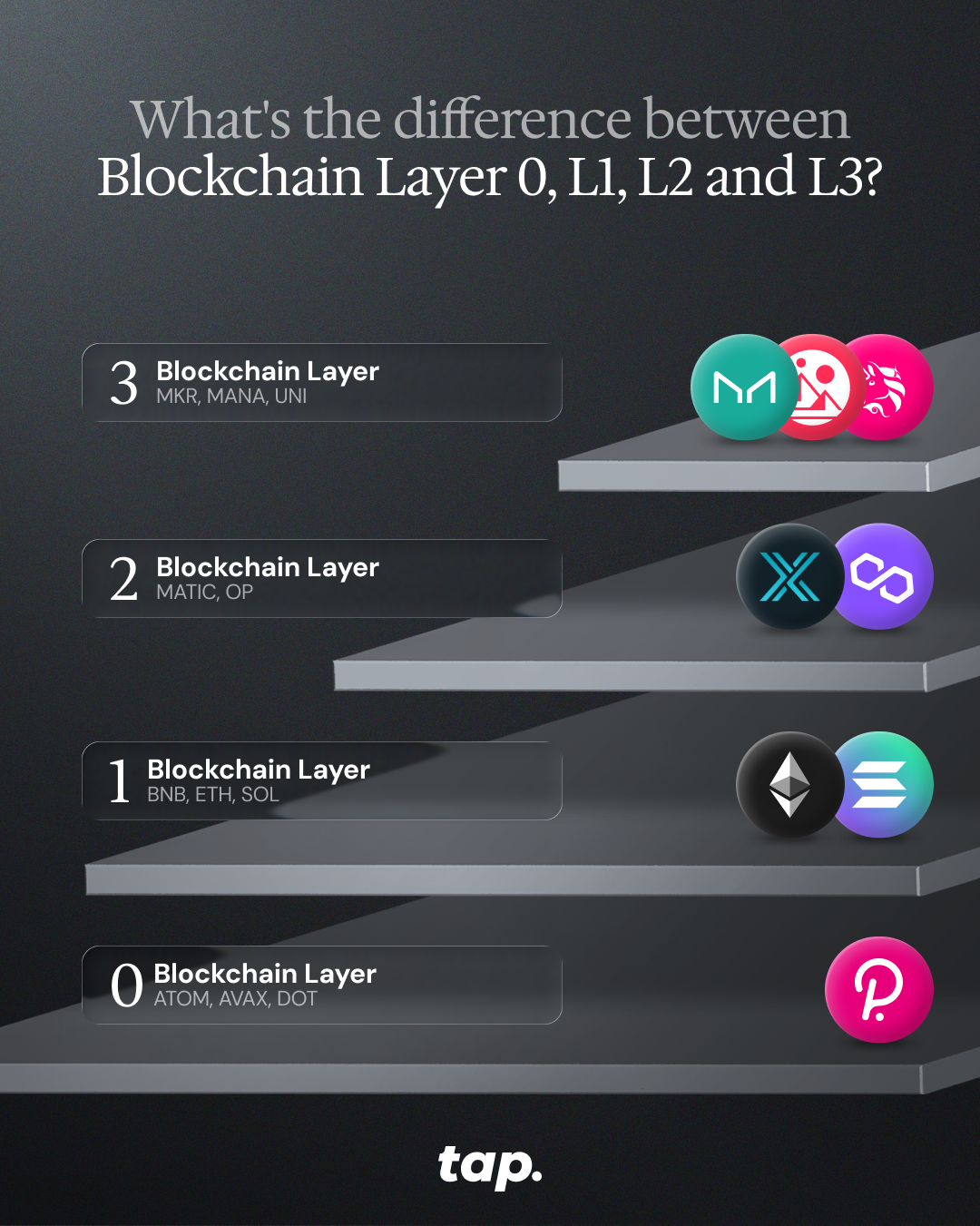
Going back to our city analogy, Layer 1 is the foundation, Layer 2 is the infrastructure that improves traffic flow, and Layer 3 is where people actually live and interact.
Layer 0: Connecting the Ecosystem
Layer 0 sits beneath everything else and focuses on interoperability and infrastructure. Its goal is to make it easier for different blockchains to communicate and share data.
Instead of building a single blockchain, Layer 0 projects, such as Polkadot, provide the tools to create entire ecosystems of connected chains. This is especially important as the crypto space grows more fragmented.
- In practice, Layer 0 enables communication between different blockchains, shared security and infrastructure, and more flexible development of new networks.
You can think of it as the “internet of blockchains,” helping different systems work together rather than in isolation.
Layer 1: The Foundation of Trust
Layer 1 is the base blockchain itself. This is where transactions are recorded, validated, and secured.
- Networks like Bitcoin and Ethereum are classic examples. Their primary role is to provide security, by protecting the network from attacks, and consensus by ensuring everyone agrees on transaction history.
Different Layer 1s can take different approaches. Bitcoin focuses on simplicity and security, acting as a highly reliable ledge. Ethereum expanded on this by introducing smart contracts, allowing developers to build entire ecosystems of apps on top of it.
However, this strength comes with limitations. Because Layer 1 prioritizes security and decentralization, it can struggle with:
- Limited transaction throughput
- Higher fees during peak demand
- Slower confirmation times
This is a direct result of the blockchain trilemma we explained previously, and it’s exactly why Layer 2 solutions emerged.
Layer 2: Scaling Without Compromise
Layer 2 is designed to make blockchains faster and cheaper without sacrificing the security of Layer 1.
- Instead of processing every transaction on the main chain, Layer 2 solutions handle transactions off-chain or in batches, compress them into a single update, and send that update back to Layer 1 for final settlement.
This dramatically improves efficiency. For example:
- On Bitcoin, the Lightning Network enables near-instant, low-cost payments
- On Ethereum, rollups bundle thousands of transactions into one
The result is a better experience for all users by allowing for faster transactions, lower fees, and greater scalability. It’s worth remembering that Layer 2 doesn’t replace Layer 1; it builds on top of it, using it as a foundation.
Layer 3: Where Users Actually Interact
Layer 3 is where blockchain becomes tangible for everyday users.
- This is the layer of decentralized finance (DeFi) platforms, NFT marketplaces, blockchain games, and social apps. In other words, it’s where people actually use crypto. Some examples are UniSwap, AAVE, and Curve.
Most users don’t consider consensus mechanisms or scaling solutions when they interact with blockchain. They’re using apps, interfaces, and wallets, and don’t see the clockwork-like mechanism that works underneath.
Why Layers Matter More Than Ever
As blockchain adoption grows, so does the need for better performance, lower costs, and smoother user experiences.
- Layered architecture allows innovation plus scalability without compromising security and specialized solutions for different needs. Instead of one system trying to do everything at once, multiple layers work together, each optimized for a specific role.
Bottom Line
Blockchain layers might seem complicated, but the idea is simple: break a complex system into smaller, more efficient parts. From the infrastructure that powers the network to the apps you use every day, each layer plays a role in making blockchain secure, decentralized, and scalable.
Explore the World of Blockchain with Tap
Whether you're interested in Layer 1 networks like Bitcoin and Ethereum, Layer 2 scaling solutions, or emerging ecosystems built on Layer 0 infrastructure, understanding how these layers work together helps you navigate the crypto space more confidently.
If you're ready to explore tokens across the entire blockchain stack, from widely known pioneers to cutting-edge DeFi platforms, you can find over 70 cryptocurrencies supported on Tap, giving you access to the projects shaping the future of decentralized technology.
This article is for general information purposes only and is not intended to constitute legal, financial or other professional advice or a recommendation of any kind whatsoever and should not be relied upon or treated as a substitute for specific advice relevant to particular circumstances. We make no warranties, representations or undertakings about any of the content of this article (including, without limitation, as to the quality, accuracy, completeness or fitness for any particular purpose of such content), or any content of any other material referred to or accessed by hyperlinks through this article. We make no representations, warranties or guarantees, whether express or implied, that the content on our site is accurate, complete or up-to-date.
