
Learning the friendly way
Dive into our resources, guides, and articles for all things money-related. Grow your financial confidence with our experts curated tips and articles for both experienced and new investors.
LATEST ARTICLEs
What Are Fiat On-Ramps and Off-Ramps?
For many users, one of the biggest challenges in the crypto space is figuring out how to move between traditional money and digital currencies safely and easily. That’s where fiat on-ramps and off-ramps come in. These essential gateways allow users to convert their local currency (like US dollars, GB pounds, or euros) into crypto and back again, helping bridge two financial worlds.
In this guide, we’ll break down what each type of ramp means, how they work, and why they’re critical for expanding real-world crypto adoption.
What Is a Fiat On-Ramp?
A fiat on-ramp is a service that lets users buy cryptocurrencies using traditional fiat currencies such as USD, EUR, or GBP. In other words, it’s the entry point into the world of crypto. Exchanges, brokerage platforms, and payment services act as intermediaries, processing financial transactions and converting fiat money into assets like Bitcoin, Ethereum, or stablecoins.
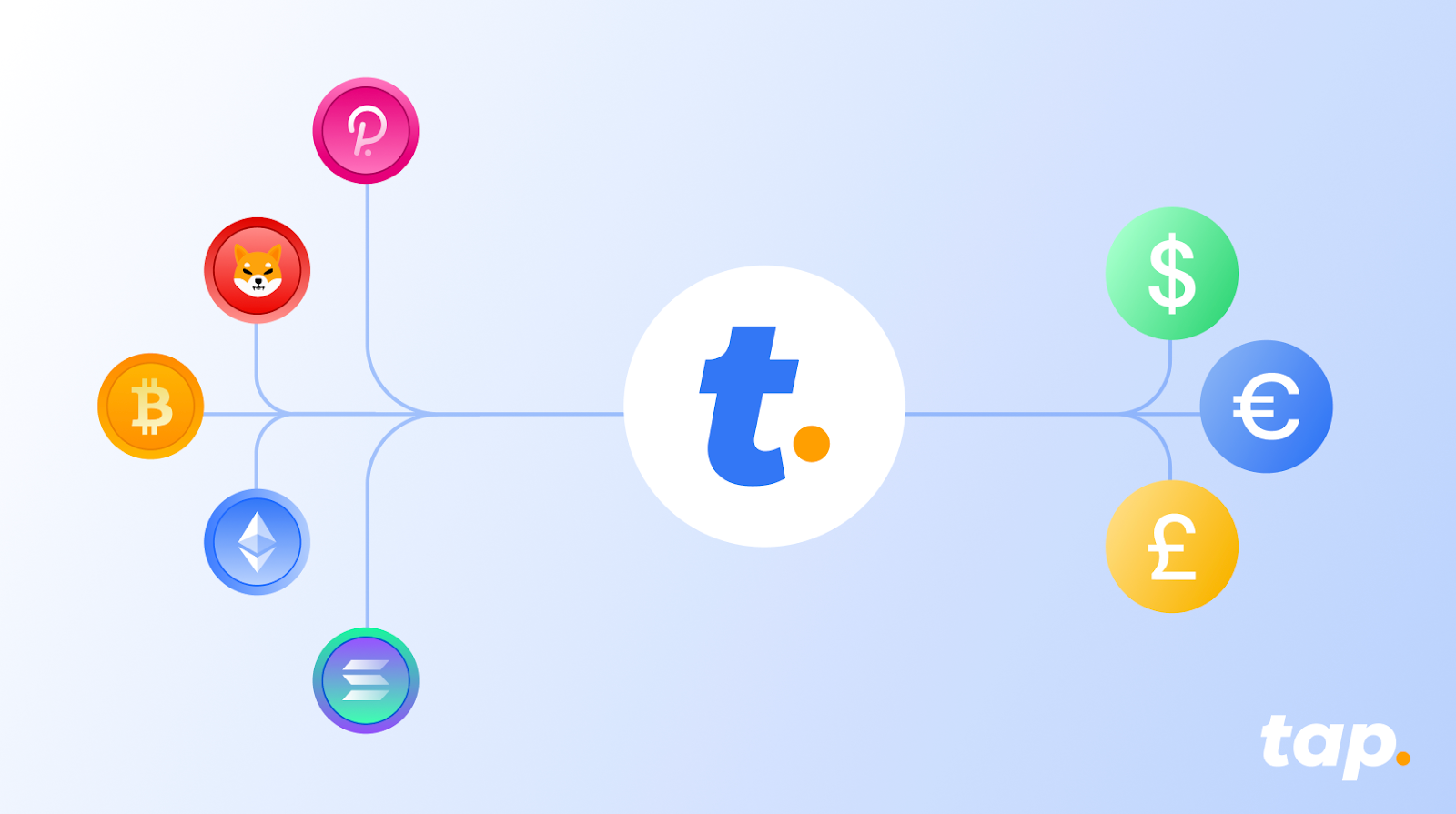
Common examples include centralized exchanges or fintech apps that integrate blockchain functionality. On-ramps are regulated financial services that typically require Know Your Customer (KYC) verification to comply with laws on anti-money laundering and consumer protection.
When choosing a fiat on-ramp, users should evaluate fees, supported currencies, and security standards to ensure a smooth and safe experience.
The Advantages and Disadvantages of Fiat On-Ramps
Fiat on-ramps make entering the crypto market much easier, particularly for beginners. They simplify the process of buying digital assets without requiring technical expertise.
They also open the door to a diverse set of cryptocurrencies, letting users explore different projects and blockchain networks. Some on-ramps even offer instant payment methods through debit or credit cards, wire transfers, or mobile apps like Google Pay, enabling fast transactions and greater convenience.
From a business perspective, on-ramps support financial inclusion by connecting traditional banking systems to blockchain-based platforms, driving mainstream adoption and innovation across the fintech industry.
While fiat on-ramps are convenient, they also come with a few challenges. Users must comply with verification and regulatory requirements, which can take time. Another potential issue is exposure to fraudulent or unlicensed platforms, which can compromise data or funds. To minimize these risks, users should choose on-ramps that offer transparent pricing and operate in full compliance with financial regulations, like Tap.
In addition, on-ramps might charge higher transaction or processing fees, especially for card purchases or smaller amounts. To keep fees low and help users get the best crypto deals without platform hopping, Tap uses a top-of-the-line smart router.
What Is a Fiat Off-Ramp?
A fiat off-ramp performs the opposite function: it lets users sell cryptocurrency and receive fiat money in their bank account. Off-ramps provide liquidity and help people turn crypto assets into spendable cash.
Off-ramps operate through centralized exchanges, peer-to-peer platforms, or crypto debit cards that automatically convert digital assets into fiat currency at the point of sale. This process makes cryptocurrencies more practical for daily use, enabling real-world purchases, payments, and withdrawals.
How Fiat Off-Ramps Work
The off-ramping process generally involves a few simple steps:
- Transfer crypto from your wallet to an exchange or service that supports fiat withdrawals.
- Sell or convert your chosen cryptocurrency into your preferred fiat currency.
- Withdraw funds to your linked bank account or payment method (for example, a debit card).
Processing times vary by provider and banking network, usually ranging from a few minutes to a few business days. Many platforms require identity verification to meet anti-fraud and regulatory standards. Key factors influencing the experience include withdrawal limits, transaction fees, and the fiat currencies supported.
The Advantages and Disadvantages of Fiat Off-Ramps
The main advantage of off-ramping is, of course, liquidity: the ability to convert digital currencies into usable cash when needed. Whether users want to pay bills, make everyday purchases, or take profits from crypto investments, off-ramping makes that possible.
It also provides flexibility in managing risk. When markets are volatile, selling crypto for fiat can help stabilize personal finances. Additionally, off-ramping plays a role in promoting transparency and regulatory compliance by ensuring that transactions are traceable and aligned with local laws.
Off-ramping faces similar challenges to on-ramping, including variable fees, conversion delays, and regulatory hurdles. Some banks restrict transactions related to cryptocurrency exchanges, causing delays or rejections. Others may require additional verification steps for large transfers.
Users should check whether a platform offers low-cost conversions, and has clear customer support channels. As always, verifying a provider’s regulatory compliance and reputation helps avoid potential issues.
The Connection Between Fiat On-Ramps and Off-Ramps
Together, fiat on-ramps and off-ramps form the foundation of the crypto-fiat ecosystem. They create a two-way bridge that connects digital currencies to the traditional financial system, improving liquidity, usability, and accessibility.
Seamless on-ramping attracts new users by making it easy to enter the market, while efficient off-ramping gives confidence that assets can be converted back to fiat when needed. This balance is what enables broader adoption of cryptocurrencies across businesses, consumers, and financial services.
Platforms like Tap exemplify this connection by offering both on-ramp and off-ramp capabilities through secure infrastructure, compliance with financial regulations, and support for multiple digital assets. Users can buy, sell, and transfer between crypto and fiat currencies using a single account, without needing multiple intermediaries.
Security and Best Practices
Security should always come first when using any financial platform. Here are a few best practices:
- Verify regulation. Check whether the platform follows financial authority standards and offers transparent reporting.
- Use two-factor authentication. This adds an extra layer of protection to your account.
- Confirm wallet and withdrawal addresses. Mistyped addresses are one of the most common causes of lost funds.
- Start with small transactions. Test the service before transferring large amounts.
- Keep records. Store transaction data securely for personal reference or tax reporting.
Following these measures helps maintain data integrity and protects against common cyber risks in digital finance.
Common Challenges and How to Overcome Them
Here are a few recurring challenges users may face:
- Banking restrictions on crypto-related transactions.
- High conversion fees that can reduce profit margins.
- Processing delays during peak trading hours.
- Strict verification procedures that slow onboarding.
The best way to overcome these obstacles is to work with reputable, user-friendly well-established providers that maintain transparent communication and have strong partnerships with trusted financial institutions, such as Tap.
In Conclusion
Now that we've explored what a fiat on-ramp and off-ramp are, it becomes clear how essential it is for cryptocurrency users and investors to understand these processes as they provide liquidity, investment opportunities, and the ability to realize profits (in fiat currency).
Looking ahead, the future of fiat on-ramps and off-ramps appears promising. As the cryptocurrency landscape continues to evolve, we can anticipate exciting advancements in these gateways, making crypto assets more accessible and further driving their adoption into mainstream use.

Tether är en av de fem största kryptovalutorna i världen och den mest populära stablecoinen på marknaden. Med ett av de högsta dagliga handelsvolymerna är Tether en självklar del av kryptolandskapet. Låt oss ta en närmare titt på denna digitala valuta och vad som gör Tether så central i ekosystemet.
Sedan den digitala ekonomin tog fart har användningen av internetbaserade pengar vuxit enormt — samtidigt som farhågorna också gjort det. Traditionella investerare är ofta skeptiska till volatiliteten på kryptomarknaden, men för många runt om i världen har kryptovalutor öppnat upp tillgång till finansiella tjänster som tidigare krävde långa bankprocesser.
Digitala valutor som Tether kan dessutom bidra med både transparens och säkerhet, vilket direkt bemöter några av de problem som traditionella valutor brottas med. Även om vissa kritiker fortfarande betraktar kryptovalutor som riskabla, är det tydligt att denna nya generation av betalningslösningar har tillfört något nytt och användbart till ett annars åldrat system.
Vad är Tether (USDT)?
Tether (USDT) är en kryptovaluta som är kopplad till den amerikanska dollarn — det som kallas en stablecoin. Stablecoins är digitala valutor som är bundna till ett fiatvärde, oftast på en 1:1-nivå.
Tether var faktiskt världens första stablecoin när den lanserades 2014 under namnet Realcoin. Initialt fungerade den via Omni Layer på Bitcoin-blockkedjan, men har sedan dess blivit kompatibel med flera andra blockkedjor, däribland Ethereum, TRON, EOS, Algorand, Solana och OMG Network.
För att hålla värdet stabilt är det avgörande att utbudet av Tether alltid motsvaras av tillgångar som hålls i reserv. Dessa reserver kan bestå av exempelvis kommersiella värdepapper, insättningar, kontanter, återköpsavtal och statsobligationer.
Det har förekommit spekulationer kring exakt hur dessa reserver är sammansatta, men detta har inte hindrat Tether från att fortsätta vara en av de mest använda stablecoins på marknaden.
Grundidén med Tether är enkel: att erbjuda en digital tillgång med stabilt marknadsvärde, så att användarna kan dra nytta av blockkedjans teknik och fördelar utan den prisvolatilitet som är vanlig hos många andra kryptovalutor. Om du vill fördjupa dig ännu mer, kan du alltid besöka Tethers officiella sida.
Vad är värdet på Tether?
Till skillnad från andra kryptovalutor, vars värde bestäms av tillgång och efterfrågan, är stablecoins som Tether alltid kopplade till en fiatvaluta eller råvara. För Tethers del innebär det att 1 USDT alltid motsvarar värdet av 1 amerikansk dollar.
Trots att värdet hålls stabilt har Tether vuxit till att bli en av de mest handlade kryptovalutorna i världen — något som tydligt visar på efterfrågan efter stabilitet i en annars volatil marknad.
Vem skapade Tether?
Som nämnts ovan lanserades Tether under namnet Realcoin år 2014 av Bitcoin-investeraren Brock Pierce, entreprenören Reeve Collins, och mjukvaruutvecklaren Craig Sellars. Kort därefter bytte projektet namn till USTether, och senare till det vi känner till idag som USDT.
De tre grundarna är alla välkända profiler inom kryptobranschen och har varit inblandade i flera andra projekt inom blockchain och digitala valutor.
Utöver USDT har teamet även tagit fram andra stablecoins, som exempelvis EURT (kopplad till euron), CNHT (kopplad till den kinesiska yuanen), och XAUT (kopplad till guld). Dessa hjälper till att hantera prisvolatilitet på flera olika marknader.
Hur fungerar Tether?
Tether har inte någon egen blockkedja utan fungerar som en så kallad second-layer token ovanpå redan etablerade blockkedjor som Bitcoin, Ethereum, EOS, Tron, Algorand, Bitcoin Cash och OMG.
USDT fungerar som andra kryptovalutor och lagras i plånböcker som är specifika för den blockkedja den är byggd på. Det är viktigt att tänka på att du inte kan skicka en USDT-token som är baserad på Ethereum till en plånbok som är skapad för Tron — det måste alltid ske inom samma blockkedja, annars riskerar du att förlora dina tokens.
Utbudet av Tether måste alltid vara uppbackat av motsvarande mängd tillgångar i reservkonton. Dessa reserver kan inkludera kontanter, likvida tillgångar, eller andra finansiella tillgångar.
Genom att erbjuda en stabil digital valuta i en annars volatil marknad, gör Tether det möjligt att genomföra USD-transaktioner globalt utan att oroa sig för snabba prisförändringar. Tether används också ofta som ett tryggt alternativ när marknaderna skakar till, och fungerar därmed som ett slags skyddsnät.
Vad är USDT?
USDT är Tethers stablecoin, knutet till den amerikanska dollarn i förhållandet 1:1. Under varumärket Tether är det idag världens mest använda stablecoin.
Även om det teoretiskt sett finns ett obegränsat antal USDT, låg cirkulerande mängd vid skrivande stund runt 72,5 miljarder tokens.
USDT fungerar som en trygg tillflykt för användare som vill undvika prisfall i kryptomarknaden, och erbjuder en stabil lösning utan att behöva sälja sina digitala tillgångar till traditionella valutor.
Hur köper man USDT?
Vill du lägga till Tether (USDT) i din kryptoplånbok? Det gör du enkelt genom Tap-appen. Efter en snabb verifiering får du tillgång till en rad kryptomarknader och kan lagra dina digitala tillgångar i våra integrerade kryptoplånböcker.
Med Tap-appen kan du dessutom hantera både din kryptoportfölj och fiat, när du är på språng. Du kan även använda ditt Tap-förbetalda kort för betalningar hos över 40 miljoner butiker världen över.

What is Return on Investment?
Return on investment is one of the most common measures of profitability and performance in both business and personal finance. It shows how much gain or loss you’ve made on an investment compared to its original cost.
In simple terms, ROI tells you whether your money has worked for you or not. Whether you’re investing in stocks, property, a business project, or a marketing campaign, ROI helps you compare how efficiently different investments use your capital. It’s widely used by companies to evaluate new projects, advertising performance, or expansion opportunities, and by individuals to assess savings, portfolios, or real estate ventures.
A clear ROI provides insight into the effectiveness of a decision and guides future strategies, whether the goal is increasing profit, cutting costs, or improving financial performance.
All investments, including stocks, bonds, real estate, and small businesses, come with the goal of making more money than you put in. The money you earn over and above your initial investment is called profit. As you’ll learn later, profit and ROI aren’t the same thing. When discussing investment profitability, however, people often use ROI. This metric expresses the amount of net profit one earned as a percentage of what the initial investment was.
ROI can help you assess if buying property or investing in a business is worth it. It also helps companies determine the value of adding new products, building more facilities, acquiring other businesses, advertising campaigns, etc.
In other terms, it's a way to compare different investments in order to figure out which ones are worth pursuing. For example, you could calculate ROI to decide whether selling one stock and buying another would be a good idea.
While there is no limit to a return on investment theoretically, in practice, no investment is guaranteed to have any return. If your ROI is negative, it means you not only failed to make a profit but also lost some of your original investment. The worst possible outcome would be -100% ROI, meaning you completely lost your initial investment. An ROI of 0% signifies that you at least recovered the money you put in, but gained nothing beyond that.
While ROI is often used as a marker of profitability, it isn't foolproof. There are several limitations to calculating ROI as your only measure which include the time frame in which you will earn back your investment, inflation rates, how risky a venture is, and additional maintenance costs that may be incurred.
ROI Terminology
Before we dive in, let's first cover some basic terminology.
Net profit or net income
Net profit is the amount of money left over after all operating costs, such as the cost of transaction costs or maintenance costs, and other expenses have been accounted for and subtracted from the total revenue. It is used to measure profitability. Net profit can also be called net income, net earnings, or the bottom line.
Total cost of investment
This figure will look at the amount of money invested in a particular investment.
How to Calculate ROI: The ROI Formula
The ROI formula is a simple equation that looks at the price change of the asset and the net profits (the initial cost of the investment minus its value when you sell it). When calculating ROI you would use this formula:
ROI = (Net Profit / Total Cost of Investment) x 100
To factor trading costs into your ROI figure, you'll use:
ROI = ((Value of Investment - Cost of Investment – Associated Costs) / Cost of Investment) x 100
As an example, let's say you buy 5 shares of $100 each in Tesla, equating to $500. You sell them a year later for $150 each, equating to $750. Let's say you paid $5 commission on each trade, costing you $25 in trading fees.
ROI = (($750 - $500 - $25) / $500) x 100 = 45%
This means that you made a 45% return on investment on that particular investment.
What is a Strong ROI
A "good" return on investment is any number above 0, as this means you made some profit. However, the ideal ROI should be higher than what you could've earned had you chosen another investment (the next best thing).
To compare this, investors often compare their earnings to what they could've made on the broader stock market or in a high-yield savings account. Using the S&P 500 as a control, over the past four decades it has made gains of around 7% (after inflation). An ROI is generally considered to be a strong one if it beats the stock market in the long term.
However, risk and return are directly linked. High ROIs often come with higher volatility or uncertainty. Property, stocks, and startups may yield better returns but can also result in losses. Safer investments, like savings accounts or government bonds, tend to offer lower but more predictable ROIs. Moreover, it's always important to note that past performance does not equate to future results.
Therefore, a strong ROI will vary depending on the investment's level of risk, your goals, and how much risk you're willing to take.
ROI vs Profits
ROI and profit are related but not identical. Profit is the absolute amount of money gained after costs, while ROI expresses that profit as a percentage of the original investment.
For instance, a $1,000 profit might sound good, but if it came from a $100,000 investment, the ROI is just 1%. That’s why ROI is a more useful metric for comparing opportunities or assessing performance across projects.
Use ROI for decision-making and benchmarking; use profit for understanding absolute earnings.
Benefits of Using ROI
Return on investment (ROI) is widely valued for its clarity and practicality. It allows both individuals and businesses to assess whether their financial choices are creating real value, providing a clear, quantitative foundation for better decision-making. It remains one of the simplest and most effective tools for:
- Comparing investments as it standardises performance across asset types.
- Guiding decisions, where it is used to prioritise projects or marketing strategies.
- Measuring performance by tracking financial efficiency over time.
- Allocating resources by showing where capital yields the best results.
Its simplicity and flexibility make it an essential concept in finance, marketing, and project management alike.
Where the ROI Formula Falls Short
The main limitation of using this return on investment ROI formula as a marker of success is that it doesn't show how long it took to earn the money back. When comparing various investments, the time it takes to mature will have a significant impact on the profits you could earn.
For instance, a year loan versus a bond held for five years versus a property held for 10 years will all have varying ROIs once you've established how long it will take to earn the specified ROIs.
In this scenario, the ROI calculations mentioned above skimp on the full story. It also doesn't account for risk. For instance, the loan repayments could be delayed or the property market might be in a slump, all affecting the potential profits earnable.
With many variables, it becomes harder to predict what the exact ROI calculation on an investment will be, so be sure to factor this in when using the return on investment ROI formula to determine how attractive an investment opportunity or business venture is.
ROI Alternatives
Although the return on investment doesn't consider how long you keep an asset, it's essential to compare the ROI of investments held for comparable lengths of time as a more clear performance measure. If that's not possible, there are a few other options.
Average Annual Return
Also known as annualized return on investment, this adjusts the ROI formula to factor in the timing. Here you would divide the ROI by the number of years you hold the asset.
Compound Annual Growth Rate (CAGR)
This option is more complicated but yields more accurate results as it factors in compound interest generated over time.
Internal Rate of Return (IRR)
This measure factors in the notion that profits earned earlier outway the same profits earned later, taking into account interest that could've been earned and factors like inflation. This equation is quite complicated but there are online calculators one can use.
Conclusion
A return on investment (ROI) is a formula used to calculate the net profit or loss of an investment in percentage form. The ROI calculation can present valuable information when investing capital or determining profitability ratios. The ROI equation looks at the initial value of one investment and determines the financial return. A negative ROI indicates that the investment returns were lower than the investment cost.
Since the advent of cryptocurrencies in 2009, the world has seen a substantial shift in the way that people transact and manage their money online. The first cryptocurrency, Bitcoin, sparked a wave that has impacted almost every corner of the globe, significantly shifting the financial landscape as we know it. Let’s explore how crypto is expanding economic freedom on a global scale.
What is economic freedom?
Before we evaluate how this $2 trillion industry is contributing to financial liberation, let’s first establish what economic freedom is. Explained simply, the term refers to measures that grant users the freedom to manage their money, property, and labour in each country, which is then compared globally.
More accurately, the measure of economic freedom is determined by using the Index of Economic Freedom, which weighs up 12 factors contributing to a country’s overall measure. This is broken down into 4 categories, each carrying varying subcategories, such as market openness measuring a country’s trade, financial and investment freedom. The others are regulatory efficiency, rules of law, and government size, each with its own subcategories.
This index was first published in 1995 by The Heritage Foundation and The Wall Street Journal and is used around the world today. This year, Singapore, New Zealand, Australia, Switzerland, and Ireland have ranked as the most financially free countries in the world.
Crypto and economic freedom
Cryptocurrencies were first established to provide an alternative monetary solution to the global financial crisis that sent the world into disarray in 2007. Satoshi Nakamoto created the new age payment system to empower individuals to hold control over their own finances, allowing them to manage and transact their money without the control of an authoritarian entity. For the first time in history, people were able to send money overseas without incurring the usual costly and time-consuming setbacks incurred with regular, global fiat transactions.
Due to the decentralized nature in which they are run, people are responsible for managing their own crypto wallets and specialised users on the network positioned across the globe are responsible for verifying and executing transactions. After Bitcoin entered the scene a significant number of new cryptocurrencies have been launched, over 12,000 at the time of writing. While some maintain the same “medium of exchange” model, many new cryptocurrencies have emerged providing alternative solutions to the industry.
Ethereum, the world’s second-biggest cryptocurrency, for example, provides a platform on which developers can create their own decentralized apps and cryptocurrencies, while other cryptocurrencies revolve around faster transaction times, cloud storage and private transactions. Each of these projects utilizes a blockchain network that was designed to improve and innovate the crypto and blockchain space.
Spanning beyond government control and lengthy paperwork, cryptocurrencies are able to provide a global currency that operates entirely online and is not confirmed to the borders of a country. Cryptocurrencies are global, accessible 24/7 and cannot be frozen in accounts.
How crypto is driving economic freedom
Requiring only an internet connection and start-up funds, Bitcoin (and cryptocurrencies in general) allows anyone around the world to create a wallet and start trading. One doesn’t need access to a large bank branch or lengthy paperwork, one simply needs an internet connection and a smartphone.
Curling back to the factors that contribute to economic freedom, cryptocurrencies are able to seamlessly check six of twelve of the categories of the Index of Economic Freedom through their innate properties.
- Trade Freedom [Market Openness]
- Financial Freedom [Market Openness]
- Business Freedom [Regulatory Efficiency]
- Labour Freedom [Regulatory Efficiency]
- Monetary Freedom [Regulatory Efficiency]
- Property Rights [Rule Of Law]
The remaining categories however revolve around the governments running the nations in question, particularly the rule of law and government size categories. Nevertheless, cryptocurrencies can still assist in creating better-functioning economies and provide the technology that allows for a more open and free financial system.
A free and open financial system
As cryptocurrencies remove the barriers of borders, they allow people to transact their money in the same way that they communicate with each other (through the internet). As the digital age continues to evolve, we are likely to continue seeing a significant increase in the level of economic freedom that crypto provides to users around the world, empowering both the individual and the nation.
Bitcoin and other cryptocurrencies are all about decentralised, worldwide, financial independence and liberty. Cryptocurrencies are borderless, censorship-resistant digital currencies that can be used by anybody with internet access.
As a result, crypto, at least in principle, appears to be the perfect solution for international travellers or "digital nomads." With the added advantage of having the Tap app, users can instantly and seamlessly use their cryptocurrencies as they would regular fiat currencies when travelling around.
With the growth rate of blockchain technology and crypto adoption increasing, it's only natural that we're seeing more options to spend and travel the world using cryptocurrency.
In this article, we'll look at a variety of different ways to spend your crypto while travelling with Tap and how to spend seamlessly with your Tap card. We will explore why people choose to use their crypto to travel and how the exploding $1 trillion travel market is important for the cryptocurrency industry.
Entirely Cashless
The beauty of travelling with crypto is that it is entirely cashless. You won't have to worry about dealing with foreign currency exchanges when entering or leaving a different country as all of your money is kept digitally online in your app.
With the Tap card, users can use their crypto balances to load their card and freely swipe away worldwide. The card allows for seamless payments at millions of merchants around the world, with the merchant none the wiser.
The option to upgrade to more premium accounts allows you to reduce or completely eliminate any FX fees. Get empowered and enjoy the best out of your money wherever you go.
Reduces Risk
Instead of being a target for muggings looking to steal cash, being entirely digital bypasses this risk.
Accessible
Should something happen at home you can easily and quickly send funds back. Operating 24/7 and only requiring an internet connection, sending money back home can be completed at a moment's notice. Send funds to your friends and family via crypto or fiat for free on their Tap account.
Discounts
Last but not least, many companies offer discounts to users paying with cryptocurrencies. From travel to retail, and everything in between, users can enjoy added discounts just by utilising crypto.
Should an event arise that you do need cash, users can easily withdraw cash from a regular ATM using their Tap card. Paying significantly lower fees than you would with your standard bank card, the Tap card allows you to seamlessly integrate into the foreign country with peace of mind.
How To Travel Abroad With Tap
This is the ultimate crypto vacation guide showing you how to buy everything that you might need through the Tap app for that epic crypto vacation abroad.
Flights
CheapAir.com was the first US online travel agency to open its doors to crypto, getting into the game as early as 2013. The company currently allows holidaymakers to make payments using Bitcoin, Litecoin, Bitcoin Cash and Dash.
In 2020, Travala and Expedia merged to give users access to millions of hotels and villas worldwide payable in over 30 popular types of cryptocurrencies. There is also Destinia.com in Spain, airBaltic in Latvia, Surf Air in the US, and Peach Aviation in Japan.
Conveniently buy everything you need with your Tap app by scanning the company’s QR code and confirming the transaction. Alternatively, you can make online purchases using your Tap card.
Accommodation
Travala, CheapAir.com and Destinia all allow users to book flights and accommodation in one smooth transaction. On Destinia look out for the GoCoin merchant plugin.
Booking.com has partnered with flight planner, A Bit Sky, to provide a location with both flight and accommodation options.
Savvy accommodation-seekers can look to Airbnb-style crypto startups like 99Flats in India or CryptoCribs on Reddit, or head over to XcelTrip,a decentralized travel ecosystem, which provides access to 400 airlines and 1.5 million hotels.
Food and Drink
CoinMap is an app for anyone and everyone wanting to find crypto-friendly companies. Felix Weis, as well as numerous other cryptocurrency influencers, has credited CoinMap with being the saviour for finding the closest cafe, bar, or restaurant that accepts Bitcoin, including international chains such as Subway and local providers who use crypto merchants. Say goodbye to walking around with boatloads of cash and just take your Tap app along instead.
Holidaymakers can also look to using crypto to buy a gift card which can be purchased online through Gyft or eGifter, with eGifter offering a 5% discount for purchases made with Bitcoin. eGifter offers gift cards to restaurants like Papa John, Taco Bell, Dunkin’ Donuts, TGI Fridays, UberEats and more.
Getting Around
Expedia, A Bit Sky, Destinia, and CheapAir all offer access to transfers or car rentals in their services, while Gyft and eGifter offer Uber vouchers. There is also SpendBitcoin.com, which locates different crypto-accepting services in an area, simply chose the car filter option.
Things To Do
Again, Gyft and eGifter provide access to options like Groupon where you can find local activities on offer, or head to purse.io for any last-minute Amazon purchases (snorkel, anyone?).
Travel The Tap Way
Both the Tap card and the Tap app can provide a seamless and cost-effective solution to using both fiat and cryptocurrencies when travelling. Simply load your wallet with crypto and fiat currencies, and pay directly from the app or use the card to pay at millions of merchants around the world. Say hello to easy travel and plenty of discounts.
With a range of coins on offer and an integrated smart engine that ensures the best possible prices in real time, travelling with cryptocurrencies and Tap is as smooth a ride as it gets.
With a range of coins on offer and an integrated smart router, Tap lets you store and manage your digital assets wherever, whenever. There are no border delays or inconvenient payment processes to worry about while travelling with crypto only speed and convenience. Tap is as seamless a journey as it gets.

If you’re a business owner looking to tap into the over 575 million people across the globe using cryptocurrencies, you’ve come to the right place. In this piece, we’re covering why that’s a great idea, and how you can incorporate cryptocurrencies as a payment option.
The benefits of crypto payments
Whether you want to accept Bitcoin payments or crypto payments, incorporating digital currencies into your business is a great idea. Below we run through several advantages that crypto payments bring to the table.
- Faster Settlements
Did you know that credit card companies can take a few business days to move the funds into your account? With crypto payments, once the transaction has been executed the funds will (almost) immediately appear in your crypto wallet.
- Lower Fees
Card processing companies charge anywhere from 1% - 3% plus an additional charge for using that service. Other payment services, like PayPal for example, charge even more. While the transaction fee structure is dependent on the specific network, cryptocurrencies charge a minimal flat rate, with no added hidden costs. When making or accepting crypto payments, you will know the transaction fees upfront.
- Wider Audience
According to Statista, there are over 575 million people using cryptocurrencies, offering a much wider audience for your business to tap into. Capture new customers by adding crypto payments to your payment options and attract a new demographic.
- Reduce Fraudulent Charges
Fraudulent card activity costs the global economy over $32 billion each year. These chargebacks can occur for a number of reasons, from technical issues to outright fraud. With cryptocurrencies, transactions are final and cannot be reversed due to the nature of blockchain technology facilitating these crypto payments.
How crypto payments can take your business to the next level
Accepting cryptocurrency payments allows your business to tap into a new growth potential, opening your business up to over 575 million global crypto users, attracting a forward-thinking new customer base seeking cutting-edge payment options.
Additionally, you will be able to enjoy the benefits of near-instant settlements directly into your crypto wallet and ultra-low transaction fees that let you save big. Say goodbye to frustrating chargebacks and fraudulent transactions thanks to crypto's secure technology. Let crypto payments propel your enterprise to new heights.
https://www.youtube.com/watch?v=ILSss0jpENQ
What does a business accepting cryptocurrencies entail?
First, you will need to have a proper understanding of cryptocurrencies and an idea of which cryptocurrencies you would like to accept. While most businesses new to accepting crypto payments might opt for Bitcoin payments, there are several alternative options with varying features. Bitcoin Cash, for example, provides faster transaction times at a lower cost.
Next, you will need to create an account with a payment gateway, the crypto equivalent of a payment processor. This gateway will allow you to transfer crypto to fiat and vice versa easily. Ensure that the platform you opt to use is reputable, has high levels of security, and is in line with the regulatory requirements. If you decide to accept Bitcoin payments, you need to ensure that everything you are doing is above board.
Once you have chosen your payment gateway and set up the account, the last step is to let your customers know. Whether you do this through a marketing campaign or simply incorporate the crypto QR code on your website or in-store, this is an excellent opportunity to get the word out there and create a buzz around your business now accepting crypto payments.
A crash course in cryptocurrencies
For the sake of getting you fully prepared to accept crypto payments, we've included a short crash course on cryptocurrencies. The first cryptocurrency to come into existence was launched in 2009 as a response to the global financial crisis. The still-anonymous creator, Satoshi Nakamoto, wanted to create a global digital currency that would allow each individual to take control of their own funds, and not have to rely on governments and centralised financial institutions to do so.
A few years after Bitcoin entered the scene, several other cryptocurrencies started emerging, many of which used the same infrastructure. Bitcoin Cash and Litecoin are examples of this, offering the same service with several tweaks, notably faster and cheaper transactions.
While adoption was slow to take off, crypto payments eventually integrated into the mainstream financial sector as several companies started catering to the crypto crowd. While the markets still go through the typical economic cycles, cryptocurrencies and most notably crypto payments are here to stay.
How can I incorporate cryptocurrency payments into my business?
If you’ve decided to accept Bitcoin payments and propel your business into the crypto-sphere, the process is likely to be much more simple than one would initially imagine. Accepting cryptocurrency payments is made even easier through Tap’s corporate crypto accounts, created especially to fulfil your business needs.
The best part about deciding to accept cryptocurrency payments is that you don't need to forgo your traditional payment methods. Cryptocurrency works perfectly alongside your current point-of-sale system and offers an alternative online payment solution. With Tap, you also don't need to worry about crypto price volatility as you can easily make the quick exchange of crypto to fiat directly through the app.
In order to start accepting Bitcoin payments, you will need to fill in a quick form on the Tap website. You do not need to have a Tap account prior to this. One of our Account Managers will make contact with you and assist with the setup process, including creating a crypto wallet for your business. This Account Manager will continue to work closely with you, providing assistance at any time.
Tap is fully regulated by the Gibraltar Financial Services Commission and operates with a stringent level of security. Known for its easy-to-use crypto payments app, Tap allows users to buy and sell a range of crypto assets and easily convert them to fiat. Integrating the traditional financial sector with the crypto sector, Tap allows users to make payments directly from the app, selecting which currency, whether fiat or crypto, they would like to use.
The app also provides users with the opportunity to earn interest on their crypto and fiat currencies by simply depositing them into a specific fiat or crypto wallet. With no lock-in periods and constant access to the funds, users can earn interest which is paid out weekly. Corporate crypto accounts offer the same earning opportunities.
To find out more about our crypto accounts for businesses and set up your account to accept cryptocurrency payments, take a look here.


