Learning the friendly way
Dive into our resources, guides, and articles for all things money-related. Grow your financial confidence with our experts curated tips and articles for both experienced and new investors.
LATEST ARTICLEs
.svg)
Playing an important role in the adoption of Web3, Enjin provides a platform of software products designed to allow anyone to harness the power of NFTs (non-fungible tokens) through the development, trade, monetization, and marketing of blockchain assets.
The Enjin Coin (ENJ) is the native utility and governance token of the Enjin ecosystem. For gamers, developers and investors alike, ENJ matters because it bridges real-world value with digital goods, offering a means to turn in-game items into tradable assets. In this article you’ll learn what ENJ is, how it works, its key use-cases, how to buy it, its tokenomics, investment considerations and how it stacks up against other gaming tokens.
What Is the Enjin Platform?
The Enjin platform is an ecosystem of interconnected, blockchain-based gaming products designed for individuals, game developers and businesses to create, manage and trade virtual goods such as digital art, games, or virtual marketplaces using the Ethereum blockchain. Enjin aims to provide users with the tools to implement smart digital solutions for blockchain games within the gaming environment.
Through the platform's software development kits (SDKs) and APIs, users can build digital assets as well as seamlessly integrate them into their games and applications.
Under the Enjin umbrella is the Enjin Network, a community gaming platform that allows users to create websites, chat, and host virtual stores. Over the course of a decade, the Enjin platform has accumulated over 20 million users.
The ecosystem binds together gaming communities, game-asset markets and blockchain infrastructure. For example, a developer might create a limited edition in-game sword, mint it using ENJ as backing, list it on the marketplace, players trade it, and the underlying ENJ can be melted or reused. For developers, Enjin provides monetisation tools. For gamers, it provides ownership and portability of digital items.
Powering the ecosystem is the Enjin Coin (ENJ), a token used to back the value of NFTs and other assets minted on the platform. When an asset is minted it locks ENJ tokens into a smart contract and effectively removes the tokens from circulation.
It’s also worth noting that Witek Radomski, Enjin's co-founder and the brainchild behind the ERC-1155 Ethereum token standard, wrote the code for the first non-fungible token (NFT). By utilizing its cutting-edge technology, Enjin is revolutionizing the future of gaming and digital assets.
Who Created Enjin?
Enjin was originally founded in 2009 as a gaming community platform by Maxim Blagov and Witek Radomski. Blagov took on the responsibility of being CEO and in charge of the platform's creative direction while Radomski took on the role of CTO, leading the technical development of the platform's products.
Following Radomski's interest in Bitcoin in 2012, the platform explored incorporating blockchain technology into its business model and embraced the world of tokenized digital assets.
Radomski went on to write the ERC-1155 token standard in June 2018, a token standard used for minting both fungible, semi-fungible and non-fungible tokens using the Ethereum network. This token standard is a critical building block in the platform’s design.
In 2017, the Enjin platform launched an initial coin offering (ICO), raising $18.9 million through ENJ token sales. A year later the project went live and in September 2019, the Enjin Marketplace was launched.
How Does Enjin Work?
The primary goal of the Enjin network is to facilitate the management and storage of virtual goods for games, anything from in-game currencies to unique in-game items. So, how does Enjin work? The process of creating and destroying these tokens involves five steps:
- Purchase
Developers purchase Enjin Coin. - Minting
In-game items are designed and effectively minted with the appropriate amount of ENJ locked into a smart contract. - Utilization
Players use these tokens within the game. - Trading
Players trade the tokens between fellow players or on the internal or external marketplace. - Melting
Players sell the tokens for Enjin Coin, referred to as melting. The token is destroyed and Enjin Coin is released from the smart contract.
SDKs (software development kits) come into play here, with kits designed to fulfill certain functions, such as facilitating a payment platform or being wallet-focused. These kits are designed to minimize costs and simplify the process of creating these virtual goods. APIs (application programming interfaces) work alongside the SDKs to integrate these virtual goods (digital assets) into the game.
The Enjin platform utilizes JumpNet which is integrated with other products in the ecosystem, such as the Marketplace, Enjin Beam, and the Enjin Wallet to allow for gas-free transactions for ENJ and NFTs.
The Enjin ecosystem encompasses the Enjin smart wallet that allows players to store and trade their in-game items with ease. The Enjin wallet is designed to connect all the features, from managing inventory to conducting transactions and selling these tokenized digital assets for ENJ.
What is the Enjin Coin (ENJ)?
As we mentioned previously, Enjin Coin (ENJ) is the native token of the Enjin ecosystem. Built on the Ethereum blockchain and compatible with multiple gaming platforms, the Enjin Coin is an ERC-20 token that allows the in-game items created on the platform to be traded with real-world value. The ENJ token has a maximum supply of 1 billion coins.
The token also allows developers to mint these digital goods. The process requires the users to lock Enjin Coin (ENJ) into a smart contract that automatically assigns value to the in-game item. Players that later use these items can use them in the game, trade them or sell them for ENJ, equivalent to the original minting cost. Once sold, the item is destroyed (known as melting) and the ENJ that was locked in the smart contract is released to the seller.
How Can I Buy the Enjin Coin?
Anyone can tap into the Enjin ecosystem by acquiring ENJ tokens through the Tap mobile app. Simply create an account and complete the verification process in order to gain access to your unique Enjin wallet, from where you can buy, trade and sell Enjin Coin.
Fully licensed and regulated, Tap provides a secure and convenient means of managing your funds, allowing users to manage and store both crypto and fiat currencies in one location. With a wide range of supported currencies and services, Tap is revolutionizing the financial space.
Take advantage of the power of Enjin Coin on the Tap app - the ultimate platform to buy, sell or hold ENJ. With seamless integration and an intuitive interface, trading Enjin tokens has never been easier. Stay up-to-date with the latest market trends and keep your portfolio on track by monitoring the Enjin Coin price in real-time.
Bottom Line
Enjin Coin (ENJ) is more than just another cryptocurrency; it's the utility token powering a complete blockchain gaming ecosystem. It allows game studios to create, manage, and monetize digital assets, gives gamers true ownership and the ability to trade those assets, and offers investors exposure to where gaming, NFTs, and Web3 infrastructure converge.
That said, adoption rates, competition, and regulatory developments all play a role in ENJ’s future. If blockchain gaming, asset tokenization, and virtual economies interest you, ENJ presents a compelling option. Just make sure to do your research, evaluate the projects actually using it, and align any investment with your own goals and risk tolerance.

Cryptocurrencies have gained a reputation for being largely volatile investments. While stocks too can have their moments (what with Peloton stocks dropping 20% every other day) the crypto market carries the brunt of it.
Thankfully, stablecoins have come to the rescue. While still functioning as digital currencies powered by blockchain technology, stablecoins are pegged to external assets such as fiat currencies or gold, thereby eradicating (most of) their volatility.
A Short History Of Stablecoins
After the advent of Bitcoin in 2009, it was only a few years later that a stable digital asset entered the market. Stablecoins came into existence in 2014 when a Hong-Kong based company named Tether Limited released a coin of the same name. The Tether coins' value was pegged to the US dollar, meaning that 1 USDT would always be worth $1.
In order to guarantee this value, the company held the dollar equivalent in bank accounts. Skip past the controversy surrounding their reserves and lack of financial analysis, and there are now plenty of other stablecoin options on the market.
Seeing the infinite benefits of digital currency transactions and blockchain technology, like speed, transparency and low fees, many companies around the world have created their own version of the stablecoin, mostly improving on the previous release. These coins have proven to be invaluable with businesses and retail merchants around the world.
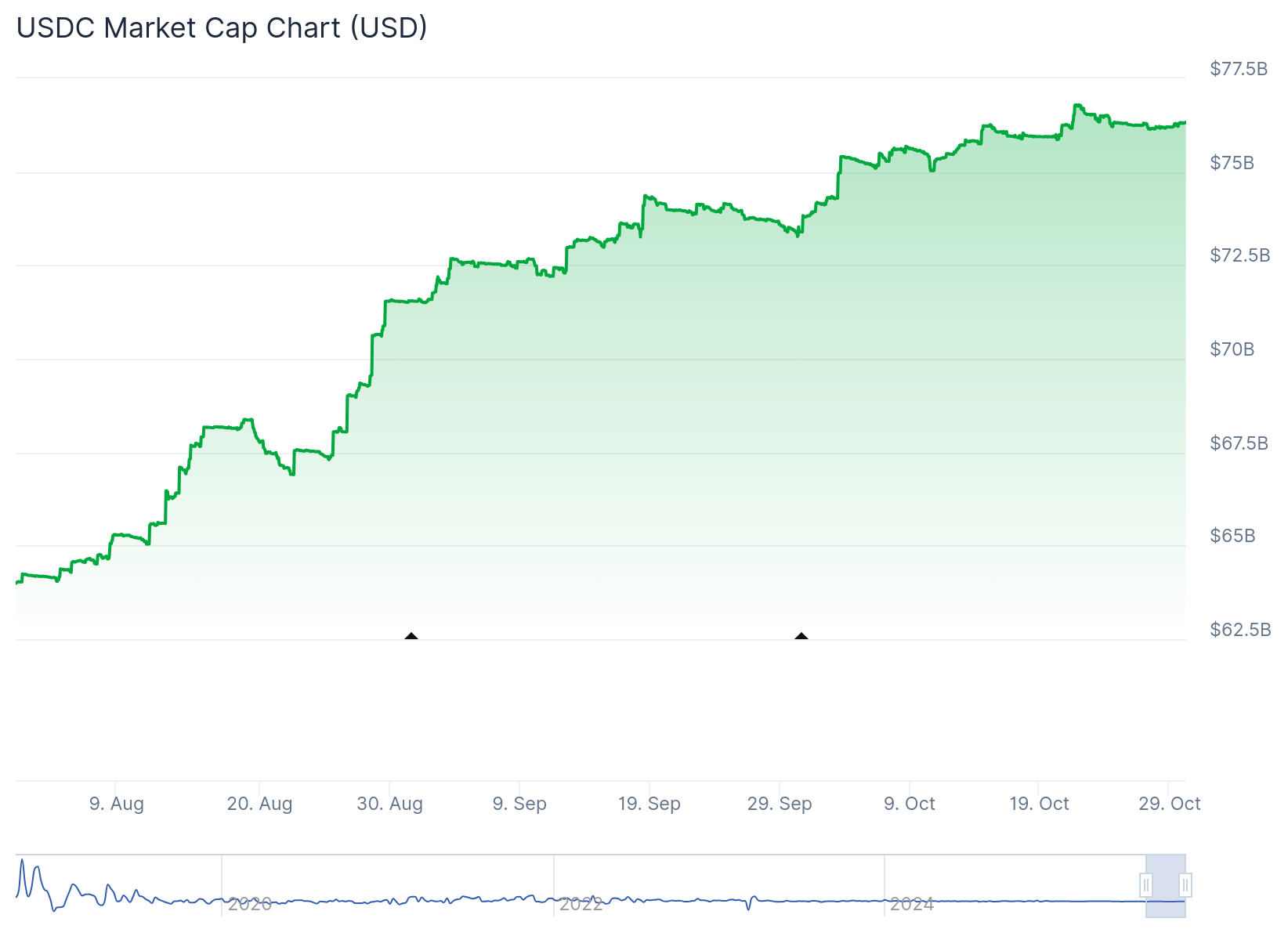
Today, the two biggest stablecoins on the market are Tether (USDT) and USD Coin (USDC). One can argue whether these are "safe haven" assets, but one cannot deny that these tokens hold most of the advantages that digital currencies hold while considerably diminishing the unpredictable market swings.
In our attempt to better understand the concept, let's take a look at the two biggest stablecoins.
Tether (USDT) vs USD Coin (USDC)
Below we explore the two multi-billion-dollar market cap stablecoins, while they both provide the same service in terms of a digital currency, the companies behind them operate quite differently.
What Is Tether (USDT)?
As mentioned above, Tether is the first stablecoin to enter the market. Launched in 2014, the network was initially built on the Ethereum blockchain but is now compatible with a number of other networks.
Note that the Ethereum-based USDT cannot be traded as a TRON-based token, coins need to stick to their respective blockchain networks as this is how the transactions are processed.
It wasn't long before USDT was listed on the top exchanges, and included in dozens of trading pairs.
Tether Limited have since released a Euro-based stablecoin as well as Tether crypto coin pegged to the price of gold. The downside to Tether falls on the company's reputation surrounding transparency and reserve funds.
There have been several court cases where individuals and regulatory bodies have called for transparency surrounding the funds held in reserves. Tether has since provided access to this information but is yet to go through a third party audit. Regardless, Tether holds the third biggest market cap (at the time of writing).

What Is USDC (USD Coin)?
USD Coin is a stablecoin created by the Centre Consortium, an organisation made up of crypto trading platform Coinbase and Circle, a peer to peer payment platform. It launched in 2018 as an ERC-20 token and has since climbed the ranks to be in the top 5 biggest cryptocurrencies based on market cap. USD Coin is available on the Ethereum blockchain, as well as Solana, Polygon, Algorand and Binance Smart Chain networks.
The significant bonus that USDC holds over its biggest competitor, USDT, is that the coin is regularly audited by a third-party institution. These audits are made public, allowing any user to verify the authenticity of their USDC value each month. Since launching USDC, Coinbase has removed USDT from its platform.
USDT vs USDC: Head-to-Head Comparison
Adoption
With over a decade in circulation, USDT has achieved far greater adoption worldwide. It remains the dominant stablecoin in trading pairs and global liquidity, particularly in emerging markets. Winner: USDT
Transparency
Tether has historically struggled with transparency, though it now publishes quarterly attestations. By contrast, USDC provides monthly reports with independent verification, giving it the edge for investors who value oversight and regulatory clarity. Winner: USDC
Regulatory Compliance
Circle and Coinbase designed USDC with U.S. and international regulations in mind. USDC reserves are kept in regulated banks and Treasuries, and Circle is registered as a money transmitter in multiple jurisdictions. Tether claims compliance but lacks comparable transparency. Winner: USDC
Price Stability
Both USDT and USDC are pegged 1:1 to the U.S. dollar. While they occasionally experience small deviations, both have shown resilience and quickly return to their peg. Winner: Tie
Redemption Process
Redeeming USDT directly requires a minimum of 100,000 USDT plus fees, which makes it impractical for small investors. USDC allows redemptions starting at just $100, giving it an accessibility advantage. Winner: USDC
Incidents
Both stablecoins have faced brief de-pegging events. USDT dipped below $0.95 during market stress in 2022, while USDC fell to around $0.87 during the Silicon Valley Bank crisis. In both cases, prices stabilized quickly. Winner: Tie
Longevity
Tether has been around since 2014, giving it a proven track record and first-mover advantage. Winner: USDT
Which Stablecoin Should You Choose?
Due to the fact that these respective companies are holding the dollar-equivalent value in reserves, these two digital currencies are considered to be centralized, while the rest of the cryptocurrency market holds a decentralized nature. As the demand for digital currencies increases, it is likely that these two stablecoins will only continue to grow.
When looking for a stablecoin, these are two most recognised options. Choosing between USDT and USDC depends on what you value most as an investor or user.
- If you need deep liquidity, global adoption, and access across more blockchains, USDT remains the go-to option. Its size and reach are unmatched, making it the default stablecoin for many traders.
- If you prioritize regulatory compliance, transparency, and a lower barrier for redemptions, USDC is the safer bet. It continues to build trust among institutions and investors who want accountability.
Ultimately, both stablecoins play vital roles in today’s crypto ecosystem. Some traders even use a combination of USDT and USDC to balance adoption with transparency, hedging against risks specific to either coin.
Users can both buy and sell USDT and USDC directly through the Tap app. Simply create your account, complete the KYC process and deposit funds into your digital wallet. Manage your entire crypto (and fiat) portfolio from one convenient, secure location.

What is Return on Investment?
Return on investment is one of the most common measures of profitability and performance in both business and personal finance. It shows how much gain or loss you’ve made on an investment compared to its original cost.
In simple terms, ROI tells you whether your money has worked for you or not. Whether you’re investing in stocks, property, a business project, or a marketing campaign, ROI helps you compare how efficiently different investments use your capital. It’s widely used by companies to evaluate new projects, advertising performance, or expansion opportunities, and by individuals to assess savings, portfolios, or real estate ventures.
A clear ROI provides insight into the effectiveness of a decision and guides future strategies, whether the goal is increasing profit, cutting costs, or improving financial performance.
All investments, including stocks, bonds, real estate, and small businesses, come with the goal of making more money than you put in. The money you earn over and above your initial investment is called profit. As you’ll learn later, profit and ROI aren’t the same thing. When discussing investment profitability, however, people often use ROI. This metric expresses the amount of net profit one earned as a percentage of what the initial investment was.
ROI can help you assess if buying property or investing in a business is worth it. It also helps companies determine the value of adding new products, building more facilities, acquiring other businesses, advertising campaigns, etc.
In other terms, it's a way to compare different investments in order to figure out which ones are worth pursuing. For example, you could calculate ROI to decide whether selling one stock and buying another would be a good idea.
While there is no limit to a return on investment theoretically, in practice, no investment is guaranteed to have any return. If your ROI is negative, it means you not only failed to make a profit but also lost some of your original investment. The worst possible outcome would be -100% ROI, meaning you completely lost your initial investment. An ROI of 0% signifies that you at least recovered the money you put in, but gained nothing beyond that.
While ROI is often used as a marker of profitability, it isn't foolproof. There are several limitations to calculating ROI as your only measure which include the time frame in which you will earn back your investment, inflation rates, how risky a venture is, and additional maintenance costs that may be incurred.
ROI Terminology
Before we dive in, let's first cover some basic terminology.
Net profit or net income
Net profit is the amount of money left over after all operating costs, such as the cost of transaction costs or maintenance costs, and other expenses have been accounted for and subtracted from the total revenue. It is used to measure profitability. Net profit can also be called net income, net earnings, or the bottom line.
Total cost of investment
This figure will look at the amount of money invested in a particular investment.
How to Calculate ROI: The ROI Formula
The ROI formula is a simple equation that looks at the price change of the asset and the net profits (the initial cost of the investment minus its value when you sell it). When calculating ROI you would use this formula:
ROI = (Net Profit / Total Cost of Investment) x 100
To factor trading costs into your ROI figure, you'll use:
ROI = ((Value of Investment - Cost of Investment – Associated Costs) / Cost of Investment) x 100
As an example, let's say you buy 5 shares of $100 each in Tesla, equating to $500. You sell them a year later for $150 each, equating to $750. Let's say you paid $5 commission on each trade, costing you $25 in trading fees.
ROI = (($750 - $500 - $25) / $500) x 100 = 45%
This means that you made a 45% return on investment on that particular investment.
What is a Strong ROI
A "good" return on investment is any number above 0, as this means you made some profit. However, the ideal ROI should be higher than what you could've earned had you chosen another investment (the next best thing).
To compare this, investors often compare their earnings to what they could've made on the broader stock market or in a high-yield savings account. Using the S&P 500 as a control, over the past four decades it has made gains of around 7% (after inflation). An ROI is generally considered to be a strong one if it beats the stock market in the long term.
However, risk and return are directly linked. High ROIs often come with higher volatility or uncertainty. Property, stocks, and startups may yield better returns but can also result in losses. Safer investments, like savings accounts or government bonds, tend to offer lower but more predictable ROIs. Moreover, it's always important to note that past performance does not equate to future results.
Therefore, a strong ROI will vary depending on the investment's level of risk, your goals, and how much risk you're willing to take.
ROI vs Profits
ROI and profit are related but not identical. Profit is the absolute amount of money gained after costs, while ROI expresses that profit as a percentage of the original investment.
For instance, a $1,000 profit might sound good, but if it came from a $100,000 investment, the ROI is just 1%. That’s why ROI is a more useful metric for comparing opportunities or assessing performance across projects.
Use ROI for decision-making and benchmarking; use profit for understanding absolute earnings.
Benefits of Using ROI
Return on investment (ROI) is widely valued for its clarity and practicality. It allows both individuals and businesses to assess whether their financial choices are creating real value, providing a clear, quantitative foundation for better decision-making. It remains one of the simplest and most effective tools for:
- Comparing investments as it standardises performance across asset types.
- Guiding decisions, where it is used to prioritise projects or marketing strategies.
- Measuring performance by tracking financial efficiency over time.
- Allocating resources by showing where capital yields the best results.
Its simplicity and flexibility make it an essential concept in finance, marketing, and project management alike.
Where the ROI Formula Falls Short
The main limitation of using this return on investment ROI formula as a marker of success is that it doesn't show how long it took to earn the money back. When comparing various investments, the time it takes to mature will have a significant impact on the profits you could earn.
For instance, a year loan versus a bond held for five years versus a property held for 10 years will all have varying ROIs once you've established how long it will take to earn the specified ROIs.
In this scenario, the ROI calculations mentioned above skimp on the full story. It also doesn't account for risk. For instance, the loan repayments could be delayed or the property market might be in a slump, all affecting the potential profits earnable.
With many variables, it becomes harder to predict what the exact ROI calculation on an investment will be, so be sure to factor this in when using the return on investment ROI formula to determine how attractive an investment opportunity or business venture is.
ROI Alternatives
Although the return on investment doesn't consider how long you keep an asset, it's essential to compare the ROI of investments held for comparable lengths of time as a more clear performance measure. If that's not possible, there are a few other options.
Average Annual Return
Also known as annualized return on investment, this adjusts the ROI formula to factor in the timing. Here you would divide the ROI by the number of years you hold the asset.
Compound Annual Growth Rate (CAGR)
This option is more complicated but yields more accurate results as it factors in compound interest generated over time.
Internal Rate of Return (IRR)
This measure factors in the notion that profits earned earlier outway the same profits earned later, taking into account interest that could've been earned and factors like inflation. This equation is quite complicated but there are online calculators one can use.
Conclusion
A return on investment (ROI) is a formula used to calculate the net profit or loss of an investment in percentage form. The ROI calculation can present valuable information when investing capital or determining profitability ratios. The ROI equation looks at the initial value of one investment and determines the financial return. A negative ROI indicates that the investment returns were lower than the investment cost.
Bitcoin and other cryptocurrencies are all about decentralised, worldwide, financial independence and liberty. Cryptocurrencies are borderless, censorship-resistant digital currencies that can be used by anybody with internet access.
As a result, crypto, at least in principle, appears to be the perfect solution for international travellers or "digital nomads." With the added advantage of having the Tap app, users can instantly and seamlessly use their cryptocurrencies as they would regular fiat currencies when travelling around.
With the growth rate of blockchain technology and crypto adoption increasing, it's only natural that we're seeing more options to spend and travel the world using cryptocurrency.
In this article, we'll look at a variety of different ways to spend your crypto while travelling with Tap and how to spend seamlessly with your Tap card. We will explore why people choose to use their crypto to travel and how the exploding $1 trillion travel market is important for the cryptocurrency industry.
Entirely Cashless
The beauty of travelling with crypto is that it is entirely cashless. You won't have to worry about dealing with foreign currency exchanges when entering or leaving a different country as all of your money is kept digitally online in your app.
With the Tap card, users can use their crypto balances to load their card and freely swipe away worldwide. The card allows for seamless payments at millions of merchants around the world, with the merchant none the wiser.
The option to upgrade to more premium accounts allows you to reduce or completely eliminate any FX fees. Get empowered and enjoy the best out of your money wherever you go.
Reduces Risk
Instead of being a target for muggings looking to steal cash, being entirely digital bypasses this risk.
Accessible
Should something happen at home you can easily and quickly send funds back. Operating 24/7 and only requiring an internet connection, sending money back home can be completed at a moment's notice. Send funds to your friends and family via crypto or fiat for free on their Tap account.
Discounts
Last but not least, many companies offer discounts to users paying with cryptocurrencies. From travel to retail, and everything in between, users can enjoy added discounts just by utilising crypto.
Should an event arise that you do need cash, users can easily withdraw cash from a regular ATM using their Tap card. Paying significantly lower fees than you would with your standard bank card, the Tap card allows you to seamlessly integrate into the foreign country with peace of mind.
How To Travel Abroad With Tap
This is the ultimate crypto vacation guide showing you how to buy everything that you might need through the Tap app for that epic crypto vacation abroad.
Flights
CheapAir.com was the first US online travel agency to open its doors to crypto, getting into the game as early as 2013. The company currently allows holidaymakers to make payments using Bitcoin, Litecoin, Bitcoin Cash and Dash.
In 2020, Travala and Expedia merged to give users access to millions of hotels and villas worldwide payable in over 30 popular types of cryptocurrencies. There is also Destinia.com in Spain, airBaltic in Latvia, Surf Air in the US, and Peach Aviation in Japan.
Conveniently buy everything you need with your Tap app by scanning the company’s QR code and confirming the transaction. Alternatively, you can make online purchases using your Tap card.
Accommodation
Travala, CheapAir.com and Destinia all allow users to book flights and accommodation in one smooth transaction. On Destinia look out for the GoCoin merchant plugin.
Booking.com has partnered with flight planner, A Bit Sky, to provide a location with both flight and accommodation options.
Savvy accommodation-seekers can look to Airbnb-style crypto startups like 99Flats in India or CryptoCribs on Reddit, or head over to XcelTrip,a decentralized travel ecosystem, which provides access to 400 airlines and 1.5 million hotels.
Food and Drink
CoinMap is an app for anyone and everyone wanting to find crypto-friendly companies. Felix Weis, as well as numerous other cryptocurrency influencers, has credited CoinMap with being the saviour for finding the closest cafe, bar, or restaurant that accepts Bitcoin, including international chains such as Subway and local providers who use crypto merchants. Say goodbye to walking around with boatloads of cash and just take your Tap app along instead.
Holidaymakers can also look to using crypto to buy a gift card which can be purchased online through Gyft or eGifter, with eGifter offering a 5% discount for purchases made with Bitcoin. eGifter offers gift cards to restaurants like Papa John, Taco Bell, Dunkin’ Donuts, TGI Fridays, UberEats and more.
Getting Around
Expedia, A Bit Sky, Destinia, and CheapAir all offer access to transfers or car rentals in their services, while Gyft and eGifter offer Uber vouchers. There is also SpendBitcoin.com, which locates different crypto-accepting services in an area, simply chose the car filter option.
Things To Do
Again, Gyft and eGifter provide access to options like Groupon where you can find local activities on offer, or head to purse.io for any last-minute Amazon purchases (snorkel, anyone?).
Travel The Tap Way
Both the Tap card and the Tap app can provide a seamless and cost-effective solution to using both fiat and cryptocurrencies when travelling. Simply load your wallet with crypto and fiat currencies, and pay directly from the app or use the card to pay at millions of merchants around the world. Say hello to easy travel and plenty of discounts.
With a range of coins on offer and an integrated smart engine that ensures the best possible prices in real time, travelling with cryptocurrencies and Tap is as smooth a ride as it gets.
With a range of coins on offer and an integrated smart router, Tap lets you store and manage your digital assets wherever, whenever. There are no border delays or inconvenient payment processes to worry about while travelling with crypto only speed and convenience. Tap is as seamless a journey as it gets.

Whether you're trying to navigate the world of Crypto Twitter or preparing for Web 3.0, understanding the lingo is imperative to understanding the information available and fitting in. You might be very familiar with the English language, but don't let that fool you, crypto slang on social media is a language of its own.
While you might be familiar with concepts such as mining and smart contract, here we upgrade you to the next level of crypto jargon content. Below we run you through the 20 biggest acronyms and terms you need to learn when embarking on your Crypto Twitter journey. Good luck!
20 Top crypto terms and acronyms
Apeing In
Apeing in refers to buying a token or more commonly an NFT right after launch without doing the necessary research. Also sometimes expressed as "I aped", this is usually a result of being fearful you're going to miss out on potential gains. Always DYOR.
Bag Holder
This term refers to an investor that is holding a cryptocurrency or NFT that they cannot sell for a higher price, and cannot sell at the current price (as it is too low). While this isn't entirely negative, it's not very positive either. Bag holders will simply need to wait out the market dip.
BUIDL
First made famous by Ethereum founder, Vitalik Buterin in 2018, buidl is an obvious typo of the word build and refers to "build useful stuff". The concept revolves around developers utilizing blockchain technology, to hopefully, provide a solution to the industry as a whole.
BTFD
Standing for Buy The F** Dip, BTFD has been described as a "prominent investment lesson". Buying the dip is when investors accumulate cryptocurrency during a bear market when the prices are trading at less than their value. Quoting Warren Buffet, "be fearful when others are greedy, and greedy when others are fearful."
DAO
DAO stands for decentralized autonomous organization and acts as a form of venture capital funding, replacing a board of directors with open-source coding. Operating entirely automatically, everyone is granted ownership and is involved in the decision-making. DAO essentially describes the structure of Web 3.0 companies.
dApps
You may be familiar with this term already, decentralized applications are any digital apps built on top of a blockchain network. Instead of operating off of a centralized computer system, dapps harness the power of blockchain and are maintained and operated by the network on which they're built.
Ethereum, Solana and Cardano are popular platforms on which developers built their dapps, with no limit to what industry these dapps can be built for, from payments to entertainment to supply chain management.
Diamond Hands
This term refers to an investor who will never sell. Diamond hands push through the losses, gains and volatility, resisting the dips and the peaks. These are hardcore hodlers who strongly believe in a project's vision.
DeFi
Another term you're likely to have come across is decentralized finance, DeFi. DeFi is a sector of the crypto industry that provides traditional financial products and services only using blockchain technology, like lending, borrowing and providing liquidity. The aim of DeFi products is to remove the centralized nature of banking and make things more accessible to the masses. PancakeSwap, Aave and The Graph are examples of DeFi platforms.
Degen
Degen is short for degenerate risk-taker, someone who makes highly risky bets without due diligence. While this is typically frowned upon in the real world, in the crypto world this is a badge of honour. Being a degen and making money fast is the ultimate flex. We still recommend that you DYOR beyond just the project's website.
DYOR
Possibly the most important phrase when it comes to investing in cryptocurrencies and NFTs: always do your own research. Never follow anyone's advice blindly, no matter how much money they've made, instead always look into a project before investing in it. DYOR takes a firm stand in reminding you that you are accountable and responsible for your investment choices.
GMI
A term of endearment in the crypto space, GMI stands for Gonna Make It, used to reassure someone that they're on the right track. Often thrown around on Twitter and Discord, GMI offers someone an affirmation in their decisions.
On that note, NGMI stands for Not Gonna Make It. Usually used when someone makes a mistake or does something crazy, or when someone makes ignorant comments about the crypto space when they know little about it. It can be brutal out there, but DYOR and you'll be ok.
Genesis Collection
Similar to how the first block on a blockchain is referred to as the genesis block, a genesis collection is the first NFT collection created by an artist. Buying items from a genesis collection is a symbol of early support and usually comes with some added benefits. Following the transaction for the digital currency, holders might be treated to early releases, insider info or concert tickets.
HODL
While we're familiar with what HODL refers to (holding onto a cryptocurrency for a long time in order to tap into possible future gains), many might not be aware that it has been gifted an acronym of its own. We say gifted because the term originated from a typo in a Bitcoin forum. HODL has affectionately been expanded to Hold On for Dear Life, encouragement for when markets dip and weak hands consider selling.
Metaverse
A hot topic at the moment, but do you know what it means? The metaverse refers to an alternative reality that exists in the digital realm. This digital space allows users to work, play, socialize and do business, interacting with others as they do. The metaverse can be described as a combination of VR (virtual reality), AR (augmented reality) and 3D worlds.
NFT
This is a big one. It stands for Non-Fungible Tokens and refers to anything that someone can create store and sell on the blockchain but is not fungible. Each NFT is unique and cannot be used interchangeably like most other cryptocurrencies. Also note that an NFT is a token standard and can be built on various blockchains, while ETH for instance is the native token to Ethereum and cannot be used by other blockchains.
Shill
Shill refers to someone promoting a particular cryptocurrency to create excitement for it, usually to their own financial benefit. The purpose of shilling a coin is to generate hype that will hopefully lead to mass buying. Most platforms frown against shilling as it's essentially part of the same family tree as pump and dumps.
Paper Hands
The opposite of diamond hands, paper hands are quick to sell, often too early. Giving in to pressure and volatility, paper hands sell when the financial risk is too high (as opposed to waiting out the dip).
P2E
P2E stands for play to earn and is a concept in gaming where players can earn an in-game asset that holds value outside of that ecosystem. Axie Infinity, for example, is a game in which users can earn AXS, which is traded on many big exchanges. Gods Unchained and Evaverse are other P2E games.
RUG
Sometimes referred to as a "rug pull", rug is used to describe a situation where the founders of a project run away with the raised funds. These scams are not uncommon in the unregulated world of cryptocurrencies, however, they have become much fewer and far between since the earlier days. Their actions often send the crypto price plummeting to zero and cause huge losses among investors.

The global financial crash in 2007 was the catalyst for the creation of Bitcoin. Designed to provide a decentralized way in which people can manage their own money, digital currencies slowly infiltrated the greater financial markets.
Almost a decade later, crypto adoption is at its highest and for the first time challenging traditional financial institutions and their product range. So, which is better? Let's explore the pros and cons of each category.
Blockchain technology has seen an incredible increase in interest in the last few years. While it provides a universal backbone relevant to almost any industry, it has also brought the world cryptocurrencies, NFTs, decentralized finance (DeFi) and other digital assets.
Tackling existing centralized monetary challenges, blockchain technology and digital currencies are two of the greatest inventions of the 21st century.
Digital currency versus banking
Cryptocurrencies are decentralized digital currencies that can be used to exchange goods and services as well as a store of value. They're typically acquired through crypto exchanges and kept in secure crypto wallets. These virtual currencies are autonomous, operate in a secure manner with little human interaction, and are increasingly considered the future of finance.
The predominant financial systems in the world are currently banks. They provide financial services to those that meet their requirements, including loans, savings, and other financial services.
However, unlike cryptocurrencies, they have several problems core to them being centralized and susceptible to biases. They're also slower than cryptos, and some of them charge exorbitant interest rates on loans as well as routine purchases.
The pros and cons of the Banking system vs digital currencies
There has been little development in the banking sector in the last several decades, so while the products are useful there has been very little innovation in the space. Below we outline the current challenges that the traditional systems face when compared to the advantages of a digital currency.
Financial Inclusivity
Banks are notorious for requiring lengthy paperwork and in-depth background checks. They are also known to provide different products and limits to different groups of people, including payment durations, soft loans, limits, etc.
When creating the digital currency Bitcoin, Satoshi Nakamoto wanted to counteract this financial inclusivity pertaining to fiat currencies and the greater financial system and instead provide a financial product available to all. Cryptocurrencies, therefore, do not require any paperwork or identification to operate or open a digital wallet.
While buying digital assets on an exchange will require personal information, they do not require any background checks or credit scores. Unlike in the traditional financial system, engaging in crypto markets is also not exclusive to location, allowing anyone from any corner of the globe to immediately access the digital payment systems.
Accessibility
Banking institutions operate within certain hours and are closed on weekends, meaning that transactions can sometimes take days to clear. They will also typically require an in-person authentication for very large transactions, and affect the remittance markets in the global financial system.
Cryptocurrencies on the other hand operate 24/7 (even on public holidays) as they are maintained by members all around the world. Cryptocurrencies provide zero downtime with unlimited amounts and do not require third-party authentication before making transactions. One digital currency can send value to the other side of the world in minutes, requiring no in-person authentication.
Security
The banking industry, particularly online systems, are susceptible to being hacked, alongside fraudulent activities and money embezzlement. While this is not always the direct fault of the central bank or financial institutions, it has become a common problem as ill actors have learned how to navigate the security systems and trick the owners of these accounts.
Through the use of blockchain technology, transactions cannot be intercepted or reversed, and are handled in a peer-to-peer nature ensuring that they do not go through a third party for authentication and require minimal human interference.
Fees and Transaction Times
During transaction periods, banks often add on extra costs and taxes. When sending and receiving money, banks frequently charge very high transaction fees and taxes, especially when conducting international remittances. These transactions also take a long time to clear due to their sluggish procedures, especially for large amounts of cash.
Cryptocurrencies provide an excellent solution to the remittance markets as they provide fast and cheap transactions. Blockchain technology ensures that they clear in several minutes (depending on the cryptocurrency and the network’s congestion at the time) and that they are sent directly to the recipient’s wallet (as opposed to waiting for the receiving bank to clear the transaction).
Diversification
Traditional banking services generally lack significant diversification options due to their competitive pricing structures. However, cryptocurrencies enable users to engage with multiple products simultaneously, which can provide opportunities for leveraging various networks and creating portfolios with reduced risk concentration.
Smart Contracts
Another advantage that blockchain currently holds over traditional banking systems is the use of smart contracts. Smart contracts are digital agreements that automatically execute once predetermined criteria have been met. Leveraging smart contracts in the financial services industry offers a seamless and entirely decentralized approach to modern banking.
Which is Better: The central bank or digital assets?
Comparing central banks and digital assets reveals intriguing aspects of both systems. Banking systems have become an integral part of modern society, underpinning economies and facilitating everyday financial transactions. They offer stability, regulatory frameworks, and familiarity to the masses.
On the other hand, cryptocurrencies introduce a realm of innovation. Their decentralized nature challenges traditional financial paradigms, enabling secure and direct peer-to-peer transactions. Additionally, cryptocurrencies empower novel applications such as smart contracts, decentralized finance (DeFi), and tokenization of assets.
Selecting one over the other isn't straightforward due to their contrasting strengths. Central banks provide stability and a well-established foundation, while digital assets spark possibilities for disruption and financial inclusivity.
Presently, these financial systems coexist synergistically. The banking system maintains its role as a bedrock for economic operations, while digital assets complement by offering alternative avenues for value exchange and financial exploration. As both systems continue to evolve, it's likely that their interaction will shape the financial landscape in intricate and unexpected ways.
Why not use both? Tap offers the perfect solution to merging the best of both worlds through an innovative alt-banking mobile app. Through the app, users can load both fiat and cryptocurrencies into their unique, secure digital wallets and use both interchangeably to pay bills, send money to friends, and even earn interest. Get the best of both worlds by enjoying the benefits of both the traditional banking systems and cryptocurrencies.
Why not harness the strengths of both paradigms? Embracing this dual approach, Tap presents a groundbreaking solution that seamlessly blends the attributes of both money accounts and digital assets within an innovative mobile application. Tap empowers users to effortlessly load fiat currencies alongside cryptocurrencies into their individualized, secure digital wallets.
This fusion enables users to fluidly alternate between these assets for various purposes, such as settling bills, conducting peer-to-peer transactions, and even capitalizing on interest-earning opportunities. By embracing this convergence, you can truly enjoy the advantages offered by both traditional finance and the dynamic potential of cryptocurrencies.