
Learning the friendly way
Dive into our resources, guides, and articles for all things money-related. Grow your financial confidence with our experts curated tips and articles for both experienced and new investors.
LATEST ARTICLEs

Let's get one thing straight: most "make money while you sleep" crypto promises are complete nonsense. The internet overflows with schemes promising $10,000 monthly returns that usually end with empty wallets and regret.
But you actually can earn passive income with crypto in 2025. The keyword here is "can," not "will automatically" or "guaranteed to". The difference lies in having realistic expectations. We're talking 3-12% annual returns through legitimate methods, not the 300% fairy tales that flood social media.
Thankfully, the crypto passive income landscape has matured since 2021's wild west era. Those 20,000% APY farms that vanished overnight? They're mostly gone (though some still lurk if you fancy yourself some financial Russian roulette). Today's opportunities are more modest but actually sustainable.
This guide covers seven common methods for earning crypto passive income. You'll find beginner-friendly options yielding 3-8% annually, plus riskier strategies that could hit 15-50% if you know what you're doing. We'll also cover the less exciting but crucial stuff: taxes, risks, and how to avoid losing everything to market volatility.
If you want get-rich-quick schemes, look elsewhere. But if you're interested in building a legitimate income stream while participating in the future of finance, let's explore what's actually possible in 2025.
Let the record state that this is educational only and should not be considered financial, investment, or tax advice. Crypto yields are variable and can result in loss of principal. Verify availability, legality, and rates in your jurisdiction before participating.
Understanding crypto passive income
Before diving into specific methods, let's clarify what we mean by "passive income" in crypto. Traditional passive income might be rental properties or dividend stocks - you invest money, then collect regular payments without active work. Crypto passive income works similarly, but with a digital twist and significantly more volatility.
The fundamental difference? Traditional investments might fluctuate 5-10% annually. Your crypto holdings can swing 50% in a week. This means your "passive" income can be passive in name only if you're constantly checking prices and panicking over market moves.
Here's the reality: crypto passive income exists on a risk spectrum. On the safer end, you have crypto savings accounts offering 2-8% APY - similar to high-yield savings but with crypto.
On the riskier end, there's yield farming, where you might earn 50-200% returns, but you could also lose everything to smart contract bugs or market crashes.
All in all, the crypto passive income market has grown substantially. By 2025, over $150 billion is locked in various DeFi protocols, and some major institutions now offer crypto earning products. This legitimacy doesn't eliminate risk, but it does mean you're not dealing with fly-by-night operations (mostly).
Why do people choose crypto for passive income? Beyond potentially higher returns, it offers 24/7 market access, global opportunities, and the ability to start with small amounts. Plus, there's something satisfying about earning yield on assets you believe will appreciate long-term.
Top 7 common methods used by market participants to earn crypto passive income
Low-complexity options (recommended for beginners)
1. Crypto savings accounts
Think of these as high-yield savings accounts, but for crypto. You deposit your coins in custodial yield products from compliant exchanges (availability varies by jurisdiction), and they lend them out or use them productively, and you earn interest.
How it works: Platforms take your deposits and lend them to institutional borrowers or use them in DeFi strategies. You earn a percentage of the profits.
Realistic returns: Expect 2-8% APY depending on the cryptocurrency and platform. Bitcoin typically offers lower rates (2-4%), while stablecoins might yield 4-8%. Each platform’s APYs will vary, ensure you read all the Ts and Cs.
Getting started: Most platforms require simple KYC verification. Deposit your crypto, choose your earning product, and start accumulating interest daily or weekly.
The catch: Your funds aren't FDIC insured like traditional banks. Platform risk is real (remember Celsius and BlockFi's 2022 collapses). Only deposit what you can afford to lose, and research platform stability before committing any amounts.
2. Staking
Staking is like earning dividends for helping secure a blockchain network. Instead of energy-intensive mining, Proof-of-Stake networks rely on validators who "stake" their coins as collateral to process transactions and secure the network.
Popular staking options:
- Ethereum (ETH): typically around 2-4%
- Solana (SOL): commonly 6-8% effective rate over time (depends on inflation & stake)
- Cardano (ADA): typically around 3-5%
- Polkadot (DOT): unbonding is 28 days; rewards vary (often high-single to low-double digits).
*for accurate, real-time staking rewards, see here.
Two approaches exist: Direct staking requires technical knowledge and sometimes significant minimum amounts. Delegated staking through platforms is simpler but typically offers slightly lower returns due to fees.
Important considerations: Many staking arrangements have lock-up periods, so factor in liquidity needs before committing funds.
Getting started: For beginners, exchange-based staking offers the easiest entry. More advanced users can stake directly through wallets or run their own validators for maximum returns.
Medium-complexity methods
3. Crypto lending
Crypto lending involves loaning your crypto to borrowers in exchange for interest payments. It's more hands-on than savings accounts but potentially more profitable.
Platform lending: Services like Aave, Compound, and Kava allow you to supply liquidity to lending pools. Borrowers pay interest, which gets distributed to lenders minus platform fees.
Expected returns: Highly variable based on demand. Stablecoin lending might yield 5-15% APY, while volatile assets can range from 2-25% depending on market conditions.
Risks to consider: Smart contract vulnerabilities, platform hacks, and borrower defaults can impact returns. The 2022 DeFi winter showed that high yields don't always last.
4. Liquidity pools and providing liquidity
Decentralised exchanges (DEXs) like Uniswap and PancakeSwap need liquidity to function. By providing paired assets to liquidity pools, you earn a share of trading fees.
How it works: You deposit equal values of two cryptocurrencies (like ETH and USDC) into a pool. Traders pay fees to swap between these assets, and you earn a portion based on your pool share.
Earning potential: Returns vary widely based on trading volume and fees. Popular pairs might yield 5-30% APY, but this fluctuates with market activity.
Impermanent loss: The biggest risk unique to liquidity provision. If one asset's price changes significantly relative to its pair, you might end up with less value than if you'd simply held the original assets.
It's "impermanent" because prices could return to original ratios, but it becomes permanent if you withdraw during unfavourable price relationships.
Higher-complexity methods (for experienced DeFi users)
5. Yield farming
Yield farming is DeFi's high-stakes game. You move funds between different protocols, chasing the highest returns through complex strategies involving multiple platforms and tokens.
The appeal: Returns can have a wide range - advertised headline APYs can occasionally exceed 50% for short periods, but are highly unstable and often decay quickly.
The reality: Most high-yield farms are unsustainable. They often rely on token rewards that lose value quickly, or they're simply Ponzi-like schemes waiting to collapse.
Who should try this: Only experienced DeFi users who understand smart contract risks, token economics, and can afford total losses. Consider this speculation, not passive income.
6. Dividend-paying tokens
Some crypto projects share profits with token holders, similar to stock dividends.
Examples include:
- KuCoin Token (KCS): pays a bonus from trading fees to eligible holders (terms/eligibility apply)
- NEO: generates GAS for on-chain usage
- VeChain (VET): Produces VTHO tokens for network usage
Returns: Highly variable and dependent on platform success. KCS might yield 2-6% annually in fee sharing, while others provide minimal returns.
7. Masternodes
Masternodes are specialised servers that perform network functions beyond basic transaction processing. They require significant upfront investment but can provide steady returns.
Requirements: Most masternodes need substantial token holdings - often $10,000-$100,000+ worth. You also need technical knowledge to maintain server uptime and security.
For example, Dash requires 1,000 DASH collateral while realised ROI varies with network conditions.
Barriers to entry: High costs, technical requirements, and ongoing maintenance make masternodes unsuitable for most passive income seekers.
Reality check: how much can you actually earn?
Let's crunch some hypothetical numbers based on current market conditions:
Potential $1,000 investment scenarios:
- Crypto savings account (5% APY): $50 annual income
- ETH staking (3.2% APY): $32 annual income
- Stablecoin lending (8% APY): $80 annual income
Potential $10,000 investment scenarios:
- Diversified approach (mix of staking/lending): $400-800 annual income
- Higher-risk DeFi strategies: $1,000-2,000 annual income (with significant loss potential)
Potential $100,000 investment scenarios:
- Conservative crypto portfolio: $4,000-8,000 annual income
- Aggressive yield farming: $10,000-20,000 annual income (extremely high risk)
Compare this to traditional passive income: a 4% dividend stock portfolio on $100,000 yields $4,000 annually. Crypto can potentially beat this, but with much higher volatility and risk.
The volatility factor: Your $10,000 crypto investment might earn $800 in interest, but if the underlying assets drop 30%, you've still lost $2,200 overall. This is why many successful crypto passive income earners focus on stablecoins and accept that they're speculating on both yield and price appreciation.
Tax implications you ought to know
Crypto passive income isn't a tax-free lunch. Most tax authorities treat crypto earnings as regular income, taxed at your ordinary income rate.
Key tax considerations:
- Staking rewards are taxable when received, based on fair market value
- Lending interest counts as ordinary income
- DeFi yields are also taxable, even if paid in obscure tokens
Record-keeping is crucial. Track every reward, airdrop, and interest payment with dates and values. Many platforms provide tax reports, but you're ultimately responsible for accuracy.
International complexity: Tax treatment varies by country. Some nations offer crypto-friendly policies, while others impose heavy taxes or outright bans. Research local regulations or consult professionals for significant amounts.
When to worry: If you're earning more than a few hundred dollars annually in crypto passive income, consider professional tax help. The penalties for getting crypto taxes wrong can be severe.
Risks and how to alleviate them
Crypto passive income isn't just about earning, it's about not losing everything to avoidable risks.
Platform risk: Centralised platforms can fail, get hacked, or freeze withdrawals. Celsius and FTX's collapses wiped out billions in customer funds.
Mitigation: diversify across platforms, research financial health, and never invest more than you can afford to lose.
Smart contract vulnerabilities: DeFi protocols run on code, and code has bugs. Multi-million dollar hacks happen regularly.
Mitigation: stick to audited, established protocols and understand that "decentralised" doesn't mean "safe."
Market volatility: Crypto's wild price swings can eliminate passive income gains quickly.
Mitigation: consider stablecoins for pure yield plays, or accept volatility as part of the crypto investment thesis.
Regulatory risks: Governments can ban or heavily regulate crypto activities overnight.
Mitigation: stay informed about regulatory developments and be prepared to exit positions quickly.
Practical risk management:
- Start small while learning
- Never invest emergency funds
- Diversify across methods and platforms
- Keep detailed records
- Stay informed about protocol changes and risks
Getting started: your first steps
Ready to dip your toes in crypto passive income? Here's a sensible approach:
Start with education: Understand the basics of crypto, wallets, and the specific methods that interest you. Rushing in with poor knowledge is the fastest way to lose money.
Begin conservatively: Try crypto savings accounts or exchange-based staking with small amounts. These offer lower returns but also lower complexity and risk.
Portfolio allocation: Financial advisors often suggest no more than 5-10% of investable assets in crypto, and passive income strategies should be a subset of that. Don't bet the farm.
Platform selection criteria: Look for established companies with good reputations, proper licensing, insurance if available, and transparent fee structures. Avoid platforms promising unrealistic returns.
Security basics: Use hardware wallets for significant amounts, enable two-factor authentication, and never share private keys. The decentralised nature of crypto means lost funds are often gone forever.
Conclusion
Earning passive income with cryptocurrency in 2025 is definitely possible, but it requires realistic expectations and careful risk management. The days of guaranteed 20% returns are over, but legitimate opportunities exist for those willing to do their homework.
The sweet spot for most people lies in conservative strategies: crypto savings accounts, established staking, and perhaps some stablecoin lending. These won't make you rich overnight, but they can provide steady returns while you learn the ecosystem.
Remember that "passive" income in crypto often requires more attention than traditional investments. Stay informed, start small, and never invest money you can't afford to lose. The future of finance is evolving rapidly - earning while you learn might be the smartest approach of all.

You know that feeling when the Fed announces a rate cut and suddenly everyone's talking about how "bullish" it is for crypto? Many people just nod along, but honestly have no clue why cheaper borrowing costs would make Bitcoin go up. Let's dig deep into this topic and share what the data shows – whether you're totally new to this stuff or already trading like a pro.
Let's Start Simple: What Are Interest Rates Anyway?
Okay, let's assume you're not an economics major here. Interest rates are basically the price of money. When you borrow money, you pay interest. When you save money, you (hopefully) earn interest. The big kahuna is the rate set by central banks like the Federal Reserve – this is the rate that affects pretty much everything else in the economy.
Here's the deal: when rates are high, borrowing money sucks because it's expensive. People spend less, businesses hold off on big investments, and suddenly that savings account looks pretty attractive. When rates are low, it's the opposite – borrowing is cheap, so people and businesses start spending and investing more aggressively.
A rate cut is just the central bank saying "Hey, we want people to spend more money and take more risks." And guess what falls into that "risky investment" bucket? Yep, crypto.
The Crypto Connection (Or: Why Bitcoin Doesn't Care About Your Savings Account)
Here's something that becomes clear when you think about it: Bitcoin doesn't pay you anything to hold it. Neither does Ethereum, Solana, or pretty much any other crypto sitting in your wallet. They're not like bonds or savings accounts that give you a steady income.
When interest rates are near zero, this isn't a big deal. But imagine government bonds are paying 5% with zero risk. Suddenly, holding volatile crypto that might crash 50% overnight doesn't look so smart, right?
So the math is pretty straightforward:
- High rates = "Why gamble on crypto when you can get guaranteed returns?"
- Low rates = "These bonds pay nothing, maybe Bitcoin looks interesting..."
This is probably the biggest reason why rate cuts get crypto people excited. When safe investments pay peanuts, risky assets start looking a lot more appealing.
How Rate Cuts Actually Push Money Into Crypto
Alright, let's get into the nitty-gritty of how this actually works. It's not just about psychology – there are real mechanisms at play here. Beyond simple psychology, several concrete mechanisms drive capital toward cryptocurrency markets when central banks ease monetary policy.
When central banks cut rates, they typically inject additional liquidity into the financial system. This expanded money supply creates excess capital that seeks higher returns, with crypto markets often benefiting from these flows.
Lower interest rates fundamentally alter investment opportunity costs. This is finance speak for "what am I giving up?" If I can only earn 0.5% in a savings account, the opportunity cost of holding Bitcoin (which pays nothing) is pretty low. But if savings accounts pay 5%, then holding Bitcoin means I'm giving up a lot of guaranteed income.
Here's something interesting: when the U.S. cuts rates, it often makes the dollar less attractive to international investors. A weaker dollar historically has been good for Bitcoin, especially since many people see it as "digital gold", a way to protect against currency debasement.
Accommodative monetary policy encourages risk-taking across markets. Traders can borrow more to make bigger bets, capital flows more easily toward crypto startups, and regular folks start FOMOing into altcoins. It's like the whole market gets a shot of adrenaline.
The COVID Case Study (AKA When Everything Went Bananas)
Want to see this in action? Look at what happened during COVID. In March 2020, everything crashed: stocks, crypto, you name it. Central banks freaked out and slashed rates to basically zero while printing money like it was going out of style.
At first, Bitcoin crashed along with everything else (down to around $3,200). But once all that stimulus money started flowing through the system, crypto went absolutely bonkers. Bitcoin went from that March low to nearly $70,000 by late 2021. That's more than a 20x return in less than two years!
Now, rate cuts alone didn't cause that rally, there was a lot going on, including institutional adoption, the whole "inflation hedge" narrative, and pure FOMO. But the massive liquidity injection definitely set the stage.
Fast forward to now, and we're starting to see rate cuts again. The Fed just cut rates for the first time in years, and everyone's wondering if we're about to see another crypto supercycle. Spoiler alert: it's complicated.
Why It's Not Always That Simple (The Plot Thickens)
The relationship between monetary policy and cryptocurrency prices isn't as straightforward as it seems. Rate cuts don't guarantee crypto rallies, and several factors can throw a wrench in this supposedly reliable connection.
Take timing, for instance. Monetary policy doesn't work like flipping a switch. The Fed cuts rates today, but that doesn't mean money suddenly floods into Bitcoin tomorrow. These effects take months to work through the financial system, creating frustrating delays between policy changes and actual market movements.
Then there's the whole expectations game. If everyone and their mother already expects a rate cut, the actual announcement might barely move markets. It's already baked into prices, as traders say. But when cuts come by surprise? That's when things get interesting, and volatile.
Inflation makes everything messier. Central banks get nervous about cutting rates when prices are already rising. And if they do cut while inflation is running hot, investors start worrying about the economy overheating. This is why smart money watches real interest rates, the actual rate minus inflation, which sometimes tells a completely different story than the headline numbers.
The Advanced Stuff (For Market Nerds)
Okay, this is where things get really interesting. If you're already trading and want to understand what moves the big money, here are the deeper dynamics that separate amateur hour from professional-grade analysis.
Real rates matter more than anything else. When rates sit at 2% but inflation runs at 4%, cash holders are losing 2% annually in purchasing power. That’s the kind of environment where Bitcoin’s ‘hard money’ narrative tends to resonate, and where institutional investors have historically shown greater interest.
The yield curve tells stories that headline rates can't. This relationship between short and long-term rates reveals market psychology. When short rates exceed long rates, the dreaded inverted curve, recession fears dominate. Rate cuts during these periods often fall flat because fear trumps greed, and nobody wants to touch risky assets regardless of how cheap money becomes.
But here's what separates the pros from everyone else: they know it's never just about rates. Credit spreads show how much extra yield risky borrowers pay compared to safe government debt. Dollar funding conditions reveal whether international markets can actually access all that cheap liquidity. And bank lending standards determine if that Fed money ever makes it past Wall Street desks into the real economy. The Fed can slash rates to zero, but if banks won't lend and credit markets freeze up, crypto won't see a dime of that stimulus.
The Dark Side (Because Nothing's Ever Perfect)
Let's be honest here, painting rate cuts as some magic crypto catalyst without acknowledging the risks would be doing everyone a disservice. Easy money creates bubbles, and when those bubbles burst, crypto typically gets damaged first and hardest.
The inflation trap is real and brutal. When rate cuts work too well and prices start spiraling upward, central banks panic and slam the brakes with aggressive rate hikes. That policy whiplash absolutely crushes speculative assets, with crypto leading the carnage every single time.
Then there's the liquidity trap – monetary policy's most frustrating failure mode. Sometimes rate cuts simply don't work. Banks refuse to lend, consumers won't borrow, and all that cheap money sits trapped in the financial system instead of flowing into markets. Japan learned this lesson painfully over decades of ineffective stimulus.
Here's an uncomfortable truth: despite all the "digital gold" rhetoric, crypto still dances to the stock market's tune most days. When rate cuts happen during genuine recessions and equities crater, Bitcoin rarely stays immune. The correlation breaks down only during very specific market conditions, not during broad-based selloffs.
Finally, there's the regulatory sword hanging over everything. Crypto rallies have this annoying habit of attracting government attention, especially when retail investors pile in and inevitably lose their shirts. That regulatory risk never disappears, it just sits there waiting for the next bubble to pop.
Strategic Approaches at Different Levels
The beauty of understanding rate cut dynamics is that you can apply this knowledge regardless of where you are in your trading journey. Here's how to think about it based on your experience level.
Starting out? Keep things dead simple. Track Fed meetings, watch inflation numbers, and brace for wild swings around major announcements. Don't get lost in the weeds trying to predict every twist and turn. Just remember that cheaper money generally makes crypto more attractive, even if the timing stays unpredictable.
Getting more serious about this game? Time to expand the toolkit. Real interest rates become your new best friend, along with the dollar index (DXY) and whatever the Fed chair actually says about future moves. Pay close attention to how crypto moves when stocks hiccup, that correlation hasn't disappeared just because Bitcoin hit some arbitrary price target.
Going full macro nerd? Now we're talking. Layer in yield curve analysis, credit spreads, and options flow data. The goal shifts from reacting to news toward positioning ahead of surprises. This means using derivatives to hedge positions and managing risk like the professionals do. At this level, it's less about being right and more about surviving when you're wrong.
The Bottom Line
So why are interest rate cuts good for crypto? Because they make safe assets less attractive, flood the system with liquidity, weaken fiat currencies, and make everyone a little more willing to take risks. For Bitcoin, that often strengthens its narrative as a store of value. For altcoins, it can fuel speculative rallies and bring more funding to interesting projects.
But here's the key insight: context is everything. Rate cuts during an economic expansion can be rocket fuel for crypto. Rate cuts during a deep recession might just keep things from getting worse. The difference comes down to liquidity conditions, market sentiment, and whether people actually believe the central bank's strategy will work.
For newcomers, the headline is simple enough: lower rates usually help crypto. For everyone else, remember that it's not just about the rate cut itself, it's about how that cut fits into the bigger macroeconomic puzzle.
The most successful traders don't just look at rate cuts in isolation. They consider the whole picture: inflation, employment, credit conditions, dollar strength, and market positioning. Because at the end of the day, markets are about human psychology as much as they are about monetary policy.
And honestly? That's what makes this whole game so fascinating, and frustrating at the same time.

Paw-sitively Profitable
Back in 2013, Dogecoin (DOGE) launched as a tongue-in-cheek knock-off version of Bitcoin (BTC). It was inspired by Kabosu, an incredibly cute Shiba Inu dog that sadly passed away last year, though not without leaving an Instagram account full of posts to remember her by.

The picture that started the meme. Fundamentals… what? Look at this cute doggy. Source.
Fast forward to 2020, and Shiba Inu (SHIB) popped up as a parody of the parody. Both were brushed off as silly, short-lived plays… until they weren’t. In February 2021, a certain billionaire you might have heard of, called Elon Musk, drew attention to Dogecoin through a series of tweets. One could safely pinpoint that tweet spree as the origin of the memecoin bonanza.
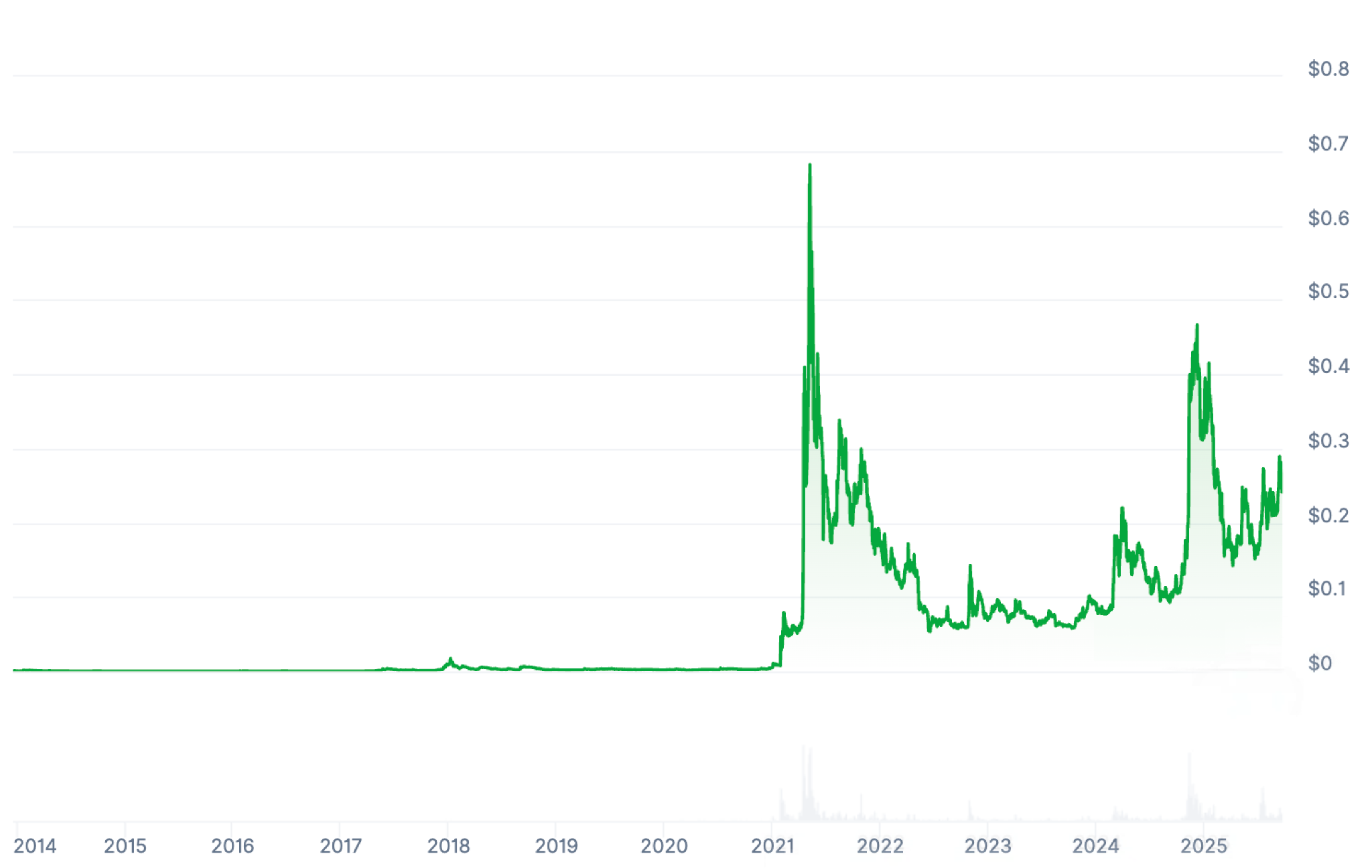
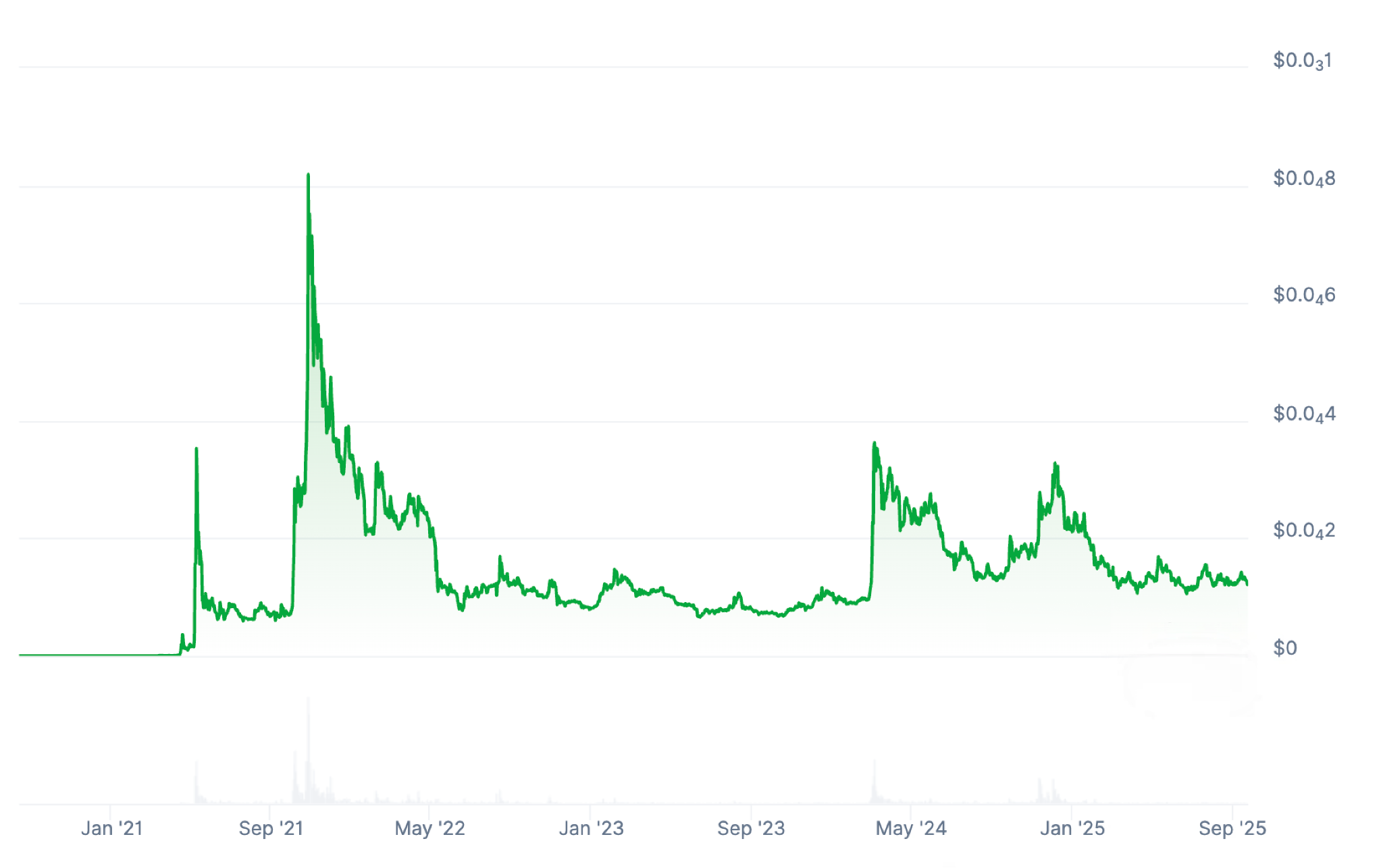
Now, let’s fast forward to September 2025. A $100 bet on Dogecoin at $0.0002 would be worth about $124,850 today. The same stake in Shiba Inu at launch? Nearly $25.5 million. Meme magic at its wildest.
For a time, Shiba Inu looked like the stronger contender thanks to its growing ecosystem. But 2025 has flipped the script: SHIB is up a good 24%, while DOGE barked its way to a massive 173% gain. Let’s dig into why.
Two Breeds of Dogs
Dogecoin runs on Litecoin’s proof-of-work code, meaning it still relies on miners. It’s inflationary, has no max cap, and uses Scrypt for faster, cheaper payments than Bitcoin. That’s given it a reputation as the “fun” payments coin.
And of course, the Musk effect can’t be ignored. Elon has championed DOGE in tweets, Tesla accepts it for select merch, and even the government’s Department of Government Efficiency was cheekily nicknamed DOGE. Very few coins, memes or not, can summon mainstream buzz the way Dogecoin can.
Shiba Inu, on the other hand, was built on Ethereum. It ditched mining for staking, is deflationary thanks to aggressive token burns (over 40% gone already), and plugs into Ethereum’s smart contract universe. That makes it more versatile than DOGE on paper.
In recent years, Shiba Inu rolled out Shibarium, a Layer-2 chain for speed and lower costs, and ShibaDEX, a cross-chain DEX. The project isn’t just riding a meme, it’s trying to build an ecosystem too.
The Dog Race Is on
For starters, both coins could ride a friendlier U.S. regulatory environment as crypto advocates step into power.
For Dogecoin, near-term ups include:
- Possible integration into Musk’s 𝕏 platform as a payments option.
- Wider retailer adoption.
- Network upgrades for scalability.
- And, of course, the constant wildcard of Musk’s next DOGE tweet.
Rumors of a Dogecoin ETF keep swirling too, which could inject serious momentum.
Shiba Inu’s playbook looks different:
- Ongoing Shibarium growth and new developer activity.
- Token burns that keep tightening supply.
- A developing metaverse with virtual land sales.
However, without a Musk-like hype machine, SHIB’s catalysts may not hit as hard.

Elon Musk’s first Dogecoin tweet, which started it all. Source.
So… Which Meme Coin Will Bark the Loudest?
Both coins are speculative, fueled as much by community buzz as fundamentals. Shiba Inu has a deeper ecosystem and long-term ambition. Dogecoin has clearer short-term sparks and, crucially, Elon Musk’s megaphone.
If forced to pick for the next 12 months, Dogecoin seems to have the edge. It may be the older meme, but for now it still has more bite.

Gold has got the Midas touch. The precious metal has been on a historic run, surging 45% this year to reach an all-time high of $3,789 per ounce. That kind of parabolic move has left commodities and even crypto markets looking sluggish by comparison. But in financial history, one pattern has repeated itself: when gold runs hot, Bitcoin isn’t far behind.
The question many traders are now asking is simple. Could Bitcoin be about to mirror gold’s rally, just as it has in past cycles?
Why Gold Is Surging
Gold’s meteoric rise began in February 2024 when it finally broke above the $2,100 resistance level after multiple failed attempts. Once through, momentum took over, sending the price soaring nearly 90% from that breakout point.
This rally hasn’t been slow and steady, it’s been almost parabolic. While bullish sentiment is undeniable, some caution flags are waving. The monthly Relative Strength Index (RSI), a common indicator of whether an asset is “overbought” or “oversold, is now at historically high levels. In layman terms, that means gold’s recent surge may be running too hot, increasing the odds of a short-term pullback.
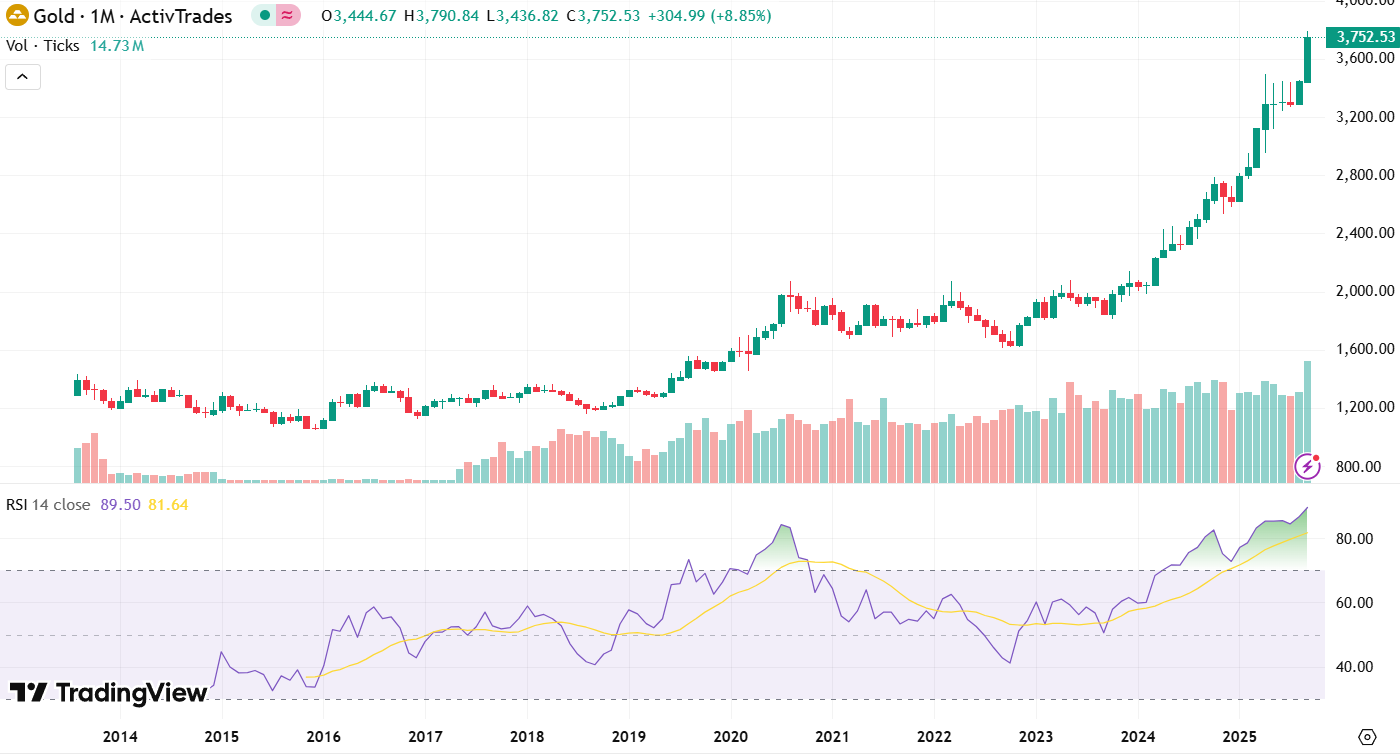
For seasoned traders, that often signals a pullback is coming. Still, even with the possibility of retracement, gold’s rally has further cemented its role as a safe-haven asset during uncertain macro conditions.
The Bitcoin–Gold Correlation
Bitcoin is often referred to as “digital gold,” and not without reason. Both assets share scarcity, gold by nature, Bitcoin by its algorithmic cap of 21 million coins. Both also thrive when confidence in fiat currencies falters.
Historically, Bitcoin and gold have shown positive correlation during major risk-off periods. When fear enters the market, whether due to inflation, geopolitical tension, or financial instability, investors often turn to either or both.
But here’s a twist… During bull markets, their paths tend to diverge.

This pattern has played out at least twice before. For instance, at the end of 2016 and again in 2024, gold’s price surged first, paused, and then Bitcoin picked up the baton with explosive upside momentum. Gold effectively takes the lead, and Bitcoin follows.
With gold now parabolic and at risk of cooling off, history suggests that capital could rotate into Bitcoin next.
Is BTC Ready for Its “Catch-Up” Rally?
Gold’s surge may be nearing exhaustion, but that doesn’t necessarily mean its safe-haven narrative fades. Instead, both assets could share the spotlight: gold as the traditional store of value, Bitcoin as its modern counterpart.
Still, Bitcoin tends to move more aggressively. Where gold posts steady climbs, Bitcoin often reacts in sharper bursts, reflecting its smaller market cap and higher volatility. If capital rotation does occur, Bitcoin’s upside could outpace gold by multiples, as it has in prior cycles.
Some analysts argue that this setup makes Bitcoin uniquely positioned for the months ahead. Gold’s record highs demonstrate demand for hard assets in today’s uncertain world. Even if just a fraction of that demand flows into Bitcoin, the impact could be amplified by its relative size and liquidity profile.
As Good as Gold?
If gold begins to retrace after such a rapid climb, traders and institutions looking for a new vehicle may view Bitcoin as the natural beneficiary. Several factors strengthen this case:
- Market Cycles. Bitcoin has historically entered new uptrends when gold’s momentum stalls, benefiting from shifting capital flows.
- Scarcity Appeal. Bitcoin’s halving in April 2024 cut block rewards to 3.125 BTC, reinforcing its scarcity narrative just as gold’s surge reminded investors of the value of limited-supply assets.
- Institutional Pathways. With U.S. spot Bitcoin ETFs now approved and seeing inflows, access for large investors has never been easier. The structure mirrors how gold ETFs opened floodgates for institutional adoption in the 2000s.
- Digital Hedge Narrative. For younger, more tech-native investors, Bitcoin increasingly plays the role that gold has for older generations; a hedge against inflation, currency debasement, and systemic shocks.
It’s important to remember that correlation does not guarantee causation. While Bitcoin has followed gold in previous cycles, macro conditions today are unique. Global central bank policy, shifting risk appetites, and regulatory landscapes all play a role in shaping Bitcoin’s trajectory.
Moreover, Bitcoin remains far more volatile than gold, which makes it less predictable as a safe-haven asset. Gold is measured in millennia; Bitcoin has just over 15 years of history. The comparison is instructive but not identical.
That said, the parallels are hard to ignore. When gold goes parabolic, Bitcoin often isn’t far behind. And if the pattern of divergence and catch-up repeats, BTC could be setting up for its own moment of glory.
A Golden Opportunity.
Gold’s explosive run to all-time highs has reminded investors (once again) why scarce assets matter during uncertain times. But recent historical data suggests the real story may still be unfolding. Bitcoin could be next in line.
With institutional rails now in place, a halving fresh in the rearview, and gold flashing signs of exhaustion, conditions appear ripe for Bitcoin to step out of gold’s shadow and capture renewed market attention.
The coming months may reveal whether Bitcoin once again mirrors gold’s path, or begins carving out its own.
XRP is currently navigating a descending wedge pattern, a chart formation commonly seen as a bullish reversal setup. While past Octobers haven’t favored the token, shifting institutional behavior and macro catalysts could make this October a turning point.
Key Takeaways:
- XRP is forming a descending wedge pattern, a typically bullish technical setup, with a breakout above $3.02 potentially triggering a rally toward new all-time highs.
- Despite historically being a weak month for XRP, the backdrop in October 2025 is different, characterized by strong institutional inflows and the potential for ETF approvals that could override seasonal trends.
- On-chain data shows a significant shift from distribution to accumulation, with 439 million XRP recently withdrawn from exchanges, reducing immediate selling pressure and signaling holder confidence.
- The key levels to watch are $3.02 as resistance for a confirmed breakout and $2.75 as critical support; a failure to hold this support would invalidate the bullish setup.
Demand Under the Surface
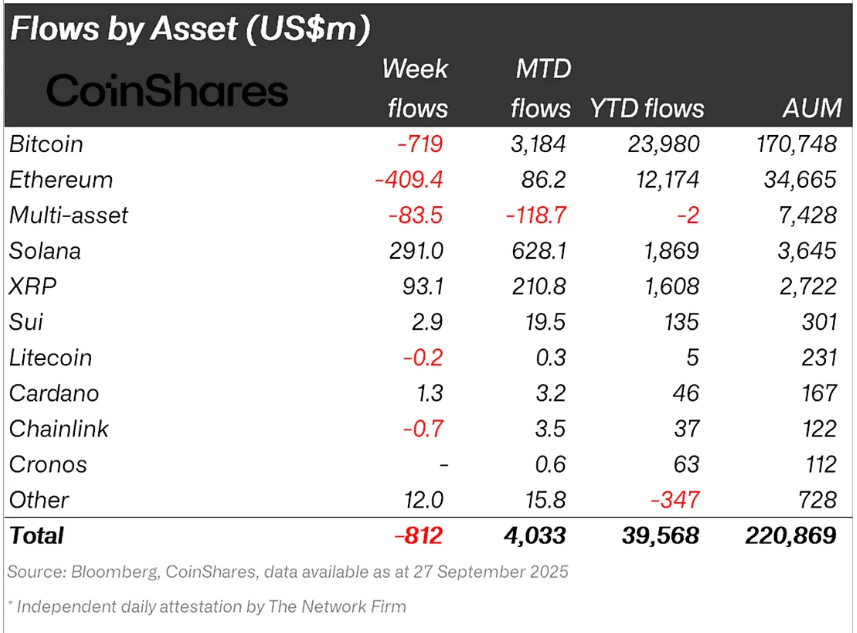
Even as price action remained mixed, institutional players kept showing up in September for XRP and other tokens. Total inflows surpassed $220 million, a strong sign that big money sees value despite volatility.
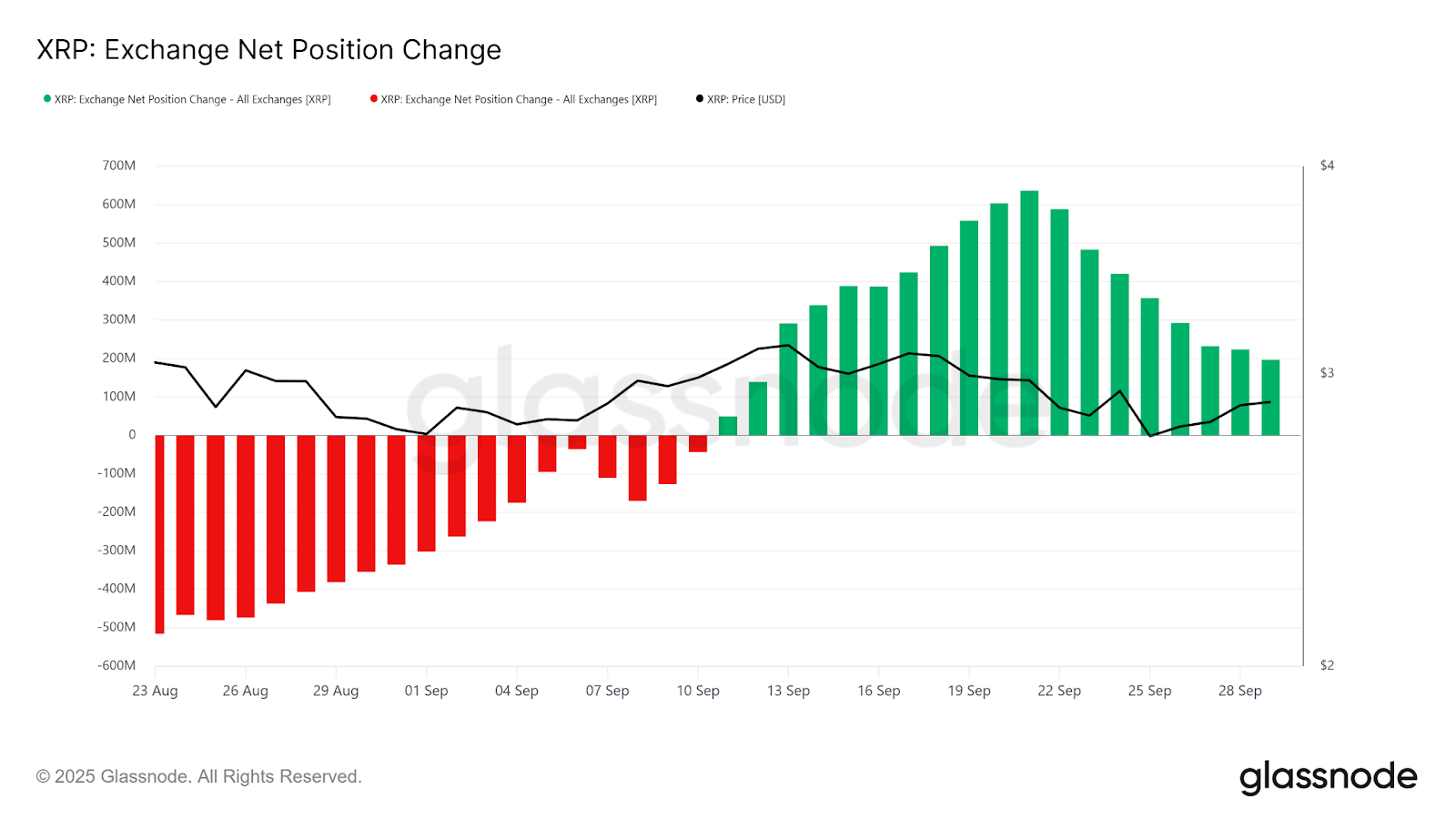
Exchange net positions support the holders’ case. Throughout much of the month, holders brought assets onto exchanges, suggesting short-term selling pressure. Yet in the last week, 439 million XRP were withdrawn from exchanges, a sign that confidence is returning, and fewer coins are available to be sold. This withdrawal trend by both retail and institutional holders indicates a shift from distribution to accumulation, potentially softening downside risk.
History Doesn’t Always Repeat
Historically, October has been a rough month for XRP. Over the past decade, it has averaged a –4.5% return, making it one of the weaker months for the token.
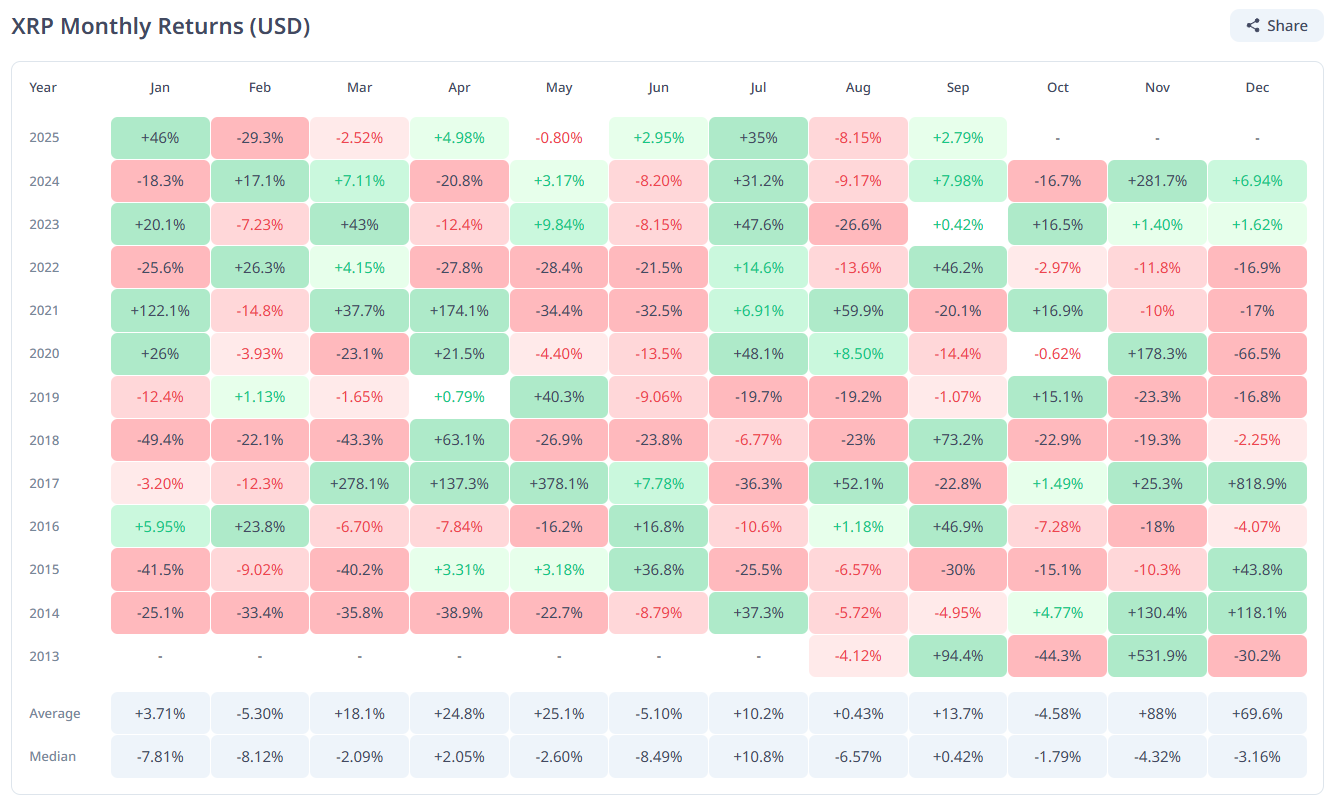
However, past patterns may not fully apply in 2025. It’s worth taking into account that past Octobers occurred during heavy regulatory uncertainty and before institutional infrastructure like ETFs existed. With those catalysts now in play, the usual October weakness may be less relevant this year.
The Price Game: Breakout or Breakdown?
XRP currently trades at around $2.90, trapped between the wedge’s resistance and support lines. A confirmed breakout above $3.02 could set the stage for a rally toward a new all-time high.
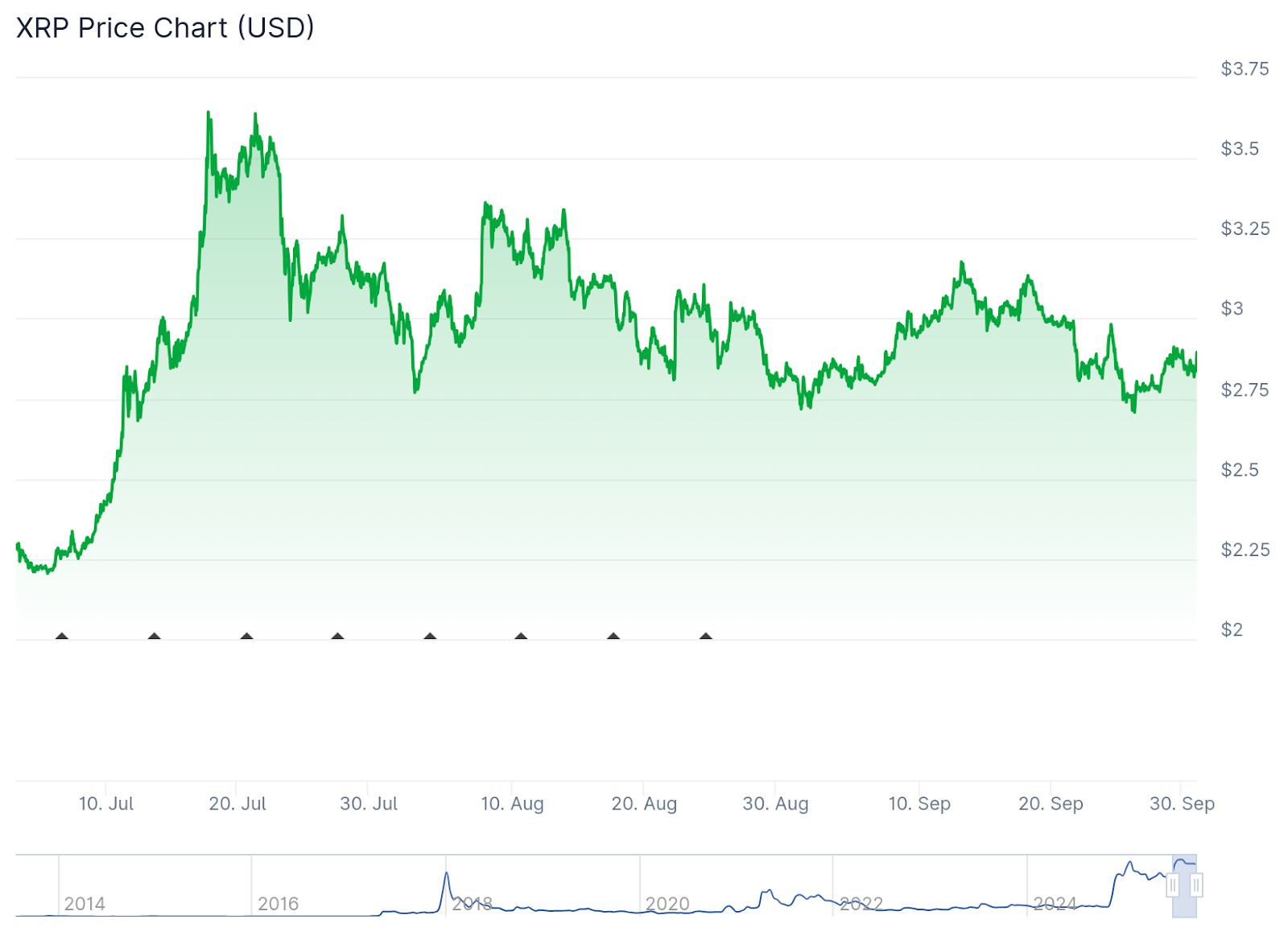
But those gains depend heavily on support levels holding firm and positive regulatory momentum. Should ETF approval chatter or institutional inflows accelerate, XRP could build enough momentum to push through resistance.
Still, risks are real. If the breakout fails, XRP could fall back to $2.75, or even lower, invalidating the bullish thesis and repeating October’s usual pattern of weakness.
What Traders and Holders Should Watch
- $2.75 level as key support, $3.02 as breakthrough resistance.
- ETF approvals or denials could act as volume catalysts.
- Fresh large withdrawals or cold-storage movements suggest longer-term conviction.
- Bitcoin’s strength or weakness often drag altcoins with it, XRP is no exception.
For beginners, this means October is a month to stay alert. For more seasoned traders, this wedge setup is looking like one of the cleaner setups in recent years. If it resolves upward, the upside could surprise some skeptics.
Turning Point
October has historically brought turbulence for XRP, but 2025 offers a different backdrop: institutional flows, ETF speculation, and stronger token infrastructure. The descending wedge pattern gives a clear roadmap. If resistance breaks, bulls may be rewarded; if not, the old October curse could strike again.
That said, XRP’s story is still being written. This month will test whether the narrative has shifted enough to rewrite past patterns. Either way, it’s absolutely shaping up to be an interesting ride.

October is off to a strong start. The total market capitalization has once again crossed the $4 trillion threshold, fueled by fresh highs in Bitcoin (BTC) and renewed optimism around altcoins. But beneath the surface, whale wallets (i.e. those holding tens or hundreds of millions in crypto) are making strategic moves that could define market direction this month.
On-chain data paints a picture of accumulation, profit-taking, and rebalancing across top assets. Let’s take a closer look at what these whales are doing, and why their moves matter.
1. Bitcoin (BTC): Holding Strong
Bitcoin remains the market anchor, and its rise above $125,000 has been both a catalyst and a cash-out moment for many whales.
One wallet (3NVeXm) transferred 1,550 BTC (~$193.75 million) to Binance shortly after BTC set a new all-time high, while an address linked to Alameda Research moved another 250 BTC ($30.1 million), likely for liquidation or reallocation.
Despite these outflows, institutional interest has remained exceptionally strong. According to BitcoinTreasuries, corporate holdings continue to climb:
- Metaplanet added 5,268 BTC,
- Marathon Digital accumulated 373 BTC,
- CleanSpark added 308 BTC, and
- MicroStrategy increased by 196 BTC.
In total, the top 100 public companies now collectively hold over 1 million BTC, reinforcing Bitcoin’s role as the primary institutional asset in the digital market.
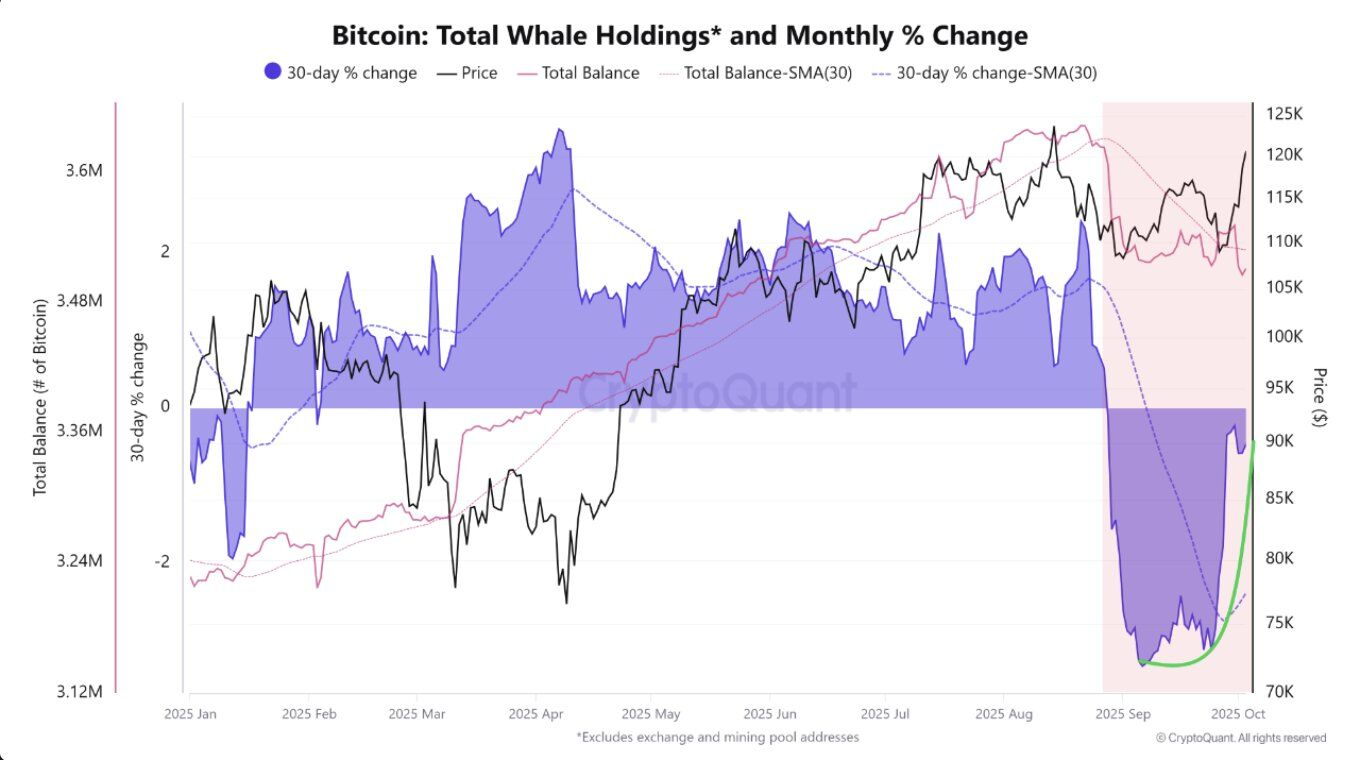
Moreover, whale selling pressure appears to be easing since late September. This sharp decline follows weeks of heavy selling activity, signaling that major holders may be positioning for a reinvigorated accumulation phase.
2. Altcoins: Strategic Bets Across the Board
Beyond the majors, whales seem to be placing their bets across select altcoins, particularly ASTER, ONDO, and Chainlink (LINK).
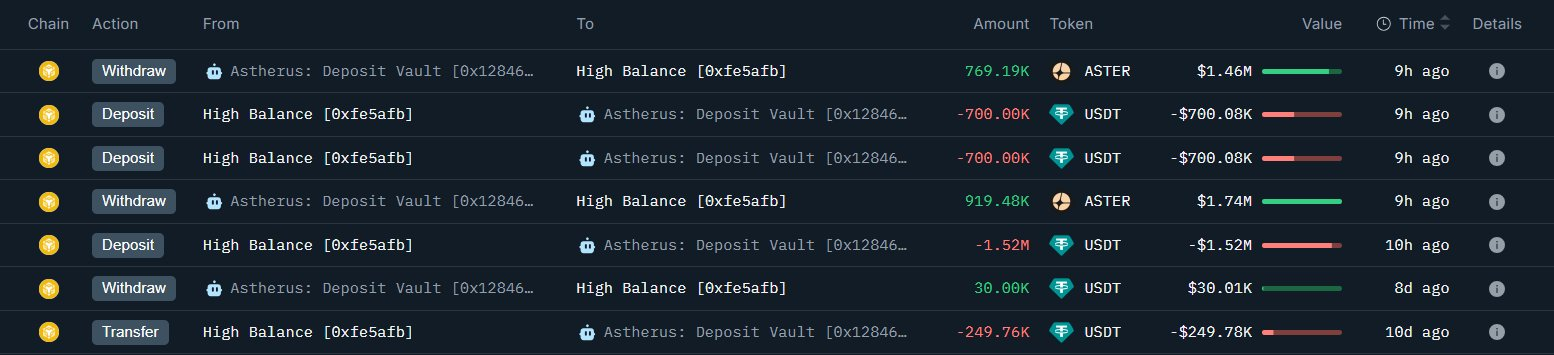
A single wallet recently accumulated 1.69 million ASTER tokens (~$3.14 million at the time of writing), while a Gnosis Safe Proxy address moved 11.67 million ONDO (~$10.8 million) into exchanges. Of that, 3.89 million ONDO was sent to a Bybit address linked to Arthur Hayes, suggesting that whales could be anticipating volatility or looking to trade around liquidity spikes.
Meanwhile, Arkham Intelligence flagged a whale deposit of 700,000 LINK (~$15.5 million) to Binance. Together, these moves suggest whales are diversifying their positions, betting selectively on tokens with strong ecosystems.
3. Ethereum (ETH): Accumulation Meets Opportunity
Ethereum has been one of the standout performers so far this month, reclaiming the $4,500 level. This rebound has coincided with heightened whale activity.
Blockchain analytics firm OnChain Lens tracked a new wallet, 0x982, that received 26,029 ETH (around $116.8 million) from Kraken before transferring the tokens into Aave for lending. Another whale, 0xa312, took 8,695 ETH (about $39.5 million) from Binance, a classic sign of long-term accumulation.

At the same time, Trend Research, a known institutional wallet, has been taking profits, sending 77,491 ETH (~$354 million) to Binance. Since October began, the firm has reportedly offloaded over 143,000 ETH, showing that even smart money is locking in gains after the rally.
Interestingly, several dormant Ethereum wallets have reactivated. An old whale (0xf97) deposited 4,500 ETH (~$20.4 million) after two years of inactivity. Two others sent funds to exchanges after four years, suggesting older holders may be using recent price strength to exit.
The Bigger Picture: Whales Drive the Waves
Whale movements are often leading indicators of market trends. Their accumulation patterns tend to precede rallies, while large exchange inflows often signal local tops. This “Uptober”, on-chain behavior shows a split strategy, whales are booking profits on rallies while continuing to deploy capital. However, data seems to lean more in favor of accumulation.
Such behavior aligns with a maturing market. Rather than chasing hype, whales appear to be rotating strategically, reinforcing assets with clear narratives, like Ethereum’s staking yields, Bitcoin’s institutional legitimacy, and select altcoins with vibrant communities and strong real-world use cases.
Watching these whale flows can provide valuable context. When the biggest wallets start moving, it’s rarely random.. and it never goes unnoticed.


