
Learning the friendly way
Dive into our resources, guides, and articles for all things money-related. Grow your financial confidence with our experts curated tips and articles for both experienced and new investors.
Latest posts
Discover Ireland’s country code for phone calls in 2025, plus tips on how to dial in and out of Ireland correctly from any location.
Need to call Ireland but not sure how to dial correctly? You're in the right place. Ireland's country code is +353, and knowing how to use it properly can save you from those awkward moments when your call doesn't go through (and your phone bill doesn't thank you either).
Whether you're calling family in Dublin, conducting business in Cork, or trying to reach that charming B&B in Galway, this guide covers everything you need to know about dialling Ireland correctly. We'll walk you through the step-by-step process, common mistakes to avoid, and even some free calling options that won't break the bank.
What is the country code for Ireland?
Ireland's country code is 353. This three-digit number is what you need to dial when calling Ireland from any other country around the world.
Country codes are part of the international telephone numbering system, designed to route calls to the correct country. Think of them as postal codes for phone calls - they tell the network exactly where your call needs to go. Ireland's 353 code has been in use since the country established its modern telecommunications system.
For reference, Ireland's ISO country codes are IE (alpha-2) and IRL (alpha-3), which you might see used in forms, websites, or official documentation.
How to call Ireland from abroad
Calling Ireland follows a simple three-step formula that works from anywhere in the world:
International Access Code → Country Code → Local Number
Here's how it breaks down:
- Dial your country's international access code (011 from the US/Canada, 00 from most European countries)
- Add Ireland's country code: 353
- Dial the local number, dropping the initial "0"
Examples in Action:
From the US to Dublin: 011 353 1 234 5678
From the UK to Cork: 00 353 21 234 5678
From Germany to Galway: 00 353 91 234 5678
The key thing to remember? Always drop that initial "0" from Irish area codes when calling from abroad. Irish numbers start with 0 when dialled domestically (like 01 for Dublin), but you skip this zero for international calls.
Ireland area codes (most common by city)
Here are the most important area codes you'll need when calling different parts of Ireland:
City/region - area code
Dublin - 01
Cork - 21
Limerick - 61
Galway - 91
Waterford - 51
Drogheda - 41
Dundalk - 42
Wexford - 53
Kilkenny - 56
Athlone - 90
Sligo - 71
Letterkenny - 74
Tralee - 66
Ennis - 65
Carlow - 59
Important note: Irish mobile numbers (starting with 08) don't use area codes. You simply dial the full mobile number after the country code.
How to call Ireland from a mobile phone
Mobile phones make international calling even simpler. Instead of remembering different international access codes, you can use the universal + symbol:
Format: +353 [area code] [local number]
Examples:
- To Dublin mobile: +353 87 123 4567
- To Cork landline: +353 21 234 5678
Most smartphones automatically recognise the + symbol when you hold down the "0" key. This method works regardless of which country you're calling from - no need to remember whether it's 011, 00, or something else.
How to call Ireland for free
Who doesn't love a good bargain? Several apps and services let you call Ireland without traditional phone charges:
Internet-based calling:
- WhatsApp: Free voice and video calls (both parties need the app)
- FaceTime: Free for Apple users calling other Apple devices
- Google Meet: Free voice and video calling
- Viber: Free app-to-app calls worldwide
Pros and cons:
Pros: Completely free (just uses your internet data), often better call quality than traditional calls Cons: Both parties need the same app and a reliable internet connection
These options work brilliantly for staying in touch with friends and family, though you might still need traditional calling for businesses or official services.
Common reasons why calls to Ireland fail
Nothing's more frustrating than a call that won't connect. Here are the usual suspects and quick fixes:
Wrong country code: Double-check you're using 353, not 533 or any other combination Incorrect area code: Check that the area code matches the city you're calling
Missing digits: Irish landlines typically have 7 digits after the area code, mobiles have 7 digits after 08
Forgot to drop the zero: Remember to skip the initial "0" when calling from abroad
No international plan: Check with your provider; some plans block international calls by default
Network issues: Try calling from a different location or wait and try again
Pro tip: If you're still having trouble, try calling an Irish directory service first to test your connection.
What time is best to call Ireland?
Ireland follows Greenwich Mean Time (GMT) in winter and Irish Standard Time (GMT+1) during daylight saving time (March to October).
For business calls: Aim for 9 AM to 5 PM Irish time, Monday through Friday
For personal calls: Consider that Irish folks often have dinner around 6-7 PM, so early evening can work well
Always use a time zone converter when scheduling important calls - there's nothing quite like waking up your Irish colleague at 3am because you miscalculated the time difference.
Emergency and service numbers in Ireland
In case you ever need them, here are Ireland's essential service numbers:
- 112 and 999: Emergency services (police, fire, ambulance)
- 116000: Missing child helpline
- 116123: Emotional support helpline
These numbers are free to call from any phone in Ireland and should only be used for genuine emergencies or crises.
Conclusion
Calling Ireland is straightforward once you know the basics: use country code 353, remember to drop the initial zero from area codes, and don't forget about free internet-based calling options. Whether you're planning a business call to Dublin or want to check in with a B&B in the countryside, following these simple steps will ensure your calls connect smoothly.
For the best experience, double-check the local time before calling and keep a time zone converter handy. With these tools in your back pocket, you'll be chatting away like a pro in no time. Sláinte to successful calls!
Learn how to call UK numbers from abroad using the +44 country code. Get dialling formats, area codes, mobile tips & common mistakes to avoid.
Need to call someone in the United Kingdom from abroad? You'll need to use the 44 country code to connect successfully. Whether you're reaching friends, family, or business contacts in England, Scotland, Wales, or Northern Ireland, understanding how to properly dial UK numbers is essential for international communication.
What is the 44 country code?
The 44 country code is the international dialling code assigned to the UK by the International Telecommunication Union (ITU). When you're calling from any other country, you must prefix the local UK number with 44 to route your call through the international telephone network.
Here's what you need to know about country code 44:
- Covers the entire UK: England, Scotland, Wales, and Northern Ireland
- Must replace the leading zero: UK numbers start with 0 domestically, but you drop this when using 44
- Works for all UK numbers: landlines, mobiles, and business lines
- Required for international calls: You cannot reach UK numbers from abroad without using 44
The key rule to remember is that when you use country code 44, you must omit the leading '0' that appears in all UK phone numbers when dialled domestically. For example, a London number that appears as 020 7946 0958 within the UK becomes +44 20 7946 0958 when called internationally.
How to call the UK from abroad
The standard format for calling UK numbers internationally follows this pattern:
[International Exit Code] + [44] + [Area Code without 0] + [Local Number]
Your international exit code depends on which country you're calling from:
From the United States or Canada:
- Dial: 011 + 44 + UK number (without the leading 0)
- Example: To call London number 020 7946 0958, dial 011 44 20 7946 0958
From European Union countries:
- Dial: 00 + 44 + UK number (without the leading 0)
- Example: From Germany to the same London number, dial 00 44 20 7946 0958
From India:
- Dial: 00 + 44 + UK number (without the leading 0)
- Example: 00 44 20 7946 0958
From Australia:
- Dial: 0011 + 44 + UK number (without the leading 0)
- Example: 0011 44 20 7946 0958
Hot tip: Most modern smartphones allow you to use the '+' symbol instead of your country's exit code. Simply dial +44 followed by the UK number without the leading zero.
UK area codes you need to know (landlines)
Understanding UK area codes for landline numbers helps you identify which region you're calling and ensures you dial correctly. Here are the major UK area codes you'll encounter:
Remember that these area codes appear after the 44 country code and never include the initial 0 that you see in domestic UK dialling.
Common mistakes when dialling UK numbers
Avoid these frequent mistakes that prevent successful connections to UK numbers:
Including the leading zero: The most common mistake is dialling +44 0 followed by the rest of the number. This creates an invalid number format that won't connect.
Using incorrect exit codes: Each country has its own international exit code. Using 00 when calling from the US (which requires 011) will result in call failure.
Incomplete area codes: Some callers truncate area codes, especially longer ones like Birmingham's 121. Always include the complete area code after 44.
Network restrictions: Your mobile carrier or VoIP service might block international calls by default. Check with your provider if calls aren't connecting despite correct dialling.
Time zone confusion: Calling during UK nighttime hours may result in unanswered calls, even if your dialling format is correct.
How to call UK mobile numbers using 44
UK mobile numbers follow a specific format that's important to understand for international calling. All UK mobile numbers begin with 07 when dialled domestically, which becomes 447 in international format.
UK Mobile Number Structure:
- Domestic format: 07XXX XXXXXX
- International format: +44 7XXX XXXXXX
Examples of calling UK mobile numbers:
- From US: 011 44 7700 900123
- From EU: 00 44 7700 900123
- Using + symbol: +44 7700 900123
When saving UK mobile numbers in your phone's contacts, use the international format (+44 7XXX XXXXXX) so the number works whether you're calling domestically within the UK or internationally from abroad.
Free ways to call the UK
Before paying for expensive international calls, consider these free alternatives:
Voice over Internet Protocol (VoIP) Apps:
- WhatsApp: Free voice and video calls over WiFi or data
- FaceTime: Free for iPhone/iPad/Mac users
- Google Meet: Free video calls with phone dial-in options
- Viber: Free calls between Viber users
When VoIP works best:
- Both parties have stable internet connections
- Calling friends or family who use smartphones
- Non-urgent conversations where call quality fluctuations are acceptable
When traditional calling is better:
- Emergency situations requiring immediate connection
- Business calls where professional quality is essential
- Calling landlines or people without smartphones
- Areas with poor internet connectivity
Emergency numbers and special codes in the UK
Understanding UK number types helps you dial correctly and know what to expect:
Emergency Numbers:
- 999: Primary emergency number (police, fire, ambulance)
- 112: European emergency number (works in UK)
- 101: Non-emergency police contact
When calling emergency numbers from abroad, you still need to use +44, but these calls receive priority routing. However, for true emergencies while visiting the UK, calling locally using 999 or 112 is faster than international routing.
Best time to call the UK from other countries
Timing your calls appropriately ensures better connection rates and recipient availability:
UK Time Zone: Greenwich Mean Time (GMT) in winter, British Summer Time (BST/GMT+1) in summer
Business Hours: Generally 9:00 AM to 5:00 PM, Monday through Friday
Optimal Calling Windows by Region:
From US East Coast:
- UK morning (9 AM-12 PM) = US early morning (4 AM-7 AM)
- UK afternoon (1 PM-5 PM) = US morning (8 AM-12 PM)
From US West Coast:
- UK morning = US very early morning (1 AM-4 AM)
- UK afternoon = US early morning (5 AM-9 AM)
From India:
- UK morning = India afternoon (2:30 PM-5:30 PM)
- UK evening = India late evening (9:30 PM-12:30 AM)
From Australia (Sydney):
- UK morning = Australia evening (8 PM-11 PM)
- UK evening = Australia early morning (2 AM-5 AM)
Lastly
Understanding the 44 country code system ensures your international calls to the UK connect successfully every time. Whether you're calling London business contacts, relatives in Edinburgh, or friends in Cardiff, following these guidelines will help you communicate effectively across international boundaries.
Learn how to type the euro symbol (€) on any keyboard - Windows, Mac, or mobile. Quick shortcuts, pro tips, and why €10 beats 10€.
Ever stared at your keyboard, spotted that little € symbol next to the 4, pressed it confidently, and watched a stubborn $ appear instead? You're not alone. This familiar frustration has a simple solution that flows smoother than you'd expect.
How to type the euro symbol (€) on a UK keyboard
The magic combination is Alt Gr + 4. Hold down the Alt Gr key (that's the right-hand Alt key) and tap 4. Like clockwork, your € appears.
Can't find Alt Gr? No worries. Ctrl + Alt + 4 delivers the same result. These shortcuts work regardless of whether the euro symbol actually appears on your 4 key - many UK keyboards show it, but the method works universally.
This common keyboard quirk happens because your system defaults to the dollar sign, but the euro lives just beneath the surface, waiting for the right key combination to unleash its glory.
Euro symbol keyboard shortcuts (Windows & Mac)
Windows Users
- Alt Gr + 4 – The primary method
- Ctrl + Alt + 4 – Alternative when Alt Gr feels awkward
- Alt + 0128 – Number pad method (requires NumLock on)
Mac Users
- Option + 2 – Clean and simple
- Option + Shift + 2 – For US keyboard layouts
- Unicode method: Type 20AC, then press Enter for instant conversion
Each method has its rhythm. Find the one that feels natural for you and let muscle memory take over.
No euro key? Here's what to do
Keyboard layouts dance to different beats. Some show € next to the E key, others place it on 5, and some hide it entirely. Where it sits doesn't matter – the shortcuts still work their magic.
Trust the Alt Gr + 4 combination even when your eyes can't see the symbol. Your keyboard knows where the euro lives.
For keyboards without Alt Gr, the Alt + 0128 using your number pad becomes your reliable backup. Just ensure NumLock glows green before you begin.
Using the Character Map or Word Processor features
Sometimes you need to take the scenic route through your software's built-in tools.
Windows Character Map
Navigate to Start Menu → Character Map. Type "euro" in the search box, select €, and click Insert. It flows directly into your active document.
Microsoft Word & Google Docs
Head to Insert → Symbol (Word) or Insert → Special Characters (Google Docs). The euro symbol sits waiting in the currency section, ready for a simple click.
AutoCorrect Shortcut
Create your own shortcut by setting AutoCorrect to replace "EUR" with "€". Type three letters, watch them transform automatically into the symbol you need.
Typing the euro sign on mobile devices
Mobile keyboards simplify the process beautifully. Switch to your symbols or numbers keyboard, then long-press the $ symbol. A menu of currency options will come up, then select €.
This method works consistently across iOS and Android devices, making currency symbols as accessible as regular letters.
Copy and paste the euro symbol
When shortcuts fail or time runs short, the simplest solution often proves most efficient: € Copy this symbol and paste it wherever needed..
What does the euro symbol (€) mean?
For those looking to learn something new today: the euro symbol is based on the Greek letter epsilon (ε), representing both Europe and economic stability. The two horizontal lines symbolise the currency's strength and unity.
The European Commission selected this design in 1995, choosing a symbol that would flow naturally alongside other currency marks while maintaining its distinctive European identity.
Does the euro sign go before or after the number?
The euro symbol sits before the number with no space between: €10, €250, €1,000.
This placement follows the standard European layout, keeping things clean, easy to read, and making the numbers flow better for readers worldwide.

Explore the world’s weakest currencies in 2025 - from Lebanon’s collapse to Vietnam’s strategic devaluation - and what these exchange rates reveal about global economics.
Money talks, but some currencies whisper so quietly you need a magnifying glass to hear them. In the grand theatre of global finance, not all currencies are created equal, while some strut around like peacocks (looking at you, Kuwaiti Dinar), others shuffle about with the confidence of a wet paper bag.
The Lebanese Pound (LBP) currently holds the unfortunate distinction of being the world's weakest currency in 2025, with an exchange rate so low that one U.S. dollar equals approximately 89,500 Lebanese pounds. To put this in perspective, you'd need a small suitcase to carry the equivalent of $100 in Lebanese pounds, assuming you could find enough physical notes.
Currency weakness isn't just about having a lot of zeros after the decimal point. It reflects a complex web of economic factors, including inflation rates, political stability, monetary policy decisions, and investor confidence. This guide on the world's weakest currencies in 2025, explores the economic stories behind their struggles and what it means for the countries (and the people) who use them.
Top 10 weakest currencies in the world (2025)
Here's the lineup of currencies that make your wallet feel surprisingly heavy when travelling abroad:
Exchange rates are approximate and fluctuate daily. Data compiled from multiple financial sources as of July 2025.
What makes a currency weak?
Before we roll our eyes at long strings of zeros, let’s get clear on what actually drives currency weakness.
Exchange rates show how much of one currency you need to buy another, usually measured against the U.S. dollar. But a low exchange rate isn’t automatically a red flag. Just like shoe sizes, bigger numbers aren’t necessarily worse, they’re just different.
The real reasons a currency weakens?
- Persistent inflation that eats away at value
- Short-term monetary policies that undermine long-term confidence
- Trade imbalances and shrinking foreign reserves
- Political instability that rattles investor trust
When investors lose faith, money moves fast, and exchange rates feel the impact. In short, weak currencies aren’t a punchline, they’re a signal of deeper economic tension.
Country spotlights - case studies behind the weakest currencies
Lebanon | A financial collapse without precedent
Lebanon’s currency crisis is a case study in how not to run an economy. As of mid-2025, the Lebanese pound trades at over 89,500 LBP per USD, making it one of the weakest currencies in the world.
The collapse stemmed from a banking sector that functioned like a state-sponsored Ponzi scheme: banks attracted deposits with sky-high interest rates, only to lend most of those funds to a debt-laden government. When confidence evaporated, the system imploded. Add in the 2019 mass protests and the devastating 2020 Beirut port explosion, and the result was economic freefall.
Today, Lebanese citizens navigate a surreal economy where ATMs limit withdrawals to tiny amounts, and many businesses have shifted to unofficial dollar pricing. A shadow economy thrives alongside the official one, proof that when trust in institutions fails, people find their own workarounds.
Iran | Sanctions, inflation, and isolation
The Iranian rial now trades at over 1,000,000 IRR per USD (yes, that's six zeros). Sanctions have cut Iran off from the global financial system, leaving its oil-rich economy unable to fully monetise its most valuable resource.
It's like owning a garage full of Ferraris with no keys to drive them. In response, Iran has attempted to bypass sanctions with crypto experiments and barter agreements, but none have stabilised the currency.
Inflation routinely exceeds 40%, and as a result Iranians have turned to gold, property, and U.S. dollars to preserve what little value they can. In a country known for its resilience, the rial’s collapse remains a stark reminder of the long-term costs of economic isolation.
Vietnam | Weak by design, not disaster
The Vietnamese dong trades at around 26,000 VND per USD, but that doesn’t signal a crisis, it actually reflects deliberate policy. Vietnam maintains a weaker currency to keep exports competitive, a strategy known as competitive devaluation.
This has helped transform Vietnam into a global manufacturing hub, attracting companies looking to diversify away from China. It's like running a permanent sale on your national output - foreign buyers love the prices, and Vietnamese factories stay busy.
The challenge lies in balance. The government works to avoid the inflation traps that have plagued other countries on this list, proving that not all weak currencies come from failure, some are tools of long-term economic strategy.
Laos | Trapped by debt and dependency
The Laotian kip now trades at around 21,800 LAK per USD, weighed down by inflation above 25% and a debt-to-GDP ratio over 125%. Much of that debt is owed to China, tied to major infrastructure projects that haven’t yet paid off economically.
Laos is a landlocked nation with limited industrial capacity and high import dependence, leaving its currency exposed whenever commodity prices shift. With little monetary wiggle room, the kip’s trajectory reflects deeper economic vulnerabilities.
Sierra Leone | A currency redefined, but still fragile
In 2022, Sierra Leone redenominated its currency, removing three zeros from the leone to simplify transactions. But even the new leone remains weak due to decades of disruption: civil war, the Ebola outbreak, COVID-19, and swings in diamond prices.
This is an economy that's faced shock after shock, and recovery is slow. The mining sector, especially diamonds, still dominates, leaving the leone vulnerable to commodity price drops.
Healthcare challenges and limited infrastructure add even more pressure, reducing productivity and increasing fiscal strain. The leone’s weakness tells the story of a country rebuilding piece by piece, with its currency reflecting both the past and the uphill path ahead.
Why some countries choose to keep their currency weak
Believe it or not, some countries actually prefer their currencies to be weaker - and for good economic reasons. It's counterintuitive, like preferring to drive in the slow lane, but the strategy can be remarkably effective.
Export competitiveness represents the primary motivation. A weaker currency makes domestic products cheaper for foreign buyers, essentially providing a permanent discount. German cars might be excellent, but if Vietnamese motorcycles cost 70% less due to currency differences, guess which ones developing countries will buy?
Countries like China famously maintained an artificially weak currency for decades, helping fuel their manufacturing boom. The strategy worked so well that other countries accused them of "currency manipulation" - the economic equivalent of being too good at a game and getting accused of cheating.
However, this approach carries significant risks. Import costs rise dramatically, making everything from oil to smartphones more expensive for domestic consumers
Long-term currency weakness can also trigger capital flight, where wealthy citisens move their money abroad. When your own citisens don't trust your currency, convincing foreigners becomes considerably more challenging.
Does a weak currency mean a weak economy?
We’ve established that a weak currency doesn't automatically signal economic disaster,sometimes it's just a reflection of different economic structures and historical circumstances.
Indonesia and Vietnam serve as the best examples of countries with numerically weak currencies but relatively strong economies. Both nations have achieved consistent growth, reduced poverty, and built increasingly diversified economies despite their currencies requiring calculators to count properly.
The key lies in purchasing power parity - what matters isn't how many zeros follow your currency symbol, but what those zeros can actually buy. A Vietnamese worker earning 10 million dong monthly isn't necessarily poor if that amount provides a comfortable living standard within the Vietnamese economy.
The real measure of economic health involves factors like employment rates, productivity growth, infrastructure development, and living standards. A country with a weak currency but growing wages, improving infrastructure, and expanding opportunities may be economically healthier than a nation with a strong currency but declining industries and rising unemployment.
What are the consequences of a weak currency?
In essence, a weak currency makes daily life more expensive, with rising prices on imports like food, fuel, and electronics. Added into the mix, Inflation erodes savings, and capital flight accelerates as people move their money into more stable currencies.
Over time, foreign currencies may replace the local one in everyday use, limiting government control. Internationally, weak currencies hurt credit ratings and investor confidence, reinforcing instability.
Final thoughts
Currency weakness is more than just numbers, it’s a signal. We’ve learnt above that it can both expose deep economic flaws or reflect deliberate strategies for growth. Lebanon and Iran highlight how instability and isolation can erode value fast, while Vietnam shows how weakness can fuel exports and development.
These disparities then shape the country’s trade, capital flows, and financial stability worldwide, causing a wider ripple effect. In a global economy, no currency moves alone; each affects the rest. And behind every weak currency are real people navigating inflation, opportunity, or uncertainty.
Discover the world’s strongest currencies in 2025: what drives their value, why they dominate global markets, and how currency strength shapes trade, investing, and travel.
Currency strength shapes global trade, investment flows, and your real-world spending power. But strength isn’t just about flashy exchange rates. It’s backed by low inflation, investor trust, and governments that don’t spontaneously combust.
In this guide, we break down the top 10 strongest currencies in the world for 2025. You'll learn what drives their dominance, why some currencies outperform others, and what this means for markets, businesses, and travellers alike.
Spoiler: it's not always the ones you expect.
Before we begin: Currency strength is measured by exchange rate value against major currencies like the USD and GBP, combined with factors including economic stability, inflation rates, trade balances, and investor demand.
The strongest currencies typically emerge from countries with sound fiscal policies, political stability, strong export economies, and substantial foreign reserves.
Top 10 strongest currencies in the world (2025 ranking)
The following currencies dominate global markets by exchange rate value against the USD and GBP. These rankings reflect the current market conditions at the time of writing.
1. Kuwaiti Dinar (KWD)
Exchange Rate: 1 KWD = 3.25 USD | 2.44 GBP
The Kuwaiti Dinar isn’t just strong - it’s consistently the world’s strongest. Fueled by vast oil reserves and a government that actually knows how to manage money, Kuwait punches well above its weight. A small population + massive petroleum wealth = eye-watering per capita income, and a currency that commands global respect.
Back in 2007, Kuwait ditched its US dollar peg for a currency basket, a bold move that gave it more control and resilience. Add in one of the largest sovereign wealth funds on the planet and a no-nonsense approach to spending oil money, and you’ve got a textbook case in currency strength.
2. Bahraini Dinar (BHD)
Exchange Rate: 1 BHD = 2.65 USD | 2.05 GBP
The Bahraini Dinar may not get the headlines, but it holds its ground thanks to a rock-solid USD peg and a thriving financial sector. As a gateway to the Gulf, Bahrain has built a reputation as a banking and investment hub, with the regulatory chops to back it up.
While oil still plays a role, the kingdom’s smart pivot into finance, tourism, and services has given the BHD more than one leg to stand on. Add close ties to Saudi Arabia and deep integration with the wider Gulf economy, and you've got a currency that’s quietly powerful and built to last.
3. Omani Rial (OMR)
Exchange Rate: 1 OMR = 2.60 USD | 1.92 GBP
Oman’s currency doesn’t just ride the oil wave - it’s powered by long-term vision. While crude still plays a role, the Omani Rial stands tall thanks to the country’s steady shift toward tourism, logistics, and manufacturing, all part of its ambitious Vision 2040 roadmap.
In a region known for volatility, Oman sets itself apart with political stability, disciplined fiscal policy, and a refreshingly balanced economic game plan. The result? A currency that’s not just strong, but built on more than just barrels.
4. Jordanian Dinar (JOD)
Exchange Rate: 1 JOD = ~1.41 USD | 1.08 GBP
Jordan doesn’t have oil fields or massive exports, but it does have one of the most stable currencies in the region. Pegged to the USD since 1995, the Jordanian Dinar has held firm through geopolitical shocks and economic headwinds.
What’s the secret? A central bank that plays it straight, a government that manages its books carefully, and a commitment to stability - even while supporting large refugee populations and navigating limited natural resources. In short: smart policy over raw power.
5. British Pound Sterling (GBP)
Exchange Rate: 1 GBP = 1.35 USD
As the world’s oldest currency still in circulation, the British Pound carries serious legacy power, but it’s more than just tradition. Backed by the UK’s diversified economy and London’s role as a global finance heavyweight, the pound remains one of the most widely held reserve currencies on the planet.
Let’s call a spade a spade. While Brexit brought its fair share of turbulence, the fundamentals haven’t changed: a strong legal system, deep capital markets, and world-class financial infrastructure keep the GBP firmly in the heavyweight league.
6. Cayman Islands Dollar (KYD)
Exchange Rate: 1 KYD = ~1.20 USD | 0.89 GBP
With more registered companies than people, the Cayman Islands punch way above their weight in global finance. The KYD benefits from this offshore powerhouse status, where financial services and tourism drive steady demand.
Pegged to the US dollar, the currency stays stable, while the islands’ investor-friendly regulations and tax perks keep international capital flowing. It’s a niche economy, but a well-oiled one, and the KYD reflects that strength.
7. Gibraltar Pound (GIP)
Exchange Rate: 1 GIP = 1 GBP (perfect parity)
The Gibraltar Pound holds a 1:1 peg with the British Pound, giving it the full weight of UK monetary policy with a distinctly local twist. It’s a territorial currency that does more than just mirror the GBP; it powers a compact but strategic economy.
Perched at the gateway to the Mediterranean, Gibraltar leverages its prime location and tight financial regulation to attract investment and business. The result? A stable, trusted currency backed by both geography and governance.
8. Swiss Franc (CHF)
Exchange Rate: 1 CHF = ~1.10 USD | 0.88 GBP
Listen, the Swiss Franc doesn’t just symbolise stability - it sets the standard. Backed by political neutrality, low inflation, and one of the world’s most trusted banking systems, the CHF is where capital goes when things get shaky.
The Swiss National Bank’s conservative approach and Switzerland’s strict fiscal discipline make the Franc a magnet for investors seeking security. In times of global turbulence, the CHF doesn’t flinch, it holds.
9. Euro (EUR)
Exchange Rate: 1 EUR = ~1.05 USD | 0.84 GBP
The Euro ties together 20 EU countries under one economic flag, creating a currency backed by a collective economy even bigger than the U.S. Despite political bumps and economic contrasts across member states, the EUR holds its ground as the world’s second-most traded currency.
What keeps it strong? The European Central Bank’s monetary oversight, the eurozone’s combined economic weight, and the Euro’s deep role in global trade and reserves. It’s not just shared money, it’s shared strength.
10. United States Dollar (USD)
The global standard
The USD may not top the exchange rate charts, but some might argue that it owns the global stage. Involved in nearly 88% of all forex trades and held as the primary reserve currency by central banks worldwide, the dollar is the backbone of international finance.
Its strength isn’t necessarily about value per unit, it’s about reach. From oil pricing to cross-border deals, the USD is the language of global trade, powered by the world’s largest economy and the deepest capital markets on earth.
What makes a currency strong?
Strong currencies aren’t just about optics: they’re built on trust, economic fundamentals, and global demand. The world’s top performers all share a few key traits that keep investors confident and capital flowing.
So, what drives currency strength?
At the core, it’s about stability and credibility. Countries with steady politics, transparent institutions, and clear economic policies tend to attract global investment. High interest rates - when balanced with low inflation - pull in foreign capital, while low inflation protects the currency’s real-world value.
Trade matters too. When a country exports more than it imports, global buyers need the local currency, driving demand and pushing up value. Large foreign exchange reserves also give central banks firepower to defend their currency when markets wobble.
Debt is another big one. Lower debt-to-GDP ratios signal fiscal discipline and room to manoeuvre during economic shocks, key ingredients for long-term currency trust.
Pegged vs floating exchange rates
Currencies typically fall into two camps: pegged or floating.
- Pegged currencies (like the Bahraini Dinar or Jordanian Dinar) lock their value to another, usually the US dollar - yes, just like stablecoins. This provides predictability for trade and investment, but demands strict monetary control and healthy reserves to keep the peg in place.
- Floating currencies (like the Swiss Franc or British Pound) let market forces do the work. That means more volatility, but also more flexibility when shocks hit, if central banks know what they’re doing.
Both systems have their strengths. The key is whether the country can maintain trust through smart policy, solid reserves, and consistent economic performance.
Honourable mentions
While these currencies didn’t make the top 10, they still offer stability, liquidity and are backed by solid economic fundamentals.
These currencies benefit from resource wealth, strong institutions, or strategic economic positions that support their value in global markets.
How is currency value measured?
Currency strength isn’t measured in a vacuum, it’s always relative. Exchange rates compare one currency against another (like USD/EUR), and those prices shift constantly based on supply, demand, and investor sentiment.
In deep, liquid markets, these rates reflect what the world thinks about a country’s economy, stability, and future outlook. Big trades happen fast and without much friction because major currencies have enough volume to absorb them.
Central banks keep a close eye on all this. In floating systems, they rarely intervene unless things get choppy. But day to day, it’s market forces that drive currency values, shaped by fundamentals and the collective mood of global finance.
What is the most stable currency in the world?
No drama, no surprises: the Swiss Franc is the gold standard for currency stability. Backed by political neutrality, low inflation, and ultra-consistent monetary policy, the CHF has earned its reputation as a safe-haven asset.
The Swiss National Bank doesn’t chase headlines. Instead, it focuses on one thing: price stability. And it’s done that with surgical precision for decades. Add in a political system designed for consensus and slow, steady change, and you get a currency that markets trust, especially when things get rough.
In times of crisis, global capital flows to the Franc. That trust? It reinforces the CHF’s strength, year after year.
What is the most traded currency in the world?
Likely no surprises here either: The dollar is (currently) the backbone of the world’s financial system. Accounting for nearly 90% of all forex trading, it’s the go-to for everything from central bank reserves to international commodity pricing.
Around 60% of global foreign exchange reserves are held in USD, and even countries with no direct US ties use the dollar to price and settle trades. This widespread use creates powerful network effects - the more the dollar flows, the more stable and liquid it becomes, drawing in even more users.
It’s a self-reinforcing cycle, fueled by the sheer size and strength of the US economy.
Conclusion
Currency strength goes beyond daily exchange rates. It’s a reflection of a nation’s economic health, fiscal discipline, and political stability. While rates bounce around day-to-day, the core drivers of strength are built to last.
Knowing what fuels currency power isn’t just academic, it’s critical for smart investing, international business, and even planning your next trip. The strongest currencies aren’t just the ones with high numbers, they’re the ones backed by solid economics and trusted institutions that keep value steady over time.
Is USDT safe? Explore how Tether works, what backs it, key risks, and why it remains the most-used stablecoin despite regulatory and transparency concerns.
USDT is everywhere in crypto: powering trades, bridging platforms, and acting as a go-to safe haven when markets turn volatile. Backed by Tether, it promises the stability of a dollar with the speed of digital assets. But how secure is that promise?
In this article, we’ll unpack how USDT works, the risks beneath the surface, and why it remains a key player in the crypto economy.
What is USDT and why it matters
Think of USDT (Tether) as the crypto world's attempt to create digital cash that doesn't give you a heart attack every time you check its price. Launched back in 2014 by a company called Tether Limited, USDT was designed to be a "stablecoin" - a cryptocurrency that maintains a steady 1:1 relationship with a certain fiat currency: the US dollar. One USDT should always equal one dollar. Simple, right?.
Well, like most things in crypto, it's a bit more complicated than that.
USDT has become the utility tool of crypto, offering a fast and flexible option to move in and out of positions without cashing out to traditional fiat. It’s the common language of the crypto ecosystem, enabling smooth transfers, seamless trading, and a place to park value when markets swing.
Tether Limited, the company behind USDT, operates globally, with roots in the British Virgin Islands and operations stretching from Hong Kong to the Bahamas. Unlike central banks, Tether isn’t printing dollars, though: it issues tokens, claiming each one is backed 1:1 by assets in reserve.
With over $160 billion in circulation as of mid-2025, USDT isn’t just a trading tool, it’s foundational infrastructure for the crypto economy. It’s also the largest stablecoin on the market, based on market cap and 24-hour trading volume.
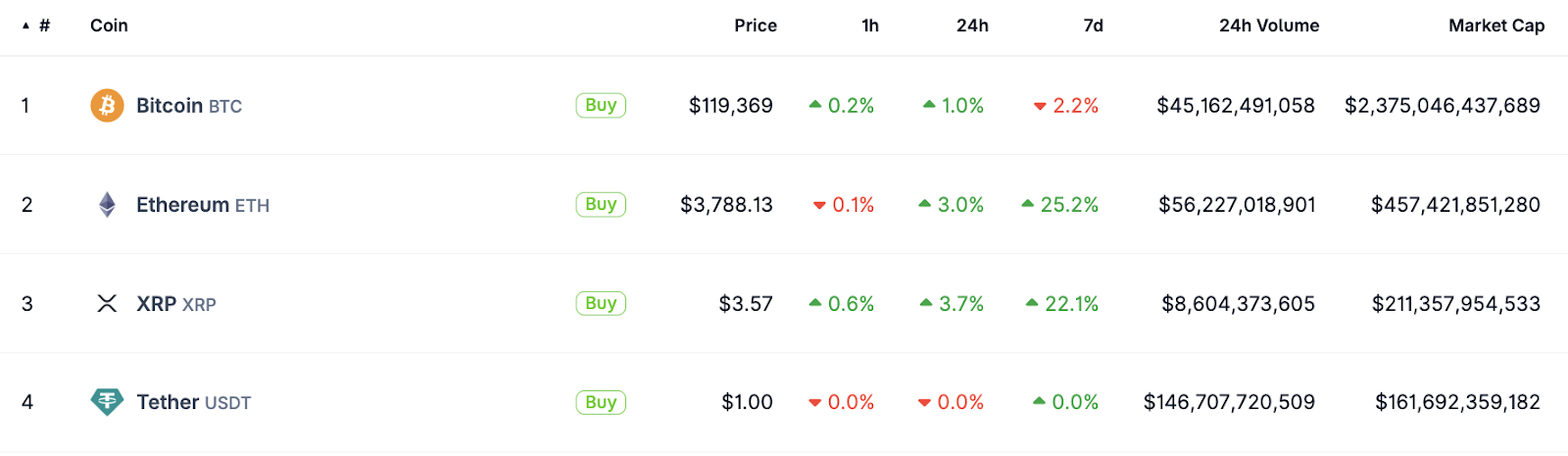
Top cryptocurrencies by market cap at the time of writing. Source.
Is USDT safe?
The short answer? USDT exists in a grey area between "reasonably safe for what it is" and "proceed with caution."
The slightly longer answer? Here's what you need to know at a glance:
What's working:
- Maintained its dollar peg through multiple market crashes
- Backed by a mix of cash, government securities, and other liquid assets
- Most widely accepted stablecoin across exchanges and platforms
- Regular attestations from accounting firms
What's concerning:
- Limited transparency compared to some competitors
- Regulatory uncertainty and past legal issues
- Concentration risk (too big to fail, too big to save?)
- Not fully backed by cash alone
The reality check: USDT has survived crypto winters, bank runs, and regulatory pressure for nearly a decade. While it's not risk-free (nothing in crypto is), it's proven more resilient than many predicted. For short-term trading and payments, most users find it reliable. For long-term wealth storage? That's where you might want to consider your options more carefully.
How USDT is backed: understanding Tether's reserves
Here’s where things get more complex and where much of the scrutiny around Tether lies.
In simple terms, USDT operates like a digital receipt: you deposit dollars, and in return, you get tokens you can use across the entire crypto ecosystem. But what happens to those dollars? Are they sitting in a vault, or being put to work?
Tether has long opted for the investment route. Instead of holding pure cash, it backs USDT with a diversified portfolio of assets. According to its Q1 2025 attestation from BDO, Tether’s reserves looked roughly like this:
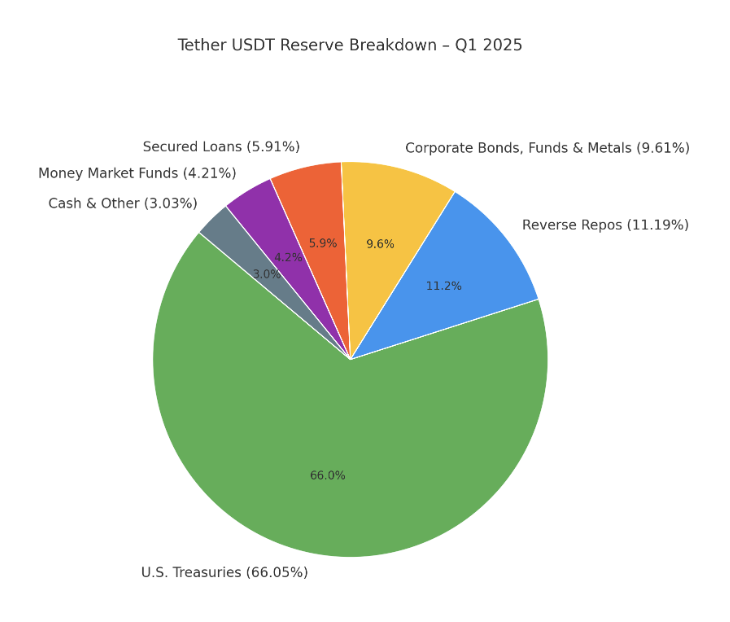
The shift toward U.S. Treasuries and away from riskier assets marked a significant improvement in its reserve quality. While not fully audited, Tether does publish quarterly attestations from BDO, providing some visibility into how reserves are managed. It’s not a full audit, but it’s a step forward from the opaque reporting of earlier years.
That being said, past controversies still shape how Tether is perceived. In 2019, Tether admitted that USDT was not fully backed by cash at all times and revealed it had lent $850 million to Bitfinex, its sister company. This led to a high-profile settlement with the New York Attorney General in 2021, requiring Tether to improve transparency and cease operations in New York.
Again, to put it in simple terms: imagine your bank quietly loaning out customer deposits to a related company without clearly telling you. Not necessarily illegal, but definitely a breach of trust for users expecting a 1:1 backed stablecoin.
Regulatory scrutiny & legal risks
If USDT were a person, it would probably have a thick file folder in regulatory offices around the world. Sure, being the largest stablecoin makes you a big target, but Tether has also found itself in the crosshairs of regulators who are still figuring out how to handle the crypto revolution.
In the United States, Tether operates in something of a regulatory twilight zone. The company has faced pressure from agencies like the Commodity Futures Trading Commission (CFTC), which fined Tether $41 million in 2021 for making false statements about being fully backed by US dollars.
The European Union is taking a more structured approach with its Markets in Crypto-Assets (MiCA) regulation, which will require stablecoins to be backed by highly liquid assets. This could actually work in Tether's favour, as they've already been moving in that direction.
Emerging markets present their own challenges. Some countries have embraced USDT as a hedge against local currency instability, while others have banned it outright, not far from a global game of regulatory whack-a-mole.
For users, the regulatory risks are real but indirect. If major jurisdictions crack down hard on Tether, it could affect the token's liquidity and usability. However, a complete overnight shutdown seems unlikely given USDT's deep integration into the crypto ecosystem.
The bigger risk might be increased compliance requirements that could make using USDT more cumbersome, similar to how traditional banking has become more regulated over time.
How safe is USDT for holding assets?
This is where we need to have an honest conversation about what "safe" means in crypto land.
For short-term use (days to weeks):
USDT works pretty well. If you're trading crypto or need to park funds briefly between investments, it's like using a decent hotel - not your forever home, but comfortable enough for a short stay.
The peg has held remarkably well through various market conditions, and liquidity is excellent across most major platforms.
For medium-term holdings (months):
Here's where things get a bit more nuanced. USDT has survived multiple "stress tests", including the Terra Luna collapse, FTX implosion, and various banking sector scares. However, you're essentially trusting that Tether's reserve management continues to work smoothly and that no major regulatory bombshell disrupts operations.
For long-term wealth storage (years):
This is where many experts start raising eyebrows. Holding large amounts in any stablecoin for extended periods comes with risks that compound over time. You're exposed to regulatory changes, potential company mismanagement, and the general "unknown unknowns" that come with relatively new financial instruments.
Essentially, USDT is like keeping money in a foreign bank account. It might work great for a while, but you're subject to the laws, regulations, and business practices of entities outside your home jurisdiction.
The key insight from the crypto community is diversification. Even USDT supporters rarely recommend putting all your eggs in the Tether basket.
Security best practices when using USDT
Using USDT safely isn't just about trusting Tether - it's also about protecting yourself from the various ways things can go wrong in the crypto world.
Platform risk management: Remember, USDT is only as safe as the platform you're using it on. The token itself might be fine, but if you're holding it on a sketchy exchange that gets hacked or goes bankrupt, you could lose everything. Stick to regulated platforms only.
Diversification strategies: Many crypto users often split their stablecoin holdings across multiple tokens and platforms. Think of it as not putting all your digital eggs in one digital basket. As an example, some might hold 40% USDT, 40% USDC, and 20% in other stablecoins or traditional assets.
For crypto beginners: Start small, learn the ropes, and, if you wish, gradually increase your holdings as you become more comfortable. Use well-established exchanges for your first purchases, enable two-factor authentication on everything, etc. Treat your crypto security like you would your online banking, that's essentially what it is.
USDT vs other stablecoins
The stablecoin world isn't a one-horse race, and understanding the alternatives helps put USDT's safety in perspective.
USDT vs USDC
USDT dominates in usage and global liquidity. It's the most widely accepted stablecoin across exchanges, DeFi platforms, and payment rails. But it has faced criticism over the years for a lack of full audits and historical opacity around reserves.
USD Coin (USDC), issued by Circle, takes a different approach. It’s often seen as the “regulated” stablecoin, with monthly attestations and a conservative reserve mix (primarily cash and short-term U.S. Treasuries).
- USDT is ideal for fast-moving markets and broad platform compatibility.
- USDC appeals to those who prioritise transparency and regulatory oversight.
USDT vs DAI
DAI takes a completely different route. Issued by MakerDAO, it’s a decentralised stablecoin backed by overcollateralised crypto assets like ETH, not fiat. There’s no single company behind it, just smart contracts and community governance.
While DAI offers full on-chain transparency and avoids centralised custodians, it also comes with higher complexity and potential risks tied to smart contract bugs or extreme market conditions.
- USDT provides speed and simplicity, backed by a traditional corporate structure.
- DAI offers a decentralised alternative, ideal for DeFi-native users.
USDT vs BUSD
BUSD, once a major player backed by Binance and Paxos, was phased out in 2024 due to regulatory pressure. It serves as a reminder that centralised stablecoins depend on both market forces and compliance frameworks, and can be wound down unexpectedly.
While USDT remains standing, BUSD’s sunset reinforces the importance of evaluating who’s behind the stablecoin and how stable their operations really are.
What happens if Tether fails?
Let's play out a hypothetical scenario: what if USDT actually collapsed?
Given USDT's role as the primary trading pair and liquidity source for much of the crypto market, a Tether failure would be like removing a major highway from a city's transportation network. The immediate effects would likely include:
Market chaos: Traders scrambling to exit USDT positions would create massive selling pressure across crypto markets. We're talking about potentially the largest fire sale in crypto history, as billions of dollars worth of USDT holders try to convert to other assets simultaneously.
Liquidity crisis: Many smaller cryptocurrencies rely heavily on USDT trading pairs. Without this liquidity, some tokens might become effectively untradeable, at least temporarily.
Contagion effects: Other stablecoins might face runs as confidence in the entire sector erodes. Even well-managed stablecoins could struggle if everyone tries to redeem at once.
The silver lining: The crypto ecosystem has become more resilient over time. Alternative stablecoins like USDC have grown substantially, providing some redundancy. Additionally, the market has survived previous "extinction-level events" and adapted.
Conclusion: Is USDT worth the risk?
USDT isn’t perfect, but it’s proven its place in the crypto ecosystem. With high liquidity and global acceptance, it’s a practical choice for trading, payments, and short-term value storage.
However, concerns around transparency and regulatory clarity mean it’s not ideal for long-term holding or users who prioritise full visibility. But like any financial tool, its value depends on how you use it.
The smart approach is to understand the trade-offs, diversify across stablecoins, and align your choices with your goals and risk tolerance. As the space evolves, USDT remains useful, but it’s just one part of a broader digital finance strategy.
News and updates
Bitcoin's Comeback: Three Forces That Could Make or Break it
Bitcoin is a long way from reclaiming its all-time high and stuck under $92,000, but three powerful forces could flip the script sooner than you think.

The Surge After the Storm: What’s Next for Bitcoin and the Market
After a brutal October sell-off, crypto just staged one of its most dramatic comebacks yet. Here's what the market's resilience signals for what comes next.

Decoding the disconnect: America's cautious approach to crypto
Bitcoin and the broader crypto market have soared to a staggering $2.1 trillion in value, but why does skepticism still linger among so many Americans? Here is a deep dive into the current trust gap.
.webp)
How the Crypto Generation could reshape the 2024 election
Explore how the Crypto Generation's values and tech influence could shape the 2024 election and impact the future of politics.