
Learning the friendly way
Dive into our resources, guides, and articles for all things money-related. Grow your financial confidence with our experts curated tips and articles for both experienced and new investors.
Latest posts
Learn how Ethereum gas fees work, why they fluctuate, and how to save on costs using smart timing, Layer 2s, and upcoming network upgrades.
Every move on Ethereum (sending crypto, minting an NFT, using a dapp) comes with a cost. That cost is called gas. It’s not just a fee - it’s the fuel that keeps the network running.
Knowing how gas works means you’re not just using Ethereum, you’re using it smarter. You can time transactions, avoid peak congestion, and cut your costs. Here we explore how it works and how to take control in a simple and easy-to-understand way.
What are Ethereum gas fees?
Let’s start with the basics: gas fees are the cost of using the Ethereum network. Any time you do something - like send ETH or swap tokens - you’re asking the network to do work. That work takes computing power, and gas fees are what you pay to get it done.
These fees serve three critical functions:
- Compensate validators for their work
- Secure the network from spam attacks, and
- Prioritise transactions during busy periods.
When the network buzzes with activity, the fees naturally rise as users compete for limited block space. Picture Ethereum as a busy highway during rush hour. More traffic means higher tolls, but the road remains secure and functional for everyone willing to pay the current rate.
How Ethereum gas fees work
Every gas fee breaks down into a simple formula that establishes your specific transaction cost:
Total fee = (base fee + priority fee) × gas limit
Let’s break it down:
- The base fee is the minimum cost to get your transaction into a block. It goes up when the network is busy and is burned (destroyed) to help reduce ETH supply.
- The priority fee (tip) is an extra amount you add to speed things up (like tipping for faster service).
- The gas limit is how much work your transaction needs. Bigger, more complex actions need a higher limit.
Another important element to understand is that gas prices are measured in Gwei, where 1 Gwei equals 0.000000001 ETH. A typical token swap might use 30,000 gas units. If the current base fee sits at 25 Gwei and you add a 5 Gwei tip, your total cost becomes:
(25 + 5) × 30,000 = 900,000 Gwei = 0.0009 ETH
Let’s say at $2,500 per ETH, that transaction would cost $2.25.
Why Ethereum gas fees fluctuate
Gas fees move with the rhythm of the network. When demand is low, fees drop. When things heat up, they spike.
Big events like new token launches, NFT drops, or market surges can therefore clog the network. More users = more competition for space. That’s when the base fee goes up (remember the formula above: total fee = (base fee + priority fee) × gas limit).
The base fee adjusts with every block (around every 15 seconds). It rises when blocks are more than 50% full and drops when they’re under that threshold.
The type of transaction also matters:
- A simple ETH transfer uses about 21,000 gas units.
- A complex smart contract call: +/-200,000.
- A typical Uniswap swap costs 3–5x more than a basic transfer.
And don’t forget ETH’s price. Even if gas stays steady in Gwei, rising ETH makes each transaction more expensive in dollars.
Quick Tip: Check gas trackers before major transactions. A few minutes of timing can save significant money.
How to check Ethereum gas prices in real time
Active users monitor gas prices like traders watch market charts. There are several tools that provide real-time visibility into the network’s condition.
- Etherscan’s gas tracker (for deep analytics)
Etherscan provides in-depth gas analytics including real-time rates, historical charts, and insights into average and peak fees. It also offers optimisation tips like identifying “safe low‑cost windows” for transactions. - Rabby wallet (for user-friendly alerts)
Rabby’s mobile and browser wallet features built-in gas monitoring, showing current prices and offering “Gas Top Up” functionality. It also supports push notifications (via its GasAccount feature) for favourable conditions. - MetaMask (for fully integrated wallet visibility)
MetaMask displays live gas rates directly in its interface and dashboard. You'll see options like Low, Market, or Aggressive for gas speeds, and it even shows fiat equivalents beside token balances.
Most gas trackers display slow, standard, and fast fee tiers, helping you balance cost and speed.
It’s also worth knowing that slow transactions may take 5-10 minutes but can save you 20-30% on fees, while fast ones aim to process within a couple of minutes, at a premium price.
Gas prices also follow weekly patterns. Fees are usually lower on weekends, when institutional and high-frequency trading slows down. And if you’re not in a rush, consider transacting during early morning hours (2–6 AM EST), often the cheapest window of the day.
Ethereum gas fees before and after the merge
Over the years, Ethereum has gone through major upgrades that changed how gas fees work, though granted not always in the ways people expected.
In 2021, the London Hard Fork introduced EIP-1559, swapping chaotic gas auctions for a more predictable pricing model: a base fee + tip. It made fee estimates more stable, but didn’t necessarily make them cheaper.
Then came The Merge in 2022, shifting Ethereum to proof-of-stake. It cut energy use and made block processing more efficient. But despite common belief, it didn’t slash gas fees overnight.
However, The Merge did lay the groundwork for future upgrades (like sharding and rollups) that will unlock real, lasting fee reductions at scale.
Looking ahead, upgrades like Proto-Danksharding aim to scale Ethereum and bring fees down for good.
How to reduce ETH gas fees
Despite what some might tell you, cutting gas fees isn’t about luck, it’s more about smart choices and good timing. Here are some options:
Use Layer 2s
Networks like Arbitrum, Optimism, and Base offer the biggest savings, sometimes up to 90–95% cheaper than the Ethereum mainnet. For example, a $50 swap on mainnet might cost just $2-$5 on these platforms, with the same level of security. (More on this below).
Simulate before you send
Tools like Tenderly and DeFi Saver let you test complex transactions first, helping you avoid failed attempts that still burn gas.
Pick your moment
As mentioned above, prices drop when the network is quiet. Use gas trackers to spot the best times to transact.
Batch when you can
Some protocols let you combine multiple actions into one transaction, so you pay one base fee instead of several.
Layer 2 solutions that cut gas costs
Layer 2 networks are the future of Ethereum scaling. They can handle thousands of transactions off-chain, then settle them on Ethereum in one go, cutting costs and speeding things up.
- Arbitrum leads in total value locked. It offers fast transactions for just $0.10-$0.50 and supports most major DeFi apps, making it feel like a cheaper version of the mainnet.
- Optimism offers similar savings, with bonus perks like token rewards for developers through its RetroPGF program, driving growth and innovation.
- Base combines low fees with easy fiat onramps. It’s great for beginners moving from exchanges into DeFi.
These networks are able to do what they do by using rollups, a tech that bundles hundreds of transactions into one. Think of it like carpooling: everyone shares the cost of the ride, but still gets where they need to go.
Who receives Ethereum gas fees?
Since The Merge, Ethereum handles gas fees in a smart split between rewards and supply control.
- Validators (who secure the network) earn priority fees - tips from users that reward them for processing transactions. This keeps the network safe and running smoothly.
- Base fees, on the other hand, are burned (permanently removed from circulation). When the network is busy, more ETH is burned, which can reduce supply and make ETH more valuable over time.
Will Ethereum gas fees ever go down?
Ethereum’s roadmap promises big fee cuts, but the biggest changes will take time.
- Proto-Danksharding (EIP-4844) is expected in upcoming upgrades. It will slash Layer 2 costs by 10-100x by creating dedicated space for rollup data. This upgrade is the closest major step toward lower fees.
- Full Danksharding, further down the line, will boost Ethereum’s capacity massively, making tiny, sub-penny transactions on Layer 2 networks a reality without sacrificing security or decentralisation.
- Ethereum’s founder, Vitalik Buterin, envisions the mainnet as a secure settlement layer, while Layer 2s handle most daily transactions quickly and cheaply.
If all goes as planned, popular Layer 2s could offer fees under one cent within 2-3 years, opening the door for micro-transactions and true global use.
Comparison: Ethereum vs other chains
Blockchain networks take different paths when balancing cost, security, and decentralisation, and fees reflect those choices. Let’s take a look at its biggest competitors.
Solana vs Ethereum
Solana offers super low, sub-penny fees and processes around 3,000 transactions per second (far more than Ethereum’s +/-15 TPS). This speed comes from different architectural choices, but with tradeoffs like higher hardware requirements and occasional network outages.
Ethereum, meanwhile, prioritises security and decentralisation, scaling through Layer 2 solutions to keep fees competitive.
Binance Smart Chain vs Ethereum
Binance Smart Chain (BSC) delivers low fees, typically $0.10–$0.50 per transaction, but it sacrifices decentralisation by relying on fewer validators and tighter connections to centralised infrastructure.
Ethereum maintains a more decentralised network while scaling costs through Layer 2s, keeping security front and centre.
Avalanche vs Ethereum
Avalanche strikes a balance with moderate fees ($0.50–$2.00), high throughput, and strong security. However, its ecosystem remains smaller than Ethereum’s rich DeFi landscape, which benefits from Layer 2 scaling and a strong focus on decentralisation.
Final thoughts
Understanding Ethereum gas fees puts you in control, allowing you to save money and utilise the network more efficiently. While fees can fluctuate, smart timing, Layer 2 solutions, and upcoming upgrades promise a future of faster, cheaper transactions.
While Ethereum continues to prioritise security and decentralisation, its gas fee roadmap reflects a careful balance between innovation and accessibility, paving the way for broader adoption and everyday use.
.webp)
ChatGPT has become the AI everyone's talking about, but with multiple plans and price points, which version actually delivers the best bang for your buck in 2025?
Unless you’ve been living under a rock, you’ve probably heard about ChatGPT… this almighty, em dash-loving AI assistant that seems to pop up in every conversation nowadays regarding productivity and technology.
It truly is everywhere, and honestly, it lives up to the hype.
Think of it as a chatty, super-smart friend you can tap into anytime, whether you’re fine-tuning an email, researching, or tackling coding questions late at night.
But one thing many newcomers don’t quickly realize: not all ChatGPT plans are created equal. The differences between the free version and paid tiers can be striking, from a helpful but occasionally busy assistant to a premium version that's always ready to go deep on your tasks. With multiple plans, variable costs, and constant updates, it’s not always clear which version offers the best value for one's specific needs.
Whether you're watching your budget or ready to upgrade your productivity, knowing which plan aligns with your needs will help you make the best choice. So, let’s dive in.
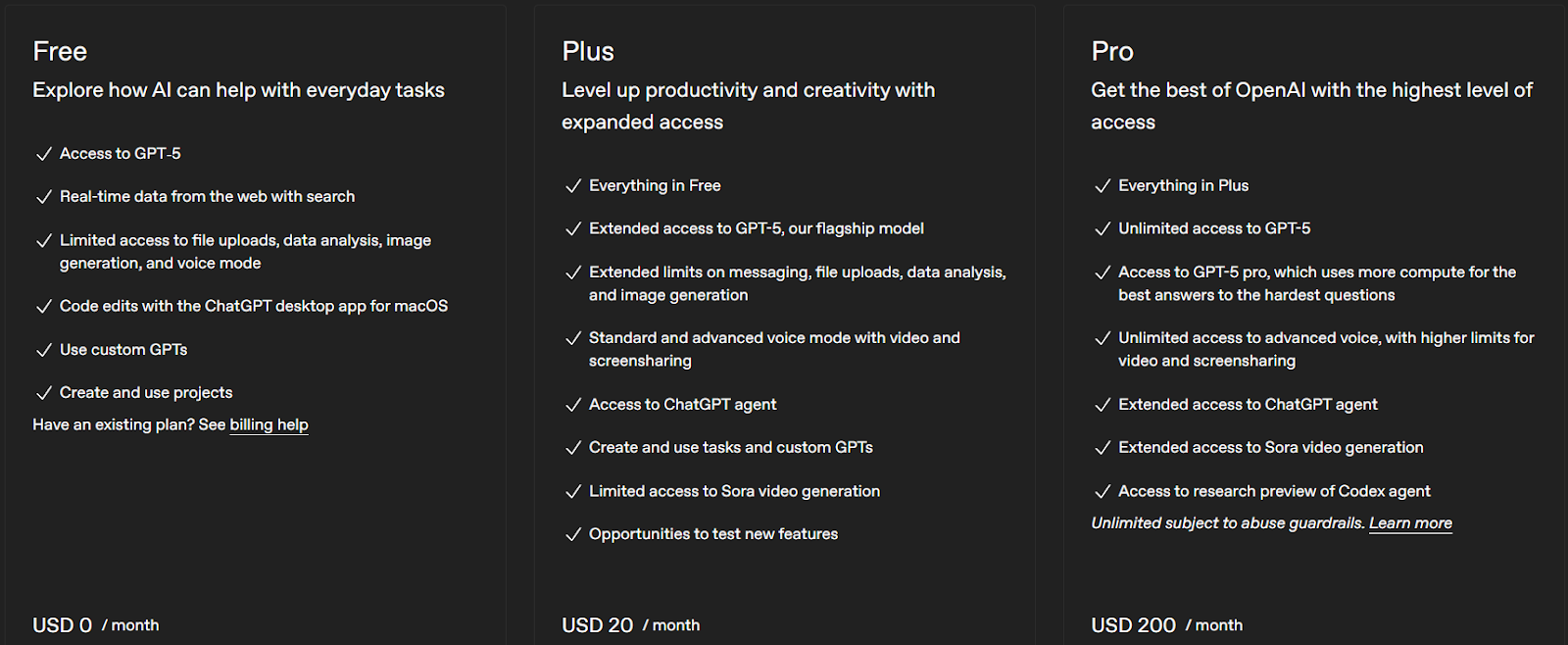
ChatGPT Pricing Plans Explained
Let’s break down what each subscription tier offers and what you're actually paying for:
ChatGPT Free Plan
- Access to GPT-5 (automatic fast/reasoning mode) with standard performance.
- Features: voice mode, file uploads, image generation, web browsing, basic analysis.
- Best for: New users exploring ChatGPT’s capabilities without commitment. Offers solid functionality for casual use, though access and speed can be limited during high demand.
ChatGPT Plus ($20/month)
- Priority access to GPT-5 with faster responses.
- Advanced voice mode, early feature access, GPT-4o, custom GPTs.
- Best for: Individuals like freelancers or students needing reliable performance and enhanced features.
ChatGPT Pro ($200/month)
- Unlimited GPT-5 access in "Pro" mode offering deeper, more complex reasoning.
- Premium compute power and research-grade performance.
- Best for: Power users; researchers, engineers, and professionals requiring high-level reasoning and uninterrupted access.
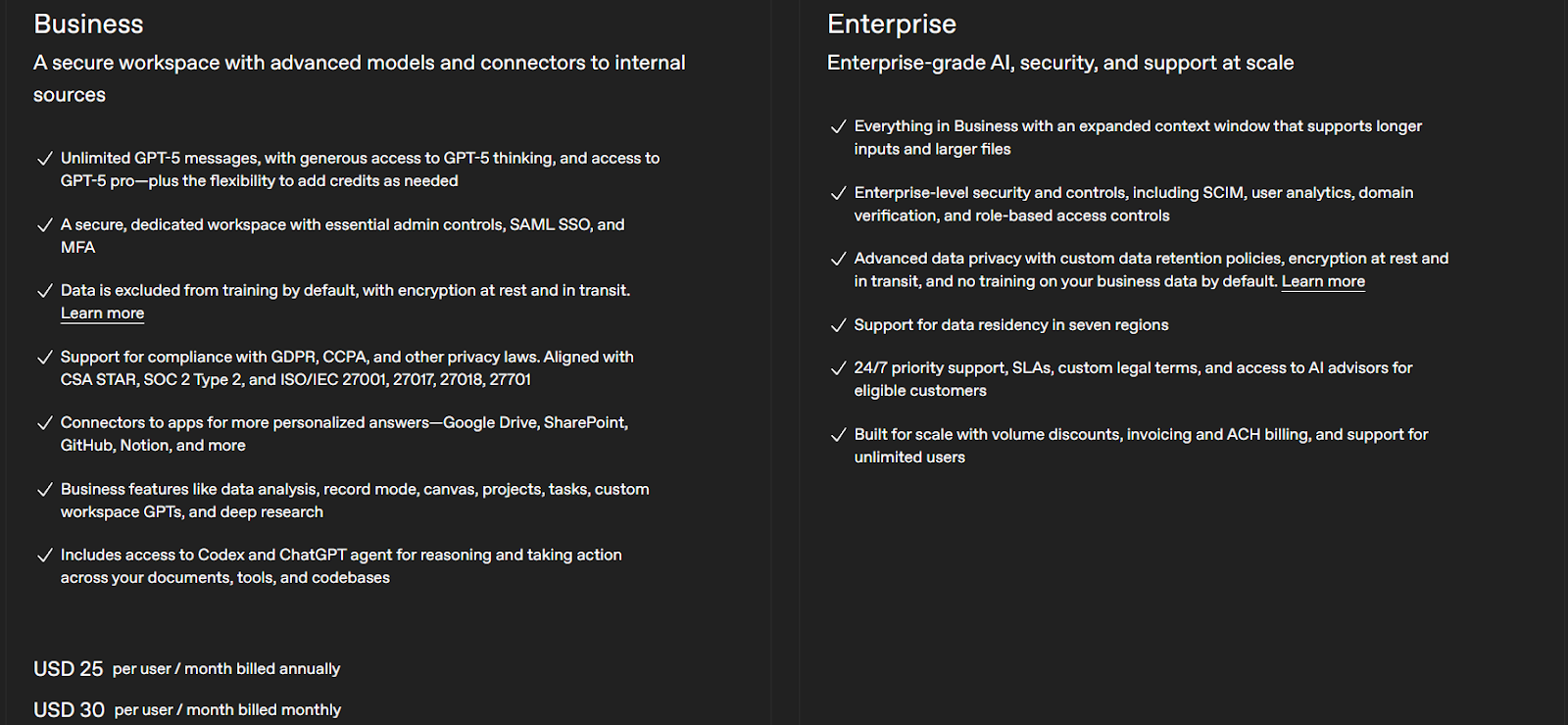
ChatGPT Team ($25–30 per user/month)
- All Plus features plus team-focused tools.
- Collaboration workspace, admin controls, privacy (OpenAI won’t train on your data), shared GPTs.
- Best for: Small teams or startups that value collaboration with enhanced security.
ChatGPT Enterprise (Custom pricing)
- Advanced security, enterprise-grade privacy, integrations (e.g., Google Drive, SharePoint), and dedicated support.
- Best for: Large organisations embedding AI into their core infrastructure with full admin and compliance controls.
Which ChatGPT Plan Is Right for You?
Choosing the right plan is like picking a mobile phone tariff. You want features that fit your needs without overpaying:
- Students: Start with Free; upgrade to Plus if peak usage becomes a drag.
- Freelancers / Pros: Plus is your professional toolkit; it’s reliable, responsive, and worth every dollar.
- Developers / Tech Users: Plus covers light work; Pro fits deep coding or complex data tasks.
- Small Teams / Startups: Team plan adds collaboration and privacy; it’s critical for joint projects.
- Large Enterprises: Enterprise plan solidifies AI as a business workflow pillar.
ChatGPT Hidden Costs & Limitations to Know
Even beyond the listed prices, here are some caveats to keep in mind:
- API Usage: If you use ChatGPT APIs, you'll pay extra per token. For example, GPT-4o mini input tokens cost significantly less than full models.
- Message Limits & Throttling: Paid plans have generous but not infinite usage. Pro handles higher loads; Free can be restrictive.
- Feature Rollouts: Some features debut first to higher plans. Free users may get them later, like being in general admission while Plus users enjoy VIP access.
- Storage Limits: File sizes and frequency may be capped, depending on the plan.
Cost-Saving Tips
- Annual billing: Check for annual pricing discounts, especially on Team plans. Savings of 15–20% are common.
- Track usage: Keep an eye on how many messages or uploads you consume. Some plans never reveal that data clearly.
- Bundle savings: If your organization qualifies, inquire about nonprofit discounts. OpenAI sometimes offers 20–50% off Business or Enterprise plans.
ChatGPT Alternatives: Is There a Better Deal?
ChatGPT isn’t the only tool in town. Here’s a quick look at the competition:
- Claude AI (Anthropic): great at deep reasoning and handling longer contexts
- Perplexity AI: excels in web search, complete with cited sources
- DeepSeek: lower cost, decent performance for budget-conscious users
- Google Gemini: seamless if you already heavily use Google’s ecosystem
Each platform brings its own strengths. ChatGPT remains very versatile, but depending on your needs, one of these may outperform it.
Final Thoughts: Is ChatGPT Worth the Price in 2025?
The value comes down to your personal use. The Free plan is surprisingly capable for casual use. For most professionals, the $20 Plus plan soon pays for itself. For teams and businesses, Team or Enterprise plans consolidate productivity, compliance, and privacy in one package.
The good news is you're not stuck with one choice forever. Experiment with free versions of ChatGPT, Claude, or Perplexity, and upgrade when the fit and features match your workflow. Try them all out. Get crazy with those chats!
We're still figuring out this whole AI conundrum, but one thing's clear, these tools are becoming as essential as e-mail or Google Drive. The question is not whether you'll use AI, it's whether you’ll find a way to make it fit your current needs… knowing you can always level up later.

A look into fintech's role in empowering the unbanked communities around the world, how far we've come, and what's still ahead.
The financial revolution isn't happening in Wall Street's landmark buildings, it's exploding through smartphone screens in rural villages, urban apartments, and immigrant communities worldwide. And while traditional banks still ask for three forms of ID and a pristine credit score, fintech is rewriting the rules of who gets to participate in the global economy.
Here's the reality: 1.4 billion adults globally remain unbanked, locked out of basic financial services that most of us take for granted. In the U.S. alone, roughly 5.4% of households (about 5.6 million families) have no relationship with a bank or credit union. These aren't just statistics; they're people paying check-cashing fees, carrying cash everywhere, and building zero credit history despite working multiple jobs.
But here's where it gets interesting: fintech isn't just offering band-aid solutions. It's fundamentally disrupting how financial services work, creating pathways to economic participation that bypass traditional gatekeepers entirely.
From mobile banking apps that require no minimum balance to blockchain-based lending that ignores credit scores, technology is democratising finance in ways that seemed impossible just a decade ago.
The question isn't whether fintech can help the unbanked, it's already happening. The real question is how fast this transformation can scale and whether it can reach the communities that need it most.
Why so many people remain unbanked
Let's dive into the barriers that keep millions locked out of traditional banking. It's not just about money, though, of course, that’s a part of it.
The most obvious culprit? Banks themselves. Traditional institutions have built their entire business model around risk assessment, which typically means credit scores, employment verification, and documentation requirements that exclude huge swaths of the population.
If you're an immigrant without an established credit history, a gig worker with irregular income, or someone who's been burned by predatory lending in the past, good luck getting a simple checking account with credit facilities.
Geographic accessibility plays a massive role, too. Rural communities have watched bank branches disappear at an alarming rate: since 2009, over 10,000 bank branches have closed across the UK. When the nearest bank is 50 miles away and you're working two jobs just to stay afloat, maintaining a traditional banking relationship becomes practically impossible.
Then there's the trust factor. Many unbanked individuals come from communities where banks have historically been extractive rather than supportive. Why would you trust an institution that charges overdraft fees designed to trap you in cycles of debt? For many, cash-only transactions feel safer and more transparent than navigating hidden fees and complex terms of service.
Digital literacy creates another layer of exclusion. While fintech promises mobile-first solutions, those solutions still require smartphone access, internet connectivity, and the technical knowledge to navigate increasingly complex apps. For older adults or those without consistent internet access, digital banking can feel more like a barrier than a bridge.
The demographic impact tells the whole story: immigrants, young adults building their first financial identity, gig workers whose income doesn't fit traditional employment models, and rural populations where infrastructure lags behind urban centres. These aren't fringe communities, they represent the fastest-growing segments of the workforce.
Traditional banking's limitations
Here's the uncomfortable truth about traditional banking: it was designed for a different era, when employment was stable, credit histories were linear, and financial relationships lasted decades. Today's economy doesn't work that way, but banks haven't caught up.
The FICO credit scoring system perfectly exemplifies this disconnect. Created in 1989, it treats credit like a single number that defines your financial worth, ignoring factors like consistent rent payments, utility bill history, or mobile phone payment patterns. If you've never had a credit card or traditional loan, you're effectively invisible to the system that determines whether you can access basic financial services.
Fee structures reveal even deeper problems. The average overdraft fee has climbed to $35, while monthly maintenance fees can easily cost $200+ annually for basic checking accounts.
For someone living paycheck to paycheck, these fees aren't just inconvenient, they can be financially devastating. Banks profit billions annually from overdraft fees alone, creating perverse incentives to trap rather than support their most vulnerable customers.
Bureaucracy adds another layer of exclusion. Opening a bank account requires documentation that many people simply don't have readily available: proof of address, employment verification, Social Security numbers, and often a minimum deposit. For undocumented immigrants, frequent movers, or those between jobs, these requirements create insurmountable barriers.
Traditional banks also struggle with personalisation at scale. They're built to serve middle-class customers with predictable income patterns, not gig workers whose earnings fluctuate wildly or small business owners who need flexible lending options. The result? Financial products that don't match real-world financial lives.
How fintech is changing the game
Sure, fintech isn’t a cure-all, but it is revolutionising finance by flipping the model: instead of forcing people to fit outdated systems, it builds systems that fit how people actually live and work.
Mobile banking & digital wallets
Mobile banking apps like Chime, Venmo, and Cash App have obliterated traditional barriers to entry. Chime offers fee-free banking with no minimum balance requirements and early direct deposit features that get workers paid up to two days faster than traditional banks.
That might not sound revolutionary until you realise that for someone living paycheck to paycheck, getting paid two days early can mean the difference between making rent on time or facing late fees.
Venmo transformed peer-to-peer payments from a complicated wire transfer process into something as simple as sending a text message. Cash App went further, adding investing features, Bitcoin purchases, and small business payment processing to a single app that anyone can download for free.
Increasingly, platforms like Tap are also stepping in - not just as digital wallets, but as integrated ecosystems that combine spending, saving, and cross-border access for underserved users. These aren't just simplified versions of traditional banking, they're entirely different approaches that prioritise accessibility and user experience over profit maximisation through fees and complexity.
Peer-to-peer lending & credit building
The lending revolution is even more dramatic. Platforms like Avant, Earnest, and newer crypto-lending protocols are using alternative data sources and AI-driven risk assessment to make lending decisions that traditional banks couldn't even consider.
Instead of relying solely on FICO scores, these platforms analyse everything from social media activity to mobile phone payment patterns to assess creditworthiness. They're building credit profiles for people who were previously invisible to the traditional system, creating pathways to financial growth that didn't exist before.
Peer-to-peer lending removes banks from the equation entirely, connecting borrowers directly with individual lenders or pools of capital. This creates more competitive interest rates and more flexible terms, especially for borrowers who don't fit traditional risk profiles.
Micro-investment & wealth-building tools
Investment platforms like Robinhood, Acorns, and international players like Nutmeg have democratised wealth building by eliminating minimum investment requirements and complex fee structures. Acorns rounds up everyday purchases and invests the spare change, allowing people to build investment portfolios with literally pennies.
These platforms reimagine what investing looks like for people who aren't already wealthy. Educational resources, simplified interfaces, and fractional share ownership mean that someone making minimum wage can start building long-term wealth with the same tools previously only reserved for high-net-worth individuals.
DeFi & blockchain for financial access
Decentralised finance represents the most radical reimagining of financial services yet. Ethereum-based platforms allow people to lend, borrow, and earn interest without any traditional financial institution involvement. Smart contracts automatically execute financial agreements, eliminating the need for banks, credit checks, or geographical restrictions.
Crypto wallets provide financial services to anyone with a smartphone and internet connection, regardless of their documentation status, credit history, or location. While still nascent and volatile, DeFi protocols are processing billions in transactions and proving that alternative financial systems can operate at scale.
Benefits fintech brings to the unbanked
The advantages aren't just theoretical, they're transforming lives in measurable ways.
Accessibility leads the list.
Fintech services operate 24/7 from any smartphone, eliminating the geographical and temporal constraints that keep people away from traditional banks. Someone working night shifts or multiple jobs can manage their finances during a break, not during banking hours that conflict with their work schedule.
Affordability follows closely.
Most fintech platforms operate with dramatically lower overhead costs than traditional banks, allowing them to offer services with minimal or no fees. When you're not paying for physical branches, armies of tellers, and legacy IT systems, you can pass those savings to customers who need them most.
Speed transforms financial emergency management.
Traditional loan applications can take weeks while fintech platforms often provide decisions in minutes. When your car breaks down and you need to get to work tomorrow, that speed difference isn't convenience - it's survival.
Transparency. Transparency. Transparency.
Fintech apps typically show real-time transaction data, clear fee structures, and straightforward terms of service. No more surprise fees or hidden charges that drain accounts without warning.
Using data instead of old patterns.
Data-driven personalisation means financial products that actually match individual circumstances. Instead of one-size-fits-all banking products, AI-powered platforms can offer customised solutions based on spending patterns, income volatility, and financial goals.
Safety from the loan sharks.
Perhaps most importantly, fintech reduces exposure to predatory lending practices. Transparent algorithms and competitive marketplaces make it harder for bad actors to exploit vulnerable populations with payday loans and other extractive financial products.
Case studies & real-world applications
The real proof lies in how these technologies are working in practice across different communities and regions.
U.S. gig workers have embraced fintech payroll advances and flexible banking solutions. Uber and Lyft drivers use apps like Earnin to access their earnings before payday, eliminating the need for expensive payday loans.
DoorDash partnered with DasherDirect to offer delivery workers immediate access to their earnings plus cashback rewards on gas purchases = financial services designed specifically for the gig economy.
Africa's mobile money revolution provides the most compelling example of fintech leapfrogging traditional banking infrastructure. M-Pesa in Kenya processes more transactions annually than Western Union globally, allowing people to send money, pay bills, and access microloans through basic mobile phones.
Over 80% of Kenyan adults now use mobile money services, creating a more financially inclusive society than many developed nations.
Latin America's neobank adoption is exploding as traditional banks struggle to serve growing populations. Brazil's Nubank has over 70 million customers, offering fee-free banking and credit building to people previously excluded from traditional financial services.
Mexico's Clip provides small business payment processing to street vendors and micro-entrepreneurs who couldn't access traditional merchant services.
These aren't isolated success stories: they're proof of concept for global financial inclusion through technology.
Barriers fintech still faces
Despite the revolutionary potential, significant obstacles remain.
Digital literacy and smartphone access create fundamental barriers. While smartphone penetration continues growing globally, reliable internet connectivity and the technical skills needed to navigate financial apps remain unevenly distributed. Older adults and rural populations often struggle with interfaces designed by young urban developers.
Regulatory hurdles complicate expansion and innovation. Know Your Customer (KYC) compliance requirements, anti-money laundering regulations, and licensing requirements vary dramatically across jurisdictions, making it difficult for fintech companies to scale globally. Regulatory uncertainty around crypto and DeFi creates additional complications for even the most innovative solutions.
Infrastructure gaps in developing regions limit fintech's reach. While mobile money works well in areas with basic cellular coverage, more sophisticated fintech services require robust internet infrastructure that many rural and low-income areas still lack.
Crypto and DeFi adoption scepticism remains high, particularly among the very populations these technologies could most benefit. Volatility concerns, complexity, and association with scams and fraud make many potential users hesitant to embrace blockchain-based financial services.
Cultural barriers also persist. In communities where cash has been king for generations, shifting to digital-first financial services requires not just technological adoption but cultural change. Trust must be earned through consistent, reliable service over time.
What the future holds: innovations & inclusion
The next wave of fintech innovation promises even more dramatic transformation.
Artificial intelligence will enable hyper-personalised financial services that adapt in real-time to individual circumstances. AI-powered financial advisors will provide wealth management services previously available only to millionaires, while machine learning algorithms will create more accurate and inclusive credit assessment models.
Open banking regulations will force traditional financial institutions to share customer data with fintech competitors, accelerating innovation and competition. This means better services, lower costs, and more options for consumers who have been underserved by traditional banks.
Regulatory evolution will create clearer frameworks for fintech innovation while protecting consumers. Central bank digital currencies (CBDCs) may provide government-backed alternatives to both traditional banking and cryptocurrencies, potentially reaching populations that current solutions miss.
Blockchain-based financial identity systems could eliminate documentation barriers that currently exclude millions from financial services. Decentralised identity solutions would allow people to build financial reputations independent of traditional credit systems or government documentation.
The convergence of fintech with other technologies (Internet of Things sensors for supply chain financing, augmented reality for financial education, 5G networks for real-time global payments) will likely create financial services we can barely imagine today.
Conclusion
Fintech isn't just disrupting traditional banking: it's democratising economic participation on a global scale.
From mobile money transforming African economies to gig worker payment solutions in American cities, technology is proving that financial inclusion isn't just morally right, it's economically inevitable.
However, the transformation isn't complete, and significant barriers still remain. But the trajectory is clear: financial services are becoming more accessible, affordable, and aligned with how people actually live and work in the 21st century.
The most exciting developments will emerge from collaboration between fintech innovators, government regulators, and community organisations that understand local needs.
This isn't a zero-sum game between technology and tradition—it's an opportunity to build financial systems that serve everyone, not just those who were lucky enough to be born into existing networks of economic privilege.
The unbanked aren't waiting for permission to participate in the global economy. They're already using whatever tools they can access to build financial stability and opportunity. Fintech's job is to make sure those tools are powerful, accessible, and designed with their real needs in mind.
The financial revolution is happening whether traditional institutions join it or not. The question is whether we'll build a system that includes everyone or leaves millions behind. The technology exists. The demand is obvious. Now it's up to us to make financial inclusion a reality, not just a promise.

Crypto's awkward teenage years are ending. See how digital currency culture trades rebellion for responsibility in this modern coming-of-age tale.
Remember when crypto was just about pizza?
In 2010, Laszlo Hanyecz paid 10,000 Bitcoin for two Papa John's pizzas, a transaction now worth over $1 billion. Gut punch aside, crypto enthusiasts celebrate this first real-world integration every 22 May as "Bitcoin Pizza Day."
Back then, the entire crypto ecosystem could fit into a few obscure forums where libertarian idealists and coding cowboys traded digital tokens like baseball cards, convinced they were building the future from their basements. In hindsight, they were.
Fast forward to today, and that scrappy subculture has evolved into something unrecognisable from its meme-driven origins. Nike is dropping NFT sneakers. Major banks hold crypto assets. Entire countries are experimenting with digital currencies. The rebellious energy that once fueled late-night Discord raids and "diamond hands" memes has crystallised into legitimate businesses, governance protocols, and entirely new economic models.
But here's what's fascinating: crypto didn't just grow up by abandoning its roots, it’s matured by doubling down on them. The community-first mentality that built Bitcoin is now reshaping how we think about ownership, identity, and value creation in the digital age.
This isn't a story about crypto going mainstream by becoming boring. It's about a culture that learned to channel its revolutionary spirit into building the infrastructure for tomorrow's economy, while somehow keeping its irreverent soul intact.

From meme coins to maturity: the evolution of crypto culture
Remember the early days of crypto culture, where things were gloriously chaotic? A community united by shared jokes about "HODLing" (born from a drunken misspelling of "hold"), treating every market crash as a buying opportunity, and genuinely believing that traditional finance was destined for the dustbin of history. The culture was equal parts utopian manifesto and internet meme factory.
And it wasn't just rebellious posturing, it was the emergence of genuinely new social norms.
Crypto communities developed their own language (think "WAGMI," "ape in," "moon"), their own heroes (Satoshi's mysterious disappearance became legendary), and their own values centred around decentralisation, permissionless innovation, and radical transparency. Forums like BitcoinTalk and subreddits became digital town squares where code was law and reputation was earned through contribution, not credentials.
But cultures mature through adversity, and crypto has weathered some brutal winters. The 2018 crash wiped out over 80% of the market's value. The 2022 collapse saw major players like FTX implode spectacularly.
Each crisis forced the community to evolve, weeding out pure speculation while strengthening the foundations of legitimate innovation. The survivors weren't just the hodlers; they were the builders who kept shipping code through bear markets.
What emerged from these trials and tribulations was a culture that kept its revolutionary energy but channelled it more strategically.
The meme coins didn't disappear, they just became one flavour in a much richer ecosystem. Fast forward to today, where crypto culture balances its anti-establishment DNA with the practical work of building alternatives to the systems it once merely criticised.
Why the crypto ecosystem is no longer just a subculture
Somewhere between the pizza transactions and the present day, crypto stopped being a niche hobby and became infrastructure. Real estate transactions are settling on blockchain networks. Identity verification happens through decentralised protocols. Entire financial systems run on code that anyone can audit, and no single entity controls.
The rise of Decentralised Autonomous Organisations (DAOs) exemplifies this maturation.
What started as an experimental governance model has evolved into a practical tool for coordinating everything from investment funds to open-source software development. DAOs like Uniswap and Compound manage billions in assets through community governance, hushing the haters and proving that decentralised decision-making can work at scale.
Meanwhile, DeFi has created a parallel financial infrastructure that operates 24/7, serves global users without permission, and offers yields that traditional banks can't match. Creator economies have exploded as artists, musicians, and content creators tokenise their work and build direct relationships with their audiences. These aren't experiments anymore, they're functioning businesses generating real revenue and solving real problems.
Perhaps most tellingly, regulatory frameworks are finally catching up. When governments start creating clear rules for an industry, that's usually a sign it's moved beyond the experimental phase.
The role of Web3 in shaping new digital identities
Let’s shine a light on Web3 - no longer just a “technical upgrade,” but now a fundamental shift in how people relate to their digital lives. For the first time in internet history, users can truly own their online identities, content, and social connections. While, admittedly, it’s still in its early stages, it's still creating new economic opportunities for millions of people.
Gamers are leading the charge in another direction, earning real income through play-to-earn games and trading in-game assets as NFTs. What seems like fun and games is actually a new form of digital labour, with some players in developing countries earning more from virtual economies than traditional jobs provide.
However you feel about Web3, you cannot deny that the cultural shift here is profound: digital activities that were once purely recreational are becoming legitimate career paths.
Investing beyond the hype: what smart money looks like now
Thankfully, the days of throwing money at anything with "coin" in the name are largely over. Today's sophisticated crypto investors approach the space with the same rigour they'd apply to any emerging technology sector, which is to say, a lot more rigour than the early "number go up" mentality.
Modern crypto investing focuses heavily on tokenomics: the economic design of how tokens are created, distributed, and used within their ecosystems. Smart investors analyse token supply schedules, utility functions, governance mechanisms, and community incentive structures. They're looking for projects that create genuine value, not just speculative buzz.
Due diligence now includes evaluating team credentials, technology innovation, product-market fit, and regulatory compliance. The most successful crypto investors today often have backgrounds in traditional venture capital or technology, bringing institutional-grade analysis to a previously amateur-dominated space.
They're backing teams building long-term infrastructure, not chasing the latest meme coin pump.
This maturation has also created new investment categories. There's now a clear distinction between speculative trading, strategic token investments, and equity stakes in crypto companies. Even institutional players like pension funds and endowments are entering the space through regulated products, bringing both capital and credibility.
The cultural shift is striking: crypto conferences now feature more suit-wearing fund managers than hoodie-wearing day traders. But the underlying belief in decentralised systems remains strong - it's just being expressed through more sophisticated financial instruments.
Community, governance, and cultural legitimacy
Consider this: crypto's greatest innovation might not be technical, it might be social.
The ecosystem has pioneered new models of community organisation that traditional institutions are now studying and adopting.
- Discord servers with hundreds of thousands of members coordinate global initiatives.
- GitHub repositories with contributors from every continent build open-source infrastructure.
- Governance tokens give stakeholders direct voting power on protocol decisions.
This community-first approach has proven remarkably resilient. When centralised exchanges fail or regulations threaten specific projects, the decentralised nature of crypto communities allows them to adapt and continue building. The culture's emphasis on transparency, open-source development, and collective ownership creates natural resistance to single points of failure.
Cultural legitimacy has arrived through an unexpected channel: brand adoption. When Nike launches NFT collections, Budweiser buys Ethereum domain names, and H&M experiments with blockchain supply chains, it signals that crypto has moved from counterculture to culture.
These aren't tech companies hedging their bets: they're traditional brands recognising that their customers expect digital ownership options.
So, what's next for crypto culture?
The next wave is already building. Real-world assets (from rental properties to intellectual property) will trade as tokens around the clock. Gen Z, raised on digital scarcity and creator economies, will make crypto-first living the norm.
Challenges remain: regulation, interoperability, and sustainability. But crypto culture thrives on adversity, turning every crisis into an upgrade opportunity.
The culture that started with a Papa John’s purchase has fundamentally rewired how we think about money, ownership, and coordination. This isn't just growing up, it's growing into the foundation of tomorrow's economy.
And somewhere, Laszlo Hanyecz is probably still enjoying pizza, though he's probably paying with dollars these days.

Explore how Proof of Work and Proof of Stake differ, their impact on security, energy use, and blockchain’s future, and discover the consensus mechanism that best suits your crypto needs.
There has been an influx of conversation about Proof of Work (PoW) and Proof of Stake (PoS) consensus mechanisms recently. But what do these really mean? In this article, we're fleshing out what they are, how they work, and how they differ from each other.
The shift from traditional PoW systems to more modern PoS alternatives represents one of the most significant developments in crypto history. Understanding these mechanisms isn't just academic curiosity - it directly impacts energy consumption, transaction speeds, security models, and the future sustainability of blockchain networks.
Whether you're considering which cryptocurrencies to invest in or simply want to understand the technology behind your digital assets, grasping these fundamental concepts is fairly important.
What is a consensus mechanism in crypto?
Before we get started, let's first address what a consensus mechanism is.
Whether PoW or PoS, the consensus mechanism is the agreed-upon protocol that the entire network will use to maintain and operate the blockchain. It looks at how transactions are verified, the amount of energy they require and how new coins enter circulation. The consensus mechanism is effectively the protocol that keeps all the computers on the network in check.
Think of a consensus mechanism as the rulebook that all participants in a blockchain network must follow. Without it, there would be no way to prevent double-spending (the digital equivalent of spending the same dollar twice). These mechanisms ensure that all participants agree on the current state of the ledger, maintaining the integrity and security that make cryptocurrencies valuable.
While PoW and PoS are the most prominent consensus mechanisms, others exist, including Proof of Authority (PoA) and Delegated Proof of Stake (DPoS). Each serves specific use cases and comes with unique trade-offs between security, speed, and decentralisation.
What is Proof of Work (PoW)?
Proof of Work might be the most well-known of the two as Bitcoin, the first cryptocurrency to come into existence, uses it. Despite what many think, this was not when the consensus mechanism was created. It dates back before crypto's integration into the financial sector, right back to the early 1990s when it was initially used as a means to mitigate email spam.
The system worked in such a way that sending an email required a small amount of work to send one email, and a large amount to send out mass spam emails. Alongside blockchain technology, Satoshi Nakamoto reworked these concepts to create the first digital currency. While the electricity and money implications remained the same, he eradicated the need for human intervention.
The blockchain is made up of blocks containing data pertaining to the network, stored in chronological order. The first block on the blockchain is known as the Genesis block and is hardcoded into its software. Each block after that references the previous block and contains an updated version of the blockchain. Still with me? Let’s dive deeper.
New blocks are added to the network by miners who compete with each other to solve a complex cryptographic puzzle. The first to complete the puzzle gets to execute the transactions and receive the miner's fee (a reward for their time and energy).
The process of miners racing to finish the puzzle is known as hashing, as miners are guessing a string of pseudorandom numbers, known as hashes. Once a miner establishes the winning hash, it is broadcast to the network for all the nodes (network of computers) to verify whether it is correct or not. If it is correct, the block is added to the blockchain, and the miner receives the reward.
The reward is new coins that are then minted and added to circulation. In the case of Bitcoin, freshly minted BTC will be distributed to the miners, with this number reducing each time the blockchain reaches a certain number of blocks. This is called a halving and takes place every 210,000 blocks (which takes place roughly every 4 years). Halvings keep the cryptocurrency deflationary and finite.
Examples of Proof of Work cryptocurrencies
Major PoW cryptocurrencies include Bitcoin, Litecoin, Dogecoin, and Ethereum Classic. These networks have demonstrated remarkable security over the years of operation, with Bitcoin alone processing over $19 trillion in transaction volume in 2024 without a successful attack on its consensus mechanism.
However, this security comes at the cost of significant energy consumption, with Bitcoin's network alone consuming more electricity than some countries.
What is Proof of Stake (PoS)?
Proof of Stake was first introduced to the world through Peercoin in 2012, gaining more traction when Ethereum began implementing PoS in 2020 with the launch of Beacon Chain, and fully transitioned via The Merge in 2022.
Considered a more "energy-efficient" means of operating crypto networks, instead of using energy to race to find the winning hash, PoS focuses on participation in the network by looking at ownership in terms of the coin's total supply. PoS was designed to solve the energy problems that PoW platforms created.
Unlike PoW, which requires specialised mining equipment (ASICs), PoS validation can be done on standard hardware, provided there is stable internet and enough ETH staked.
Instead of a number of miners racing at the same time to solve the same puzzle, the PoS algorithm pseudo-randomly selects a node that will be responsible for verifying the transactions.
This election is based on the number of coins that a particular node holds. Once selected, the node verifies and signs off on the validity of the transactions and proposes the block to the network. Once the network accepts, the block is added to the blockchain in the same chronological order as the PoW consensus.
Nodes are selected by engaging in a process called staking. They are required to stake (lock) their funds on the platform as collateral in order to be selected. In order not to favour the richest of the nodes, the algorithm will typically also favour how long the funds have been staked for and add an element of randomisation.
As there is no competition between the miners to race to solve the puzzle, this process is referred to as minting or forging on the PoS networks. The cost implications are specific to that of the platform.
PoS networks often implement additional mechanisms to ensure fairness and security. Slashing is a penalty system where validators can lose a portion of their staked tokens if they act maliciously or fail to properly validate transactions. This economic incentive structure replaces the computational cost of PoW with financial risk, creating a different but equally effective deterrent against bad actors.
Examples of Proof of Stake cryptocurrencies
Leading PoS cryptocurrencies include Ethereum, Solana, Cardano, Polkadot, and Avalanche. These networks can process thousands of transactions per second while consuming a fraction of the energy required by PoW systems, making them attractive for applications requiring high throughput and environmental sustainability.
Proof of Work vs. Proof of Stake: key differences
The differences extend beyond these technical aspects. PoW networks tend to have more predictable issuance schedules and have proven their resilience over longer periods.
PoS networks also offer more flexibility in governance and can implement upgrades more easily, but they're still relatively new compared to established PoW systems.
Industry experts have varying perspectives on these trade-offs. Fidelity Digital Assets noted that PoW's "proven track record" gives it advantages in terms of demonstrated security, while others argue that PoS represents the natural evolution of blockchain technology toward greater efficiency and sustainability.
Pros and cons of PoW and PoS
Proof of Work: advantages and disadvantages
Advantages:
- PoW systems offer unparalleled security through their requirement for massive computational investment, making 51% attacks on networks like Bitcoin practically impossible to execute due to the enormous costs involved.
- These systems have demonstrated remarkable stability over more than a decade of operation, processing trillions of dollars in value with zero successful attacks on their core consensus mechanisms.
- The decentralised nature of mining operations, while concentrated in pools, still maintains a high degree of censorship resistance and network independence.
- PoW has a proven track record that provides confidence to institutional investors and long-term holders seeking maximum security for their assets.
Disadvantages:
- The energy consumption of PoW networks has become their most criticised aspect, with Bitcoin alone consuming more electricity than countries like Argentina.
- Transaction throughput remains severely limited, creating bottlenecks during periods of high demand and resulting in dramatically increased fees for users.
- The environmental impact has led to regulatory scrutiny in various jurisdictions, with some countries banning or restricting PoW mining operations.
- The high barrier to entry for mining has created concerns about centralisation in regions with cheap electricity, potentially concentrating power in specific geographic areas.
Proof of Stake: advantages and disadvantages
Advantages:
- PoS systems consume dramatically less energy while maintaining strong security through economic incentives rather than computational waste, reducing environmental impact by over 99%.
- They can process transactions much faster and at lower costs, making them suitable for everyday use and complex applications like DeFi.
- The lower barrier to entry allows more participants to earn rewards through staking, potentially leading to better decentralisation and broader network participation.
- These systems offer more flexibility for implementing upgrades and governance changes, allowing networks to evolve more rapidly in response to user needs.
Disadvantages:
- PoS networks are relatively new and haven't been tested over the same timeframes as PoW systems, creating uncertainty about their long-term security properties under extreme conditions.
- The "rich get richer" dynamic, where larger stakes earn proportionally more rewards, could lead to centralisation over time as wealth concentrates among the largest validators.
- Some critics argue that PoS systems are less censorship-resistant because validators can be more easily identified and potentially coerced by authorities or malicious actors.
- The complexity of slashing mechanisms and validator requirements introduces new types of risks for participants, including the potential for technical errors to result in financial losses.
It’s worth noting that Ethereum's successful transition to PoS through "The Merge" in September 2022 provided significant validation for the PoS model, demonstrating that large, valuable networks can successfully implement this consensus mechanism while maintaining security and functionality.
Why did Ethereum move to Proof of Stake?
Ethereum's transition from PoW to PoS, known as "The Merge," arguably represented one of the most significant technical achievements in crypto history. The upgrade, completed in September 2022, was driven by several critical factors that had been limiting Ethereum's growth and adoption.
The primary motivation was scalability. Ethereum's PoW system could only process about 15 transactions per second, creating severe bottlenecks as the network grew. High gas fees during peak usage periods made the network unsuitable for many applications, particularly those requiring frequent, small-value transactions.
The PoS system laid the groundwork for future upgrades that would dramatically increase transaction throughput.
Environmental concerns were a key factor in the shift, with the move to PoS cutting energy use by over 99%, directly tackling one of crypto’s biggest criticisms.
The economic shift was significant. Under its proof‑of‑work system, Ethereum paid out roughly $5 billion annually to miners via block rewards. After the Merge, those rewards shrank by over 80%, now going to validators who stake ETH—an approach widely seen as more sustainable. At the same time, the protocol burns a major portion of transaction fees under EIP‑1559, making ETH potentially deflationary during high usage.
The successful completion of The Merge sent a powerful signal to the broader crypto industry about the viability of PoS systems. It demonstrated that even large, complex networks with billions of dollars in value could successfully transition to more efficient consensus mechanisms without compromising security or functionality.
Which is more secure: PoW or PoS?
The security debate between PoW and PoS systems involves fundamentally different approaches to protecting blockchain networks. Both have proven effective, but they operate on distinct principles that create unique strengths and vulnerabilities.
Security
PoW security relies on the economic cost of mounting an attack. To successfully attack a PoW network, an adversary would need to control more than 50% of the network's hash rate, requiring massive investments in specialised hardware and electricity.
For Bitcoin, this would cost billions of dollars and require more mining equipment than currently exists. The beauty of this system lies in its simplicity - the security assumptions are straightforward and have been tested over many years.
PoS security operates through economic penalties rather than computational costs. Validators must stake significant amounts of the network's native token as collateral. If they act maliciously or fail to properly validate transactions, they face slashing: the permanent loss of their staked tokens. This economic incentive structure ensures that honest behaviour is more profitable than attempting to attack the network.
Centralisation
Each system faces different types of centralisation risks. PoW networks can become centralised through mining pools and the concentration of mining operations in regions with cheap electricity. PoS networks face the risk of wealth concentration, where large stakeholders could potentially gain disproportionate control over the network.
The "nothing at stake" problem, often cited as a weakness of PoS, has been largely addressed through sophisticated slashing mechanisms and finality rules. Modern PoS implementations include penalties that make it economically irrational to validate conflicting blockchain histories.
Which is better?
Experts remain divided on which system offers superior long-term security. The reality is that both systems can be highly secure when properly implemented, with the choice often depending on other factors like energy efficiency, scalability, and governance requirements.
The future of blockchain consensus mechanisms
The evolution of consensus mechanisms continues beyond the PoW versus PoS debate. While these two models dominate current discussions, innovative alternatives are emerging that could reshape how blockchain networks operate in the future.
Hybrid consensus models are gaining attention, combining elements of different mechanisms to balance security, efficiency, and decentralisation. Some networks use PoW for initial block creation and PoS for finalisation, attempting to capture the benefits of both systems while mitigating their individual weaknesses.
Proof of Authority (PoA) systems have found success in enterprise and consortium blockchains where participants are known and trusted. These systems sacrifice some decentralisation for dramatically improved performance and energy efficiency.
Delegated Proof of Stake (DPoS) represents another variation, where token holders vote for delegates who validate transactions on their behalf.
Emerging mechanisms like Proof of Space, Proof of Burn, and various forms of Proof of Activity are being explored for specific use cases. These alternatives aim to address particular limitations of existing systems or serve specialised applications.
The trend toward environmental sustainability is likely to continue driving innovation in consensus mechanisms. As regulatory pressure increases and institutional adoption grows, networks that can demonstrate minimal environmental impact while maintaining security will have significant advantages.
However, it's unlikely that PoS will completely replace PoW in the near future. Bitcoin's position as digital gold seems secure, and its PoW consensus mechanism is integral to its value proposition. Instead, we're likely to see continued specialisation, with different consensus mechanisms serving different purposes within the broader crypto ecosystem.
Conclusion
The PoW versus PoS debate isn't about declaring a winner, it's about recognising that each serves different purposes in the evolving crypto landscape. Many in the industry consider Bitcoin’s PoW to be a benchmark for security and decentralisation, while PoS networks are becoming the preferred choice for apps requiring speed, efficiency, and environmental sustainability.
Ethereum's successful transition to PoS proved that established networks can evolve without sacrificing security, validating PoS as a mature alternative. As the space develops, expect to see continued specialisation rather than replacement, with different consensus mechanisms optimised for specific use cases.
For investors and enthusiasts, understanding these mechanisms is essential for evaluating projects and predicting where the technology is headed. The consensus mechanism innovation continues to be one of blockchain's most dynamic frontiers.

Learn how Sweat Token (SWEAT) lets you earn crypto by walking. Free to start, blockchain rewards. Complete guide to the move-to-earn crypto revolution.
Built on the idea that movement has value, SWEAT turns your daily steps into digital currency. Whether you’re heading to the coffee shop or chasing your dog around the park, this app quietly rewards you for staying active, a novel approach to merging fitness and crypto.
This revolutionary approach to fitness motivation is being called "Move-to-Earn" (M2E) technology. Built on the foundation of the popular Sweatcoin app, which has attracted over 120 million users worldwide, SWEAT transforms your daily steps into actual crypto that holds real-world value.
The concept is beautifully simple: the more you move, the more SWEAT tokens you can earn. But unlike traditional fitness apps that offer points or badges, SWEAT tokens can be traded, staked for additional rewards, or used to purchase real goods and services. It's part of the broader Sweat Economy – an ecosystem designed to make healthy living financially rewarding.
For the realists wondering how this is made possible, let’s get into it.
How does Sweat Token work?
The intriguing concept behind SWEAT lies in its seamless integration between physical activity and blockchain technology. Here's how the system operates:
Step Tracking and Verification
The Sweatcoin app uses your smartphone's built-in sensors or connected wearable devices to track your steps. Using sophisticated algorithms to verify that your movement is genuine, it distinguishes between actual walking and artificial movement like shaking your phone.
Minting SWEAT Tokens
Once your steps are verified, the app converts them into SWEAT tokens through a process called "minting." Initially, users could mint 1 SWEAT token for every 1,000 verified steps. However, this rate gradually decreases over time as part of the tokenomics design to maintain scarcity and value.
Blockchain Integration
SWEAT operates on the NEAR Protocol blockchain, known for its speed and low transaction fees. When you mint SWEAT tokens, they're automatically transferred to your Sweat Wallet – a built-in crypto wallet that makes managing your tokens straightforward, even for crypto beginners.
Unlike other Move-to-Earn platforms that demand expensive NFT purchases to get started, SWEAT is free to begin earning.
Sweat Token tokenomics explained
Let’s take a look at SWEAT’s launch and distribution, total supply structure, minting decay schedule and burning mechanisms. Understanding SWEAT's economic model helps evaluate its long-term potential:
SWEAT launched in September 2022 with no initial coin offering (ICO) or pre-sale. Instead, SWEAT were distributed 1:1 to pre-existing Sweatcoin users via a token generation event, with a total supply capped and a minting schedule that decays over time to ensure scarcity.
Initially, 1,000 steps yielded 1 SWEAT, but this rate has reduced (e.g. ~0.33 SWEAT after one year, with plans for further reductions).
And lastly, the ecosystem includes staking rewards that encourage holding tokens rather than immediate selling. Additionally, certain activities may burn tokens, removing them from circulation permanently.
Sweatcoin vs SWEAT
This distinction often confuses newcomers, so let's break it down clearly:
Sweatcoins are the original in-app currency that Sweatcoin users have been earning since 2016. These points exist only within the Sweatcoin app and can be spent in the app's marketplace on various products and experiences.
SWEAT tokens, launched in September 2022, are actual cryptocurrency that exists on the blockchain. They have real market value and can be traded on trading platforms, staked for rewards, or used across the broader Sweat Economy ecosystem.
Think of Sweatcoins as arcade tokens that only work in one specific arcade, while SWEAT tokens are like actual money that you can use anywhere that accepts them. Both currencies coexist - you can continue earning Sweatcoins for in-app purchases while simultaneously earning SWEAT tokens for broader crypto utility.
Real-world uses of SWEAT Tokens
Let’s explore SWEAT tokens use cases outside of the Sweat Economy ecosystem:
- Marketplace Purchases: The Sweat Economy marketplace offers real products and services that you can purchase directly with SWEAT tokens. From fitness equipment to wellness products, the marketplace continues expanding its offerings.
- Staking for Passive Income: You can stake your SWEAT tokens to earn additional rewards over time. This process involves locking up your tokens for a specified period in exchange for earning more SWEAT tokens as interest.
- Charitable Donations: The platform enables users to donate their SWEAT tokens to various charitable causes, adding a philanthropic dimension to one’s daily fitness routine.
- Gaming and NFTs: The Sweat Economy includes gaming elements and NFT collections that can be purchased or earned using SWEAT tokens, adding a gamefying element.
- Brand Partnerships: SWEAT tokens can be used with various fitness and wellness brands that have partnered with the Sweat Economy, expanding the utility beyond the core app.
How to earn SWEAT Tokens
Getting started with earning SWEAT is refreshingly simple:
- Download the Sweatcoin app from your device's app store and create an account. The app will guide you through connecting your step tracking permissions.
- Go about your daily activities - walking to work, taking the stairs, going for a jog, or any other movement that generates steps. The app runs in the background, automatically tracking your activity.
- Each day, you can mint SWEAT tokens based on your verified steps. The current rate varies due to the decay mechanism, but historically started at 1 SWEAT per 1,000 steps.
There are also several other ways to increase your SWEAT earning potential:
- Complete daily challenges and achievements
- Refer friends to join the platform
- Participate in special events and promotions
- Maintain consistent daily activity streaks
The platform implements daily minting limits to prevent abuse, but these limits can be increased through various engagement activities within the app.
Storing and managing your SWEAT Tokens
The easiest way to manage your SWEAT tokens is through the Sweat Wallet, automatically created when you start earning (no setup or technical know-how required). For those who prefer more control, SWEAT can also be stored in any NEAR-compatible wallet, like NEAR Wallet.
Whichever option you choose, security is key. Always enable two-factor authentication and never share your private keys or recovery phrases. While the Sweat Wallet includes built-in protections, staying vigilant is essential.
Where and How to Buy SWEAT Tokens
While earning through movement is the primary method, you can also purchase SWEAT tokens directly through centralised exchanges (CEX) and, for those comfortable with DeFi, on decentralised exchanges (DEX) within the NEAR ecosystem.
Always research exchanges thoroughly and start with small amounts if you're new to crypto trading.
To stay on the safe side, keep an eye on Tap - an announcement is coming that could put SWEAT firmly on your radar.
Is Sweat Token safe? Looking at security and privacy
Data privacy
Sweatcoin has built its reputation on user privacy. The app collects step data and location information necessary for verification, but has implemented strong privacy protections. Users maintain control over their data sharing preferences.
Fraud prevention
Be warned: the platform uses sophisticated anti-fraud mechanisms to prevent fake step generation. Machine learning algorithms analyse movement patterns to identify and prevent cheating attempts.
What data is collected vs shared
The app collects step counts, basic movement patterns, and location data for verification purposes. However, personal health data isn't shared with third parties without explicit consent, and users can opt out of data sharing for marketing purposes.
Blockchain security
Operating on the NEAR Protocol provides inherent security benefits through blockchain technology, including transparent transactions and decentralised validation.
M2E Movement: Sweat Token vs STEPN
Comparing SWEAT to STEPN, another popular Move-to-Earn platform, reveals important distinctions:
Entry Barriers
STEPN requires purchasing expensive NFT sneakers (often $500-2000) to begin earning, while SWEAT is completely free to start.
Token Utility
STEPN focuses heavily on NFT trading and upgrading, while SWEAT emphasises real-world utility through marketplace purchases and staking.
Monetisation Approach
STEPN operates more like a game with complex mechanics, while SWEAT maintains simplicity and accessibility for mainstream users.
The choice between platforms often comes down to whether you prefer high-barrier, high-reward gaming (STEPN) or low-barrier, steady-reward fitness motivation (SWEAT).
Pros and Cons of Sweat Token
Advantages
- Zero Entry Cost: No upfront investment required to start earning
- Health Benefits: Encourages genuine physical activity and wellness
- User-Friendly: Simple interface accessible to crypto newcomers
- Real Utility: Tokens have actual use cases beyond speculation
- Large User Base: Built on proven Sweatcoin platform with millions of users
- Established Partnerships: Growing ecosystem of brand partnerships
Potential Drawbacks
- Token Inflation: Continuous minting may pressure token value
- Earning Limits: Daily minting caps limit earning potential
- Market Volatility: Like all cryptocurrencies, SWEAT price can fluctuate significantly
- Sustainability Questions: Long-term viability depends on user retention and ecosystem growth
Conclusion
Sweat Token combines fitness and crypto by rewarding daily movement with digital currency, making it an accessible entry point into Web3. With no upfront cost and real-world utility through staking and marketplace rewards, it appeals to both fitness enthusiasts and crypto newcomers. Its long-term success will depend on user engagement and expanding utility, but its low barrier to entry and alignment with everyday habits give it strong growth potential.
News and updates

Bitcoin's Comeback: Three Forces That Could Make or Break it
Bitcoin is a long way from reclaiming its all-time high and stuck under $92,000, but three powerful forces could flip the script sooner than you think.

The Surge After the Storm: What’s Next for Bitcoin and the Market
After a brutal October sell-off, crypto just staged one of its most dramatic comebacks yet. Here's what the market's resilience signals for what comes next.

Decoding the disconnect: America's cautious approach to crypto
Bitcoin and the broader crypto market have soared to a staggering $2.1 trillion in value, but why does skepticism still linger among so many Americans? Here is a deep dive into the current trust gap.
.webp)
How the Crypto Generation could reshape the 2024 election
Explore how the Crypto Generation's values and tech influence could shape the 2024 election and impact the future of politics.