
Learning the friendly way
Dive into our resources, guides, and articles for all things money-related. Grow your financial confidence with our experts curated tips and articles for both experienced and new investors.
Latest posts

Understanding yield: a beginner's guide to generating returns in the world of crypto and finance.
When it comes to investing, yield is a term that gets thrown around a lot. But what exactly is yield, and why does it matter? In its simplest form, yield refers to the income generated by an investment. It's a key metric that investors use to assess the performance of an investment, and it can be influenced by a range of factors.
Understanding yield is essential for anyone looking to build a successful investment portfolio. In this article, we'll explore what yield is, how to calculate yield, and why it's important. We'll also look at different types of yield. Whether you're a seasoned investor or just starting out, this article will provide you with the knowledge to help you make informed investment decisions.
What is yield? Understanding the basics
Simply put, yield refers to the income generated by an investment. It's typically expressed as a percentage of the investment's current value, and it can come in many forms, such as interest payments, dividends, or rental income.
Understanding yield is important for investors because it provides a way to compare different types of investments and assess their potential for generating income. For example, a bond with a higher yield may be more attractive to an investor than a similar bond with a lower yield, all else being equal.
Yield can be influenced by a range of factors, including market conditions, interest rates, and the type of investment being made. Different types of investments may have different types of yield as well, with some providing a fixed yield and others offering a variable yield.
By understanding the basics of yield, investors can make more informed decisions about where to put their money and how to build a successful investment portfolio.
The different types of yield
Yields can vary based on the invested security, the duration of investment, and the return amount. There are different types of yields for different types of investments.
Bond's yield
The yield on bonds that pay annual interest can be calculated using the nominal yield, which is calculated as the annual interest earned divided by the face value of the bond. However, a floating interest rate bond yields will change over the life of the bond depending on the applicable interest rate at different times. Floating interest rate bonds pay a variable interest over its tenure.
Similarly, the interest earned on an index-linked bond, which has its interest payments adjusted for an index, such as the Consumer Price Index (CPI) inflation index, will change as the fluctuations in the value of the index.
Yield on stocks
When investing in stocks, two types of yields are popularly used. The first is yield on cost (YOC), which is calculated based on the purchase price at the initial investment. This yield is calculated as the sum of the price increase and dividends paid divided by the purchase price. The second is the current yield, which is calculated based on the current market price of the stock.
Yield to maturity
Yield to maturity (YTM) is a special measure of the total return expected on a bond each year if the bond is held until maturity. It differs from nominal yield, which is usually calculated on a per-year basis and is subject to change with each passing year.
On the other hand, YTM is the yield expected per year and the value is expected to remain constant throughout the holding period until the maturity of the bond.
Yield to worst
The yield to worst (YTW) is a measure of the lowest potential yield that can be received on a bond without the possibility of the issuer defaulting. YTW indicates the worst-case scenario on the bond by calculating the return that would be received if the issuer uses provisions including prepayments, call back, or sinking funds.
This yield forms an important risk measure and ensures that certain income requirements will still be met even in the worst scenarios.
Yield to call
The yield to call (YTC) is a measure linked to a callable bond—a special category of bonds that can be redeemed by the issuer prior to its maturity—and YTC refers to the bond’s yield at the time of its call date.
Tax-equivalent yield
Municipal bonds, which are bonds issued by a state, municipality, or county to finance its capital expenditures and are mostly non-taxable, also have a tax-equivalent yield (TEY). TEY is the pretax yield that a taxable bond needs to have for its yield to be the same as that of a tax-free municipal bond, and it is determined by the investor's tax bracket.
Mutual fund yield
Mutual fund yield is used to represent the net income return of a mutual fund and is calculated by dividing the annual income distribution payment by the value of a mutual fund’s shares. It includes the income received through dividends and interest that was earned by the fund's portfolio during the given year.
The importance of yield in investing
Yield is a crucial metric for investors to consider when making investment decisions.
For income-seeking investors, yield is particularly important as it directly impacts their cash flow. High-yield investments can provide a steady stream of income to investors, allowing them to meet their financial goals and cover their expenses.
However, it's important to note that high yields can come with higher risks. Investors must carefully evaluate the underlying assets and the sustainability of the yield to ensure that it's not artificially inflated.
Overall, yield should be one of many factors investors consider when making investment decisions, but it's a crucial one for those seeking income.
Yield vs. return on an initial investment: what's the difference?
In investing, yield and return are both important metrics as they measure the performance of an investment, however, they have different meanings.
Return on investment (ROI) is a measure of the overall profitability of an investment over a given period of time, taking into account both capital gains and income rendered by the investment.
Yield, on the other hand, excludes capital gains and is specifically the income generated by an investment as a percentage of the investment's current value. Yield is often used to measure the income generated by fixed-income investments like bonds or dividend-paying stocks.
While yield and return are related, they can differ in certain situations. For example, if the value of an investment increases significantly, the yield may decrease even if the total return remains high. Alternatively, an investment with a low yield may have a high return if its value appreciates significantly.
Ultimately, investors should consider both yield and return when evaluating investments, but the importance of each metric will depend on the individual investor's goals and priorities.
How to calculate average yield
To calculate yield, you need to determine the return on investment for a given security or investment. The method of used to calculate yield varies depending on the type of investment.
For stocks, the two most commonly used yields are the yield on cost and the current yield.
Calculating yield on cost
The yield on cost is calculated based on the purchase price, price increase, and dividends paid. To calculate the yield on cost of an investment, you need to know the current annual income generated by the investment and the original cost of the investment. The formula for yield on cost is:
YOC = (Annual Income / Original Cost) x 100
For example, let's say you purchased a stock for $100 and it pays an annual dividend of $5. After one year, the yield on cost would be:
YOC = ($5 / $100) x 100 = 5%
This means that for every $100 you invested, you are earning a 5% return in annual income.
Yield on cost is particularly useful for investments that increase their dividend payments over time. As the annual income generated by the investment increases, the yield on cost will also increase, which can be a sign of a successful long-term investment.
Calculating current yield
The current yield is calculated based on the current market value, price increase, and dividends paid.
The current yield is the annual income (interest or dividends) divided by the current market price of the security. It is calculated as follows:
Current Yield = Annual Income / Current Market Price
For example, suppose a bond with a face value of $1,000, a coupon rate of 5%, and a maturity of 10 years is currently trading at $950.
Annual income = $50 (5% coupon rate * $1,000 face value)
Current market price = $950
Current yield = $50 / $950 = 5.26%
The calculated yield value therefore is 5.26%.
In conclusion
What is yield? Yield is an essential term in investing that refers to the income generated by an investment, and it provides a way for investors to compare different types of investments and assess their potential for generating income. While a higher yield is generally preferable, investors must look at a range of other factors when determining whether it is a valuable investment or not.

Who invented Bitcoin? Tracing the history and origins of the world's first cryptocurrency.
The financial landscape well and truly changed after Bitcoin was released in 2009. The new digital cash system took the financial power away from banks and government entities and put it back into the hands of the people. While Bitcoin has become a household name over the last decade, the creator remains a mystery. Let's take a deeper dive into one of the biggest mysteries of the modern world.
The Bitcoin solution
Before we plunge into the mysteries of the anonymous entity behind this century's greatest invention, let us first highlight the revolutionary product that is Bitcoin. The electronic cash system was first introduced to the world in late 2008 by a certain Satoshi Nakamoto.
The character seemingly came from the abyss and presented to the world a solution to the global financial crisis that caused widespread destruction. This solution was in the form of a digital currency and used blockchain technology to facilitate, maintain and operate the network.
Nakamoto did not invent blockchain technology, instead, he improved on several issues like the double-spending problem. The technology was originally created to facilitate file sharing although was hindered by that issue. Today, blockchain technology has a wide range of use cases and is being implemented into industries around the world, far beyond just the crypto and financial fields.
Bitcoin remains the biggest cryptocurrency to this day, with over 17,500 alternative cryptocurrencies and counting. At the time of writing the industry is worth just under $2 trillion, although it reached highs of $2.968 trillion in November 2021. No asset in the history of the world has gone on to achieve such success in such a short space of time.
What we know about Satoshi Nakamoto
While we know the name Satoshi Nakamoto, it remains to be known who is behind the pseudonym. This person or entity released the Bitcoin whitepaper in October 2008 to a group of cryptographers and shortly afterwards created the BitcoinTalk forum and Bitcoin.org website.
Two months later, the first block on the Bitcoin network was mined, known as the Genesis block, with the caption "The Times 03/Jan/2009 Chancellor on brink of second bailout for banks." It was mined that same day.
Stephan Thomas, a BitcoinTalk Forum member, mapped out when Nakamoto posted on forums to get an indication of what time zone he might live in. The results showed that he was least active during 6h00 to 11h00 GMT, suggesting that should he sleep at night (not a given for developers) that would place him in a time zone somewhere between GMT -5 to GMT -7, somewhere in the Americas.
During 2010, Nakamoto was an active member of the Bitcoin community. He worked on building Bitcoin's protocol and often collaborated and communicated with other developers. Then, towards the end of the year, he strangely handed over the keys and codes to another active developer, Gavin Andresen, and transferred the domains he had created to other members of the community. By the end of the year, he seemed to have cut ties with the project.
Before all but vanishing, the last trace of communication we know of from Satoshi Nakamoto was a message to Mike Hearn, another developer, on 23 April 2011, that read: "I've moved on to other things. It's in good hands with Gavin and everyone." And just as abruptly as Bitcoin had entered the world, Nakamoto left it.
Who could be behind the anonymous entity?
While many people have been suspected of being Satoshi Nakamoto, there is yet to be enough evidence to convince anyone else. Over the years, many journalists have tried to lift the veil, and again, to no avail. For over a decade the world has been left wondering who is behind the anonymous name, and why would they not come forward?
The biggest contenders for the mystery person have been Hal Finney, Nick Szabo, and Dave Kleiman, who have all denied this. One man, Craig Wright, has come forward to claim to be Satoshi Nakamoto, however, the industry remains unconvinced.
Hal Finney
Hal Finney is a computer scientist who had previously tried to create a digital cash system. Finney is noted as being one of the earliest people interested in Bitcoin, with the first transaction taking place between Satoshi Nakamoto's wallet and Finney's.
Finney also lived in the same town as Dorian Satoshi Nakamoto, a Japanese man who was hunted by the media when they assumed they had found the "real" identity. Finney passed away in August 2014.
Nick Szabo
Nick Szabo is also credited with having tried to create a digital cash system prior to Bitcoin's launch, releasing BitGold in 1998. He also coined the name "smart contracts". The cryptographer and computer scientist was listed as the most likely person to be Satoshi Nakamoto following a study done in 2014 by a group of students and researchers at Aston University who conducted a thorough linguistics analysis on all previous communication.
Dave Kleiman
Dave Kleiman was a computer forensics expert whose name has come up plenty of times, largely thanks to Craig Wright. Kleiman's estate sued Wright over claims that they had invented Bitcoin together and had access to a large, shared amount of BTC. He died broke and in squalor in 2013.
Craig Wright
The Australian computer scientist and businessman has gone to great lengths to claim to be Satoshi Nakamoto, however, has provided little to no evidence. These claims have been unequivocally disregarded by the Bitcoin community.
The mystery remains unsolved
Perhaps the biggest irony of all is that while the technology is entirely trustless and operates with the work of thousands of nodes who don't know each other. All we know is that whoever it was/they are, they revolutionized the world as we know it and have left us with some sort of extraordinary.

Test your investing IQ with our quiz! Discover your investment knowledge and gain insights to enhance your investment strategies.
Having an investment IQ is crucial for anyone who wants to build long-term wealth and financial security. An investment IQ refers to the knowledge and understanding of the principles, strategies, and risks associated with investing in financial markets.
With a strong investment IQ, you can make informed decisions about how to allocate your money and build a diversified portfolio that can weather market volatility and generate solid returns over time. It will also help you to avoid common mistakes, such as chasing “trendy” stocks or trying to time the market.
The investing quiz below is about testing and building your investment IQ, designed to give you the confidence and competence needed to manage your finances effectively and achieve your financial goals.
Question 1
Who famously said, "The four most dangerous words in investing are: 'this time it's different'"?
a) Warren Buffett
b) Peter Lynch
c) Benjamin Graham
d) Ray Dalio

a) Warren Buffet
Warren Buffett famously said, "The four most dangerous words in investing are: 'this time it's different'" to highlight the risk of complacency and overconfidence among investors. The phrase is often used to describe the belief that the rules of investing have somehow changed and that the past is no longer relevant to current market conditions.
However, as Buffett has emphasized, this mindset can lead investors to make risky decisions based on false assumptions, ultimately leading to significant losses. By recognizing that the fundamental principles of investing remain constant over time, investors can avoid being blindsided by unexpected events and make sound, informed decisions based on a long-term perspective.
Question 2
What is the most important factor to consider when evaluating a company's stock?
a) Its price-to-earnings (P/E) ratio
b) Its revenue growth rate
c) Its market capitalization
d) Its dividend yield

a) Its price-to-earnings (P/E) ratio
The price-to-earnings (P/E) ratio is a widely used metric in evaluating a company's stock because it provides insight into a company's valuation and potential growth prospects.
A high P/E ratio may suggest that the market has high expectations for the company's future earnings growth, while a low P/E ratio may indicate that the market is not optimistic about the company's growth prospects. This makes P/E ratio a valuable tool in assessing the relative value of a company's stock and its potential for long-term growth.
Question 3
Who famously said, "In investing, what is comfortable is rarely profitable"?
a) Jim Rogers
b) Jack Bogle
c) Peter Lynch
d) John Paulson

a) Jim Rogers
Jim Rogers meant that investors often seek the safety of familiar, comfortable investments, such as blue-chip stocks or low-risk bonds. However, these investments may not always offer the highest returns, and may even lead to missed opportunities for growth.
By stepping outside of one's comfort zone and exploring new, potentially riskier investments, investors can potentially reap greater rewards and achieve more profitable outcomes in the long run.
Question 4
What is the primary goal of diversification in investing?
a) To maximize returns
b) To minimize risk
c) To beat the market
d) To invest in a variety of industries

b) To minimize risk
The primary goal of diversification in investing is to minimize risk by spreading investments across different assets and sectors. This strategy aims to reduce the impact of any single investment's poor performance by offsetting losses with gains from other investments. By diversifying a portfolio, investors can potentially reduce their overall risk and increase their chances of achieving long-term financial goals.
Question 5
Who famously said, "The stock market is a device for transferring money from the impatient to the patient"?
a) Benjamin Graham
b) Peter Lynch
c) Warren Buffett
d) Jack Bogle

c) Warren Buffet
Warren Buffet said these words to emphasize the importance of patience and long-term thinking in investing. Many investors are often tempted to make quick trades or chase short-term gains, but these actions can be risky and result in losses.
On the other hand, investors who are patient and willing to hold onto their investments for the long-term are more likely to see their portfolios grow in value. By recognizing that successful investing requires a patient approach, investors can avoid impulsive decisions and focus on achieving their long-term financial goals.
Question 6
What is the difference between a stock and a bond?
a) Stocks represent ownership in a company, while bonds represent a loan to a company.
b) Stocks pay interest to investors, while bonds pay dividends.
c) Stocks are guaranteed by the government, while bonds are not.
d) Stocks are generally considered lower risk than bonds.

a) Stocks represent ownership in a company, while bonds represent a loan to a company.
A stock represents ownership in a company, while a bond represents a loan to a company or government entity. Stocks offer the potential for capital appreciation and dividends, while bonds offer fixed interest payments and return of principal at maturity. Stocks are generally considered riskier than bonds but also have greater potential for reward.
Question 7
Who famously said, "Rule No. 1: Never lose money. Rule No. 2: Never forget rule No.1"?
a) Warren Buffett
b) Ray Dalio
c) Peter Lynch
d) John Paulson

a) Warren Buffet
Warren Buffett said, "Rule No. 1: Never lose money. Rule No. 2: Never forget rule No. 1," to emphasize the importance of risk management and capital preservation in investing. By avoiding losses, investors can protect their capital and avoid the difficult task of having to recoup losses.
Buffett's approach focuses on investing in high-quality companies with strong fundamentals, which are less likely to experience significant declines in value. By following these two simple rules, investors can potentially achieve greater long-term success and avoid costly mistakes in their investment decisions.
Question 8
What is a mutual fund?
a) A type of stock that pays dividends to investors
b) A pool of money from many investors that is used to buy a diversified portfolio of stocks, bonds, or other securities.
c) A type of bond that is issued by the government
d) A certificate of deposit (CD) issued by a bank

b) A pool of money from many investors that is used to buy a diversified portfolio of stocks, bonds, or other securities.
A mutual fund is a professionally managed investment account that pools money from multiple investors to invest in a diverse range of assets. They offer diversification and professional management, making investing more accessible and convenient for individual investors.
Question 9
Who famously said, "The investor's chief problem and even his worst enemy is likely to be himself"?
a) Warren Buffett
b) Benjamin Graham
c) John Templeton
d) Jack Bogle

b) Benjamin Graham
Benjamin Graham said, "The investor's chief problem and even his worst enemy is likely to be himself," emphasizing the role of emotions and behavioral biases in investment decisions. Many investors are prone to making impulsive decisions based on fear, greed, or other emotional triggers, which can lead to poor investment outcomes.
By recognizing one's own tendencies towards emotional decision-making and by practicing discipline and rationality in investment decisions, investors can potentially achieve greater long-term success and avoid costly mistakes.
Question 10
What is dollar-cost averaging?
a) Buying stocks only when they are at their lowest price
b) Investing a fixed amount of money in a stock or mutual fund at regular intervals, regardless of market conditions.
c) Selling stocks when they reach their highest price
d) Investing a lump sum of money in a stock or mutual fund all at once.

b) Investing a fixed amount of money in a stock or mutual fund at regular intervals, regardless of market conditions.
Dollar-cost averaging is an investment strategy where an investor invests a fixed amount of money at regular intervals, regardless of market conditions. This can potentially reduce the impact of market volatility on investment returns.
In conclusion
That concludes our investing quiz. Did you learn something new? As mentioned above, Investing IQ is essential for building wealth and achieving financial security. It involves understanding the principles, strategies, and risks of investing. With a strong investment IQ, investors can make informed decisions, build diversified portfolios with an appropriate asset allocation that can withstand market volatility, and avoid common mistakes.
Key factors to consider when investing include a company's P/E ratio and the importance of diversification to minimize risk. Famous investors like Warren Buffet and Jim Rogers have emphasized the importance of patience, long-term thinking, and avoiding losses.

USDT and USDC are the top stablecoins, but they're not the same. Here's what makes them different, and which one might be right for your portfolio.
Cryptocurrencies have gained a reputation for being largely volatile investments. While stocks too can have their moments (what with Peloton stocks dropping 20% every other day) the crypto market carries the brunt of it.
Thankfully, stablecoins have come to the rescue. While still functioning as digital currencies powered by blockchain technology, stablecoins are pegged to external assets such as fiat currencies or gold, thereby eradicating (most of) their volatility.
A Short History Of Stablecoins
After the advent of Bitcoin in 2009, it was only a few years later that a stable digital asset entered the market. Stablecoins came into existence in 2014 when a Hong-Kong based company named Tether Limited released a coin of the same name. The Tether coins' value was pegged to the US dollar, meaning that 1 USDT would always be worth $1.
In order to guarantee this value, the company held the dollar equivalent in bank accounts. Skip past the controversy surrounding their reserves and lack of financial analysis, and there are now plenty of other stablecoin options on the market.
Seeing the infinite benefits of digital currency transactions and blockchain technology, like speed, transparency and low fees, many companies around the world have created their own version of the stablecoin, mostly improving on the previous release. These coins have proven to be invaluable with businesses and retail merchants around the world.
Today, the two biggest stablecoins on the market are Tether (USDT) and USD Coin (USDC). One can argue whether these are "safe haven" assets, but one cannot deny that these tokens hold most of the advantages that digital currencies hold while considerably diminishing the unpredictable market swings.
In our attempt to better understand the concept, let's take a look at the two biggest stablecoins.
Tether (USDT) vs USD Coin (USDC)
Below we explore the two multi-billion-dollar market cap stablecoins, while they both provide the same service in terms of a digital currency, the companies behind them operate quite differently.
What Is Tether (USDT)?
As mentioned above, Tether is the first stablecoin to enter the market. Launched in 2014, the network was initially built on the Ethereum blockchain but is now compatible with a number of other networks.
Note that the Ethereum-based USDT cannot be traded as a TRON-based token, coins need to stick to their respective blockchain networks as this is how the transactions are processed.
It wasn't long before USDT was listed on the top exchanges, and included in dozens of trading pairs.
Tether Limited have since released a Euro-based stablecoin as well as Tether crypto coin pegged to the price of gold. The downside to Tether falls on the company's reputation surrounding transparency and reserve funds.
There have been several court cases where individuals and regulatory bodies have called for transparency surrounding the funds held in reserves. Tether has since provided access to this information but is yet to go through a third party audit. Regardless, Tether holds the third biggest market cap (at the time of writing).

What Is USDC (USD Coin)?
USD Coin is a stablecoin created by the Centre Consortium, an organisation made up of crypto trading platform Coinbase and Circle, a peer to peer payment platform. It launched in 2018 as an ERC-20 token and has since climbed the ranks to be in the top 5 biggest cryptocurrencies based on market cap. USD Coin is available on the Ethereum blockchain, as well as Solana, Polygon, Algorand and Binance Smart Chain networks.
The significant bonus that USDC holds over its biggest competitor, USDT, is that the coin is regularly audited by a third-party institution. These audits are made public, allowing any user to verify the authenticity of their USDC value each month. Since launching USDC, Coinbase has removed USDT from its platform.
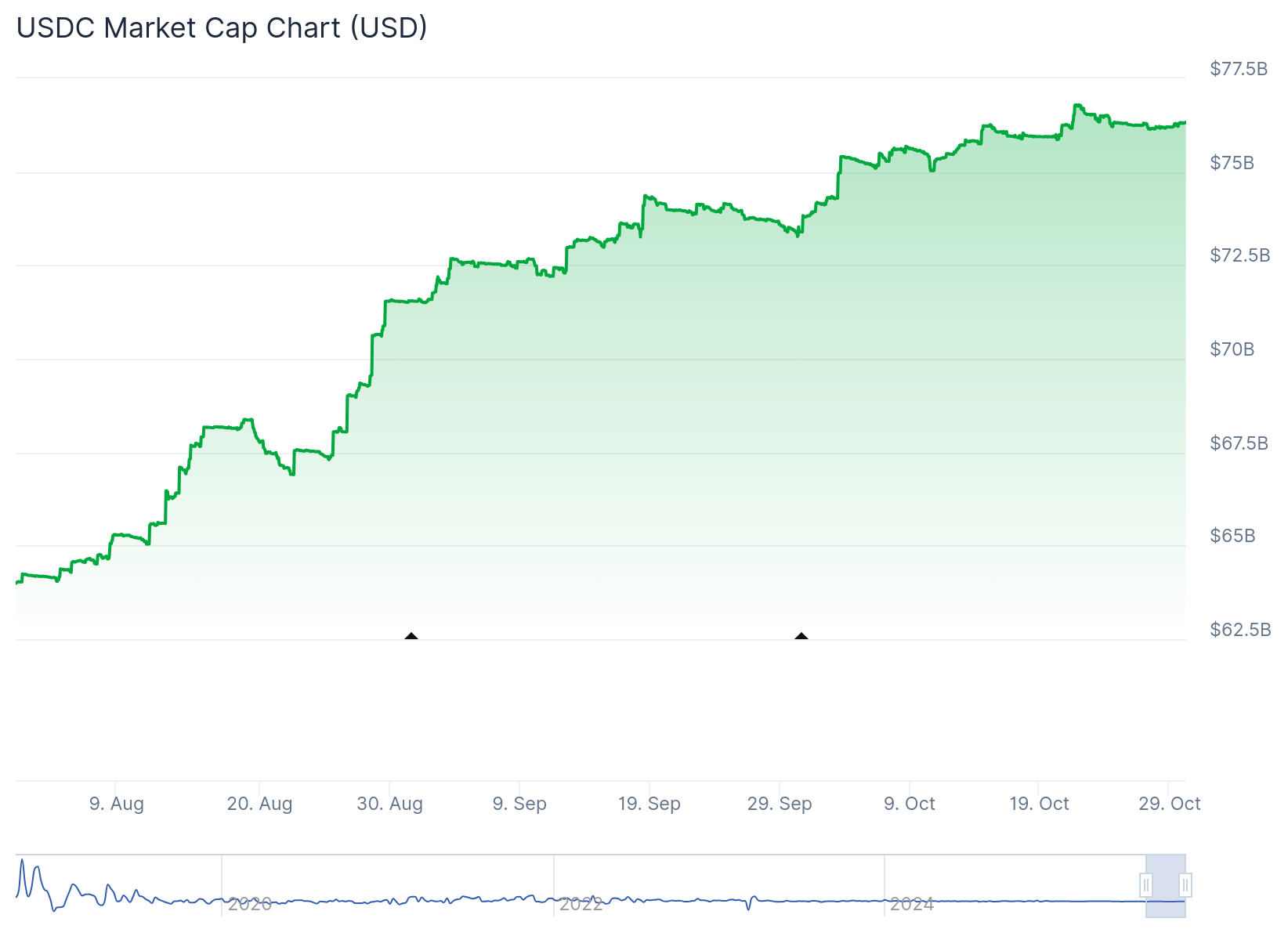
USDT vs USDC: Head-to-Head Comparison
Adoption
With over a decade in circulation, USDT has achieved far greater adoption worldwide. It remains the dominant stablecoin in trading pairs and global liquidity, particularly in emerging markets. Winner: USDT
Transparency
Tether has historically struggled with transparency, though it now publishes quarterly attestations. By contrast, USDC provides monthly reports with independent verification, giving it the edge for investors who value oversight and regulatory clarity. Winner: USDC
Regulatory Compliance
Circle and Coinbase designed USDC with U.S. and international regulations in mind. USDC reserves are kept in regulated banks and Treasuries, and Circle is registered as a money transmitter in multiple jurisdictions. Tether claims compliance but lacks comparable transparency. Winner: USDC
Price Stability
Both USDT and USDC are pegged 1:1 to the U.S. dollar. While they occasionally experience small deviations, both have shown resilience and quickly return to their peg. Winner: Tie
Redemption Process
Redeeming USDT directly requires a minimum of 100,000 USDT plus fees, which makes it impractical for small investors. USDC allows redemptions starting at just $100, giving it an accessibility advantage. Winner: USDC
Incidents
Both stablecoins have faced brief de-pegging events. USDT dipped below $0.95 during market stress in 2022, while USDC fell to around $0.87 during the Silicon Valley Bank crisis. In both cases, prices stabilized quickly. Winner: Tie
Longevity
Tether has been around since 2014, giving it a proven track record and first-mover advantage. Winner: USDT
Which Stablecoin Should You Choose?
Due to the fact that these respective companies are holding the dollar-equivalent value in reserves, these two digital currencies are considered to be centralized, while the rest of the cryptocurrency market holds a decentralized nature. As the demand for digital currencies increases, it is likely that these two stablecoins will only continue to grow.
When looking for a stablecoin, these are two most recognised options. Choosing between USDT and USDC depends on what you value most as an investor or user.
- If you need deep liquidity, global adoption, and access across more blockchains, USDT remains the go-to option. Its size and reach are unmatched, making it the default stablecoin for many traders.
- If you prioritize regulatory compliance, transparency, and a lower barrier for redemptions, USDC is the safer bet. It continues to build trust among institutions and investors who want accountability.
Ultimately, both stablecoins play vital roles in today’s crypto ecosystem. Some traders even use a combination of USDT and USDC to balance adoption with transparency, hedging against risks specific to either coin.
Users can both buy and sell USDT and USDC directly through the Tap app. Simply create your account, complete the KYC process and deposit funds into your digital wallet. Manage your entire crypto (and fiat) portfolio from one convenient, secure location.

Secure your cryptocurrencies with the right wallet! Discover the different types of crypto wallets and find out which one is the best fit for you.
Crypto wallets are a critical tool for anyone looking to use, store, and manage crypto assets. Crypto wallets come in various forms, with different features and security options that cater to the needs of different users. Finding the right crypto wallet is essential if you want to get the most out of your cryptocurrency holdings.
No matter what type of crypto wallet you choose, it’s important to do your research before making a decision since each one comes with its own set of advantages and disadvantages. It’s also important that you keep your private keys safe so no one else can access them, this will ensure that only you have control over your funds and crypto assets.
What is a crypto a wallet?
A crypto wallet is a digital wallet that stores manages and facilitates the use of various cryptocurrencies. In order to store and use crypto assets, one needs a digital wallet. Unlike traditional wallets that simply hold your cash or cards, crypto wallets facilitate transactions as well as store your funds.
Each crypto wallet has a public and private key which are unique alphanumeric codes that grant the user access to the funds. Public keys are wallet addresses to which other users can send you cryptocurrencies, similar to your bank account number, while private keys are akin to a pin number and should not be shared with anyone.
In essence, crypto wallets act as secure interfaces for users to access, store and transfer funds across different blockchain networks. In essence, it’s like a bank account for digital currencies.
The different types of crypto wallets
Crypto wallets can be divided into two main categories: hot wallets and cold wallets.
Internet connectivity is the defining factor between hot wallets and cold wallets. Hot wallets are connected to the internet, making them less secure but much more user-friendly. On the other hand, cold wallets are stored completely offline and do not require any internet connection. This provides a higher level of security, which makes them ideal for individuals who plan on storing their crypto assets long-term.
Each of these categories can be further broken down into varying wallets. Under the hot wallets umbrella, there are desktop wallets, mobile wallets, and web wallets, while under the cold wallets umbrella, there are hardware and paper wallets.
Hot wallets
As a hot wallet is easy to set up and constantly connected to the internet they are ideal for users looking to make daily or frequent transactions. Typically with hot wallets, funds are quickly accessible and they tend to be very straightforward to operate. Below we look at the three main types of hot wallets: desktop wallets, mobile wallets, and web wallets.
Desktop wallet
A desktop wallet is a cryptocurrency storage solution that allows users to store, send, and receive crypto assets from their personal computers with the crypto wallet stored on the device’s hard drive.
It is generally considered to be a secure way of managing crypto assets as it does not require the user to store their funds on an exchange, instead giving control over the private keys associated with the hot wallet to the user.
The downside however is that it may be vulnerable to computer viruses should someone gain access to your desktop.
Mobile wallet
Mobile wallets are digital crypto wallets that allow users to manage their cryptocurrencies directly on their mobile devices. These crypto wallets are very convenient and secure compared to carrying large amounts of money around or keeping it in a traditional bank account.
Mobile wallets provide users instant access with more control over their funds and are particularly useful for quick payments that require a scan of a QR code. When downloading this type of hot wallet ensure that you use a link from the website directly to ensure that you are not falling for a fake wallet. This goes for all hot wallets and cold wallets listed here.
Mobile wallets are typically the best crypto wallets for users actively using or spending their crypto assets. If you are choosing this option you might want to consider Tap for its convenience, security and ease of use.
Web wallet
Web wallets are hosted by third-party services, which act as custodians for users' private keys. Web wallets provide an easy way to manage digital currencies, allowing users to quickly send and receive payments without having to download or install any software.
Additionally, web wallets offer enhanced security features such as two-factor authentication and multi-signature transactions. With these features in place, web wallets can provide a secure environment for storing cryptocurrencies regardless of the user's level of technical expertise, an added bonus for hot wallets.
Cold wallets
Cold wallets are hack resistant and therefore are considered the best crypto wallets for hodlers. In order to facilitate trades, cold wallets need to connect to the internet in order to trade directly from their cold storage devices.
Hardware wallet
Hardware wallets store private keys on a physical device like a USB drive or an external hard drive. A common example of this is the Ledger Nano X, while secure it retails for roughly $150.
These crypto wallets provide maximum security but require more effort to set up and use compared to other types of crypto wallets. They typically are also more expensive as one needs to buy a physical device.
Paper wallet
Finally, paper wallets are simply printed copies of public/private key pairs which allow you to securely store funds offline without having any digital device at all. While these are considered to be the best crypto wallets in terms of security, if the paper gets damaged then the funds are lost.
Finding the right crypto wallet for you
In order to find the right crypto wallet you will need to establish what specifically you wish to do with your funds. If you are looking to hold them long-term, cold wallets are by far the more secure solution, however, if you are making payments and using cryptocurrencies in your day-to-day life, a hot wallet or even a mobile wallet might be better suited to your needs.
Many crypto users utilize a combination of two or three, using the more secure crypto wallet option to hold their funds long-term while also having a portion of funds in a preferred hot wallet allowing them quick and easy access to their funds when they need them.

Discover the meaning of volatility, its measurement methods, and its implications. Empower yourself to make informed choices in an ever-changing market.
In a world where markets fluctuate and investments rise and fall, understanding market volatility is key to making informed choices. Whether you're a novice investor, an aspiring trader, or simply curious about the financial landscape, this article will empower you with a concise explanation of volatility. By the end, you'll be equipped with the knowledge to navigate through uncertain times and seize opportunities when they arise.
What is volatility?
In the dynamic world of finance and investing, volatility stands as a powerful force that can influence markets and impact investment outcomes. But what exactly is volatility? At its core, volatility is a statistical measure of variation or fluctuation in the value of an asset or market index over a specific period. It paints a picture of the price fluctuations of the financial instrument, showcasing the twists and turns it experiences along the way.
Understanding volatility is crucial for anyone seeking to make informed choices in the financial realm. By comprehending this concept, you gain the ability to navigate through uncertain times and seize opportunities when they arise. Volatility is not just about random price movements, it carries meaning, insights, and opportunities for those who can decipher its patterns.
Measuring volatility involves a range of calculation methods, with volatility indicators like standard deviation and Bollinger Bands providing valuable insights. These measurements help quantify the speed and magnitude of price changes, giving investors and traders a clearer picture of an asset's behavior.
What drives volatility?
Economic indicators, market conditions, and even investor sentiment play significant roles in shaping volatility levels. Understanding these factors can help you anticipate and interpret market movements, empowering you to make more informed decisions about any financial instrument.
It is important to note that volatility is not something to fear. Instead, it is an essential element of any market that offers opportunities for growth and profit. By embracing volatility and equipping yourself with the knowledge to navigate its ebbs and flows, you can embark on a journey that leads to greater financial empowerment and success.
How to measure volatility
When it comes to calculating volatility, there are several calculation methods that provide insights into the degree of price fluctuation and market dynamics. Let's explore three commonly used volatility measures: standard deviation, Bollinger bands and average true range.
Standard deviation
Standard deviation is a widely used statistical tool for measuring volatility. It quantifies the variability of an asset's returns from its average market price. A greater standard deviation indicates high volatility. By calculating the standard deviation of historical price data, investors and analysts can assess the asset's typical price movements and potential risk.
This measurement helps provide a statistical framework for understanding volatility patterns and making informed decisions.
Bollinger bands
Bollinger bands are another popular tool for measuring volatility. They consist of three lines plotted on a price chart. The middle line represents a moving average, while the upper and lower lines depict bands that are typically two standard deviations away from the average price.
The width of the bands expands and contracts based on the asset's price volatility. Narrower bands suggest low volatility, while wider bands indicate high volatility. Traders often use Bollinger bands to identify potential price breakouts or reversals, making it a practical tool for short-term trading strategies.
Average True Range (ATR)
The Average true range is a volatility indicator that measures the average trading range of a financial asset over a given period. It takes into account the asset's daily highs and lows, capturing the true extent of price movement. A higher ATR suggests higher volatility, while a lower ATR indicates lower volatility.
The ATR helps investors and traders gauge the potential range of price trends and set appropriate stop-loss levels or profit targets. It can be particularly useful for determining position sizes and managing risk in various trading strategies.
These three measurements provide valuable insights into volatility, allowing market participants to assess risk, identify opportunities, and make informed decisions. By incorporating these tools into their analysis, individuals can navigate the ever-changing market landscape with greater confidence and precision.
Three main factors affecting market volatility
Volatility in financial markets is influenced by a multitude of factors, ranging from economic indicators to market conditions and investor sentiment. Understanding these factors is crucial for comprehending the drivers behind volatility and making informed decisions on how to trade volatility. Let's explore three key factors that can affect volatility:
Economic indicators
Economic indicators, such as GDP growth, inflation rates, interest rates, and employment figures, have a significant impact on market volatility. Positive economic data can boost investor confidence and lead to periods of low volatility, while negative or unexpected data can create uncertainty and increase volatility. Traders and investors closely monitor these indicators to gauge the health of the economy and anticipate potential market movements.
Market conditions
Market conditions, including geopolitical events, industry trends, and regulatory changes, can greatly influence stock prices and therefore volatility. Geopolitical tensions, such as trade disputes or political instability, can create uncertainty and volatility in global markets. Similarly, changes in industry dynamics, technological advancements, or shifts in consumer behavior can disrupt established market patterns, leading to increased volatility.
Investor sentiment
The collective sentiment and behavior of market participants play a significant role in driving volatility. Investor optimism or pessimism can lead to exaggerated price movements and heightened volatility. Factors such as market psychology, fear, and greed can influence how investors interpret and respond to market information. Understanding and monitoring investor sentiment can provide insights into potential market shifts and the overall level of volatility.
It's important to note that these factors interact with one another, creating a complex web of influences on volatility. Keeping a close eye on economic indicators, staying informed about market conditions, and gauging investor sentiment can help individuals navigate volatile markets and make empowered decisions.
By recognizing and analyzing these factors, investors and traders can better understand the underlying forces driving volatility and position themselves for success.
Types of volatility
There are two primary types of volatility: historical and implied.
Historical volatility
Historical volatility, a reflection of an asset's past price movements, plays a vital role in understanding an investment's risk and potential reward. By examining an asset's historical price data over a specific period, investors can gain valuable insights into its typical fluctuations.
This knowledge empowers them to assess the level of risk associated with the investment at hand. Higher historical volatility signals a greater likelihood of significant price swings, while lower historical volatility indicates more stable price behavior. Armed with an understanding of an asset's historical volatility, investors can make informed decisions, effectively manage risk, and devise appropriate investment strategies tailored to their risk tolerance and goals.
Implied volatility
A powerful concept derived from options pricing, implied volatility measures the market's collective expectations regarding future price movements of the underlying asset. It serves as a measure of perceived uncertainty surrounding the underlying asset's future performance.
By examining implied volatility, investors can gauge the market participants' outlook and sentiment, providing valuable insights into potential price movements. Higher implied volatility suggests increased anticipated price fluctuations, while lower implied volatility signifies a more subdued market outlook.
Understanding implied volatility equips investors with a deeper understanding of market sentiment, enabling them to make more informed decisions and adjust their strategies accordingly to capitalize on opportunities in the market.
Understanding both historical and implied volatility allows traders to develop effective strategies in different market conditions.
What volatility means for trading vs investing in the stock market
Volatility plays a distinct role for traders and investors in the stock market. For investors, volatility represents risk and the potential for higher returns. They must carefully assess their risk tolerance and investment horizon when navigating through volatile markets. Long-term investors often view volatility as an opportunity to buy assets at discounted prices, confident that the market will eventually stabilize and provide favorable returns over time.
Traders, on the other hand, embrace volatile assets as they present short-term opportunities for gains. They capitalize on rapid price movements by executing timely buy and sell orders, aiming to profit from the volatility itself. Traders employ various strategies, such as momentum trading or breakout trading, to take advantage of price swings that occur during volatile market conditions.
Businesses also feel the impact of volatility as they plan budgets, manage supply chains, and make strategic decisions. Fluctuating prices and uncertain market conditions can significantly impact profitability and operational stability. Businesses must develop contingency plans and risk management strategies to navigate through periods of heightened volatility.
In summary, while volatile assets carry risk, they also offer opportunities. Understanding the implications of volatility is vital for all stakeholders involved in the stock market, allowing them to make informed decisions and navigate through dynamic market conditions.
Tips on how to manage volatility in markets
Managing volatility in the financial markets can be a daunting task, but there are strategies that can help individuals navigate uncertain times and mitigate risks. Here are some tips for managing volatility:
Diversify your portfolio
One of the fundamental principles of managing volatility is diversification. By spreading your investments across different asset classes, sectors, and geographic regions, you can reduce the impact of volatility on your portfolio. Diversification helps to ensure that if one investment performs poorly, others may offset the losses, providing a more balanced approach to risk management.
Set realistic expectations
Volatility is an inherent characteristic of the markets, and it's essential to set realistic expectations. Avoid chasing short-term gains or trying to time the market during volatile periods. Instead, focus on long-term goals and develop a disciplined investment strategy that aligns with your risk tolerance and financial objectives.
Maintain adequate liquidity
Having sufficient liquidity is crucial during periods of volatility. It provides the flexibility to take advantage of opportunities that may arise and helps you weather market downturns without having to make hasty or unplanned investment decisions. Keeping a portion of your portfolio in cash or highly liquid assets can provide a buffer and peace of mind.
Stay informed and educated
Knowledge is power when it comes to managing volatility. Stay informed about market trends, economic indicators, and global events that can impact the financial markets. Continuously educate yourself about investment strategies, risk management techniques, and asset allocation. By staying informed, you can make more informed decisions and react appropriately to changing market conditions.
Maintain a long-term perspective
Volatility can tempt investors to make impulsive decisions based on short-term fluctuations. However, maintaining a long-term perspective is vital for success. Understand that markets go through cycles, and volatility is often temporary. Stick to your investment plan, avoid emotional reactions, and focus on the underlying fundamentals of your investments.
Consider risk management techniques
In addition to diversification, consider risk management techniques such as setting stop-loss orders, using trailing stops, or implementing hedging strategies. These tools can help protect against sudden market downturns and limit potential losses.
Remember, managing volatility is about accepting that it's a natural part of investing. By following these tips and maintaining a disciplined approach, you can navigate through volatile periods with more confidence, make informed decisions, and potentially seize opportunities that arise.
Volatility across different markets
Volatility is not limited to the financial world; it pervades various industries, each with its own unique dynamics. In the realm of finance, stock markets are particularly prone to volatility. Factors such as company earnings, economic indicators, and investor sentiment can drive rapid price fluctuations. Understanding these drivers and monitoring market trends can help investors adjust their strategies and make well-informed decisions to navigate through volatile stock markets.
Cryptocurrencies have gained significant attention due to their unprecedented volatility. The prices of cryptocurrencies can surge or plummet within a matter of hours or even minutes. Factors such as regulatory developments, technological advancements, and market speculation can trigger intense price swings. Individuals investing or trading in cryptocurrencies need to be prepared for this inherent volatility and develop strategies that account for the unique characteristics of this asset class.
Commodity markets, encompassing resources such as oil, gold, and agricultural products, also experience considerable volatility. Supply and demand dynamics, geopolitical factors, and natural disasters can all contribute to price fluctuations. Traders and businesses operating in these markets must stay attuned to global events and industry-specific factors to manage risks effectively and capitalize on potential opportunities arising from volatile commodity prices.
By recognizing the varying indications of volatility in different fields, investors, traders, and businesses can adapt their strategies and decision-making processes accordingly. This understanding allows for the development of sector-specific expertise and the implementation of risk management techniques tailored to the particular industry's volatility.
Always remember that navigating volatility in these specific fields requires vigilance, adaptability, and a deep understanding of the unique factors at play.
In conclusion
Volatility, in its simplest form, refers to the degree of variation or fluctuation in the price or value of an asset. It measures the speed and magnitude of price changes over a given period. It is an inherent aspect of financial markets, but it doesn't have to be a barrier to success. By comprehending the concept of volatility, understanding its measurement methods, and recognizing the factors that drive it, you can make informed choices.
Empowered with this knowledge, you can navigate through uncertainty, capitalize on opportunities, and weather the storm when markets become turbulent. Remember, volatility is not negative, it's a dynamic force that, when harnessed wisely, can lead to rewarding outcomes.
News and updates
Bitcoin December Outlook: Will BTC Deliver a Holiday Rally Before 2026?
Bitcoin rebounded and now sits at a crossroads. Discover what whale accumulation, macro developments, and key technical levels signal for the end of 2025.
Bitcoin's Comeback: Three Forces That Could Make or Break it
Bitcoin is a long way from reclaiming its all-time high and stuck under $92,000, but three powerful forces could flip the script sooner than you think.
The Surge After the Storm: What’s Next for Bitcoin and the Market
After a brutal October sell-off, crypto just staged one of its most dramatic comebacks yet. Here's what the market's resilience signals for what comes next.

Decoding the disconnect: America's cautious approach to crypto
Bitcoin and the broader crypto market have soared to a staggering $2.1 trillion in value, but why does skepticism still linger among so many Americans? Here is a deep dive into the current trust gap.