
Learning the friendly way
Dive into our resources, guides, and articles for all things money-related. Grow your financial confidence with our experts curated tips and articles for both experienced and new investors.
LATEST ARTICLEs

Stocks are essentially shares in a company that the company sells to shareholders in order to raise money. Shareholders are then entitled to dividends if the company succeeds, and might also receive voting rights when the company makes big decisions (depending on the company).
When you invest in stocks, you’re putting your money to work so it can potentially increase in value over time and generate capital gains, dividends, and long-term financial independence. Instead of letting inflation quietly reduce your spending power, investing allows you to build a portfolio that supports your future goals like retirement planning, buying a home, or increasing passive income.
By the end of this guide, you’ll understand how stocks work and how to start investing confidently and responsibly.
What Are Stocks?
A stock is a unit of ownership in a public company; when you purchase shares, you become a shareholder. Companies issue stock to raise capital to fund development, hiring, and expansion. If the company performs well, the share price can rise, allowing investors to sell at a profit. Some companies also pay dividends, which are regular payments from company earnings.
If you buy a share at $100, for instance, and the price grows to $120, you earn $20 plus a dividend.
Stocks play an important role in the global economy, assisting both companies (in raising capital) and individuals (in potentially earning returns). Traders can buy and sell stocks through stock trades facilitated by various stock exchanges. The stock price is determined by supply and demand, largely influenced by the company's success and media representation.
These "units of ownership" are sold through exchanges, like Nasdaq or the London Stock Exchange, under the guidance of regulatory bodies, such as the Securities and Exchange Commission (SEC) in the United States. These regulatory bodies set specific regulations on how companies can distribute and manage their stocks.
What Are the Different Types of Stocks?
There are two types of stocks, common stocks and preferred stocks, as outlined below.
Common Stock
Shareholders of common stock typically have voting rights, where each shareholder has one vote per share. This might grant them access to attending annual general meetings and being able to vote on corporate issues like electing people to the board, stock splits, or general company strategy.
Preferred Stock
For investors more interested in stability and receiving regular payments rather than voting on corporate issues, preferred stocks are often the security of choice. Preferred stock are shares that provide dividends but without the voting rights. Like bonds, there are a number of features that make them attractive investments. For example, many companies include clauses allowing them to repurchase shares at an agreed-upon price.
Stock vs Bond
Although both stocks and bonds signify an investment, they vary in how they operate. With bonds, you're essentially lending money to the government or a company and collecting interest as a return while with stocks you're buying part-ownership of a company. Another key difference is that bondholders usually have more protection than stockholders do.
In contrast to stocks, bonds are not normally traded on an exchange, but rather over the counter (the investor has to deal straight with the issuing company, government, or other entity).
Stocks vs Futures vs Options
Futures and Options contrast stocks in that they are derivatives; their value is reliant on other assets like commodities, shares, currencies, and so on. They are contracts established off the volatility of underlying assets instead of ownership of the asset itself.
Stocks vs Cryptocurrencies
While stocks provide a unit of ownership in a company, cryptocurrencies are digital assets that operate on their own network. Cryptocurrencies are decentralized, meaning that no one entity is in charge, while stocks are shares in companies that are heavily centralized and held accountable for their price movements. Both the stock price and the price of cryptocurrencies are determined by supply and demand.
Another key difference is that stocks are regulated while, at present, cryptocurrencies are not.
Where Did Stock Trading Originate?
The first recorded instance of stock-like instruments being used was by the Romans as a way to involve their citizens in public works. Businesses contracted by the state would sell an instrument similar to a share to raise money for different ventures. This method was called 'lease holding.'
The 1600s gave rise to the East India Company (EIC), which is considered by many the first joint-stock company in history. The EIC increased its notoriety by trading various commodities in the Indian Ocean region. Today, we see the limited liability company (LLC) as a watered-down version of the joint-stock company.
How Does the Stock Market Work?
The 'stock market’ is an umbrella term that refers to the various exchanges where stocks in public companies are bought, sold, and traded.
The stock market is composed of similar yet different investment opportunities that allow investors to buy and sell stocks, these are called "stock exchanges." The best-known exchanges in the United States are the New York Stock Exchange (NYSE), Nasdaq, Better Alternative Trading System (BATS), and the Chicago Board Options Exchange (CBOE).
Together, these organizations form what we call the U.S. stock market. Other financial instruments like commodities, bonds, derivatives, and currencies are also traded on the stock market.
Example: The New York Stock Exchange
The New York Stock Exchange (NYSE) is the largest equity exchange in the world, and it has a long and rich history. Established in 1792, it was originally known as the "Buttonwood Agreement" between 24 stockbrokers who gathered at 68 Wall Street to sign an agreement that called for the trading of securities in an organized manner.
Since then, the NYSE has become a global leader in financial markets, with more than 2,400 companies listed and nearly $26.2 trillion in market capitalization. The exchange has an average daily trade volume of $123 billion.
Investing in common stock or preferred stock on the NYSE can be done through a broker or online stock trading platform. When trading on the NYSE, investors have access to a wide range of products and services, including stocks, bonds, mutual funds and ETFs (exchange-traded funds).
Investors can also take advantage of the numerous benefits that come with trading on the NYSE, such as access to real-time information and the ability to buy and sell quickly. The trading platform is regulated by the U.S. Securities and Exchange Commission (SEC).
How to Navigate Stock Market Volatility
Stock market volatility, characterized by rapid and unpredictable changes in stock prices, is influenced by economic indicators, geopolitical events, and investor sentiment. To manage this volatility, investors can diversify their portfolios, set clear investment goals, and maintain a long-term perspective.
Regular portfolio reviews and seeking guidance from financial advisors can also help when it comes to making informed decisions during volatile periods. Investors who stay informed about market trends and use strategic approaches can navigate market fluctuations more effectively, which better positions them for long-term success in stock investing.
The Importance of Diversification When Investing
Diversification is key when investing, and the stock market is no exception. The "don't put all your eggs in one basket" approach offers benefits like risk reduction and the potential for higher returns. Strategies for diversification include investing across different sectors, industries, and asset classes.
By spreading investments, investors can manage risk effectively, ensuring their portfolio isn't overly exposed to any single asset or market sector. This helps cushion against market downturns and enhances the overall stability of the investment portfolio.
Terms Associated with the Stock Market
Understanding the stock market means getting comfortable with its language. These terms form the foundation of how markets operate. Below are some of the most important concepts every investor should know:
- Broker: A broker is someone who buys and sells assets on behalf of another person, charging a commission for their services.
- Stockholders equity: The value of a company's stock can be better understood by this metric, which is the company's assets remaining after all bills are covered (liabilities).
- Stock splits: Conducting a stock split is one way that companies make their stocks more accessible to investors. Although it won't change the market capitalization or value of shares, it will increase the number available.
- Short selling: If an investor wants to bet on a stock's price going down, they can take a "short" position. To do this, they must borrow the stock from either a broker or a financial institution.
- Blue-chip stocks: Companies that are large and have a lot of capital typically fall into the blue-chip category. They usually trade on famous stock exchanges, like the NYSE or Nasdaq.
- Pink sheet stocks: 'Penny' or 'pink-sheet' stocks are those that trade below the $5 threshold and are typically OTC (over the counter). These can be high risk.
- Buying on margin: Buying on margin is using borrowed money to buy stocks, bonds, or other investments in the hopes of making big returns and paying off the loan.
- Market order: When placing an order for a trade, the investor needs to pick from several types of orders. A market order is executed at whatever the next price is, which can be risky if there's a big gap between what buyers and sellers are offering.
- Limit order: A limit order is an order to buy or sell a security at a specified price, with a maximum amount decided on before executing the trade.
- Stop order: A stop order, also referred to as a stop-loss order, is an order placed with a broker to buy or sell once the stock reaches a predetermined price.
Bottom Line
Stocks represent partial ownership in a company and offer the potential to grow your wealth through rising share prices and dividends. They’re a core building block of long-term investing and a tool for reaching financial goals like retirement, major purchases, or building passive income. While prices can rise and fall in the short term, a smart strategy focused on diversification and patience can help investors benefit from the market’s growth over time. Start small, learn as you go, and allow your investment to work for you.

When Satoshi Nakamoto created Bitcoin, he designed it in such a way that should the value increase dramatically, there would still be an inclusive decimal value for the masses. Satoshis could one day be how we buy a cup of coffee anywhere in the world, using the same currency from Britain to Japan.
How Many Satoshis Are in One Bitcoin?
Often shortened to SAT, Satoshi is the smallest unit of Bitcoin, the world’s first and most popular cryptocurrency. Just like the U.S. dollar divides into cents, Bitcoin divides into Satoshis, but on a much finer scale. One Bitcoin equals 100,000,000 Satoshis (0.00000001 BTC).
This structure ensures that Bitcoin remains usable for everyday financial transactions, even as its market value rises. Whether someone is investing a few dollars or buying a cup of coffee, the Bitcoin network allows precise division and ownership down to a single Satoshi, making the digital currency accessible to everyone.
Why Satoshis Matter
Bitcoin’s price often exceeds tens of thousands of U.S. dollars, creating a psychological barrier for newcomers who assume they must buy an entire coin. Satoshis remove that barrier by enabling fractional ownership.
This level of accessibility supports financial inclusion, allowing individuals from all backgrounds (including those in developing markets) to participate in the cryptocurrency economy.
From micropayments to online services, Satoshis make purchasing small products, tipping creators possible, etc. As adoption grows, the ability to transact in Satoshis could become a standard part of personal finance and global economic development.
How to Convert Satoshis
Because 1 BTC = 100,000,000 SATs, converting between the two is very simple math:
Satoshis = Bitcoin × 100,000,000
Bitcoin = Satoshis ÷ 100,000,000
For instance, if Bitcoin trades at $60,000, then:
- 1 SAT = $0.0006
- 10,000 SATs = $6
- 100,000 SATs = $60
To simplify conversions, users can access Satoshi calculators or adjust display preferences within their cryptocurrency wallet or favorite platform. Many platforms also allow price displays in SATs to improve user experience and accuracy.
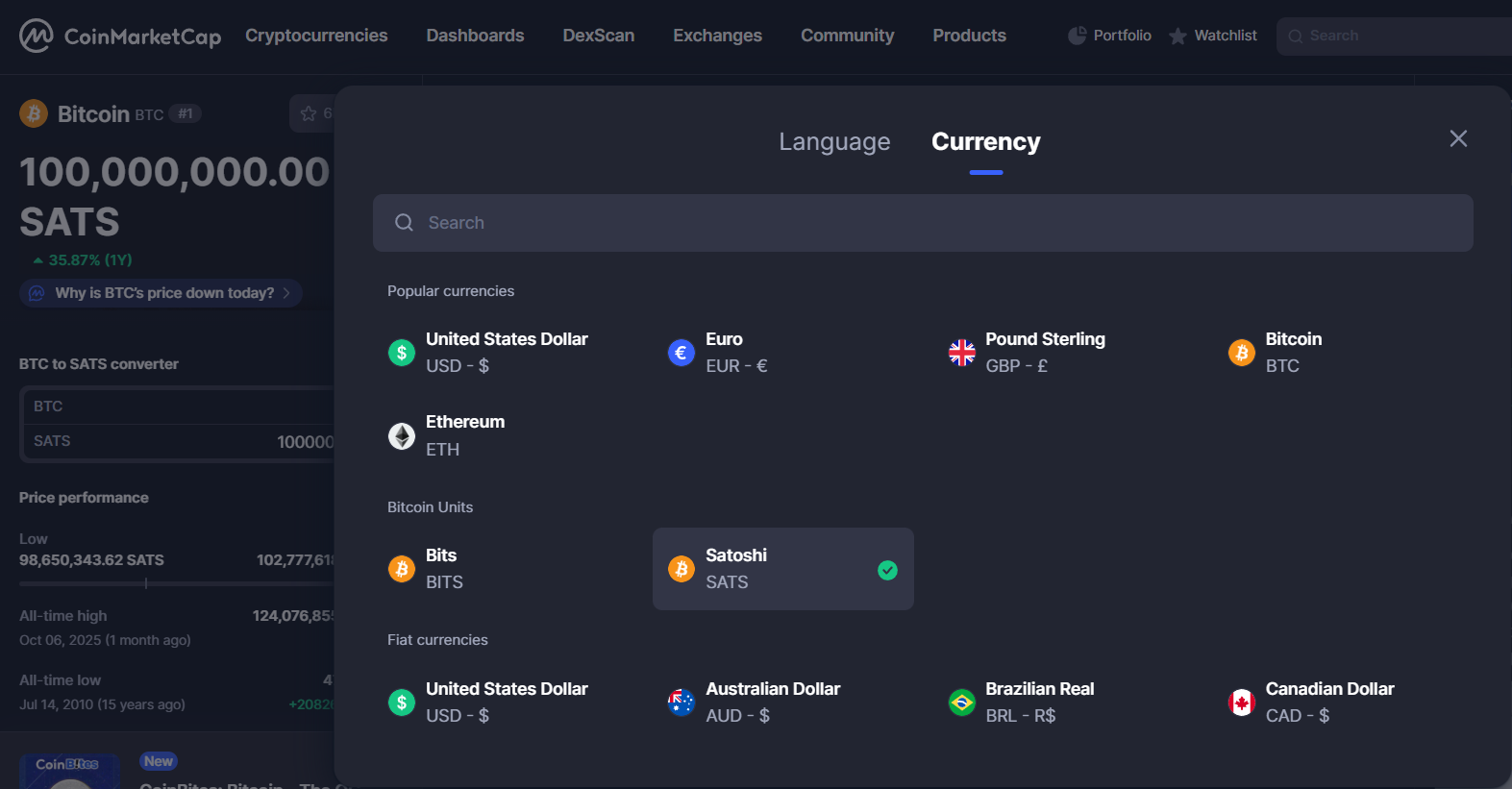
For instance, on CoinMarketCap, you can change the default currency to SATs by selecting the currency drop down option in the top right-hand corner. Select the Satoshi option under Bitcoin units. This will then display all values as Satoshis.
The History Behind the Name
The name “Satoshi” honors Satoshi Nakamoto, the mysterious programmer who invented Bitcoin and published its white paper in 2008.
The term was first proposed in 2010 on the BitcoinTalk forum by a user named Ribuck, who suggested defining a smaller Bitcoin unit for microtransactions. The community endorsed it, and “Satoshi” became the standard reference for Bitcoin’s smallest fraction.
This naming not only pays tribute to Bitcoin’s anonymous creator but also reflects the peer-to-peer and community-driven nature of the blockchain project.
Bitcoin Unit Hierarchy Explained
Bitcoin can be divided into several measurement units, which make it easier to display or calculate different values depending on trade size or market purpose:
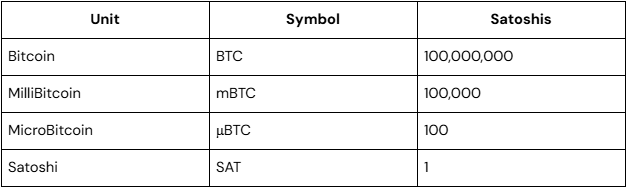
Users can choose their preferred unit in most cryptocurrency wallets or mobile apps, which helps reduce confusion when managing balances. This hierarchical structure is part of Bitcoin’s software design, ensuring precision, scalability, and transparency across every financial service or exchange that integrates it.
Real-World Applications of Satoshis
The use of Satoshis extends far beyond calculations. They play a vital role in everyday transactions and digital finance. Examples include:
- Micropayments. Paying for an article, video, or song online using fractions of Bitcoin.
- Remittances. Sending money across borders with minimal fees and no intermediary banks.
- Retail payments. Buying coffee, subscriptions, or services priced in SATs.
- Mining rewards. Bitcoin miners earn Satoshis as rewards for validating blocks on the blockchain.
- Lightning Network transactions. Enables instant, low-cost peer-to-peer payments denominated in milli- or micro-Satoshis.
These use cases show us how cryptocurrency adoption supports faster, cheaper, and more inclusive financial transactions, which helps bridge gaps between traditional fiat money and the digital economy. Satoshis make it easier to represent these small, day-to-day amounts.
Satoshis vs Other Cryptocurrency Units
Other blockchains have their own smallest units. For example, Ethereum uses the Wei, where 1 ETH = 1,000,000,000,000,000,000 Wei (18 decimal places). While Ethereum’s extreme divisibility helps with DeFi and smart contract operations, Bitcoin’s 8-decimal precision balances usability and simplicity. The Satoshi system keeps values easy to calculate, supports market liquidity, and provides enough granularity for future adoption.
This approach makes Bitcoin user-friendly, maintaining accuracy and precision in every financial transaction without overwhelming users with excessive mathematical complexity.
Considerations
Despite its simplicity, using the Satoshi unit can bring some hurdles too:
- Many newcomers are unfamiliar with terms like “Satoshi” or how to interpret BTC in fractional units.
- Since Bitcoin’s price fluctuates, the value of a Satoshi changes constantly, affecting everyday purchasing power.
- Not all wallets and exchanges display Satoshis by default, creating potential confusion for the end user.
- While some companies and fintech platforms already support SAT-based payments, widespread retail exposure is still limited.
Overcoming these hurdles will require better user experience design, educational content, and standardized software development practices across the industry.
The Future of Satoshis
As Bitcoin adoption expands, Satoshis may play an even bigger role in daily finance. With the Lightning Network, users can already transact in milli-satoshis, enabling high-speed, low-cost microtransactions far below one SAT.
In the long term, Bitcoin’s fractional-reserve capabilities and tokenization could make it a backbone for financial services, virtual payments, and cross-border trade. For emerging economies, Satoshis could represent economic empowerment, offering a stable, global currency that anyone around the world can use.
In short, Satoshis are not just a mathematical fraction. They are the mathematical foundation of a global peer-to-peer financial system that continues to evolve.
Key Takeaways
- 1 Satoshi = 0.00000001 Bitcoin
- Enables fractional ownership and global accessibility
- Named after Satoshi Nakamoto, Bitcoin’s anonymous creator
- Used for microtransactions, payments, and mining rewards
- Essential for the future of financial inclusion and digital payments
Getting Started: How to Buy and Use Satoshis
You can acquire the exact amount of Satoshis you're looking for through the Tap app, making it easy to begin your journey into the exciting world of Bitcoin.

You’ve probably heard whispers about the "whales" swimming in the crypto seas. But these aren’t your typical marine mammals. They’re the ultra-wealthy folks and organizations holding massive amounts of digital currency.
What Exactly is a Crypto Whale?
So, what makes someone a crypto whale? There’s no hard-and-fast rule, but it generally comes down to owning a huge chunk of a coin’s total supply. If we’re talking over 10% of the available coins for a particular cryptocurrency, then that’s an ocean-sized wallet!
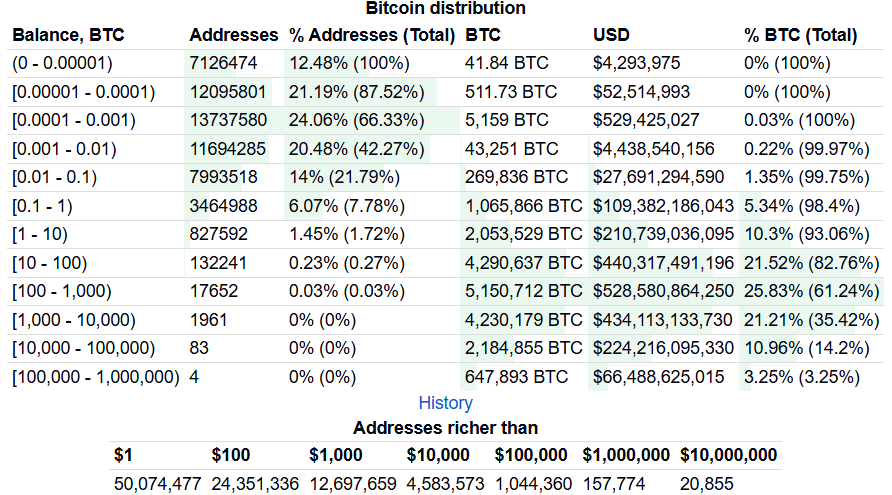
Take Bitcoin, for example. In October 2025, the wealthiest addresses controlled over 14% of all Bitcoin in existence. From Satoshi Nakamoto himself to MicroStrategy. Now that’s some serious whale power!
Bitcoin isn’t the only one with its share of whales. Dogecoin, the beloved meme coin, had a pretty wild concentration too. In 2025, just 3 addresses held over 32% of its total supply. Even Vitalik Buterin, the mastermind behind Ethereum, is considered an Ether whale thanks to his massive stake in the coin he created.
How Much Money Makes You a Crypto Whale?
The exact percentage threshold varies by cryptocurrency, but Bitcoin probably offers the clearest benchmark. Analysts typically define a Bitcoin whale as anyone holding over 1,000 BTC, worth around $100 million USD at recent 2025 market prices.
What About Other Assets?
- Whales usually hold 10,000 ETH or more.
- Generally, 500,000 SOL or more.
These thresholds aren’t clear-cut, and they shift as market value, liquidity, and overall supply and demand evolve. In simple terms, whales are the elite of the cryptocurrency market, capable of moving markets with a single transaction.
How Whales Make Waves
With that kind of buying power, whales can really make waves in the crypto marketplace. If a whale decides to sell off a giant chunk of their holdings, it creates a tidal wave of downward pressure on prices due to the sheer volume and lack of liquidity. Other crypto enthusiasts are always on the lookout for signs of an impending "whale dump," closely monitoring exchange inflows to spot potential dangers.
Here’s the twist, though – whales keeping their coins locked away actually reduces trading liquidity in the market since there are fewer coins actively circulating. Their massive idle fortunes are like icebergs weighing down the crypto ocean.
Tracking Whale Movements
Not every whale transaction is a sell-off. These giants could simply be migrating to new wallets, switching exchanges, or making monster-sized purchases. But you can bet experienced crypto folks keep a keen eye on those huge whale wallets, carefully tracking any ripples they make to navigate the ever-shifting tides of the market.
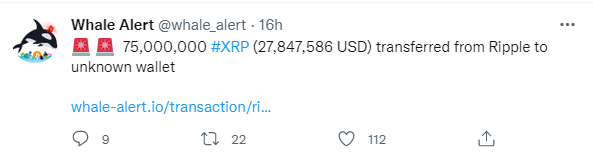
Whale Alert is a popular service that tracks these large transactions and reports them, often on Twitter. Whenever a whale makes a big move, it’s usually publicized quickly, giving everyone a heads-up on potential market changes.
Below is an example from Twitter from Whale Alert:
The Human Side of Whales
Behind these massive holdings are real people and organizations. Some whales are early adopters who bought into Bitcoin or other cryptocurrencies when they were cheap. Others are companies that have invested heavily in the belief that cryptocurrencies will continue to grow in value. For instance, Ethereum’s founder, Vitalik Buterin, is the biggest Ethereum whale because he holds a significant amount of the cryptocurrency he created.
How Whales Affect Crypto's Price
Price volatility can be increased by whales, particularly when they move a significant amount of one cryptocurrency in one go. For example, when an owner tries to sell their BTC for fiat currency, the lack of liquidity and enormous transaction size create downward pressure on Bitcoin's price. When whales sell, other investors become extremely vigilant, looking for hints of whether the whale is "dumping" their crypto (and whether they should do the same).
The exchange inflow mean, also known as the average amount of a certain cryptocurrency deposited into exchanges, is one of the most common indicators crypto investors look for. If the mean transaction volume rises above 2.0, it implies that whales are likely to start dumping if there are a large number of them using the exchange. This can be viewed by regular crypto traders as a time to act before losing any potential profit.
How Whales Affect Liquidity
When it comes to learning about whales and liquidity, one must remember that while whales are generally considered neutral elements in the industry, when a large number of whales hold a particular cryptocurrency, instead of using it, this reduces the liquidity in the market due to there being fewer coins available.
What Crypto Whales Mean to Investors
In terms of the relationship between whales and investors, one must remember that there are various situations in which a person may transfer their cryptocurrency holdings. It's worth mentioning that moving one's assets doesn't always indicate that you're selling them; they might be switching wallets or exchanges, or making a major purchase.
Occasionally, whales may sell portions of their holdings in discrete transactions over a longer period to avoid drawing attention to themselves or generating market anomalies that send the price up or down unpredictably. This is why investors keep an eye on known whale addresses to check for the number of transactions and value. This is not necessarily a task that newbie investors need to actively be involved with, however, understanding the terms and how whale accounts can affect the market is recommended.
Why Whales Matter
Whether you love them or hate them, whales are a formidable force in the crypto world, shaping its dynamics in profound ways. These giants, whether they’re creators, collectors, or traders, have a tremendous impact across the digital waters. When they make a move, it can trigger monumental swells that ripple through the entire market.
By understanding whale activity, anyone involved in cryptocurrency can better navigate these choppy waters. Staying informed about whale movements helps both newbies and seasoned traders make smarter decisions and stay afloat in this ever-changing space. Keep an eye on these behemoths; their actions can significantly influence your crypto journey.
While tracking whale activity can offer valuable insights into the cryptocurrency market, it's important to complement this knowledge with expert advice. Consulting with a financial advisor can help you navigate the complexities of investing and ensure your strategies align with your personal financial goals and risk tolerance.
In recent years, cryptocurrency, and therefore cryptocurrency exchanges, have firmly established themselves in the global financial market. As they become increasingly popular, many concerns have been raised over the regulation of these entities, and how they are preventing illicit monetary activity from taking place.
In an attempt to crack down on funds being illegally moved, exchanges are required to implement KYC (Know Your Customer) and AML (anti-money laundering) policies. Regulatory bodies are working to build legal frameworks for the industry, in an attempt to fight crime conducted using blockchain technology.
The biggest challenge for these regulatory bodies is to find a solution that doesn't hamper the innovative qualities of cryptocurrencies.
In the UK there is the Financial Conduct Authority, a financial regulatory body that operates outside of the UK government. In 2020, the FCA required every company participating in any crypto activity in the sector to comply with its Money Laundering, Terrorist Financing and Transfer of Funds (Information on the Payer) Regulations 2017 policy (the 'MLR's). This obligation requires crypto service providers to complete the necessary registration and infrastructural requirements.
What is AML in crypto?
AML stands for anti-money laundering and involves protocols that ensure that every transaction can be tied to an identity, thus providing greater transparency. This ensures that if any suspicious activity is flagged, the origins and/or destination of the funds can be confirmed on the platform.
Due to the anonymous, or more accurately pseudonymous, nature of cryptocurrencies, many believe that it provides an easy opportunity for ill actors to engage in money laundering. Money laundering is the act of changing large amounts of illicit income into a legitimate avenue, the money is "laundered" so as to appear clean.
While cryptocurrencies seemingly provide a perfect platform for money laundering due to the lack of central authority or third parties, AML processes are implemented on exchanges to stop this activity in its tracks.
What are the risks hindering AML practices?
The first risk that challenges AML practices is privacy coins, cryptocurrencies designed to conceal transactions and the relevant information attached to them. Platforms like Monero offer users the opportunity to send funds with no record of the transaction taking place.
The data associated with the transactions like the sender, receiver and amount sent are encrypted and often broken up when stored on the blockchain to ensure they are untraceable.
The second risk is coin join platforms that mix cryptocurrency transactions, hiding the origin and destination of the funds. These platforms essentially provide a service that can make ordinary cryptocurrencies anonymous.
While cryptocurrencies have their benefits, there are a number of challenges they pose to regulatory bodies, AML and CFT (Combating the Financing of Terrorism) intentions:
- The anonymity they can provide
- Opportunity for gaps when transacting cross-border transactions
- Absence of one central authority to ensure compliance
- The limited scope of identity verification processes
Differentiating between illicit activity and investors just wanting to safeguard their investments is a tricky business. Bad actors might make use of paper wallets to hide funds and keep them secret, while an investor might make use of a paper wallet in order to protect their funds against theft.
AML in crypto exchanges
Despite the challenges it faces, AML has proven to be valuable in cracking down on illegal activity conducted on crypto exchanges.
In July, $1.45 billion worth of illegal cross-border crypto transactions were traced back to 33 individuals on the South Korean exchange, Bithump. The platform quickly banned all foreign transactions, requiring a mobile KYC verification, and increased the KYC requirements so as to align with the country's AML regulations.
Bitcoin ATMs, a notorious option for mixing funds, have come together to form the Cryptocurrency Compliance Cooperative (CCC). This operation calls for cash-based cryptocurrency services, financial institutions, and regulators to participate in building universal compliance factors.
Does AML help or hinder the crypto market?
While AML tends to go against the decentralized nature of cryptocurrencies, the crypto community actively welcomes these regulatory efforts as it drives more trust and interest in the market on top of innovation and adoption. For example, an institution or retail investor is more likely to invest in a regulated asset than in a lawless, anything-goes market.
Anyone that has been watching the markets closely for the last several months will have noticed a definite chill in the air (not to mention a decline in their money). As the bears become more prominent, weak hands are losing faith and exiting the market. Why are we talking about a cryptocurrency winter now? Before we firmly declare this to be a crypto winter, let's explore the recent dips of the digital asset market and what previous crypto winters have detailed.
What is a cryptocurrency winter?
A cryptocurrency winter is a term used in the crypto market to describe a long term bear market. A bear market is classified as a declining market where shares have fallen below 20%. Investors typically call it a crypto winter when the markets have struggled to reclaim highs previously witnessed (usually right before the winter set in). Does that mean cryptocurrency investors should take out their snow shoes? Metaphorically, yes. And by snow shoes we mean thick skin and strong hands.
The recent market climate (five month period).
Since reaching its most recent all-time high, Bitcoin has dropped over 40%. After reaching highs of $68,789.63 in November 2021, Bitcoin has gone through a red-tainted slump reaching lows of $33,710 in late January and since recovering to just under the $40,000 mark.
Ethereum, the second-biggest cryptocurrency, has experienced a similar fate, dropping from highs of $4,891 in November 2021 to lows of $2,211 in late January. Ethereum has since corrected to the $2,800 region as it generates interest in its move to a Proof-of-Stake consensus.
It's no secret that the stock markets have suffered a similar fate in recent months, with seemingly only gold remaining unscathed. Experts have suggested in various articles that the uncertainty in global politics is playing a considerable role in the decline of various markets and businesses.
Buterin confirms a crypto winter
As touched on above, the current ongoing war between Russia & Ukraine has played a large role in driving investors' uncertainty as prices bounce through the highly volatile period. While we've seen an increase in trading volume, there have also been strong price swings.
This paired with the declining prices has led to a downfall in companies and traders entering the market, further fuelling the problem. This has become known in the industry as a crypto winter.
Ethereum founder, Vitalik Buterin, recently confirmed the case, although he also highlighted the positives, particularly for those on the development side. He pointed out that crypto winters offer a period of rejuvenation for the industry, allowing unsustainable projects to fall away.
"They welcome the bear market because when there are these long periods of prices moving up by huge amounts as it does - it does obviously make a lot of people happy - but it does also tend to invite a lot of very short-term speculative attention."
He added that it encompasses a "time when a lot of those applications fall away and you can see which projects are actually long-term sustainable, like both in their models and in their teams and their people." If one factors the development side of things in, we can bank on the industry coming out stronger after this period.
Unwrapping the previous crypto winter
The last crypto winter we experienced took place in 2018 after the highs of December 2017 (when Bitcoin almost reached $20,000). This bear market continued until mid-2019 before it started showing signs of recovery. It wasn't until Bitcoin defied the odds in 2020 and overcame the pandemic that it soared to higher heights, almost triple that of the previous all-time high.
While losing 40% of its value this season sounds rough, the previous crypto winter saw losses of 84%. As cryptocurrencies further emerge themselves into the mainstream financial markets, many believe it is only a matter of time before the prices enter the green again. Time also tends to play a regulator role when it comes to changing crypto seasons.
Bitcoin's four year cycle theory
There is a growing belief in the industry that Bitcoin has a definitive four-year cycle of prices rising and falling. This aligns with the halving mechanism which takes effect every 210,000 blocks, or roughly every four years.
The halving, the last of which took place in May 2020, halves the rewards given to miners for verifying transactions and effectively halves the number of new coins entering circulation. History has shown that a bull run succeeds these events, roughly twelve to eighteen months later.
Surviving the chill
While many can agree that the crypto winter is upon us, there is no saying how long it might last, or how low it may go. Analysts suggest that traders use the time to sharpen their investment strategies and implement plans of action that keep risk to a minimum. As blockchain and cryptocurrencies have already passed a significant milestone in their adoption, there is no stopping it now. For any traders concerned over the crypto winter, fear not. It will pass.
Tap is a regulated DLT company in Gibraltar, we are also agents of Transact Payments Limited who and as a regulated Electronic Money Institution (EMI) Transact Payments are required by law to “safeguard” customer monies received under its E-Money or Payment Services permissions.
What is safeguarding?
Under the requirements of the Gibraltar E-Money Regulations 2020 and Payment Services Regulations 2020 Transact Payments must;
· Segregate all client monies from our own funds.
· Deposit customer funds with a Credit Institution (Bank) with permission to hold client funds.
That Credit Institution must designate (name) the account to show that it is an account which is held for the purpose of segregating and safeguarding the funds or assets in accordance with regulations.
No person other than the payment institution may have any interest in or right over any funds or assets placed in safeguarding accounts.
What does this mean?
All Customer funds are entirely separate from operational funds and held within an authorised credit institution separate from Tap and Transact Payments.
During the course of normal business, Tap and or Transact Payments have rights to use those funds to settle transactions as authorised / instructed by the customer, including redemption to the customer.
Should Tap or Transact Payments experience an insolvency event those segregated safeguarded funds cannot be used for any other purposes.
Is safeguarding limited?
No. 100% of customer balances are safeguarded. There is no limit to the amount that you would receive should an event occur that required the return of your funds.
Reporting.
Transact Payments regulatory reporting requires regular reporting on Transact Payments regulatory capital, own funds calculations and outstanding e-money balances.
Both Tap and Transact Team are committed to open and transparent engagement with our customers. If you have any further question or queries, please do not hesitate to contact us.


