
Learning the friendly way
Dive into our resources, guides, and articles for all things money-related. Grow your financial confidence with our experts curated tips and articles for both experienced and new investors.
LATEST ARTICLEs

Du kanske redan har testat att köpa och sälja kryptovalutor – men har du koll på airdrops? En airdrop är en marknadsföringsstrategi som används för att skapa uppmärksamhet och bygga upp ett starkare nätverk kring ett kryptoprojekt.
I den här guiden går vi igenom vad airdrops är, hur de fungerar och varför de har blivit ett populärt sätt att engagera communityn – ofta med riktiga tokenbelöningar.
Vad är en krypto-airdrop?
En krypto-airdrop innebär att ett projekt delar ut sina egna tokens gratis till användare. Målet? Att skapa hype, öka spridningen av sina tokens och locka nya användare – ofta i ett tidigt skede innan projektet listas på en börs.
I vissa fall krävs det små insatser, som att följa projektets sociala medier eller gå med i en Telegram-kanal. I andra fall får man tokenbelöningen utan att behöva göra något alls.
Airdrops blev särskilt populära under ICO-boomen 2017 och används fortfarande idag. Och även om tokenen ges bort gratis, kan dess värde öka med tiden – vilket gör airdrops potentiellt intressanta för användare.
När projekten delar ut tokens ökar också decentraliseringen, vilket ofta ses som ett positivt tecken på att projektet är community-drivet.
Hur fungerar en krypto-airdrop?
En airdrop finns ofta med i ett projekts roadmap och startar när vissa kriterier är uppfyllda. Det kan handla om att uppnå ett antal användare, genomföra en marknadskampanj eller lansera en viss funktion.
Tokens delas vanligtvis ut i små mängder till många olika plånböcker. Dessa tokens bygger ofta på blockkedjor som Ethereum eller andra smarta kontraktsplattformar.
För att kvalificera sig kan man behöva:
- Hålla ett visst antal tokens i sin plånbok
- Gå med i en community
- Utföra enkla marknadsföringsuppgifter (t.ex. gilla ett inlägg)
En lyckad airdrop leder ofta till att användare själva sprider ordet och skapar intresse kring projektet.
Airdrop vs ICO – vad är skillnaden?
Både airdrops och ICO:er handlar om nya kryptoprojekt, men det finns en tydlig skillnad:
- Airdrop: Tokens delas ut gratis som en form av marknadsföring.
- ICO (Initial Coin Offering): Tokens säljs till användare till ett fast pris – som ett sätt att samla in kapital.
Man kan säga att ICO är ett crowdfunding-verktyg, medan airdrops är ett marknadsföringsgrepp.
Vilka typer av airdrops finns?
Det finns olika typer av airdrops – här är de tre vanligaste:
🎯 Exklusiva airdrops
Riktade mot aktiva medlemmar eller early adopters. Tokens skickas endast till utvalda plånböcker.
Exempel: Uniswap skickade 400 UNI till varje användare som använt plattformen innan ett visst datum.
🪙 Bounty airdrops
Användare måste utföra uppgifter, t.ex. gilla inlägg, dela tweets eller tagga vänner. Vissa projekt ber om bevis innan distribution.
🔒 Holder airdrops
Belöningar till befintliga innehavare av projektets token. Projekten tar en "snapshot" av alla plånböcker och skickar belöningar till dem som uppfyller kriterierna.
Exempel: 2016 airdroppade Stellar 3 miljarder XLM till Bitcoin-innehavare för att locka användare till sin plattform.
Finns det risker med airdrops?
Ja – precis som allt annat i krypto finns det risker att känna till:
- Bedrägliga projekt kan skicka tokens till din plånbok – men när du försöker använda dem kan plånboken bli tömd.
- Phishing-sajter kan efterlikna riktiga projekt och be dig ansluta din plånbok – och i värsta fall stjäla dina tillgångar.
- Ingen legitim airdrop kommer någonsin kräva din seed phrase eller att du skickar pengar för att "låsa upp" en token.
En annan nackdel är att distributionen kan ge falska intryck. Tusentals tokens i tusentals plånböcker kan få ett projekt att se större ut än det egentligen är.
👉 Tips: Kontrollera alltid att projektet har verklig handelsvolym – inte bara många innehavare.
Picture this: You're scrolling through DeFi platforms, and suddenly you see two different projects. One screams "12% APR!" while another boasts "12% APY!" Your brain probably thinks, "Same, right?"
Wrong. Very wrong.
When it comes to comparing interest rates, APR and APY might look like twins… but they’re not. Far from it. The difference between them can determine whether you grow your savings or overpay on a loan. In this guide, we’ll break down what APR and APY really mean, how they work in banking, lending, and crypto, and how understanding them can help you make smarter financial decisions.
Key Takeaways
- APR (Annual Percentage Rate) shows the yearly cost of borrowing, including interest and certain fees.
- APY (Annual Percentage Yield) reflects your total yearly return, factoring in compounding.
- For borrowers, lower APR = lower total cost. For savers, higher APY = higher returns.
- In crypto and DeFi, compounding frequency can turn modest APRs into much higher APYs.
APY vs APR: The Essential Difference
At a glance, APR tells you how much interest you’ll pay (or earn) over a year, without compounding. APY, on the other hand, includes compounding, the process where interest earns more interest over time.
When comparing financial products, whether a credit card, savings account, or staking pool, this distinction matters. For borrowers, APR reveals the true cost of debt, while for investors, APY highlights the power of compound growth.
TL;DR. APR is about cost, APY is about growth. Knowing which one applies helps you choose between competing offers with confidence.
What Is APR (Annual Percentage Rate)?
APR represents the yearly interest rate charged to borrow money, or the rate you earn before compounding if you lend it. It includes interest and certain fees, helping you understand the total cost of credit.
APR is widely used in credit cards, personal loans, mortgages, and auto financing. For example, if your credit card has an 18% APR, you’ll pay 18% interest on any carried balance. Fixed-rate loans maintain the same APR, while variable-rate loans fluctuate with market conditions and Federal Reserve changes.
Example: Borrow $10,000 at 10% APR for one year. You’ll owe $1,000 in interest. Simple and transparent, without compounding surprises.
What Is APY (Annual Percentage Yield)?
APY measures how much your money grows over a year, including compounding. It reflects how often your interest is added to your balance (daily, monthly, or annually) which then generates more interest.
This is the standard metric for savings accounts, money market accounts, and certificates of deposit (CDs). Banks and digital financial platforms often advertise APY because it paints a more complete picture of earning potential.
Example: Deposit $10,000 in an account with a 5% APY, compounded monthly. After one year, your balance grows to $10,511, slightly higher than a flat 5% APR return.
The more frequent the compounding, the greater the growth, especially important in DeFi protocols that compound every few minutes.
APR vs APY in Different Financial Products
Credit Cards and Loans (APR)
When borrowing, APR helps you understand the true borrowing cost. For instance, if a mortgage advertises a 6.5% APR, that includes both the interest and certain closing costs.
Car loans, student loans, and credit cards use APR to keep comparisons straightforward across lenders. The key? Lower APR = less expensive borrowing.
Savings and Investment Accounts (APY Focus)
If your goal is wealth building, APY is your guide. A high-yield savings account with 4.5% APY grows faster than one with 4% because compounding quietly amplifies returns.
For certificates of deposit (CDs) or fixed deposits, APY helps you compare the real impact of compounding frequency.
Cryptocurrency and DeFi (Both APR and APY)
In crypto lending, staking, or yield farming, both metrics appear and can be easily confused.
- APR shows base rewards (without compounding).
- APY assumes you’re constantly reinvesting.
Example: A DeFi pool may show 100% APR, but with daily compounding, it becomes 171% APY. The key is understanding how often you can claim rewards and whether gas fees make compounding worthwhile.
How to Calculate APR vs APY
To compare offers correctly, you can calculate one from the other:
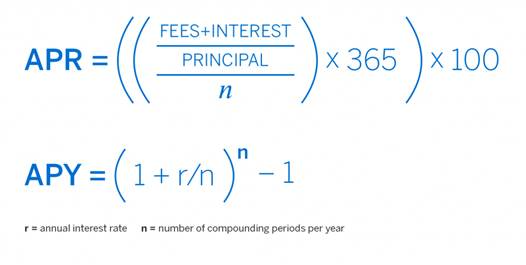
Example: 12% APR compounded monthly
APY = (1 + 0.12/12)^12 - 1 = 12.68%
Compounding more frequently increases APY slightly each time.
Which Should You Focus On?
- If you’re borrowing, prioritize APR. It reflects the total cost of debt.
- If you’re saving or investing, look at APY. It shows how compounding boosts earnings.
- In crypto, check both. APR tells you the base reward, APY reveals potential if you reinvest.
When comparing offers, always read the fine print; frequency, fees, and conditions can shift the real value dramatically.
Common Misconceptions and Pro Tips
Myth: “APY is always better.”
Reality: Only if compounding happens, or if you reinvest earnings.
Myth: “APR ignores compounding, so it’s useless.”
Reality: APR helps borrowers compare costs clearly.
Pro Tip: Use online APR-to-APY calculators for quick comparisons. They’re free and eliminate guesswork.
The Bottom Line
APR and APY aren't just different ways of saying the same thing, they represent two different approaches to measuring returns.
When you see APR, you're looking at simple interest calculated over a year. When you see APY, you're seeing what happens when earnings get reinvested and compound over time. Both are valid measurements, just showing different scenarios.
This distinction becomes more noticeable with higher interest rates. A 50% APR becomes closer to 65% when compounded daily. The higher the base rate, the bigger the difference between these two numbers becomes.
Understanding which one you're looking at helps you compare options accurately. APR gives you the base rate, while APY shows the potential with compounding factored in.
Once you get the hang of spotting the difference, those financial offers suddenly make a lot more sense. No more squinting at numbers wondering why similar-sounding deals seem to work out so differently. It's like finally understanding why some recipe measurements are in cups and others in ounces - same concept, different scales, and knowing which is which makes all the difference.

Yield farming is a method to generate more crypto with your crypto holdings. The process involves you lending your digital assets to others by means of the power of computer programs known as smart contracts.
Cryptocurrency holders have the option of leaving their assets idle in a wallet or binding them into a smart contract to assist with liquidity. Yield farming allows you to benefit and gain rewards from your cryptocurrency without spending any more of it. Sounds quite easy, right?
Well, hold on because it isn't that straightforward and we are just getting started.
Yield farmers employ highly advanced tactics in order to improve returns.
They constantly move their cryptocurrencies among a variety of lending markets in order to optimize their returns. After a quick Google search, you would wonder why there isn't more content surrounding strategies and why these yield farmers are so tight-lipped about the greatest yield farming procedures.
Well, the answer is quite simple: the more people are informed about a strategy, the less effective it becomes. Yield farming is the lawless territory of Decentralized Finance (DeFi), where farmers compete for the opportunity to grow the highest-yield crops.
As of November 2021, there is $269 billion in crypto assets locked in DeFi, gaining an impressive almost 27% in value compared to the previous month of October.
The DeFi yield farming rise shows that the excitement in the crypto market has extended far beyond community- and culture-based meme tokens and planted itself in the centre of the hype. What exactly does it take to be a yield farmer?
What kinds of yields can you anticipate? Where do you start If you're considering becoming a yield farmer? Here, we'll guide you through everything you need to know.
What is Yield Farming?
Also referred to as liquidity farming, yield farming is a method for generating profits using your cryptocurrency holdings instead of leaving them idle in an account on a crypto website. In a nutshell, it involves bidding cryptocurrency assets into platforms that offer lending and borrowing services and earning a reward for it.
Yield farming is similar to bank loans or bonds in that you must pay back the money with interest when the loan is due. Yield farming works the same way, but this time, the banks are replaced in this scenario by crypto holders like yourself in a decentralized environment. Yield farming is a form of cryptocurrency investment in which "idle cryptocurrencies" that would have otherwise been held on an exchange or hot wallet are utilized to provide liquidity in DeFi protocols in exchange for a return.
Yield farming is not possible without liquidity pools or liquidity farming. But, what is a liquidity pool? It's basically a smart contract that contains funds. Liquidity pools are working with users called liquidity providers (LP) that add funds to liquidity pools. Find more information about liquidity pools, liquidity providers, and the automated market maker model below.
How Does Yield Farming Work?
Liquidity pools (smart contracts filled with cash) are used by yield farming platforms to offer trustless methods for crypto investors to make passive revenue by loaning out their funds or crypto using smart contracts.
Similar to how people create bonds to pay off a house and then pay the bank interest for the loan, users can tap into a decentralized loan pool to pay for the bonds.
Yield farming is a type of investment that involves the use of a liquidity provider and a liquidity pool in order to run a DeFi market.
- A liquidity provider is a person or company who puts money into a smart contract.
- The liquidity pool is a smart contract filled with cash.
Liquidity providers (LPs), also known as market makers, are in charge of staking funds in liquidity pools enabling sellers and purchasers to transact conveniently by executing a buyer-seller agreement utilizing smart contracts. LPs earn a reward for providing liquidity to the pool. Yield farming is based on liquidity providers and liquidity pools, which are the foundations of yield farming. These work by staking or lending crypto assets on DeFi protocols to earn incentives, interest or additional cryptocurrency. It's similar to how venture capital firms invest in high-yield equities, which is the practice of investing in equities that offer better long term results.
Yield farmers will frequently shuffle their money between diverse protocols in search of high yields. For this reason, DeFi platforms may also use other economic incentives to entice more capital onto their platform as higher liquidity tends to attract more liquidity. The method of distribution of the rewards will be determined by the specific implementation of the protocol. By yield farming law, the liquidity providers get compensated for the amount of liquidity they contribute to the pool.
How Are Yield Farming Returns Calculated?
Estimated yield returns are calculated on an annualized model. This estimates the returns that you could expect throughout a year. The primary difference between them is that annual percentage rates (APR) don't consider compound interest, while annual percentage yield (APY) does. Compounding is the process of reinvesting current profits to achieve greater results (i.e. returns). Most calculation models are simply estimates. It is difficult to accurately calculate returns on yield farming because it is a dynamic market and the rewards can fluctuate rapidly leading to a drop in profitability. The market is quite volatile and risky for both borrowers and lenders.
Before Getting Started, Understand The Risks Of Yield Farming
Despite the obvious potential benefits, yield farming has its challenges. Yield farming isn't easy. The most successful yield farming techniques are quite complex, recommended only to advanced users or experts who have done their research.
Here are the different risks:
Smart contract
Smart contracts are computerized agreements that automatically implement the terms of the agreement between parties and predefined rules. Smart contracts remove intermediaries, are less expensive to operate and are a safer way to conduct transactions. However, they are vulnerable to attack vectors and bugs in the code.
Liquidation risks
DeFi platforms, like traditional finance platforms, use customer deposits to create liquidity in their markets. However, if the collateral's value falls below the loan's price, you would be liquidated. Collateral is subject to volatility, and debt positions are vulnerable to under-collateralization in market fluctuations.
If you borrow XX collateralized by YY a rise in the value of XX would force the loan to be liquidated since the collateral YY value would be inferior to the value of the XX loan.
DeFi Rug Pulls
In most cases, rug pulls are obvious exit scams that are intended to entice investors with a well-manufactured promising project in order to attract investors.
A crypto rug pull happens when developers create a token paired with a valuable cryptocurrency. When funds flow into the project and the price rises, developers then seize as much liquidity they can get their hands on resulting in losses for the investors left in.
Impermanent loss
Impermanent loss happens when a liquidity provider deposits their crypto into a liquidity pool and the price changes within a few days. The amount of money lost as a result of that change is what is called an impermanent loss. This situation is counter-intuitive yet crucial for liquidity providers to comprehend.
Exercise Caution When Getting Into Yield Farming
If you have no prior knowledge of the cryptocurrency world, entering into the yield farming production may be a hazardous endeavour. You might lose everything you've put into the project. Yield farming is a fast-paced and volatile industry. If you want to venture into yield farming, make sure you don't put more money in than you can afford, there's a reason why the United Kingdom has recently implemented serious crypto regulations.
What The Future Holds For Yield Farming
We hope that after reading this article you will have a much deeper understanding of yield farming and that it answered some of your burning questions.
In summary, yield farming uses investors' funds to create liquidity in the market in exchange for returns. It has significant potential for growth, but it's not without its faults.
What else might the decentralized financial revolution have in store for us? It's difficult to anticipate what future applications may emerge based on these present components. However, trustless liquidity protocols and other DeFi technologies are driving finance, cryptoeconomics, and computer science forward.
Certainly, DeFi money markets have the ability to contribute to the development of a more open and inclusive financial system that is accessible to everyone with an Internet connection.

You've likely come across the term "token" in your crypto ventures, or heard Bitcoin and Ethereum described as a token, but what does this all mean? In this article, we're breaking down what a token is, and how to distinguish a coin from a token and how it can be used as a tool to store value.
Token Definition
A token, in the cryptocurrency sense of the world, represents a particular asset or utility. It's worth noting in this item that tokens and cryptocurrencies are terms often used interchangeably however they technically differ. Tokens typically fall into one of the following three categories:
Payment tokens
These tokens allow users to purchase goods and services outside of the blockchain, offering an alternative currency.
Security tokens
Similar to initial public offerings (IPOs) on the stock market, security tokens offer users an ownership stake or entitle the holder to dividends in a blockchain project.
Utility tokens
Utility tokens offer users access to a service within a particular ecosystem, similar to loyalty points on a Starbucks card. These points hold value within their own ecosystem but cannot be used outside of that.
Coins vs Tokens
Getting more technical, when exploring coins vs tokens, tokens are categorised as crypto assets that have been built on top of another blockchain while coins are built on their own blockchain.
Ether, for example, is the native token to the Ethereum blockchain, however, the platform allows developers to create a range of token standards on top of it. Based on this information, all ERC-20 tokens are therefore categorised as tokens as opposed to coins.
USD Coin (USDC) and Tether (USDT) are therefore tokens as they are built on top of the Ethereum blockchain. While each network is operated by its own leadership, both use Ethereum's blockchain to facilitate all transactions.
How Are Tokens Traded?
Much like coins, tokens can be bought, sold and traded on exchanges, or sent directly from one wallet to another. This is facilitated by blockchain technology, in the same way that coins are transferred from one location to another. Unlike coins, which are all fungible in nature, tokens can sometimes be non-fungible, meaning that they are not identical in value and function.
Tokens are sent using the wallet address of a recipient's blockchain-compatible wallet. The address is often represented by a barcode in the form of a QR code, or through a lengthy alphanumeric code. All transactions take place from the wallet holding the tokens and are sent directly to the wallet of the recipient without the need for a centralized authority like a bank. Tokens can typically be bought on exchanges, often with Visa or Mastercard, or exchanged between users.
How is an NFT Different from Cryptocurrency?
Non-fungible tokens (NFTs) are all different from each other as they each represent a real-world object, whether a digital piece of artwork or a bottle of fine wine. Bitcoin can be traded for anything around the world, whereas NFTs are unique in nature and while they hold value they cannot be used interchangeably.
What Are NFTs Used For?
NFTs are used to represent a particular asset, whether it be physical or digital. When minted, these tokens will permanently represent that asset and cannot be changed. For example, one NFT could represent an apartment in London while another could represent a song by Kings of Leon. The possibilities are endless, and the marketplaces are huge.
Users can easily trade NFTs on marketplaces (through a website or mobile app) such as OpenSea or Rarible. Once you own an NFT you are credited with the ownership rights of the asset the NFT represents. Due to the nature of blockchain technology, this is permanently displayed on the network's public ledger for anyone to review. This process ensures that the ownership of an NFT cannot the changed and the information is available for anyone to credit.
Note that several blockchain networks currently support the minting of NFTs, and the holder will need a wallet specific to that blockchain in order to hold the NFT.
Are Tokens Regulated?
When it comes to regulation, countries around the world are currently drawing up legal frameworks to better implement cryptocurrencies into our current financial system. This includes the likes of tokens.
Once cryptocurrencies are regulated by government authorities, they could provide the world with unrealized use cases like being used to manage a prescription at a pharmacy or clinical services or to provide feedback to IT support. While there are plenty of tokens available on the market today, it's likely that this is only the tip of the iceberg in terms of their potential to improve issues faced around the world.

Axie Infinity är ett blockkedjebaserat strids- och samlarsystem där spelare kan föda upp, strida med och handla digitala varelser kallade Axies. Inspirerat av Pokémon och Tamagotchi kombinerar Axie Infinity spelvärlden med blockkedjeteknik och de populära NFT:erna (icke-fungibla tokens).
I takt med att Tap lägger till nya kryptovalutor, har AXS tagits upp på grund av sin höga handelsvolym, engagerade community och starka spelupplevelse. Genom att kombinera avancerad teknik med spelmekanik står Axie Infinity i frontlinjen för nästa generations spelplattformar. Här nedan får du veta mer om denna decentraliserade innovation.
Vad är Axie Infinity (AXS)?
Axie Infinity bygger på Ethereum-blockkedjan och använder NFT:er för att representera unika spelkaraktärer, förmågor, markplättar och andra tillgångar i spelet. Spelare kan tjäna både Axie Infinity Shards (AXS) och Smooth Love Potions (SLP) under spelets gång.
Varje Axie har unika attribut, med över 500 möjliga kroppsdelar fördelade över olika klasser som exempelvis beast, bird, plant och aquatic – med allt från vanliga till legendariska sällsynthetsnivåer. Det gör Axies till eftertraktade tillgångar i spelet och de bygger på Ethereum-standarden för NFT:er.
Vem skapade Axie Infinity?
Axie Infinity grundades 2018 av Trung Nguyen och Aleksander Larsen, tillsammans med Viet Anh Ho. De arbetar genom spelstudion Sky Mavis i Vietnam, ett teknikfokuserat företag med stark inriktning på blockkedjespel.
Projektet har lockat investerare som Blocktower Capital och Mark Cuban, och lyckades i sin sista finansieringsrunda genom Binance Launchpad samla in nästan 3 miljoner USD.
Hur fungerar Axie Infinity?
I spelet strider spelare med sina Axies – NFT:er som är unika och som har olika attribut som påverkar deras förmåga i strid. Dessa attribut inkluderar hälsa, moral, skicklighet och snabbhet.
Axies delas in i olika klasser som Aquatic, Beast, Bird, Plant och Reptile samt specialklasser som Dawn, Dusk och Mech. Varje Axie har sex kroppsdelar (rygg, öron, ögon, horn, mun och svans), vilket påverkar deras egenskaper i spelet.
Axies kan också födas upp, där varje uppfödning kräver både AXS och SLP. En Axie kan födas upp maximalt sju gånger, med ökande kostnad i SLP för varje gång.
En annan aspekt av spelet är mark: spelare kan köpa och sälja virtuella hem till sina Axies – dessa kallas Lunacias. Det finns också en marknadsplats inom spelet där spelare kan köpa och sälja Axies och tillgångar.
Vad är Axie Infinity Shards (AXS)?
AXS är spelets styrningstoken och bygger på Ethereum-standarden ERC-721. Dessa tokens används inte bara i spelet, utan även för att ge innehavare möjlighet att påverka spelets framtid genom röstning. AXS kan också handlas på externa börser.
SLP används istället som en ren spelvaluta för att föda upp Axies. Både AXS och SLP har blivit populära även utanför spelvärlden.
Kan man tjäna något genom att spela Axie Infinity?
Axie Infinity är ett av de mest framstående spelen i den växande "play-to-earn"-ekonomin. Här är tre sätt som spelare kan tjäna belöningar på:
Sälja SLP
Genom att delta i strider (Arena Mode), spela uppdrag (Adventure Mode) eller slutföra dagliga uppgifter kan spelare tjäna SLP. Dessa kan sedan säljas på externa marknadsplatser.
Föda upp sällsynta Axies
Genom att föda upp unika kombinationer kan spelare skapa sällsynta Axies som kan säljas vidare på spelets marknadsplats. Vissa Axies har sålts för hundratusentals kronor.
AXS-staking
I framtiden kommer det att vara möjligt att "stakea" AXS – det vill säga låsa sina tokens i smarta kontrakt – för att få belöningar över tid.

Arbitrage är en alternativ handelsstrategi där investerare köper en tillgång på en marknadsplats och säljer den på en annan – till ett högre pris. Strategin används inom allt från aktiemarknader som New York Stock Exchange till råvaruhandel och kryptovalutor. Rätt genomförd kan det vara en lukrativ metod, men som alltid finns det risker att känna till.
Här går vi igenom vad arbitrage innebär, hur det fungerar i praktiken och vilka risker du bör ha koll på.
Vad är arbitrage?
Arbitrage innebär att utnyttja prisskillnader på samma tillgång mellan olika marknader genom att köpa billigt på en plats och sälja dyrare på en annan – samtidigt. Prisskillnaderna uppstår på grund av ineffektivitet i marknaderna, något som arbitragehandlare både drar nytta av och indirekt hjälper till att rätta till.
De som ägnar sig åt detta kallas arbitrageörer och fokuserar ofta på ett specifikt tillgångsslag eller geografiskt område. Ett klassiskt exempel är att köpa en aktie på Londonbörsen och sälja den samtidigt på New Yorkbörsen – och på så sätt tjäna på prisskillnaden.
Även om det kan låta enkelt krävs både marknadskännedom och förmågan att snabbt identifiera möjligheter. Det är en avancerad metod som lämpar sig bäst för mer erfarna handlare.
Vilka risker finns det?
Arbitragehandel kan verka riskfri på ytan, men det finns flera saker som kan gå fel om man inte har full förståelse för hur marknaderna fungerar. Här är några av de vanligaste riskerna:
Felbedömningar i prisskillnader
Eftersom hela affären bygger på att upptäcka rätt prisskillnad i rätt ögonblick kan minsta felsteg göra att du blir sittande med en tillgång som inte längre går att sälja med vinst. Därför behöver arbitrageörer vara pålästa och följa nyhetsflödet noga.
Avgifter och växlingskurser
Avgifter från mäklare, transaktionskostnader och valutaväxlingar kan äta upp vinsten från en arbitrageaffär. Det är viktigt att räkna in dessa kostnader i förväg för att förstå om affären är värd att genomföra.
Timing
Timing är avgörande i arbitragehandel. Om du inte agerar tillräckligt snabbt kan prisskillnaden försvinna innan affären är genomförd. Det kräver både snabbhet och precision.
Hur börjar man med arbitrage?
Eftersom arbitrage ofta innebär handel mellan internationella marknader är första steget att övervaka och analysera dem noggrant. Du behöver hålla utkik efter tillfälliga prisskillnader och vara redo att agera direkt – köpa billigt på en marknad och samtidigt sälja på en annan.
Ett exempel på arbitrage
Låt oss säga att du följer ett bilföretags aktie som handlas på både Londonbörsen (LSE) och Tokyobörsen (TYO). Vid ett tillfälle ser du att aktien kostar motsvarande 100 USD i London och 75 USD i Tokyo.
Du köper aktien i Tokyo till det lägre priset och säljer den i London till det högre. Prisskillnaden – i detta fall 25 USD – blir din potentiella vinst per aktie.
Men i verkligheten tillkommer valutaskillnader och avgifter, vilket påverkar den faktiska vinsten. Ju fler aktier du hanterar, desto större blir möjligheterna – men även riskerna.
Är arbitragehandel något för mig?
Det finns potential för vinst, men det kräver tid, analys och noggranna beräkningar. Arbitrage är ingen genväg till snabba pengar – det är en strategi som kräver tålamod och förståelse. Om du är villig att lära dig och jobba aktivt med din analys kan det vara värt att utforska.


