Learning the friendly way
Dive into our resources, guides, and articles for all things money-related. Grow your financial confidence with our experts curated tips and articles for both experienced and new investors.
LATEST ARTICLEs

Η ανεπαρκεια αποτελεί έναν θεμελιώδη όρο που αναδεικνύει τη διαφορά μεταξύ των ατελείωτων αναγκών μας και των περιορισμένων διαθέσιμων πόρων στον κόσμο. Αυτή η ιδέα δεν αφορά μόνο τα καθημερινά αγαθά και τις υπηρεσίες· είναι εξίσου σημαντική και στον κόσμο των επενδύσεων. Η κατανόηση της έννοιας της έλλειψης βοηθά να εξηγήσουμε πώς λαμβάνουμε αποφάσεις σχετικά με τη χρήση πόρων, πώς λειτουργούν οι αγορές και πώς καθορίζονται οι τιμές. Είτε σκέφτεστε τις παγκόσμιες προκλήσεις των πόρων είτε τις επενδυτικές ευκαιρίες, η κατανόηση της επίδρασης της έλλειψης είναι απαραίτητη.
Ορισμός της σπανιοτητα
Στους οικονομικούς όρους, η έλλειψη αναφέρεται στη πεπερασμένη διαθεσιμότητα πρώτων υλών, γης, εργασίας και κεφαλαίου, ενώ οι ανάγκες και οι επιθυμίες των ατόμων, των επιχειρήσεων και της κοινωνίας συνολικά είναι πρακτικά απεριόριστες.
Από επενδυτική άποψη, η έλλειψη εμφανίζεται στον περιορισμένο αριθμό ποιοτικών μετοχών που διατίθενται στην αγορά. Καθώς ένας συνεχώς αυξανόμενος αριθμός επενδυτών αναζητά κερδοφόρες ευκαιρίες, μόνο λίγες εταιρείες υψηλών επιδόσεων είναι διαθέσιμες για επένδυση.
Ναι, υπάρχει ένα κενό που λείπει. Το διορθωμένο κείμενο είναι:
Αυτή η έλλειψη συχνά ανεβάζει τις τιμές των κορυφαίων μετοχών, καθώς περισσότεροι επενδυτές ανταγωνίζονται για να αποκτήσουν μερίδια σε αυτές τις περιζήτητες εταιρείες. Ως αποτέλεσμα, οι επενδυτές πρέπει να προτεραιοποιούν προσεκτικά τις επιλογές τους, ζυγίζοντας τις πιθανές αποδόσεις έναντι του υψηλότερου κόστους επένδυσης σε σπάνια, περιζήτητα περιουσιακά στοιχεία.
Παράγοντες που επηρεάζουν την σπανιοτητα
Οι οικονομολόγοι χρησιμοποιούν τον όρο "έλλειψη" για να εξηγήσουν γιατί κάποια αγαθά ή πόροι που κάποτε ήταν άφθονοι γίνονται περιορισμένοι με την πάροδο του χρόνου. Οι βασικές αιτίες της έλλειψης χωρίζονται σε τρεις κατηγορίες:
- Έλλειψη λόγω ζήτησης: Εμφανίζεται όταν η ζήτηση για κάτι ξεπερνά τη διαθεσιμότητά του. Για παράδειγμα, όταν κυκλοφορεί μια νέα δημοφιλής κονσόλα παιχνιδιών, μπορεί να εξαντληθεί γρήγορα, καθώς η ζήτηση υπερβαίνει την αρχική προσφορά.
- Έλλειψη λόγω προσφοράς: Προκύπτει όταν εξωτερικοί παράγοντες δυσχεραίνουν την παραγωγή ή την απόκτηση ενός πόρου, μειώνοντας τη διαθεσιμότητά του χωρίς να αλλάζει απαραίτητα η ζήτηση. Ένα παράδειγμα είναι η έλλειψη μικροτσίπ λόγω διακοπών στην παραγωγή, επηρεάζοντας την κατασκευή ηλεκτρονικών συσκευών.
- Δομική ή σχετική έλλειψη: Αυτού του τύπου η έλλειψη προκύπτει όταν ορισμένες ομάδες έχουν καλύτερη πρόσβαση σε έναν πόρο σε σχέση με άλλες. Αυτή η ανισότητα συχνά οφείλεται σε πολιτικούς ή οικονομικούς παράγοντες, παρά στη συνολική ποσότητα του διαθέσιμου πόρου.
σπανιοτητα σε διαφορετικούς κλάδους
Η έλλειψη επηρεάζει διαφορετικούς κλάδους με μοναδικούς τρόπους. Στη γεωργία, φαινόμενα όπως οι ξηρασίες ή οι κακές σοδειές μπορούν να μειώσουν την προσφορά τροφίμων, ανεβάζοντας τις τιμές και αλλάζοντας τις διατροφικές συνήθειες των ανθρώπων. Στην τεχνολογία, ελλείψεις εξαρτημάτων όπως τα μικροτσίπ μπορούν να επιβραδύνουν την παραγωγή, να αυξήσουν τις τιμές των συσκευών και να περιορίσουν τις επιλογές των καταναλωτών.
Στην υγειονομική περίθαλψη, η έλλειψη βασικών φαρμάκων ή εξοπλισμού μπορεί να ανεβάσει τα κόστη και να περιορίσει την πρόσβαση στη φροντίδα. Αυτές οι ελλείψεις επηρεάζουν την ποσότητα παραγωγής, τις τιμές και τις επιλογές που κάνουμε για το τι μπορούμε να αντέξουμε οικονομικά ή να αποκτήσουμε.
Στα χρηματοοικονομικά, η έλλειψη παίζει επίσης σημαντικό ρόλο. Οι περιορισμένοι κεφαλαιακοί πόροι σημαίνουν ότι οι επενδυτές πρέπει να επιλέξουν προσεκτικά πού να διαθέσουν τα κεφάλαιά τους, ενώ η έλλειψη επενδυτικών ευκαιριών μπορεί να αυξήσει τις τιμές περιουσιακών στοιχείων σε δημοφιλείς οικονομικούς τομείς.
Πώς μας επηρεάζει η σπανιοτητα
Στη σύγχρονη κοινωνία, η έλλειψη επηρεάζει όλους – άτομα, επιχειρήσεις και κυβερνήσεις. Για τους ανθρώπους, σημαίνει να παίρνουν δύσκολες αποφάσεις σχετικά με το πώς θα ξοδέψουν τα χρήματά τους και τι θα προτεραιοποιήσουν.
Οι επιχειρήσεις, από την άλλη, αντιμετωπίζουν προκλήσεις στην προμήθεια υλικών ή τη διαχείριση της παραγωγής, επηρεάζοντας τις τιμές και τις λειτουργίες τους. Οι κυβερνήσεις πρέπει να διαχειρίζονται την έλλειψη κατά τον σχεδιασμό πολιτικών, την ισορροπία προϋπολογισμών και την κάλυψη δημόσιων αναγκών.
Η έλλειψη καθοδηγεί τις οικονομικές πολιτικές, επηρεάζοντας τις αποφάσεις για την κατανομή πόρων, τις επενδύσεις και τη ρύθμιση. Διαμορφώνει επίσης τη δυναμική των αγορών, καθώς οι μεταβολές στην προσφορά και τη ζήτηση επηρεάζουν τις τιμές και τη διαθεσιμότητα αγαθών και υπηρεσιών, επηρεάζοντας την ευρύτερη οικονομία.
Έλλειψη στην οικονομία
Από επενδυτική σκοπιά, η έλλειψη αναφέρεται στη περιορισμένη διαθεσιμότητα ενός περιουσιακού στοιχείου σε σχέση με τη μεγάλη ζήτηση, κάτι που μπορεί να ανεβάσει την αξία του. Αυτό συμβαίνει όταν οι πόροι ή τα περιουσιακά στοιχεία είναι σε έλλειψη συγκριτικά με τον αριθμό των ενδιαφερόμενων αγοραστών. Παράγοντες που προκαλούν έλλειψη περιλαμβάνουν τους περιορισμένους φυσικούς πόρους, την αυξημένη ζήτηση ή διακοπές στις αλυσίδες εφοδιασμού.
Για τους επενδυτές, η έλλειψη μπορεί να κάνει ορισμένα περιουσιακά στοιχεία πιο ελκυστικά, καθώς η περιορισμένη φύση τους μπορεί να οδηγήσει σε υψηλότερες τιμές και πιθανές αποδόσεις. Ένα χαρακτηριστικό παράδειγμα είναι το Bitcoin, το οποίο έχει μέγιστη προσφορά 21 εκατομμυρίων νομισμάτων, υποδηλώνοντας ότι όταν η διαθεσιμότητά του μειώνεται, η τιμή του μπορεί να αυξηθεί.
Στρατηγικές για την αντιμετώπιση της έλλειψης στις αγορές
Είτε επενδύετε είτε κάνετε συναλλαγές, εδώ είναι 6 στρατηγικές που μπορούν να σας βοηθήσουν να περιηγηθείτε στις αγορές με αυτοπεποίθηση:
- Διαφοροποιήστε τις Επενδύσεις σας: Κατανείμετε τις επενδύσεις σας σε διαφορετικούς τομείς για να μειώσετε τον αντίκτυπο αν ένας τομέας αντιμετωπίσει προβλήματα.
- Επιλέξτε Σταθερούς Τομείς: Προτιμήστε περιοχές ή περιουσιακά στοιχεία που είναι λιγότερο πιθανό να αντιμετωπίσουν προβλήματα προσφοράς, όπως εκείνα με άφθονους πόρους.
- Εξερευνήστε Νέες Αγορές και Τεχνολογίες: Αναζητήστε αναδυόμενες αγορές ή καινοτόμες τεχνολογίες που μπορούν να προσφέρουν ευκαιρίες ανάπτυξης.
- Επικεντρωθείτε στη Μακροπρόθεσμη Αξία: Σκεφτείτε περιουσιακά στοιχεία, όπως ακίνητα ή εμπορεύματα, που είναι πιθανό να διατηρήσουν την αξία τους με την πάροδο του χρόνου.
- Μείνετε Ενημερωμένοι: Παρακολουθήστε τις τάσεις της αγοράς και τις αλλαγές στην προσφορά και τη ζήτηση για να προσαρμοστείτε στην έλλειψη.
- Σκεφτείτε τη Βιωσιμότητα: Επενδύστε σε έργα ή τεχνολογίες που χρησιμοποιούν πόρους αποτελεσματικά και μπορούν να βοηθήσουν στην αντιμετώπιση μελλοντικών προκλήσεων έλλειψης.
Αυτές είναι προτάσεις που μπορείτε να λάβετε υπόψη, αλλά δεν αποτελούν οικονομική συμβουλή. Κάντε ενδελεχή έρευνα πριν εφαρμόσετε οποιαδήποτε από αυτές τις στρατηγικές.
Συμπέρασμα
Η έλλειψη είναι μια βασική έννοια της οικονομίας που δείχνει τη διαφορά μεταξύ των ατελείωτων επιθυμιών μας και των περιορισμένων διαθέσιμων πόρων. Επηρεάζει τους πάντες, από τις καθημερινές μας επιλογές μέχρι τον τρόπο που οι επιχειρήσεις και οι κυβερνήσεις σχεδιάζουν.
Με την κατανόηση της έλλειψης, μπορούμε να παίρνουμε καλύτερες επενδυτικές αποφάσεις, να διαχειριζόμαστε τους πόρους με σοφία και να διαμορφώνουμε αποτελεσματικές πολιτικές. Αυτή η γνώση είναι απαραίτητη για την πλοήγηση στις αγορές, την εξισορρόπηση αναγκών και τη διασφάλιση ότι οι πόροι χρησιμοποιούνται αποδοτικά.

Από τη δημιουργία του Bitcoin το 2009, ο όρος fiat νόμισμα έχει γίνει όλο και πιο διαδεδομένος. Αλλά τι ακριβώς σημαίνει; Στο άρθρο αυτό, θα δούμε την προέλευση του όρου, πώς λειτουργεί, ποια παραδείγματα fiat υπάρχουν και πώς τα κρυπτονομίσματα έχουν αμφισβητήσει τον ρόλο του.
Ο όρος "fiat" προέρχεται από τα λατινικά και σημαίνει περίπου "κατ’ εντολή", δηλαδή μια επίσημη απόφαση με ισχύ νόμου. Έτσι, fiat χρήμα είναι εκείνο που αναγνωρίζεται ως νόμιμο μέσο πληρωμής από το κράτος.
Εκδίδεται και διαχειρίζεται από την κυβέρνηση ή την κεντρική τράπεζα και χρησιμοποιείται στις καθημερινές συναλλαγές για αγαθά και υπηρεσίες.
Από το 2020, όλα τα νομίσματα που διαπραγματεύονται διεθνώς θεωρούνται fiat. Η αξία τους δεν βασίζεται πλέον σε φυσικά αγαθά, όπως ο χρυσός ή το ασήμι, αλλά στην εμπιστοσύνη και την αξιοπιστία του κράτους που τα εκδίδει.
Fiat νόμισμα ή fiat χρήμα;
Οι όροι fiat currency και fiat money αναφέρονται ουσιαστικά στο ίδιο πράγμα: στα κρατικά εκδιδόμενα νομίσματα που χρησιμοποιούνται σε κάθε χώρα.
Υπάρχουν περίπου 180 διαφορετικά fiat νομίσματα σε κυκλοφορία παγκοσμίως, όπως:
- Δολάριο ΗΠΑ
- Ευρώ
- Στερλίνα
- Γιεν Ιαπωνίας
- Δολάριο Καναδά
Η ισοτιμία μεταξύ δύο fiat νομισμάτων ονομάζεται συναλλαγματική ισοτιμία.
Fiat χρήμα vs νομίσματα βασισμένα σε εμπορεύματα
Το fiat χρήμα είναι το ακριβώς αντίθετο από ένα νόμισμα που έχει εγγενή αξία, όπως ένα νόμισμα από χρυσό ή ασήμι.
Ενώ ένα commodity money (νόμισμα εμπορεύματος) έχει αξία λόγω του υλικού από το οποίο είναι φτιαγμένο, το fiat δεν έχει εγγενή αξία — αποκτά αξία μόνο γιατί η κυβέρνηση το ορίζει ως μέσο ανταλλαγής.
Πώς δημιουργήθηκαν τα fiat νομίσματα;
Όλα τα νομίσματα ξεκίνησαν ουσιαστικά ως υποσχέσεις πληρωμής (IOUs). Αρχικά υπήρχε το σύστημα ανταλλαγής (barter).
Παράδειγμα ανταλλαγής:
Αν ένας αγρότης αντάλλασσε 2 κιλά αλεύρι σήμερα για 10 κολοκύθες το φθινόπωρο, θα λάμβανε ένα "χαρτί" που επιβεβαίωνε αυτή τη συμφωνία. Το χαρτί αυτό αποκτούσε αξία και μπορούσε να ανταλλαχθεί και για άλλα αγαθά.
Για να γίνει πιο πρακτικό, οι άνθρωποι άρχισαν να χρησιμοποιούν φυσικά εμπορεύματα, όπως ο χρυσός, ως ενιαίο μέσο ανταλλαγής.
Από τον χρυσό στα νομίσματα
Η ζύγιση του χρυσού δεν ήταν πρακτική, οπότε τα κράτη άρχισαν να κόβουν χρυσά νομίσματα με σταθερό βάρος και εγγυημένη ποσότητα χρυσού. Έβαζαν χαρακώσεις γύρω από την άκρη του νομίσματος για να διασφαλίσουν ότι δεν έχει «ξυστεί» χρυσός από αυτό.
Η εμφάνιση των τραπεζών
Ο χρυσός ήταν δύσκολο να κουβαληθεί και επικίνδυνος να διατηρηθεί, έτσι εμφανίστηκαν οι τράπεζες. Εκεί, οι άνθρωποι αποθήκευαν τον χρυσό τους και έπαιρναν αποδείξεις ιδιοκτησίας — τα πρώτα "χαρτονομίσματα".
Από το χρυσό στο χαρτονόμισμα
Με τον καιρό, οι πολίτες έπαψαν να ανταλλάσσουν τα χαρτονομίσματα με χρυσό, και απλώς τα χρησιμοποιούσαν για συναλλαγές. Κάπως έτσι γεννήθηκε το σύστημα του fiat.
Η τιμή του νομίσματος δεν βασιζόταν πια στον χρυσό, αλλά στην απόφαση του κράτους για την αξία του — «κατ’ εντολή» δηλαδή.
Το τέλος του κανόνα του χρυσού
Μέχρι το 1971, το δολάριο ΗΠΑ ήταν συνδεδεμένο με συγκεκριμένη ποσότητα χρυσού. Τότε ο Πρόεδρος Ρίτσαρντ Νίξον κατάργησε οριστικά το σύστημα αυτό (γνωστό ως “Nixon shock”).
Από τότε, τα νομίσματα απέκτησαν ελεύθερη κυμαινόμενη αξία βασισμένη στην εμπιστοσύνη της αγοράς και την νομισματική πολιτική κάθε χώρας.
Είναι ακόμα χρήσιμο το fiat χρήμα;
Με την εμφάνιση των κρυπτονομισμάτων, ο τρόπος που αντιλαμβανόμαστε το χρήμα έχει αλλάξει σημαντικά.
Παρόλο που χώρες όπως το Ελ Σαλβαδόρ έχουν αναγνωρίσει το Bitcoin ως νόμιμο μέσο πληρωμής, τα fiat νομίσματα παραμένουν ο βασικός πυλώνας της παγκόσμιας οικονομίας και δύσκολα θα αντικατασταθούν στο άμεσο μέλλον.
CBDCs: Ψηφιακή εξέλιξη του fiat
Μια πρόσφατη καινοτομία είναι τα CBDCs (Central Bank Digital Currencies), τα οποία συνδυάζουν τον κόσμο των fiat με την τεχνολογία blockchain.
Πρόκειται για ψηφιακά νομίσματα που εκδίδονται από κεντρικές τράπεζες, λειτουργούν με τεχνολογία blockchain, είναι σταθερά σε αξία (όπως το ευρώ ή το δολάριο), και δεν παρουσιάζουν μεταβλητότητα όπως τα περισσότερα κρυπτονομίσματα.
Συμπέρασμα
Το fiat χρήμα παραμένει η ραχοκοκαλιά του παγκόσμιου χρηματοοικονομικού συστήματος. Παρά την άνοδο των ψηφιακών νομισμάτων, το fiat εξακολουθεί να παίζει καθοριστικό ρόλο στο παγκόσμιο εμπόριο, τη χρηματοδότηση και την καθημερινή οικονομική δραστηριότητα.
Η έννοια του χρήματος έχει αλλάξει ριζικά μέσα σε έναν αιώνα — και δεν αποκλείεται να δούμε ακόμα πιο δραστικές εξελίξεις στο μέλλον.

Το διαδίκτυο έχει κάνει την online δημιουργία εισοδήματος πιο προσιτή από ποτέ. Είτε θέλεις ένα side hustle για λίγα επιπλέον χρήματα είτε σκέφτεσαι μια πλήρως online δραστηριότητα, οι επιλογές αυξάνονται συνεχώς. Από γρήγορα gigs μέχρι μακροπρόθεσμες πηγές παθητικών εσόδων, υπάρχει κάτι για όλους.
Βέβαια, μην περιμένεις να πλουτίσεις από τη μια μέρα στην άλλη. Αν κάποιος σου το υποσχεθεί, πιθανότατα πρόκειται για απάτη. Με σωστή συγκέντρωση, υπομονή και έξυπνες κινήσεις, μπορείς να χτίσεις ένα πραγματικό και βιώσιμο εισόδημα online.
Αυτός ο οδηγός συγκεντρώνει αποδεδειγμένους τρόπους με τους οποίους άνθρωποι κερδίζουν χρήματα από το σπίτι, άλλους χωρίς κανένα αρχικό κόστος και άλλους που στοχεύουν σε πιο σταθερή ανάπτυξη. Το μυστικό είναι να βρεις αυτό που ταιριάζει στις δεξιότητές σου, στον χρόνο σου και στους στόχους σου.
Πάμε να ξεκινήσουμε.
1. Οι καλύτεροι τρόποι για να βγάλεις γρήγορα χρήματα online (χαμηλές απαιτήσεις, υψηλό ενδιαφέρον)
Αν είσαι νέος στον χώρο ή χρειάζεσαι άμεσα επιπλέον εισόδημα, αυτές οι επιλογές έχουν χαμηλό εμπόδιο εισόδου και δεν απαιτούν εξειδικευμένες δεξιότητες. Δεν αντικαθιστούν μια πλήρη δουλειά, αλλά είναι ιδανικές για έξτρα χρήματα ή για να κάνεις την πρώτη σου επαφή με το online εισόδημα.
Πληρωμένες online έρευνες
Ένας από τους πιο εύκολους τρόπους να ξεκινήσεις. Τα brands πληρώνουν για τις απόψεις σου. Δεν χρειάζεται εμπειρία, μόνο λίγος ελεύθερος χρόνος.
Κορυφαίες πλατφόρμες: Swagbucks, Branded Surveys, YouGov, Prolific
Μέσο κέρδος: €0.50–€3 ανά έρευνα
Tip: Οι περισσότερες πλατφόρμες έχουν όριο ανάληψης.
Πληρωμές για click, παρακολούθηση ή αναζήτηση
Απλές εργασίες όπως να δεις ένα βίντεο ή να κάνεις μια αναζήτηση. Μικρά ποσά, αλλά εύκολη συμμετοχή.
Δοκίμασε: Qmee, InboxPounds, Swagbucks
Micro-tasks
Σύντομες online εργασίες όπως καταχώριση δεδομένων ή απλή έρευνα.
Πλατφόρμες: Clickworker, Amazon Mechanical Turk, Lionbridge
Αμοιβή: €2–€10 την ώρα
Τεστ σε ιστοσελίδες και εφαρμογές
Δίνεις feedback για λειτουργικότητα και εμπειρία χρήστη.
Sites: UserTesting, Userlytics, TryMyUI
Αμοιβή: €8–€12 για test 20 λεπτών
Απαιτήσεις: Καλή επικοινωνία και σταθερή σύνδεση.
Διαγωνισμοί και κληρώσεις
Δεν είναι εγγυημένο εισόδημα, αλλά αρκετοί κερδίζουν δώρα μεγάλης αξίας.
Ιδέες: ακολούθησε brands στα social, χρησιμοποίησε aggregators όπως LoquaxTM και MSE’s Competition Corner.
2. Μέθοδοι μεσαίας προσπάθειας με πιο σταθερές αποδόσεις
Απαιτούν περισσότερη ενασχόληση ή δεξιότητες, αλλά έχουν καλύτερη δυναμική.
Freelance γράψιμο και επιμέλεια
Η ζήτηση για περιεχόμενο παραμένει υψηλή.
Ξεκίνα: Upwork, Intch, Freelancer
Τιμές: €10–€20 για αρχάριους, €30–€100 την ώρα για έμπειρους
Tip: Χτίσε portfolio και εξειδίκευση.
Πώληση stock φωτογραφιών ή βίντεο
Ιδανικό αν έχεις καλή σχέση με την κάμερα. Πλατφόρμες: Shutterstock, Adobe Stock.
Virtual Assistant (VA)
Υποστήριξη επιχειρήσεων σε admin tasks, social media, email management κ.ά.
Αμοιβή: €8–€25 την ώρα
Στόχος: σταθερές συνεργασίες.
Πώληση χειροποίητων προϊόντων
Μέσω Etsy, Folksy ή Amazon Handmade.
Πώληση ψηφιακών προϊόντων
Χαμηλό κόστος, υψηλό περιθώριο. Δημοφιλή προϊόντα: Notion templates, Canva designs, prompts, planners.
Πλατφόρμες: Gumroad, Etsy, Creative Market.
3. Scalable και παθητικές πηγές εισοδήματος
Απαιτούν χρόνο στην αρχή αλλά χρειάζονται λιγότερη συντήρηση στη συνέχεια.
Dropshipping
Πωλήσεις χωρίς απόθεμα μέσω Shopify ή WooCommerce.
Περιθώριο κέρδους: συνήθως 3–7 τοις εκατό μετά τις διαφημίσεις.
Print-on-demand
Προϊόντα που τυπώνονται μόνο στην παραγγελία.
Πλατφόρμες: Printful, Printify, Merch by Amazon, Redbubble.
Blog ή niche website
Έσοδα από ads, affiliate links, sponsorships και ψηφιακά προϊόντα.
Απαιτεί 6–18 μήνες για ανάπτυξη.
Online courses
Δημιούργησε μαθήματα σε Udemy, Skillshare, Teachable ή Coursera.
Ebooks
Self-publish στο Kindle Direct Publishing ή Smashwords.
YouTube channel
Έσοδα μέσω ads, memberships, super chats, συνεργασιών και affiliate links.
Side hustles με όσα ήδη έχεις
Γιατί να μην αξιοποιήσεις αντικείμενα ή χώρο που ήδη υπάρχει;
• Ενοικίαση χώρου σε Airbnb ή Booking.com
• Ενοικίαση αντικειμένων όπως αυτοκίνητα (Turo), εξοπλισμός (Fat Llama) ή parking (JustPark)
• Πώληση αχρησιμοποίητων αντικειμένων σε Facebook Marketplace, eBay ή Vinted
• Χρήση cashback apps όπως Shoppix, TopCashback ή το cashback της κάρτας Tap (έως 8 τοις εκατό σε ορισμένες περιπτώσεις)
Αυτές οι επιλογές λειτουργούν ακόμη καλύτερα σε αστικές περιοχές και απαιτούν ελάχιστο αρχικό κόστος.
Τι να προσέξεις
Το διαδίκτυο έχει πολλές νόμιμες ευκαιρίες, αλλά και αρκετές απάτες. Η προσοχή είναι απαραίτητη.
Απόφυγε όσα υπόσχονται:
• Σίγουρο και μεγάλο κέρδος με ελάχιστη προσπάθεια
• Πληρωμή εκ των προτέρων για “εκπαίδευση” ή “kits”
• Δομές τύπου πυραμίδας ή MLM
Στο Ηνωμένο Βασίλειο, εισόδημα άνω των €1.000 πρέπει να δηλώνεται στη HMRC. Κράτησε καλές καταγραφές για τις δραστηριότητές σου.
Επίσης, διάβασε προσεκτικά τους όρους κάθε πλατφόρμας. Έλεγξε τα ελάχιστα ποσά ανάληψης, τις χρεώσεις και τον τρόπο πληρωμής.
Συμβουλές για επιτυχία στο online earning
• Χρησιμοποίησε ξεχωριστό email για τις online δραστηριότητες
• Παρακολούθησε τα έσοδα και τον χρόνο σου σε ένα απλό spreadsheet
• Εστίασε σε πλατφόρμες με καλύτερες αποδόσεις και ανέπτυξε δεξιότητες
• Ξεκίνα μικρά και αύξησε σταδιακά ό,τι λειτουργεί
• Μάθε digital skills μέσα από δωρεάν online tutorials
Τελικές σκέψεις
Το να κερδίζεις χρήματα online σου δίνει ευελιξία, αλλά χρειάζεται προσπάθεια και συνέπεια. Δεν υπάρχει μαγική φόρμουλα. Άλλοι πετυχαίνουν με blogs, άλλοι με micro-tasks ή έρευνες. Σημασία έχει να ξεκινήσεις, να μάθεις και να εξελίσσεσαι.
Και το πιο σημαντικό: πρόσεχε τις απάτες, κράτα σωστές σημειώσεις και συνέχισε να δημιουργείς αξία.
Αν έφτασες μέχρι εδώ, τότε είσαι ήδη έτοιμος να πάρεις στα χέρια σου το δικό σου online ταξίδι εισοδήματος.

In today's digital-first economy, businesses across all sectors are seeking innovative financial solutions to drive efficiency, enhance customer experiences, and unlock new revenue streams. One compelling strategy is the implementation of co-branded credit cards, which have been shown to significantly boost customer loyalty and spending.
Notably, 75% of financially stable consumers prefer co-branded cards for their rewards and benefits, indicating a strong alignment between these card programs and consumer desires.
By collaborating with financial institutions to offer co-branded cards, businesses can create tailored payment solutions that meet customer expectations and reinforce brand loyalty. This approach transforms the payment infrastructure from a mere operational necessity into a strategic asset that fuels growth.
For instance, the co-branded credit card market is projected to grow from $13.41 billion in 2023 to $25.72 billion by 2030, reflecting a compound annual growth rate (CAGR) of 9.74%.
Whether you're in retail, SaaS, or manufacturing, a tailored card program could be the key to transforming how your business engages with customers—and how you scale.
What is card program management?
Card program management encompasses the end-to-end process of designing, implementing, and optimising payment card solutions tailored to your business. From corporate expense cards that streamline internal processes to branded payment cards that enhance customer loyalty, these programs offer versatility that can benefit virtually any organisation looking to modernise its financial operations.
As businesses continue to navigate increasingly complex markets, those equipped with flexible financial tools gain a significant competitive advantage. The right card program doesn't just process payments—it generates valuable data, reduces administrative burden, and creates opportunities for deeper engagement with both employees and customers.
Why it matters
At its core, card program management involves overseeing all aspects of a payment card ecosystem—from issuing and distribution to transaction processing, reporting, and compliance. Modern card program management platforms provide businesses with the infrastructure to create customised payment solutions while maintaining visibility and control.
This matters because traditional payment methods often create friction points that slow business growth. Manual expense reporting, limited payment visibility, and rigid financial systems can drain resources and limit innovation.
However, a well-managed card program addresses these pain points by automating processes, enhancing security, and providing greater flexibility.
Key benefits for businesses across sectors
Streamlined operations
Card programs dramatically reduce administrative overhead by automating expense tracking, simplifying reconciliation, and eliminating paper-based processes. This operational efficiency translates directly to cost savings and allows your team to focus on strategic initiatives rather than transaction management.
Enhanced Customer Experience
For businesses that implement customer-facing card programs, the benefits extend to experience enhancement. Branded payment cards can strengthen loyalty, while instant issuance capabilities meet modern expectations for immediacy.
From hospitality to healthcare, organisations are using card programs to differentiate their service offerings.
Data-driven insights
Perhaps the most overlooked advantage of modern card program management is the wealth of data it generates. Every transaction becomes a data point that can inform business decisions, reveal spending patterns, and identify opportunities for optimisation. This business intelligence becomes increasingly valuable as programs scale.
Scalability and flexibility
As your business grows, your card program can evolve alongside it. Whether you're expanding into new markets or adding new product lines, a well-designed card program adapts to changing requirements without requiring complete system overhauls.
The implementation process simplified
Implementing a card program doesn't have to be overwhelming. The process typically follows these key steps:
- Assessment and strategy development: Evaluate your current payment ecosystem and define clear objectives for your card program.
- Platform selection and integration: Choose a card program management solution that aligns with your technical requirements and business goals, then integrate it with your existing systems.
- Program launch and optimisation: Deploy your program with proper training and support, then continuously refine based on performance data and user feedback.
Real-World Impact
Across industries, businesses are leveraging card program management to solve specific challenges:
- Retail companies are implementing instant digital card issuance to capture sales opportunities.
- Healthcare providers are using specialised payment cards to simplify patient financial assistance.
- Manufacturing firms are deploying corporate card programs with custom spending controls to streamline procurement.
The common thread? Each organisation is using card program management as a strategic tool rather than just a payment method.
How Tap can help
Navigating the complexities of card program management requires expertise and the right technology partner. Tap's comprehensive platform brings together cutting-edge technology with industry-specific knowledge to help businesses design, implement, and optimise card programs that deliver measurable results.
Our solution addresses common challenges like regulatory compliance, security concerns, and integration complexities, allowing you to focus on the strategic benefits rather than implementation hurdles.
Ready to explore how card program management could transform your business operations and drive growth? Connect with Tap's team of specialists for a personalised consultation and discover the potential of a tailored card program for your organisation.
Article Framework: Card Program Management
Tone & Perspective
- Tone: Professional, informative, and authoritative.
- Perspective: Written from an expert viewpoint, educating businesses on launching and managing a successful card program.
Priority Headings & Structure
1. Introduction
- What is card program management?
- Why businesses need effective card program management.
- Overview of key stakeholders (issuers, networks, processors, etc.).
2. How Card Program Management Works
- Key components: issuing, processing, compliance, and risk management.
- The role of a program manager (self-managed vs. outsourced).
- The relationship between issuing banks, networks, and program managers.
3. Core Elements of a Successful Card Program
- Program Design: Choosing card types (prepaid, debit, credit), network selection (Visa, Mastercard), and branding.
- Issuance & Account Management: BIN sponsorship, account setup, and customer onboarding.
- Compliance & Risk Management: KYC, AML, PCI DSS, and fraud prevention strategies.
- Transaction Processing & Settlement: How funds flow through the ecosystem.
- Customer Experience & Support: Ensuring smooth cardholder interactions.
4. Self-Managed vs. Partner-Managed Card Programs
- Benefits and challenges of managing in-house.
- When outsourcing makes sense.
- How third-party program managers add value.
5. Key Considerations Before Launching a Card Program
- Business goals and revenue model.
- Regulatory and security requirements.
- Time-to-market considerations.
6. Trends & Future of Card Program Management
- Embedded finance & BaaS (Banking-as-a-Service).
- AI-driven fraud detection and risk management.
- Open banking and API-driven solutions.
7. Conclusion & Next Steps
- Recap of key insights.
- How businesses can get started with a card program.
- Contact a program management expert.

There’s no denying that the recent surge in Bitcoin adoption has largely been fueled by the incredible bull run. With mainstream media, large corporations, and more retail investors taking notice, many merchants have followed suit and added the original cryptocurrency to their list of payment options. As the market erupts, let’s explore what can you buy with Bitcoin exactly.
Bitcoin’s Surge In Adoption
While 2020 was a challenge for most industries, the crypto markets saw unbelievable gains. Despite the universal market destruction that was witnessed across the board, Bitcoin flourished from $3,870 in March to an all time high of $20,000 by the end of the year. Just one week into the new year and the cryptocurrency had doubled reaching $41,515. By 21 February the cryptocurrency was worth $58,330, almost triple the previous all time high.
The extended bull run was due to large firms moving their company reserves from fiat to BTC, with Tesla bringing a lot of media attention to both this pattern but Bitcoin in general. As more people sought to enter the market, more vendors, businesses and retailers sought to offer it as an alternative payment option. According to a study conducted by HSB in 2020, 36% of small-medium businesses in the US accept Bitcoin. This is also likely to triple in coming months.
What Can You Buy With Bitcoin?
As you’ll see below, almost everything. While not every store offers Bitcoin payments, there are plenty of services which offer gift cards for such stores that can be bought with BTC. Where there’s a will, there’s a way. Let’s dive into all the things available for purchase with Bitcoin. To make things a bit simpler, we’ve broken it down into the following categories:
Tech
Consumers can purchase everything from a VPN service (ExpressVPN) to cloud storage space (Mega.nz) with the cryptocurrency. Microsoft, Wikipedia and AT&T also grace the list, having accepted Bitcoin as a payment method for some years now. Unsurprisingly, the gaming platform Twitch also features crypto payments (they disabled them and then brought them back). There is even a digital library in San Francisco providing the world with “universal access to all knowledge” that operates off of Bitcoin donations.
Sports
Tech you can understand, but sports? Yes, that’s right. A number of large sports clubs around the world have chosen to embrace the digital currency movement. In America, the most famous to do so are the Miami Dolphins and the Dallas Mavericks, while across the pond in the United Kingdom the following football clubs are all in: Tottenham Hotspur, Crystal Palace, Brighton & Hove Albion, Southampton, Leicester City, Newcastle United, and Cardiff City. S.L Benfica, one of the oldest and most popular sports clubs in Portugal, has also decided to accept Bitcoin for everything from merchandise to game tickets.
Retail
Most famously the American retailer dealing with home decor, Overstock, is one of the largest retailers to accept Bitcoin. Home Depot and Whole Foods also joined the ranks through the Winklevoss Flexa spending app ‘Spedn’ that allows for seamless crypto payments.
Then there are companies that provide a middle ground enabling you to purchase goods from stores that don’t necessarily accept the cryptocurrency directly. This includes Purse.io that is most famously used for Amazon purchase with Bitcoin, and Gyft, a company that sells gift cards for popular stores in exchange for crypto. Gyft can be used for everything from Starbucks to Sephora to iTunes.
Travel
You’d be surprised how many travel companies are now offering purchases with cryptocurrencies. One of the first to cross over was Latvia’s national airline, airBaltic, which announced in 2014 that they would be offering the payment option. Since then a number of leading travel companies including Expedia, CheapAir, and Destinia have followed suit. Alternatively, you could purchase a trip to space with Richard Branson’s Virgin Galactic. There is even a specially designed travel company catering solely to Bitcoin shoppers, Bitcoin.Travel.
Food
Another industry to embrace Bitcoin payments with a number of top fast food chains embracing the crypto life in various corners of the globe. Multiple Subways around the world, Pizza Hut in Venezuela, 40 international locations of Burger King, and KFC in Canada have all joined the forward driven club.
BTC Tapping Into The Future
And then of course just about anything in Japan. If you’re looking for goods to purchase with Bitcoin, you can usually see from an online stores’ homepage if it is an option, or in a brick-and-mortar store there will usually be QR code at the checkout counter indicating that Bitcoin is accepted there. If you’ve found that Bitcoin payments are definitely for you, buy, send and spend BTC directly from your Tap app. What can you buy with Bitcoin through your Tap app? Just about anything thanks to the seamless payments integration technology.

Bitcoin and Ethereum dominate headlines, but they represent just one approach to distributed ledger technology. While most projects iterate on blockchain's foundational concepts, Hedera Hashgraph (HBAR) takes a different approach, pursuing an entirely different architectural philosophy.
The result is a network engineered for enterprise-grade performance - processing thousands of transactions per second with deterministic fees and minimal energy consumption. Where many blockchain networks struggle with the scalability trilemma, Hedera's hashgraph consensus mechanism offers a compelling alternative that doesn't sacrifice security for speed.
What distinguishes Hedera in practice is its enterprise adoption trajectory. Major corporations across finance, healthcare, and supply chain management have moved beyond pilot programs to production deployments. This isn't theoretical adoption - it's measurable network activity from organizations with serious compliance and performance requirements.
Hedera has positioned itself as one of the most corporate-friendly distributed ledger technologies (DLTs) available today. But how exactly does it work, and why does it stand apart from the blockchain crowd?
The Basics: What Is Hedera Hashgraph?
Launched in 2018, Hedera Hashgraph is a distributed ledger technology that offers a genuine alternative to blockchain architecture. Instead of organizing transactions into sequential blocks like a digital filing cabinet, Hedera uses a directed acyclic graph (DAG) structure called the hashgraph. Think of it more like a web of interconnected transactions.
This design allows multiple transactions to be processed in parallel rather than waiting in a single-file line. The result? Hedera can handle over 10,000 transactions per second (TPS) with finality in just a few seconds, while Bitcoin manages about 6–8 TPS and Ethereum handles 12–15 TPS.
At its core, Hedera is engineered to tackle three persistent challenges that have plagued distributed ledger technology:
- Transactions settle in seconds, not the minutes or hours you might wait with other networks. This makes it possible to build applications where timing actually counts.
- Scalability without the usual trade-offs, The network can handle thousands of transactions simultaneously without slowing down or getting expensive when things get busy. Most blockchains struggle with this balancing act.
- Energy use that makes sense, unlike networks that consume as much electricity as small countries, Hedera runs efficiently enough that companies don't have to justify massive energy bills to their boards.
How Hedera Works: Gossip and Virtual Voting
Hedera's performance stems from its unique consensus mechanism, which combines two clever innovations that work together like a well-orchestrated dance.
Instead of broadcasting every transaction to the entire network simultaneously (imagine shouting news in a crowded room), nodes "gossip" by randomly sharing information with a few neighbors. Those nodes then pass it along to their neighbors, creating a ripple effect. Over time, the entire network organically learns about every transaction without the communication overhead. That is known as the “gossip-about-gossip protocol”.
Virtual voting is where things get interesting: once all nodes have the same historical record of gossip, they can independently calculate how the network would vote on each transaction. No actual vote messages need to be sent across the network. The outcome is mathematically deterministic based on the gossip history, saving significant time and bandwidth.
Together, these methods achieve asynchronous Byzantine fault tolerance (aBFT), which represents one of the highest levels of security available in distributed systems. This means the network can reach consensus and continue operating even if up to one-third of nodes act maliciously or fail completely.
Governance: The Hedera Council
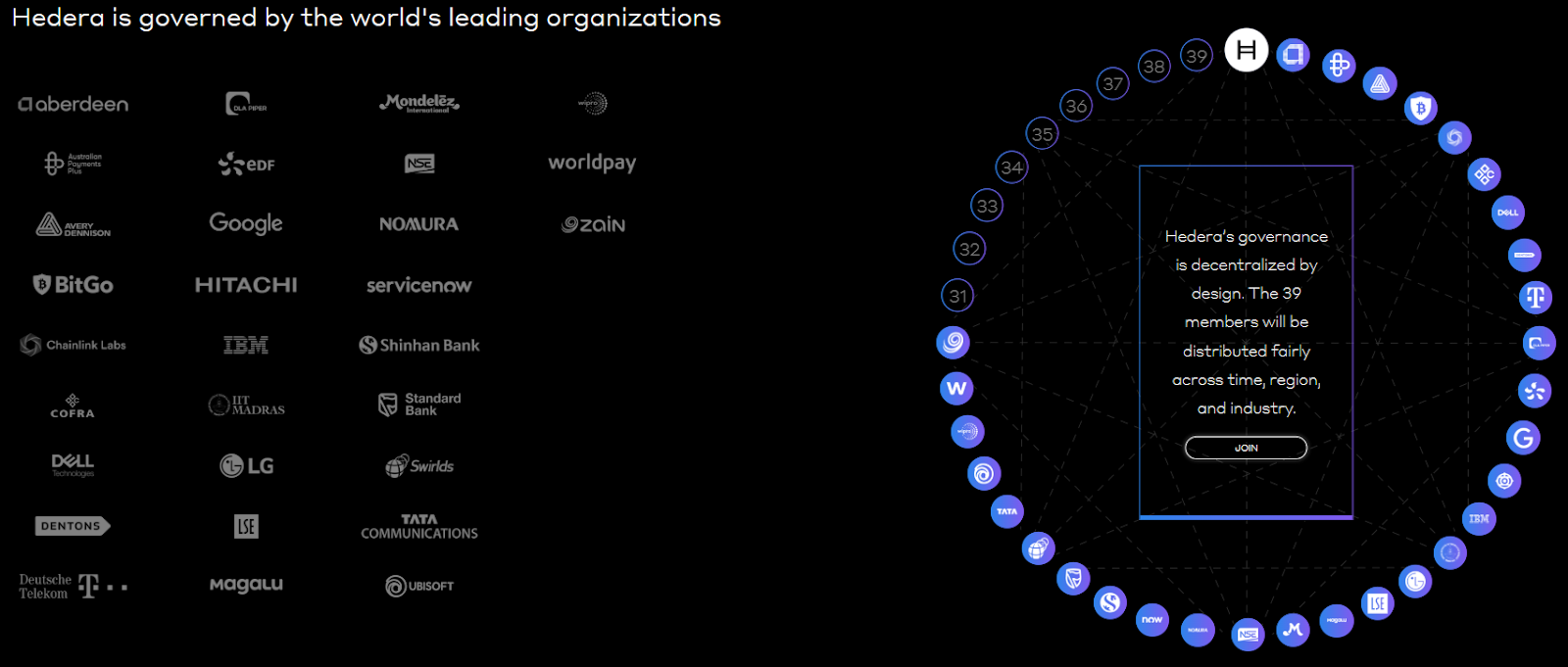
Perhaps the most controversial, and arguably the most distinctive, aspect of Hedera is its governance model. Instead of leaving critical network decisions to anonymous miners or distributed token holders, Hedera operates under a Governing Council of up to 39 well-known global organizations.
Current members include companies like Google, IBM, Dell, Boeing, Standard Bank, Ubisoft, and other established corporations. Each council member holds an equal vote on network decisions, including software upgrades, fee structures, and treasury management.
The rationale is straightforward: provide stability, accountability, and long-term strategic planning. However, this structure has sparked ongoing debate within the crypto community. Critics argue it reduces decentralization compared to blockchain networks where theoretically anyone can participate in governance, while supporters contend it offers the predictability that many enterprises require for serious adoption.
Key Services of Hedera
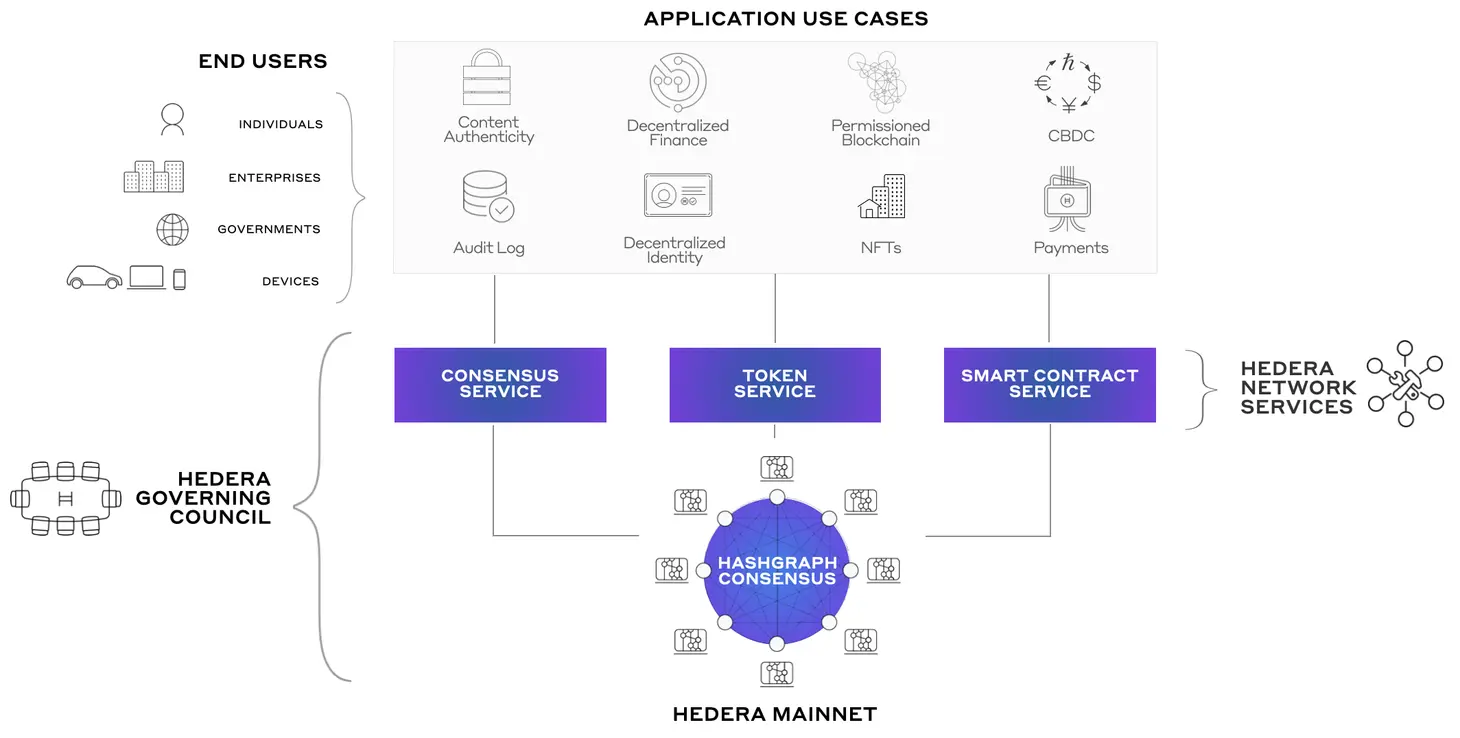
Hedera functions as more than just a payment network. The platform offers three core services that developers and enterprises can leverage to build decentralized applications:
Hedera Consensus Service (HCS): Provides secure, immutable logs of events and data. This proves particularly valuable for supply chain tracking, regulatory audits, and maintaining data integrity in heavily regulated industries like healthcare and finance.
Hedera Token Service (HTS): Enables the creation and management of various token types, including stablecoins, NFTs, and tokenized assets. Built-in features like account-level controls and compliance tools make it especially appealing for enterprises that need to meet regulatory requirements.
Hedera Smart Contract Service (HSCS): Supports Ethereum-compatible smart contracts, allowing developers to build DeFi applications, games, and automation tools while benefiting from Hedera's superior speed and substantially lower transaction fees.
Real-World Applications
Hedera's enterprise-focused approach has translated into practical implementations across multiple sectors:
- Finance: Standard Bank leverages Hedera's infrastructure for faster, more transparent cross-border payment processing.
- Supply chain: Companies like Suku and Avery Dennison use Hedera for product traceability and logistics management, providing end-to-end visibility.
- Healthcare: Safe Health Systems employs the network to securely log medical and clinical trial data while maintaining strict patient privacy standards.
- Gaming: Animoca Brands integrates Hedera's technology to create fair and tamper-proof in-game economies and digital asset management.
- Sustainability: Environmental organizations use Hedera's consensus service to track carbon credits and monitor environmental impact data with immutable records.
These implementations highlight Hedera's positioning as an enterprise-focused platform, creating a distinct contrast to networks that primarily serve DeFi protocols or retail trading activities.
Understanding HBAR: The Native Token
Like most distributed ledger technologies, Hedera operates with its own native cryptocurrency: HBAR. The token serves two fundamental purposes within the ecosystem:
- Network fuel: HBAR is required to pay transaction fees and access network services, including consensus operations, tokenization features, and smart contract execution.
- Network security: Node operators stake HBAR tokens to participate in consensus and help secure the network infrastructure.
One of Hedera's most practical advantages lies in its cost structure. A typical transaction costs approximately $0.0001, it’s economical enough to enable microtransactions and machine-to-machine payment scenarios that would be prohibitively expensive on other networks.
The total supply of HBAR is capped at 50 billion tokens. The distribution follows a controlled release schedule designed to avoid sudden market flooding while ensuring adequate liquidity for network operations.
How Hedera Compares to Other Networks
To understand Hedera's market position, it's helpful to consider how it stacks up against established blockchain models:
Proof-of-Work (PoW), exemplified by Bitcoin, is highly secure and battle-tested, but notoriously slow and energy-intensive.
Proof-of-Stake (PoS), used by Ethereum 2.0, is more energy-efficient than PoW, but can lead to wealth concentration among large token holders.
Lastly, Hedera Hashgraph uses gossip protocols and virtual voting to achieve speed, security, and efficiency simultaneously, while operating under corporate governance rather than anonymous network participants.
The trade-off is crystal-clear. Hedera prioritizes corporate trust, performance, and regulatory clarity, while accepting criticism that it may sacrifice some degree of decentralization compared to traditional blockchain networks.
The Challenges Ahead
Despite its technical strengths and enterprise adoption, Hedera faces some hurdles that could impact its long-term trajectory. The Governing Council model continues to raise questions about whether Hedera represents genuine decentralization or simply distributed corporate control, a debate that matters deeply to the broader crypto community's acceptance. Meanwhile, established networks like Solana, Avalanche, and Ethereum maintain their dominance over ecosystem development, making it challenging for Hedera to attract the vibrant developer communities that drive innovation.
The platform also faces an adoption challenge. While it excels in enterprise use cases, Hedera could broaden its appeal beyond corporate applications to achieve the kind of recognition that sustains long-term growth. Moreover, like all cryptocurrency projects, Hedera must navigate evolving regulatory frameworks across multiple jurisdictions, each with their own compliance requirements and restrictions.
Nevertheless, Hedera's focus on performance, enterprise-grade reliability, and regulatory compliance could provide resilience in certain market conditions where other projects would struggle to maintain institutional confidence.
HBAR ETF on the Horizon
Over the past several months, talk of a potential HBAR ETF has gained traction. An ETF would offer institutional and retail investors exposure to HBAR without needing to manage wallets, private keys, or direct custody. That kind of access lowers the entry-level barrier. Moreover, SEC approval of a Hedera ETF would imply a level of oversight, due diligence, and compliance that can help reduce perceived risks among cautious or regulated investors. It puts HBAR closer to the realm of mainstream finance instruments.
The U.S. Securities and Exchange Commission (SEC) recently pushed back the decision on the Canary HBAR ETF to November 8. The ETF was proposed by Nasdaq back in February; the SEC has delayed the decision twice already. Despite the most recent delay, however, market analysts remain optimistic. Bloomberg’s analysts, for instance, maintain a 90% likelihood of ETF approval in the near term.
The Future of Hedera
Hedera stands out in a crowded field by taking a completely different approach than most blockchain projects. Instead of following the usual playbook, they built something that actually works for businesses: fast transactions, costs you can predict, and energy usage that won't make your CFO cringe.
The real test isn't whether Hedera can keep doing what it's doing well. It's whether they can stay relevant as the whole distributed ledger world keeps evolving at breakneck speed. But here's the thing: while everyone else was busy trying to be the next Bitcoin, Hedera quietly built something that Fortune 500 companies actually want to use.
Whether that bet pays off long-term is anyone's guess. What's not up for debate is that they've proven there's more than one way to build a distributed ledger, and sometimes the road less traveled leads somewhere pretty interesting.