
Learning the friendly way
Dive into our resources, guides, and articles for all things money-related. Grow your financial confidence with our experts curated tips and articles for both experienced and new investors.
LATEST ARTICLEs

Money talks, but some currencies whisper so quietly you need a magnifying glass to hear them. In the grand theatre of global finance, not all currencies are created equal, while some strut around like peacocks (looking at you, Kuwaiti Dinar), others shuffle about with the confidence of a wet paper bag.
The Lebanese Pound (LBP) currently holds the unfortunate distinction of being the world's weakest currency in 2025, with an exchange rate so low that one U.S. dollar equals approximately 89,500 Lebanese pounds. To put this in perspective, you'd need a small suitcase to carry the equivalent of $100 in Lebanese pounds, assuming you could find enough physical notes.
Currency weakness isn't just about having a lot of zeros after the decimal point. It reflects a complex web of economic factors, including inflation rates, political stability, monetary policy decisions, and investor confidence. This guide on the world's weakest currencies in 2025, explores the economic stories behind their struggles and what it means for the countries (and the people) who use them.
Top 10 weakest currencies in the world (2025)
Here's the lineup of currencies that make your wallet feel surprisingly heavy when travelling abroad:
Exchange rates are approximate and fluctuate daily. Data compiled from multiple financial sources as of July 2025.
What makes a currency weak?
Before we roll our eyes at long strings of zeros, let’s get clear on what actually drives currency weakness.
Exchange rates show how much of one currency you need to buy another, usually measured against the U.S. dollar. But a low exchange rate isn’t automatically a red flag. Just like shoe sizes, bigger numbers aren’t necessarily worse, they’re just different.
The real reasons a currency weakens?
- Persistent inflation that eats away at value
- Short-term monetary policies that undermine long-term confidence
- Trade imbalances and shrinking foreign reserves
- Political instability that rattles investor trust
When investors lose faith, money moves fast, and exchange rates feel the impact. In short, weak currencies aren’t a punchline, they’re a signal of deeper economic tension.
Country spotlights - case studies behind the weakest currencies
Lebanon | A financial collapse without precedent
Lebanon’s currency crisis is a case study in how not to run an economy. As of mid-2025, the Lebanese pound trades at over 89,500 LBP per USD, making it one of the weakest currencies in the world.
The collapse stemmed from a banking sector that functioned like a state-sponsored Ponzi scheme: banks attracted deposits with sky-high interest rates, only to lend most of those funds to a debt-laden government. When confidence evaporated, the system imploded. Add in the 2019 mass protests and the devastating 2020 Beirut port explosion, and the result was economic freefall.
Today, Lebanese citizens navigate a surreal economy where ATMs limit withdrawals to tiny amounts, and many businesses have shifted to unofficial dollar pricing. A shadow economy thrives alongside the official one, proof that when trust in institutions fails, people find their own workarounds.
Iran | Sanctions, inflation, and isolation
The Iranian rial now trades at over 1,000,000 IRR per USD (yes, that's six zeros). Sanctions have cut Iran off from the global financial system, leaving its oil-rich economy unable to fully monetise its most valuable resource.
It's like owning a garage full of Ferraris with no keys to drive them. In response, Iran has attempted to bypass sanctions with crypto experiments and barter agreements, but none have stabilised the currency.
Inflation routinely exceeds 40%, and as a result Iranians have turned to gold, property, and U.S. dollars to preserve what little value they can. In a country known for its resilience, the rial’s collapse remains a stark reminder of the long-term costs of economic isolation.
Vietnam | Weak by design, not disaster
The Vietnamese dong trades at around 26,000 VND per USD, but that doesn’t signal a crisis, it actually reflects deliberate policy. Vietnam maintains a weaker currency to keep exports competitive, a strategy known as competitive devaluation.
This has helped transform Vietnam into a global manufacturing hub, attracting companies looking to diversify away from China. It's like running a permanent sale on your national output - foreign buyers love the prices, and Vietnamese factories stay busy.
The challenge lies in balance. The government works to avoid the inflation traps that have plagued other countries on this list, proving that not all weak currencies come from failure, some are tools of long-term economic strategy.
Laos | Trapped by debt and dependency
The Laotian kip now trades at around 21,800 LAK per USD, weighed down by inflation above 25% and a debt-to-GDP ratio over 125%. Much of that debt is owed to China, tied to major infrastructure projects that haven’t yet paid off economically.
Laos is a landlocked nation with limited industrial capacity and high import dependence, leaving its currency exposed whenever commodity prices shift. With little monetary wiggle room, the kip’s trajectory reflects deeper economic vulnerabilities.
Sierra Leone | A currency redefined, but still fragile
In 2022, Sierra Leone redenominated its currency, removing three zeros from the leone to simplify transactions. But even the new leone remains weak due to decades of disruption: civil war, the Ebola outbreak, COVID-19, and swings in diamond prices.
This is an economy that's faced shock after shock, and recovery is slow. The mining sector, especially diamonds, still dominates, leaving the leone vulnerable to commodity price drops.
Healthcare challenges and limited infrastructure add even more pressure, reducing productivity and increasing fiscal strain. The leone’s weakness tells the story of a country rebuilding piece by piece, with its currency reflecting both the past and the uphill path ahead.
Why some countries choose to keep their currency weak
Believe it or not, some countries actually prefer their currencies to be weaker - and for good economic reasons. It's counterintuitive, like preferring to drive in the slow lane, but the strategy can be remarkably effective.
Export competitiveness represents the primary motivation. A weaker currency makes domestic products cheaper for foreign buyers, essentially providing a permanent discount. German cars might be excellent, but if Vietnamese motorcycles cost 70% less due to currency differences, guess which ones developing countries will buy?
Countries like China famously maintained an artificially weak currency for decades, helping fuel their manufacturing boom. The strategy worked so well that other countries accused them of "currency manipulation" - the economic equivalent of being too good at a game and getting accused of cheating.
However, this approach carries significant risks. Import costs rise dramatically, making everything from oil to smartphones more expensive for domestic consumers
Long-term currency weakness can also trigger capital flight, where wealthy citisens move their money abroad. When your own citisens don't trust your currency, convincing foreigners becomes considerably more challenging.
Does a weak currency mean a weak economy?
We’ve established that a weak currency doesn't automatically signal economic disaster,sometimes it's just a reflection of different economic structures and historical circumstances.
Indonesia and Vietnam serve as the best examples of countries with numerically weak currencies but relatively strong economies. Both nations have achieved consistent growth, reduced poverty, and built increasingly diversified economies despite their currencies requiring calculators to count properly.
The key lies in purchasing power parity - what matters isn't how many zeros follow your currency symbol, but what those zeros can actually buy. A Vietnamese worker earning 10 million dong monthly isn't necessarily poor if that amount provides a comfortable living standard within the Vietnamese economy.
The real measure of economic health involves factors like employment rates, productivity growth, infrastructure development, and living standards. A country with a weak currency but growing wages, improving infrastructure, and expanding opportunities may be economically healthier than a nation with a strong currency but declining industries and rising unemployment.
What are the consequences of a weak currency?
In essence, a weak currency makes daily life more expensive, with rising prices on imports like food, fuel, and electronics. Added into the mix, Inflation erodes savings, and capital flight accelerates as people move their money into more stable currencies.
Over time, foreign currencies may replace the local one in everyday use, limiting government control. Internationally, weak currencies hurt credit ratings and investor confidence, reinforcing instability.
Final thoughts
Currency weakness is more than just numbers, it’s a signal. We’ve learnt above that it can both expose deep economic flaws or reflect deliberate strategies for growth. Lebanon and Iran highlight how instability and isolation can erode value fast, while Vietnam shows how weakness can fuel exports and development.
These disparities then shape the country’s trade, capital flows, and financial stability worldwide, causing a wider ripple effect. In a global economy, no currency moves alone; each affects the rest. And behind every weak currency are real people navigating inflation, opportunity, or uncertainty.

If you’re interested in staking Ethereum, you came to the right place. The largest liquid staking protocol in the crypto ecosystem, trusted by thousands of ETH holders who want rewards without losing liquidity, has a name: Lido DAO.
Ethereum's Leading Liquid Staking Protocol
How does it work?
Lido DAO is a decentralized autonomous organization that provides a liquid staking solution on the Ethereum 2.0 blockchain as well as other Proof of Stake (PoS) platforms like Solana (SOL), Polygon (MATIC), Polkadot (DOT), and Kusama (KSM).
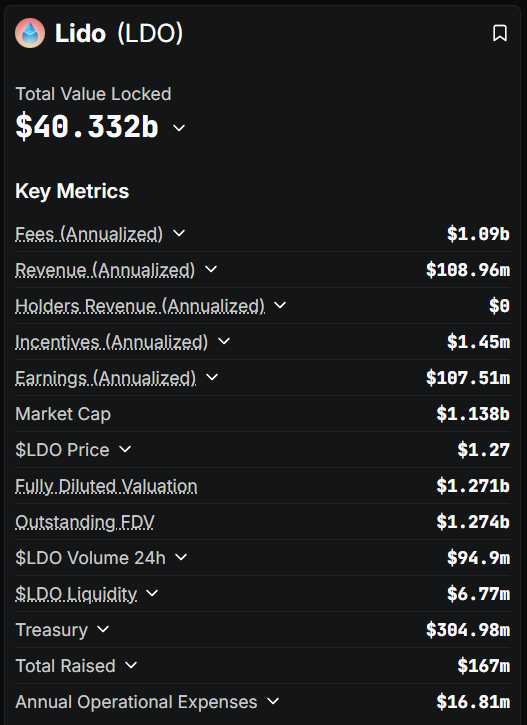
Instead of locking up funds, users stake ETH and receive stETH tokens in return, which represent their staked ETH plus accrued rewards. This allows users to continue trading, lending, or using their tokens across DeFi while still benefiting from staking yields. Since launching in 2020, Lido DAO has grown to manage more than $40.33B in Total Value Locked (TVL), with staking rewards currently averaging an annual percentage rate (APR) of 2.71%. The protocol is governed by holders of the LDO token, ensuring community-driven decision-making.
Where did it come from?
Lido DAO was co-founded by Kasper Rasmussen and Jordan Fish, also known as CryptoCobain. Behind the Lido DAO are a number of individuals and organizations that are well-regarded within the DeFi space. Since its inception in December 2020, shortly after ETH 2.0's release, the platform has been overseen by the Lido DAO, with several key members including Semantic VC, Chorus, ParaFi Capital, P2P Capital, Libertus Capital, Terra, StakeFish, Bitscale Capital, StakingFacilities, and KR1. Several of the highly esteemed angel investors include Stani Kulechov of Aave, Banteg of Yearn, Will Harborne of Deversifi, Julien Bouteloup from Stake Capital, and Kain Warwick from Synthetix.
Since then, Lido DAO has gained an impressive reputation for its liquid staking capabilities, and now boasts over $13 billion in staked assets. Its core focus is on Ethereum, yet its horizons are expanding to other blockchain networks including Terra and Solana, both of which launched staking capabilities in 2021, as well as several other layer 1 PoS blockchains.
Liquid Staking Made Simple
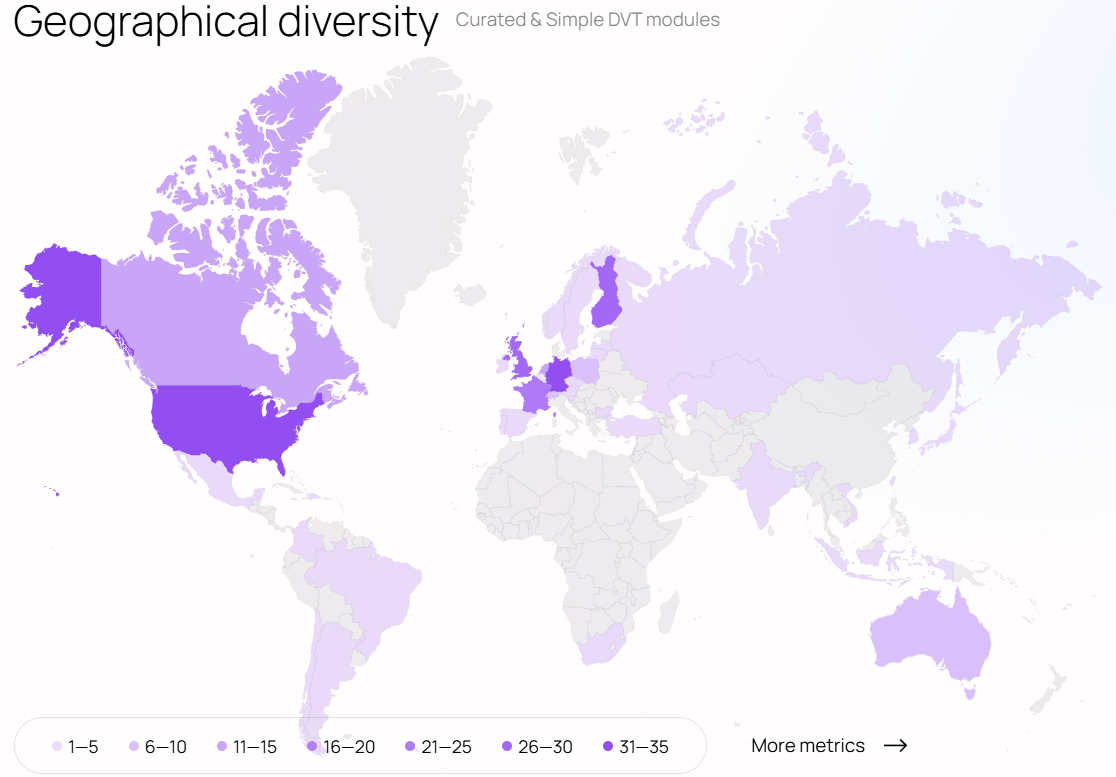
Lido DAO simplifies staking into a three-step process: deposit ETH, receive stETH, and start earning rewards automatically. When a user deposits ETH, the protocol delegates funds to a decentralized network of professional node operators. There are over 800 node operators worldwide, who manage validation securely and efficiently.
The stETH tokens received are liquid ERC-20 assets whose value increases over time as rewards accumulate. With one-click staking through Lido DAO’s interface, users can skip the hassle of running their own validator while enjoying a 98.2% validator performance.
How validator rewards are earned from staked assets
So, in order to stake ETH, become a validator and earn rewards for validating payments on the Ethereum platform, users are required to stake a minimum of 32 ETH tokens. What if I don’t have 32 ETH? You may ask. To bypass this minimum requirement and still earn rewards, Lido DAO allows users to stake a fraction of this amount and earn a proportionate amount of block rewards.
Users will then deposit ETH into the Lido smart contract and receive the same number of stETH. These tokens are minted once the funds have been received and are burned when the users withdraw their original ETH. The staked funds will then be distributed to the validators on the Lido network and deposited into the Ethereum Beacon Chain from where they will be secured in a smart contract.
The Lido DAO will then assign, onboard, support and enter the validators' addresses to the smart contract registry before being given a set of keys for the validation. All ETH that users have deposited on the Lido platform will be split into groups of 32 ETH among the active Lido node operators who will use this public validation key to validate transactions. The block rewards will then be shared proportionately.
Notably, this distribution process of sharing staked assets eliminates single-point-of-failure risks common among single-validator staking.
Your Liquid Staking Asset
At the center of Lido DAO’s system is stETH, the tokenized representation of staked ETH. stETH trades on major exchanges, offering deep liquidity and integration with several DeFi protocols. Staking rewards are earned automatically, so users never need to claim manually.
Users can stake any amount of ETH to the Beacon Chain without having to deal with lock-up requirements or withdrawal delays. This way Ethereum holders can enjoy both liquidity and yield simultaneously. For providing this staked ETH service, a 10% fee is collected by Lido for each process.
DeFi Integration Opportunities
For advanced users, stETH unlocks a wide range of yield optimization strategies. Lending platforms like AAVE accept stETH as collateral, while liquidity pools on CURVE and UNISWAP offer additional yield opportunities. Leveraged staking strategies also allow users to compound rewards further.
Proven Security
Security and safety are central to Lido DAO's success. Since the beginning, the protocol has undergone a dramatic array of independent audits, conducted by top-tier firms including Statemind, Certora, Hexens, Oxorio, MixBytes, and Ackee Blockchain.
Importantly, Lido DAO has never suffered a major protocol-wide hack. The protocol takes advantage of open-source code, multisig governance, and safeguards like GateSeal for emergency pauses, deposit security modules, and DAO oversight to anticipate and mitigate emerging threats. These layers of defense, combined with a multi-validator, geographically distributed network, reduce single points of failure.
What is Lido DAO token (LDO)?
Governance of the Lido DAO is powered by the LDO token, which grants voting rights to its holders. With a market capitalization of $1.14B and an all time high (ATH) price of $2.38 USD, LDO plays a central role in shaping the protocol’s future. Token holders vote on proposals, influence fee structures, and participate in selecting node operators. The governance community is highly active, with regular proposals and ongoing discussions that ensure the protocol evolves in a decentralized and transparent way.
How to buy Lido LDO?
Staking with Lido DAO is meant to be as accessible as possible. There are no minimum deposit requirements; end users can stake any amount of ETH. You can connect an Ethereum wallet, confirm the transaction, and receive stETH instantly.
If you're looking to expand your digital currencies portfolio, LDO tokens can be a potential addition. The Tap app provides an easy and secure way for anyone with an account to add these tokens to their portfolios in no time, making it one of the most effortless trading experiences around.
You can utilize the Tap app to access the Lido ecosystem by purchasing LDO tokens with either crypto or fiat currencies. End users can then choose to store their LDO tokens securely in the integrated crypto wallet or transfer them to the Lido platform and engage in the platform's earning potential. All you need to do to get started is download the app and create an account in minutes.

Despite radically reshaping the world’s financial landscape, the first ever cryptocurrency has limitations when interacting with newer blockchains. For example, Ethereum. Wrapped Bitcoin (WBTC) solves this limitation by allowing Bitcoin to function on the Ethereum network, enabling access to decentralized finance (DeFi) services.
WBTC is an ERC-20 token that represents Bitcoin 1:1 on the Ethereum blockchain, combining Bitcoin’s value with Ethereum’s smart contract power, and opening new opportunities for BTC holders in decentralized finance (DeFi). Unlike Bitcoin variants aiming to improve its technology, WBTC extends Bitcoin's utility without replacing it.
Join us in this deep dive on how WBTC works, its benefits, risks, and how it connects Bitcoin to the broader DeFi ecosystem.
Unlocking Bitcoin’s Power on Ethereum
Launched in January 2019, approximately 10 years after Bitcoin's initial release, WBTC was created as a collaborative effort between BitGo, Kyber Network, and Ren (formerly Republic Protocol), along with other major players in the DeFi space including MakerDAO, Dharma, and Set Protocol.
As an ERC-20 token, WBTC adheres to Ethereum's token standard, making it compatible with the entire Ethereum ecosystem, including its smart contracts, decentralized applications, and wallets.
In structure, WBTC bears similarities to stablecoins like USDC or USDT, which are backed by reserve assets. However, while stablecoins aim to maintain a stable value (usually pegged to a fiat currency like the US dollar), WBTC's value fluctuates with Bitcoin's market price.
Each WBTC token is backed by an equivalent amount of Bitcoin (BTC) held in reserve by a custodian, maintaining a strict 1:1 ratio, meaning 1 WBTC is always equivalent to 1 BTC in value.
Wrapped Bitcoin is now under the control of a Decentralized Autonomous Organization (DAO) called the WBTC DAO. This organization oversees the protocol, ensuring the integrity of the wrapping process and maintaining transparency in the system. Unlike Bitcoin's fully decentralized nature, WBTC relies on certain trusted entities to maintain the backing of the tokens, which creates an interesting balance between utility and trustworthiness.
WBTC belongs to a broader category of financial instruments known as "wrapped tokens." These are cryptocurrencies that are enclosed or "wrapped" in a digital vault and represented as another token on a different blockchain. While WBTC represents Bitcoin on Ethereum, there are other wrapped tokens in the cryptocurrency space, including Wrapped Ether (WETH) which, somewhat paradoxically, is a wrapped version of Ethereum's native token on its own blockchain that conforms more strictly to the ERC-20 standard.
Why Does Wrapped Bitcoin Exist?
Wrapped Bitcoin (WBTC) was created to bridge the gap between Bitcoin and newer blockchain platforms like Ethereum.
1. Bitcoin's limited smart contract functionality
Bitcoin prioritizes security over programmability, making it unsuitable for complex decentralized apps. In contrast, Ethereum supports smart contracts that power a wide range of automated financial services.
2. Access to DeFi for Bitcoin holders
Ethereum's DeFi ecosystem offers lending, trading, and yield farming, but Bitcoin holders couldn't participate without converting their BTC. WBTC solves this, letting them use Bitcoin's value within Ethereum-based applications.
3. Unlocking Bitcoin's liquidity
Bitcoin's vast market capitalization holds significant untapped liquidity. WBTC brings this capital into Ethereum's DeFi network, benefiting both Bitcoin holders and the broader ecosystem.
4. Faster, more flexible Bitcoin transactions
While Bitcoin transactions can be slow and costly, WBTC uses Ethereum's network for quicker, cheaper trades-ideal for active traders and DeFi users.
In short, WBTC enhances Bitcoin's utility without altering its core protocol, connecting it to the evolving world of decentralized finance.
How Does Wrapped Bitcoin Work? The Nuts and Bolts
Wrapped Bitcoin (WBTC) bridges Bitcoin and Ethereum through a secure, transparent process involving key participants and smart contracts.
1. Wrapping and unwrapping process:
Wrapping (BTC → WBTC): Users send Bitcoin to a custodian, who secures it and mints an equivalent amount of WBTC on Ethereum, sending it to the user's Ethereum wallet.
Unwrapping (WBTC → BTC): Users burn WBTC, prompting the custodian to release the equivalent Bitcoin back to their Bitcoin wallet.
This 1:1 pegging ensures WBTC is fully backed by Bitcoin reserves.
2. Key participants:
Custodians (e.g., BitGo): Hold and safeguard the Bitcoin backing WBTC.
Merchants: Authorized to request minting or burning of WBTC.
Users: Individuals or entities using WBTC in Ethereum's DeFi ecosystem.
WBTC DAO Members: Stakeholders who govern protocol decisions.
3. Transparency and verification:
Proof of reserves: Publicly verifiable Bitcoin addresses back every WBTC in circulation.
On-chain verification: Minting and burning are recorded on both blockchains.
Regular attestations: Independent checks confirm reserve accuracy.
4. Technical implementation:
WBTC is built as an ERC-20 token, Ethereum’s standard for fungible tokens. All ERC-20 tokens follow the same set of rules, which makes them interchangeable, easy to trade, and instantly compatible with most Ethereum wallets and DeFi apps.
This makes WBTC easily transferable, compatible with wallets, and usable in DeFi apps like lending platforms, decentralized exchanges, and yield farming protocols. It gives Bitcoin the same programmability and utility as Ethereum-native assets.
Showdown: Wrapped Bitcoin (WBTC) vs. Bitcoin (BTC)
Although WBTC and BTC share the same value, their use cases differ. Bitcoin is designed for security, immutability, and censorship resistance. WBTC, on the other hand, thrives in Ethereum’s ecosystem where smart contracts enable lending, borrowing, and trading.
For storing wealth long-term, Bitcoin remains the go-to. For generating yield or accessing DeFi, WBTC is the practical choice. Different uses for different needs.
How Wrapped Bitcoin Boosts Your Crypto
1. DeFi accessibility:
WBTC lets users leverage Bitcoin in DeFi platforms for:
Lending & borrowing: Use WBTC as collateral on platforms like Aave or Compound to earn interest or borrow assets.
Yield farming: Provide WBTC liquidity for rewards, often surpassing Bitcoin's passive holding returns.
Liquidity provision: Earn trading fees by adding WBTC to pools on exchanges like Uniswap.
Synthetic assets: Mint assets pegged to traditional markets using WBTC as collateral.
2. Enhanced liquidity:
WBTC boosts capital efficiency across Ethereum by:
Expanding DeFi liquidity: Unlocking Bitcoin's market value to strengthen liquidity pools.
Reducing slippage: Deeper markets enable smoother trades.
Providing stable collateral: Bitcoin-backed assets offer trusted options for DeFi protocols.
3. Transaction advantages:
Compared to Bitcoin, WBTC transactions on Ethereum benefit from:
Faster confirmations: Ethereum's ~12-second block times outpace Bitcoin's 10-minute average.
Predictable fees: Ethereum's fee structure can be more cost-effective in certain conditions.
Smart contract integration: WBTC supports complex transactions Bitcoin's network can't handle.
4. Broader utility:
Beyond DeFi, WBTC enhances user options by:
Accessing smart contracts: Participate in advanced applications without selling Bitcoin.
Composability: Use WBTC across multiple protocols simultaneously.
Simplified management: Store WBTC alongside other Ethereum assets in common wallets.
Gaming & NFTs: Spend WBTC in blockchain games or NFT marketplaces.
While WBTC offers significant opportunities, it comes with trade-offs regarding decentralization and security, as covered in the next section.
Navigating Wrapped Bitcoin: Risks and Challenges
Custodial risks
While WBTC brings Bitcoin into DeFi, it introduces centralization as well. WBTC depends on BitGo as the sole custodian to hold the backing Bitcoin, creating a central point of failure. Users must trust these custodians to safeguard funds, process redemptions, and comply with regulations that could freeze assets or restrict conversions.
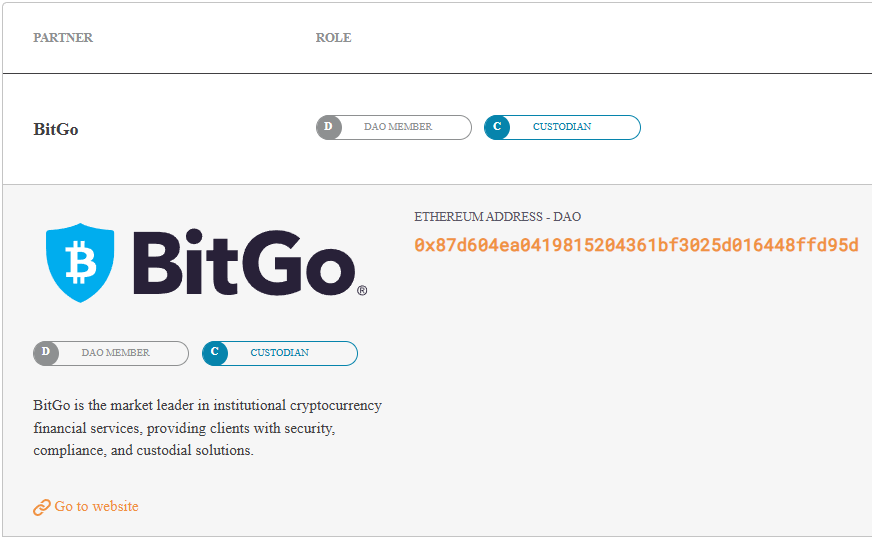
BitGo, DAO member and sole custodian. Source.
Smart contract risks
WBTC relies on Ethereum smart contracts, which, despite audits, can still have vulnerabilities or coding flaws. It's also affected by Ethereum network issues like congestion, high gas fees, and risks from interacting with DeFi platforms.
Price and market risks
WBTC tracks Bitcoin's price and shares its volatility. In turbulent markets, it may trade slightly above or below Bitcoin's value. Large conversions can strain liquidity, making big trades harder without impacting price.
Operational challenges
Managing WBTC involves both Bitcoin and Ethereum blockchains, which can be complex for newcomers. High Ethereum gas fees and slow WBTC-to-Bitcoin conversions (especially for large transactions) are additional hurdles.
Alternatives with less trust required
Some users prefer fully decentralized options like native Bitcoin, though it lacks smart contract functionality. Other wrapped Bitcoin solutions use different technologies to reduce reliance on custodians.
Wrapping Up WBTC
WBTC represents a shift in the cryptocurrency space, bridging the gap between Bitcoin's unparalleled network security and store-of-value properties with Ethereum's programmability and vibrant DeFi landscape. Since its launch in 2019, WBTC has grown from a novel concept to a cornerstone of cross-chain interoperability, enabling countless new use cases for Bitcoin holders.
For users, WBTC allows exposure to Bitcoin while engaging with decentralized finance (DeFi) on Ethereum and other platforms, enabling participation in both without choosing between them. While for DeFi, Bitcoin's liquidity has fostered growth, stability and asset diversity. WBTC has also paved the way for other wrapped assets, making the crypto ecosystem more interconnected and efficient.
As blockchain technology evolves, solutions like WBTC will address limitations while retaining core utility. Its success shows how cryptocurrency innovation can build upon existing strengths without replacing them.
Other Wrapped Bitcoin alternatives
While WBTC is the most widely used Bitcoin representation on Ethereum, several alternatives have emerged, each with different approaches to the bridge between Bitcoin and other blockchains:
- renBTC
- tBTC
- sBTC (Synthetic BTC)
- HBTC
- pBTC
How Can I Buy Wrapped Bitcoin (WBTC)?
If you’re looking to bring Bitcoin into the world of Ethereum, Wrapped Bitcoin (WBTC) is the gateway you might be looking for. Through the Tap app, users can easily add WBTC to their portfolios, opening up access to Ethereum’s thriving DeFi ecosystem. Getting started is simple: just download the app, create an account, and start trading WBTC in minutes.

For a fleeting moment, it looked like altcoin season was finally here. Google searches for “altcoins” skyrocketed to record highs, 𝕏 was buzzing, and retail excitement seemed to return in full force. But within a week, that hype fizzled out almost as quickly as it appeared, leaving traders wondering if the long-awaited alt season was just a mirage.
A Spike That Vanished Overnight
Search interest for “altcoin” on Google Trends hit its highest score ever in early August, only to fall back to baseline levels within days. Globally, the same pattern played out, with scores dropping from 100 to just 16 in a week, mimicking a “pump and dump” pattern that you would expect from a memecoin.
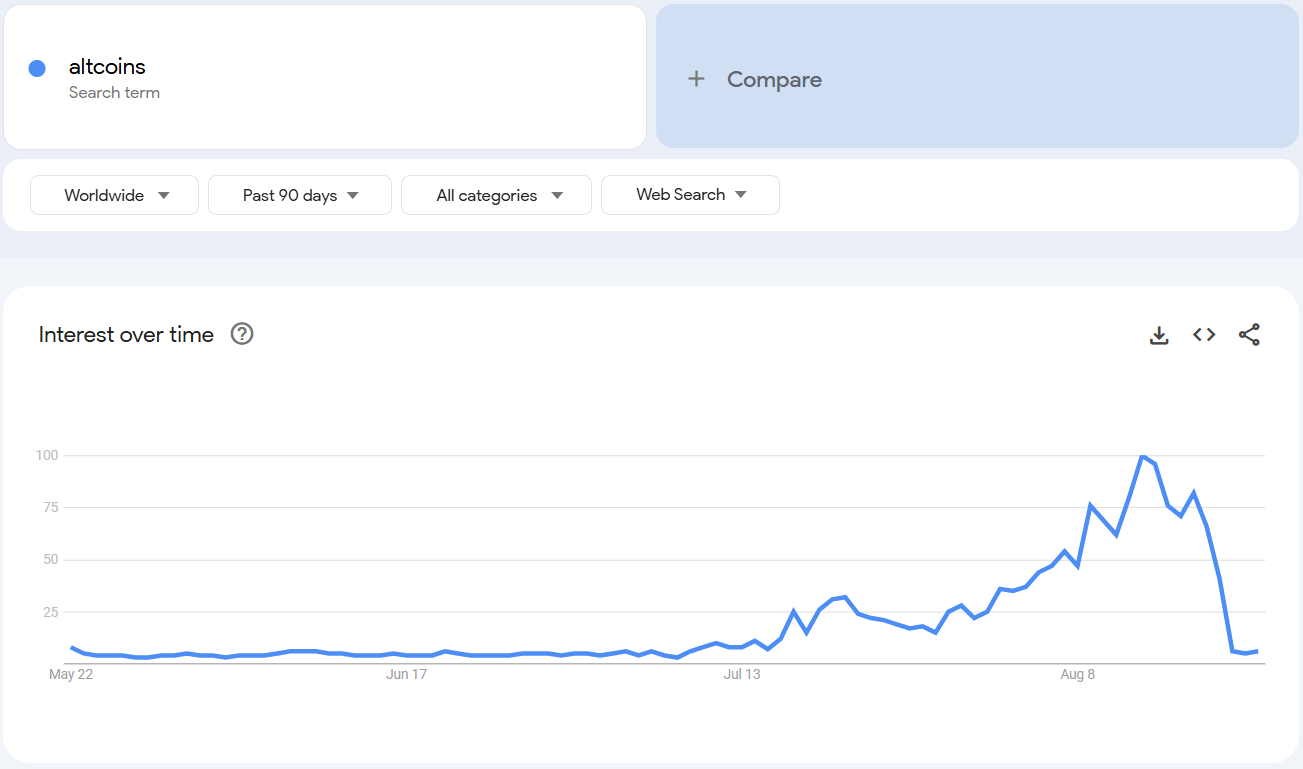
Market cap data told the same story. The total value of altcoins (excluding Bitcoin and Ethereum) briefly climbed by $100 billion before giving it all back, leaving investors wondering whether the hype had any real weight behind it.
Naturally, some saw the collapse as proof that the altcoin season had ended before it really began. Others, however, like analyst Cyclop, argue the spike shows something deeper: that “altcoin” has become the mainstream term retail uses today, replacing “crypto” in 2021. In his view, this isn’t the peak. Rather, it’s just the beginning of broader interest.
Why Google Trends Doesn’t Tell the Whole Story
Relying on Google searches to measure retail demand may no longer work the way it used to. With AI tools increasingly replacing traditional search, and with concepts like “altcoins” now part of everyday investor vocabulary, Trends data might not be capturing where and how money is really flowing.
Instead, analysts point to on-chain and trading activity as better indicators of where momentum is building. And in August, that momentum was fragmented.
A Season of Winners and Losers
Data from Artemis showed only a few categories outperforming last month: Ethereum, exchange tokens, and oracles.
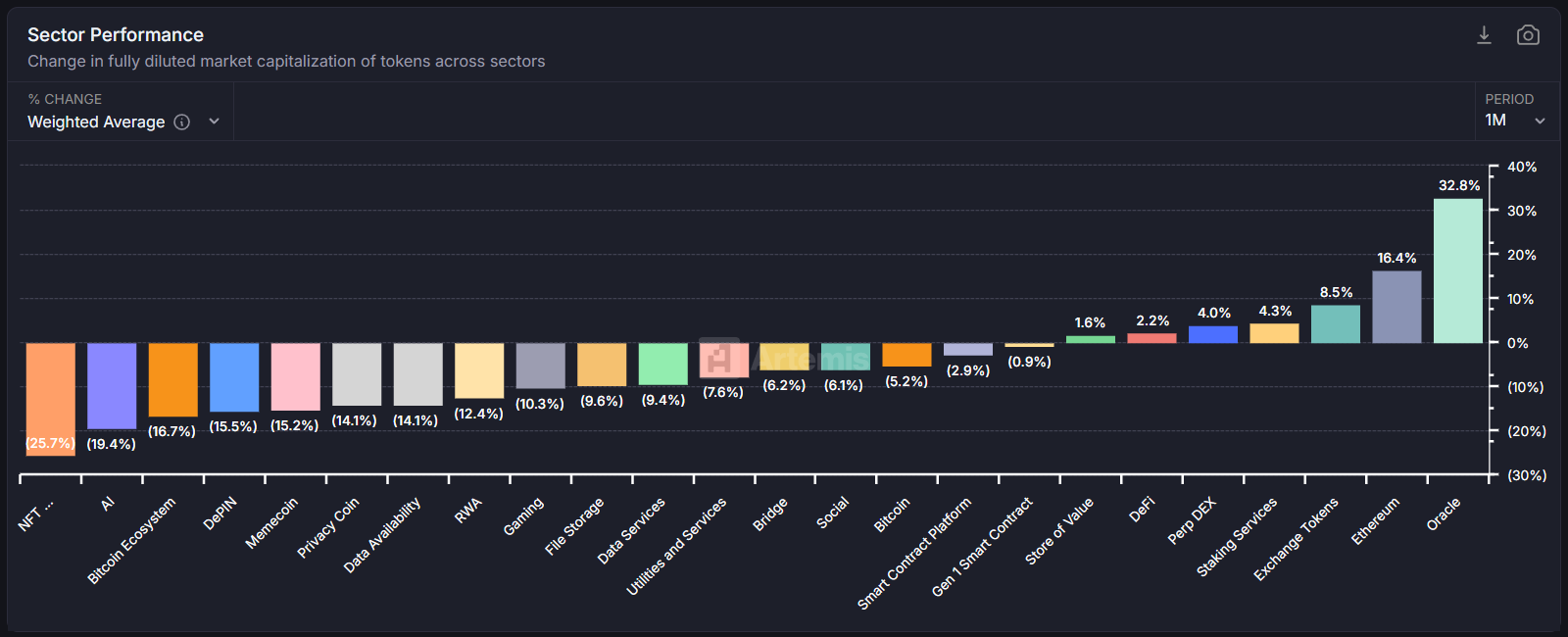
Beyond these bright spots, however, most altcoins struggled. The result? A patchwork “mini season” rather than the explosive, across-the-board surge that retail and social media had been hoping for.
Polygon’s co-founder Sandeep put it bluntly: "Retail is searching, but institutions aren't buying the narratives yet. Old altcoin seasons were driven by speculation and promises and narratives and marketing. Institutional money is smarter money. It cares about real utility and cash flows. The next "alt season" won't look like 2017 or 2021. It’ll be fewer tokens with actual usage, not just tokens with better marketing." Sandeep said.
The Road Ahead
That doesn’t mean altcoin season is dead, it probably just means it’s evolving.Coinbase has suggested that the next true wave could arrive as early as September, but that it likely won’t be a full-scale altcoin season.
Bottom line? The altcoin season isn’t gone; it’s just different. It’s maturing. And the next leg up may not belong to every token in the market, but only to the select few proving they can deliver value beyond mere speculation.
Crypto lending might be the hot new product in the cryptocurrency space, but before you dive in be sure to first understand what it entails. The concept grew great traction with the rise of the decentralized finance (DeFi) movement, with platforms offering users high yields for borrowing crypto assets.
Let’s get started with what crypto lending is, and then explore how the product works.
What is crypto lending?
Crypto lending is a traditional banking service curated to the crypto world. With the DeFi space remains largely unregulated, many crypto exchanges and other platforms have started offering these services, with added security.
Crypto lending involves a user lending crypto assets to a platform in return for interest, which allows other users to then borrow said crypto assets, paying interest on the amount borrowed. The platform will then take a small percentage of the interest paid.
Depending on the platform and other factors, crypto lending platforms may be centralized or decentralized and offer exceptionally high-interest rates, with annual percentage yields (APYs) of 15% or more. With the interest rates being higher than traditional bank accounts, lenders gain access to much greater yields, increasing their returns.
Another advantage to crypto lending is that users are still exposed to price gains in the market. Meaning that if you deposit your Bitcoin when it's worth $20,000 and the price rises in value to $50,000, you are still able to realize these returns and earn interest for the duration of the loan.
Note that interest rates might fluctuate with market conditions on some platforms, increasing when the prices increase and decreasing when markets are down.
How does crypto lending work?
Cryptocurrency lending platforms function as middlemen connecting lenders to borrowers. Lenders deposit their digital currency into high-interest lending accounts, and borrowers utilize the lending platform to acquire loans. These systems then lend money utilizing the crypto that investors have provided them.
The platform controls its net interest margins by establishing the interest rates for both lending and borrowing.
Rates on platforms differ from cryptocurrency to cryptocurrency, some platforms might offer higher interest rates to lenders willing to commit to a certain time frame. There is no standard interest rate for cryptocurrencies, as each platform has its own set of rules.
Centralized crypto lending means putting your money in the hands of a corporation or other entity to manage and make the process easier. Accounts are created for borrowers and lenders, and loans may be requested by applicants.
Lenders and borrowers may connect their cryptocurrency wallets to a decentralized crypto lending protocol, which uses smart contracts to automate the lender-borrower relationship. Smart contracts are automated digital agreements that execute once certain criteria is met.
The advantages of crypto lending
There are several benefits to crypto lending when comparing it to a regular bank account.
Borrowers have access to these financial services without having to pass a credit check, making it more financially inclusive than traditional banking services. They are also exposed to lower interest rates than regular banking loans.
Lenders that give loans in the form of cryptocurrencies can make a lot more money from their crypto assets than savings accounts. It may also be a more adaptable choice to crypto staking, which requires users to lock up their cryptocurrency and submit it to a blockchain security method. Depending on the platform, lending usually gives users access to their funds.
The downside to crypto lending
The agreement with crypto loan companies is generally made on individual terms by institution borrowers. As interest rates vary across platforms and cryptocurrencies, each company is different.
There have been several cases where lending platforms have been hit by severe liquidity crisis, notably Celsius, Voyager Digital, and BlockFi. Glenn Huybrecht, COO of Cake DeFi, said, “Some lending providers have been very generous with low collateral requirements, which then puts them in hot water when one of their customer's defaults.”
Due to the ongoing regulation battles, these crypto services are also not backed by government safety nets, like the traditional banks are. However, some platforms do hold insurance and the necessary regulatory accreditations so be sure to seek one that has all of the above.
Closing thoughts
Crypto lending platforms differ greatly from one another so be sure to check each platform, their interest rates for all the various currencies supported, and if there are any lock-up periods or fees payable.
Every move on Ethereum (sending crypto, minting an NFT, using a dapp) comes with a cost. That cost is called gas. It’s not just a fee - it’s the fuel that keeps the network running.
Knowing how gas works means you’re not just using Ethereum, you’re using it smarter. You can time transactions, avoid peak congestion, and cut your costs. Here we explore how it works and how to take control in a simple and easy-to-understand way.
What are Ethereum gas fees?
Let’s start with the basics: gas fees are the cost of using the Ethereum network. Any time you do something - like send ETH or swap tokens - you’re asking the network to do work. That work takes computing power, and gas fees are what you pay to get it done.
These fees serve three critical functions:
- Compensate validators for their work
- Secure the network from spam attacks, and
- Prioritise transactions during busy periods.
When the network buzzes with activity, the fees naturally rise as users compete for limited block space. Picture Ethereum as a busy highway during rush hour. More traffic means higher tolls, but the road remains secure and functional for everyone willing to pay the current rate.
How Ethereum gas fees work
Every gas fee breaks down into a simple formula that establishes your specific transaction cost:
Total fee = (base fee + priority fee) × gas limit
Let’s break it down:
- The base fee is the minimum cost to get your transaction into a block. It goes up when the network is busy and is burned (destroyed) to help reduce ETH supply.
- The priority fee (tip) is an extra amount you add to speed things up (like tipping for faster service).
- The gas limit is how much work your transaction needs. Bigger, more complex actions need a higher limit.
Another important element to understand is that gas prices are measured in Gwei, where 1 Gwei equals 0.000000001 ETH. A typical token swap might use 30,000 gas units. If the current base fee sits at 25 Gwei and you add a 5 Gwei tip, your total cost becomes:
(25 + 5) × 30,000 = 900,000 Gwei = 0.0009 ETH
Let’s say at $2,500 per ETH, that transaction would cost $2.25.
Why Ethereum gas fees fluctuate
Gas fees move with the rhythm of the network. When demand is low, fees drop. When things heat up, they spike.
Big events like new token launches, NFT drops, or market surges can therefore clog the network. More users = more competition for space. That’s when the base fee goes up (remember the formula above: total fee = (base fee + priority fee) × gas limit).
The base fee adjusts with every block (around every 15 seconds). It rises when blocks are more than 50% full and drops when they’re under that threshold.
The type of transaction also matters:
- A simple ETH transfer uses about 21,000 gas units.
- A complex smart contract call: +/-200,000.
- A typical Uniswap swap costs 3–5x more than a basic transfer.
And don’t forget ETH’s price. Even if gas stays steady in Gwei, rising ETH makes each transaction more expensive in dollars.
Quick Tip: Check gas trackers before major transactions. A few minutes of timing can save significant money.
How to check Ethereum gas prices in real time
Active users monitor gas prices like traders watch market charts. There are several tools that provide real-time visibility into the network’s condition.
- Etherscan’s gas tracker (for deep analytics)
Etherscan provides in-depth gas analytics including real-time rates, historical charts, and insights into average and peak fees. It also offers optimisation tips like identifying “safe low‑cost windows” for transactions. - Rabby wallet (for user-friendly alerts)
Rabby’s mobile and browser wallet features built-in gas monitoring, showing current prices and offering “Gas Top Up” functionality. It also supports push notifications (via its GasAccount feature) for favourable conditions. - MetaMask (for fully integrated wallet visibility)
MetaMask displays live gas rates directly in its interface and dashboard. You'll see options like Low, Market, or Aggressive for gas speeds, and it even shows fiat equivalents beside token balances.
Most gas trackers display slow, standard, and fast fee tiers, helping you balance cost and speed.
It’s also worth knowing that slow transactions may take 5-10 minutes but can save you 20-30% on fees, while fast ones aim to process within a couple of minutes, at a premium price.
Gas prices also follow weekly patterns. Fees are usually lower on weekends, when institutional and high-frequency trading slows down. And if you’re not in a rush, consider transacting during early morning hours (2–6 AM EST), often the cheapest window of the day.
Ethereum gas fees before and after the merge
Over the years, Ethereum has gone through major upgrades that changed how gas fees work, though granted not always in the ways people expected.
In 2021, the London Hard Fork introduced EIP-1559, swapping chaotic gas auctions for a more predictable pricing model: a base fee + tip. It made fee estimates more stable, but didn’t necessarily make them cheaper.
Then came The Merge in 2022, shifting Ethereum to proof-of-stake. It cut energy use and made block processing more efficient. But despite common belief, it didn’t slash gas fees overnight.
However, The Merge did lay the groundwork for future upgrades (like sharding and rollups) that will unlock real, lasting fee reductions at scale.
Looking ahead, upgrades like Proto-Danksharding aim to scale Ethereum and bring fees down for good.
How to reduce ETH gas fees
Despite what some might tell you, cutting gas fees isn’t about luck, it’s more about smart choices and good timing. Here are some options:
Use Layer 2s
Networks like Arbitrum, Optimism, and Base offer the biggest savings, sometimes up to 90–95% cheaper than the Ethereum mainnet. For example, a $50 swap on mainnet might cost just $2-$5 on these platforms, with the same level of security. (More on this below).
Simulate before you send
Tools like Tenderly and DeFi Saver let you test complex transactions first, helping you avoid failed attempts that still burn gas.
Pick your moment
As mentioned above, prices drop when the network is quiet. Use gas trackers to spot the best times to transact.
Batch when you can
Some protocols let you combine multiple actions into one transaction, so you pay one base fee instead of several.
Layer 2 solutions that cut gas costs
Layer 2 networks are the future of Ethereum scaling. They can handle thousands of transactions off-chain, then settle them on Ethereum in one go, cutting costs and speeding things up.
- Arbitrum leads in total value locked. It offers fast transactions for just $0.10-$0.50 and supports most major DeFi apps, making it feel like a cheaper version of the mainnet.
- Optimism offers similar savings, with bonus perks like token rewards for developers through its RetroPGF program, driving growth and innovation.
- Base combines low fees with easy fiat onramps. It’s great for beginners moving from exchanges into DeFi.
These networks are able to do what they do by using rollups, a tech that bundles hundreds of transactions into one. Think of it like carpooling: everyone shares the cost of the ride, but still gets where they need to go.
Who receives Ethereum gas fees?
Since The Merge, Ethereum handles gas fees in a smart split between rewards and supply control.
- Validators (who secure the network) earn priority fees - tips from users that reward them for processing transactions. This keeps the network safe and running smoothly.
- Base fees, on the other hand, are burned (permanently removed from circulation). When the network is busy, more ETH is burned, which can reduce supply and make ETH more valuable over time.
Will Ethereum gas fees ever go down?
Ethereum’s roadmap promises big fee cuts, but the biggest changes will take time.
- Proto-Danksharding (EIP-4844) is expected in upcoming upgrades. It will slash Layer 2 costs by 10-100x by creating dedicated space for rollup data. This upgrade is the closest major step toward lower fees.
- Full Danksharding, further down the line, will boost Ethereum’s capacity massively, making tiny, sub-penny transactions on Layer 2 networks a reality without sacrificing security or decentralisation.
- Ethereum’s founder, Vitalik Buterin, envisions the mainnet as a secure settlement layer, while Layer 2s handle most daily transactions quickly and cheaply.
If all goes as planned, popular Layer 2s could offer fees under one cent within 2-3 years, opening the door for micro-transactions and true global use.
Comparison: Ethereum vs other chains
Blockchain networks take different paths when balancing cost, security, and decentralisation, and fees reflect those choices. Let’s take a look at its biggest competitors.
Solana vs Ethereum
Solana offers super low, sub-penny fees and processes around 3,000 transactions per second (far more than Ethereum’s +/-15 TPS). This speed comes from different architectural choices, but with tradeoffs like higher hardware requirements and occasional network outages.
Ethereum, meanwhile, prioritises security and decentralisation, scaling through Layer 2 solutions to keep fees competitive.
Binance Smart Chain vs Ethereum
Binance Smart Chain (BSC) delivers low fees, typically $0.10–$0.50 per transaction, but it sacrifices decentralisation by relying on fewer validators and tighter connections to centralised infrastructure.
Ethereum maintains a more decentralised network while scaling costs through Layer 2s, keeping security front and centre.
Avalanche vs Ethereum
Avalanche strikes a balance with moderate fees ($0.50–$2.00), high throughput, and strong security. However, its ecosystem remains smaller than Ethereum’s rich DeFi landscape, which benefits from Layer 2 scaling and a strong focus on decentralisation.
Final thoughts
Understanding Ethereum gas fees puts you in control, allowing you to save money and utilise the network more efficiently. While fees can fluctuate, smart timing, Layer 2 solutions, and upcoming upgrades promise a future of faster, cheaper transactions.
While Ethereum continues to prioritise security and decentralisation, its gas fee roadmap reflects a careful balance between innovation and accessibility, paving the way for broader adoption and everyday use.


