Learning the friendly way
Dive into our resources, guides, and articles for all things money-related. Grow your financial confidence with our experts curated tips and articles for both experienced and new investors.
LATEST ARTICLEs

Sure, crypto markets reacting negatively to macroeconomic policy shifts is nothing new, but these “worse than expected” Liberation Day tariff announcements have been particularly brutal.
Looking at the numbers, the sweeping tariffs introduced by U.S. President Donald Trump have resulted in mass liquidations. Almost a week later, $8.27 trillion has been wiped from global stock markets and $233 billion from crypto markets, bringing the overall crypto market cap down 8.5%.
But how exactly do tariffs influence crypto? The immediate reaction was a sharp downturn, with big names like Bitcoin falling below $82,000, and later $74,700, and Ethereum dropping to lows of $1,400.
In the long term, could these economic policies position crypto as a safe haven? Let’s explore the interplay between trade policy, traditional finance, and crypto prices.
Firstly, what are tariffs, and how do they affect the markets?
In a nutshell, tariffs, or taxes on imported goods, create ripple effects across various financial markets. Historically, they have had an impact on:
- Foreign exchange (FX) markets: The USD typically strengthens when tariffs are imposed, as more global investors seek stability, and in response, a stronger USD often puts downward pressure on Bitcoin and altcoins.
- Equities: Stocks, particularly in sectors reliant on global trade, tend to decline as tariffs increase business costs and disrupt supply chains.
- Inflation & interest rates: Tariffs can contribute to higher consumer prices, influencing Federal Reserve policy and liquidity conditions, which in turn affect investment in risk assets like crypto.
The interconnected nature of these macroeconomic factors proves once again that digital assets are not insulated from traditional market turbulence. Let’s explore the damages.
Trump’s “Liberation Day” tariff announcement
So, what happened? On 3 April, Trump announced a 10% baseline tariff on U.S. imports, with 60 countries, including Cambodia, China, Vietnam, Malaysia, and Bangladesh, facing tariffs of up to 50%. Companies in the EU will see 20% tariffs, all taking effect a week later.
Previously announced 25% tariffs on steel, aluminum, and foreign-made cars remain in place.
How the crypto market responded
Never missing a beat, the crypto market reacted swiftly to the tariff announcements:
- Bitcoin has dropped ~10% since February. On 3 April, the price fell from $87,106 to $82,526 in a matter of hours, falling to lows of $74,700 days later.
- Ethereum followed a similar trajectory, dipping to lows of $1,430.
- Altcoins were hit harder, with SOL dropping nearly 25% to $97.52 - its first dip below $100 since February 2024.
- Crypto-related equities tanked, with Strategy (formerly MicroStrategy) down 15%, and mining firms like MARA Holdings and Riot Platforms losing 11%.
- Correlation with equities strengthened, as the Nasdaq and S&P 500 also experienced sharp declines.
According to technical analysis, the overall market cap formed a bear flag pattern, signaling potential price declines (this pattern appears after a sharp drop, followed by a temporary upward channel). If the price breaks below this channel, a further decline is likely.

Source: Emmaculate, published on TradingView, April 3, 2025
Why Bitcoin might bounce back
A note from the bears. Despite the initial sell-off, Bitcoin could see a rebound for several reasons:
- Bitcoin as "digital gold": During economic uncertainty, BTC has historically been viewed as a hedge against inflation and fiat devaluation.
- Institutional movements: Exchange outflows suggest that institutions are holding rather than panic-selling, reducing BTC liquidity and potentially driving prices higher in the future.
- Monetary policy shifts: If the Federal Reserve pivots toward rate cuts or quantitative easing (QE), Bitcoin could benefit from increased liquidity.
BitMEX co-founder Arthur Hayes has argued that such macro conditions could push BTC toward $150,000 in the next cycle.
Do tariffs + the U.S. Dollar = a crypto opportunity?
The impact of tariffs on the U.S. dollar has direct implications for crypto:
- Reduced exports and lower bond demand could weaken the USD over time.
- A weaker dollar typically boosts Bitcoin, as investors look for alternative stores of value.
- Grayscale suggests that Bitcoin could benefit from a fragmented monetary landscape, particularly as central banks diversify reserves away from USD.
Tariffs, regulation & crypto’s role in the financial system
Trump’s policies could indirectly accelerate crypto adoption by:
- Increasing the use of crypto for trade settlements due to currency uncertainties.
- Encouraging alternative reserve assets beyond the U.S. dollar.
- Aligning with a potentially pro-crypto regulatory stance under a second Trump administration.
What should crypto investors do now?
Crypto investors should watch a few key things closely:
- When and how the new tariffs are rolled out, and if any changes are made along the way
- How other countries respond, especially with their own tariffs
- Changes in crypto regulations, as governments adjust to the new economic climate
- How money moves between traditional markets and crypto, which can impact prices and sentiment
- Consider long-term portfolio strategies, as crypto’s role in a shifting financial landscape could strengthen.
Conclusion: Tariffs may hurt now, but crypto could emerge stronger
While recent tariffs triggered a downturn across both traditional and crypto markets, it’s worth noting that this was driven more by uncertainty than fundamentals. As has previously been the case, crypto’s response is often tied to macro trends, with Liberation Day tariffs being no exception.
The bottom line is that market dynamics are changing. As liquidity patterns shift and capital moves differently, crypto’s role within broader portfolios continues to evolve. While this can have both a positive and negative impact on portfolios, continuing to stay informed is the wisest step one could take.

La question revient sans cesse : quand sera miné le tout dernier Bitcoin ?
On s’est tous posé la question à un moment ou un autre, alors on a décidé de faire le point. Spoiler alert : ce n’est pas pour tout de suite.
Mais avant d’entrer dans le vif du sujet, il faut d’abord comprendre deux éléments clés : l’offre totale de Bitcoin et le mécanisme de halving (ou réduction des récompenses). Allez, on embarque ?
L’offre totale de Bitcoin
Quand le Bitcoin est apparu dans un whitepaper en 2008, le monde découvrait une nouvelle façon de concevoir la monnaie. Contrairement aux devises classiques gérées par des banques centrales, le Bitcoin repose sur un système décentralisé sans aucun intermédiaire.
En réponse à la crise financière de 2007-2009, son mystérieux créateur Satoshi Nakamoto a intégré un principe fort : il n’y aura jamais plus de 21 millions de BTC en circulation. Un choix qui rend le Bitcoin naturellement déflationniste, à l’inverse des monnaies traditionnelles que l’on peut imprimer à volonté.
En mai 2021, environ 18,7 millions de BTC avaient déjà été minés, soit près de 89 % de l’offre totale. Mais ne vous laissez pas tromper : le chemin est encore long avant d’atteindre les 100 %.
Le halving : un mécanisme bien pensé
Autre astuce géniale intégrée au protocole : le halving.
Tous les 210 000 blocs minés (environ tous les 4 ans), la récompense des mineurs est divisée par deux.
Petit rappel : les mineurs sont les personnes (ou machines) qui vérifient les transactions sur la blockchain. Pour chaque bloc validé, ils reçoivent une récompense en BTC. En 2009, cette récompense était de 50 BTC. Douze ans plus tard, elle est passée à 6,25 BTC… et continue de baisser.
Ce système permet de ralentir l’arrivée de nouveaux Bitcoins en circulation. Là où les banques peuvent injecter des masses d’argent (comme pendant la pandémie de Covid-19), le Bitcoin limite volontairement l’émission de sa monnaie. Résultat : un actif rare, potentiellement de plus en plus précieux.
Alors, c’est pour quand le dernier Bitcoin ?
Maintenant que vous avez les bases, passons à la fameuse question : combien de temps avant que tous les Bitcoins soient minés ?
La prochaine réduction de la récompense est prévue pour 2024, où elle passera à 3,125 BTC par bloc. Ensuite, on aura des halvings en 2028, 2032, etc. En 2032, plus de 99 % des BTC auront été extraits.
Mais cette dernière portion, si petite soit-elle, prendra du temps… beaucoup de temps.
À cause du halving, les récompenses deviennent minuscules au fil des décennies. Résultat ? Le tout dernier Bitcoin devrait être miné en… 2140.
Oui, vous avez bien lu. Encore plus d’un siècle à attendre. Autrement dit, nous ne serons sûrement plus là pour le voir.
Et après ?
Le Bitcoin est passé de quelques centimes à plusieurs dizaines de milliers de dollars en un peu plus de dix ans. Ce que l’avenir réserve est encore flou, mais une chose est sûre : le processus de minage, lui, est clair et défini.
Si vous souhaitez découvrir ou utiliser Bitcoin dès maintenant, l’appli Tap permet de l’acheter, le vendre, le stocker et même de le dépenser facilement.
Vous vous demandez quand le dernier Bitcoin sera miné ? Peut-être que c’est le moment de taper dans l’avenir.
👉 Disponible sur Android
👉 Disponible sur iOS
.svg)
Playing an important role in the adoption of Web3, Enjin provides a platform of software products designed to allow anyone to harness the power of NFTs (non-fungible tokens) through the development, trade, monetization, and marketing of blockchain assets.
The Enjin Coin (ENJ) is the native utility and governance token of the Enjin ecosystem. For gamers, developers and investors alike, ENJ matters because it bridges real-world value with digital goods, offering a means to turn in-game items into tradable assets. In this article you’ll learn what ENJ is, how it works, its key use-cases, how to buy it, its tokenomics, investment considerations and how it stacks up against other gaming tokens.
What Is the Enjin Platform?
The Enjin platform is an ecosystem of interconnected, blockchain-based gaming products designed for individuals, game developers and businesses to create, manage and trade virtual goods such as digital art, games, or virtual marketplaces using the Ethereum blockchain. Enjin aims to provide users with the tools to implement smart digital solutions for blockchain games within the gaming environment.
Through the platform's software development kits (SDKs) and APIs, users can build digital assets as well as seamlessly integrate them into their games and applications.
Under the Enjin umbrella is the Enjin Network, a community gaming platform that allows users to create websites, chat, and host virtual stores. Over the course of a decade, the Enjin platform has accumulated over 20 million users.
The ecosystem binds together gaming communities, game-asset markets and blockchain infrastructure. For example, a developer might create a limited edition in-game sword, mint it using ENJ as backing, list it on the marketplace, players trade it, and the underlying ENJ can be melted or reused. For developers, Enjin provides monetisation tools. For gamers, it provides ownership and portability of digital items.
Powering the ecosystem is the Enjin Coin (ENJ), a token used to back the value of NFTs and other assets minted on the platform. When an asset is minted it locks ENJ tokens into a smart contract and effectively removes the tokens from circulation.
It’s also worth noting that Witek Radomski, Enjin's co-founder and the brainchild behind the ERC-1155 Ethereum token standard, wrote the code for the first non-fungible token (NFT). By utilizing its cutting-edge technology, Enjin is revolutionizing the future of gaming and digital assets.
Who Created Enjin?
Enjin was originally founded in 2009 as a gaming community platform by Maxim Blagov and Witek Radomski. Blagov took on the responsibility of being CEO and in charge of the platform's creative direction while Radomski took on the role of CTO, leading the technical development of the platform's products.
Following Radomski's interest in Bitcoin in 2012, the platform explored incorporating blockchain technology into its business model and embraced the world of tokenized digital assets.
Radomski went on to write the ERC-1155 token standard in June 2018, a token standard used for minting both fungible, semi-fungible and non-fungible tokens using the Ethereum network. This token standard is a critical building block in the platform’s design.
In 2017, the Enjin platform launched an initial coin offering (ICO), raising $18.9 million through ENJ token sales. A year later the project went live and in September 2019, the Enjin Marketplace was launched.
How Does Enjin Work?
The primary goal of the Enjin network is to facilitate the management and storage of virtual goods for games, anything from in-game currencies to unique in-game items. So, how does Enjin work? The process of creating and destroying these tokens involves five steps:
- Purchase
Developers purchase Enjin Coin. - Minting
In-game items are designed and effectively minted with the appropriate amount of ENJ locked into a smart contract. - Utilization
Players use these tokens within the game. - Trading
Players trade the tokens between fellow players or on the internal or external marketplace. - Melting
Players sell the tokens for Enjin Coin, referred to as melting. The token is destroyed and Enjin Coin is released from the smart contract.
SDKs (software development kits) come into play here, with kits designed to fulfill certain functions, such as facilitating a payment platform or being wallet-focused. These kits are designed to minimize costs and simplify the process of creating these virtual goods. APIs (application programming interfaces) work alongside the SDKs to integrate these virtual goods (digital assets) into the game.
The Enjin platform utilizes JumpNet which is integrated with other products in the ecosystem, such as the Marketplace, Enjin Beam, and the Enjin Wallet to allow for gas-free transactions for ENJ and NFTs.
The Enjin ecosystem encompasses the Enjin smart wallet that allows players to store and trade their in-game items with ease. The Enjin wallet is designed to connect all the features, from managing inventory to conducting transactions and selling these tokenized digital assets for ENJ.
What is the Enjin Coin (ENJ)?
As we mentioned previously, Enjin Coin (ENJ) is the native token of the Enjin ecosystem. Built on the Ethereum blockchain and compatible with multiple gaming platforms, the Enjin Coin is an ERC-20 token that allows the in-game items created on the platform to be traded with real-world value. The ENJ token has a maximum supply of 1 billion coins.
The token also allows developers to mint these digital goods. The process requires the users to lock Enjin Coin (ENJ) into a smart contract that automatically assigns value to the in-game item. Players that later use these items can use them in the game, trade them or sell them for ENJ, equivalent to the original minting cost. Once sold, the item is destroyed (known as melting) and the ENJ that was locked in the smart contract is released to the seller.
How Can I Buy the Enjin Coin?
Anyone can tap into the Enjin ecosystem by acquiring ENJ tokens through the Tap mobile app. Simply create an account and complete the verification process in order to gain access to your unique Enjin wallet, from where you can buy, trade and sell Enjin Coin.
Fully licensed and regulated, Tap provides a secure and convenient means of managing your funds, allowing users to manage and store both crypto and fiat currencies in one location. With a wide range of supported currencies and services, Tap is revolutionizing the financial space.
Take advantage of the power of Enjin Coin on the Tap app - the ultimate platform to buy, sell or hold ENJ. With seamless integration and an intuitive interface, trading Enjin tokens has never been easier. Stay up-to-date with the latest market trends and keep your portfolio on track by monitoring the Enjin Coin price in real-time.
Bottom Line
Enjin Coin (ENJ) is more than just another cryptocurrency; it's the utility token powering a complete blockchain gaming ecosystem. It allows game studios to create, manage, and monetize digital assets, gives gamers true ownership and the ability to trade those assets, and offers investors exposure to where gaming, NFTs, and Web3 infrastructure converge.
That said, adoption rates, competition, and regulatory developments all play a role in ENJ’s future. If blockchain gaming, asset tokenization, and virtual economies interest you, ENJ presents a compelling option. Just make sure to do your research, evaluate the projects actually using it, and align any investment with your own goals and risk tolerance.

Cryptocurrencies have gained a reputation for being largely volatile investments. While stocks too can have their moments (what with Peloton stocks dropping 20% every other day) the crypto market carries the brunt of it.
Thankfully, stablecoins have come to the rescue. While still functioning as digital currencies powered by blockchain technology, stablecoins are pegged to external assets such as fiat currencies or gold, thereby eradicating (most of) their volatility.
A Short History Of Stablecoins
After the advent of Bitcoin in 2009, it was only a few years later that a stable digital asset entered the market. Stablecoins came into existence in 2014 when a Hong-Kong based company named Tether Limited released a coin of the same name. The Tether coins' value was pegged to the US dollar, meaning that 1 USDT would always be worth $1.
In order to guarantee this value, the company held the dollar equivalent in bank accounts. Skip past the controversy surrounding their reserves and lack of financial analysis, and there are now plenty of other stablecoin options on the market.
Seeing the infinite benefits of digital currency transactions and blockchain technology, like speed, transparency and low fees, many companies around the world have created their own version of the stablecoin, mostly improving on the previous release. These coins have proven to be invaluable with businesses and retail merchants around the world.
Today, the two biggest stablecoins on the market are Tether (USDT) and USD Coin (USDC). One can argue whether these are "safe haven" assets, but one cannot deny that these tokens hold most of the advantages that digital currencies hold while considerably diminishing the unpredictable market swings.
In our attempt to better understand the concept, let's take a look at the two biggest stablecoins.
Tether (USDT) vs USD Coin (USDC)
Below we explore the two multi-billion-dollar market cap stablecoins, while they both provide the same service in terms of a digital currency, the companies behind them operate quite differently.
What Is Tether (USDT)?
As mentioned above, Tether is the first stablecoin to enter the market. Launched in 2014, the network was initially built on the Ethereum blockchain but is now compatible with a number of other networks.
Note that the Ethereum-based USDT cannot be traded as a TRON-based token, coins need to stick to their respective blockchain networks as this is how the transactions are processed.
It wasn't long before USDT was listed on the top exchanges, and included in dozens of trading pairs.
Tether Limited have since released a Euro-based stablecoin as well as Tether crypto coin pegged to the price of gold. The downside to Tether falls on the company's reputation surrounding transparency and reserve funds.
There have been several court cases where individuals and regulatory bodies have called for transparency surrounding the funds held in reserves. Tether has since provided access to this information but is yet to go through a third party audit. Regardless, Tether holds the third biggest market cap (at the time of writing).

What Is USDC (USD Coin)?
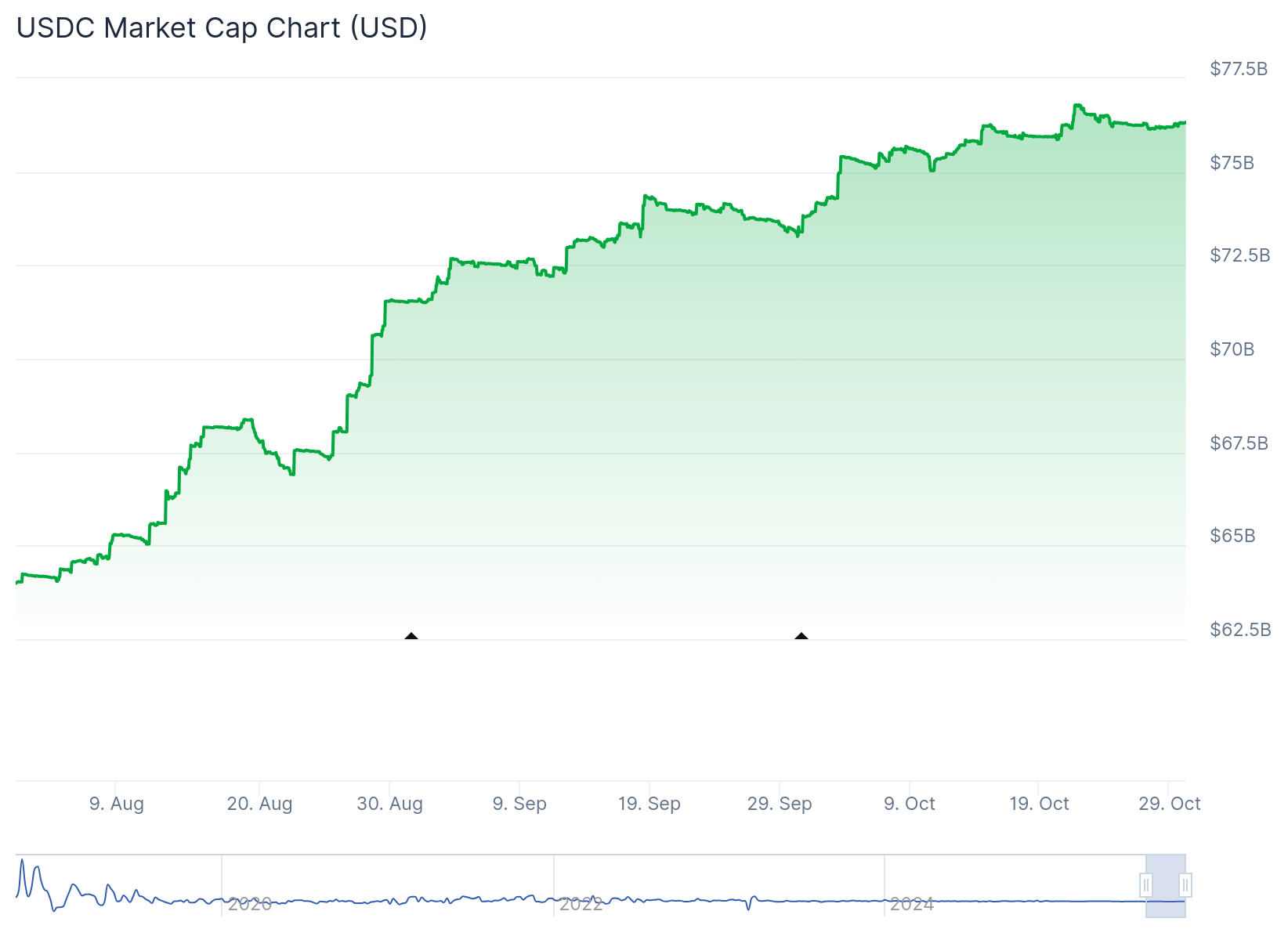
USD Coin is a stablecoin created by the Centre Consortium, an organisation made up of crypto trading platform Coinbase and Circle, a peer to peer payment platform. It launched in 2018 as an ERC-20 token and has since climbed the ranks to be in the top 5 biggest cryptocurrencies based on market cap. USD Coin is available on the Ethereum blockchain, as well as Solana, Polygon, Algorand and Binance Smart Chain networks.
The significant bonus that USDC holds over its biggest competitor, USDT, is that the coin is regularly audited by a third-party institution. These audits are made public, allowing any user to verify the authenticity of their USDC value each month. Since launching USDC, Coinbase has removed USDT from its platform.
USDT vs USDC: Head-to-Head Comparison
Adoption
With over a decade in circulation, USDT has achieved far greater adoption worldwide. It remains the dominant stablecoin in trading pairs and global liquidity, particularly in emerging markets. Winner: USDT
Transparency
Tether has historically struggled with transparency, though it now publishes quarterly attestations. By contrast, USDC provides monthly reports with independent verification, giving it the edge for investors who value oversight and regulatory clarity. Winner: USDC
Regulatory Compliance
Circle and Coinbase designed USDC with U.S. and international regulations in mind. USDC reserves are kept in regulated banks and Treasuries, and Circle is registered as a money transmitter in multiple jurisdictions. Tether claims compliance but lacks comparable transparency. Winner: USDC
Price Stability
Both USDT and USDC are pegged 1:1 to the U.S. dollar. While they occasionally experience small deviations, both have shown resilience and quickly return to their peg. Winner: Tie
Redemption Process
Redeeming USDT directly requires a minimum of 100,000 USDT plus fees, which makes it impractical for small investors. USDC allows redemptions starting at just $100, giving it an accessibility advantage. Winner: USDC
Incidents
Both stablecoins have faced brief de-pegging events. USDT dipped below $0.95 during market stress in 2022, while USDC fell to around $0.87 during the Silicon Valley Bank crisis. In both cases, prices stabilized quickly. Winner: Tie
Longevity
Tether has been around since 2014, giving it a proven track record and first-mover advantage. Winner: USDT
Which Stablecoin Should You Choose?
Due to the fact that these respective companies are holding the dollar-equivalent value in reserves, these two digital currencies are considered to be centralized, while the rest of the cryptocurrency market holds a decentralized nature. As the demand for digital currencies increases, it is likely that these two stablecoins will only continue to grow.
When looking for a stablecoin, these are two most recognised options. Choosing between USDT and USDC depends on what you value most as an investor or user.
- If you need deep liquidity, global adoption, and access across more blockchains, USDT remains the go-to option. Its size and reach are unmatched, making it the default stablecoin for many traders.
- If you prioritize regulatory compliance, transparency, and a lower barrier for redemptions, USDC is the safer bet. It continues to build trust among institutions and investors who want accountability.
Ultimately, both stablecoins play vital roles in today’s crypto ecosystem. Some traders even use a combination of USDT and USDC to balance adoption with transparency, hedging against risks specific to either coin.
Users can both buy and sell USDT and USDC directly through the Tap app. Simply create your account, complete the KYC process and deposit funds into your digital wallet. Manage your entire crypto (and fiat) portfolio from one convenient, secure location.

What is Return on Investment?
Return on investment is one of the most common measures of profitability and performance in both business and personal finance. It shows how much gain or loss you’ve made on an investment compared to its original cost.
In simple terms, ROI tells you whether your money has worked for you or not. Whether you’re investing in stocks, property, a business project, or a marketing campaign, ROI helps you compare how efficiently different investments use your capital. It’s widely used by companies to evaluate new projects, advertising performance, or expansion opportunities, and by individuals to assess savings, portfolios, or real estate ventures.
A clear ROI provides insight into the effectiveness of a decision and guides future strategies, whether the goal is increasing profit, cutting costs, or improving financial performance.
All investments, including stocks, bonds, real estate, and small businesses, come with the goal of making more money than you put in. The money you earn over and above your initial investment is called profit. As you’ll learn later, profit and ROI aren’t the same thing. When discussing investment profitability, however, people often use ROI. This metric expresses the amount of net profit one earned as a percentage of what the initial investment was.
ROI can help you assess if buying property or investing in a business is worth it. It also helps companies determine the value of adding new products, building more facilities, acquiring other businesses, advertising campaigns, etc.
In other terms, it's a way to compare different investments in order to figure out which ones are worth pursuing. For example, you could calculate ROI to decide whether selling one stock and buying another would be a good idea.
While there is no limit to a return on investment theoretically, in practice, no investment is guaranteed to have any return. If your ROI is negative, it means you not only failed to make a profit but also lost some of your original investment. The worst possible outcome would be -100% ROI, meaning you completely lost your initial investment. An ROI of 0% signifies that you at least recovered the money you put in, but gained nothing beyond that.
While ROI is often used as a marker of profitability, it isn't foolproof. There are several limitations to calculating ROI as your only measure which include the time frame in which you will earn back your investment, inflation rates, how risky a venture is, and additional maintenance costs that may be incurred.
ROI Terminology
Before we dive in, let's first cover some basic terminology.
Net profit or net income
Net profit is the amount of money left over after all operating costs, such as the cost of transaction costs or maintenance costs, and other expenses have been accounted for and subtracted from the total revenue. It is used to measure profitability. Net profit can also be called net income, net earnings, or the bottom line.
Total cost of investment
This figure will look at the amount of money invested in a particular investment.
How to Calculate ROI: The ROI Formula
The ROI formula is a simple equation that looks at the price change of the asset and the net profits (the initial cost of the investment minus its value when you sell it). When calculating ROI you would use this formula:
ROI = (Net Profit / Total Cost of Investment) x 100
To factor trading costs into your ROI figure, you'll use:
ROI = ((Value of Investment - Cost of Investment – Associated Costs) / Cost of Investment) x 100
As an example, let's say you buy 5 shares of $100 each in Tesla, equating to $500. You sell them a year later for $150 each, equating to $750. Let's say you paid $5 commission on each trade, costing you $25 in trading fees.
ROI = (($750 - $500 - $25) / $500) x 100 = 45%
This means that you made a 45% return on investment on that particular investment.
What is a Strong ROI
A "good" return on investment is any number above 0, as this means you made some profit. However, the ideal ROI should be higher than what you could've earned had you chosen another investment (the next best thing).
To compare this, investors often compare their earnings to what they could've made on the broader stock market or in a high-yield savings account. Using the S&P 500 as a control, over the past four decades it has made gains of around 7% (after inflation). An ROI is generally considered to be a strong one if it beats the stock market in the long term.
However, risk and return are directly linked. High ROIs often come with higher volatility or uncertainty. Property, stocks, and startups may yield better returns but can also result in losses. Safer investments, like savings accounts or government bonds, tend to offer lower but more predictable ROIs. Moreover, it's always important to note that past performance does not equate to future results.
Therefore, a strong ROI will vary depending on the investment's level of risk, your goals, and how much risk you're willing to take.
ROI vs Profits
ROI and profit are related but not identical. Profit is the absolute amount of money gained after costs, while ROI expresses that profit as a percentage of the original investment.
For instance, a $1,000 profit might sound good, but if it came from a $100,000 investment, the ROI is just 1%. That’s why ROI is a more useful metric for comparing opportunities or assessing performance across projects.
Use ROI for decision-making and benchmarking; use profit for understanding absolute earnings.
Benefits of Using ROI
Return on investment (ROI) is widely valued for its clarity and practicality. It allows both individuals and businesses to assess whether their financial choices are creating real value, providing a clear, quantitative foundation for better decision-making. It remains one of the simplest and most effective tools for:
- Comparing investments as it standardises performance across asset types.
- Guiding decisions, where it is used to prioritise projects or marketing strategies.
- Measuring performance by tracking financial efficiency over time.
- Allocating resources by showing where capital yields the best results.
Its simplicity and flexibility make it an essential concept in finance, marketing, and project management alike.
Where the ROI Formula Falls Short
The main limitation of using this return on investment ROI formula as a marker of success is that it doesn't show how long it took to earn the money back. When comparing various investments, the time it takes to mature will have a significant impact on the profits you could earn.
For instance, a year loan versus a bond held for five years versus a property held for 10 years will all have varying ROIs once you've established how long it will take to earn the specified ROIs.
In this scenario, the ROI calculations mentioned above skimp on the full story. It also doesn't account for risk. For instance, the loan repayments could be delayed or the property market might be in a slump, all affecting the potential profits earnable.
With many variables, it becomes harder to predict what the exact ROI calculation on an investment will be, so be sure to factor this in when using the return on investment ROI formula to determine how attractive an investment opportunity or business venture is.
ROI Alternatives
Although the return on investment doesn't consider how long you keep an asset, it's essential to compare the ROI of investments held for comparable lengths of time as a more clear performance measure. If that's not possible, there are a few other options.
Average Annual Return
Also known as annualized return on investment, this adjusts the ROI formula to factor in the timing. Here you would divide the ROI by the number of years you hold the asset.
Compound Annual Growth Rate (CAGR)
This option is more complicated but yields more accurate results as it factors in compound interest generated over time.
Internal Rate of Return (IRR)
This measure factors in the notion that profits earned earlier outway the same profits earned later, taking into account interest that could've been earned and factors like inflation. This equation is quite complicated but there are online calculators one can use.
Conclusion
A return on investment (ROI) is a formula used to calculate the net profit or loss of an investment in percentage form. The ROI calculation can present valuable information when investing capital or determining profitability ratios. The ROI equation looks at the initial value of one investment and determines the financial return. A negative ROI indicates that the investment returns were lower than the investment cost.
Since the advent of cryptocurrencies in 2009, the world has seen a substantial shift in the way that people transact and manage their money online. The first cryptocurrency, Bitcoin, sparked a wave that has impacted almost every corner of the globe, significantly shifting the financial landscape as we know it. Let’s explore how crypto is expanding economic freedom on a global scale.
What is economic freedom?
Before we evaluate how this $2 trillion industry is contributing to financial liberation, let’s first establish what economic freedom is. Explained simply, the term refers to measures that grant users the freedom to manage their money, property, and labour in each country, which is then compared globally.
More accurately, the measure of economic freedom is determined by using the Index of Economic Freedom, which weighs up 12 factors contributing to a country’s overall measure. This is broken down into 4 categories, each carrying varying subcategories, such as market openness measuring a country’s trade, financial and investment freedom. The others are regulatory efficiency, rules of law, and government size, each with its own subcategories.
This index was first published in 1995 by The Heritage Foundation and The Wall Street Journal and is used around the world today. This year, Singapore, New Zealand, Australia, Switzerland, and Ireland have ranked as the most financially free countries in the world.
Crypto and economic freedom
Cryptocurrencies were first established to provide an alternative monetary solution to the global financial crisis that sent the world into disarray in 2007. Satoshi Nakamoto created the new age payment system to empower individuals to hold control over their own finances, allowing them to manage and transact their money without the control of an authoritarian entity. For the first time in history, people were able to send money overseas without incurring the usual costly and time-consuming setbacks incurred with regular, global fiat transactions.
Due to the decentralized nature in which they are run, people are responsible for managing their own crypto wallets and specialised users on the network positioned across the globe are responsible for verifying and executing transactions. After Bitcoin entered the scene a significant number of new cryptocurrencies have been launched, over 12,000 at the time of writing. While some maintain the same “medium of exchange” model, many new cryptocurrencies have emerged providing alternative solutions to the industry.
Ethereum, the world’s second-biggest cryptocurrency, for example, provides a platform on which developers can create their own decentralized apps and cryptocurrencies, while other cryptocurrencies revolve around faster transaction times, cloud storage and private transactions. Each of these projects utilizes a blockchain network that was designed to improve and innovate the crypto and blockchain space.
Spanning beyond government control and lengthy paperwork, cryptocurrencies are able to provide a global currency that operates entirely online and is not confirmed to the borders of a country. Cryptocurrencies are global, accessible 24/7 and cannot be frozen in accounts.
How crypto is driving economic freedom
Requiring only an internet connection and start-up funds, Bitcoin (and cryptocurrencies in general) allows anyone around the world to create a wallet and start trading. One doesn’t need access to a large bank branch or lengthy paperwork, one simply needs an internet connection and a smartphone.
Curling back to the factors that contribute to economic freedom, cryptocurrencies are able to seamlessly check six of twelve of the categories of the Index of Economic Freedom through their innate properties.
- Trade Freedom [Market Openness]
- Financial Freedom [Market Openness]
- Business Freedom [Regulatory Efficiency]
- Labour Freedom [Regulatory Efficiency]
- Monetary Freedom [Regulatory Efficiency]
- Property Rights [Rule Of Law]
The remaining categories however revolve around the governments running the nations in question, particularly the rule of law and government size categories. Nevertheless, cryptocurrencies can still assist in creating better-functioning economies and provide the technology that allows for a more open and free financial system.
A free and open financial system
As cryptocurrencies remove the barriers of borders, they allow people to transact their money in the same way that they communicate with each other (through the internet). As the digital age continues to evolve, we are likely to continue seeing a significant increase in the level of economic freedom that crypto provides to users around the world, empowering both the individual and the nation.