
Learning the friendly way
Dive into our resources, guides, and articles for all things money-related. Grow your financial confidence with our experts curated tips and articles for both experienced and new investors.
LATEST ARTICLEs

Travailler et être payé en cryptos, c’est désormais possible
Se faire rémunérer en cryptomonnaie a ouvert les portes d’un marché du travail mondial sans frontières. Finis les freins géographiques ou les lourdeurs administratives : aujourd’hui, vous pouvez travailler pour une entreprise à l’autre bout du monde et recevoir votre salaire en crypto, en quelques minutes et sans frais bancaires excessifs.
Avant de plonger dans la liste des plateformes qui proposent ce genre de jobs, voyons ensemble les avantages que présente ce mode de paiement nouvelle génération.
Pourquoi se faire payer en crypto ?
Le secteur de la blockchain a rapidement intégré les cryptomonnaies aux modèles de travail traditionnels. Résultat : des milliers de postes à pourvoir dans tous les domaines, rémunérés directement en cryptos.
Parmi les bénéfices notables :
- Des paiements rapides et peu coûteux : les frais de transaction sont minimes, et les virements se font en quelques minutes.
- Une ouverture internationale : plus besoin d’être dans le même pays (ou fuseau horaire) que votre employeur.
- Un accès facilité aux micro-tâches : grâce à des frais faibles, même les petits contrats deviennent intéressants.
En résumé, tout le monde peut désormais accéder à un job crypto-friendly, que vous soyez développeur, designer ou assistant virtuel.
Où trouver des jobs rémunérés en crypto ?
LaborX
LaborX est une plateforme de type job board qui met en relation freelances et employeurs. On y trouve aussi bien des missions ponctuelles que des postes à temps plein. Les paiements peuvent se faire en plusieurs cryptomonnaies, selon vos préférences.
La plateforme est gérée par une entreprise blockchain spécialisée dans les solutions RH – un bon point pour la fiabilité.
Jobs4Bitcoins (sur Reddit)
Malgré son nom, cette section de Reddit propose toutes sortes de jobs rémunérés en cryptomonnaie, pas uniquement en Bitcoin.
Les utilisateurs postent soit des offres d’emploi, soit leurs compétences. Le système est libre et ouvert, mais non vérifié, donc prudence est de mise.
Blocklancer
Blocklancer est une autre plateforme dédiée aux freelances crypto. Ici, vous êtes payé en Ethereum pour des missions très variées : rédaction, analyse, développement, etc. En cas de conflit, un système de médiation est proposé. Et si vous préférez être payé dans une autre crypto ou en euros, vous pouvez facilement échanger vos ETH avec l’appli Tap.
Bitfortip
Vous aimez donner des idées ? Bitfortip permet de gagner des tips en crypto (Bitcoin, Bitcoin Cash, Tezos, NANO) simplement en répondant à des questions postées par les autres utilisateurs.
C’est un format plus informel, mais idéal pour se lancer en douceur dans l’univers des cryptos.
PompCryptoJobs
PompCryptoJobs est une plateforme dédiée aux métiers du Web3. Vous y trouverez des postes à temps plein, dans des entreprises sérieuses du secteur : UX designer, data analyst, développeur, rédacteur… le tout rémunéré en crypto.
Le site est bien structuré, professionnel, et régulièrement mis à jour.
Comment recevoir un salaire en crypto ?
Si vous ne savez pas comment être payé en cryptomonnaie, Tap vous facilite la vie.
Notre application propose un compte dédié aux indépendants et freelances, permettant de recevoir des paiements en cryptos et en devises classiques.
En ouvrant un compte, vous avez accès à :
- Des portefeuilles crypto sécurisés
- Des IBANs pour les virements en euros, dollars ou livres sterling
- Les adresses de portefeuille à partager avec votre employeur
Il suffit d’envoyer votre adresse crypto au client, et le paiement est reçu en quelques minutes.
Et pour vos dépenses du quotidien ? Avec la carte Tap, vous pouvez utiliser vos cryptos comme de l’argent classique – que ce soit pour régler un café, faire vos courses ou payer vos abonnements.
En conclusion
Le monde du travail évolue, et avec lui, les moyens de se faire payer. Grâce à la cryptomonnaie, vous pouvez travailler sans frontières, avec plus de flexibilité et de rapidité. Que vous soyez développeur, créatif ou tout simplement curieux, il y a probablement une mission crypto qui vous attend.
Alors, prêt à décrocher votre premier job payé en crypto ?


Money talks, but some currencies whisper so quietly you need a magnifying glass to hear them. In the grand theatre of global finance, not all currencies are created equal, while some strut around like peacocks (looking at you, Kuwaiti Dinar), others shuffle about with the confidence of a wet paper bag.
The Lebanese Pound (LBP) currently holds the unfortunate distinction of being the world's weakest currency in 2025, with an exchange rate so low that one U.S. dollar equals approximately 89,500 Lebanese pounds. To put this in perspective, you'd need a small suitcase to carry the equivalent of $100 in Lebanese pounds, assuming you could find enough physical notes.
Currency weakness isn't just about having a lot of zeros after the decimal point. It reflects a complex web of economic factors, including inflation rates, political stability, monetary policy decisions, and investor confidence. This guide on the world's weakest currencies in 2025, explores the economic stories behind their struggles and what it means for the countries (and the people) who use them.
Top 10 weakest currencies in the world (2025)
Here's the lineup of currencies that make your wallet feel surprisingly heavy when travelling abroad:
Exchange rates are approximate and fluctuate daily. Data compiled from multiple financial sources as of July 2025.
What makes a currency weak?
Before we roll our eyes at long strings of zeros, let’s get clear on what actually drives currency weakness.
Exchange rates show how much of one currency you need to buy another, usually measured against the U.S. dollar. But a low exchange rate isn’t automatically a red flag. Just like shoe sizes, bigger numbers aren’t necessarily worse, they’re just different.
The real reasons a currency weakens?
- Persistent inflation that eats away at value
- Short-term monetary policies that undermine long-term confidence
- Trade imbalances and shrinking foreign reserves
- Political instability that rattles investor trust
When investors lose faith, money moves fast, and exchange rates feel the impact. In short, weak currencies aren’t a punchline, they’re a signal of deeper economic tension.
Country spotlights - case studies behind the weakest currencies
Lebanon | A financial collapse without precedent
Lebanon’s currency crisis is a case study in how not to run an economy. As of mid-2025, the Lebanese pound trades at over 89,500 LBP per USD, making it one of the weakest currencies in the world.
The collapse stemmed from a banking sector that functioned like a state-sponsored Ponzi scheme: banks attracted deposits with sky-high interest rates, only to lend most of those funds to a debt-laden government. When confidence evaporated, the system imploded. Add in the 2019 mass protests and the devastating 2020 Beirut port explosion, and the result was economic freefall.
Today, Lebanese citizens navigate a surreal economy where ATMs limit withdrawals to tiny amounts, and many businesses have shifted to unofficial dollar pricing. A shadow economy thrives alongside the official one, proof that when trust in institutions fails, people find their own workarounds.
Iran | Sanctions, inflation, and isolation
The Iranian rial now trades at over 1,000,000 IRR per USD (yes, that's six zeros). Sanctions have cut Iran off from the global financial system, leaving its oil-rich economy unable to fully monetise its most valuable resource.
It's like owning a garage full of Ferraris with no keys to drive them. In response, Iran has attempted to bypass sanctions with crypto experiments and barter agreements, but none have stabilised the currency.
Inflation routinely exceeds 40%, and as a result Iranians have turned to gold, property, and U.S. dollars to preserve what little value they can. In a country known for its resilience, the rial’s collapse remains a stark reminder of the long-term costs of economic isolation.
Vietnam | Weak by design, not disaster
The Vietnamese dong trades at around 26,000 VND per USD, but that doesn’t signal a crisis, it actually reflects deliberate policy. Vietnam maintains a weaker currency to keep exports competitive, a strategy known as competitive devaluation.
This has helped transform Vietnam into a global manufacturing hub, attracting companies looking to diversify away from China. It's like running a permanent sale on your national output - foreign buyers love the prices, and Vietnamese factories stay busy.
The challenge lies in balance. The government works to avoid the inflation traps that have plagued other countries on this list, proving that not all weak currencies come from failure, some are tools of long-term economic strategy.
Laos | Trapped by debt and dependency
The Laotian kip now trades at around 21,800 LAK per USD, weighed down by inflation above 25% and a debt-to-GDP ratio over 125%. Much of that debt is owed to China, tied to major infrastructure projects that haven’t yet paid off economically.
Laos is a landlocked nation with limited industrial capacity and high import dependence, leaving its currency exposed whenever commodity prices shift. With little monetary wiggle room, the kip’s trajectory reflects deeper economic vulnerabilities.
Sierra Leone | A currency redefined, but still fragile
In 2022, Sierra Leone redenominated its currency, removing three zeros from the leone to simplify transactions. But even the new leone remains weak due to decades of disruption: civil war, the Ebola outbreak, COVID-19, and swings in diamond prices.
This is an economy that's faced shock after shock, and recovery is slow. The mining sector, especially diamonds, still dominates, leaving the leone vulnerable to commodity price drops.
Healthcare challenges and limited infrastructure add even more pressure, reducing productivity and increasing fiscal strain. The leone’s weakness tells the story of a country rebuilding piece by piece, with its currency reflecting both the past and the uphill path ahead.
Why some countries choose to keep their currency weak
Believe it or not, some countries actually prefer their currencies to be weaker - and for good economic reasons. It's counterintuitive, like preferring to drive in the slow lane, but the strategy can be remarkably effective.
Export competitiveness represents the primary motivation. A weaker currency makes domestic products cheaper for foreign buyers, essentially providing a permanent discount. German cars might be excellent, but if Vietnamese motorcycles cost 70% less due to currency differences, guess which ones developing countries will buy?
Countries like China famously maintained an artificially weak currency for decades, helping fuel their manufacturing boom. The strategy worked so well that other countries accused them of "currency manipulation" - the economic equivalent of being too good at a game and getting accused of cheating.
However, this approach carries significant risks. Import costs rise dramatically, making everything from oil to smartphones more expensive for domestic consumers
Long-term currency weakness can also trigger capital flight, where wealthy citisens move their money abroad. When your own citisens don't trust your currency, convincing foreigners becomes considerably more challenging.
Does a weak currency mean a weak economy?
We’ve established that a weak currency doesn't automatically signal economic disaster,sometimes it's just a reflection of different economic structures and historical circumstances.
Indonesia and Vietnam serve as the best examples of countries with numerically weak currencies but relatively strong economies. Both nations have achieved consistent growth, reduced poverty, and built increasingly diversified economies despite their currencies requiring calculators to count properly.
The key lies in purchasing power parity - what matters isn't how many zeros follow your currency symbol, but what those zeros can actually buy. A Vietnamese worker earning 10 million dong monthly isn't necessarily poor if that amount provides a comfortable living standard within the Vietnamese economy.
The real measure of economic health involves factors like employment rates, productivity growth, infrastructure development, and living standards. A country with a weak currency but growing wages, improving infrastructure, and expanding opportunities may be economically healthier than a nation with a strong currency but declining industries and rising unemployment.
What are the consequences of a weak currency?
In essence, a weak currency makes daily life more expensive, with rising prices on imports like food, fuel, and electronics. Added into the mix, Inflation erodes savings, and capital flight accelerates as people move their money into more stable currencies.
Over time, foreign currencies may replace the local one in everyday use, limiting government control. Internationally, weak currencies hurt credit ratings and investor confidence, reinforcing instability.
Final thoughts
Currency weakness is more than just numbers, it’s a signal. We’ve learnt above that it can both expose deep economic flaws or reflect deliberate strategies for growth. Lebanon and Iran highlight how instability and isolation can erode value fast, while Vietnam shows how weakness can fuel exports and development.
These disparities then shape the country’s trade, capital flows, and financial stability worldwide, causing a wider ripple effect. In a global economy, no currency moves alone; each affects the rest. And behind every weak currency are real people navigating inflation, opportunity, or uncertainty.

For a fleeting moment, it looked like altcoin season was finally here. Google searches for “altcoins” skyrocketed to record highs, 𝕏 was buzzing, and retail excitement seemed to return in full force. But within a week, that hype fizzled out almost as quickly as it appeared, leaving traders wondering if the long-awaited alt season was just a mirage.
A Spike That Vanished Overnight
Search interest for “altcoin” on Google Trends hit its highest score ever in early August, only to fall back to baseline levels within days. Globally, the same pattern played out, with scores dropping from 100 to just 16 in a week, mimicking a “pump and dump” pattern that you would expect from a memecoin.
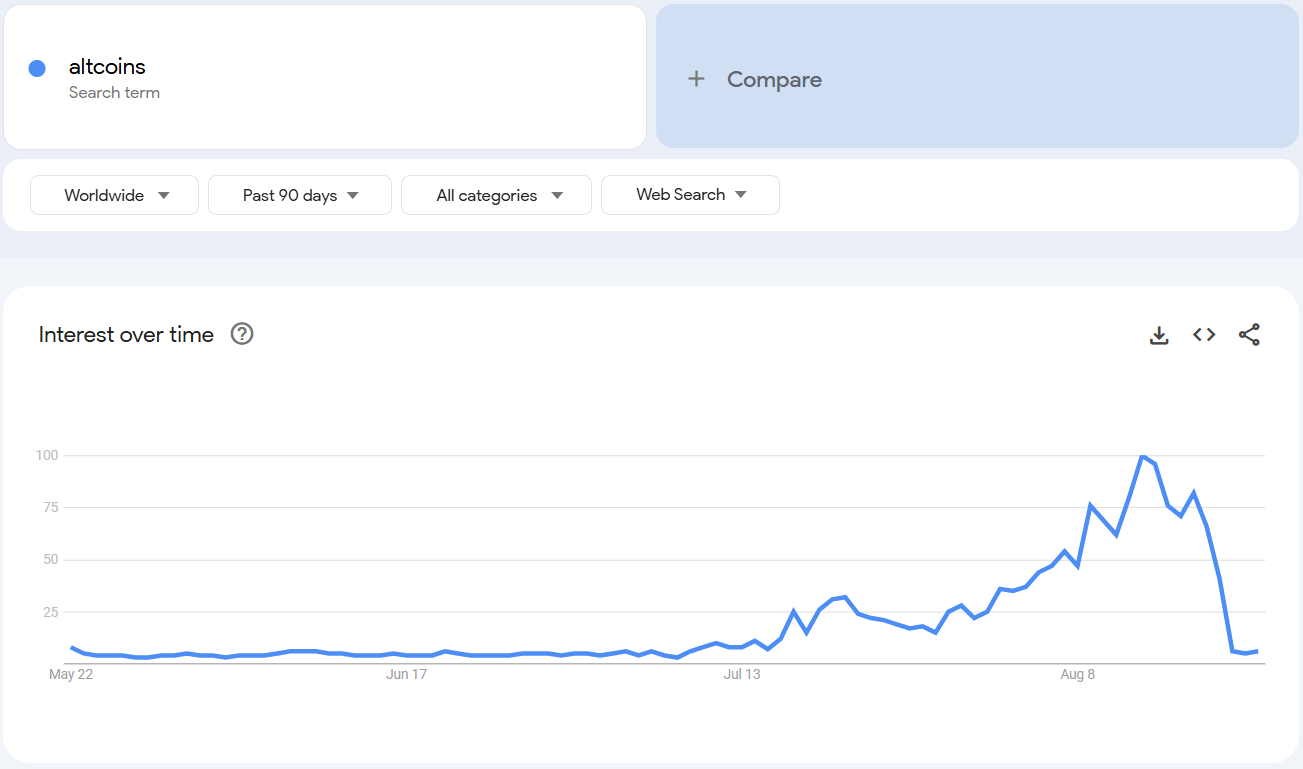
Market cap data told the same story. The total value of altcoins (excluding Bitcoin and Ethereum) briefly climbed by $100 billion before giving it all back, leaving investors wondering whether the hype had any real weight behind it.
Naturally, some saw the collapse as proof that the altcoin season had ended before it really began. Others, however, like analyst Cyclop, argue the spike shows something deeper: that “altcoin” has become the mainstream term retail uses today, replacing “crypto” in 2021. In his view, this isn’t the peak. Rather, it’s just the beginning of broader interest.
Why Google Trends Doesn’t Tell the Whole Story
Relying on Google searches to measure retail demand may no longer work the way it used to. With AI tools increasingly replacing traditional search, and with concepts like “altcoins” now part of everyday investor vocabulary, Trends data might not be capturing where and how money is really flowing.
Instead, analysts point to on-chain and trading activity as better indicators of where momentum is building. And in August, that momentum was fragmented.
A Season of Winners and Losers
Data from Artemis showed only a few categories outperforming last month: Ethereum, exchange tokens, and oracles.
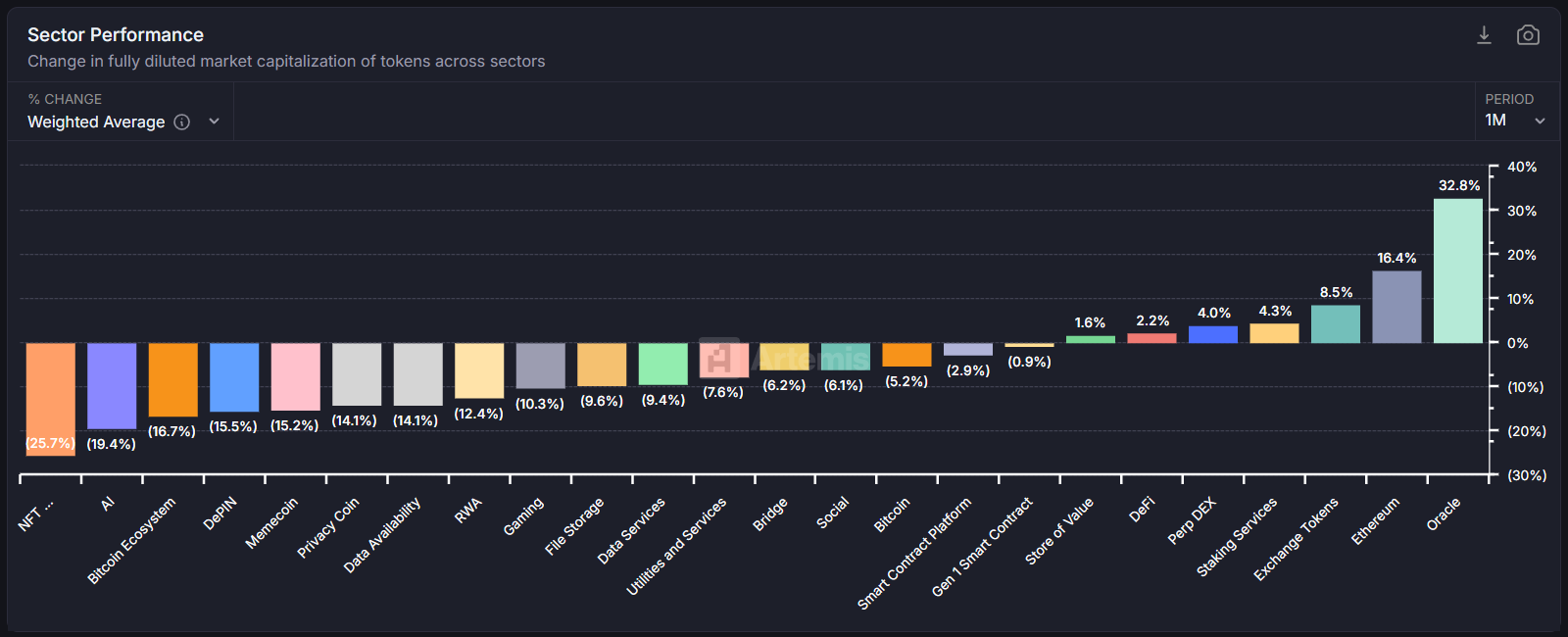
Beyond these bright spots, however, most altcoins struggled. The result? A patchwork “mini season” rather than the explosive, across-the-board surge that retail and social media had been hoping for.
Polygon’s co-founder Sandeep put it bluntly: "Retail is searching, but institutions aren't buying the narratives yet. Old altcoin seasons were driven by speculation and promises and narratives and marketing. Institutional money is smarter money. It cares about real utility and cash flows. The next "alt season" won't look like 2017 or 2021. It’ll be fewer tokens with actual usage, not just tokens with better marketing." Sandeep said.
The Road Ahead
That doesn’t mean altcoin season is dead, it probably just means it’s evolving.Coinbase has suggested that the next true wave could arrive as early as September, but that it likely won’t be a full-scale altcoin season.
Bottom line? The altcoin season isn’t gone; it’s just different. It’s maturing. And the next leg up may not belong to every token in the market, but only to the select few proving they can deliver value beyond mere speculation.
Crypto lending might be the hot new product in the cryptocurrency space, but before you dive in be sure to first understand what it entails. The concept grew great traction with the rise of the decentralized finance (DeFi) movement, with platforms offering users high yields for borrowing crypto assets.
Let’s get started with what crypto lending is, and then explore how the product works.
What is crypto lending?
Crypto lending is a traditional banking service curated to the crypto world. With the DeFi space remains largely unregulated, many crypto exchanges and other platforms have started offering these services, with added security.
Crypto lending involves a user lending crypto assets to a platform in return for interest, which allows other users to then borrow said crypto assets, paying interest on the amount borrowed. The platform will then take a small percentage of the interest paid.
Depending on the platform and other factors, crypto lending platforms may be centralized or decentralized and offer exceptionally high-interest rates, with annual percentage yields (APYs) of 15% or more. With the interest rates being higher than traditional bank accounts, lenders gain access to much greater yields, increasing their returns.
Another advantage to crypto lending is that users are still exposed to price gains in the market. Meaning that if you deposit your Bitcoin when it's worth $20,000 and the price rises in value to $50,000, you are still able to realize these returns and earn interest for the duration of the loan.
Note that interest rates might fluctuate with market conditions on some platforms, increasing when the prices increase and decreasing when markets are down.
How does crypto lending work?
Cryptocurrency lending platforms function as middlemen connecting lenders to borrowers. Lenders deposit their digital currency into high-interest lending accounts, and borrowers utilize the lending platform to acquire loans. These systems then lend money utilizing the crypto that investors have provided them.
The platform controls its net interest margins by establishing the interest rates for both lending and borrowing.
Rates on platforms differ from cryptocurrency to cryptocurrency, some platforms might offer higher interest rates to lenders willing to commit to a certain time frame. There is no standard interest rate for cryptocurrencies, as each platform has its own set of rules.
Centralized crypto lending means putting your money in the hands of a corporation or other entity to manage and make the process easier. Accounts are created for borrowers and lenders, and loans may be requested by applicants.
Lenders and borrowers may connect their cryptocurrency wallets to a decentralized crypto lending protocol, which uses smart contracts to automate the lender-borrower relationship. Smart contracts are automated digital agreements that execute once certain criteria is met.
The advantages of crypto lending
There are several benefits to crypto lending when comparing it to a regular bank account.
Borrowers have access to these financial services without having to pass a credit check, making it more financially inclusive than traditional banking services. They are also exposed to lower interest rates than regular banking loans.
Lenders that give loans in the form of cryptocurrencies can make a lot more money from their crypto assets than savings accounts. It may also be a more adaptable choice to crypto staking, which requires users to lock up their cryptocurrency and submit it to a blockchain security method. Depending on the platform, lending usually gives users access to their funds.
The downside to crypto lending
The agreement with crypto loan companies is generally made on individual terms by institution borrowers. As interest rates vary across platforms and cryptocurrencies, each company is different.
There have been several cases where lending platforms have been hit by severe liquidity crisis, notably Celsius, Voyager Digital, and BlockFi. Glenn Huybrecht, COO of Cake DeFi, said, “Some lending providers have been very generous with low collateral requirements, which then puts them in hot water when one of their customer's defaults.”
Due to the ongoing regulation battles, these crypto services are also not backed by government safety nets, like the traditional banks are. However, some platforms do hold insurance and the necessary regulatory accreditations so be sure to seek one that has all of the above.
Closing thoughts
Crypto lending platforms differ greatly from one another so be sure to check each platform, their interest rates for all the various currencies supported, and if there are any lock-up periods or fees payable.
Every move on Ethereum (sending crypto, minting an NFT, using a dapp) comes with a cost. That cost is called gas. It’s not just a fee - it’s the fuel that keeps the network running.
Knowing how gas works means you’re not just using Ethereum, you’re using it smarter. You can time transactions, avoid peak congestion, and cut your costs. Here we explore how it works and how to take control in a simple and easy-to-understand way.
What are Ethereum gas fees?
Let’s start with the basics: gas fees are the cost of using the Ethereum network. Any time you do something - like send ETH or swap tokens - you’re asking the network to do work. That work takes computing power, and gas fees are what you pay to get it done.
These fees serve three critical functions:
- Compensate validators for their work
- Secure the network from spam attacks, and
- Prioritise transactions during busy periods.
When the network buzzes with activity, the fees naturally rise as users compete for limited block space. Picture Ethereum as a busy highway during rush hour. More traffic means higher tolls, but the road remains secure and functional for everyone willing to pay the current rate.
How Ethereum gas fees work
Every gas fee breaks down into a simple formula that establishes your specific transaction cost:
Total fee = (base fee + priority fee) × gas limit
Let’s break it down:
- The base fee is the minimum cost to get your transaction into a block. It goes up when the network is busy and is burned (destroyed) to help reduce ETH supply.
- The priority fee (tip) is an extra amount you add to speed things up (like tipping for faster service).
- The gas limit is how much work your transaction needs. Bigger, more complex actions need a higher limit.
Another important element to understand is that gas prices are measured in Gwei, where 1 Gwei equals 0.000000001 ETH. A typical token swap might use 30,000 gas units. If the current base fee sits at 25 Gwei and you add a 5 Gwei tip, your total cost becomes:
(25 + 5) × 30,000 = 900,000 Gwei = 0.0009 ETH
Let’s say at $2,500 per ETH, that transaction would cost $2.25.
Why Ethereum gas fees fluctuate
Gas fees move with the rhythm of the network. When demand is low, fees drop. When things heat up, they spike.
Big events like new token launches, NFT drops, or market surges can therefore clog the network. More users = more competition for space. That’s when the base fee goes up (remember the formula above: total fee = (base fee + priority fee) × gas limit).
The base fee adjusts with every block (around every 15 seconds). It rises when blocks are more than 50% full and drops when they’re under that threshold.
The type of transaction also matters:
- A simple ETH transfer uses about 21,000 gas units.
- A complex smart contract call: +/-200,000.
- A typical Uniswap swap costs 3–5x more than a basic transfer.
And don’t forget ETH’s price. Even if gas stays steady in Gwei, rising ETH makes each transaction more expensive in dollars.
Quick Tip: Check gas trackers before major transactions. A few minutes of timing can save significant money.
How to check Ethereum gas prices in real time
Active users monitor gas prices like traders watch market charts. There are several tools that provide real-time visibility into the network’s condition.
- Etherscan’s gas tracker (for deep analytics)
Etherscan provides in-depth gas analytics including real-time rates, historical charts, and insights into average and peak fees. It also offers optimisation tips like identifying “safe low‑cost windows” for transactions. - Rabby wallet (for user-friendly alerts)
Rabby’s mobile and browser wallet features built-in gas monitoring, showing current prices and offering “Gas Top Up” functionality. It also supports push notifications (via its GasAccount feature) for favourable conditions. - MetaMask (for fully integrated wallet visibility)
MetaMask displays live gas rates directly in its interface and dashboard. You'll see options like Low, Market, or Aggressive for gas speeds, and it even shows fiat equivalents beside token balances.
Most gas trackers display slow, standard, and fast fee tiers, helping you balance cost and speed.
It’s also worth knowing that slow transactions may take 5-10 minutes but can save you 20-30% on fees, while fast ones aim to process within a couple of minutes, at a premium price.
Gas prices also follow weekly patterns. Fees are usually lower on weekends, when institutional and high-frequency trading slows down. And if you’re not in a rush, consider transacting during early morning hours (2–6 AM EST), often the cheapest window of the day.
Ethereum gas fees before and after the merge
Over the years, Ethereum has gone through major upgrades that changed how gas fees work, though granted not always in the ways people expected.
In 2021, the London Hard Fork introduced EIP-1559, swapping chaotic gas auctions for a more predictable pricing model: a base fee + tip. It made fee estimates more stable, but didn’t necessarily make them cheaper.
Then came The Merge in 2022, shifting Ethereum to proof-of-stake. It cut energy use and made block processing more efficient. But despite common belief, it didn’t slash gas fees overnight.
However, The Merge did lay the groundwork for future upgrades (like sharding and rollups) that will unlock real, lasting fee reductions at scale.
Looking ahead, upgrades like Proto-Danksharding aim to scale Ethereum and bring fees down for good.
How to reduce ETH gas fees
Despite what some might tell you, cutting gas fees isn’t about luck, it’s more about smart choices and good timing. Here are some options:
Use Layer 2s
Networks like Arbitrum, Optimism, and Base offer the biggest savings, sometimes up to 90–95% cheaper than the Ethereum mainnet. For example, a $50 swap on mainnet might cost just $2-$5 on these platforms, with the same level of security. (More on this below).
Simulate before you send
Tools like Tenderly and DeFi Saver let you test complex transactions first, helping you avoid failed attempts that still burn gas.
Pick your moment
As mentioned above, prices drop when the network is quiet. Use gas trackers to spot the best times to transact.
Batch when you can
Some protocols let you combine multiple actions into one transaction, so you pay one base fee instead of several.
Layer 2 solutions that cut gas costs
Layer 2 networks are the future of Ethereum scaling. They can handle thousands of transactions off-chain, then settle them on Ethereum in one go, cutting costs and speeding things up.
- Arbitrum leads in total value locked. It offers fast transactions for just $0.10-$0.50 and supports most major DeFi apps, making it feel like a cheaper version of the mainnet.
- Optimism offers similar savings, with bonus perks like token rewards for developers through its RetroPGF program, driving growth and innovation.
- Base combines low fees with easy fiat onramps. It’s great for beginners moving from exchanges into DeFi.
These networks are able to do what they do by using rollups, a tech that bundles hundreds of transactions into one. Think of it like carpooling: everyone shares the cost of the ride, but still gets where they need to go.
Who receives Ethereum gas fees?
Since The Merge, Ethereum handles gas fees in a smart split between rewards and supply control.
- Validators (who secure the network) earn priority fees - tips from users that reward them for processing transactions. This keeps the network safe and running smoothly.
- Base fees, on the other hand, are burned (permanently removed from circulation). When the network is busy, more ETH is burned, which can reduce supply and make ETH more valuable over time.
Will Ethereum gas fees ever go down?
Ethereum’s roadmap promises big fee cuts, but the biggest changes will take time.
- Proto-Danksharding (EIP-4844) is expected in upcoming upgrades. It will slash Layer 2 costs by 10-100x by creating dedicated space for rollup data. This upgrade is the closest major step toward lower fees.
- Full Danksharding, further down the line, will boost Ethereum’s capacity massively, making tiny, sub-penny transactions on Layer 2 networks a reality without sacrificing security or decentralisation.
- Ethereum’s founder, Vitalik Buterin, envisions the mainnet as a secure settlement layer, while Layer 2s handle most daily transactions quickly and cheaply.
If all goes as planned, popular Layer 2s could offer fees under one cent within 2-3 years, opening the door for micro-transactions and true global use.
Comparison: Ethereum vs other chains
Blockchain networks take different paths when balancing cost, security, and decentralisation, and fees reflect those choices. Let’s take a look at its biggest competitors.
Solana vs Ethereum
Solana offers super low, sub-penny fees and processes around 3,000 transactions per second (far more than Ethereum’s +/-15 TPS). This speed comes from different architectural choices, but with tradeoffs like higher hardware requirements and occasional network outages.
Ethereum, meanwhile, prioritises security and decentralisation, scaling through Layer 2 solutions to keep fees competitive.
Binance Smart Chain vs Ethereum
Binance Smart Chain (BSC) delivers low fees, typically $0.10–$0.50 per transaction, but it sacrifices decentralisation by relying on fewer validators and tighter connections to centralised infrastructure.
Ethereum maintains a more decentralised network while scaling costs through Layer 2s, keeping security front and centre.
Avalanche vs Ethereum
Avalanche strikes a balance with moderate fees ($0.50–$2.00), high throughput, and strong security. However, its ecosystem remains smaller than Ethereum’s rich DeFi landscape, which benefits from Layer 2 scaling and a strong focus on decentralisation.
Final thoughts
Understanding Ethereum gas fees puts you in control, allowing you to save money and utilise the network more efficiently. While fees can fluctuate, smart timing, Layer 2 solutions, and upcoming upgrades promise a future of faster, cheaper transactions.
While Ethereum continues to prioritise security and decentralisation, its gas fee roadmap reflects a careful balance between innovation and accessibility, paving the way for broader adoption and everyday use.


